Tag: / Military History

  • Can Ken Burns revitalize American patriotism?

    Can Ken Burns revitalize American patriotism?

    This post was originally published on this site.


    Ken Burns has had a busy year.

    The famed documentary filmmaker and his co-producers, Sarah Botstein and David Schmidt, have stumped across the United States, speaking, gently of course, about their upcoming docuseries, “American Revolution,” which premieres Sunday on PBS.

    During their six-month promotional tour across 32 cities and 17 states, the trio has consistently delivered a nonpartisan, hopeful message to Americans.

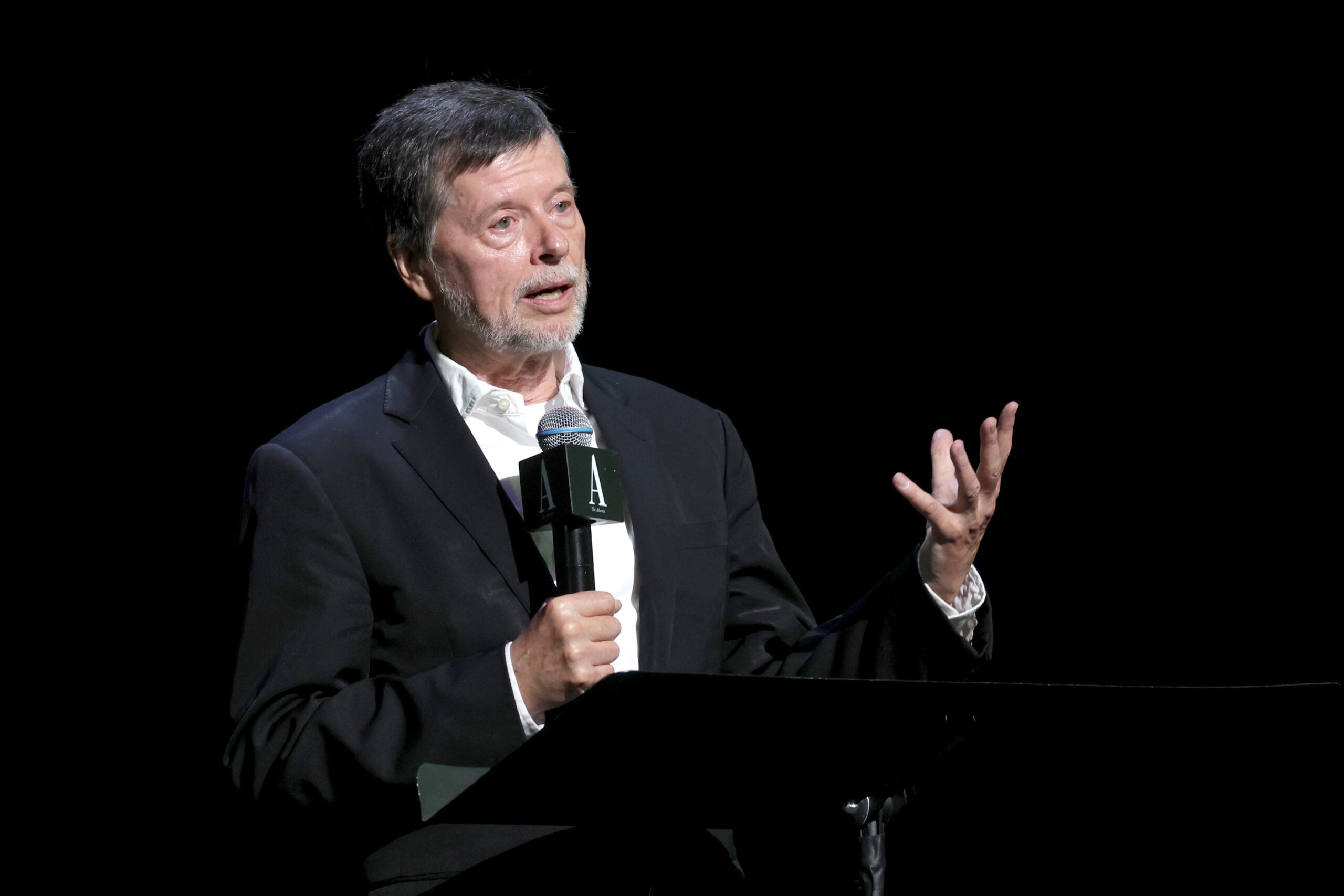
    “We think always in sort of Chicken Little terms,” Burns told an audience during a panel event at Mount Vernon, Virginia, on Oct. 29, “that our time must be the very, very worst.”

    “You can have at least the possible reassurance that things were really divided back then. It was a civil war,” he said of the American Revolution. “Examining the origin story provides you with a kind of renewal and a fresh understanding.”

    Burns has endeavored to provide such reassurances. The director and his team have spoken to a spectrum of media over the course of the year, from podcasters like Theo Von and Joe Rogan to MSNBC and The New York Times.

    Burns spent nearly two hours on Von’s show and three on Rogan’s, with one listener noting in the latter’s YouTube comment section, “We need an annual Ken Burns discussion, if not more. This is cathartic.”

    “We’re trying to reach as many people as we can,” Schmidt told Military Times in a recent interview. “If anybody wants to talk to us, we’re really happy to speak to them.”

    The makings of liberty

    For Burns and his team, the decision to make a documentary on the American Revolution was “spontaneous,” according to the director.

    To put it into context, the year was 2015, President Barack Obama still had 13 months left in his presidency and “nobody was talking 250” — America’s semiquincentennial anniversary in 2026 — Burns told the audience at Mount Vernon.

    “But I was looking at this map that we had of the Ia Drang Valley, in the central highlands [of Vietnam], and I just said, ‘That could be the British moving west on Long Island towards American positions in Brooklyn,” Burns recalled at the Mount Vernon panel. “I just went, ‘We could do it.’”

    With the absence of archival footage for the series, the filmmakers had to get creative — shooting reenactors throughout the documentary. (PBS)

    The filmmakers, however, had to get creative. Without photographs, B-roll or archival footage, the trio resorted to maps, diaries and reenactors to tell the epic tale of Great Britain’s 13 North American colonies’ fight for independence.

    “We went out and filmed with reenactors,” Schmidt said of the filmmaking process, which also included commissioning watercolors from a group called Wood Ronsaville Harlin.

    “Probably the most expensive line item in our budget is re-creating North America as faithfully as we could in a map,” he noted. “That was challenging, but also really fun. Waterways across America have changed since the 18th century. We had to erase the Erie Canal. Stuff like that you just don’t think of.”

    Despite such challenges, according to Schmidt, the lack of visual primary sources presented opportunities to find “new ways to solve these problems.”

    Over the course of several years, the trio shot original footage of nearly 100 locations within the original 13 colonies, as well as in London and the English countryside.

    For 10 years — and to the tune of more than $30 million — Burns and his team built up a vast archive of knowledge.

    “Part of the reason it was so exciting to make [this film] is that we got to spend a decade learning what actually happened and finding out the way to artistically shape that into a 12-hour film to share with the American people,” Schmidt shared.

    “We aren’t trying to dispel myths. We’re not mythbusters out there poking holes in your understanding of the American Revolution. In fact, what we’re doing is taking what you already know and rebooting it,” he said. “It’s going to supplement what you already know and make it make more sense.”

    Heart of the story

    The six-part series follows more than just the well-known characters of the American Revolution.

    While it includes rank-and-file Continental soldiers, militiamen and American Loyalists, the series also delves into the oft-unheard stories of Indigenous soldiers and civilians, enslaved and free African Americans, German soldiers in the British service, French and Spanish allies and an array of civilians living in North America.

    The documentary highlights a war that not only touched the lives of those living within the 13 colonies, but also engaged and inspired millions of people in North America and beyond.

    Over the course of several years, the trio shot original footage of nearly 100 locations — in every season — within the original 13 colonies, as well as in London and the English countryside. (PBS)

    “The war begins in Lexington,” Schmidt said, “but it spreads all throughout — not just the original 13 colonies — but over the mountains to the Ohio River, along the Gulf Coast, even out to the Mississippi River. It’s also in the Caribbean. It’s fought off the coast of England. It’s fought in the Atlantic Ocean. It’s fought along the coast of France, along the coast of Africa, even in the Indian subcontinent — and that’s just the war.

    “The ideas just grow and grow and inspire revolutions — and have inspired revolutions for the past 250 years all throughout the world. Ho Chi Minh, when he declared Vietnamese independence, had two United States OSS officers standing next to him and was quoting Thomas Jefferson in Vietnamese.”

    Despite these ideas that have shaped the world since 1776 (many argue that date is even earlier), Schmidt recalls how surprised he was when learning about the original aims of the conflict.

    The now-lauded notions of civilian rule and non-partisanship that created the republic that we still live under were not, says Schmidt, “on the table at the start.”

    “Those weren’t war objectives,” he continued. “On April 19, 1775, they became necessary to win the war. But they were kind of outcomes of the war, rather than goals. What they were really trying to do at the start was to liberate Boston, to get a redress of grievances and to bring things back to the way they were under the British Empire. But in order to win the war, they had to involve all sorts of American people who otherwise might not get along.

    “Coalition building made it a war about liberty. It made it this fight for a union. Then in order to win the war, they had to involve foreign powers. The French came in. The Spanish came in as the allies of the French. The Dutch declared war on the British,” ultimately creating a coalition war.

    Former Commandant of the Marine Corps Gen. Joseph Dunford, who spoke alongside Burns at the panel at Mount Vernon, echoed Schmidt.

    “I would argue — and I think it’d be tough to argue against it — that our strategic center of gravity as a country comes from allies and partners,” Dunford said. “There’s almost nothing that we have to deal with, certainly in the 21st century, where coherent collective action isn’t required to address a problem.”

    That coalition is what makes up the heart of the documentary. Nearly 150 characters are highlighted in the series, with their stories read by a staggering 61 different voice actors, including: Kenneth Branagh, Josh Brolin, Jeff Daniels, Morgan Freeman, Paul Giamatti, Domhnall Gleeson, Tom Hanks, Ethan Hawke, Samuel L. Jackson, Michael Keaton, Damian Lewis, Laura Linney, Edward Norton, Mandy Patinkin and Meryl Streep, among many others.

    The military story itself features 36 battle sequences that range from the well-known, like Bunker Hill and Yorktown, to the more obscure, while showing that the American Revolution was a test of logistics and strategy as much as it was a war of ideals.

    Washington, according to Schmidt, understood the “arithmetic of this war” — that is, the importance of not losing it all “in one motion.” (PBS)

    George Washington is, naturally, also front and center in the series — a point that Burns noted while speaking at the historic home of America’s first president.

    “He’s our guy, and that’s pretty amazing. Look, we do not soft pedal the flaws. Not only are there really bad tactical mistakes: there’s the rashness of riding out on the battlefield, not just as Princeton but at Monmouth and Kip’s Bay; and he owns hundreds of human beings. You can’t square that circle. But we are so lucky [to have had him], and we’re here because of him.”

    Civilians, not subjects

    One point that Burns and his team spend considerable time exploring is the notion of citizenship.

    “I’m really still overwhelmed by some of the obvious things, that for the first time, we were creating citizens, not subjects under authoritarian rule,” says Burns.

    “Thomas Jefferson says, ‘All experience has shown that mankind are more disposed to suffer while evils are sufferable.’ That just means that for most of human history, people have been under authoritarian rule and they’ve accepted it. They’ve acquiesced that those evils are sufferable. Essentially this [American] ‘project’ was to say no to that.”

    The war, however violent and bloody it was (which Burns succeeds in displaying) was the vehicle for that freedom.

    “I’m really proud to have worked on this film. I’m prouder to be a citizen of a country that invented that idea,” he added.

    Burns ended the panel with a potent mix of patriotism grounded in history, closing with one of his favorite quotes from a Hessian soldier, Johann Ewald, who served under the British during the war.

    “Who would have thought 100 years ago that out of this multitude of rabble would arise a people who could defy kings?” Ewald once quipped.

    “That to me,” says Burns, “is the whole essence of the project. The right to defy kings.”
  • ‘Gunners!’ revives forgotten chapter of air war over Korea

    ‘Gunners!’ revives forgotten chapter of air war over Korea

    This post was originally published on this site.


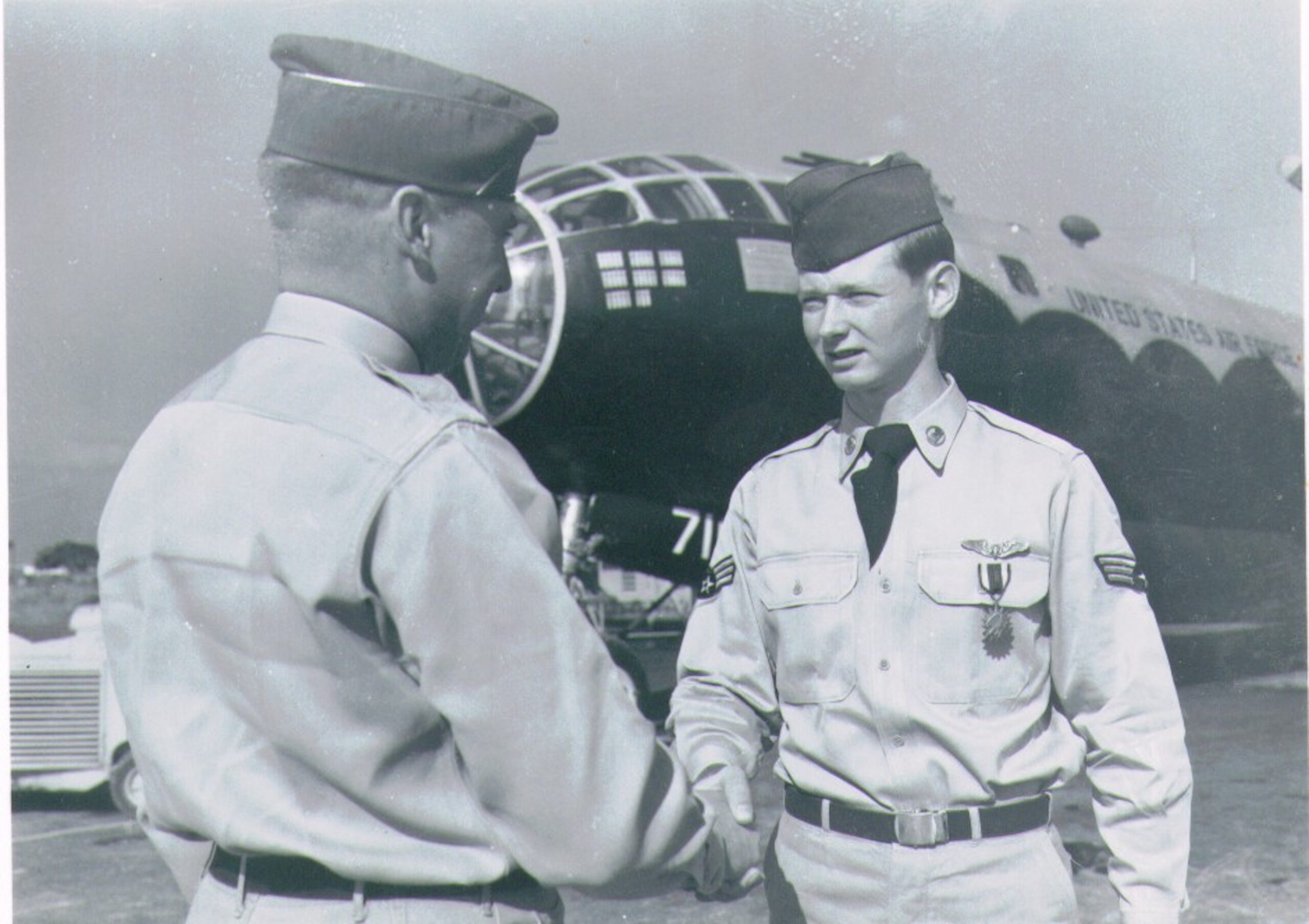
    Thomas Stevens’ first combat mission was memorable — and defied direct orders from the commander in chief. On Nov. 28, 1952, the 19-year-old airman was a tail gunner on a Boeing B-29 Superfortress on a nighttime bombing run over North Korea.

    After dropping its load of 20 500-pound bombs on a target along the Yalu River, the aircraft was caught in a strong wind and blown over the border into Manchuria. President Harry S. Truman had forbidden any U.S. Air Force planes from crossing into Chinese airspace to prevent further escalation of the Korean War.

    However, instead of a reprimand, the crews of the 307th Bombardment Group of the 13th Air Force were treated to breakfast. Running low on gas, the squadron diverted to Japan for refueling and a meal of fresh eggs — a welcome reprieve from the powdered eggs served in the unit’s mess at Kadena Air Base on Okinawa.

    “We were not supposed to be in Manchurian airspace,” Stevens, now 92 and living in Overland Park, Kansas, told Military Times. “It was something the officers laughed about, but we knew we needed to get out of there in a hurry.”

    He added with a chuckle, “We did enjoy the breakfast.”

    Stevens' crew at Randolph Field, San Antonio, Texas, before departing for Okinawa. Stevens is in the back row, first on the left. (Courtesy Thomas Stevens/USAF)

    Stevens is one of five veterans featured in “Gunners! B-29 Machine Gunners in the Korean War” by author and military analyst James Blackwell. The others include the late Philip Aaronson, who was shot down and spent 36 months in a POW camp, Dale Crist, Romaine Gregg and Jack Bernaciak, who flew the last B-29 combat mission in Korea. Blackwell conducted personal interviews and reviewed oral histories and military records of the five men in compiling this account of their service.

    “In many ways, Korea was the ‘Forgotten War,’” the author said. “This was my father’s generation. They were young children during the Dust Bowl and Great Depression. They were the ‘Silent Generation,’ as Time Magazine referred to them. I wanted to write something that reflected who they were and what they went through.”

    The new book examines a nearly forgotten chapter of the air war over Korea. With a limited number of jet bombers in service at the time, the Air Force reactivated the Superfortress to deliver payloads against enemy targets. Technologically superior only a few years earlier, the slow, four-engine heavy bombers were now relics in a supersonic jet war.

    “The B-29 against MiG-15s — it was like David and Goliath,” Stevens said. “It was no contest against those jet fighters.”

    Stevens flew 27 missions over North Korea and accidentally over China. From his position as a tail gunner, he had a bird’s-eye view of the results of his aircraft’s bombing runs. He could also view the fighting on the ground as Marines and soldiers slugged it out with North Korean and Chinese forces.

    “I could look down at what was happening,” he recalled. “I was glad I was not down there.”

    It was no joy ride in the air either. In addition to enemy jets, Superfortresses were susceptible to antiaircraft fire. The last few minutes to the target were always the toughest. Stevens remembered hearing the deafening sound of shrapnel from exploding flak hitting and occasionally piercing the aircraft’s fuselage.

    “It made a loud bang, like a car in a hailstorm,” he said. “There would be little dents and holes all over the aircraft. Flak hits varied. One time it was so close that it bumped me out of my seat. We had flak suits. I couldn’t wear mine because of the tight space in the tail, so I put mine on the floor to help protect me.”

    As a 19-year-old farm boy from Missouri, Stevens stated he was too young to be frightened by the danger he faced at the time. He couldn’t wear a parachute because of the confines of his firing position, so he just assumed he would go down with the plane if anything happened.

    “When I think back now, I say, ‘Did I really do that? Was I that crazy?’” he stated. “We had our orders and we followed them. It was an exciting time.”

    Stevens on the flight line at Kadena Air Base. Gunners shared duties for checking bombs before they were loaded. (Courtesy Thomas Stevens)

    Capable of delivering conventional and nuclear weapons, the B-29 was a modern marvel when it first flew in World War II. The high-altitude strategic bomber featured an analog computerized firing system that enabled one person to direct four remote-controlled machine gun turrets, known as “blisters” because of rounded Plexiglas covers. If a gunner was wounded, the fire-control officer could direct shooting at enemy planes at that position.

    Instead of firing by Kentucky windage, airmen sat in seats with a screen that showed the target and adjusted for speed, distance and other factors. When an enemy aircraft appeared in a circle of dots, the gunner flipped a switch.

    “It was an analog system that was essentially mechanical, so it didn’t have the speed of a modern computer,” Blackwell said. “It was designed for shooting down German and Japanese fighters. It was a little slow against jets, but still did a good job.”

    Blackwell began researching the book believing the slower Superfortress was overmatched by a faster Soviet Union jet flown in the Chinese and North Korean air forces. However, he found that premise to be not quite true.

    “I had heard the stories and came to this with the impression that B-29s were obsolete and outclassed in the Korean War,” he said. “After checking the statistics, I came to a different conclusion and changed my approach to writing the book.”

    While the propeller-driven heavy bombers were outpaced by enemy jets, they managed to hold their own in combat. Blackwell’s analysis of statistics showed the Superfortress was at a definite disadvantage in the early days of the Korean War when the Air Force was flying daytime missions using World War II formations. However, air command changed tactics and had the B-29s fly only at night while making single-file bombing runs. By the end of the war, B-29s had shot down 25 MiG-15s compared to 16 bombers lost to enemy jets.

    “The Air Force flipped the trend by adapting new techniques,” Blackwell said. “Ending daytime missions was critical because MiG-15s weren’t equipped for nighttime attacks. Flying single file on bombing runs also reduced losses. In addition, our gunnery training outpaced that of the enemy, enabling the B-29s to stay ahead of enemy jets in terms of kills.”

    Since Stevens flew only night missions, he rarely saw MiG-15s chasing his Superfortress. In fact, he did not use his two 50-caliber machine guns against a threat.

    “I never fired them in combat,” he said. “Only test-fired them at the start of missions.”

    Stevens and his wife, Barbara, pose with President Barack Obama at the White House on Veterans Day 2017. (Courtesy Thomas Stevens)

    After Korea, Stevens left the Air Force as a staff sergeant in 1955. He married and raised two sons while attending college on the GI Bill. He then joined Southwestern Bell Telephone Company, retiring as a district manager after 33 years.

    However, Stevens’ work was not done. In 2006, he helped build and dedicate the Korean War Veterans Memorial Park in his retirement community of Overland Park, Kansas. In 2010, he was elected to the national board of the Korean War Veterans Association, serving eventually as president. In that role, he championed the cause of Korean War vets in meetings with President Barack Obama and Vice President Mike Pence, as well as other government officials.

    Today, Stevens continues to speak to school groups and others about the “Forgotten War” and the sacrifices made by the men and women who served in the conflict. He is especially proud of his time in the Air Force and all he learned as an airman.

    “It was an invaluable experience that helped shape the rest of my life,” he said.

    Blackwell hopes his book inform readers of the debt they owe to Korean War veterans. On his speaking tour, he gives away free copies of his book to veterans so they “never forget” the people who came before them.

    “Korean War vets have the same needs and hurts as the veterans of Iraq and Afghanistan,” he said. “We need to sit and listen to what they have to say, too.”

  • This American soldier saved Charlemagne’s cathedral in World War II

    This American soldier saved Charlemagne’s cathedral in World War II

    This post was originally published on this site.


    As the city of Aachen, once the seat of power of the emperor Charlemagne, lay in ruins in World War II’s bitterest winter, an American soldier worked feverishly alongside German civilians to make sure its ancient cathedral remained standing. Capt. Walter Johan Huchthausen of Perry, Oklahoma, strove tirelessly to stop the building from collapsing and ensured it would be preserved as it is today.

    The son of a German immigrant father, Huchthausen was a rising star in the field of architecture. His strong grasp of design principles and enthusiasm for history brought him accolades for his work and professional success. After receiving a Master’s degree from Harvard, he worked in New York and Boston and eventually became an assistant professor of architecture at the University of Minnesota.

    Becoming a Monuments Man

    Huchthausen’s German heritage was important to him. He studied abroad in Germany on a fellowship for Harvard prior to the war and mastered the language with native proficiency as he worked alongside German museum professionals. His connection with the German language and culture would later become vital to his success as a U.S. Army Monuments Man tasked with preserving valuable historical artifacts.

    After World War II broke out, Huchthausen, then age 38, volunteered for military service in 1942, joining the U.S. Army Air Forces. His service in the USAAF would be short-lived, however. Wounded badly by a V-1 “flying bomb” in London in June 1944, he joined the U.S. Army’s European Civil Affairs Division and was selected as a talented candidate for the Monuments, Fine Arts and Archives program, whose officers were popularly known as “the Monuments Men.” As the Battle of the Bulge raged in December 1944, Huchthausen joined the Ninth Army as its Monuments officer.

    Attaining the rank of captain, he was nicknamed “Hutch” by his comrades, who likely struggled to pronounce his German last name.

    Huchthausen communicated well with German POWs and local civilians and thus, within a relatively short timeframe, he was able to locate 30 hidden caches of art stashed away by Nazi officials — salvaging both historical German artifacts and looted objects from occupied countries. He was known for being especially hardworking and was admired by his colleagues for his organizational talents and attention to detail.

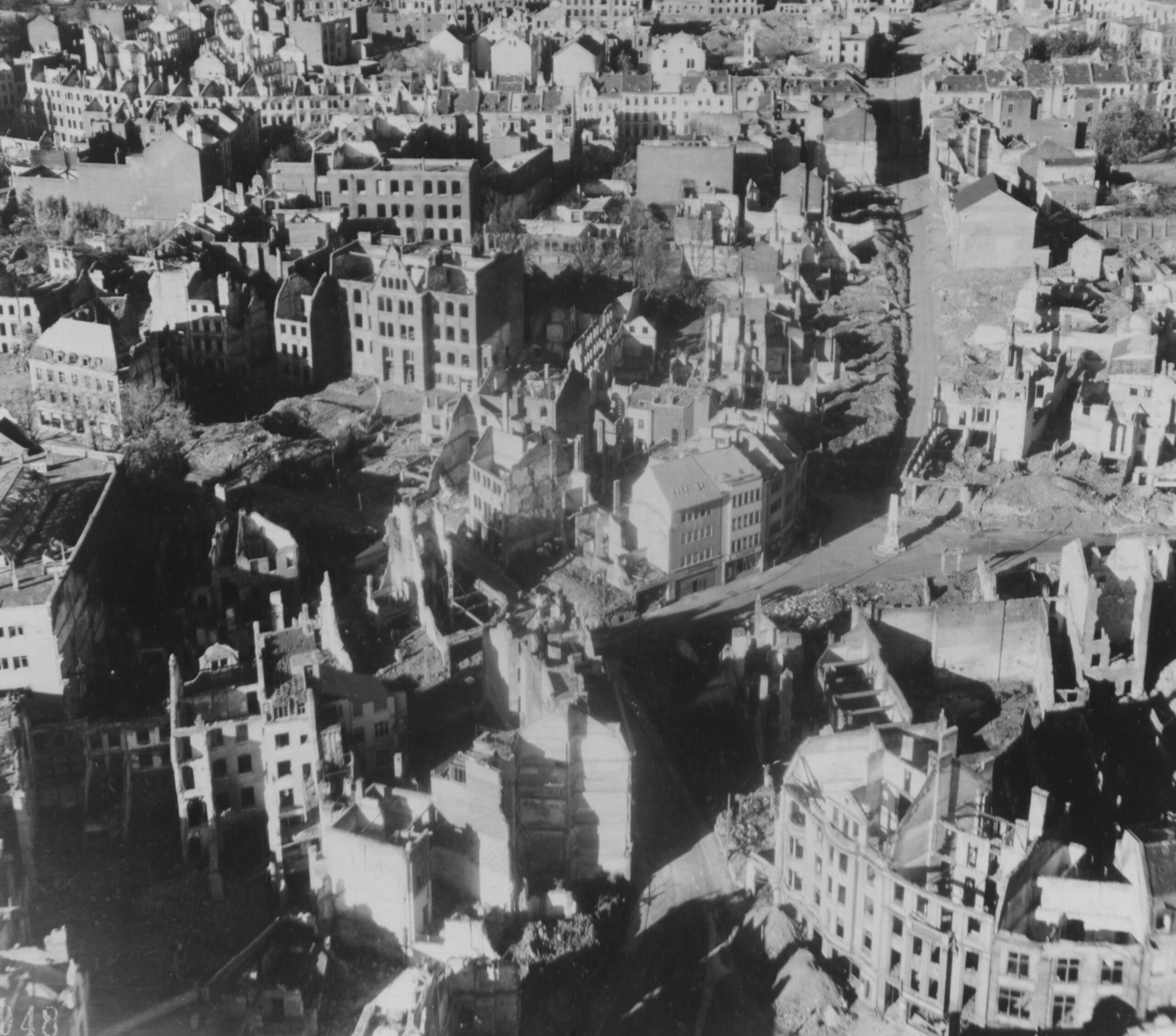
    A siege photo taken by the U.S. Army, Aachen 1944. (National Archives)

    In the ruins of a royal city

    After working briefly in France, he distinguished himself after arriving in the shattered ruins of Aachen, a city ripped apart both by external and internal strife. Its history as the citadel of Emperor Charlemagne, the first ruler of what would become the Holy Roman Empire, gave it special status — not only to locals but to Adolf Hitler, who saw it as a propaganda symbol.

    As the U.S. Army approached, Hitler ordered the city to be defended to the last man and destroyed totally rather than surrendered. Local civilians were at first prevented from evacuating by the Schutzstaffel, better known as the SS, and subsequently forced from their homes as Nazi officials prepared for a deadly siege that began in early September and became one of the war’s bloodiest urban battles.

    A U.S. soldier helps German civilians evacuate who had been shot at by Nazis earlier for trying to leave. (National Archives)

    Treated brutally by the SS, many civilians hid in various locations inside the city and tried to break out to safety later. Photos taken by the U.S. Army during the battle of Aachen note that elderly German residents were fired upon by Nazis with automatic weapons as they tried to flee. American soldiers later rescued several infirm elderly women who were nearly gunned down while trying to escape through the ruins.

    Once a magnificent structure with its own treasure chamber, Aachen’s cathedral had already suffered bombing damage throughout the war. In the early war years it had been protected by local German youths who formed a volunteer fire brigade to preserve the church.

    However, the cathedral was on its last legs. The ferocious battle that ended on Oct. 21 had seen tanks tear through the city and buildings ripped apart by shellfire. The cathedral was in danger of collapse.

    Saving the cathedral

    Arriving in January 1945, Huchthausen came to the rescue. Creating his own headquarters in the city’s Suermondt-Ludwig-Museum, he set about identifying and collecting the cathedral’s numerous altarpieces and artifacts to preserve them. Huchthausen successfully organized and led local German civilians to locate missing objects and start repairing the site.

    He used his architectural expertise to rescue what he could. Under his leadership, civilians repaired the roof, preserved paintings and covered bomb-damaged windows. He successfully reinforced the cathedral’s buttresses to stop them from caving in and strengthened the interior structure — saving it from collapse.

    Challenged by a reporter about why he cared about preserving a site in the Third Reich, Huchthausen replied that its history was world heritage. “Aachen Cathedral belongs to the world and if we can prevent it from falling in ruins…we are doing a service to the world,” he said.

    Aachen cathedral earlier during the war years. (Polish State Archive)

    Killed in action

    Tragically, that statement defining his approach to his work was published two days after Huchthausen was killed in action on April 2, 1945. Working closely behind the Ninth Army’s frontlines, Huchthausen and his assistant Lt. Sheldon Keck, formerly a conservator of the Brooklyn Museum of Art, were driving in search of a stolen artifact when they came under fire from a machine gun. Huchthausen was killed instantly, falling on top of his comrade as the vehicle overturned. Keck survived.

    Fellow Monuments Man Maj. Walker Hancock wrote a touching tribute to Huchthausen after his death. “The buildings that Hutch hoped, as a young architect, to build will never exist,” he wrote, “but the few people who saw him at his job — friend and enemy — must think more of the human race because of him.”

    Huchthausen is buried in the Netherlands American Cemetery in Holland, and was posthumously awarded the Bronze Star and Purple Heart with oak leaf cluster.