
Assisted Living vs. In-Home Care: Costs, Benefits, and How to Choose
For many of us, there comes a moment when we must broach the subject of professional eldercare with our aging parents, grandparents, or spouse. This can be a difficult conversation that requires emotional adjustment and research on a range of options tailored to your loved one’s needs. Many of us assume assisted living is their only choice, but in-home care may meet their needs just as well, or better. Here is our breakdown of assisted living vs. in-home care, including benefits, drawbacks, and cost comparison.
How Does Assisted Living Work?
Assisted living takes place at a senior facility or community, where trained staff provides care, including for ADLs (activities of daily living) and medication management. Meals are served in a cafeteria-style setting, and daily life is structured and scheduled by care staff.
There are five levels of care in assisted living:
● Level 1: For more independent seniors, this provides community living, maintenance, security, and meals as desired, but not ADL support.
● Level 2: One step up, this level provides some ADL support as needed, as well as medication support (like reminders).
● Level 3: Daily ADL and mobility support is provided.
● Level 4: Memory-care is added, including safety monitoring and supervision.
● Level 5: Significant medical care is provided, including skilled nursing services and therapies such as occupational and speech.
Potential benefits of assisted living include:
● More socialization compared with in-home care, as the setting is more communal and lively by nature
● Staff healthcare workers and aides
● On-site recreation, such as pools, group exercise classes, movie nights, and field trips
● Other on-site services, such as mail and transportation
● 24/7 assistance for emergencies
● On-site maintenance and security
Note that these benefits vary by facility/community.
Potential drawbacks of assisted living include:
● Having to move out of their home, which is difficult and undesirable for many seniors
● Less privacy, particularly if your loved one opts to have roommates to cut costs
● Less independence and flexibility, extending to things like having a pet or seeing visitors
● Caregivers are shared, so there is less individualized attention
● Less customizable to your loved one’s needs; you may pay for services you don’t actually want as part of a package
Why In-Home Care?
As you might imagine, in-home care takes place in your loved one’s home. Home care—not to be confused with home health—is provided by a trained caregiver and includes ADLs, help around the house, and very importantly, companionship. Caregivers offer respite to family members by taking on daily duties and being another pair of eyes and ears monitoring their loved one’s health and state of mind.
Potential benefits of in-home care include:
● No need to move out of their home (which aligns with what most seniors want)
● Maintaining independence and self-determination
● Individualized attention and focused companionship, which can provide intellectual and emotional benefits
● Help with household tasks like laundry and meal prep
● Customizable services and schedules tailored to your loved one’s needs
● Support and knowledge for the family, as a caregiver often builds relationships with them as well
Potential drawbacks of in-home care include:
● The need to coordinate more services, vs. an assisted living facility with basic healthcare, transportation, etc. on-site
● 24/7 in-home care can be very costly
● Home maintenance must still be done, and home modifications are needed to maintain a safe environment
An excellent caregiver can improve the morale in a family and help family caregivers reduce their risk of burnout and compassion fatigue.
In-Home Care vs. Assisted Living Costs
In the US, the average assisted living facility will cost around $3,000-$6,000 per month. Rates will vary by the region’s cost-of-living, the individual facility, and level of care needed. You may also find variations by whether your loved one will have a private or shared living space.
In-home care tends to be more customizable, with hourly rates around $21-35 as a national average (within a much broader range). A professional caregiver present 20 hours per week at a rate of $35/hour will cost approximately $2,800 per month.
Most US families pay out-of-pocket for in-home care or assisted living, but other options exist. Long term care (LTC) insurance may cover both in-home care and assisted living, but policies vary in their coverage, so be sure to read the fine print. For in-home care, Medicare and Medicaid will cover a certain number of hours of medically-necessary care prescribed by a doctor; this is not available for assisted living. For qualifying veterans and their spouses, the VA’s Aid and Attendance benefit covers in-home care coverage. Read more about paying for in-home care here.
Deciding Between In-Home Care and Assisted Living
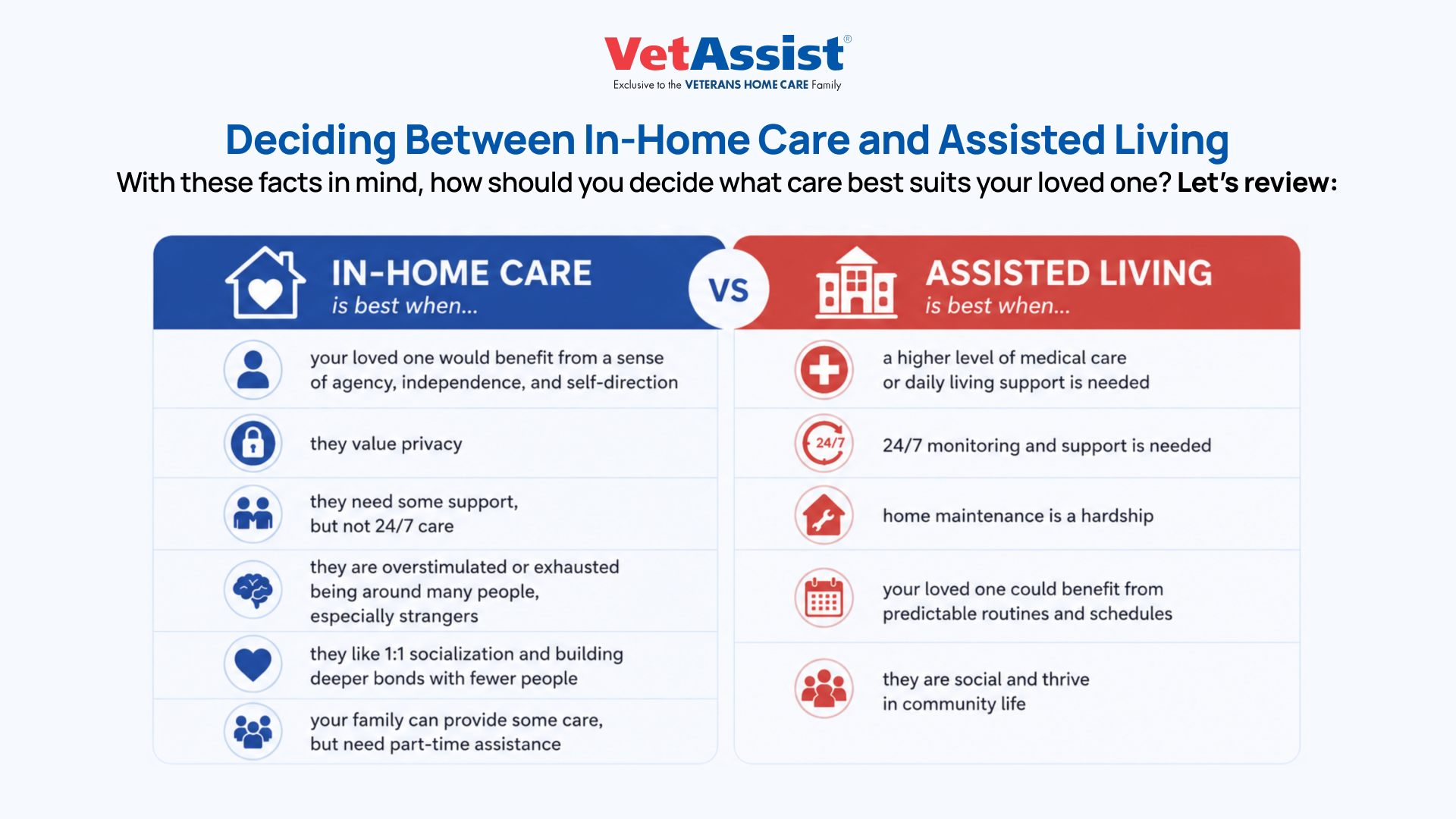
With these facts in mind, how should you decide what care best suits your loved one? Let’s review:
In-home care is best when…
● your loved one would benefit from a sense of agency, independence, and self-direction
● they value privacy
● they need some support, but not 24/7 care
● they are overstimulated or exhausted being around many people, especially strangers
● they like 1:1 socialization and building deeper bonds with fewer people
● your family can provide some care, but need part-time assistance
Assisted living is best when…
● a higher level of medical care or daily living support is needed
● 24/7 monitoring and support is needed
● home maintenance is a hardship
● your loved one could benefit from predictable routines and schedules
● they are social and thrive in community life
In both cases, your family can benefit from increased peace of mind, practical support, and professional expertise.
If your loved one needs home care, our VetAssist mission is to make home care easily and quickly accessible for those who qualify through the VA Pension with Aid and Attendance benefit. Veterans Home Care can help you determine whether you or your loved one will be eligible to receive the benefit, which can cover some or all of the cost of home care, and we make it easy to apply. Chat with us via our website, or call us at (888) 314-6075.
The post Assisted Living vs. In-Home Care: Costs, Benefits, and How to Choose appeared first on Veterans Home Care – VA Aid and Attendance Pension Benefit.