
Birders flock to Newfoundland and New Brunswick to see puffin colonies from tour boats and sometimes even from land
by Jennifer Bain
The summer begins with the sound of puffins tap-dancing over my head.
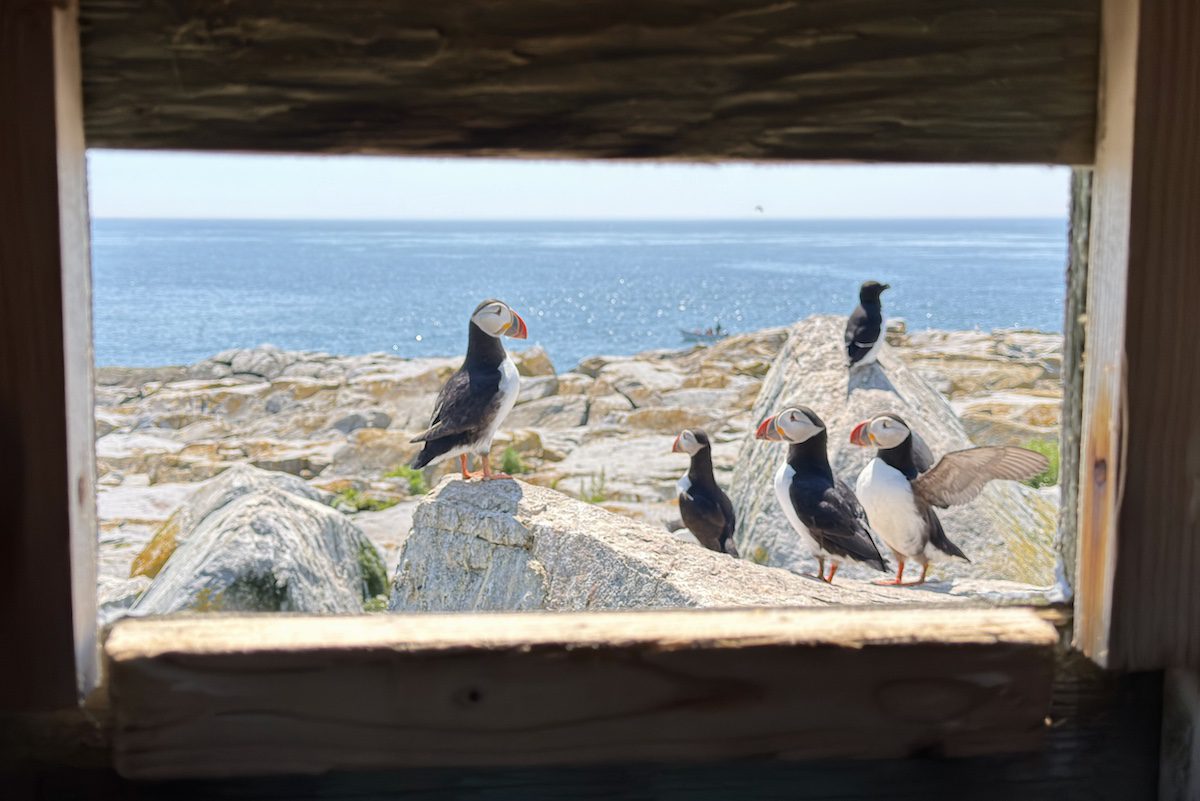
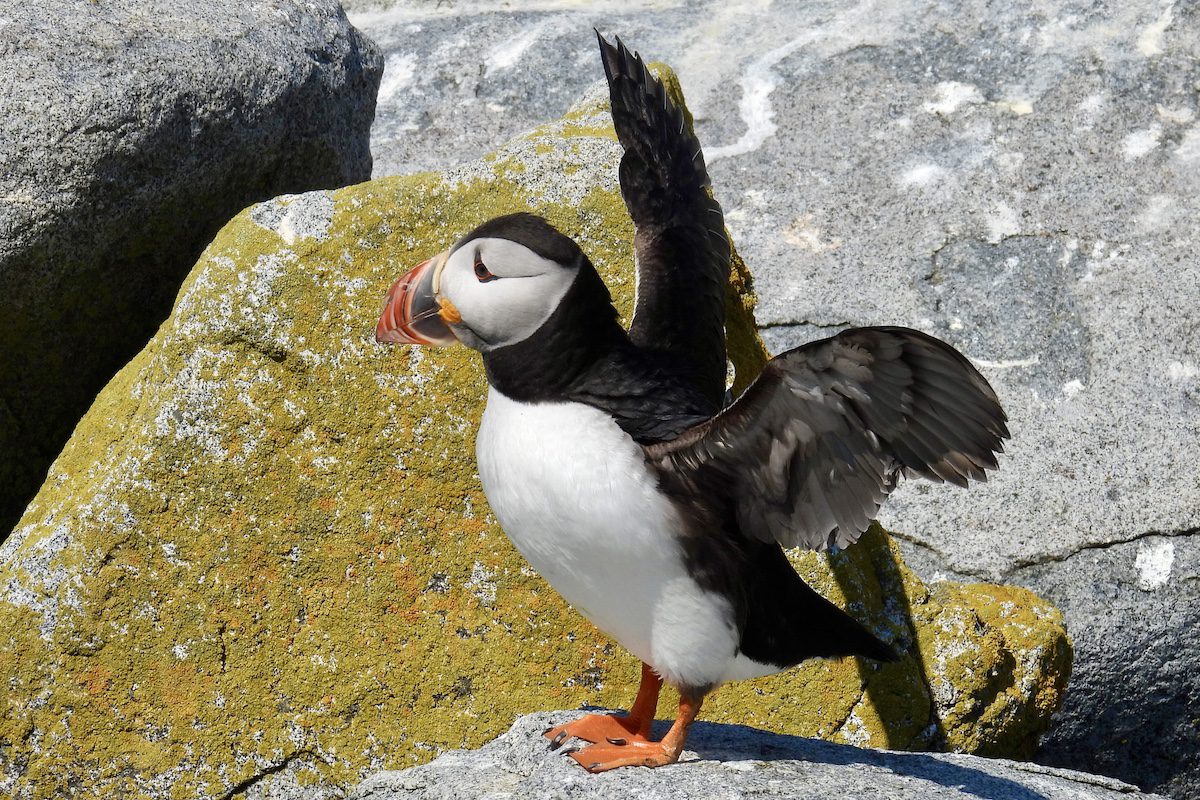
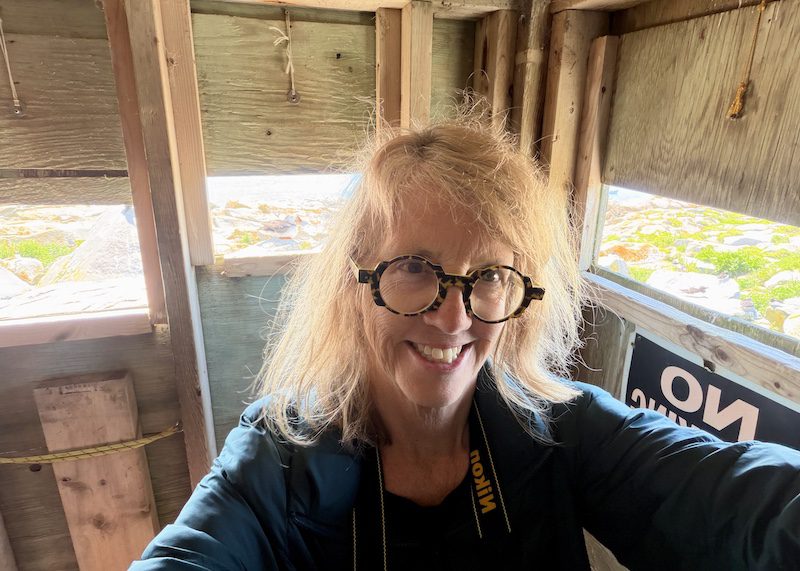
I’m standing inside a bird blind on Machias Seal Island surrounded by Atlantic Puffins as one of them lands on the roof. Click-click-clack goes the pitter-patter of bright orange webbed feet. Thunk. Thunk. Two more clowns of the sea land and now a full-blown puffin performance is in full swing.
Inside the plywood shack that’s barely bigger than an outhouse, four of us swap knowing looks. We’re having an incredibly rare land-based puffin experience.
Before you go…
- Confirm flight routes on Skyscanner
- Find a place to stay on Booking.com
- Find a vetted travel company in our Women’s Travel Directory
- Buy insurance or check your coverage (Try Insureyourtrip or Wanderwell, a B Corp)
- Check official government travel advisories
Get stories just like this one delivered straight to your inbox. Join our mailing list here.
I’m the kind of birder that loves a single-species quest. I’ve seen Nebraska’s Sandhill Crane migration twice, the world’s smallest hummingbirds in Cuba, Blue-footed Boobies in the Galápagos, and magnificent Frigatebirds in Barbuda. I’ve written about Yellow-shouldered Amazons being reintroduced in Aruba after going locally extinct because of the pet trade, and about eccentric American Woodcocks whose mating rituals steal the show at the Festival of Birds at Ontario’s Point Pelee National Park.
At the top of my bird bucket list are Japan’s Shima-enaga (Snow Fairies) and the single Steller’s Sea Eagle that found its way to Newfoundland from either Russia, Japan or Korea. But puffins would be my desert island bird. Luckily, I live in Toronto and am just a plane ride away from the puffin colonies of New Brunswick and Newfoundland and Labrador.
Puffin spotting on Machias Seal Island in New Brunswick
“With a show of hands, who’s excited to see some terns?” guide Rorey Chamberlain says as Sea Watch Tours launches from Grand Manan Island in New Brunswick.
A few hands shoot up.
“Guillemots?”
A few more go up.
“Who’s here to see the puffins today?”
All 20 people whoop and wave their hands.
Machias Seal Island Migratory Bird Sanctuary is a tiny, treeless island and Important Bird Area (IBA) that’s home to more than 1,000 pairs of Atlantic Puffins and one of the most southerly colonies.
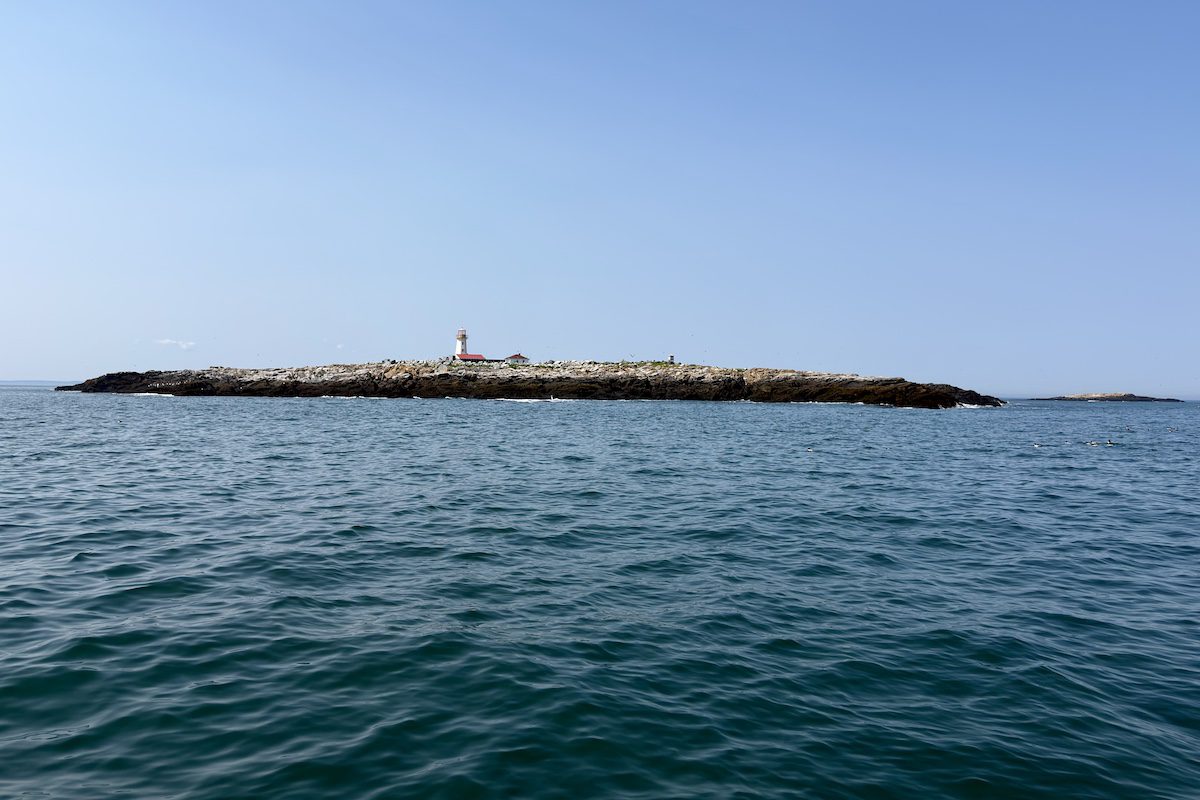
It also attracts Razorbills with black and white feathers and thick, blunt bills, plus Arctic and Common Terns, who can be so protective of their nests that they dive-bomb people, so we’re going to carry “tern sticks” to protect our heads.
“I will not let anybody get terned to death on my watch,” Chamberlain vows.
This outing has an interesting geopolitical twist.
Twenty-acre Machias Seal Island lies where the Bay of Fundy meets the Gulf of Maine, and Canada and the United States have been righting over it since the War of 1812 even though it’s just 500 metres long and 250 metres wide.
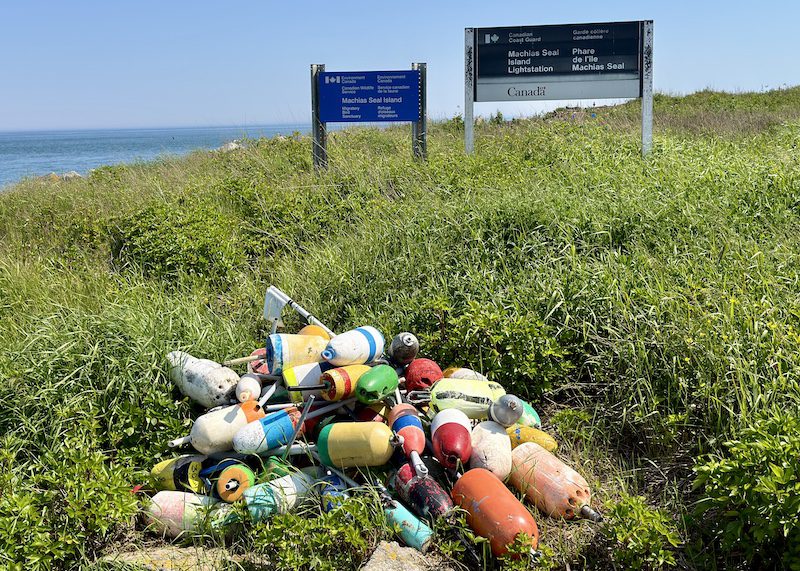
The island is Canadian as far as I’m concerned. There’s a Canadian flag, a Canadian-built lighthouse, rotating Canadian Coast Guard staff and regular researcher visits from the University of New Brunswick and the Atlantic Laboratory for Avian Research.
The Canadian Wildlife Service manages the migratory bird sanctuary. Fisheries and Oceans Canada grants permission to land. It lets one Canadian operator (Sea Watch) and one American (Bold Coast Charter Co. out of Cutler, Maine) bring an equal number of tourists during the summer nesting season.
“I want to remind you it’s a privilege and not a right to be here,” Chamberlain says as we stop near the island and prepare to take a smaller skiff to the rockweed-covered landing ramp.
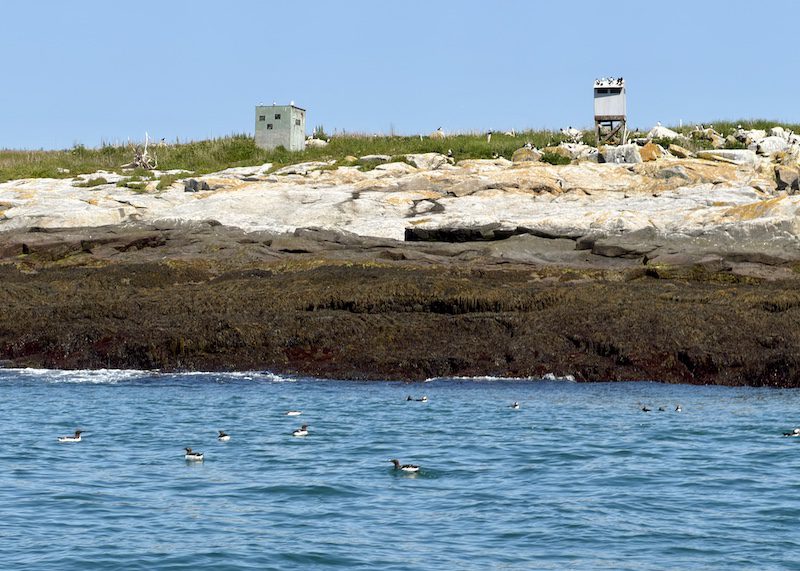
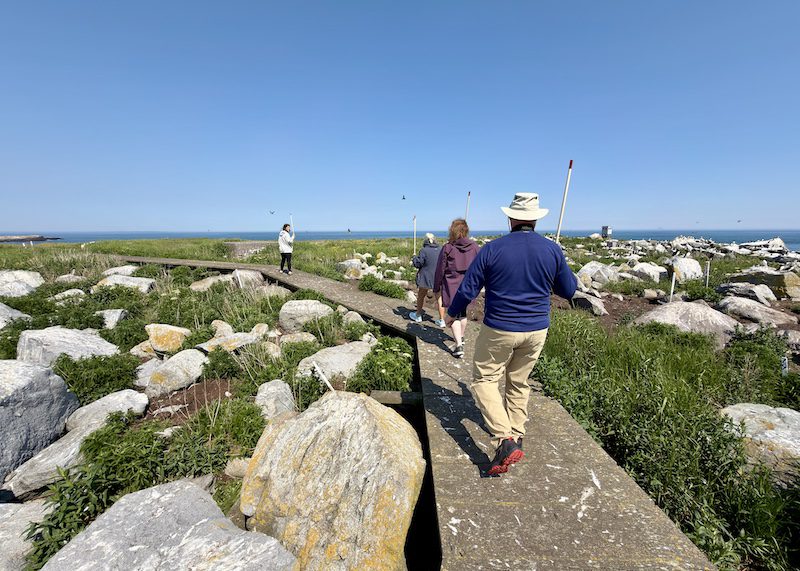
Five people bought tickets to simply view the puffins from the sea. Fifteen of us will walk single file along a boardwalk and divide among four bird blinds. We must keep our heads, hands and camera lenses inside the blinds. We can open small sliding panels/viewing ports, but not two that face each other lest the puffins try to fly through them. We get one hour in the blinds. There are no bathrooms, and we can’t leave until someone returns to collect us.
“Our livelihood depends on following the rules,” Chamberlain warns.
Coming here is a wonderful consolation prize for failing to make it to Skomer Island in Wales recently because the sea didn’t cooperate. Home to 40,000 puffins and managed by the Wildlife Trust of South and West Wales, Skomer welcomes some daytrippers but also overnight guests.
I’m ready to make the most of my precious hour on Machias Seal Island watching puffins live their best lives as they prepare nests and await pufflings. Fun fact — their famously colourful striped beaks only appear during breeding season.
“Are we puffined out?” Chamberlain asks when we reluctantly return to the lobster boat turned tour boat.
“No,” everyone shouts.
I can’t speak for my fellow birders, but I’m heading to Newfoundland to commune with more puffins.
Puffin spotting in Newfoundland and Labrador
Atlantic Puffins are the provincial bird here for good reason.
“Atlantic Puffins are easier to see here than almost anywhere else on the planet,” explains Jared Clarke, whose company, Bird the Rock, creates custom bird and nature tours. “More than 95 per cent of all the Atlantic Puffins in North America breed along our coasts, many of them in huge spectacular colonies that are the most accessible in the world.”
Puffin lovers gravitate to Elliston on the Bonavista Peninsula.
The community is one of the only places in North America where you can watch puffins from the comfort of land. Not only can you walk to the Elliston Puffin Viewing Site from your car in just a few minutes, but it’s also free (although donations are very welcome).
You’ll stand on a grassy cliff about 30 metres from the rocky islet that locals call Puffin Island.
“When we were young, puffins were not a big deal in the community,” Marilyn Coles-Hayley, a former chair of Tourism Elliston, tells me. “As the interest in wildlife grew, and birding grew, we recognized the value of the puffin site. It’s one of our most valuable assets. The whole community benefits — restaurants, craft stores, donations, B+Bs.”
I’ve visited before, but this time I linger for two days to photograph the colony at sunrise and sunset.
It’s neat to see how Elliston has started plowing grant money into the site. There’s a more defined pathway with compacted crushed stone. Stairs help people navigate a short hill. Ropes try to keep everyone away from the dangerous, eroding cliff edge. Visitor counters will bring in useful statistics. An interpretation centre is in the works.
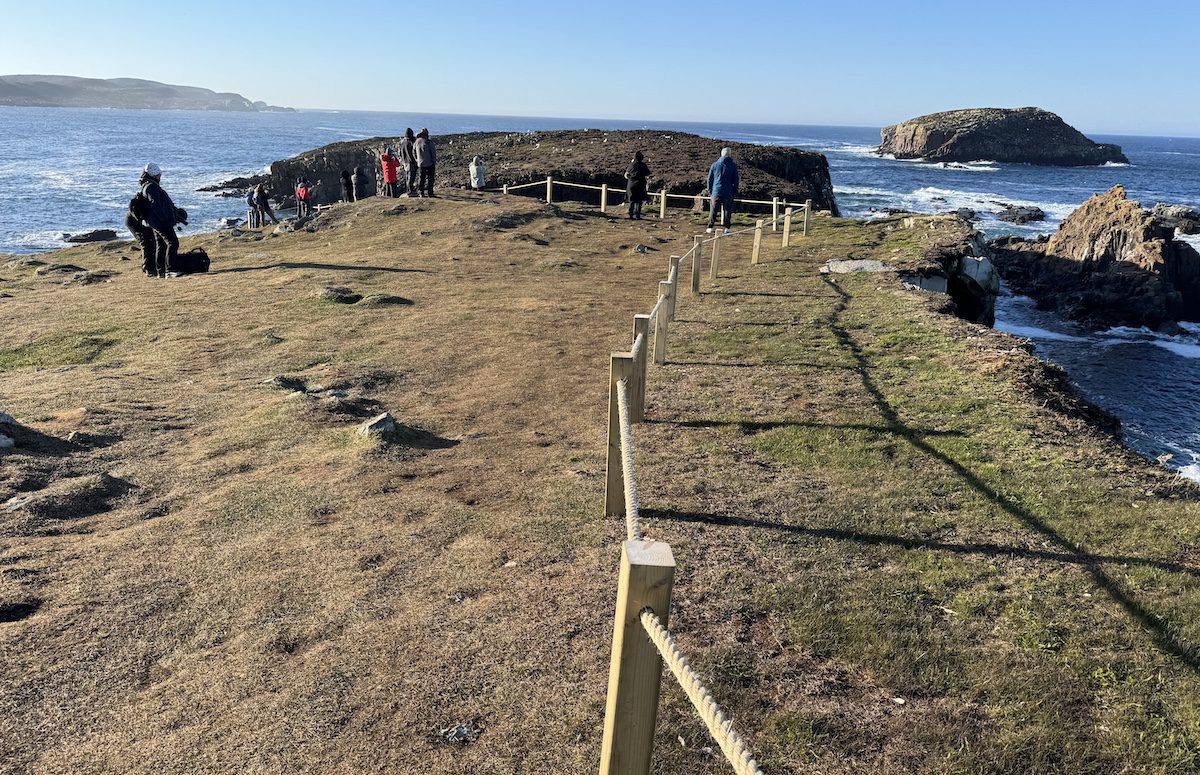
For now, there’s no staff on site — just a donation box.
“We do the best we can,” says Coles-Hayley. “We do need to educate people about how they need to be respectful of the puffins’ space so they can come and go as they please and not be frightened of people.”
Which brings me to one heads-up. Some daring puffins fly over from the safety of their islet and land within reach of their fans. That happens several times when I’m there and everyone freezes and snaps as many photos as possible. But just after I leave one night, a puffin gets carried off by a fox and somebody posts a rather gruesome photo on a Facebook site devoted to the site.
“Oh my god, that was heartbreaking,” remembers Coles-Hayley. “I guess in the end that’s the way it is in nature.”
Her comment reminds me of my two stints with the Puffin & Petrel Patrol, a grassroots movement that’s now run by the Canadian Parks and Wilderness Society Newfoundland and Labrador Chapter (CPAWS-NL).

Light pollution from coastal communities south of St. John’s can draw confused pufflings from the Witless Bay Ecological Reserve to shore who think they’re following the moon out to sea. Many get run over or killed by wildlife and pets.
Volunteers patrol the towns at night hoping to rescue wayward pufflings that are then released back to sea the next day either from a beach or a tour boat.
Witless Bay is a four-island reserve that protects several million nesting seabirds, including North America’s largest Atlantic puffin colony with more than 260,000 pairs.
You can go puffin spotting with companies out of Bay Bulls like O’Brien’s Whale and Boat Tours and Gatherall’s Puffin & Whale Watch. Sometimes you’ll even spot whales and icebergs.
“Welcome to Jurassic Park,” guide Noah O’Brien quips this summer. “There are lots of puffins today. Mostly they’re up in the sky, flying around, and you will see them on the surface of the water as well. Common murres are pointy on each end, kind of like a football with wings, and the puffin is round on each end, kind of like a flying potato.”
From the top deck, 98 of us packed on benches gaze up at grassy slopes where puffins are milling around burrows.
“Once they take a mate, that will be their mate for life,” says O’Brien. “Everyone thinks it’s really cute. I think it’s a bit boring, myself. They will keep the same burrow for life as well — so same house, same spouse. A good Catholic seabird refuge.”
It’s lovely to have commentary. It’s even nicer when the talking stops so we can take in the cacophony of puffins mixing with Common Murres, Razorbills and Black-legged Kittiwakes and other less-loved seabirds.
I can’t speak for the others, but I’ve got one more puffin colony to visit.
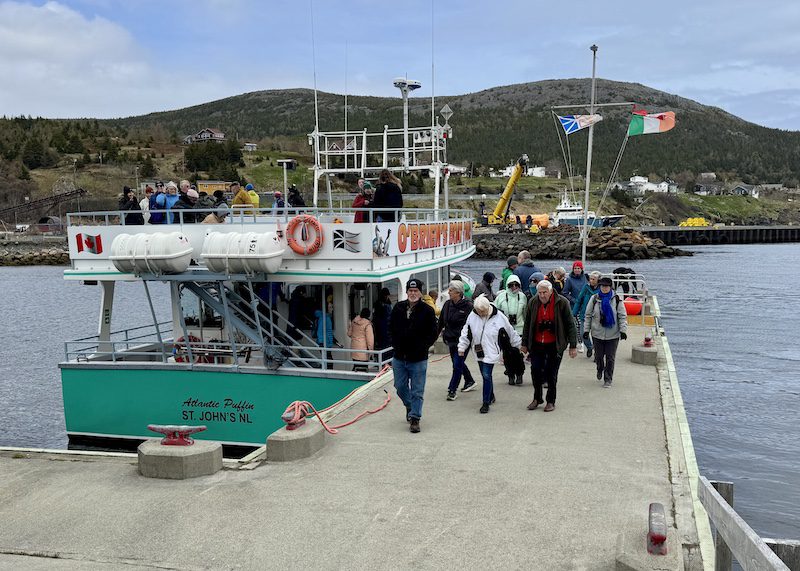
O’Brien’s Whale and Bird Tours disemarking / Photo by Jennifer Bain

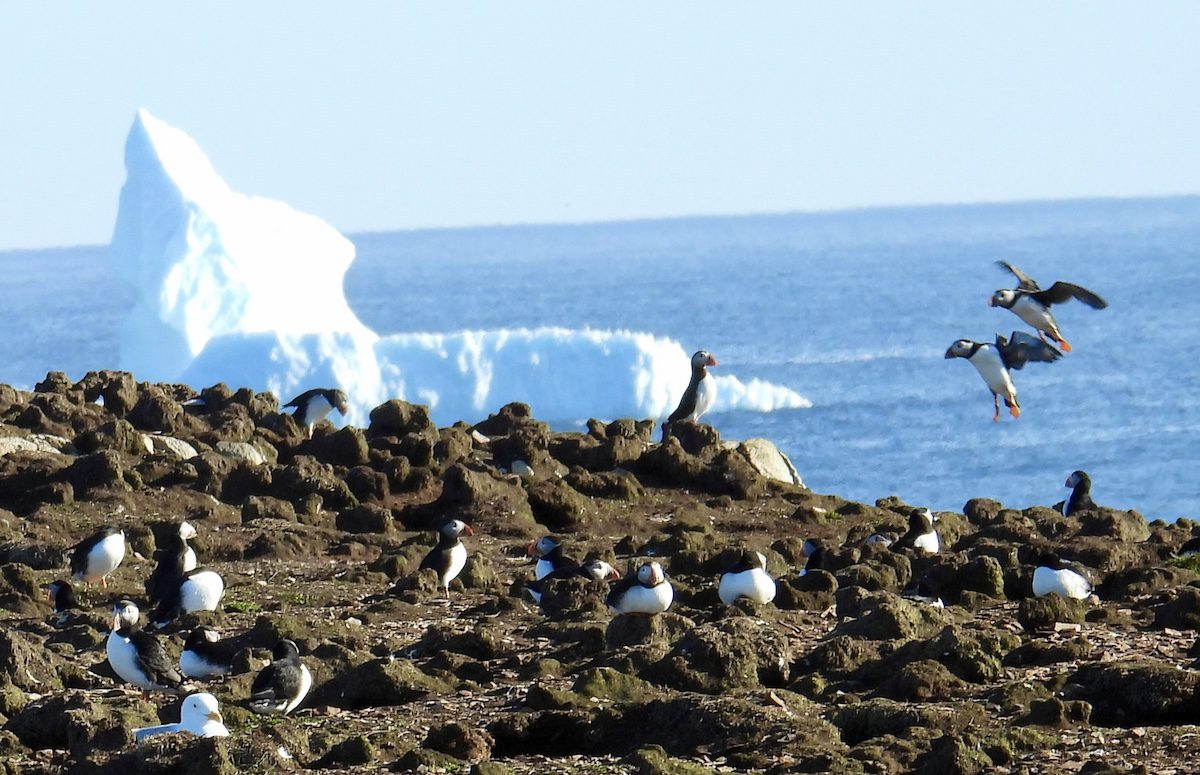
Two puffins land in front of iceberg in Elliston / Photo by Jennifer Bain
Puffin spotting near Fogo Island
Why do we love puffins so much? I turn to Clarke for answers.
“Atlantic Puffins are an iconic symbol of Newfoundland and Labrador for a reason — everyone that visits here dreams of seeing one (or thousands),” he philosophizes.
“These little seabirds are the definition of adorable, with their colourful, cartoonish bills, silly antics and overall cuteness. But they are also an image of what it means to be truly wild, free and (surprisingly) tough — spending most of their lives eking out a living on the cold, open ocean much like generations of people have done in the province.”
I head to my cottage on Fogo Island for my annual boat trip to Little Fogo Islands. Nobody has counted how many puffins visit this lesser-known colony, but anecdotally the population is exploding and spreading across the archipelago.
My puffin-spotting summer ends aboard the MV Island Explorer with Fogo Island Boat Tours as I stand in silent reverie as the sky fills with swarms of puffins. I learn that a group of puffins is called a colony when the seabirds are on land, a raft when they’re swimming and a whirl when they’re flying.
The summer ends with the sound of a whirl of puffins flying over my head.
Make a trip to Atlantic Canada happen
How to get to New Brunswick: Air Canada and Flair Airlines fly into Saint John (YSJ). From there, drive one hour to Blacks Harbour to catch a Coastal Transport vehicle ferry to Grand Manan Island. To get to Machias Seal Island, you can only book “ashore” or “skiff” spots with Sea Watch Tours. The short tour season typically runs late June to late July. Check flights here.
How to get to Newfoundland: Air Canada, WestJet, Porter Airlines and Flair Airlines all fly to St. John’s (YYT). You can use St. John’s as a base for the Witless Bay Ecological Reserve and Puffin & Petrel Patrol, Elliston or Trinity as a base for the Elliston Puffin Viewing Site, and Fogo Island as a base for Little Fogo Islands. Check flights here.
How to get around: Pick up car rentals at the airport. They can be in short supply in Newfoundland, so secure a car before you book a flight. Find a rental car here.
Best time to visit: Puffins typically arrive around mid-May to breed and return to the open ocean by mid-September.
Where to stay in New Brunswick: There are a handful of modest spots to stay on Grand Manan, including Surfside Motel.
Where to stay in Newfoundland: The rock-themed JAG Hotel is a fun option in St. John’s. Me Mudder’s Bed & Breakfast is right in Elliston. Rosewood Suites in Trinity, just 50 minutes from Elliston. Fogo Island now has several dozen small accommodation options. Find a place to stay here!
Stay Connected in Canada: Skip the roaming fees and stay connected with an Airalo eSIM. Use code JOURNEY15 for 15% off your first plan. Get an Airalo eSIM here!


The post How I Spent my Summer: Puffin-Spotting Across Atlantic Canada appeared first on JourneyWoman.