If you have a service-connected back, hip, or knee condition and you’ve never filed for nerve damage, you’re not alone — and the newest VA data suggests you may be missing something real.
Neurological conditions, which include nerve damage, migraines, and traumatic brain injury effects, are growing faster than any other major body system in the VA disability compensation system.
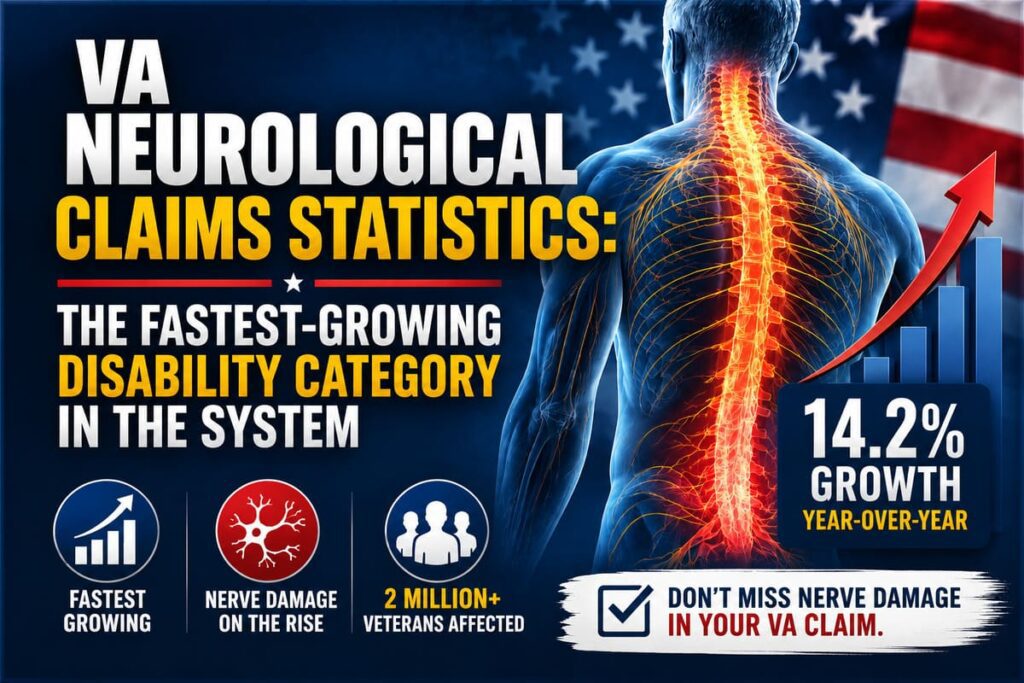
This isn’t a marginal trend. The recent VBA report shows neurological service-connected disabilities grew 14.2% year-over-year — outpacing musculoskeletal, mental health, respiratory, and every other major category. Behind that number sits a specific, common, and frequently under-claimed condition: radiculopathy, or nerve damage radiating from a compressed or irritated spinal nerve.
This article breaks down what the data shows, which neurological conditions are driving the growth, and what it means if you have a back, hip, or blast-exposure injury and haven’t looked into whether nerve damage belongs in your claim file.
Table of Contents
Summary of Key Points
Neurological service-connected disabilities grew 14.2% year-over-year in FY2025 — the fastest growth rate of any major body system in the VBA data.
Paralysis of the sciatic nerve (radiculopathy) affects 2,026,583 veterans, making it one of the most prevalent service-connected conditions in the entire VA system.
Migraine affects 1,300,172 veterans and represents 26.77% of all neurological claims among GWOT veterans specifically.
New neurological claims (new recipients only) grew 5.9% in FY2025 — slower than the all-recipient growth rate, meaning existing veterans are increasingly identifying and claiming neurological conditions over time, not just new claimants.
The VBA data shows the trend clearly. It doesn’t explain the medical or administrative reasons behind it (we’ll address those here as informed context, not established fact).
Neurological conditions are the fastest-growing major body system in the VA disability system, according to FY2025 VBA data — service-connected neurological disabilities grew 14.2% year-over-year among all recipients, faster than any other category tracked. Paralysis of the sciatic nerve, commonly called radiculopathy, alone affects 2,026,583 veterans, making nerve damage one of the most common service-connected conditions in the country.
The VBA Compensation Report tracks service-connected disabilities across 15 major body systems. In FY2025, neurological conditions grew faster than any of them — 14.2% year-over-year among all recipients, according to the five-year trend tables in the report.
That figure covers the full neurological category: nerve damage (radiculopathy and peripheral neuropathy), migraine, traumatic brain injury (TBI) residuals, and other neurological and convulsive disorders. Three conditions inside that category stand out by sheer size:
Condition
Veterans Affected (FY2025)
Paralysis of the sciatic nerve (radiculopathy)
2,026,583
Migraine
1,300,172
Brain disease due to trauma (TBI-related)
162,949
Source: FY2025 VBA Compensation Report, as analyzed in the VBA Data Intelligence Report. Radiculopathy alone affects more veterans than several entire body systems combined.
New Claims vs. the Total Picture
It’s worth separating two different numbers here, because they tell slightly different stories. The 14.2% figure above measures growth in the total number of veterans with a neurological service connection — the full population on the VA’s books. A second, narrower number tracks only new neurological disabilities granted to new compensation recipients in FY2025:
Metric
FY2024
FY2025
YoY Change
New neurological disabilities (new recipients only)
291,292
308,494
+5.9%
New neurological claims grew 5.9% — solid growth, but well behind the 14.2% growth in the total neurological population. The gap between those two numbers matters. It suggests a meaningful share of the growth is coming from veterans who already have an open VA claim file, not just brand-new claimants — consistent with veterans identifying and filing for neurological conditions, like radiculopathy from an existing back condition, that they didn’t claim the first time around.
Why Radiculopathy is the ‘Story Inside the Story’
Radiculopathy is nerve damage caused by a compressed, irritated, or inflamed spinal nerve root. When it affects the sciatic nerve — the largest nerve in the body, running from the lower back down each leg — it produces pain, numbness, tingling, or weakness that radiates well beyond the spine itself.
The reason radiculopathy shows up so heavily in this data is straightforward: it’s overwhelmingly a secondary condition. Veterans with a service-connected lumbar or cervical spine condition — degenerative disc disease, herniated disc, lumbosacral strain — are the population most likely to develop it. At 2,026,583 affected veterans, it’s not a rare diagnosis.
It’s one of the most common service-connected conditions in the whole VA system!
The data doesn’t tell us how many of those veterans filed for radiculopathy separately from their back condition versus how many were rated for it automatically as part of the same claim. What it does tell us is the scale: this is a large, well-established, frequently-occurring condition (not an ‘edge case’).
Peripheral nerve conditions like sciatic nerve radiculopathy are rated under 38 CFR § 4.124a, using a separate diagnostic code for each major nerve. The sciatic nerve has its own code because it’s the largest nerve in the body, and the rating schedule reflects that — the percentages available for sciatic nerve involvement run higher than for most smaller peripheral nerves.
Ratings are based on the severity of the paralysis, not simply on having a diagnosis:
Mild incomplete paralysis: 10%
Moderate incomplete paralysis: 20%
Moderately severe incomplete paralysis: 40%
Severe incomplete paralysis, with marked muscular atrophy: 60%
Complete paralysis (foot drop and similar total loss of function): 80%
That range — 10% up to 80% for one nerve — is a big part of why documentation matters so much for these claims. A C&P examiner’s characterization of “mild” versus “moderately severe” can be the difference between a 10% add-on and a 40% one, which is a meaningful swing in combined-rating math.
Migraines are the second-largest neurological condition in the data, affecting 1,300,172 veterans. Among GWOT (Global War on Terror) veterans specifically, migraine represents 26.77% of all their neurological claims — more than a quarter, in a generation of veterans already dealing with blast exposure, deployment-related sleep disruption, and higher rates of TBI.
Brain disease due to trauma — the VA’s rating category for lasting TBI residuals — affects 162,949 veterans. That’s a smaller population than radiculopathy or migraine, but it represents some of the system’s most complex claims, since TBI residuals frequently overlap with mental health and headache conditions and require careful, specific documentation of functional impact.
What the Data Doesn’t Show
The VBA data is a count, not an explanation. It doesn’t tell us what share of radiculopathy claims get approved, how long they take, or why neurological conditions specifically are growing faster than musculoskeletal or mental health claims this year.
It also doesn’t tell us whether the growth is driven more by better awareness of secondary-condition claiming, an aging veteran population, or something else — those are reasonable questions, but the data doesn’t answer them directly, so I’m not going to assume.
What This Means for Your VA Claim
None of this means every veteran with a back condition automatically has radiculopathy, or that every migraine is service-connected. The data shows a trend across millions of claims; it doesn’t diagnose you, and it doesn’t establish causation for any individual case. What it does show is scale — these are common, well-documented, frequently-approved categories of claim, not fringe conditions.
If you have a service-connected back, hip, or knee condition and you’ve noticed radiating pain, numbness, or tingling that your primary condition alone doesn’t explain, that’s worth raising with your doctor and documenting specifically. The same goes for recurring headaches that developed or worsened after a documented head injury or blast exposure during service.
Neurological conditions are growing faster than any other body system in the VA’s recent data, and radiculopathy is the single biggest reason why. This is a data trend, not a guarantee — but it’s a strong signal that nerve damage, migraine, and TBI residuals are common, well-established, and worth a closer look if you have a related service-connected condition and haven’t filed for them separately.
YOU SERVED. YOU DESERVE.
You served. You earned the right to file. You earned the right to be heard. And you earned the right to pursue every VA benefit you legally qualify for.
So here is the real question:
Do you have the VA rating you were given, or the VA rating you truly deserve?
Want Expert-Level VA Claim Help? WE GOT YOUR SIX!
VA Claims Insider helps educate and empower veterans to get the VA rating they deserve.
Work directly with a VA Claims Insider Coach who can help lead you to VA claim victory.
50,000+ disabled veterans served in our membership programs since 2016.
33% average rating increase for veterans who complete our Elite program.
What is the fastest-growing VA disability category?
According to FY2025 VBA data, neurological conditions grew 14.2% year-over-year among all recipients (the fastest growth rate of any major body system tracked in the report).
How common is radiculopathy as a VA disability claim?
Very common. Paralysis of the sciatic nerve (radiculopathy) affects 2,026,583 veterans, making it one of the most prevalent service-connected conditions in the entire VA system.
Is radiculopathy usually a primary or secondary condition?
Radiculopathy is most often claimed as a secondary condition to an existing service-connected spine condition, such as degenerative disc disease or a lumbosacral strain, since nerve compression frequently develops from those underlying issues.
Does having a back condition mean I automatically have radiculopathy?
No. The VBA data shows how common radiculopathy is across the veteran population, but it doesn’t diagnose any individual veteran. A current diagnosis from a medical provider, plus evidence connecting it to your service-connected condition, is still required.
Why does the data separate ‘new claims’ from ‘all recipients’ growth for neurological conditions?
New-claims growth (5.9%) measures only disabilities granted to first-time compensation recipients in FY2025. All-recipient growth (14.2%) measures the total neurological population, including veterans who added a neurological condition to an already-open claim file. The gap suggests existing veterans are a meaningful part of the growth, not just new claimants.
What does the VBA data NOT tell us about this trend?
It doesn’t establish why neurological claims are growing faster than other categories, and it doesn’t provide approval or denial rates for these conditions. Those explanations aren’t in the source data and aren’t claimed in this article.
Content Reviewed By
Quality Assurance Team
The Quality Assurance (QA) team at VA Claims Insider has extensive experience researching, fact-checking, and ensuring accuracy in all produced content. The QA team consists of individuals with specialized knowledge in the VA disability claims adjudication processes, laws and regulations, and they understand the needs of our target audience. Any changes or suggestions the QA team makes are thoroughly reviewed and incorporated into the content by our writers and creators.
Brian Reese is a world-renowned VA disability benefits expert and the #1 bestselling author of VA Claim Secrets and You Deserve It. Motivated by his own frustration with the VA claim process, Brian founded VA Claims Insider to help disabled veterans secure their VA disability compensation faster, regardless of their past struggles with the VA. Since 2013, he has positively impacted the lives of over 10 million military, veterans, and their families.
A former active-duty Air Force officer, Brian has extensive experience leading diverse teams in challenging international environments, including a combat tour in Afghanistan in 2011 supporting Operation ENDURING FREEDOM.
Brian is a Distinguished Graduate of Management from the United States Air Force Academy and earned his MBA from Oklahoma State University’s Spears School of Business, where he was a National Honor Scholar, ranking in the top 1% of his class.