Tag: Marines News

  • Washington’s orders to troops after July 4: You’re fighting for a new nation

    Washington’s orders to troops after July 4: You’re fighting for a new nation

    The Fourth of July and the signing of the Declaration of Independence severed ties with Great Britain and thus receives its due attention.

    But it was on July 5, 1776, that the former colonials got down to the nuts-and-bolts of governing and winning a war.

    One of the first orders of business that day for members of the Second Continental Congress meeting in Philadelphia was getting cooking kettles to the militia. The Committees of Inspection and Observation were told to “furnish a good kettle to every six men, and give all the assistance in their power, that the said militia be well armed and equipped, and march with the greatest expedition,” according to the Journals of the Continental Congress at the Library of Congress.

    It was also resolved “That a chaplain be appointed to each regiment in the Continental Army, and their allowance be increased to thirty three dollars and one third of a dollar a month.”

    Members then had to deal with the always grumpy John Adams, who got approval to send a copy of the Declaration to Mary Palmer, the daughter of family friends of the Adamses in Braintree, Massachusetts, along with a somewhat-snotty note now preserved by the Massachusetts Historical Society.

    “I will enclose to you a Declaration, in which all America is remarkably united,” Adams’ letter read. “It completes a Revolution, which will make as good a Figure in the History of Mankind, as any that has preceded it — provided always, that the Ladies take Care to record the Circumstances of it, for by the Experience I have had of the other Sex, they are either too lazy, or too active, to commemorate them.”

    On the morning of July 5, the members of the Congress also ordered copies of the Declaration printed by John Dunlap to be distributed throughout the former colonies.

    The thought also occurred to them that somebody ought to tell the troops what they were fighting for now that independence had been declared.

    And so John Hancock, the Boston merchant-smuggler and president of the Second Continental Congress, was authorized to tell Gen. George Washington to have the Declaration read to his fledgling army at formations.

    In his letter to Washington, Hancock wrote that “the Congress have judged it necessary to dissolve the Connection between Great Britain and the American Colonies, and to declare them free and independent States; as you will perceive by the enclosed Declaration, which I am directed to transmit to you, and to request you will have it proclaimed at the Head of the Army in the Way, you shall think most proper.”

    Washington was in New York at the time, warily watching the buildup near the harbor of a British armada that would grow to 400 ships and 32,000 British regulars and Hessians. He scheduled the reading of the Declaration for July 9.

    “The Honorable the Continental Congress, impelled by the dictates of duty, policy and necessity, having been pleased to dissolve the Connection which subsisted between this Country, and Great Britain, and to declare the United Colonies of North America, free and independent STATES,” Washington’s General Orders for July 9 read.

    “The several brigades are to be drawn up this evening on their respective Parades, at six [o’clock], when the declaration of Congress, shewing the grounds and reasons of this measure, is to be read with an audible voice.”

    Washington hoped that movement would “serve as a fresh incentive to every officer, and soldier, to act with Fidelity and Courage, as knowing that now the peace and safety of his Country depends (under God) solely on the success of our arms.

    “And that he is now in the service of a State, possessed of sufficient power to reward his merit, and advance him to the highest Honors of a free Country.”

    Things did not immediately go according to plan, however.

    Washington was livid when a mob of troops and locals rioted, storming down Broadway to Bowling Green where they toppled a statue of King George III and lopped off its head.

    This post was originally published on this site.

  • US withdrew forces from Nigeria after operation against ISIS, AFRICOM chief says

    US withdrew forces from Nigeria after operation against ISIS, AFRICOM chief says

    The United States has withdrawn most of the forces it deployed for a recent operation against Islamic State militants in Nigeria and is now providing intelligence support at Abuja’s request, the head of U.S. Africa Command said.

    In May, U.S. and Nigerian forces conducted military operations in northeastern Nigeria that killed Abu-Bilal al-Minuki, the second-in-command of ISIS globally.

    That followed a U.S. strike on Christmas Day against the militants ordered by President Donald Trump, who said they had been targeting Christians in the African country.

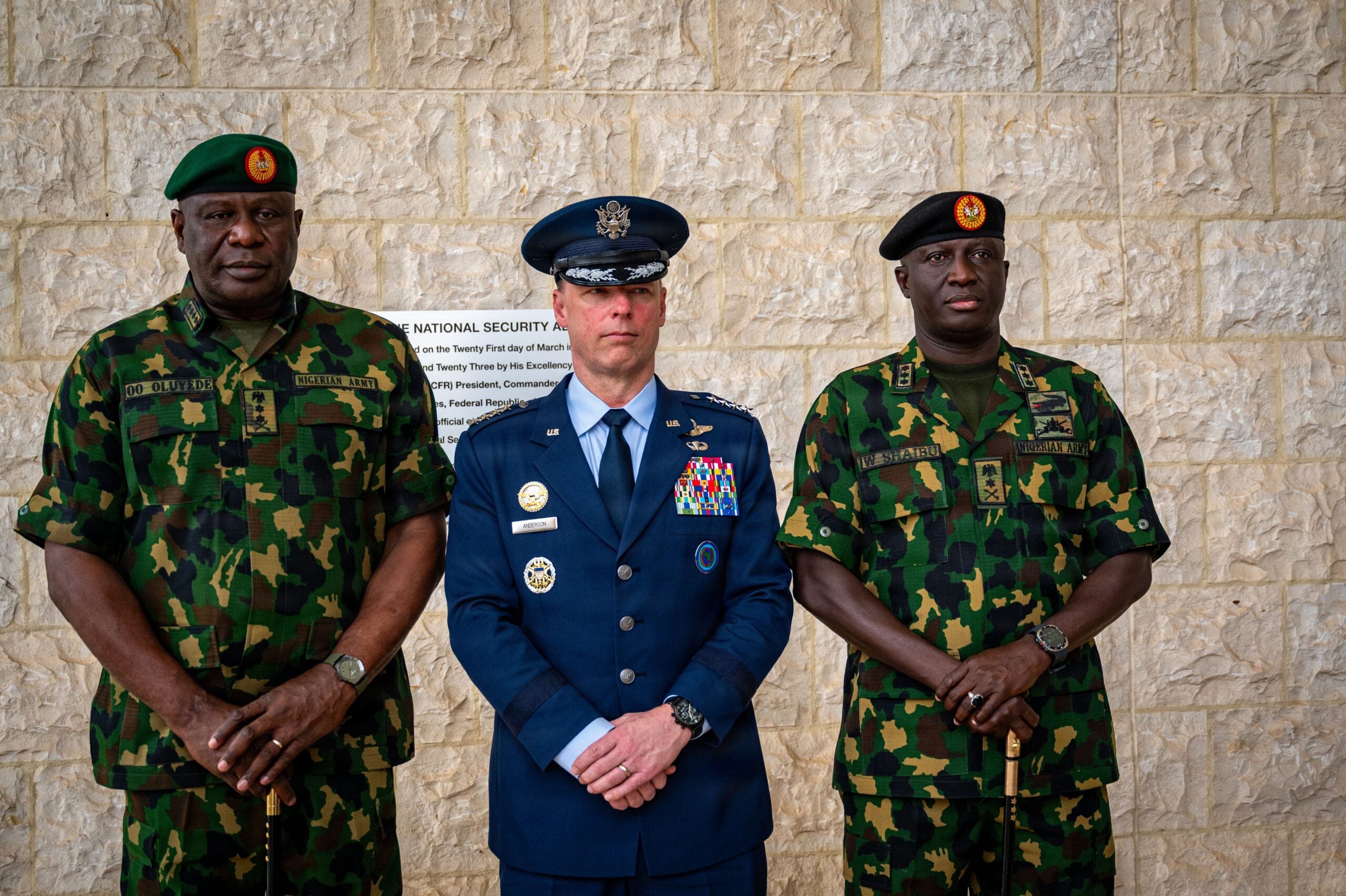
    Addressing a conference of African defense chiefs in Angola on Thursday, AFRICOM Commander Gen. Dagvin Anderson described May’s joint U.S.-Nigerian as a model for future security cooperation in Africa.

    “We have withdrawn much of our forces that were just there for that operation, but are continuing the partnership that Nigeria has asked for to help continue with the intelligence sharing,” Anderson told journalists during a U.S. State Department-hosted briefing after the conference.

    Anderson said the operation, in Nigeria’s Lake Chad Basin region, demonstrated Washington’s approach of providing specialized capabilities while allowing African partners to lead security operations.

    He said cooperation with Nigeria had helped significantly degrade Islamic State’s leadership, adding that the impact had extended beyond West Africa because of the militant group’s international network.

    The operation disrupted not only local commanders but also broader Islamic State communications and operations, he added.

    “Nigeria has been very active since that operation in May,” Anderson said. “They continue to prosecute targets themselves.”

    He added that Nigerian military pressure, combined with efforts to publicize the operation, had encouraged additional defections and surrenders among ISIS fighters in northeastern Nigeria.

    The three-day conference in Angola’s capital, Luanda, was attended by military leaders from 35 African countries, alongside representatives from the U.S. and Brazil.

    This post was originally published on this site.

  • Unemployment for post-9/11 veterans climbs in June as nation’s job market slides

    Unemployment for post-9/11 veterans climbs in June as nation’s job market slides

    The closely watched jobless rate for the post-9/11 generation of veterans bumped up from 4.1% in May to 4.8% in June as the nation’s ability to create new jobs took a nosedive, according to a monthly jobs report released Thursday by the Bureau of Labor Statistics.

    The report also showed an increase in the unemployment rate for all veterans from a remarkably low 3.2% in May to 4.1% in June, despite the continued strong showing of women veterans in the labor market.

    The BLS data showed that the jobless rate for women veterans has come down from 7.1% in March to 4.4% in April and 3.3% in May before ticking up to 3.6% in June, which was still well below the month’s unemployment rate for the general population (4.1%).

    For many analysts, the most concerning figures in the BLS report were the weak numbers on job creation. Total nonfarm payroll employment changed little in June by adding 57,000 jobs, about half of what analysts predicted.

    A main concern was the hiring slowdown in the healthcare sector, which has consistently been setting the pace for adding jobs through both the Biden and Trump administrations.

    The BLS report said that employment in healthcare added 22,000 jobs in June, “but at a slower pace than the average monthly gain over the prior 12 months of 38,000.”

    Leisure and hospitality employment, meanwhile, usually a strong performer, declined by 61,000 jobs in June, “reflecting weaker than usual seasonal hiring,” the report said. Thus far in 2026, “employment in the industry has shown little net change.”

    Overall, “it’s a pretty disappointing jobs report,” Heather Long, chief economist for the Navy Federal Credit Union, told Military Times in a phone interview.

    “Tech is still strong,” she said, “but healthcare has cooled off a little bit,” and “wages are not keeping up with inflation.”

    Long noted increases in the unemployment rates for veterans but added that the data is from a relatively small sample.

    “That’s why you see a lot of movement” in the numbers for veterans, she said, adding that the “verdict is still out” on whether artificial intelligence will be the major job killer that many expect.

    The AI impact on the jobs market is “not showing up in the data yet,” Natasha Sarin, a former assistant secretary at the Treasury Department under the Biden administration, told MS Now, which could be the result of new research showing that the expected impact of AI on white collar entry-level jobs may have been overstated.

    The Trump administration sought to put the best face on the BLS report, showing a weakening labor market. Kush Desai, a White House spokesman, posted that the report “reinforces that the American labor market remains solid thanks to President Trump’s economic agenda.”

    He called attention to the report that the nation added 3,000 manufacturing jobs in June, although that was down from 7,000 manufacturing jobs added in May.

    New acting Secretary of Labor Keith Sonderling stated that “Manufacturing employment, which was devastated under the Biden Administration, continues to grow as we secure historic investments and reshoring of critical industries,” despite the loss of 4,000 manufacturing jobs cited in the BLS report.

    “President Trump’s America first agenda continues to provide greater wages for workers and certainty to the sectors which will fuel the next 250 years of U.S. economic security,” he added.

    Despite the claims, the BLS data showed that wages were not keeping up with inflation. The report showed that wages rose 3.5% in June, while the annual inflation rate through May noted in a separate BLS report (the Consumer Price Index) rose by 4.2%.

    This post was originally published on this site.

  • Proposed ‘Honor and Remember’ flag resembles communist imagery, Vietnam veterans argue

    Proposed ‘Honor and Remember’ flag resembles communist imagery, Vietnam veterans argue

    Vietnam War veterans are pushing back against the use of an “Honor and Remember” flag because of its resemblance to the Bolshevik Communist flag and the flag flown by the Democratic Republic of Vietnam.

    Vietnam Veterans of America, a national veterans service organization, argued Thursday that the flag “cannot serve as a positive symbol” for veterans who fought against communism. The flag shows a gold star on a red background — imagery reminiscent of multiple communist movements, VVA said in a public statement.

    “For Vietnam veterans especially, the striking resemblance to the flag flown by the Democratic Republic of Vietnam during the Vietnam War, and seen in all the images of North Vietnamese tanks invading Saigon on April 30, 1975, is impossible to ignore,” the group wrote.

    A congressional effort is underway to designate the Honor and Remember flag as a national symbol of remembrance for service members and veterans who died as a result of their military service. VVA said the proposal was recently attached to the fiscal 2027 National Defense Authorization Act, an annual, must-pass defense policy and budget bill.

    The proposal was originally introduced by Reps. Don Davis, D-N.C., Jen Kiggans, R-Va., and Glenn Thompson, R-Pa. The bipartisan Problem Solvers Caucus endorsed the measure in February.

    The amendment mandates that the flag be displayed at federal sites, including the U.S. Capitol, White House and national cemeteries on Memorial Day, Veterans Day, Independence Day and other holidays.

    “The brave men and women who laid down their lives in service to our nation deserve our deepest gratitude and lasting remembrance,” Kiggans said in a February statement. “While we can never fully repay the debt we owe them, we must always ensure their legacy is honored.”

    The flag was created by George Lutz after the death of his son, Army Cpl. George “Tony” Lutz, who was killed by an enemy sniper in Fallujah, Iraq, in 2005. Since its creation, 29 states have adopted the Honor and Remember flag as an official symbol.

    VVA National President Tom Burke argued the idea was not adequately discussed before being proposed for a national designation. The American flag already represents the sacrifices of Americans who have died in defense of the nation, he contended.

    “Rather than creating confusion and strife regarding official national symbols by introducing new federally recognized commemorative flags, VVA encourages Congress to direct its efforts towards policies that directly benefit Gold Star families, survivors, wounded veterans, and those currently serving,” Burke said.

    This post was originally published on this site.

  • Army contractor swindles over $1 million … in MREs

    Army contractor swindles over $1 million … in MREs

    For one U.S. Army soldier-turned-contractor, the lure of a processed lemon poppy seed poundcake seemingly proved too tempting to resist.

    Joseph Lavar Davis, 47, was convicted of stealing over $1.1 million worth of the military’s pre-packaged Meals-Ready-to-Eat, or MREs, in El Paso, Texas, the U.S. Attorney’s Office, Western District of Texas, said Tuesday, in a scheme involving three other co-defendants and more than 200 pallets of the shelf-stable rations.

    MREs, typically sealed in distinctive brown branding, are used to feed troops basic nutrients in austere situations and training exercises.

    Known for their energy content as opposed to their taste, the emergency rations can be eaten hot or cold and are notorious for producing foul flatulence and blocked bowels — oftentimes contributing to the MRE’s other moniker of Meal, Refusing to Exit.

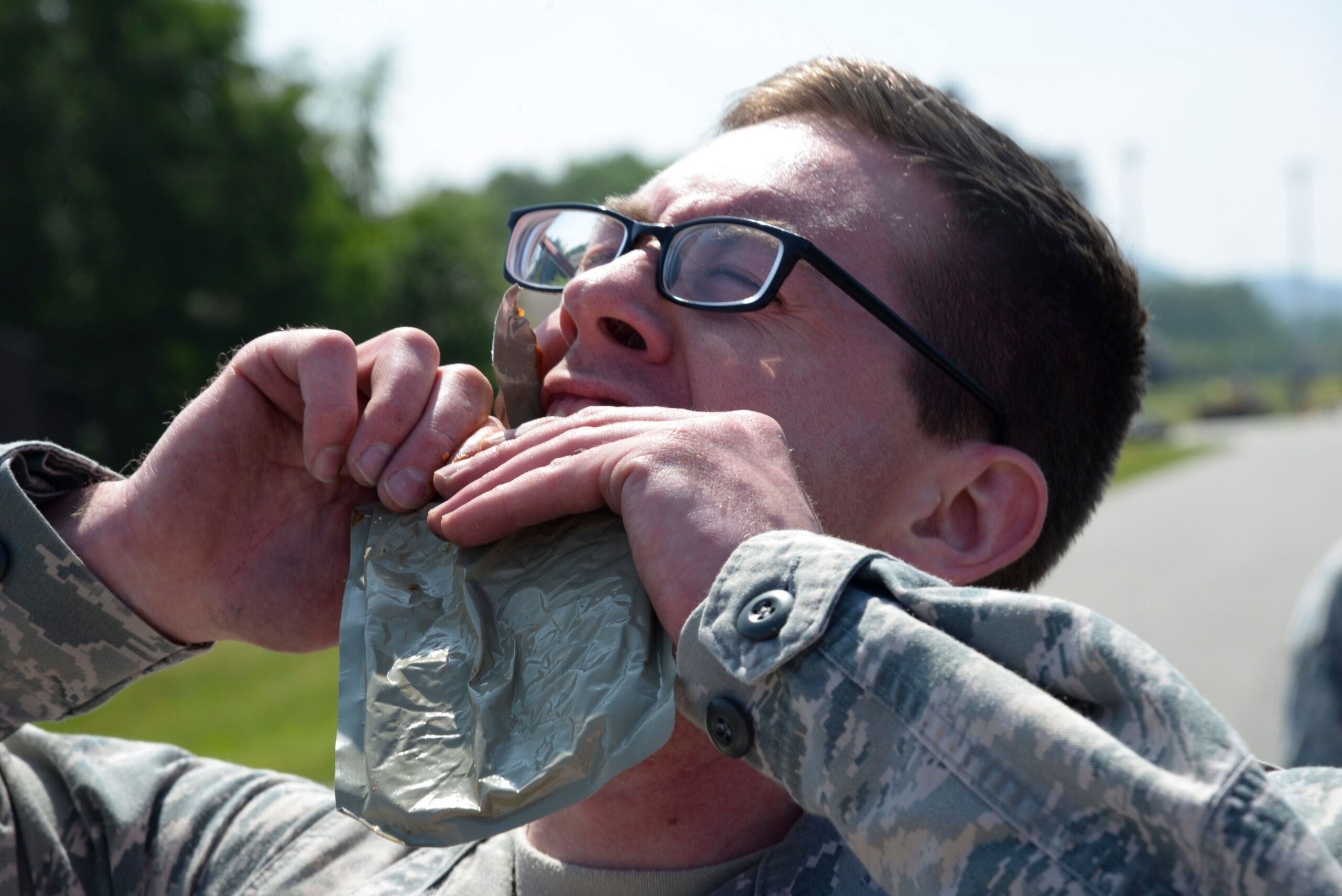
    A supply of Meals Ready-to-Eat (MREs) is prepared for distribution. (Tech. Sgt. Tyler J. Bolken/U.S. Air Force)

    According to a statement from the office, the group used false paperwork to acquire MREs from Fort Bliss and Davis created false requests, rented vehicles to move the calorically dense provisions, fixed prices and collected compensation in the operation.

    The FBI and Army Criminal Investigation Division agents executed a search warrant on a civilian warehouse in August 2020 and found scores of pallets of MREs that an investigation showed was a holding facility for a company that purchased the rations from people who had pillaged them from Fort Bliss, the statement said.

    Davis was named in the February 2025 indictment — along with the three others — for conspiracy to commit theft of government property and a substantive count of theft of government property between Feb. 4, 2020, and Aug. 12, 2020.

    The office said that Davis learned the Army’s food procurement process while working in food service supply in the service. When he retired, the statements said, he got a job as a civilian contractor in a similar position.

    “Joseph Davis betrayed the very country he once swore to protect in an effort to satisfy his own selfish ambition and a jury of his peers held him accountable for it,” said U.S. Attorney Justin R. Simmons.

    Military Times contacted the Army for details regarding Davis’ time in service, but had not received a response as of publication.

    This post was originally published on this site.

  • Transgender troops granted class action lawsuit against government

    Transgender troops granted class action lawsuit against government

    A federal court issued a ruling Tuesday that paves the way for all transgender service members to continue serving in the military despite a Trump administration policy that ordered their removal.

    The U.S. District Court for the District of Columbia granted a motion to certify Talbott v. USA as a class action lawsuit several weeks after the U.S. Court of Appeals for the D.C. Circuit said in a June 1 ruling that the Pentagon’s transgender military ban was unlawful.

    The June ruling only allowed the plaintiffs in that case to continue serving, meaning all other transgender service members are currently still banned from the military. But if the class action lawsuit goes into effect in two weeks along with with the June ruling, the protections won in Talbott v. USA would extend to all transgender service members currently serving.

    “The protection afforded to our plaintiffs should be available to all transgender servicemembers and their families,” said National Center for LGBTQ Rights Legal Director Shannon Minter. “We know that this ban is discriminatory, rooted in animus, and irrationally excludes highly decorated servicemembers who have deployed around the world and given everything to our country.”

    President Donald Trump signed an executive order on Jan. 27, 2025, stating that service members with a history of “gender dysphoria” have medical, surgical and mental health constraints “incompatible with the high mental and physical standards necessary for military service.”

    Transgender troops previously needed a gender dysphoria diagnosis in order to receive gender affirming care while in the military and, as a result, many transgender service members have the term in their medical record.

    Approximately 4,240 transgender individuals are serving in the military have a gender dysphoria diagnosis, both on active duty and in the reserves, according to an Associated Press report.

    The Defense Department rolled out a sweeping “voluntary separation” policy last February that attempted to incentivize transgender military service members to separate from the military by offering more money than they’d otherwise receive for involuntary separation.

    Service members who Military Times spoke to at the time said the move was anything but voluntary, as they wanted to continue to serve and saw the policy as a way to kick them out.

    Transgender service members have either been voluntarily or involuntarily separated or are in the process of being separated while on paid administrative leave.

    The National Center for LGBTQ Rights and GLAD Law filed a lawsuit against Trump on Jan. 28, 2025, alleging that the ban was unconstitutional because the policy was based on animus.

    The lawsuit eventually shifted so that the plaintiffs were suing the U.S. government.

    The United States District Court for the District of Columbia issued a nationwide preliminary injunction on March 18, 2025, blocking the discharge of transgender service members, which the newly enacted Defense Department policy called for.

    The U.S. government appealed to the U.S. Court of Appeals for the D.C. Circuit, which ultimately ruled in the plaintiffs’ favor over a year later on June 1, 2026.

    The government has 45 days after the June 1 ruling to file a petition for rehearing.

    The U.S. Court of Appeals for the D.C. Circuit can either accept or deny that request.

    The government can also ask the entire U.S. Court of Appeals for the D.C. Circuit to rehear the case, which would comprise 11 active judges, as opposed to a three-judge panel, like the one that decided the June 1 ruling.

    If the government went that route, the ruling of that rehearing would go into effect seven days after the decision.

    The Trump administration could also ask the U.S. Supreme Court to issue an emergency stay to stop the preliminary injunction and class action lawsuit from going into effect.

    The government hasn’t filed as of Wednesday.

    This post was originally published on this site.

  • The US military wants a fleet of laser trucks. Here’s what they might look like.

    The US military wants a fleet of laser trucks. Here’s what they might look like.

    Editor’s note: This story originally appeared on Laser Wars, a newsletter about military laser weapons and other futuristic defense technology. Subscribe here.

    The U.S. military is closing in on its high-energy laser weapon of choice for counter-drone missions. Now it needs the vehicles to support it.

    With the demise of its Stryker-based Directed Energy-Maneuver Short Range Air Defense (DE-MSHORAD) program, the U.S. Army has focused its ground-based laser weapon efforts on light tactical vehicles.

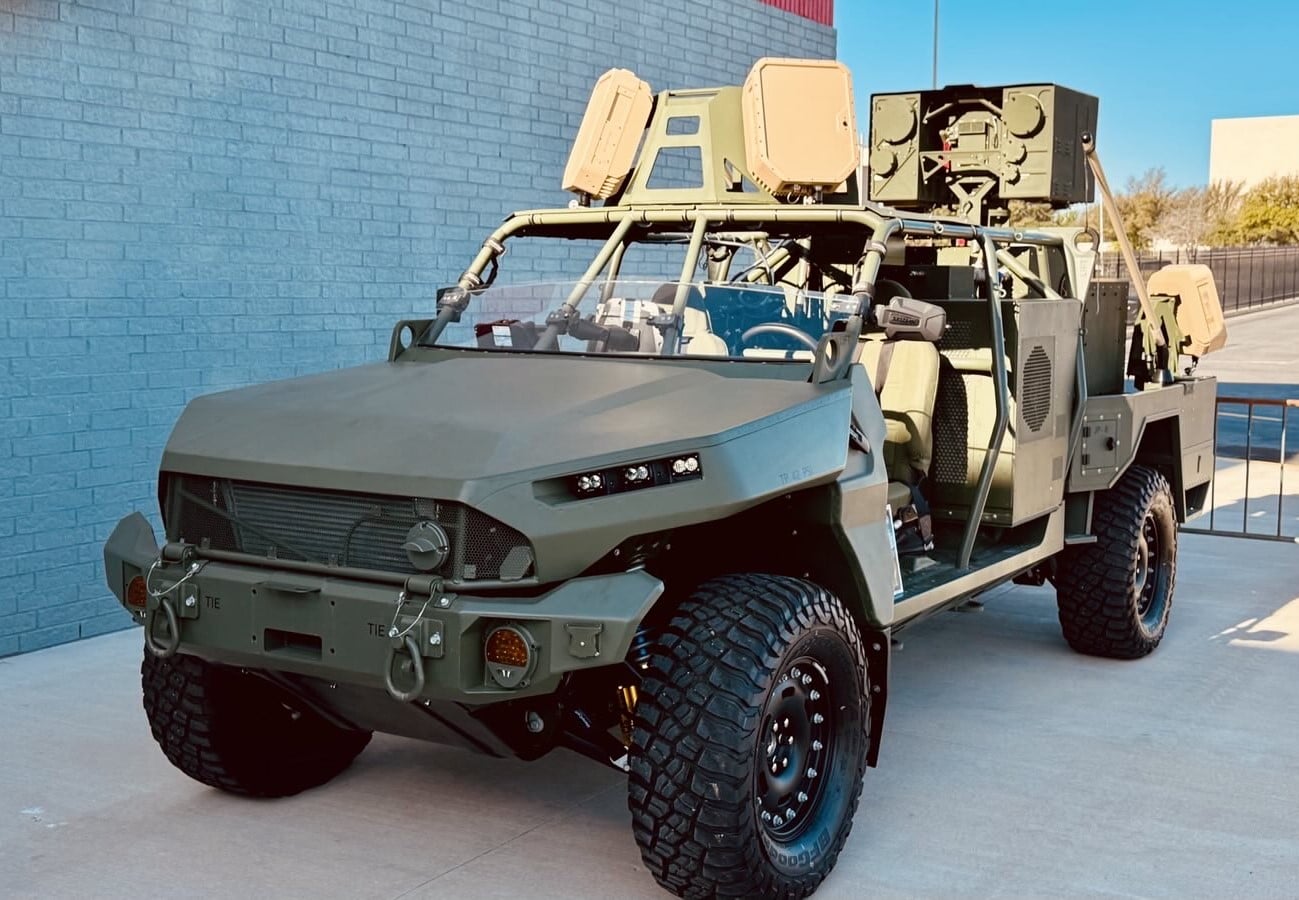
    AeroVironment’s 20 kW LOCUST Laser Weapon System has already been operationally tested aboard both the Infantry Squad Vehicle and the Joint Light Tactical Vehicle through the Army Multi-Purpose High Energy Laser (AMP-HEL) effort, establishing that the U.S. military’s preferred mobile platforms can carry and employ directed energy weapons in the field.

    The Army has reinforced this preference with its Enduring High Energy Laser (E-HEL) push, which is explicitly targeting light tactical vehicles like the JLTV for what might become the U.S. military’s first directed energy program of record.

    Both the ISV and JLTV are at the center of the U.S. military’s emerging approach to future distributed operations. For the Army, the speedy and versatile ISV is seen as providing an essential maneuver capability for Mobile Brigade Combat Teams on a battlefield increasingly dominated by low-cost weaponized drones.

    And while the ultimate fate of the JLTV remains uncertain, the vehicle is currently the chosen platform for the Marine Corps air defense system that’s the backbone of the service’s new Marine Littoral Regiments.

    Both platforms, however, face the same big problem: power. The two services’ potential solutions offer a look at what the U.S. military’s future fleet of laser trucks might actually look like.

    U.S. soldiers prepare to sling load a All-Terrain M1301 Infantry Squad Vehicle to a CH-47 Chinook at Fort Bliss, Texas, July 16, 2025. (Staff Sgt. Rynishia Lewis/U.S. Army)

    As the modern battlefield is increasingly defined by unmanned systems and the electronics needed to counter them, consistent and reliable power at the tactical edge has become as important as ammunition.

    During the height of the Global War on Terrorism, a 30-soldier infantry platoon carried 400 pounds of batteries during a 72-hour mission to power equipment, a load that Army researchers have sought to lighten in the intervening years.

    The U.S. military’s new crop of tactical vehicles don’t currently offer a robust solution: the JLTV can only generate up to 15 kW of exportable power, while the ISV’s output beyond baseline vehicle operations is not public (and likely negligible).

    The challenge for building a laser truck is bigger than just raw power. The core problem for directed energy weapons, as Chariot Defense founder and CEO Adam Warmoth told Laser Wars earlier this month, is that while they don’t consume enormous amounts of energy in absolute terms, each engagement demands a significant spike in power sustained for several seconds.

    Conventional generators are optimized for steady output but not for these spikes, and running one at the ready around the clock is not just inefficient and expensive, but actively dangerous on a battlefield where heat signatures and engine noise turn are prime targets for drone-based reconnaissance and precision strikes.

    “That targetable signature is always on because you have to be ready to provide power to that laser system at any moment,” Warmoth said. “So, you have efficiency challenges, signature management challenges and then mobility problems, where you have to bring the generator sized to your peak demand, which is three to five times larger than the equivalent battery system.”

    The proposed solution to this problem is a hybrid architecture: a generator sized for average load paired with a high-voltage battery system capable of delivering instantaneous surges on demand. The battery handles the spike, the generator recharges the battery between shots and the overall system is smaller, quieter and more tactically versatile than alternatives.

    A vehicle with the right hybrid architecture becomes more than just a maneuver capability, but a node in a distributed battlefield power grid capable of charging drone batteries, running C2 and sensor networks and powering electronic warfare equipment — and, when the moment requires it, feeding a laser weapon the juice it needs to fry a target.

    The Army and Marine Corps have understood the benefits of vehicle electrification for some time. In January 2024, GM Defense demonstrated its Next Generation Tactical Vehicle-Hybrid — built on a Chevrolet Silverado HD 3500 with the same Duramax engine used in the ISV and paired with a battery producing roughly 300 kW hours — with soldiers from the 3rd Brigade, 10th Mountain Division in Hohenfels, Germany.

    GM Defense's Next-Generation Tactical Vehicle. (Staff)

    The following February, the service’s Rapid Capabilities and Critical Technologies Office demonstrated a Humvee-based Tactical Hybrid Electric Vehicle at Aberdeen Proving Ground in Maryland, highlighting silent watch, silent mobility and increased power generation and export as the core operational advantages.

    And later that month, the Army’s JLTV program office released a market survey for a “projected new production effort of a light tactical wheeled hybrid-electric vehicle.”

    The U.S. military has validated this technology despite ongoing concerns that the Trump administration might put the kibosh on such efforts. Now the Pentagon has to actually field it in the right package.

    The Army’s answer to the power gap is the ISV-Heavy. The name is slightly misleading: what makes the vehicle “heavy” is its chassis and, more importantly, its proposed power generation capabilities.

    According to a commercial solutions opening (CSO) document published in late March, the system must produce and export a minimum 60 kW of continuous high-voltage DC power to support modular mission-specific payloads, from C2 communication equipment and radar to, explicitly, future directed energy weapons.

    If the original ISV, based on GM Defense’s Chevrolet Colorado ZR2, was intended as a high-speed troop transport, the ISV-H is envisioned as a mobile power plant that happens to carry soldiers.

    The ISV-H is designed to fill a “niche requirement there between an ISV and then, say, a JLTV, and it’s really going to be focused on the power generation part,” Jess Tolleson, principal deputy assistant secretary of the Army for Acquisition, Logistics, and Technology, told the Senate Armed Services Committee during a June 16 hearing.

    “One of the things that we do have a critical capability gap on right now is power generation at that mobile brigade combat team level,” she added.

    The ISV-H, meanwhile, is moving faster than the earlier CSO document might have indicated. According to the Army’s fiscal year 2027 budget request released in April, the service plans on procuring an initial tranche of 34 ISV-H vehicles at a unit cost of roughly $463,000 each, with a total procurement objective set at 606 vehicles.

    The service plans to release proposal requests by the end of this year, Tolleson said, describing the platform’s development as “a top priority” that the service wants to accelerate. The Army wants to award a contract by September 2027 and accept its first deliveries by January 2028, per the budget documents.

    GM Defense had previously announced it will offer the same Chevrolet Silverado model showcased as the Next Generation Tactical Vehicle-Hybrid for the effort.

    The ISV-H’s power specifications track with the hybrid architecture necessary for a mobile directed energy weapon employment, while the silent operations mode addresses the generator signature problem. The vehicle is purpose-built for the demands of the electronically-defined battlefield — a laser truck designed from the outset to fight, and win, the laser wars of the future.

    For the Marine Corps, there is no equivalent clean-sheet solution available. The JLTV is firmly entrenched in the Corps’ redesigned force structure: the Marine Air Defense Integrated System (MADIS) counter-drone and air defense system, which carries a 30mm cannon and Stinger missiles, operates across a fighting pair of the vehicles, while the Navy-Marine Corps Expeditionary Ship Interdiction System (NMESIS), which mounts the Naval Strike Missile on a JLTV, forms the centerpiece of the service’s Indo-Pacific sea denial strategy.

    A Marine Air Defense Integrated System at Yuma Proving Grounds, Yuma, Arizona, Sept. 27, 2023. (Neil Mabini/Navy)

    The main problem is that the Army’s relationship with the JLTV has deteriorated sharply over the past year. In May 2025, Secretary of the Army Dan Driscoll published a directive stating that the service would cancel procurement of “excess ground vehicles like the [Humvee] and JLTV” and redirect funds toward modernizing light formations around the ISV. According to the Congressional Research Service, the service planned to procure no additional JLTVs beyond the 250 delivered in January of that year.

    AM General’s JLTV A2 variant, the next-generation successor that was supposed to carry the program forward, is now running more than 20 months behind schedule with roughly 2,000 vehicles in arrears, and House appropriators have proposed cutting $133 million from the program’s $245 million budget.

    The Army’s JLTV ongoing issues jeopardize the Corps’ plans for the platform. As Marine Corps Commandant Gen. Eric Smith stated during a June 2025 posture hearing, the service would have to buy fewer JLTVs in the future due to the Army stoppage. The Corps has already fielded roughly half its 12,500-vehicle requirement, but with Army volume gone, per-unit costs will rise.

    This past February, the service reaffirmed its commitment to fielding the vehicle as part of its new force structure, as its Marine Littoral Regiments are built around JLTV-mounted capabilities in a way that makes a clean break from the platform effectively impossible.

    In May, the service released a request for information seeking “mature, production-ready, rapidly fieldable” alternatives from vendors capable of supplementing or replacing AM General’s supply, a tacit acknowledgment of the A2’s production troubles.

    This is where original JLTV manufacturer Oshkosh Defense comes in.

    Displaced by AM General in 2023, Oshkosh arrived at Eurosatory 2026 in Paris with a potential answer to the power problem: an upgraded version of the hybrid-electric eJLTV demonstrator the company first unveiled in 2022, capable of generating 115 kW of exportable power and operating in silent drive and watch modes that allow for full electronic functionality without the tactical liability of a engine signature.

    With the purported ability to generate bursts of power up to 250 kW, the system was explicitly designed with future directed energy weapons in mind.

    “[Working out where to] aim the power available for export is a consideration and the top end is kind of where we’re focused,” Logan Jones, chief growth officer of Oshkosh’s transport division, told Shephard Media. “One that we’ve been tracking is the Australian-based Electro Optic Systems Apollo high energy laser weapon. At the other end, another type of integration is the Cilas HELMA-P [counter-drone] system.”

    Oshkosh is already pushing to reclaim its role as primary JLTV supplier for the Marine Corps, but its broader institutional argument for eJLTV adoption is relatively straightforward: a service that already operates JLTVs can easily integrate the electric version into existing maintenance infrastructure, draw on established spare parts supply chains and train crews already familiar with the base vehicle.

    With the Army walking away from the JLTV and the Marines actively shopping for alternatives, Oshkosh’s power-capable variant may prove the most realistic near-term path for the latter service to get directed energy into the fight.

    Together, the ISV-H and eJLTV offer the U.S. military a two-track approach to fielding laser weapons on light tactical vehicles at scale. The Army gets a purpose-built platform with the power architecture, silent operations capability and modular payload bays to support directed energy weapons like the E-HEL from the ground up. Meanwhile, the Marine Corps gets an evolutionary upgrade to a platform it is already committed to.

    Neither track, however, is without risk. The Army has yet to select an ISV-H manufacturer, and 606 vehicles is a modest procurement objective for a capability the service describes as a critical gap.

    The eJLTV remains a demonstrator, and the Marine Corps’ JLTV procurement future depends heavily on whether AM General can close its production gap and Congress will continue to fund a program it has already threatened to cut.

    But if AV’s LOCUST proved the feasibility of a real-world laser truck, the ISV-H and the eJLTV are the U.S. military’s first serious attempts to build enough of the right vehicles to make laser weapons a standard battlefield capability.

    The major challenge ahead, as senior defense officials have repeatedly emphasized, is whether directed energy weapons can be produced, procured, fielded and sustained at the scale required to prove effective. Without the right platforms to support them, these weapons will remain niche capabilities — impressive in demonstrations, but absent when it matters most.

    This post was originally published on this site.

  • Here’s where the services stand in cutting PCS moves

    Here’s where the services stand in cutting PCS moves

    Editor’s note: This story has been updated to include a response from the U.S. Air Force.

    The U.S. Army is moving ahead to meet the Defense Department’s direction to cut the number of military moves.

    Army officials announced they’re cutting more than 12,000 relocations in fiscal 2026 and more than 13,600 in fiscal 2027, in an effort to provide more stability to soldiers and their families.

    The Navy, Marine Corps and Air Force haven’t established specific numbers of military moves targeted for reduction in 2026 or 2027, service officials told Military Times. All noted that their reviews are ongoing, and key milestones for the Navy and Marine Corps are tied to implementation in 2027.

    Pentagon officials ordered the military service branches in May 2025 to cut by half the amount of money spent on Permanent Change of Station, or PCS, moves by fiscal 2030. DOD spends about $5 billion every year on these moves, which include the physical moves of household goods, as well as allowances and other entitlements related to moving.

    It’s not just DoD that spends money on PCS moves.

    Many service members face financial burdens every time they move, and they’re generally uprooted every two to three years. A recently released Military Family Advisory Network survey conducted in late 2025 found that 60% of active duty families who had made a PCS move in the previous two years paid more than $1,000 out of pocket, above what they were reimbursed. That was an increase over the survey conducted in 2023, when 45% reported paying that much out of pocket.

    Half of those reported the extra cost was attributed to re-purchasing consumable supplies that couldn’t be shipped. They also cited utility deposits, rental deposits, hotel stays, rental cars and new vehicle purchases.

    Pre-move costs like house hunting and preparing their home for a move added to the burden, said Gabby L’Esperance, vice president of research and evaluation for the Military Family Advisory Network.

    The financial burden is just one consequence of being uprooted, with moves contributing to spousal unemployment and difficulty finding child care, in addition to other challenges.

    ‘Much-needed predictability’

    Defense officials outlined that the services will target “discretionary moves,” such as PCS moves within the United States, overseas and individual service member travel. The services are directed to reduce these discretionary move budgets by 10% in fiscal year 2027, 30% in fiscal 2028, 40% in fiscal 2029 and 50% by fiscal 2030. The reductions will be based on the fiscal 2026 budget, adjusted for inflation.

    DoD specified the percentage of reductions in the budget, not the number of moves.

    Do military families really need to move so much?

    In announcing the relocation reductions on June 15, Army personnel officials said various efforts are underway, such as incentives for stabilization to reduce unnecessary moves. Some pilot programs, like the Armor Crewman MOS (19K) stabilization at Fort Riley, Kansas, and Fort Bliss, Texas, offer bonuses for certain soldiers to remain at their current locations.

    Among other things, Army officials are undertaking a broad review of professional military education to find ways to reduce PCS requirements. Their effort emphasizes expanding distance learning options and using options to allow soldiers to complete courses without having to relocate.

    Their PCS reduction efforts are part of their larger Human Resource Continuous Transformation initiatives. The shift will keep warfighting formations intact longer, officials said, and will help them build “more lethal, cohesive teams, boost overall readiness, and provide much-needed predictability for soldiers and their families.”

    The Army’s long-standing High School Stabilization program, which allows families to stay at one duty station through a child’s senior year, benefited about 4,000 soldiers in the past year, officials said. Another program, the Stabilization Retention Option, allowed about 6,200 soldiers to stay at their duty station in fiscal 2025.

    The Navy recognizes the importance of reducing PCS costs while maintaining sailor well-being and operational readiness, said Navy spokesman Lt. Cmdr. Stuart Phillips. Officials are “reviewing policies, procedures, and efficiencies to maintain lethality, readiness and overall effectiveness” in line with the DoD’s direction to reduce the amount of money spent on PCS moves, he said.

    The Marine Corps’ ability to reduce moves “is constrained by the need to ensure the right Marines are in the right billets at the right time,” said Marine Corps spokesman Maj. Jacoby Getty.

    “Every PCS move is tied to a validated operational requirement, including unit readiness, force distribution, professional military development, and global mission demands,” Getty said. “The Marine Corps operates with a highly specialized force structure and limited personnel inventory, which requires deliberate movement of talent across the force to meet operational requirements worldwide.”

    Air Force officials said they are reviewing their internal assignment policies to identify efficiencies. They added that their objective is to “optimize resources without compromising our global power-project, space operations and mission-generation capabilities.”

    This post was originally published on this site.

  • VA uses hundreds of AI systems. Veterans may not know when they’re involved.

    VA uses hundreds of AI systems. Veterans may not know when they’re involved.

    The Department of Veterans Affairs currently has 367 documented artificial intelligence use cases supporting everything from medical appointments and disability claims to customer service and records management. However, veterans seeking medical care or VA benefits may encounter artificial intelligence without realizing it.

    The VA’s recently released 2025 AI Inventory identifies 215 of those use cases as high-impact systems. Although VA officials say safeguards and human oversight remain in place, veteran advocates say veterans are more likely to trust AI systems if they understand when they are being used and what role they play.

    For Navy veteran Markus Williams, the issue surfaced during a recent VA medical appointment. “Yesterday the nurse asked if I was cool with them using AI during my visit with my doc to help them with notes,” Williams said. “When I told her no I wasn’t comfortable with that she didn’t seem too happy.”

    Williams said he declined because he was not comfortable with AI being used during his visit and that he didn’t really know how it was actually being utilized. Veterans, advocates and former VA clinicians interviewed by Military Times described varying levels of veteran awareness about when AI is used and what role it plays in veterans’ interactions with the department.

    Veterans may not know when AI is involved

    VA officials say many veterans may not be interacting with artificial intelligence in the ways they assume they are. “The term ‘AI’ cannot be used interchangeably with VA’s Automated Decision Support system,” VA Press Secretary Quinn Slaven told Military Times. “Automation is constrained to perform exactly what it’s programmed to do, while AI can assess patterns from data.”

    Slaven said, “At the beginning of a visit, the provider will ask if the veteran wants to use Ambient AI Scribe and explain how it works. The veteran can agree, opt out or ask the provider to turn off Ambient AI Scribe at any time. If the veteran chooses not to opt out, the provider will document the visit with Ambient AI Scribe.”

    Veterans interviewed by Military Times described widely different experiences with AI use and notification. Williams said he was asked whether he consented to AI-assisted note taking during a recent appointment. Army veteran Tim King said he has never been asked. “There was a big email sent out recently about it,” King said. “I have yet to be asked if I am ok with it during appointments and I do not intend to okay them using it.”

    Some veterans said they did not distinguish a difference between automation and AI, while others said they viewed the technologies differently.

    Advocates say transparency must extend beyond an inventory

    Jon Retzer, national legislative director for the Disabled American Veterans, called VA’s public inventory an important step toward transparency because it provides a centralized accounting of how AI is being explored and deployed across benefits, health care and operations.

    However, Retzer said the inventory largely operates at a high level and provides limited insight into how systems are monitored after deployment, how performance is evaluated over time and what accountability mechanisms are triggered when problems arise.

    “Veterans would benefit from more detailed, consistent, and publicly accessible information about how these systems function in practice, not just their intended use,” he said.

    Retzer explained veterans should expect clear notification when artificial intelligence is used in decision-making affecting their care or benefits, along with ongoing monitoring, strong privacy protections and meaningful human oversight. But Retzer warns that human oversight alone does not answer broader concerns about whether veterans are informed when AI contributes to their medical appointments, records or benefits experience.

    Even when a clinician or claims processor makes the final decision, he said, veterans may receive little information about how AI influenced the documentation or workflows supporting that decision.

    Clinical use raises new questions

    Notification may be particularly important in health care settings. In January, the VA Office of Inspector General issued a preliminary advisory identifying a potential patient safety risk related to the Veterans Health Administration’s use of generative AI chat tools for clinical care and documentation.

    The watchdog found that VHA lacked a formal mechanism to identify, track or resolve risks associated with generative AI and expressed concern that the absence of a standardized process could limit the department’s ability to safeguard patient safety.

    The advisory states that outputs generated by approved AI chat tools can be used to support medical decision-making and copied into veterans’ electronic health records. The OIG also noted that generative AI systems can produce inaccurate outputs, including omissions, that could affect diagnosis and treatment decisions.

    The OIG review remains ongoing, and the advisory did not identify specific instances of patient harm. However, investigators said the absence of a standardized process for managing AI-related risks could limit VHA’s ability to identify patterns, improve safety and address problems associated with generative AI tools used in clinical settings.

    Clinical documentation can affect future treatment, disability claims and continuity of care for years. A missing detail or inaccurate entry may require repeated appointments, additional paperwork or lengthy efforts to correct the record.

    Veterans and clinicians see both risks and benefits

    Not every veteran views artificial intelligence with skepticism. Helen Cooper, Marine Corps veteran and retired registered nurse from a Tennessee VA medical center, said she would welcome AI-assisted documentation if it results in more accurate records.

    “If I were to choose between AI assisting in thorough documentation of our visits or the status quo of overworked nurses and doctors blatantly ignoring things we tell them or filling our charts with absolute nonsense, I’ll choose AI,” Cooper said.

    “Time and time again VA doctors completely neglect to document veterans’ concerns,” she added. “I’m happy to allow a robot to do their job if they can’t.”

    Air Force veteran and former VA physician Dr. Charles Faulk said documentation requirements have expanded dramatically during his career, often forcing clinicians to spend hours completing records after clinic hours. “The notes burden in the VA has probably tripled in the past quarter century,” Faulk said. “Maybe the AI will make life more livable for the clinician.”

    But even veterans who support the use of artificial intelligence said they want to understand when it is involved in their care. “I need to know what it really does before I can be okay with them using it,” explained Tim King.

    DAV’s Retzer said veterans should expect clear notification when AI is used in decisions affecting their care or benefits and should be able to understand how those systems affect their interactions with VA.

    “AI must never diminish due process, reduce access to earned benefits, or replace necessary human judgment in decisions that affect veterans’ lives,” Retzer said.

    This post was originally published on this site.

  • DoD, movers try to ease the heavy lift for troops moving this summer

    DoD, movers try to ease the heavy lift for troops moving this summer

    As military moving season shifts into high gear, service members and their families should be seeing the results of changes aimed at improving their household goods moves.

    And for those experiencing issues, there’s a direct line to DoD’s new Personal Property Activity, where service members can ask for assistance. Since that call center was set up in August of last year, the volume has reached 20,121 calls and emails, said Army Maj. Matthew Visser, spokesman for the Personal Property Activity.

    That includes calls received into the center, as well as calls made from the center.

    “We often see issues arising, and we can be proactive at reaching out to folks who we know may be impacted,” Visser said.

    That number has increased by about 4,000 since March.

    “The feedback we get from the families and the people we talk to, is that they like the fact they’re talking to another service member who understands what they’re going through, and they call them back if they can’t immediately answer the question,” said Army Col. Mike Ashton, director of operations for DoD’s new Personal Property Activity.

    As of June 30, there had been 138,570 pickups of household goods in 2026, compared to 134,282 at this time in 2025, Visser said. This year, because of PPA changes, service members could start booking their summer moves as early as March, if they had PCS orders in hand.

    The change was designed to help service members in their planning and preparation — and to help spread the load for moving companies during the peak season, which generally runs from mid-May through August.

    Defense Secretary Pete Hegseth designated the PPA as a special activity in January, giving it the authority to take action to improve the household goods process for service members.

    For decades, military families have complained about broken, damaged and lost belongings, delayed pickups and deliveries and onerous claims processes. Families have complained there’s nowhere to turn for help with these problems.

    Mold, broken furniture — just a start to this family’s PCS nightmare

    This moving season marks a stark departure from last year, when a number of moving companies were considering getting out of the business of making military moves because of the U.S. Transportation Command’s effort to privatize the management of military moves.

    Movers complained about the amount of compensation for moves, among other things, and were turning down shipments, leaving military families to scramble at the last minute. DoD terminated the Global Household Goods Contract in May 2025.

    “This peak season, movers have done a really good job of saying, ‘All right, we’re going to step up to the plate. … We are bringing our best drivers, our best crews.’ They’re working really hard to make this summer successful for service members,” said Katie McMichael, executive director of Movers for America, a coalition of over 1,000 moving professionals and independent owner-operators who haul household shipments for military families.

    PPA has improved DoD’s relationship with moving companies to the benefit of all, especially service members, according to those in the industry.

    The PPA and the actions of its commander, Army Maj. Gen. Lance Curtis, have been “a breath of fresh air,” said Ryan McConnell, president and chief operating officer of Atlas Van Lines. PPA has worked to better understand the military moving industry and to build better communications, he said.

    “In the end, this is all of us getting the business component lined up with PPA so that we can provide that service to families,” McConnell said. “Ultimately, that’s what this is all about.”

    ‘Purge parties’ and more tips from the real PCS pros

    This season, movers have seen an earlier start to the peak season, beginning in early May, said Steve Weitekamp, president of the California Moving and Storage Association.

    “We’ve been talking since the beginning of time almost, to try to spread out the peak season from such a short period of time to a longer period, which we’ve kind of seen this season,” he said. “I think it’s been to the benefit of both military members and moving companies.”

    A few tips

    Weitekamp’s advice to service members: “When you get your orders, you should book your move early to ensure the best possible service. … The sooner the military member gets in the queue, the more apt they are to get the top quality service.”

    Because installation security has been tightened because of what’s happening in the Middle East, movers urge families who live on installations to be aware of some of the consequences, said McMichael. Movers are trying to prepare families for the reality that getting on base is going to be difficult this year.

    “We’re not the only tractor trailer truck coming through the gate. There are lots of deliveries. … In a lot of cases it’s not necessarily because our trucks can’t get on base,” she said.

    If they’re behind other trucks that are having issues, she added, “the only thing we can do is sit there. This is for everyone’s safety. But please be mindful that for pickups and drop-offs, there are going to be some circumstances where there will be delays.”

    More suggested tips for easing military moves include:

    • Checking out PPA’s new website, www.ppa.mil, where they’ve consolidated a patchwork of different websites to support service members and families, DoD civilians and industry. It offers a link to start setting up the move, step-by-step guidance through the move process with checklists for every stage, as well as tips for overseas shipments, filing claims, shipping personally owned vehicles and other topics.
    • Doing what you can to prepare early. For example, start clearing out items you don’t want to go to your new location.
    • Organizing your items and make sure you separate important documents, medicines, uniforms and other items that you want to carry with you.
    • Asking questions of the movers. If you don’t get an answer, take it to someone else, including your local transportation office on base. You can contact the PCS call center at any time with questions or problems at 1-833-MIL-MOVE, operated 24/7 during peak season. Or email pcscallcenter@mail.mil.
    • Fill out the customer-service surveys to provide feedback to help DoD decide whether a company gets more business in the future.

    Have you made a military move this year and want to talk about your experience with Military Times? Email staff reporter kjowers@militarytimes.com.

    This post was originally published on this site.