Last Updated on April 20, 2026 by Sarah Wilson If you’re looking for an easy weekend escape from busy Bogotá, the colonial town of Villa de Leyva is a great choice. I spent 1.5 days here and loved the slow pace, mountain views, and relaxed atmosphere. Getting to Villa de Leyva I booked my bus […]
What Is In-Home Care? An Overview of Support for the Elderly and Their Families
Home care for elderly people is somewhat misunderstood as a medical service. While it can include home health, home care is practical aid that brings bonus benefits: socialization, cognitive stimulation, personal empowerment, dignity, and comfort for your aging loved one. Families also benefit from peace of mind and vital support.
In-Home Elder Care: What Are ADLs?
ADLs are activities of daily living. According to the National Institutes of Health, the ability to carry out these tasks defines an individual’s level of functioning (more here). Someone who cannot carry out ADLs requires intensive assistance, whether that’s from a family caregiver or a professional.
Examples of ADLs include:
Feeding oneself
Bathing
Getting dressed
Transferring from one place/position to another
Toileting
Someone who cannot do these activities independently often ends up in full-time care outside their own home. While this is sometimes the best option, it can come with downsides in the form of the senior’s lost sense of agency, comfort, and dignity. In addition, not all families can afford this option, or want it. In this case, they turn to in-home options (their elderly parent’s home, or moving them into their own).
Another type of ADL assistance is for IADLs, or instrumental activities of daily living. Some of these are:
Cleaning the home and doing laundry
Communicating via phone or other devices
Managing personal finances
Getting to and from places like the grocery store (whether that’s driving, walking, or using public transportation)
Cooking/meal preparation
What In-Home Care Provides
Professional caregivers typically work on a customizable basis in your elderly loved one’s home, performing ADLs and some IADLs. (Many of our clients see their caregiver daily for a few hours, or just a few days per week.) Some benefits of in-home care are:
Decreased hospital readmission rates. Post-discharge care is known to impact whether a patient makes a full recovery without additional hospital visits. A professional caregiver monitoring your loved one’s routine—everything from taking meds on time to drinking water—means the doctor’s aftercare instructions are followed. It also means attentive help to prevent falls and quick response to emergencies, like post-surgical infections.
Cleaner, safer living environment. A caregiver can help keep your loved one’s home tidy and organized, reducing the risk of falls and other injury and preventing overwhelm from incomplete chores. On paper, a caregiver is doing dishes and laundry and making the bed; in practice, they are maintaining an uplifting, tranquil, and sanitary living environment.
Quick and informed eyes and ears. A caregiver is alert to changes in your senior loved one’s health, including mental health. They will notice depressed moods or pessimism, as well as frequent headaches or shaking hands. They will notice signs of cognitive decline and memory loss. They may hear about questionable activity before you do, like online or phone-based scams. They will also quickly know about home maintenance needs, like a drafty door or a leaking sink. Their routine attention ensures you know sooner about issues that need a response.
Socialization and cognitive support. If the caregiver is a good fit, your elderly loved one will look forward to spending time with them. Along with practical assistance, they provide conversation and moral support. They can also play games with your loved one to keep them intellectually engaged, encourage creative activities, or help them do their PT-approved exercises to maintain brain and body health. Beyond tasks like cooking and cleaning, a caregiver helps raise your loved one’s spirits and live a fuller daily life.
Family support. A good caregiver will educate the family about their senior’s care and available resources they might not know about, based on their experience with many other elderly clients. They are a wealth of knowledge about routines that work, self-care and respite care, and getting what you need from a busy healthcare provider.
Agency and self-direction. Caring for the elderly in their own home, versus in an institution, gives them a greater sense of independence. They are able to voice their preferences, from the temperature in the house to what they’ll have for dinner. Particularly when your loved one begins to need more help, options for elderly care at home can feel easier to accept and get used to.
How to Get Started with Home Care
Beginning home care can be intimidating. When it comes to your elderly loved one, broaching the subject takes sensitivity and empathy, as well as preparation. Gather information about your options, costs, and benefits your loved one qualifies for. (Veterans and their spouses tend to underuse their available VA benefits.) Take stock of their needs and desires, and get their genuine consent to make a collaborative plan.
Families sometimes have differing opinions about how to help parents or grandparents, who will do what, who will pay for what, and who will be a point of contact. Make an intentional plan with siblings and be transparent about what your loved one needs in terms of care. Home care is often a lifesaver when everyone has full time work and children, or when families are spread across the country and can’t be physically available.
When screening agencies and caregivers, look for verifiable experience and qualities such as reliability, patience, and interpersonal abilities. Use reviews and references. Get deeply involved early on so you can feel confident trusting them in the long term.
In-home care can be the best alternative to providing all their care yourself or moving your loved one into a care institution. If your loved one needs home care, our VetAssist mission is to make home care easily and quickly accessible for those who qualify through the VA Pension with Aid and Attendance benefit. Veterans Home Care can help you determine whether you or your loved one will be eligible to receive the benefit, which can cover some or all of the cost of home care, and we make it easy to apply. Chat with us via our website, or call us at (888) 314-6075.
Last Updated on April 20, 2026 by Sarah Wilson After enjoying the peaceful mountains of Salento in the coffee region, arriving in Bogotá felt like stepping into another world. The city is busy, energetic, and full of contrasts. To make things easy, I pre-booked an airport transfer. I based myself in La Candelaria (the old […]
Last Updated on April 20, 2026 by Sarah Wilson Planning a trip to Colombia’s coffee region? Salento is a top destination. Its green valleys, colourful balconies, delicious food, and close access to the Cocora Valley make it a great addition to any Colombia itinerary. I spent two relaxed days here, found Salento incredibly easy to […]
Last Updated on April 20, 2026 by Sarah Wilson If you’re planning a trip to Medellín and wondering how to spend a few days in the city, this post shares exactly what I did during my own three-day visit as a solo traveller. From exploring Comuna 13 to taking a day trip to Guatapé, here’s an honest look at what […]
If you love our Sweet Potato Chickpea Tacos, get ready for another FAVE! Meet: the Vegan Sweet Potato Chickpea TACO SALAD! It’s got fresh kale + romaine, crunchy tortilla chips, smoky roasted chickpeas + sweet potatoes, and a creamy jalapeño dressing.
The result? BIG flavor, lots of textures, and ready in just 30 minutes (hello, weeknight ease with weekend flavor)! Let’s make this satisfying, flavorful, plant-based dinner!
A little multi-tasking and some speedy knife skills are the tricks to keeping this a 30-minute meal!
Podcasts have become very popular in recent years, and why not? They can be hilarious, educational, practical, and inspirational. There seems to be a podcast for every interest, and more recently, some creators have focused on content specifically for seniors.
Podcasts for elderly audiences touch on topics such as preventative health, home safety hacks, and retired life. They offer stories of decades past with warmth and humor. They drill deep into niche topics for the ever-curious mind.
Some reasons your senior might tune in to a podcast include:
Cognitive engagement. Whether you’re learning the story of the clipper tea races or how GPS works, a great podcast pulls you in and teaches you new things. Some podcasts focus on trivia, riddles, or puzzles—entertaining while making your brain work.
Decreased isolation. For those with limited mobility or a slowed-down routine, podcasts can keep you connected with current events and cultural milestones.
Improved relationships. Podcasts focused on parenting, grandparenting, and making or maintaining friendships can teach you something about having hard conversations or making lasting memories.
Better physical health. Medical experts share useful information on topics like diet, exercise, and sleep. (Note that everyone—not just seniors—should always consult their own doctor before changing or adopting new health habits.)
Fun and entertainment. Talented hosts brighten your day with their antics and banter.
New interests and hobbies. Discover unexplored activities like art journaling, senior chair yoga, or bird watching.
Many podcasts can be accessed for free (usually with ads) or through paid subscriptions to platforms like Spotify, Apple Podcasts, iHeartPodcasts, Pocket Casts, or YouTube. (Our clients who have SmartCompanion already have iHeartPodcasts.) Some also have their own websites with media players, for those who don’t have a subscription to another service.
More than ever, there is a podcast for everyone! Here are some starting points to a wide world of options—either exclusively for seniors, or just something they may enjoy.
Lifestyle Podcasts
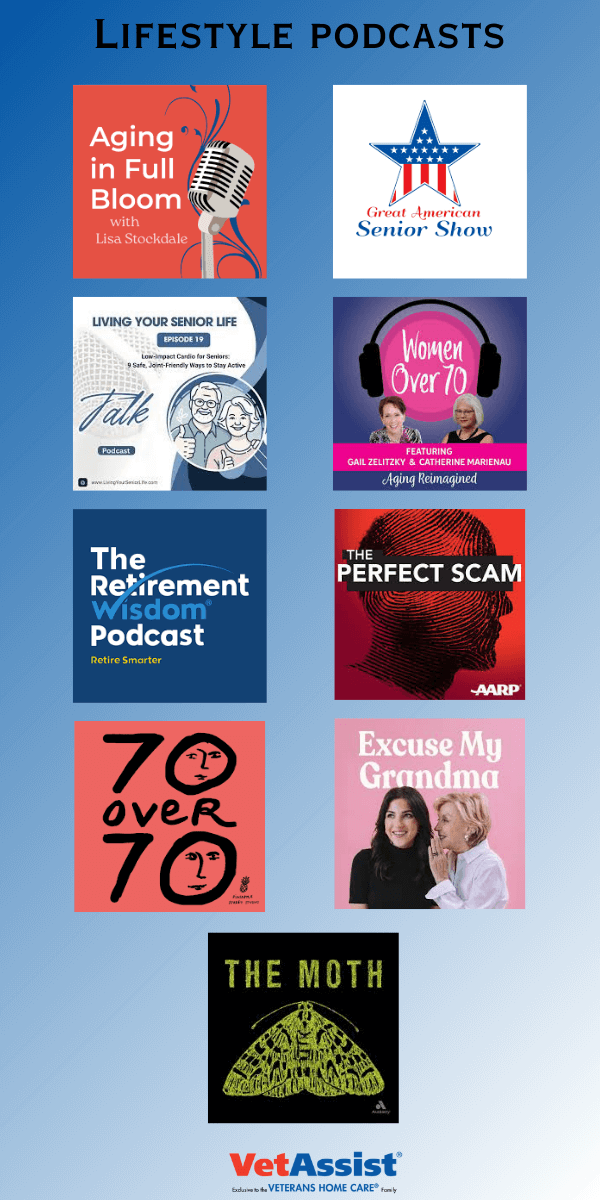
Aging in Full Bloom (link). This senior-focused podcast discusses such topics as retirement life, preventative home maintenance, and simplifying technology.
The Great American Senior Show (link). Veteran journalist Sam Yates offers a broad range of interviews with attorneys, healthcare providers, law enforcement officers, and everyday heroes. While there is a strong Florida angle (where he is based), most episodes are of interest no matter where you live in the US.
The Retirement Wisdom Podcast (link). Another offering with sundry topics, this podcast features episodes on friendship, purpose, and legacy in the golden years of life.
Women Over 70 (link). This inspirational podcast for older women features stories from those over the age of 70 living purposeful, creative lives.
Living Your Senior Life (linkto iHeart; available on more platforms). Covering a variety of topics from hobbies to bone density, this popular show features short episodes packed with helpful tips.
The Perfect Scam (link). This project from the AARP Fraud Watch Network profiles real people and their stories of being scammed, along with expert advice on how to stay safe.
Excuse My Grandma (link). This grandmother-granddaughter duo talk about current events and pop culture, each bringing their own generational lens and a lot of laughs.
70 Over 70 (link to iHeart; available on more platforms). This host interviews 70 individuals over 70 years old about their lives.
The Moth (link). While not exclusively focused on senior life, The Moth is a hugely popular storytelling event—now with a podcast, so you can listen from the comfort of your living room.
Nostalgia Podcasts
You Must Remember This (link). If you love Hollywood glamour and intrigue, you’ll love these stories of giants like Alfred Hitchcock, the Rat Pack, Bette Davis, and many more, leading all the way up through 1990s stars.
Baby Boomer Tales (link). This amusing slice-of-life podcast will scratch the itch for conversations about Baby Boomer common experiences.
Relic Radio (link). If you or your loved one grew up listening to radio dramas, this one’s for you!
Desert Island Discs (link). This fun podcast jumps off the popular “what-if” question—what five music albums would you want if you were stuck on a desert island?—and interviews celebrities on their selections. While ongoing, this show has been recording since the 1940s
Podcasts on Aging and Health
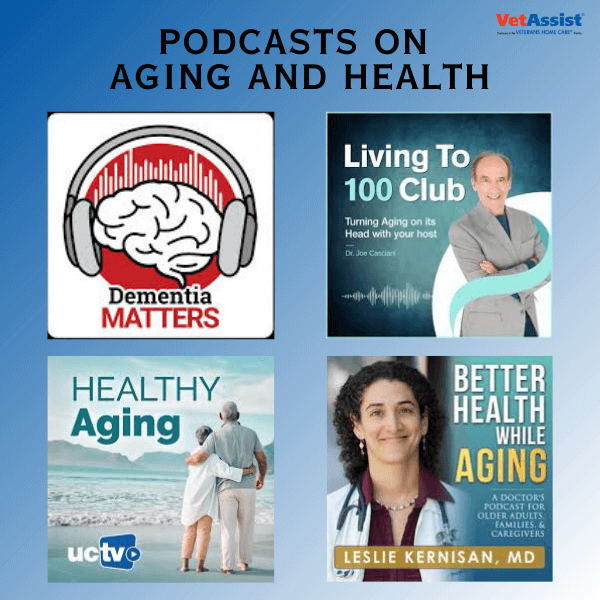
Dementia Mattes (link). Hosted by a geriatrician and director of the Wisconsin Alzheimer’s Disease Research Center, this podcast discusses memory and cognitive health.
Living to 100 Club (link). Dr. Joseph Casciani interviews physicians and researchers on topics related to healthy aging.
Aging and Senior Health (link to videos; audio available on several platforms). The University of California publishes these episodes on everyday health topics for seniors.
Better Health While Aging (link). This popular podcast is also hosted by a geriatrician and offers informed advice in preventative healthcare.
Educational Podcasts
Stuff You Missed in History Class (link). This podcast discusses obscure and forgotten stories from history. Learn how Washington Irving impacted the way Americans celebrate Christmas or why the abandoned Italian mansion, Villa de Vecchi, may be haunted.
Stuff You Should Know (link). Unrelated to the podcast above, this one covers a wide range of topics, with each episode under an hour.
Hidden Brain (link). For those who love practical psychology, this podcast talks about such topics as the science of happiness, when to trust your intuition, and why being in nature makes us feel good.
99% Invisible (link). Each episode of this podcast is like a mini documentary on a singular object or issue.
In Our Time (link). Another podcast in this vein, this BBC series talks geography, science, historical figures, and much more.
For Senior Veterans: Podcasts on Military History
US Army History and Heritage Podcast (link). The US Army’s Center of Military History publishes episodes featuring in-depth interviews from historians and experts.
Duty & Valor (link). This podcast is dedicated to honoring Veterans and military heroes lost in active duty.
The Unknown Soldiers Podcast (link). This one focuses on lesser-known stories and figures from military operations around the world.
WW2 Podcast (link). For WW2 buffs, this podcast explores a variety of angles of this milestone in American hi
Podcasts are a great way to pass the time, learn something new, and keep your mind engaged. Share these with the senior in your life! And if that senior loved one needs home care, our VetAssist mission is to make home care easily and quickly accessible for those who qualify through the VA Pension with Aid and Attendance benefit. Veterans Home Care can help you determine whether you or your loved one will be eligible to receive the benefit, which can cover some or all of the cost of home care, and we make it easy to apply. Chat with us via our website, or call us at (888) 314-6075.
The consulting firm Milliman recently published its 2025 Long-Term Care Index, calculating that – on average – 65-year-olds should set aside $135,000 for their future high-intensity long-term care needs.
Great Variability
While an average figure can be a helpful anchor point, Milliman’s estimates show substantial variability based on gender, location, and health status, among other factors. For instance, the average cost for women is $171,000 and that for men is $98,000, largely because women live longer. As a result, they may need care for a longer period of time and are less likely to have a spouse available to assist them at no cost.
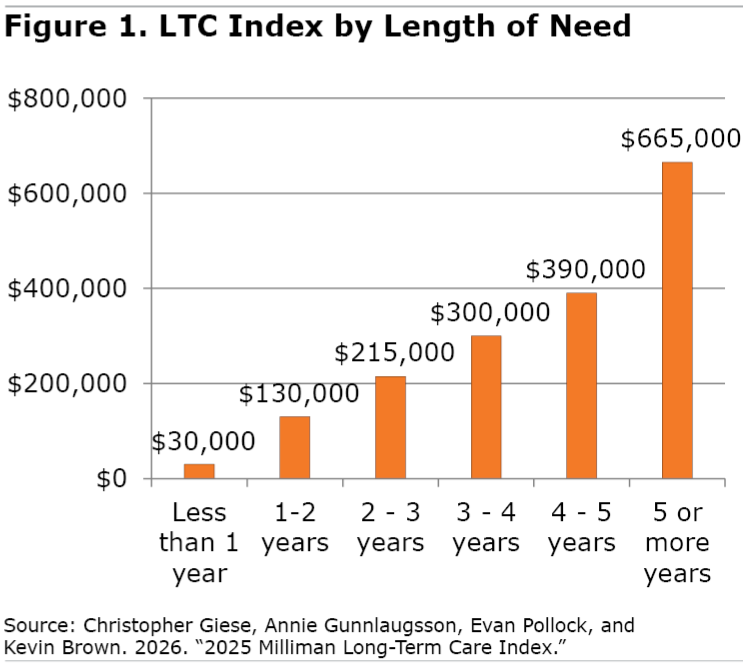
According to Milliman, almost half of men and four out of ten women will need no paid care at all during their lives. Another quarter of men will receive less than a year of paid care, leaving just 29 percent requiring more than a year of paid care. Women, on the other hand, are much more likely to need care for an extended period with 41 percent facing more than a year and 14 percent needing five years or more, which will on average cost them $665,000 (see Figure 1).
I should note that the Milliman figures assume all care is paid care. The Center for Retirement Research at Boston College has estimated that families typically provide at least half of the care hours, even for those with high needs. Milliman also doesn’t say how these costs are paid, in particular whether they include Medicaid-covered care or only amounts paid out-of-pocket.
Location, Location, Location
Costs vary considerably by type of care needed – home health, assisted living, or nursing home – and by location. Location matters not only in terms of costs of care but also longevity and health. People live longer (and, thus, may need care longer) in some states – such as Hawaii, California, Washington, Florida and New Hampshire – than others – such as Mississippi, Alabama, West Virginia, Louisiana and Kentucky.
On the other hand, people who are healthier tend to need care for less time. Milliman highlights Colorado, Montana and Hawaii as states where residents are least likely to need any paid long-term care and Montana, again, along with Arizona and Oklahoma as the states where people need the shortest duration of care. At the other end of the spectrum, those with care needs in Hawaii, Connecticut and New York receive care for the longest periods of time.
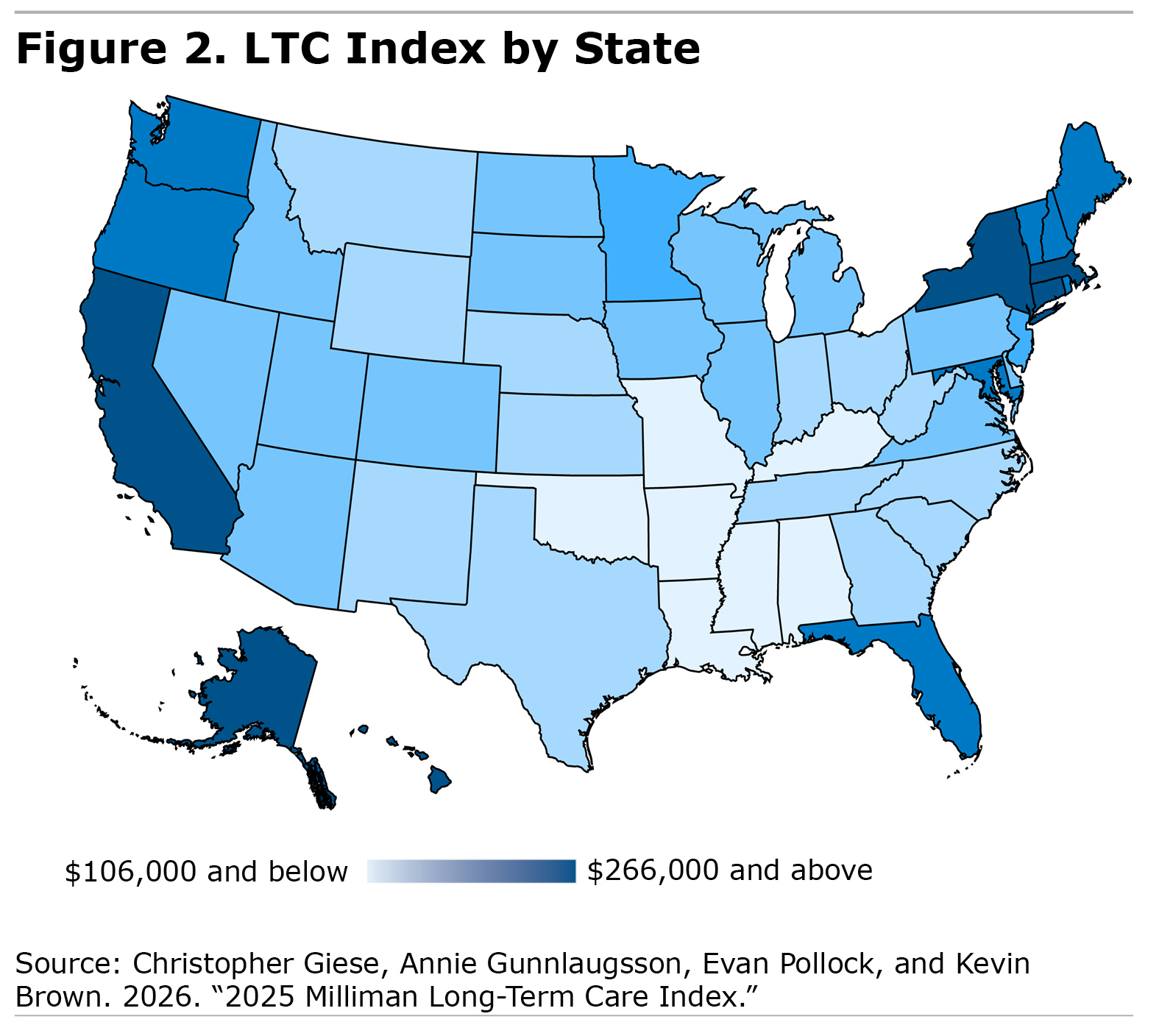
Combining all these factors – so that the cost of LTC services, the likelihood of needing services, and the duration of the needs are accounted for – Figure 2 shows Milliman’s ranking of the average long-term care costs per state (see Figure 2).
The most expensive states (dark blue) are on the West Coast and in the Northeast, where average costs are about twice the national average. The least expensive are largely in the South-Central region (light blue).
A further variation on how much 65-year-olds need to set aside for their care is the anticipated rate of return. The $135,000 average is based on an average investment return of 4.35 percent. Using a higher figure of 7 percent, the average 65-year-old would only need to set aside $74,000, but using a lower return of 3 percent, they’d need $187,000 in the bank.
What Does This Mean for You?
For individuals and families planning for future long-term care costs, it can be difficult to anticipate the need. I’ve written before about the factors that affect the need for paid long-term care, including overall health, family history, and family situation.
But the $135,000 figure seems like a good starting point. Increase that number if you live in a high-cost state, have a family history of dementia or other illnesses that may require a long period of assistance, or if you do not have family members who could help.
Your existing health may affect the figure both positively and negatively. If you are already suffering from a debilitating chronic disease that you could live with for many years, such as Parkinson’s, you can anticipate needing more money. But if you have a form of cancer that may shorten your life but not lead to a long period of disability, you may need considerably less.
An Insurance Solution?
My biggest take away from the Milliman report is that we need a universal long-term care insurance program since we have great uncertainty about individual needs combined with relative certainty about those of the entire elder population. In addition, while a small minority of seniors can afford the cost of their care, whatever it may be, a majority cannot.
According to the Federal Reserve, the median retirement savings of 65- to 74-year-olds in the United States is $200,000, meaning that half have less than this amount. Individuals ages 75+ have median savings of just $130,000. In short, most baby boomers likely do not have enough money to pay their future long-term care costs.
The cost for covering long-term care needs would be significantly less if we started contributing at an earlier age through a national insurance plan. At its 4.35-percent rate of return, Milliman calculates a 35-year-old would only have to set aside $38,000, on average, to cover their future long-term care costs, almost $100,000 less than a 65-year-old. Of course, few 35-year-olds are thinking about their future care needs, but collectively we can approach this challenge. In fact, Washington State has set up such a program, which provides a base layer of long-term care protection for its workers (up to $36,500); and it is exploring ways to allow people to buy additional long-term care insurance at a group rate. Several other states, including Massachusetts, are already exploring similar programs.
For more from Harry Margolis, check out his Risking Old Age in America blog and podcast. He also answers consumer estate planning questions at AskHarry.info. To stay current on the Squared Away blog, join our free email list.
Last Updated on May 8, 2026 by Sarah Wilson If you’re staying in Salerno and want a simple, low-stress day trip, Paestum is an excellent and rewarding choice. With well-preserved Greek temples, a relaxed archaeological park atmosphere, and an excellent museum, it’s one of the easiest excursions you can do by train. This guide covers […]
Last Updated on March 2, 2026 by Sarah Wilson Vietri sul Mare is often treated as the start of the Amalfi Coast rather than a destination in its own right. In summer it can feel busy and rushed, but in winter it slows down. I visited in January, did the town in the morning and […]