Author: Harry S. Margolis

  • Medicaid Coverage of Home Health Care is Growing: But Will the Trend Last?

    Medicaid Coverage of Home Health Care is Growing: But Will the Trend Last?

    Most seniors want to stay in their own homes when and if they need care. In response to this desire and the generally lower cost of home health and assisted living services compared to nursing home care, Medicaid has expanded its coverage of home-and-community-based services (HCBS) over time.

    According to the Centers for Medicare & Medicaid Services, in 2023, 8.4 million Medicaid beneficiaries received assistance paying for care at home or in assisted living facilities – a substantial increase of 8 percent from 7.8 million in 2022. In comparison, 1.5 million beneficiaries received institutional care – mostly in nursing homes – a more modest 3-percent increase over 2022. However, the overall costs for institutional services grew by 17 percent compared to 13 percent for HCBS.

    Growing HCBS Coverage

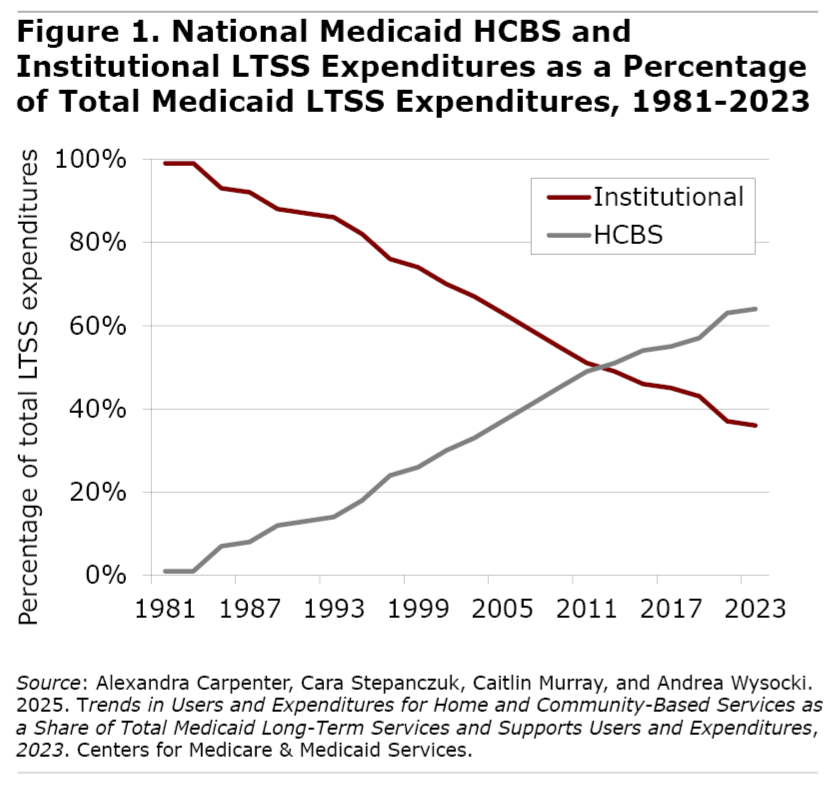
    HCBS accounted for almost two-thirds of all spending on long-term services and supports (LTSS). For historical perspective, in 1981 only one dollar out of a hundred spent by Medicaid for LTSS went to HCBS, rising to half of LTSS spending by 2013 and continuing to grow thereafter (see Figure 1).

    State Variation

    Large variations exist in Medicaid coverage of HCBS by state in large part because such coverage is discretionary, in contrast to nursing home coverage, which is mandatory. Ninety-nine percent of Medicaid beneficiaries in Oregon and Wisconsin receiving LTSS were doing so at home or in assisted living facilities, in contrast with just 56 percent in Kentucky and 61 percent in Mississippi.

    In terms of spending, Medicaid costs for HCBS constituted 95 percent of LTSS costs in Wisconsin as compared to just 36 percent in Arkansas. In other words, only 5 percent of Wisconsin’s expenditures on LTSS are going to nursing homes in contrast with 64 percent of Arkansas’ spending.

    The Future?

    Many people who work on long-term care policy are concerned that the $900 billion in Medicaid cuts in the “One Big Beautiful Bill” will reverse the trend towards more coverage of HCBS. While a lot of the bill’s cuts are aimed at younger beneficiaries, in large part by instituting work requirements, others, such as limitations on so-called provider taxes, are not. States will have to find ways to make up the shortfall in revenue or reduce services. One way may be to cut home health and assisted living coverage, since they are optional under the federal Medicaid rules.

    For more from Harry Margolis, check out his Risking Old Age in America blog and podcast.  He also answers consumer estate planning questions at AskHarry.info.  To stay current on the Squared Away blog, join our free email list.

    This post was originally published on this site.

  • Senior Heart Health: Ailments, Care, and Prevention

    Senior Heart Health: Ailments, Care, and Prevention


    Senior Heart Health: Ailments, Care, and Prevention

    February is American Heart Month, and those of us who care for seniors use it as an opportunity to raise awareness about one of the leading ailments in the elderly: cardiovascular disease.

    Heart health for seniors takes on increasing importance as the cardiovascular system ages. Older people deal with more arrhythmia (irregular heartbeat), blood clots, thickening walls of the heart and blood vessels, and less efficient blood flow through the body. These problems often start quietly in middle age and accelerate as we get into our 60s, 70s, and 80s.

    While aging is itself a risk factor for heart disease, some risk factors are within our control. The following covers essential information to discuss with your elderly loved one and their healthcare providers.

    Cardiovascular Disease in the Elderly

    The term “cardiovascular” reminds us that we are talking about ailments of both the heart and all the vessels that work with it—arteries, veins, and capillaries. While individuals of any age can suffer from cardiovascular disease, it becomes more common as we get older. Common heart problems in elderly patients include, but are not limited to:

    High blood pressure: Also known as hypertension, this very common condition increases the risk of many other cardiovascular problems, including stroke and heart attack. What’s difficult about hypertension is that, day to day, it’s not that noticeable. This can lead to ignoring its very real risks. Contributing factors to high blood pressure are diets high in saturated fat and sodium, chronic stress, obesity, lack of exercise, poor sleep (including with apnea), using tobacco or alcohol, and certain health conditions like kidney disease.

    Coronary artery disease (CAD): When there is damage to the arteries from high blood pressure, high cholesterol, diabetes, and other conditions, plaque can build up in the arteries, blocking normal blood flow. This plaque buildup is also called atherosclerosis and is made up of cholesterol, other fats, and calcium. CAD is the leading cause of angina (chest pain) as well as heart attacks.

    Arrhythmia: This is experienced as an irregular heartbeat and is caused by damage to the heart’s electrical system. Contributing factors are age itself (due to tissue damage and deterioration), hypertension, diabetes, thyroid disease, and sleep apnea. Arrhythmia can also result from dehydration or electrolyte imbalance (from missing nutrients like potassium), and it can be a side effect of some medications. Arrhythmia increases the risk of stroke and heart failure.

     Myocardial degeneration: This is when heart tissue thickens and weakens, leading to reduced blood flow throughout the body. In an individual, this can look like shortness of breath—even when sitting down—fatigue, and edema (swelling in parts of the body, often legs or feet, because of pooling blood and other fluids). Causes include certain infections, nutritional deficiency, drinking alcohol, stress, and sometimes genetics.

    Arteriosclerosis: This is similar to myocardial degeneration, but for the blood vessels instead of the heart.

    Congestive heart failure: This is a chronic condition that happens when a damaged heart cannot pump adequate blood through the body. Fluid builds up in the lungs and/or legs and arms. Heart failure is often the result of chronic cardiovascular disease/damage, or it can begin after a heart attack. It is more common in those over 75 years of age.

    Aneurysm: Aneurysms happen suddenly and are frequently fatal. They occur when part of a weakened artery widens abnormally and then bursts. Prevention of an aneurysm is focused on general blood vessel health, as well as medical screening.

    Heart attack: Medically known as a myocardial infarction, a heart attack happens when a blockage (usually a blood clot triggered by plaque buildup) stops blood from flowing normally to the heart. When this happens, heart tissue quickly begins to die. Signs of a heart attack include shortness of breath, nausea or vomiting, extreme fatigue, dizziness, a cold sweat, and intense chest pain. Different symptoms are more common in women vs. men.

    Stroke: This is similar to a heart attack, but affecting the brain instead. In addition to a clot, it can be caused by brain bleeding (hemorrhage). Signs of a stroke include severe headache, vision problems, confusion, difficulty speaking, and sudden numbness. It is common to lose control over one half of the body.

    Other common conditions include varicose veins, deep vein thrombosis, and aortic stenosis.

    Preventive Care for Heart Disease

    Much of senior heart disease prevention is focused on keeping the heart and blood vessels strong and clear. This means preventing the strain caused by hypertension, safely exercising the cardiovascular system, and making lifestyle choices that promote healthy arteries.

    First, be sure your loved one visits their doctor regularly. Blood tests can assess cholesterol levels and catch problems early, including high blood sugar or other diseases that impact cardiovascular health. Their medical office will take their blood pressure, but this is something you can also do at home. You can also monitor pulse; a normal heart rate for an elderly individual is 60-100 beats per minute when they are at rest, with an average in the 70s. If resting heart rate falls outside this window, bring it up with their doctor.

    If your loved one is prescribed medications to manage cholesterol or hypertension, make a plan to ensure they take it exactly as prescribed. Encourage them to speak up about side effects or changes they notice, and don’t be shy about bringing issues promptly to their doctor.

    The most important lifestyle change your loved one can make for their cardiovascular health is to quit smoking, since it severely damages bodily tissue. Beyond this, avoiding alcohol and adopting a heart healthy diet are effective ways to preserve the health of their heart and blood vessels. Speak to a doctor or registered dietician about foods to emphasize and foods to avoid. Also find out the healthy target weight range for your loved one and get assistance with diet planning to help them stay within it.

    Stress is hard on the whole body, so managing it becomes crucial. Help your loved one find enjoyable activities for relieving stress, whether that is chair yoga or playing a musical instrument. Facilitate their social life; this may mean helping them with rides or with technology to stay in touch with friends and family. If their stress is intense and possibly diagnosable as a mental health disorder, help them find resources such as a counselor or support group.

    Exercise is important at every age, but seniors may not be able to safely do all the activities they once did. Talk to their doctor or an occupational therapist about simple, appropriate exercises to maintain flexibility and balance, increase blood flow, and strengthen muscles. This is important for cardiovascular health, but has the side benefit of helping to prevent falls.

    Check in with your senior loved one about any cardiovascular symptoms they may be experiencing—shortness of breath, easy tiredness, chest pain, pain in arms or legs, dizziness, or trouble sleeping. Encourage them to see their doctor regularly and to make lifestyle choices that help prevent heart disease in old age.

    If you need support in caring for your elderly loved one, our VetAssist mission is to make home care easily and quickly accessible for those who qualify through the VA Pension with Aid and Attendance benefit. Veterans Home Care can help you determine whether you or your loved one will be eligible to receive the benefit, which can cover some or all of the cost of home care, and we make it easy to apply. Chat with us via our website, or call us at (888) 314-6075.

    The post Senior Heart Health: Ailments, Care, and Prevention appeared first on Veterans Home Care – VA Aid and Attendance Pension Benefit.

  • New Tax Break for Seniors

    New Tax Break for Seniors

    Part of the recently passed tax bill includes what the administration is calling “No Tax on Social Security.” The bill does not directly remove taxes on Social Security payments, but it does provide an additional deduction for seniors under certain income limits. This provision may effectively reduce – or, in some cases, even eliminate – federal taxes paid by people ages 65+.

    First of all, it should be noted that this tax break worsens the tenuous fiscal condition of Social Security. Social Security actuaries estimate that the new tax provisions will move up the trust fund depletion date by roughly six months – from the 3rd quarter to the 1st quarter of 2034.

    Nevertheless, current beneficiaries will see the benefits of lower taxes. This blog post looks at how the new deduction works and how it may impact your federal income taxes.

    How Deductions Work

    To understand the mechanics of this new tax break, it helps to know how deductions work. The following is a simplified explanation of the standard deduction (this is not tax advice).

    You start with gross income, which is the total of all sources of taxable income. This amount typically includes work income, most pensions, taxable investment income, and up to 85 percent of your Social Security income. The taxable share of your Social Security is based on what is called “combined income,” which equals half of your Social Security benefit, plus nontaxable interest, plus all other taxable income. Once combined income is greater than $44,000 for married couples filing jointly or greater than $34,000 for single filers, 85 percent of Social Security benefits are taxable. (At lower thresholds, people are taxed on up to 50 percent of their benefit income; below these thresholds, benefits are not taxed at all.)

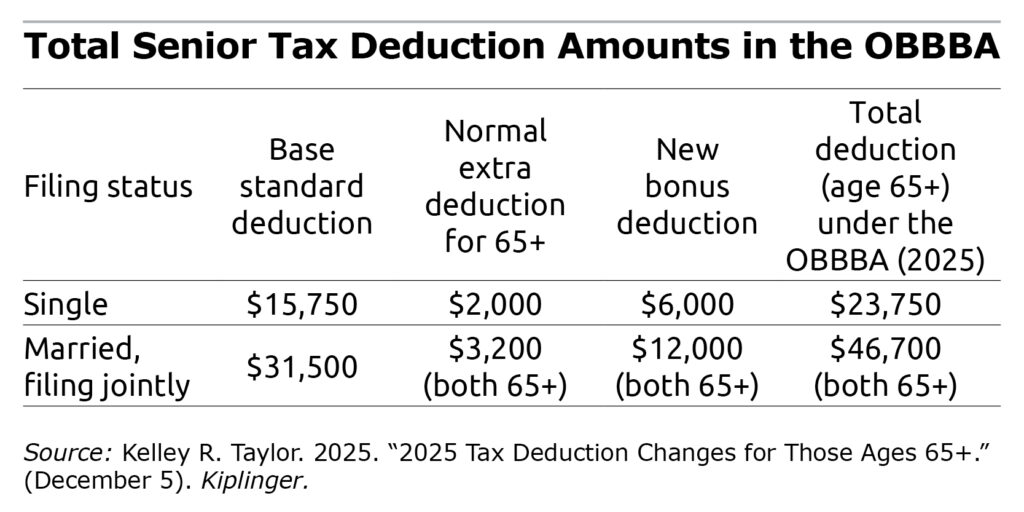
    After totaling your gross income, including taxable Social Security, you subtract deductions. You have the option of tallying up individual items and itemizing deductions, but most people do better by taking the standard deduction. People ages 65+ also receive an extra standard deduction. The new tax bill adds to this already increased standard deduction, bringing the total to $23,750 for singles and up to $46,700 for married couples filing jointly (see Table). It is worth noting that this new deduction is temporary – it is available from 2025 through 2028. This potentially whopping standard deduction is then subtracted from gross income to arrive at taxable income.

    Impact of the New Provision

    The new provision doesn’t explicitly remove federal taxes on Social Security, but it does have the same effect for many people, reducing taxable income by $6,000 per person for those ages 65+. For lower-income retirees who are reliant on Social Security, this might be enough to all but eliminate their entire federal income tax liability. Note, though, that lower-income households below certain thresholds were already untaxed on Social Security. For these households, the additional deduction will reduce other taxable income.

    Let’s look at how this might impact income taxes. Take a single woman over age 65. Say she receives a taxable pension of $30,000, investment income of $10,000, and Social Security benefits of $24,000 (85 percent of which is taxable). That puts her in the 12-percent federal tax bracket. Incorporating the new $6,000 tax provision will effectively reduce her federal tax bill by $720.

    Pay Attention to Income

    An important caveat to this new provision is that it is phased out for single taxpayers with incomes over $75,000 and married filers with incomes over $150,000. The phaseout is $60 for each $1,000 over the threshold. It is fully phased out at $175,000 for single filers and $250,000 for joint filers.

    Bigger Refunds in 2026

    Although the new tax provision does not explicitly eliminate taxes on Social Security, it will reduce taxes for many filers age 65+. If you’ve paid estimated taxes throughout the year or had taxes withheld on your income, you may end up getting a bigger refund (or owe less) in 2026.

    Luke Delorme, CFP® is Director of Financial Planning at Tableaux Wealth in Great Barrington, MA (www.tableauxwealth.com), reachable at luke@tableauxwealth.com. To stay current on the Squared Away blog, join our free email list.

    This blog post is for informational and educational purposes only and should not be considered financial advice. Consult a qualified professional for advice specific to your situation.

    This post was originally published on this site.

  • How the Civil War inspired this iconic poet’s classic Christmas song

    How the Civil War inspired this iconic poet’s classic Christmas song


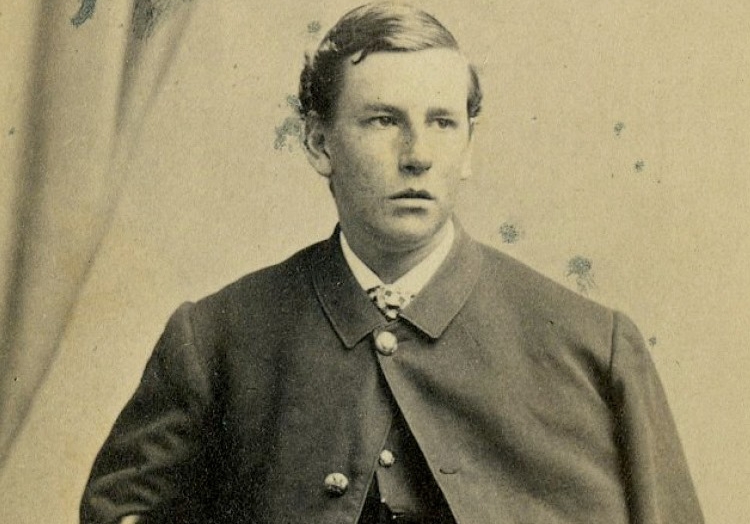
    Charles Appleton Longfellow was the oldest child of American poet and writer Henry Wadsworth Longfellow.

    A dramatized version of Charley’s story was recently made into the movie “I Heard the Bells,” but the true story behind the origins of the Christmastime poem-turned-song is just as, if not more, interesting.

    Henry Wadsworth Longfellow vehemently objected to his son’s desire to enlist in the Union Army. But in 1863, at the age of 18, Charley ran away from home and enlisted in the 1st Massachusetts Artillery.

    He informed his father of his decision in a letter mailed from Portland, Maine.

    “I have tried hard to resist the temptation of going without your leave but I cannot any longer,” he wrote. “I feel it to be my first duty to do what I can for my country and I would willingly lay down my life for it if it would be of any good.”

    Within two weeks of his arrival, likely because of his famous father’s connections, Longfellow was commissioned a 2nd Lieutenant in the 1st Massachusetts Cavalry.

    On Nov. 27, 1863, while involved in a skirmish during a battle of the Mine Run Campaign, Charley was shot through the left shoulder. The bullet exited under his right shoulder blade and skimmed his spine.

    The wound was considered grave, and the army surgeon told the elder Longfellow that “paralysis might ensue” for his son.

    On Christmas day 1863, as his son recovered from his wounds, Henry penned the poem “I Heard the Bells on Christmas Day,” with many references to the Civil War.

    The cannon thundered in the South

    And with the sound    

    The carols drowned

    Of peace on earth, good-will to men!

    It was as if an earthquake rent

    The hearth-stones of a continent,    

    And made forlorn    

    The households born

    Of peace on earth, good-will to men!

    And in despair I bowed my head;

    “There is no peace on earth,” I said;    

    “For hate is strong,    

    And mocks the song 

    Of peace on earth, good-will to men!”

    Then pealed the bells more loud and deep:

    “God is not dead, nor doth He sleep;    

    The Wrong shall fail,    

    The Right prevail,

    With peace on earth, good-will to men

    Henry Wadsworth Longfellow

    Charley would survive his wounds, but did not return to the war.

    He kept in touch with friends made during his brief career as a soldier, receiving letters and photographs from them and creating a scrapbook of newspaper articles relating to his unit’s role in the war.

    He went on to become a world traveler and author.

  • Can Ken Burns revitalize American patriotism?

    Can Ken Burns revitalize American patriotism?


    Ken Burns has had a busy year.

    The famed documentary filmmaker and his co-producers, Sarah Botstein and David Schmidt, have stumped across the United States, speaking, gently of course, about their upcoming docuseries, “American Revolution,” which premieres Sunday on PBS.

    During their six-month promotional tour across 32 cities and 17 states, the trio has consistently delivered a nonpartisan, hopeful message to Americans.

    “We think always in sort of Chicken Little terms,” Burns told an audience during a panel event at Mount Vernon, Virginia, on Oct. 29, “that our time must be the very, very worst.”

    “You can have at least the possible reassurance that things were really divided back then. It was a civil war,” he said of the American Revolution. “Examining the origin story provides you with a kind of renewal and a fresh understanding.”

    Burns has endeavored to provide such reassurances. The director and his team have spoken to a spectrum of media over the course of the year, from podcasters like Theo Von and Joe Rogan to MSNBC and The New York Times.

    Burns spent nearly two hours on Von’s show and three on Rogan’s, with one listener noting in the latter’s YouTube comment section, “We need an annual Ken Burns discussion, if not more. This is cathartic.”

    “We’re trying to reach as many people as we can,” Schmidt told Military Times in a recent interview. “If anybody wants to talk to us, we’re really happy to speak to them.”

    The makings of liberty

    For Burns and his team, the decision to make a documentary on the American Revolution was “spontaneous,” according to the director.

    To put it into context, the year was 2015, President Barack Obama still had 13 months left in his presidency and “nobody was talking 250” — America’s semiquincentennial anniversary in 2026 — Burns told the audience at Mount Vernon.

    “But I was looking at this map that we had of the Ia Drang Valley, in the central highlands [of Vietnam], and I just said, ‘That could be the British moving west on Long Island towards American positions in Brooklyn,” Burns recalled at the Mount Vernon panel. “I just went, ‘We could do it.’”

    With the absence of archival footage for the series, the filmmakers had to get creative — shooting reenactors throughout the documentary. (PBS)

    The filmmakers, however, had to get creative. Without photographs, B-roll or archival footage, the trio resorted to maps, diaries and reenactors to tell the epic tale of Great Britain’s 13 North American colonies’ fight for independence.

    “We went out and filmed with reenactors,” Schmidt said of the filmmaking process, which also included commissioning watercolors from a group called Wood Ronsaville Harlin.

    “Probably the most expensive line item in our budget is re-creating North America as faithfully as we could in a map,” he noted. “That was challenging, but also really fun. Waterways across America have changed since the 18th century. We had to erase the Erie Canal. Stuff like that you just don’t think of.”

    Despite such challenges, according to Schmidt, the lack of visual primary sources presented opportunities to find “new ways to solve these problems.”

    Over the course of several years, the trio shot original footage of nearly 100 locations within the original 13 colonies, as well as in London and the English countryside.

    For 10 years — and to the tune of more than $30 million — Burns and his team built up a vast archive of knowledge.

    “Part of the reason it was so exciting to make [this film] is that we got to spend a decade learning what actually happened and finding out the way to artistically shape that into a 12-hour film to share with the American people,” Schmidt shared.

    “We aren’t trying to dispel myths. We’re not mythbusters out there poking holes in your understanding of the American Revolution. In fact, what we’re doing is taking what you already know and rebooting it,” he said. “It’s going to supplement what you already know and make it make more sense.”

    Heart of the story

    The six-part series follows more than just the well-known characters of the American Revolution.

    While it includes rank-and-file Continental soldiers, militiamen and American Loyalists, the series also delves into the oft-unheard stories of Indigenous soldiers and civilians, enslaved and free African Americans, German soldiers in the British service, French and Spanish allies and an array of civilians living in North America.

    The documentary highlights a war that not only touched the lives of those living within the 13 colonies, but also engaged and inspired millions of people in North America and beyond.

    Over the course of several years, the trio shot original footage of nearly 100 locations — in every season — within the original 13 colonies, as well as in London and the English countryside. (PBS)

    “The war begins in Lexington,” Schmidt said, “but it spreads all throughout — not just the original 13 colonies — but over the mountains to the Ohio River, along the Gulf Coast, even out to the Mississippi River. It’s also in the Caribbean. It’s fought off the coast of England. It’s fought in the Atlantic Ocean. It’s fought along the coast of France, along the coast of Africa, even in the Indian subcontinent — and that’s just the war.

    “The ideas just grow and grow and inspire revolutions — and have inspired revolutions for the past 250 years all throughout the world. Ho Chi Minh, when he declared Vietnamese independence, had two United States OSS officers standing next to him and was quoting Thomas Jefferson in Vietnamese.”

    Despite these ideas that have shaped the world since 1776 (many argue that date is even earlier), Schmidt recalls how surprised he was when learning about the original aims of the conflict.

    The now-lauded notions of civilian rule and non-partisanship that created the republic that we still live under were not, says Schmidt, “on the table at the start.”

    “Those weren’t war objectives,” he continued. “On April 19, 1775, they became necessary to win the war. But they were kind of outcomes of the war, rather than goals. What they were really trying to do at the start was to liberate Boston, to get a redress of grievances and to bring things back to the way they were under the British Empire. But in order to win the war, they had to involve all sorts of American people who otherwise might not get along.

    “Coalition building made it a war about liberty. It made it this fight for a union. Then in order to win the war, they had to involve foreign powers. The French came in. The Spanish came in as the allies of the French. The Dutch declared war on the British,” ultimately creating a coalition war.

    Former Commandant of the Marine Corps Gen. Joseph Dunford, who spoke alongside Burns at the panel at Mount Vernon, echoed Schmidt.

    “I would argue — and I think it’d be tough to argue against it — that our strategic center of gravity as a country comes from allies and partners,” Dunford said. “There’s almost nothing that we have to deal with, certainly in the 21st century, where coherent collective action isn’t required to address a problem.”

    That coalition is what makes up the heart of the documentary. Nearly 150 characters are highlighted in the series, with their stories read by a staggering 61 different voice actors, including: Kenneth Branagh, Josh Brolin, Jeff Daniels, Morgan Freeman, Paul Giamatti, Domhnall Gleeson, Tom Hanks, Ethan Hawke, Samuel L. Jackson, Michael Keaton, Damian Lewis, Laura Linney, Edward Norton, Mandy Patinkin and Meryl Streep, among many others.

    The military story itself features 36 battle sequences that range from the well-known, like Bunker Hill and Yorktown, to the more obscure, while showing that the American Revolution was a test of logistics and strategy as much as it was a war of ideals.

    Washington, according to Schmidt, understood the “arithmetic of this war” — that is, the importance of not losing it all “in one motion.” (PBS)

    George Washington is, naturally, also front and center in the series — a point that Burns noted while speaking at the historic home of America’s first president.

    “He’s our guy, and that’s pretty amazing. Look, we do not soft pedal the flaws. Not only are there really bad tactical mistakes: there’s the rashness of riding out on the battlefield, not just as Princeton but at Monmouth and Kip’s Bay; and he owns hundreds of human beings. You can’t square that circle. But we are so lucky [to have had him], and we’re here because of him.”

    Civilians, not subjects

    One point that Burns and his team spend considerable time exploring is the notion of citizenship.

    “I’m really still overwhelmed by some of the obvious things, that for the first time, we were creating citizens, not subjects under authoritarian rule,” says Burns.

    “Thomas Jefferson says, ‘All experience has shown that mankind are more disposed to suffer while evils are sufferable.’ That just means that for most of human history, people have been under authoritarian rule and they’ve accepted it. They’ve acquiesced that those evils are sufferable. Essentially this [American] ‘project’ was to say no to that.”

    The war, however violent and bloody it was (which Burns succeeds in displaying) was the vehicle for that freedom.

    “I’m really proud to have worked on this film. I’m prouder to be a citizen of a country that invented that idea,” he added.

    Burns ended the panel with a potent mix of patriotism grounded in history, closing with one of his favorite quotes from a Hessian soldier, Johann Ewald, who served under the British during the war.

    “Who would have thought 100 years ago that out of this multitude of rabble would arise a people who could defy kings?” Ewald once quipped.

    “That to me,” says Burns, “is the whole essence of the project. The right to defy kings.”

  • ‘Gunners!’ revives forgotten chapter of air war over Korea

    ‘Gunners!’ revives forgotten chapter of air war over Korea


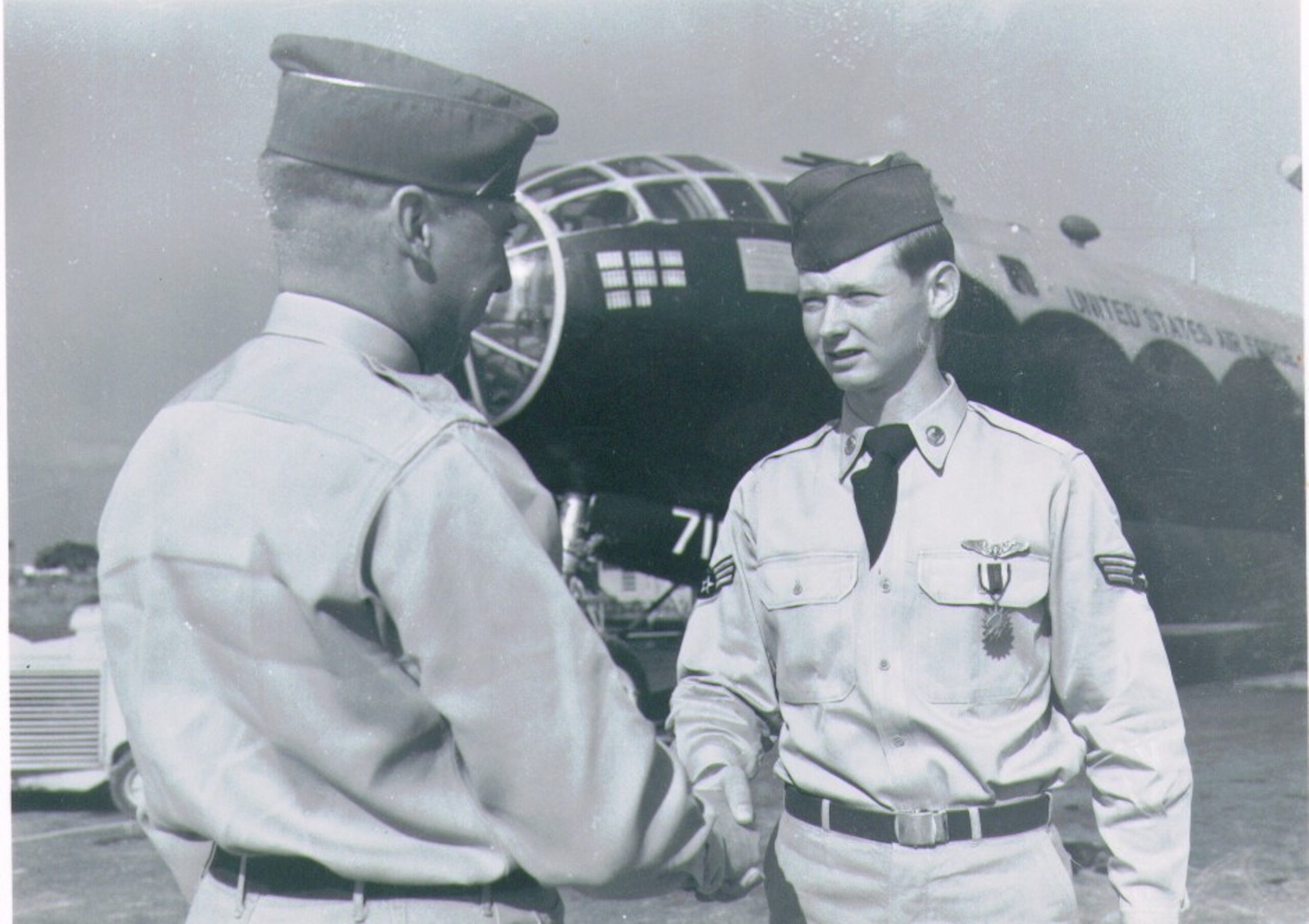
    Thomas Stevens’ first combat mission was memorable — and defied direct orders from the commander in chief. On Nov. 28, 1952, the 19-year-old airman was a tail gunner on a Boeing B-29 Superfortress on a nighttime bombing run over North Korea.

    After dropping its load of 20 500-pound bombs on a target along the Yalu River, the aircraft was caught in a strong wind and blown over the border into Manchuria. President Harry S. Truman had forbidden any U.S. Air Force planes from crossing into Chinese airspace to prevent further escalation of the Korean War.

    However, instead of a reprimand, the crews of the 307th Bombardment Group of the 13th Air Force were treated to breakfast. Running low on gas, the squadron diverted to Japan for refueling and a meal of fresh eggs — a welcome reprieve from the powdered eggs served in the unit’s mess at Kadena Air Base on Okinawa.

    “We were not supposed to be in Manchurian airspace,” Stevens, now 92 and living in Overland Park, Kansas, told Military Times. “It was something the officers laughed about, but we knew we needed to get out of there in a hurry.”

    He added with a chuckle, “We did enjoy the breakfast.”

    Stevens' crew at Randolph Field, San Antonio, Texas, before departing for Okinawa. Stevens is in the back row, first on the left. (Courtesy Thomas Stevens/USAF)

    Stevens is one of five veterans featured in “Gunners! B-29 Machine Gunners in the Korean War” by author and military analyst James Blackwell. The others include the late Philip Aaronson, who was shot down and spent 36 months in a POW camp, Dale Crist, Romaine Gregg and Jack Bernaciak, who flew the last B-29 combat mission in Korea. Blackwell conducted personal interviews and reviewed oral histories and military records of the five men in compiling this account of their service.

    “In many ways, Korea was the ‘Forgotten War,’” the author said. “This was my father’s generation. They were young children during the Dust Bowl and Great Depression. They were the ‘Silent Generation,’ as Time Magazine referred to them. I wanted to write something that reflected who they were and what they went through.”

    The new book examines a nearly forgotten chapter of the air war over Korea. With a limited number of jet bombers in service at the time, the Air Force reactivated the Superfortress to deliver payloads against enemy targets. Technologically superior only a few years earlier, the slow, four-engine heavy bombers were now relics in a supersonic jet war.

    “The B-29 against MiG-15s — it was like David and Goliath,” Stevens said. “It was no contest against those jet fighters.”

    Stevens flew 27 missions over North Korea and accidentally over China. From his position as a tail gunner, he had a bird’s-eye view of the results of his aircraft’s bombing runs. He could also view the fighting on the ground as Marines and soldiers slugged it out with North Korean and Chinese forces.

    “I could look down at what was happening,” he recalled. “I was glad I was not down there.”

    It was no joy ride in the air either. In addition to enemy jets, Superfortresses were susceptible to antiaircraft fire. The last few minutes to the target were always the toughest. Stevens remembered hearing the deafening sound of shrapnel from exploding flak hitting and occasionally piercing the aircraft’s fuselage.

    “It made a loud bang, like a car in a hailstorm,” he said. “There would be little dents and holes all over the aircraft. Flak hits varied. One time it was so close that it bumped me out of my seat. We had flak suits. I couldn’t wear mine because of the tight space in the tail, so I put mine on the floor to help protect me.”

    As a 19-year-old farm boy from Missouri, Stevens stated he was too young to be frightened by the danger he faced at the time. He couldn’t wear a parachute because of the confines of his firing position, so he just assumed he would go down with the plane if anything happened.

    “When I think back now, I say, ‘Did I really do that? Was I that crazy?’” he stated. “We had our orders and we followed them. It was an exciting time.”

    Stevens on the flight line at Kadena Air Base. Gunners shared duties for checking bombs before they were loaded. (Courtesy Thomas Stevens)

    Capable of delivering conventional and nuclear weapons, the B-29 was a modern marvel when it first flew in World War II. The high-altitude strategic bomber featured an analog computerized firing system that enabled one person to direct four remote-controlled machine gun turrets, known as “blisters” because of rounded Plexiglas covers. If a gunner was wounded, the fire-control officer could direct shooting at enemy planes at that position.

    Instead of firing by Kentucky windage, airmen sat in seats with a screen that showed the target and adjusted for speed, distance and other factors. When an enemy aircraft appeared in a circle of dots, the gunner flipped a switch.

    “It was an analog system that was essentially mechanical, so it didn’t have the speed of a modern computer,” Blackwell said. “It was designed for shooting down German and Japanese fighters. It was a little slow against jets, but still did a good job.”

    Blackwell began researching the book believing the slower Superfortress was overmatched by a faster Soviet Union jet flown in the Chinese and North Korean air forces. However, he found that premise to be not quite true.

    “I had heard the stories and came to this with the impression that B-29s were obsolete and outclassed in the Korean War,” he said. “After checking the statistics, I came to a different conclusion and changed my approach to writing the book.”

    While the propeller-driven heavy bombers were outpaced by enemy jets, they managed to hold their own in combat. Blackwell’s analysis of statistics showed the Superfortress was at a definite disadvantage in the early days of the Korean War when the Air Force was flying daytime missions using World War II formations. However, air command changed tactics and had the B-29s fly only at night while making single-file bombing runs. By the end of the war, B-29s had shot down 25 MiG-15s compared to 16 bombers lost to enemy jets.

    “The Air Force flipped the trend by adapting new techniques,” Blackwell said. “Ending daytime missions was critical because MiG-15s weren’t equipped for nighttime attacks. Flying single file on bombing runs also reduced losses. In addition, our gunnery training outpaced that of the enemy, enabling the B-29s to stay ahead of enemy jets in terms of kills.”

    Since Stevens flew only night missions, he rarely saw MiG-15s chasing his Superfortress. In fact, he did not use his two 50-caliber machine guns against a threat.

    “I never fired them in combat,” he said. “Only test-fired them at the start of missions.”

    Stevens and his wife, Barbara, pose with President Barack Obama at the White House on Veterans Day 2017. (Courtesy Thomas Stevens)

    After Korea, Stevens left the Air Force as a staff sergeant in 1955. He married and raised two sons while attending college on the GI Bill. He then joined Southwestern Bell Telephone Company, retiring as a district manager after 33 years.

    However, Stevens’ work was not done. In 2006, he helped build and dedicate the Korean War Veterans Memorial Park in his retirement community of Overland Park, Kansas. In 2010, he was elected to the national board of the Korean War Veterans Association, serving eventually as president. In that role, he championed the cause of Korean War vets in meetings with President Barack Obama and Vice President Mike Pence, as well as other government officials.

    Today, Stevens continues to speak to school groups and others about the “Forgotten War” and the sacrifices made by the men and women who served in the conflict. He is especially proud of his time in the Air Force and all he learned as an airman.

    “It was an invaluable experience that helped shape the rest of my life,” he said.

    Blackwell hopes his book inform readers of the debt they owe to Korean War veterans. On his speaking tour, he gives away free copies of his book to veterans so they “never forget” the people who came before them.

    “Korean War vets have the same needs and hurts as the veterans of Iraq and Afghanistan,” he said. “We need to sit and listen to what they have to say, too.”

  • WWII nurses deserve Congressional Gold Medal, lawmakers say

    WWII nurses deserve Congressional Gold Medal, lawmakers say


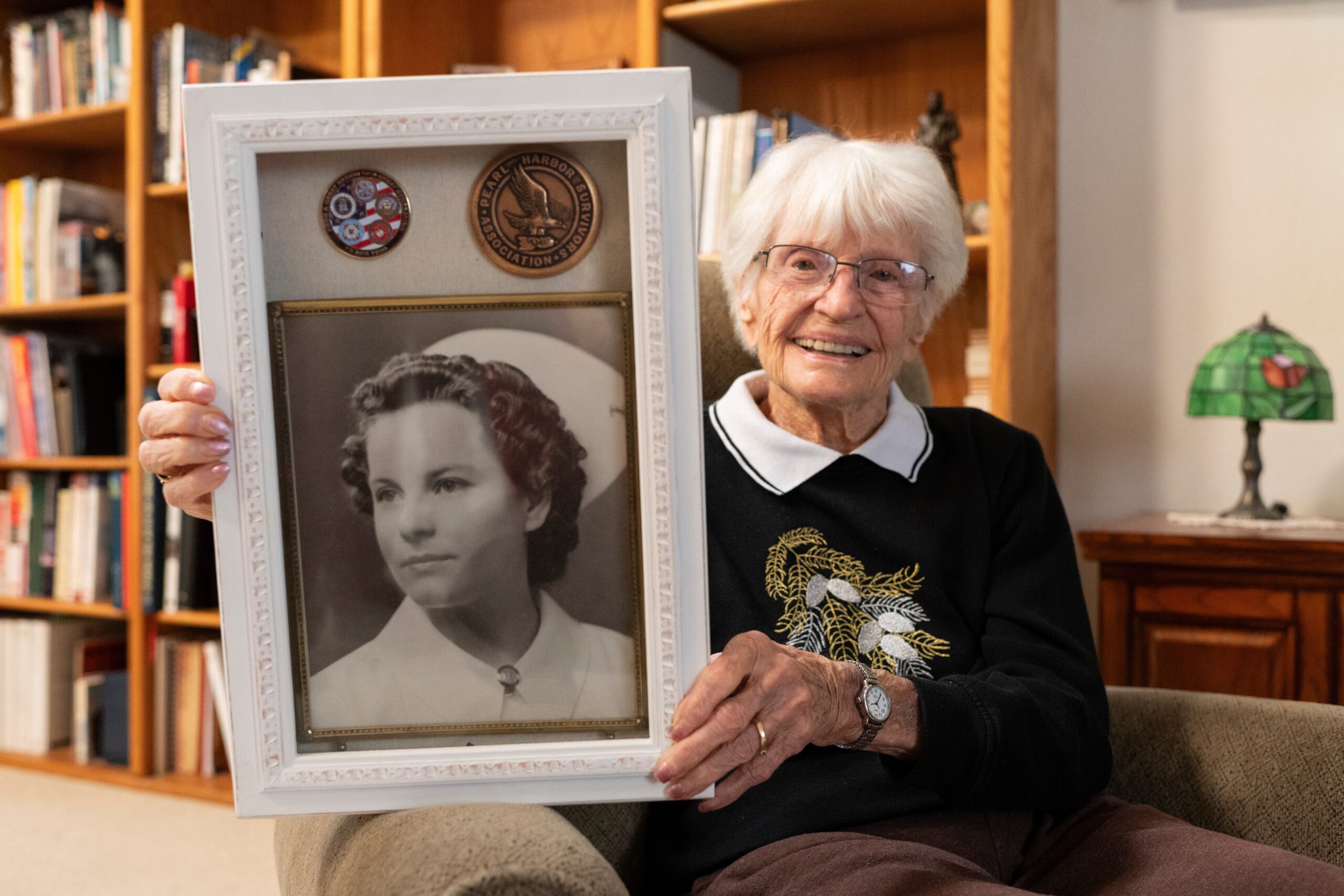
    DANVILLE, Calif. — At age 106, Alice Darrow can clearly recall her days as a nurse during World War II, part of a pioneering group that dodged bullets as they hauled packs full of medical supplies and treated the burns and gunshot wounds of troops.

    Some nurses were killed by enemy fire. Others spent years as prisoners of war. Most returned home to quiet lives, receiving little recognition.

    Darrow sat with patients, even after-hours. One of them had arrived at her hospital on California’s Mare Island with a bullet lodged in his heart. He was not expected to survive surgery, yet he would change her life.

    “To them, you’re everything because you’re taking care of them,” she said, sitting at her home in the San Francisco Bay Area town of Danville.

    A bullet struck his heart at Pearl Harbor. His widow just returned it.

    Eighty years after the war ended, a coalition of retired military nurses and others is campaigning to award one of the nation’s highest civilian honors, the Congressional Gold Medal, to all nurses who served in WWII. Other groups, such as the Women Airforce Service Pilots of WWII and the real-life Rosie the Riveters, have already received the honor.

    “The general public doesn’t often recognize, I think, the contribution that the nurses have made in pretty much every war,” said Patricia Upah, a retired colonel who served as an Army nurse in conflicts abroad, and whose late mother was also a Army nurse in the South Pacific in World War II.

    Only a handful, like Darrow, are still alive. The coalition knows of five World War II nurses who are still living — including Elsie Chin Yuen Seetoo, 107, who became the first Chinese American nurse to join the Army Nurse Corps. They fear time is running out to honor the trailblazers.

    “It’s high time we honor the nurses who stepped up and did their part to defend our freedom,” U.S. Sen. Tammy Baldwin, a Democrat from Wisconsin, said in a statement.

    Baldwin and U.S. Rep. Elise Stefanik, a New York Republican, have sponsored legislation to award the medal, but it faces steep odds. It needs two-thirds of each chamber — 67 cosponsors in the Senate and 290 in the House — and so far, the bills have eight and six cosponsors, respectively.

    This photo provided by Elaine Yuen shows her mother, Elsie Chin Yuen Seetoo, next to a photo of herself at an exhibit at the Army Historical Foundation in Arlington, Virginia, in May 2017. (Elaine Yuen via AP)

    Saving lives in the face of danger

    Before the war, there were fewer than 600 nurses with the U.S. Army and 1,700 with the U.S. Navy. By the end of the war, those numbers had ballooned to 59,000 in the Army and 14,000 in the Navy.

    The Congressional bills cite harrowing examples of bravery. Some nurses served on Navy hospital ships treating patients as the vessels came under fire. Sixty nurses landed off the coast of North Africa on Nov. 8, 1942, to set up shop and care for invading troops.

    “Without weapons, they waded ashore amid enemy sniper fire and ultimately took shelter in an abandoned civilian hospital,” the legislation states.

    The nurses saved lives. Fewer than 4% of U.S. soldiers in WWII who received medical care in the field or underwent evacuation died from wounds or disease, the legislation states.

    “They probably saw more infections. They probably saw more chemical casualties. Remember, they didn’t have disposable products, so they had to sterilize everything,” says Edward Yackel, a retired colonel and president of the Army Nurse Corps Association, of World War II nurses.

    “Without them,” he says, “we would not have the knowledge base we need now to fight the wars of today.”

    Some nurses endured harsh captivity. In 1942, nearly 80 military nurses were captured when the U.S. surrendered the Philippines to Japan. Held as prisoners of war, the women endured starvation rations and disease but continued to work until their liberation three years later.

    Nurses played outsized roles in 600 U.S. Army hospitals worldwide and 700 prisoner-of-war camps at military bases in the U.S., said Phoebe Pollitt, a retired nurse and professor of nursing at the University of North Carolina Greensboro. But their role has largely gone unrecognized.

    “Within even women’s history and health care history, nurses are kind of at the bottom of the barrel,” she said.

    Alice Darrow looks at pictures of her and her late husband, Dean Darrow, taken in July 1942. (Laure Andrillon/AP)

    Breaking color barriers

    The majority of military nurses were white, and those who were not often had to fight for the right to serve.

    In 1941, only 56 Black nurses were allowed into the U.S. Army. Japanese American applicants, whose families were incarcerated during the war, were not accepted into the Army Nurse Corps until 1943.

    Elsie Chin Yuen Seetoo was born in Stockton, California, but spent her teens China. She joined the Chinese Red Cross Medical Relief Corps in unoccupied China after fleeing Japanese forces in Hong Kong.

    She later applied to the U.S. Army Nurse Corps, but they said she had an obligation to serve her country — and that meant China.

    An indignant Chinese American medical officer fired off a letter on Seetoo’s behalf, stating that she was a U.S. citizen. She became the first Chinese American nurse to join the Army Nurse Corps, working in China and India before returning to the U.S.

    She already has a Congressional Gold Medal awarded to Chinese Americans for their service in the war despite the discrimination they faced.

    “We answered the call to duty when our country faced threats to our freedom,” she said in video recorded remarks at the 2020 ceremony.

    A love story

    Among the patients Darrow cared for was a young soldier wounded in Japan’s attack on Pearl Harbor. Before surgery to remove the bullet in his heart, he asked if she would go on a date with him, if he made it through.

    “I said, ‘Well sure, you can count on me,’” she says, and laughs. “I couldn’t say, ‘No, I don’t think you’re going to make it.’”

    Dean Darrow did survive and they did go out. The couple kept the 7.7 mm bullet. They married and raised four children. He died in 1991.

    In September, Alice Darrow took a cruise to Hawaii with her daughter and son-in-law, where she donated the bullet to the Pearl Harbor National Memorial so visitors from around the world could learn of its significance and the love story behind it.

    Darrow said she’s looking forward to seeing the bullet on display. The Congressional Gold Medal would be another treasure to look forward to.

    “It would be an honor,” she said.

    Terry Tang of AP’s race and ethnicity team contributed from Phoenix, Arizona.

  • Remembering the battles of Najaf and Fallujah in ‘The Last 600 Meters’

    Remembering the battles of Najaf and Fallujah in ‘The Last 600 Meters’


    Jan Bender remembers the moment as if it were yesterday.

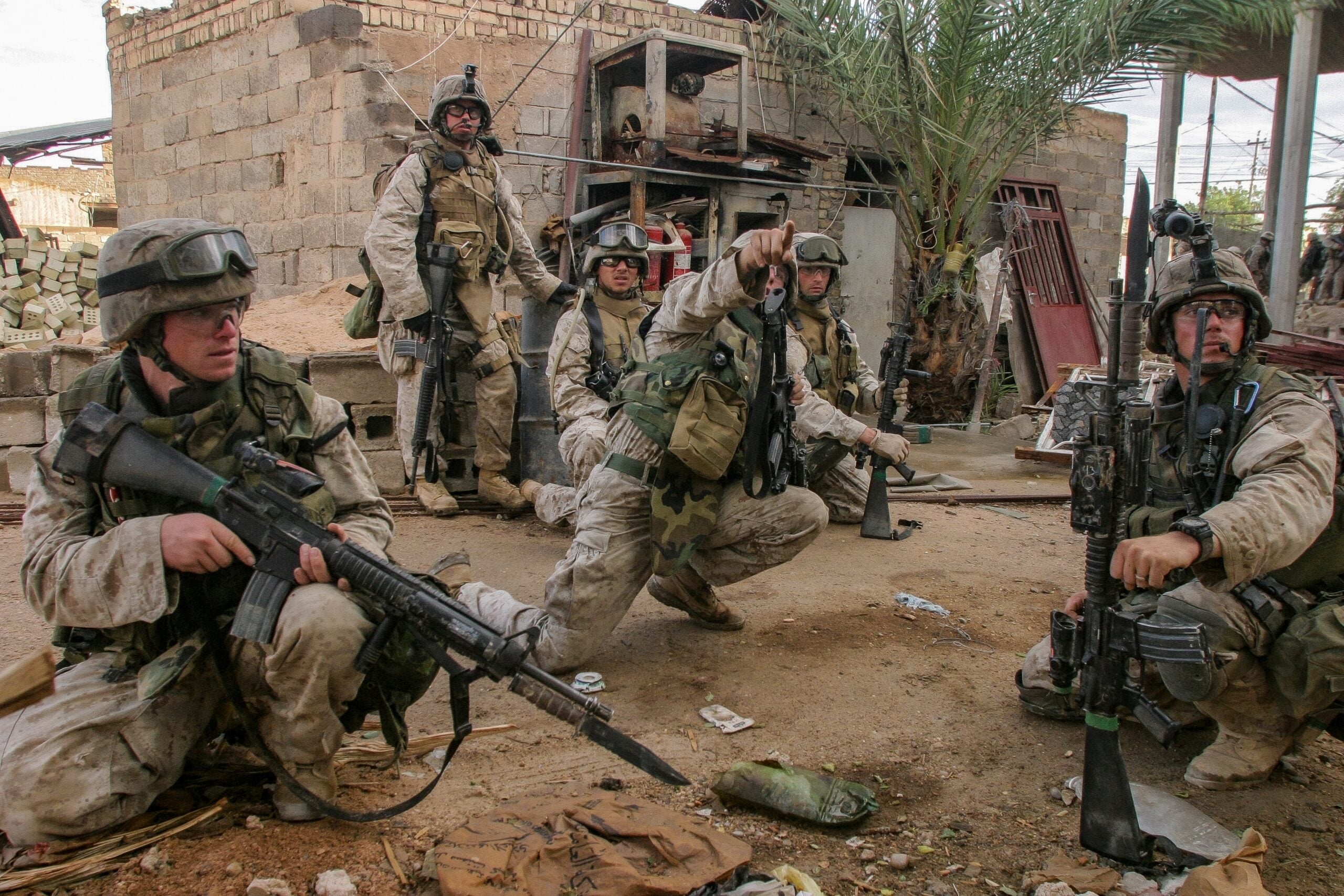
    Taking cover from insurgents, his fireteam had just assembled in the dark in front of a house in Fallujah, Iraq, when the Marines were overwhelmed by the percussive blast of an explosion. About 40 yards in front of them was a mass of flames — the fiery remains of an Iraqi vehicle. Just behind them was the smoking barrel of the 120mm cannon from an M1A2 Abrams Main Battle Tank.

    In the wee hours of Nov. 8, 2004, the Iraq War became very real for Bender, who was embedded with India Company, 3rd Battalion, 1st Marine Division. With a camera in one hand and a 9mm M9 Beretta pistol in the other, the then-20-year-old combat correspondent was momentarily deafened and disoriented by the roar of the near-simultaneous explosions.

    “I had never been on the business end of an Abrams before that close,” he recalled in an interview with Military Times. “We worked with tanks for weeks and weeks after that and came to be kind of numb to it. Just being a few feet behind the barrel is much different than being a few feet in front of it as far as the overpressure and blast go.”

    20 years later, the Marine Corps can still learn from Fallujah

    That’s the kind of gritty realism on display in the documentary “The Last 600 Meters: The Battles of Najaf and Fallujah,” airing on PBS on Monday, the day before Veterans Day and the 250th anniversary of the U.S. Marine Corps. The film by Michael Pack tells the story of these deadly engagements through the words and emotions of the U.S. troops who survived them.

    The film gets its name from a comment made by Master Sgt. Karl R. Erickson, a U.S. Army Special Forces sniper who equates his mission with looking through his scope at a target: “Foreign policy? I don’t make it. I just deliver the last 600 meters of it.”

    The rest of the documentary details what that means for the troops on the ground and in the air over these deadly battlefields, chronicling their courage, commitment and camaraderie through a bloody ordeal.

    “We conducted the interviews three years after the battles when memories were fresh,” Pack said in an interview. “But it was hard time to get it on the air then. Everyone had their opinions about the war and it was clouded in politics. We strove to tell these stories without politics from the point of view of the people who were there. Maybe now is a good time to look back and remember what happened.”

    Marines fight in Najaf in 2004. (Courtesy Manifold Productions, Inc.)

    What happened was some of the heaviest urban combat by the U.S. military since the 1968 Battle of Hue in Vietnam. Engaging scores of insurgent groups in an uprising similar to the Tet Offensive, U.S. forces fought from house-to-house, alley-to-alley and even face-to-face to retake the Iraqi cities of Fallujah and Najaf.

    In the film, Jeff Stevenson, then a Marine major, refers to the deadly close-quarters combat as a “three-block war.” Marines and soldiers had to clear each area in succession so enemy fighters would not be able to get behind them.

    During the 2003 invasion of Iraq, the U.S. military quickly defeated the armies of Iraqi leader Saddam Hussein. However, the fighting was not over. Insurgents flooded into the country to resist the U.S. takeover. In “The Last 600 Meters,” journalist Thomas E. Ricks described how surprised he was by the situation on the ground:

    “Iraq was a much more troubled place than we realized. I remember thinking, ‘I thought this was bad. I hadn’t thought it was going to be this bad.’”

    By 2004, insurgents had taken over the two cities. American troops were given the mission of recapturing them. In early August, Army and Marine units pushed into Najaf amid heavy combat. The fiercest fighting took place at the massive Wadi al-Salam cemetery, which features a series of underground tunnels and aboveground monuments — ideal hiding places for ambushes. American forces often resorted to close-quarter combat to clear the seven-square-mile graveyard.

    The battle for Najaf ground on throughout the month with heavy losses on both sides. At the center of the city was the Imam Ali Shrine, where enemy fighters had taken refuge. While U.S. Air Force gunships and jets attacked the area around the holy site, Marines and soldiers participated in hand-to-hand fighting to close the gauntlet.

    One of the Marines interviewed in the documentary, Lt. Seth Moulton, now a U.S. representative from Massachusetts, was leading a platoon of Marines in the basement of a building when the patrol next to him encountered insurgents. It happened so fast that the Marine on point only had time to react.

    “It was so dark and the Marine was clearing this room,” Moulton said in an interview with Military Times. “This guy tried to tackle him and the Marine couldn’t get his gun on him. They got into a ground fight, so the Marine pulled out his bayonet and killed the guy.”

    As commandos of the Iraqi security forces prepared to storm the shrine, a negotiated settlement brought an end to the fighting in Najaf. A few months later, U.S. forces moved into Fallujah. In April, a ceasefire was declared, though tensions remained high. On Nov. 7, the attack began anew with American troops pushing the insurgents south through the built-up city to more open terrain.

    Bender accompanied India Company into what he called “a sea of violence.” Fallujah was the scene of intense house-to-house fighting against a well-armed and determined enemy.

    “There were a number of firefights in open streets, engagements where the asphalt is popcorning around you,” he recalled. “You have absolutely no cover and you are running wide open, trying to return fire. It’s a humbling experience. If you don’t have a relationship with your maker before you get into a situation like that, you will during it.”

    Marines take cover from an explosion during the second battle of Fallujah in 2004. (Courtesy Manifold Productions, Inc.)

    One of the most intense moments in “The Last 600 Meters” takes place at “Hell House” in Fallujah. Marines had entered the structure and were shot by insurgents from the second floor. Teams attempted to rescue the men, each in turn being pinned down by machine gun fire and grenades. Trapped, there seemed to be no way to get the wounded Marines out of the kill zone.

    Finally, two Marines, 1st Lt. Jesse Grapes and Pfc. Justin Boswood, broke through a barred window of the house into another part of the room. They trained their rifles on the second floor and began blasting away.

    “We start unloading on these guys upstairs and these two selfless Marines run across this kill zone — not once, not twice, but four times to pull Marines out,” Grapes said in the film. “We had some Marines who were in pretty bad shape.”

    Though 11 seriously wounded were rescued and a dead Marine recovered, the two insurgents remained on the second floor. A satchel charge was used to destroy the building. As Marines inspected the rubble, they found half buried what they thought was a dead insurgent. He was still alive and threw a grenade. The team scrambled for cover, then finished off the resolute enemy fighter.

    “In Fallujah, I can honestly say, wow, we certainly don’t agree with their political ideology or their religious ideology,” Grapes says on camera. “We respected the fact that they stood there and faced us and fought us.”

    Fighting in Fallujah lasted until Dec. 23 in what became the bloodiest battle for U.S. forces since the Vietnam War. Though traumatic, their experiences served to link them emotionally with their brothers in arms in a way few civilians understand.

    “Nothing bonds like shared suffering and sacrifice for a common cause or a higher purpose,” Bender said. “Fallujah was that for us, for those of us in the fight. Those bonds definitely endure.”

    He added, “That fireteam, that squad, that battalion — they are my family from the Corps.”

    “The Last 600 Meters: The Battles of Najaf and Fallujah” airs Nov. 10 on many PBS stations. It can also be viewed on the PBS app and will later be shown on Prime Video and other streaming services.

  • From hot dogs to haircuts, your Veterans Day deals await

    From hot dogs to haircuts, your Veterans Day deals await


    Editor’s note: This list was updated Nov. 10 at 4:55 p.m. Eastern Standard Time.

    Service members, veterans and their families know that Veterans Day means much more than a discount or deal at their local eatery or store.

    Still, a number of businesses want to show their appreciation for those who serve or have served, so check out the deals below that honor your service.

    Our annual list of verified Veterans Day deals is here to help you navigate offers from restaurants, retail establishments and other businesses. If you plan wisely, you could fortify yourself with free breakfast, lunch and dinner while you head to stores with a trove of in-person and online markdowns.

    We’ll update the list throughout the day. Contact Karen Jowers at kjowers@militarytimes.com with suggestions.

    Food and drink

    • Another Broken Egg Cafe: Offering active duty and veterans a free Patriot French Toast and coffee on Nov. 11. Dine-in only. Show proof of service.
    • Applebee’s: Offering active duty and veterans free full-size entree from a select menu, Nov. 11. Dine-in only. Also offering a $5 card for a future visit within a three-week redemption window. Show proof of service.
    • Aroma Joe’s: Offering active duty and veterans a free beverage, any size up to 24 ounces, on Nov. 11, at its locations across Maine, New Hampshire, Massachusetts, Pennsylvania, Florida, Rhode Island, New York and Connecticut. Show proof of service.
    • Bad Daddy’s Burger Bar: Offering active duty and veterans a free All American Burger with cheese and a classic side, from 11 a.m. to 3 p.m. on Nov. 11 at participating restaurants. Dine-in only. Show proof of service.
    • Bob Evans: Offering active duty and veterans a free meal from a select menu of 10 options on Nov. 11. Dine-in only. Show proof of service.
    • Bombshells: Offering veterans a free entree, and active duty get a 20% discount on all menu items. Dine-in only at all locations in Texas and Colorado. Show proof of service.
    • Bubbakoo’s Burritos: Offering active duty and veterans a free Taco Trio on Nov. 11. Dine-in only. Show proof of service.
    • Chicken Salad Chick: Offering active duty and veterans a free meal with drink on Nov. 11. Available to those in uniform and those who show proof of service.
    • Chipotle: Offering active duty and veterans a buy-one-get-one-free deal from 4 p.m. to 8 p.m. local time. Offer applies to Chipotle bowls, burritos, salads and taco entrees. Show proof of service.
    • Cody’s Original Roadhouse: Offering active duty and veterans a free entree, either a half rack of ribs or grilled BBQ chicken breast, on Nov. 11. Dine-in only at its eight Florida locations. Show proof of service.
    • Denny’s: Offering active duty and veterans a free Original Grand Slam from store opening until noon local time on Nov. 11 at participating locations. Show military ID or DD-214.
    • Dog Haus: Offering active duty and veterans free Haus Dog on Nov. 11. Dine-in only at participating locations. Show proof of service.
    • Eddie Merlot’s: Offering active duty and veterans a free Eddie’s Prime Cheeseburger with fries on Nov. 11. Dine-in only. Show proof of service.
    • Fogo de Chao: Offering active duty and veterans a 50% discount off Full Churrasco or Indulgent Churrasco meals for themselves, and their guests will receive a 10% discount, through Nov. 11. Dine-in only. These Brazilian steak houses are located in a number of states. Show proof of service.
    • Friendly’s: Offering active duty and veterans a free All American Burger with cheese and a beverage on Nov. 11. Dine-in only. Show military ID or honorable discharge document.
    • Golden Corral: Offering active duty and veterans a free dinner buffet meal and drink from 4 p.m. to closing on Nov. 11 as part of its annual Military Appreciation Night. Dine-in only.
    • Hard Rock Cafe: Offering active and retired military a free Legendary Burger on Nov. 11 at participating locations. Accompanying friends and family members can receive the always-available 15% military discount.
    • Hooters: Offering active duty and veterans one free meal from a menu of four select entrees on Nov. 11, with purchase of a beverage, at participating restaurants. Dine-in only. Show proof of service.
    • IHOP: Offering active duty and veterans a free Red, White and Blueberry Pancake Combo on Nov. 11, 7 a.m. to 7 p.m. Dine-in only at participating restaurants. Show proof of service.
    • Kolache Factory: Offering active duty and veterans a free kolache and a cup of coffee on Nov. 11. Check for hours at participating locations. Show proof of service.
    • Logan’s Roadhouse: Offering active duty and veterans a free meal from a select menu on Nov. 11, 11 a.m. to 3 p.m. Dine-in only, at participating restaurants. Proof of service required.
    • Outback Steakhouse: Offering active duty and veterans a free Aussie Three-Course Meal, including starter, choice of entree and dessert Nov. 10 and Nov. 11 at participating locations. Dine-in only. Show proof of service.
    • Perry’s Steakhouse: Active duty and veterans receive a 50% discount on a dinner-cut pork chop on Nov. 11 from 4 p.m. to closing; if dining with a guest purchasing a full dinner entree, the veteran’s pork chop is free. Military ID or proof of service required.
    • Pilot: Offering active duty and veterans and their families a choice of a free breakfast sandwich and coffee, or a lunch item and fountain drink, on Nov. 11, through Pilot’s myRewards Plus app at participating Pilot, Flying J and One9 Fuel Network travel centers. Get verification of status through ID.me in the myRewards Plus app.
    • Playa Bowls: Offering active duty and veterans a free bowl on Nov. 11, in shop only at select locations. Show proof of service.
    • Polly’s Pies: Offering active duty and veterans a free slice of pie at their California locations Nov. 10-11. No purchase necessary. Show proof of service in the store.
    • QDOBA: Offering active duty and veterans free chips and dip on Nov. 11 at participating restaurants. Dine-in only. Show proof of service.
    • Red Lobster: Offering active duty and veterans a free Veteran’s Shrimp and Chips on Nov. 11. Dine-in only at participating locations. Show proof of service.
    • Santa Fe Cattle Co.: Offering active duty and veterans a free entree from their Lunch Express Menu on Nov. 11. Dine-in only. Show proof of service.
    • Shake Shack: Offering active duty and veterans free Big Shack burger on Nov. 11 ordered in store at participating locations. Show proof of service.
    • Sizzler: Offering active duty and veterans free lunch from a select menu on Nov. 11 from opening until 4 p.m. All locations except for those in Utah, Idaho and Puerto Rico will participate.
    • Starbucks: Offering veterans, active duty and their spouses a free tall (12-ounce) hot or iced brewed coffee on Nov. 11 at cafe and drive-through locations.
    • Sullivan’s Steakhouse: Offering active duty and veterans a free Sullivan’s Signature Angus Burger with fries on Nov. 11. Dine-in only. Show proof of service.
    • Taffer’s Tavern: Offering active duty and veterans a 50% discount on one plate, handheld or salad with valid ID through Nov. 16. Dine-in only. Show proof of service. Locations in Georgia and Florida.
    • Teriyaki Madness: Offering active duty and veterans a free bowl of their choice on Nov. 11 at participating shops. In-shop only. Show proof of service.
    • The Greene Turtle: Offering active duty and veterans a free meal up to $15 on Nov. 11. Dine-in only; available at select locations. Show valid ID.
    • Twin Peaks: Offering active duty and retired military a free lunch from a select menu on Nov. 11, 11 a.m. to 3 p.m., at participating locations. Show proof of service.
    • Tuscan Brands restaurants: Offering veterans and their guest a free traditional Italian family-style meal on Nov. 11, 11 a.m. to 3 p.m., at the company’s Tuscan Kitchen locations, Tuscan Sea Grill and Bar and Tuscana Italian Chop House and Wine Bar. These are located in Massachusetts and New Hampshire. Veterans must call their local restaurant to make a reservation, or reserve online at www.tuscanbrands.com/veterans-eat-free/.
    • Wendy’s: Offering active duty and veterans a free breakfast combo at participating locations during breakfast hours on Nov. 11. No purchase required. Notify the crew member at the register.
    • White Castle: Offering active duty and veterans a free individual combo meal or a breakfast combo meal on Nov. 11. No purchase necessary, but proof of service needed.
    • Wienerschnitzel: Offering active duty and veterans a free Original Chili Dog, small fries and small soda at participating locations nationwide on Nov. 11. Show proof of service.
    • Yogurtland: Offering active duty a 15% in-store discount on Nov. 11. Show military ID.

    Active duty and retired service members can take a free spin on the Capital Wheel at National Harbor, Md., on Veterans Day. (Courtesy The Capital Wheel)

    Recreation

    • Regal: Offering active duty and veterans free admission to showtimes of “Brothers on Three” and “Saving Private Ryan” on Nov. 11 at participating locations. Show proof of service.
    • The Capital Wheel at National Harbor, Maryland: Offering active duty and retired service members a free ride on Nov. 11, noon to 10 p.m. Accompanying family members are eligible for military discount. Show military ID.

    Retail

    • Army and Air Force Exchange Service: In store and online at shopmyexchange.com, authorized customers can get a variety of deals through Nov. 13, such as: up to $250 off Samsung smart TVs; $300 off MacBook Air laptops; 10% off Ray-Ban, Oakley and Costa sunglasses; 20% off Yeti coolers, drinkware and gear; 30% off tactical brands including United States Tactical, Toaks, Red Rock Outdoor Gear and more; up to 50% off bedding items; and 40% off haircare and personal hygiene. Weekly deals are available through Nov. 28.
    • 4Patriots: Offering active duty and veterans a free 72-Hour Survival Food Kit for emergency preparedness on Nov. 11. Contains 20 individual breakfast, lunch and dinner servings and is designed to last 25 years. To receive the free food kit, customers register online on the 4Patriots Veterans Day Celebration Event page on Nov. 11 only.
    • Academy Sport + Outdoors: Offering active duty and veterans a 10% discount on purchases in stores and online through Nov. 11. Visit the website for information on the process for receiving the discount in stores and online.
    • Navy Exchange and Marine Corps Exchange online: Offering a variety of discounts for authorized shoppers such as an $800 discount on select Sony TVs; extra 15% discount on select grills from Traeger and Weber; extra 20% off 5.11 shoes; 40% discount on Gap and Old Navy apparel; and extra discounts on select gaming accessories from Turtle Beach and SteelSeries.
    • Office Depot: Offering active duty and veterans a year-round 20% military discount on qualifying regularly priced purchase. Show proof of service.
    • Samsung: Through its Military Offers Program, active duty and veterans and their families can receive discounts of up to 30% on phones, tablets, smart watches and other items at samsung.com year-round.
    • Sheetz: Offering active duty and veterans a free half turkey sub and regular size fountain drink and a free car wash at Sheetz locations with a car wash on Nov. 11. Show proof of service.
    • Walgreens: Offering active duty and veterans and their families a 20% discount on regularly priced eligible items through Nov. 11. Available at any Walgreens or Duane Reade drugstore. Show proof of service.

    Services

    • AutoNation: Offering active duty, veterans and their spouses a 20% discount on all services in-store at AutoNation locations nationwide through Nov. 16 (maximum discount $200). Also applies to the AutoNation Mobile Service at the customer’s preferred location (maximum discount $150). Show proof of service.
    • Great Clips: Offering active duty and veterans a free haircut on Nov. 11, or a free haircut card to use later.
    • Take 5 Oil Change: Offering active duty and veterans a year-round 25% discount on oil changes at participating locations. Show proof of service.

    What to know before you go

    • Check the fine print and call the participating organization to be sure the offer is available at the time you plan to arrive.
    • Most eateries require you to dine in to receive the deal.
    • Let the host, cashier, attendant, reservation agent or other relevant employee know up front that you want the discount or deal.
    • “Free” isn’t always completely free. A free meal doesn’t always come with a drink, for instance. Be prepared to pay for extras such as taxes (and tip).
    • Call ahead to local establishments to be sure they are aware of, and are participating in, national chain programs. Confirm availability and what type of ID is required.
    • Not all offers apply to veterans of all stripes. Most offers will apply to Guard and Reserve members, but check ahead. Be sure you are eligible and you have the appropriate ID/paperwork.
    • Most discounts don’t apply to the entire party. Be sure you’re clear whether family members or guests are covered in the discount.
    • This is by no means an all-inclusive list. Check with your favorite eatery or store to see if they offer a military discount. It doesn’t hurt to ask a company whether they offer a military discount before you book a reservation or order from your server. But don’t act like you expect it.

  • Army veteran becomes the face of Call of Duty’s new bionic hero

    Army veteran becomes the face of Call of Duty’s new bionic hero

    Twenty years after losing her arm in Baghdad, Army veteran Danielle Green is once again showing what resilience looks like.

    Green’s likeness and story are the inspiration behind a new Call of Duty operator bundle launching Friday, making her the first female combat veteran to be featured as a playable Call of Duty character. The bundle launches alongside the new game Call of Duty: Black Ops 7.

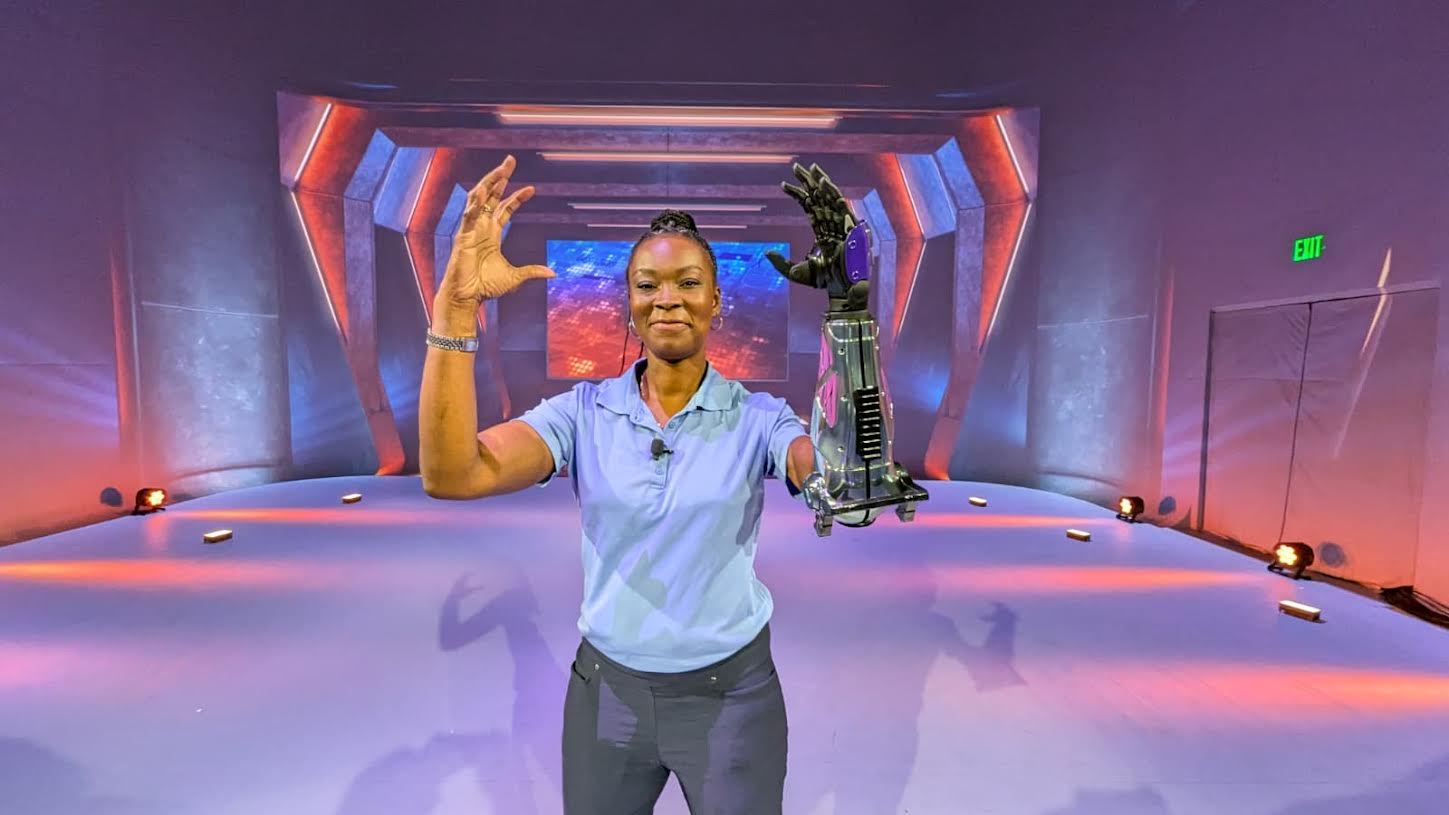
    The character, called 50/50, is outfitted with a bionic arm based on Green’s real-life prosthetic, the Hero RGD, developed by the prosthetics company Open Bionics and supported by the Call of Duty Endowment.

    The Hero RGD, short for “rugged,” debuted publicly at the Call of Duty Endowment Bowl in Las Vegas in September. It’s the world’s most advanced bionic arm built for strength and durability, but for Green, it represents much more than technology.

    “I love my bionic arm. It gives me balance, it makes me feel whole,” Green said in an interview with Military Times. “As a combat veteran wearing this arm in public, I know it’s about more than just me. Little girls who have lost a limb see someone like them moving forward with confidence.”

    Green lost her left arm in a rocket-propelled grenade attack on May 25, 2004. Being left-handed, she had to relearn everything, from writing to daily tasks.

    Her prosthetic is the first of its kind, combining titanium joints and high-strength nylon with a fully wireless muscle-sensor system that allows her to move the hand with speed and precision, according to Open Bionics. The Hero RGD can lift up to 77 pounds and is twice as fast as any other bionic limb available.

    The custom version she wears features personalized details, including the date of her injury engraved on the arm, the coordinates of Mount Kilimanjaro, which she recently climbed, and a purple wedding band on the in-game operator, inspired by the one her team recovered from the battlefield after her injury.

    Army veteran Danielle Green uses her prosthetic hand to hold a photo of herself from her 2004 deployment to Baghdad, before the rocket-propelled grenade attack that claimed her left arm. (Courtesy of Call of Duty Endowment)

    Samantha Payne, Open Bionics co-founder and CEO, said she had followed Green’s story for years through her work with the Wounded Warrior Project and immediately knew she was the right person to represent the company’s latest design.

    “She exudes strength and a vibrant, live-your-best-life energy,” Payne said. “She is all about living with confidence and helping others overcome. What a wonderful person to align with.”

    Payne explained that the Hero RGD was developed over four years at a cost of approximately $2 million. Engineers aimed to make it the strongest, fastest and most reliable prosthetic ever produced.

    “Our users are makers, parents, veterans, and builders. They are busy and active. We wanted to build something that could keep up with them,” Payne said. “The RGD is built like a Toyota Camry and runs like a Ferrari. You can’t destroy it.”

    Open Bionics continues to expand access to its devices through partnerships with the Department of Veterans Affairs. The company confirmed that the VA funds the Hero RGD for eligible veterans and encourages those interested to reach out directly to begin the process.

    “We are actively fitting veterans right now,” Payne said. “If you need a prosthetic, contact us. We can help you get one of these through the VA.”

    Green’s collaboration with Call of Duty began when the Endowment and Open Bionics partnered to showcase a real veteran’s story through gaming.

    “When the Endowment reached out, we saw an opportunity to celebrate a true hero,” Payne said. “This technology was designed to keep up with how veterans live and work, and Danielle embodies that perfectly.”

    A new Call of Duty operator bundle, based on Army veteran Danielle Green and her prosthetic arm, is set to release Friday. (Courtesy of Call of Duty)

    For Green, the project is also a way to connect with other veterans who are navigating life after service.

    “In the military, we never leave anyone behind, and that’s how I see this project,” she said. “This is my way of helping hundreds of thousands of veterans who are looking for a new purpose in life.”

    Dan Goldenberg, executive director of the Call of Duty Endowment, said the partnership with Open Bionics and Green represents exactly what the nonprofit strives to highlight.

    “It is easy to tell stories of beaten-down veterans or incredible heroics,” Goldenberg said. “But the quiet heroics of pushing through difficulty and going on to do great things are just as important. Veterans are an asset to their communities, and Danielle’s story helps us show that.”

    Since 2009, the Call of Duty Endowment has placed over 150,000 veterans in high-quality civilian jobs through its network of top-performing nonprofits. Veterans seeking employment can visit the Endowment’s website for free career support, including résumé help and interview coaching through vetted partner organizations.

    Green’s story and her in-game representation now connect two worlds that rarely intersect: veterans’ recovery and mainstream entertainment.

    Proceeds from her new operator bundle will support the endowment’s mission to help veterans find meaningful work.

    “This isn’t the end of my story,” Green said. “It’s just a new chapter. We are not talking about surviving anymore. We are talking about thriving.”