Category: Uncategorized

  • 2027 VA Disability Rates (Projected 3.9% COLA Increase)

    2027 VA Disability Rates (Projected 3.9% COLA Increase)

    This post was originally published on this site.

    2027 VA disability pay rates are projected to increase by 3.9% with the annual COLA. If that estimate holds, it would be the largest COLA increase for veterans since 2022.

    But here’s the deal: These rates are not official yet. The final 2027 COLA won’t be announced until mid-October 2026, after the July, August, and September CPI-W inflation data is released.

    For now, we’ve applied a projected 3.9% COLA to the official 2026 VA disability rates so you can estimate your projected 2027 tax-free monthly VA compensation by rating and dependents.

    2027 VA Disability Pay Rates (Without Children)

    Rating Veteran Alone Veteran & Spouse Veteran, Spouse, & One Parent Veteran, Spouse, & Two Parents Veteran & One Parent Veteran & Two Parents
    100% $4,092.18 $4,320.34 $4,503.45 $4,686.57 $4,275.30 $4,458.41
    90% $2,454.43 $2,659.15 $2,823.37 $2,987.59 $2,618.65 $2,782.87
    80% $2,184.13 $2,365.71 $2,512.03 $2,658.36 $2,330.46 $2,476.79
    70% $1,878.98 $2,038.12 $2,166.29 $2,294.47 $2,007.15 $2,135.32
    60% $1,490.99 $1,627.70 $1,736.65 $1,845.59 $1,599.92 $1,708.87
    50% $1,177.08 $1,290.30 $1,381.09 $1,471.88 $1,267.87 $1,358.66
    40% $826.88 $917.67 $990.29 $1,062.92 $899.50 $972.13
    30% $574.02 $642.37 $696.85 $751.32 $628.49 $682.96
    Rating 100% 90% 80% 70% 60% 50% 40% 30%
    Additional For A/A Spouses $209.26 $187.99 $167.69 $146.33 $124.97 $104.67 $83.31 $61.95

    2027 VA Disability Pay Rates (With Children)

    Rating Veteran & Child Veteran, Spouse, & Child Veteran, Spouse, Child, & One Parent Veteran, Spouse, Child, & Two Parents Veteran, Child, & One Parent Veteran, Child, & Two Parents
    100% $4,244.76 $4,487.43 $4,670.55 $4,853.67 $4,427.88 $4,610.99
    90% $2,591.16 $2,810.11 $2,974.64 $3,139.08 $2,755.61 $2,920.13
    80% $2,305.90 $2,500.28 $2,646.62 $2,792.96 $2,452.23 $2,598.56
    70% $1,984.72 $2,155.62 $2,283.79 $2,411.97 $2,112.89 $2,241.07
    60% $1,581.78 $1,728.11 $1,837.06 $1,946.00 $1,690.71 $1,799.66
    50% $1,252.92 $1,374.68 $1,465.47 $1,556.26 $1,343.71 $1,434.50
    40% $887.76 $984.95 $1,057.57 $1,130.20 $960.38 $1,033.01
    30% $618.88 $692.59 $747.06 $801.54 $673.35 $727.83
    Rating 100% 90% 80% 70% 60% 50% 40% 30%
    Each Additional Child Under 18 $113.37 $101.47 $89.72 $79.04 $67.29 $56.60 $44.86 $33.11
    Each Additional Schoolchild Over 18 $366.20 $328.97 $292.66 $255.27 $218.96 $182.65 $146.33 $108.95

    Frequently Asked Questions

    What is the 2027 COLA prediction?

    The latest 2027 COLA prediction is 3.9%, according to The Senior Citizens League, with some estimates as high as 4.2% if inflation stays elevated. The official COLA won’t be announced until October 2026, after July, August, and September CPI-W data is released.

    Why does the projected 2027 COLA keep increasing?

    The projected 2027 COLA keeps rising because inflation is running hotter than expected. Everyday costs like energy, housing, food, utilities, and healthcare are still putting pressure on Americans, which is why COLA estimates have moved higher in recent months.

    What is the projected 2027 VA disability pay increase?

    The projected 2027 VA disability pay increase is 3.9%. If that estimate holds, veterans rated 10% or higher would see their tax-free monthly VA compensation increase beginning with their January 2027 payment. A 3.9% COLA boost would also be the largest COLA for veterans since 2022. For example, a veteran receiving $1,000/month in 2026 would see about a $39/month increase in 2027, while a veteran receiving $4,000/month would see about a $156/month increase.

    When do the new rates take effect, and when will I see the higher payment?

    The new 2027 VA disability pay rates will take effect on December 1, 2026. Because VA pays disability compensation in arrears, your December 2026 benefits are paid in your January 2027 payment. That means veterans should typically see the higher 2027 VA disability payment around January 1, 2027. However, your deposit may arrive one to three days early depending on your bank or credit union, including institutions like USAA or Navy Federal.

    Do I need to do anything to get the 2027 COLA increase?

    No. The COLA increase is automatic. You don’t need to apply, call the VA, or submit a claim. The VA adjusts your benefit amount internally based on your VA rating, and you’ll see the change reflected in your January 2026 deposit. If you’re receiving multiple VA benefits—like Special Monthly Compensation (SMC), Dependency and Indemnity Compensation (DIC), or VA Pension—they’ll all increase automatically as well.

    Who gets the 2027 COLA increase?

    All veterans with a VA disability rating of 10% or higher should qualify for the 2027 COLA increase if it’s finalized. That includes veterans rated from 10% to 100%, veterans receiving Total Disability Individual Unemployability (TDIU) paid at the 100% rate, and recipients of Special Monthly Compensation (SMC), Dependency and Indemnity Compensation (DIC), or VA Pension benefits. If you have a 0% VA rating, you won’t see a monthly pay increase because 0% ratings do not include monthly VA disability compensation.

    Do I get extra dependent pay at 10% or 20%?

    No. Veterans rated at 10% or 20% receive a flat monthly rate, regardless of dependents. Additional VA compensation for dependents, including a spouse, children, or dependent parents, starts at a combined VA disability rating of 30% or higher. See the projected 2027 VA pay tables above to estimate your monthly compensation with or without dependents.

    Does the projected 2027 3.9% COLA affect my retroactive or back pay?

    It depends on the months covered by your retroactive pay. VA back pay is calculated using the pay rates that were in effect for each month of your retro period. If your back pay includes months after December 1, 2026, those months would use the new 2027 VA disability rates. But if your back pay covers earlier years, those months are calculated using the VA pay rates in effect for those specific years.

    Is VA disability pay taxable?

    No. VA disability compensation is completely tax-free at both the federal and state levels. That includes payments for SMC, DIC, VA Pension, and Combat-Related Special Compensation (CRSC). If you receive both VA disability and military retired pay, make sure to review your DFAS Form 1099-R to understand which portions are taxable. See my full breakdown of Veterans’ Tax Rules and Exemptions.

    How does the VA determine my disability rating?

    The VA uses the Schedule for Rating Disabilities (VASRD) found in 38 CFR Part 4 to assign a percentage to each service-connected condition. Each condition gets a diagnostic code and rating level based on symptom severity, frequency, and impact on your work and life. If you have multiple service-connected conditions, VA applies the Combined Ratings Table—often called “VA math”—to determine your final combined rating. Try our free VA disability calculator to quickly find your combined VA rating and monthly payment amount.

    Can I file for a VA disability rating increase?

    Yes. If your service-connected conditions have worsened or you’ve obtained new medical evidence, you can request a VA rating increase at any time through VA.gov. A properly documented increase claim can often raise your monthly benefit more than a COLA adjustment alone. If you need help developing your evidence and strategy, see my guide: 8 Ways to Increase Your VA Disability Rating.

    How do I find VA resources near me?

    You can search for VA-accredited VSOs, attorneys, or claims agents using the VA’s official tool (VSO services on claims are free), and you can look up nearby VA facilities (medical centers, Vet Centers, regional benefits offices).

    Want Expert-Level VA Claim Help? WE GOT YOUR SIX!

    • Work directly with a VA Claims Insider Coach who can help lead you to VA claim victory.
    • 50,000+ disabled veterans served in our membership programs since 2016.
    • 33% average rating increase for veterans who complete our #1 rated Elite program.
    • 92% of all VA Claims Insider customer reviews are 4 or 5 stars.

    Content Reviewed By

    Content Reviewed by: VA Claims Insider Quality Control Team


    Quality Assurance Team

    The Quality Assurance (QA) team at VA Claims Insider has extensive experience researching, fact-checking, and ensuring accuracy in all produced content. The QA team consists of individuals with specialized knowledge in the VA disability claims adjudication processes, laws and regulations, and they understand the needs of our target audience. Any changes or suggestions the QA team makes are thoroughly reviewed and incorporated into the content by our writers and creators.

    About The Author

    Brian Reese
    Brian Reese

    Brian Reese

    Brian Reese is a world-renowned VA disability benefits expert and the #1 bestselling author of VA Claim Secrets and You Deserve It. Motivated by his own frustration with the VA claim process, Brian founded VA Claims Insider to help disabled veterans secure their VA disability compensation faster, regardless of their past struggles with the VA. Since 2013, he has positively impacted the lives of over 10 million military, veterans, and their families.

    A former active-duty Air Force officer, Brian has extensive experience leading diverse teams in challenging international environments, including a combat tour in Afghanistan in 2011 supporting Operation ENDURING FREEDOM.

    Brian is a Distinguished Graduate of Management from the United States Air Force Academy and earned his MBA from Oklahoma State University’s Spears School of Business, where he was a National Honor Scholar, ranking in the top 1% of his class.

  • RelaxAway, Half Moon Cay vs. Celebration Key: We Visited Both Carnival Destinations on the Same Cruise

    RelaxAway, Half Moon Cay vs. Celebration Key: We Visited Both Carnival Destinations on the Same Cruise

    We just returned from a Carnival cruise visiting both the brand-new RelaxAway, Half Moon Cay and Celebration Key in the Bahamas. Both private destinations were a highlight of the trip but for very different reasons. Each has a distinct vibe — one is a purpose-built resort with a massive lagoon pool, waterslides, and 30+ food and drink options and the other is 2.5 miles of natural, pristine Bahamian beach. Which one is better? That depends entirely on what kind of beach day you want. RelaxAway Half Moon Cay vs. Celebration Key: here’s how they compare.

    What Are Celebration Key and RelaxAway, Half Moon Cay?

    Both Celebration Key and RelaxAway, Half Moon Cay are privately owned by Carnival Corporation, which means the only way to visit either is on a cruise. Carnival guests at both destinations dock directly at a dedicated pier — so getting ashore at each is simple.

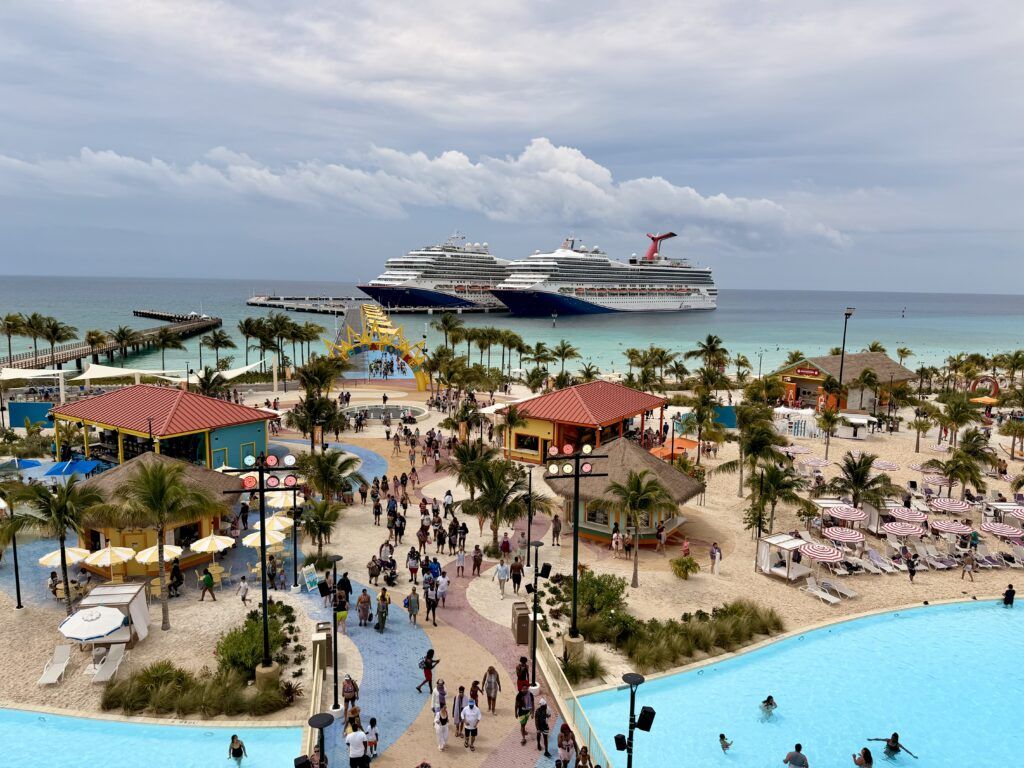
    Celebration Key is Carnival’s newest private destination, located on the southern coast of Grand Bahama Island about 23 miles from Freeport. It opened in July 2025 and is designed from the ground up to be a full resort experience — a freshwater lagoon, a 10-story sandcastle with dual waterslides, an adults-only beach club, and more food and drink options than most ships. It’s lively, amenity-packed, and built for fun. Carnival ships and Princess ships visit Celebration Key.

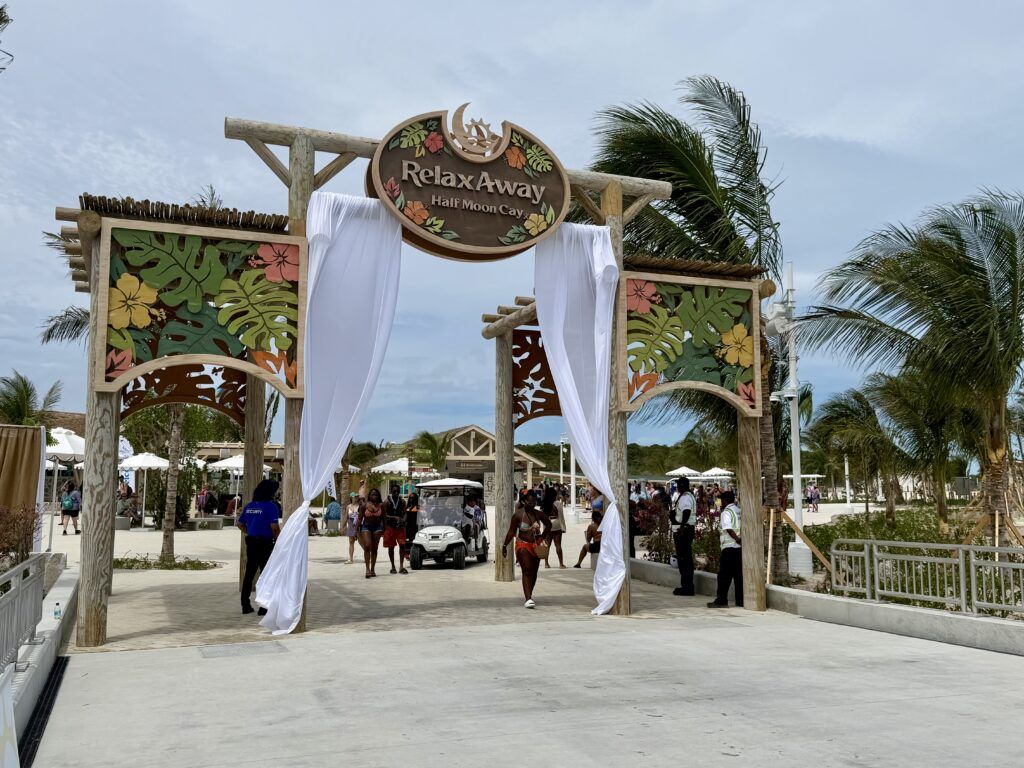
    RelaxAway, Half Moon Cay is entirely different. Formerly known simply as Half Moon Cay, this crescent-shaped island about 100 miles southeast of Nassau has been a Carnival Corporation destination since it opened in 1997. It recently underwent a major expansion and rebrand as part of Carnival’s Paradise Collection — including a brand-new pier and a fully developed north side experience exclusively for Carnival guests. Holland America ships still visit the south side of the island via tender boats. But the philosophy hasn’t changed: this is a natural beach perfect for relaxation. No pools, no waterpark, no manufactured lagoon.

    Beach & Pool Experience

    Key Takeaway: If you want a pool and a resort day vibe, go to Celebration Key. If you want a natural unspoiled beach, go to Half Moon Cay. Neither is objectively better — they’re just completely different.

    Celebration Key

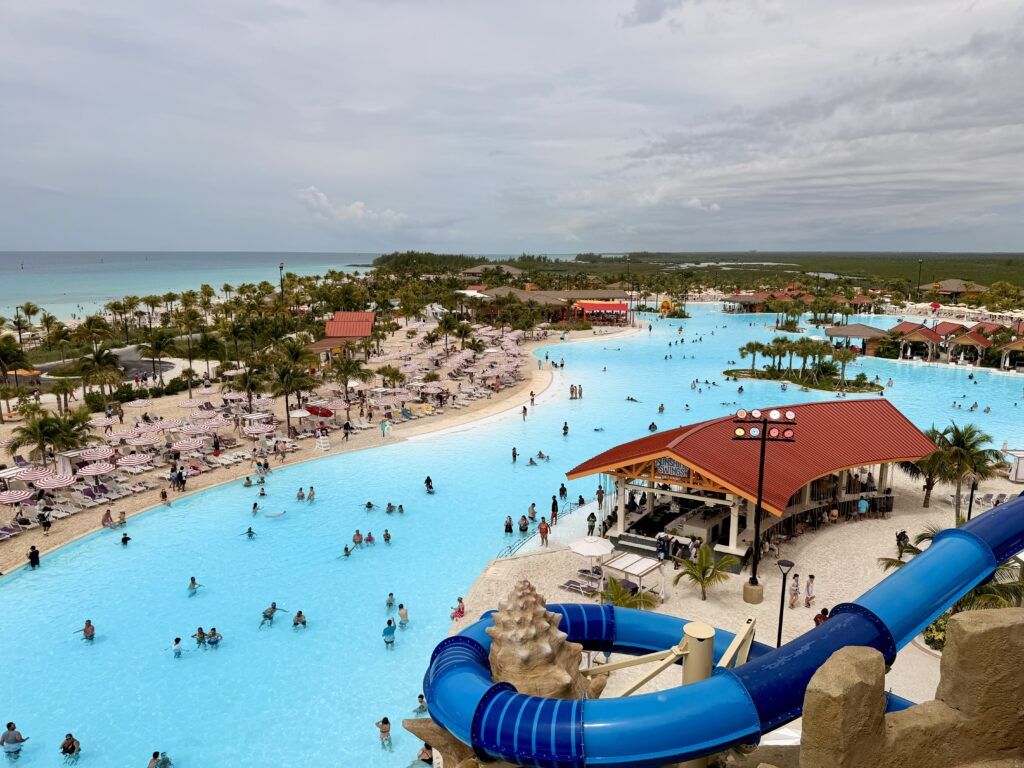
    Celebration Key’s signature feature is its enormous freshwater lagoon — totaling over 275,000 square feet, making it the largest freshwater lagoon in the Caribbean. Starfish Lagoon on the east side of the property is the family-friendly pool with a gentle sloped entry, a 10-story sandcastle structure with two waterslides, and a splash pad nearby for younger kids. Calypso Lagoon on the west side has more of an adult energy and a DJ island at the center. There’s also a beach on both sides — Starfish Beach and Calypso Beach — with free loungers and umbrellas available.

    RelaxAway, Half Moon Cay

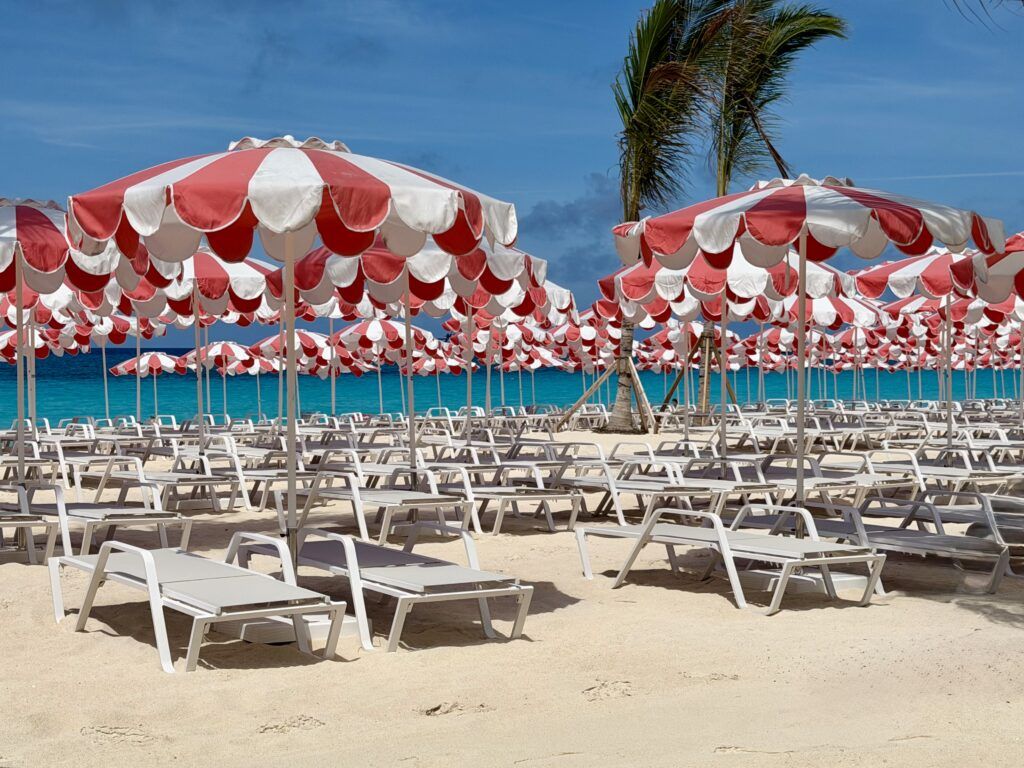
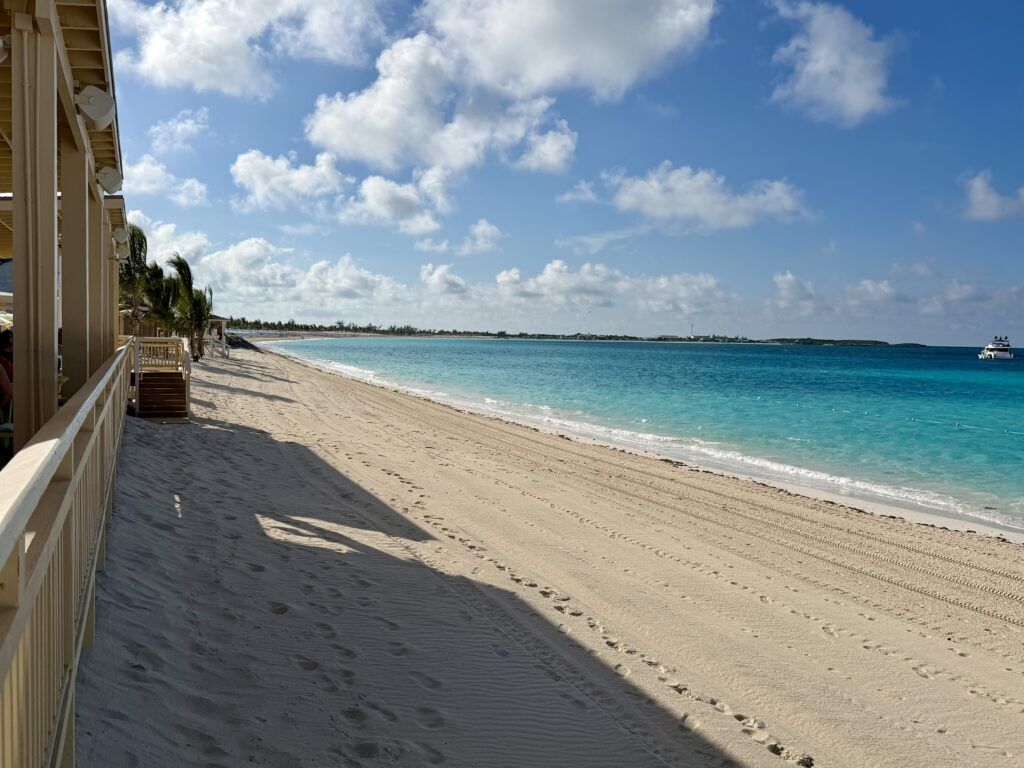
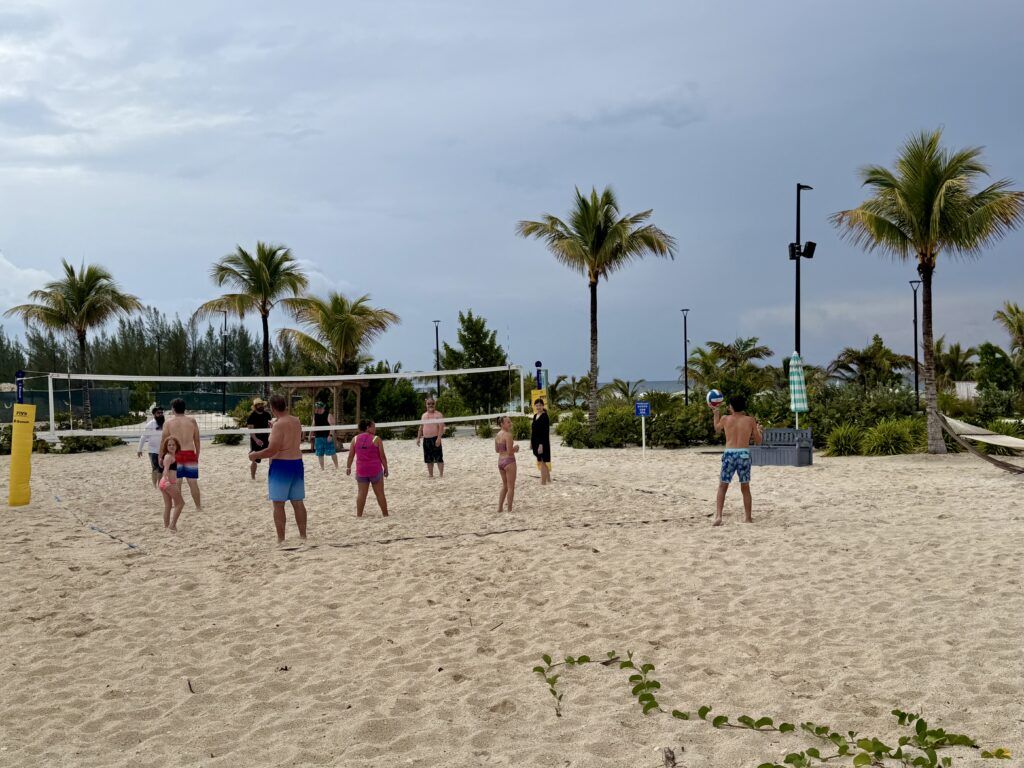
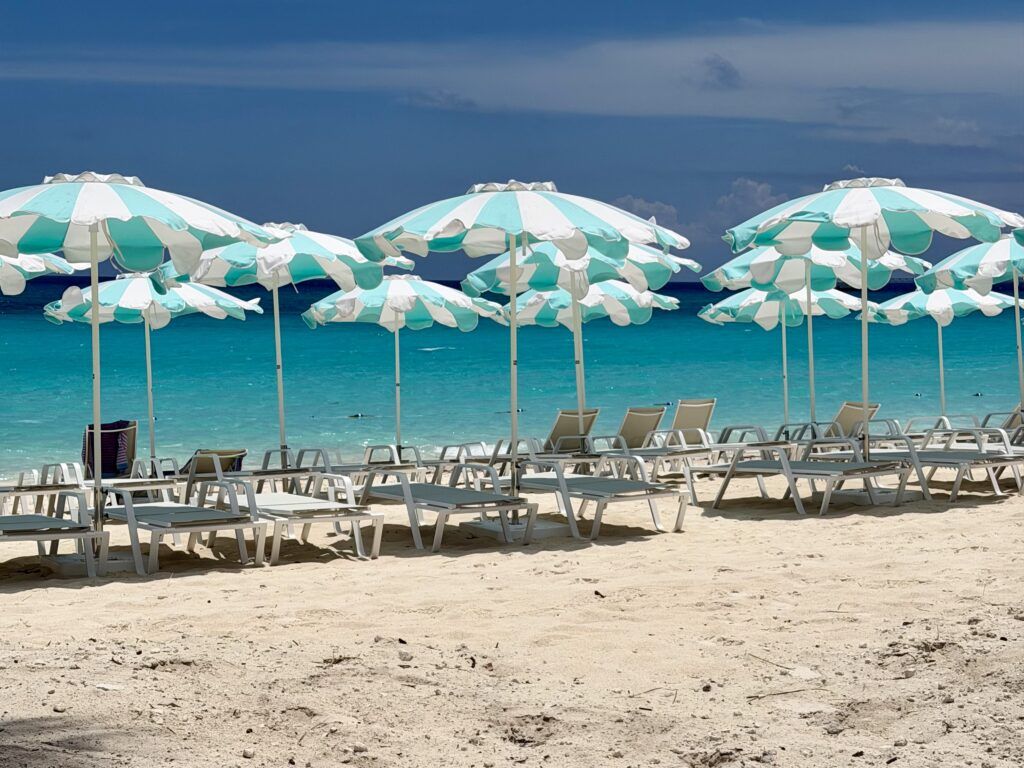
    Half Moon Cay has no pool, splash pad, or waterslides by design. Instead, it has approximately 2.5 miles of beachfront. Think white sand, turquoise water, and over 4,500 complimentary umbrellas and double that number of chairs spread across the sandy shoreline. This is a proper beach day, where guests can swim, snorkel, or simply relax away.

    Food & Drinks

    Key Takeaway: Food is included at both destinations, but in very different ways. Half Moon Cay offers an unlimited buffet. Celebration Key gives each guest one Island Eats meal credit with 30+ options to choose from — but everything beyond that costs extra. At both destinations, the Cheers drink package does not work.

    Celebration Key

    Celebration Key has a variety of food offerings spread across the property, from food trucks serving Bahamian tacos, doughnuts, and fritters, to a food hall, Snack Shack locations, and full-service sit-down restaurants including Mingo’s Tropical Bar & Kitchen, Surf N’ Sauce BBQ & Brews, and Gill’s Grill.

    The catch is the Island Eats credit system. Rather than an unlimited buffet, each guest receives one meal credit per person — redeemable at a quick-casual venue for a free meal, or as a 40% discount on one entrée at a full-service restaurant.

    On the drinks side, there’s no shortage of bars — swim-up bars in both lagoons, the Sunshine Swings Bar, multiple beach bars, and even a coffee shop. However, Carnival’s Cheers drink package does not work at Celebration Key. All alcoholic and specialty drinks are paid out of pocket via your Sail & Sign card.

    The menu items we sampled were flavorful and the portions were a good size. We appreciate the variety when compared to a traditional island BBQ; however, you need to go in knowing that you’ll likely spend extra on food.

    RelaxAway, Half Moon Cay

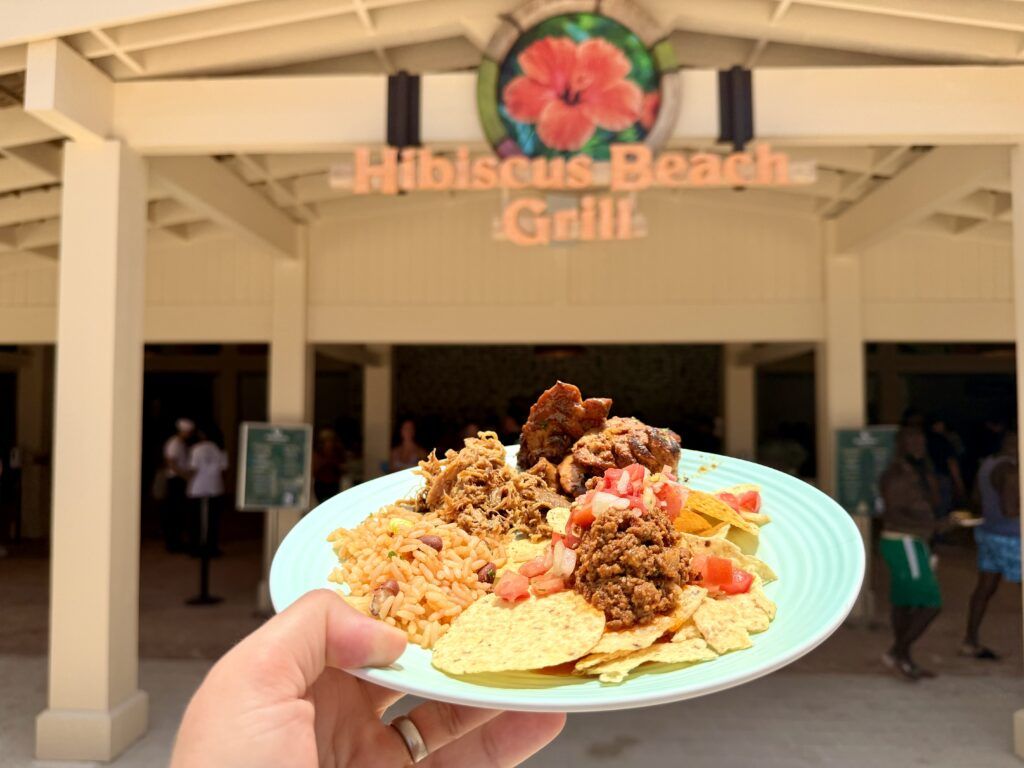
    Half Moon Cay keeps it simple. A complimentary, unlimited lunch buffet is available at two locations on the north side — Orchid Beach Grill & Bar and Hibiscus Beach Grill & Bar serving burgers, hot dogs, BBQ chicken, pulled pork, nachos, salads, and desserts. There are currently no premium offerings or up-charge restaurants.

    There are bars spread across the north side, including Lil’ Tiki Bar, Stay Awhile Beach Shack, Luna Tide Beach Bar, and Rum Time Bar Shack — each serving a full menu of island-inspired cocktails. Like Celebration Key, Carnival’s Cheers package does not work at Half Moon Cay either. You’ll need to use your Sail & Sign card for beverages.

    The RelaxAway, Half Moon Cay buffet is large with lots of stations and seating areas. The items we sampled were definitely on par or slightly better than other cruise lines’ island buffets.

    Activities & Amenities

    Key Takeaway: Choose Celebration Key for built-in thrills and resort-style amenities and Half Moon Cay for nature-based experiences including the very popular horseback riding excursion.

    Celebration Key

    Celebration Key was built to keep guests active and entertained beyond the beach and pools. The standout upcharge activity is the Suncastle’s dual racing waterslides — two 350-foot, 10-story slides available for $15 per person for unlimited rides. Sports courts with pickleball, basketball, and volleyball are complimentary, as is the gaming pavilion with table tennis and cornhole. The Guppy Grotto splash pad is free for younger kids.

    For those wanting to venture off property, Celebration Key’s location on Grand Bahama Island opens up a range of shore excursions like ATV tours, ziplining, city tours, glass-bottom boat trips, and more.

    Cabana and villa rentals are available across both lagoon areas and the beach. The adults-only Pearl Cove Beach Club is the premium experience, with an 11,000-square-foot infinity pool, elevated dining, and a swim-up bar.

    RelaxAway, Half Moon Cay

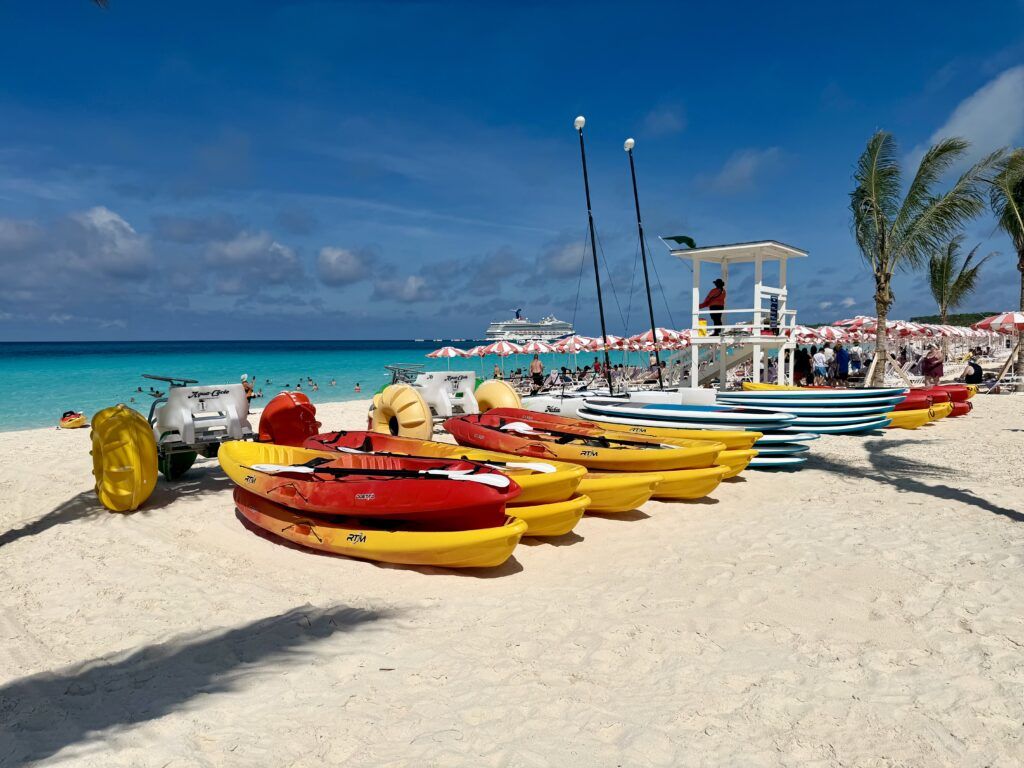
    Half Moon Cay’s activities lean heavily on the natural environment. Horseback riding is one of the most popular shore excursions on the island and a bucket-list experience. Beyond that, guests can rent kayaks, paddleboards, snorkel gear, and more, or book guided excursions like a stingray adventure, eco lagoon tour, or snorkeling by boat. Cabana and daybed rentals are available at an upcharge, with standard cabanas starting at $799.99 and daybeds starting at $149.99.

    On the complimentary side, the beach itself is the main attraction. And unlike Celebration Key, Half Moon Cay does not have an adults-only section.

    Comparison Table

    RelaxAway, Half Moon Cay Celebration Key
    Getting Ashore Dedicated pier on north side for up to 2 ships Dedicated pier for up to 4 ships
    Beach Yes — 2.5 miles of natural beach Yes — Starfish & Calypso Beaches
    Pool/Lagoon None Massive freshwater lagoon
    Included Food Unlimited lunch buffet One Island Eats meal credit per guest
    Cheers Package Does not work Does not work
    WiFi Package Works on north side of island Works
    Waterslides No Yes — upcharge ($15/person)
    Adult-Only Space No Yes — Pearl Cove Beach Club (upcharge) & 13+ section in Calypso Lagoon
    Overall Vibe Natural, relaxed beach Lively and fun resort

    Overall Vibe & Pros and Cons

    Visiting both destinations on the same cruise made one thing immediately clear to us: these two Carnival private destinations are completely different.

    RelaxAway, Half Moon Cay has been a Carnival Corporation favorite for years and for good reason. The island’s entire identity is built around preservation and simplicity, and the 2026 expansion has added infrastructure without changing the island’s vibe. The beach is beautiful, the pace is slow, and the experience feels like the Bahamas rather than a theme park. The tradeoff is that if you’re expecting the amenities of Celebration Key, you’ll be surprised by what isn’t here.

    Celebration Key is Carnival’s vision of what a private destination can be. It’s lively, impressive, and loaded with amenities. The lagoons are breathtaking in scale, Pearl Cove is one of the best adults-only retreats at any cruise destination, and the sheer variety of food and activities means there’s something for everyone. The tradeoff is that it can feel too loud for those seeking a relaxing day in the sun.

    RelaxAway, Half Moon Cay Pros

    • 2.5 miles of pristine white sand beach with included chairs and umbrellas
    • Unlimited included lunch buffet
    • Horseback riding and other nature-focused excursions
    • A natural, unhurried vibe
    • Maximum of three ships in port with plenty of beach space to spread out
    • Pier allows for easy access ashore, no more tendering

    RelaxAway, Half Moon Cay Cons

    • No pool of any kind
    • No adult-only section
    • Cheers package doesn’t work here
    • Fewer dining options and bars vs. Celebration Key
    • Distance between tram stops/amenities can be significant

    Celebration Key Pros

    • Massive freshwater lagoon — PLUS plenty of beach space
    • A variety of food and drink options
    • Pearl Cove Beach Club is an adults-only retreat
    • Waterslides, sports courts, splash pad, and plenty to keep everyone busy
    • Access to Grand Bahama Island for diverse shore excursions
    • Authentic Bahamian touches — local food vendors & craft beer, artisan market, Junkanoo parades

    Celebration Key Cons

    • Island Eats credit system adds complexity to dining
    • Cheers package doesn’t work here
    • Feels theme park-like rather than naturally beautiful
    • Pier now accommodates up to four ships at a time, which could lead to crowding
    • Louder, party vibes can distract from a relaxing day ashore

    Which Should You Choose?

    Here’s our honest bottom line: RelaxAway, Half Moon Cay and Celebration Key are built for different travelers on different kinds of days. “Better” all depends on how you define your perfect beach day. Do you want a fun, more active day ashore or a quiet, relaxing retreat?

    We loved both of these exclusive destinations and think they complement each other nicely on Bahamas and Caribbean itineraries. We wouldn’t hesitate to book another cruise visiting both of these Carnival Paradise Collection locales.

    Choose RelaxAway, Half Moon Cay if you want:

    • One of the most beautiful beaches in the Bahamas
    • A simple, relaxed day ashore
    • Horseback riding or other nature-based excursions
    • The feel of a real Bahamian island rather than a built resort

    Choose Celebration Key if you want:

    • A pool day with swim-up bars and all the amenities
    • The biggest adults-only beach club retreat in the Caribbean
    • Maximum variety in food, drinks, and entertainment
    • A lively, social atmosphere with music and energy

    If you’re on a Carnival itinerary that calls at both — as we were — you’re in for two very different but equally memorable days.

    Comments

    Do you have an upcoming cruise visiting RelaxAway, Half Moon Cay or Celebration Key? Which of these exclusive Carnival destinations do you prefer? Drop us an anchor below to share your experiences visiting Half Moon Cay and Celebration Key.

    The post RelaxAway, Half Moon Cay vs. Celebration Key: We Visited Both Carnival Destinations on the Same Cruise appeared first on EatSleepCruise.com.

    This post was originally published on this site.

  • One Day in Lomé, Togo

    One Day in Lomé, Togo

    Last Updated on June 25, 2026 by Sarah Wilson Lomé wasn’t a city I knew much about before arriving, but it turned out to be the perfect and surprisingly gentle introduction to West Africa. Arrival and Visa Lomé was the starting point of my West Africa trip through Togo and Benin. Before you go, you’ll […]

    The post One Day in Lomé, Togo appeared first on LifePart2andBeyond.com.

    This post was originally published on this site.

  • What the New Blood Pressure Guidelines — & Research — Mean For Older Adults

    What the New Blood Pressure Guidelines — & Research — Mean For Older Adults

    Are you on medication to lower blood pressure? Or are you caring for an older person with hypertension, also known as high blood pressure? 

    If so, you are probably wondering just what is the right blood pressure (BP) for older adults.

    This is a good question, given that guidelines on blood pressure for older adults changed as a result of the landmark Systolic Blood Pressure Intervention Trial (abbreviated as “SPRINT”).

    The SPRINT study first made headlines in part because the findings seemed to contradict expert hypertension guidelines released in December 2013, which for the first time had proposed a higher goal BP (a systolic BP of less than 150mm mercury) for most adults aged 60 or older.

    In particular, SPRINT randomly assigned participants — all of whom were aged 50 or older, and were at high risk for cardiovascular events — to have their systolic blood pressure (that’s the top number) treated to a goal of either 140, or 120. Because the study found that people randomized to a goal of 120 were experiencing better health outcomes, the study was ended early.

    For those of us who specialize in optimizing the health of older adults, this was obviously an important research development that could change our medical recommendations for certain older adults.

    But what about for you, or for your older relative? Do the SPRINT results mean you aim for a BP goal of 120?

    Maybe yes, but quite possibly no. In this article, I’ll help you better understand the SPRINT study and results, as well as the side-effects and special considerations for older adults at risk for falls. This way, you’ll better understand how SPRINT’s findings might inform the BP goals that you and your doctors choose to pursue.

    Here’s what this post will cover: 

    • What is currently considered “normal” blood pressure for older adults in their 60s, 70s, 80s
    • What the latest blood pressure guidelines recommend
    • What to know about the landmark SPRINT blood pressure in older adults trial, including who was included and excluded, and what type of BP medications were used most often
    • What the actual likelihood of benefits and harms was within SPRINT, and what you might expect if you are similar to the SPRINT participants
    • Why you probably need to make a change in how your blood pressure is measured before considering a SPRINT-style systolic BP goal of 120
    • My own approach and how to avoid over-treatment of high blood pressure

    I also cover the details of this article in video form on my Youtube channel: 

    What is considered normal blood pressure for older adults?

    Blood pressure is usually recorded as the systolic blood pressure over the diastolic blood pressure. These are measured in millimeters of mercury (“mm Hg”). The systolic measurement (the “top number”) is usually much more important, when it comes to stroke risk and more practical medical considerations. (For more on the basic terminology of blood pressure, see this article.)

    As of 2017, the American College of Cardiology and the American Heart Association (ACC/AHA) are defining normal blood pressure and high blood pressure using the same ranges for all adults, regardless of age or gender.

    Here is the definition of normal blood pressure (and hypertension) per the ACC/AHA:

    BP Category Systolic BP   Diastolic BP
    Normal 120 mm Hg and 80 mm Hg
    Elevated 120–129 mm Hg and 80 mm Hg
    Hypertension
     Stage 1 130–139 mm Hg or 80–89 mm Hg
     Stage 2 ≥140 mm Hg or ≥90 mm Hg

    In short, if you are wondering what is “normal” blood pressure by age: whether a person is in their 60s, 70s, 80s, or 90s, normal blood pressure is considered to be a BP less than 120/80.

    Furthermore, the definition of normal blood pressure does not vary between men and women.

    Do geriatricians define normal blood pressure differently?

    The American Geriatrics Society has not attempted to define normal blood pressure in older adults. 

    That said, here is the approach that most geriatricians — including myself — take when it comes to blood pressure:

    • We first focus on helping an older adult get their systolic blood pressure down to the 140-150mm Hg range.
      • After we reach a BP in the 140s, we consider more intensive treatment if it seems feasible and if the older person is not experiencing worrisome side-effects from blood pressure medication.
    • We are very alert to the possibility of blood pressure being too low; some older adults feel weak or dizzy when they stand up, especially if their sitting systolic blood pressure is below 120.

    For more on how we approach blood pressure treatment, see this article: 6 Steps to Better High Blood Pressure Treatment for Older Adults.

    I also recommend learning more about the landmark SPRINT blood pressure trial, which I explain later in this article.

    Is there such a thing as low blood pressure?

    Yes, this is called hypotension.

    Interestingly, the ACC/AHA do not define a lower limit for normal blood pressure. Instead, hypotension is often defined as blood pressure being “lower than expected.”

    Generally, a reading of less than 90/60 mm Hg is considered hypotension.

    Older adults are also prone to experience something called orthostatic hypotension, which means experiencing a decline >20 mm Hg in systolic BP or >10 mm Hg in diastolic BP, within a few minutes of standing up.

    Because orthostatic hypotension can be associated with falls or with passing out, checking BP sitting and standing is one of the things geriatricians do after a fall. (Learn more things to do after a fall here: 8 Things to Have the Doctor Check After an Aging Person Falls.)

    What do the newest (2025) blood pressure treatment guidelines recommend?

    In the US, the American College of Cardiology/American Heart Association (ACC/AHA) guidelines are very prominent. They were last updated in 2025.

    The previous 2017 ACC/AHA guidelines did make a recommendation for older adults, which was basically to treat SBP of 130 or higher, and reconsider if there was limited life expectancy.

    The latest 2025 guidelines, however, have eliminated age as a consideration for BP treatment. 

    Instead, the recommendation for BP treatment for all adults regardless of age is:

    • If average BP is ≥ 140/90, initiate BP-lowering medications
    • If average SBP is between 130 and 140, evaluate for cardiovascular risk factors and initiate medications if the person is at higher risk
      • Criteria for higher risk include a history of past heart attack or stroke, heart failure, diabetes, and/or chronic kidney disease. Or a 10-year risk of cardiovascular event ≥ 7.5%

    The guidelines also note that in older adults who are frail or have limited life expectancy, “a clinician-patient assessment of potential benefits and harms of BP lowering should be pursued to align care with patient goals.”

    In other words: 

    • Older adults should be treated for high blood pressure if their average systolic BP is higher than 130 mm Hg. The goal should be to get them below 130 mm Hg.
    • In those older adults who are chronically ill and may only have a few years left to live, the goal of getting BP below 130 should be reconsidered.

    Note: European Society of Hypertension recommends higher BP treatment goals for adults over age 80

    The European Society of Hypertension (ESH) issued updated treatment guidelines in 2023. 

    Those guidelines do recommend different BP targets based on age, as follows:

    • Ages 18-64: target BP 130/80
    • Ages 65-79: target BP 140/80, and then target 130/80 if tolerated
    • Ages 80+: target BP 140-150/80

    You can learn more about the European hypertension guidelines here: 2023 ESH Hypertension Guideline Update: Bringing Us Closer Together Across the Pond.

    What to know about the SPRINT trial

    Who was — and wasn’t — studied in the SPRINT blood pressure trial 

    The current blood pressure treatment guidelines for older adults are very related to the SPRINT trial results. So it can useful to understand this landmark study.

    In particular: do the study results apply to you or your older relative? This is one of the two most important questions to ask yourself when you hear exciting news about clinical research. (The other question to ask is “What’s the “number needed-to-treat,” which corresponds to your odds of actually benefiting; more on that below.)

    Why? Because a well-done medical study tells us what health outcomes happened when we applied a certain intervention to a certain group of people. If you aren’t like the people who were studied, then there’s a higher chance you won’t experience the benefits that study participants did.

    So who was in SPRINT? Here are the criteria the researchers used to define the study group, and enroll participants.

    What the SPRINT participants were like:

    • Aged 50 or older, with systolic blood pressure of 130-180mm mercury, and 
    • At increased risk for cardiovascular disease, which was defined by meeting one of the following conditions:
      • Aged 75 or older. Yep, that in of itself puts people at risk.
      • A 10-year risk of cardiovascular disease of 15% or greater on the basis of the Framingham risk score. You can check your own Framingham risk score here; you’ll need to know your total cholesterol, HDL cholesterol, and systolic blood pressure.
      • Chronic kidney disease, defined by an estimated glomerular filtration rate (eGFR) of 20-60.
      • Clinical or subclinical cardiovascular disease other than stroke. This means things like a history of heart attack, bypass surgery, peripheral artery disease, carotid artery stenting or surgery, or any testing considered “positive” for cardiovascular disease. For a full list of criteria, see the published study’s supplemental materials here.

    It’s equally important to consider who was excluded from SPRINT. You may have already heard that SPRINT didn’t cover people with diabetes or stroke, but the exclusion list is much longer than that. (See the study appendix for the full detailed list.)

    What the SPRINT participants were not like: Older persons with any of the following diagnoses, conditions, or circumstances were not eligible for the study:

    • Diabetes
    • Past stroke
    • Clinical diagnosis of dementia, and/or being on dementia medication
    • People residing in a nursing home. (Assisted living was ok.)
    • Substance abuse (active or within the past 12 months)
    • Symptomatic heart failure within the past 6 months or left ventricular ejection fraction (by any method) 35%
    • Polycystic kidney disease or eGFR 20
    • “Significant history of poor compliance with medications or attendance at clinic visits.”

    As you can see, quite a lot of common diagnoses and circumstances were grounds for exclusion from the SPRINT study.

    Ultimately, 9361 people were enrolled between November 2010 and March 2013. The average age was 68, and 28% of participants were aged 75 or older.

    Surprisingly to me, the average systolic blood pressure at baseline was 140, which struck me as better BP control than average older adults. And only 34% of participants had a systolic blood pressure higher than 145 at the start of the study. (For comparison, the CDC reports that only about 1 in 4 adults with hypertension have their blood pressure under control.)

    On average, at the start of the study, participants were taking two blood pressure medications.

    What did the SPRINT intervention involve?

    SPRINT participants were randomly assigned to be treated to a systolic BP goal of either 140, or 120.

    Participants were seen once a month for the first three months, and then every 3 months after that.

    To treat blood pressure, SPRINT provided all the major classes of BP medication for free, and also allowed clinicians to use other BP medications if they saw fit. Here are the main classes of medication used; I’ve organized them roughly by how commonly they were used (per table S2 of the appendix).

    Blood Pressure Medications Used in SPRINT:

    Those last three classes of BP medication were used in 10% of people or less, which makes sense as none of them are recommended as first-line medication choices for hypertension, heart conditions, or kidney disease.

    What about non-drug methods to manage high blood pressure? 

    In the scholarly publication, the SPRINT investigators say that “Lifestyle modification was encouraged as part of the management strategy,” but they don’t provide more specifics on what modifications were encouraged or how. So it’s hard to know how any non-drug methods — diet, exercise, salt reduction, stress reduction — might have factored into this study.

    Benefits and Harms Observed in SPRINT

    SPRINT randomly divided participants into an intensive-treatment group, which aimed for systolic BP less than 120, and a standard-treatment group, which aimed for systolic BP less than 140.

    After one year, the average systolic BP among the intensive-treatment group was 121, compared to 136 among the standard-treatment group. The intensive group required an average of 2.8 medications to reach their lower BP goal; the standard group required an average of 1.8 medications.

    The follow-up period averaged about three years.

    Benefits of intensive BP treatment:

    During follow-up, 1.65% per year of people in the intensive-treatment group and 2.19% per year of people in the standard-treatment experienced a significant cardiovascular “outcome event”: a heart attack, a stroke, acute decompensated heart failure, or death from cardiovascular causes.

    The study authors calculated that “The numbers needed to treat to prevent a primary outcome event, death from any cause, and death from cardiovascular causes during the median 3.26 years of the trial were 61, 90, and 172, respectively.”

    In other words, if you are like the study participants, and if you decide to switch from a systolic BP goal of 140 to a goal of 120, over a few years you’ll have:

    • A 1 in 61 (1.6%) chance of avoiding a cardiovascular event
    • A 1 in 90 chance (1.1%) chance of avoiding death from any cause
    • A 1 in 172 chance (0.6%) chance of avoiding death from cardiovascular causes

    (For more on the wonderfully useful statistic the Number Needed to Treat, see this informative NYT article and also the website www.thennt.com.)

    Harms of Intensive BP Treatment

    The SPRINT investigators were careful to track side-effects and complications. They found that serious adverse events occurred in 38.3% of the intensive-treatment group and in 37.1% of  the standard-treatment group.

    Adverse events included problems like hypotension (low blood pressure), syncope (passing out), electrolyte problems, declines in kidney function, and injurious falls. Most problems affected 1-7% of participants, with the exception of orthostatic hypotension — which means BP dropping with standing — which affected 16-18% of participants. (Standing BP was checked at baseline, 1, 6, and 12 months and yearly thereafter.)

    Although many side-effects were a little more common in the intensively-treated group, injurious falls were equally common in both treatment groups, and affected 7.1% of participants.

    This finding is actually consistent with what was reported in a 2014 study of serious falls (e.g. bone-breaking falls) in older people with high blood pressure. In that study, the researchers classified people as being on no BP medication, moderate-intensity BP treatment, or high-intensity BP treatment. Moderate- and high-intensity treatment was linked to a nearly equivalent risk of falling over three years (about 8.5%), whereas 7.1% of older adults on no BP medication had a bad fall.

    How Blood Pressure Was Measured in SPRINT

    Blood pressure was measured in a very careful way that is quite different from the way patients usually have BP measured by their doctors. Here’s what they did in SPRINT:

    • Had people sit down and rest for five minutes before checking BP
    • Checked BP three times consecutively, using an automated BP monitor (Omron 907)
    • Used the average of those three BP measurements to assess the person’s BP and determine whether medications should be adjusted up or down.

    Obviously, this is not the experience that most people have in the doctor’s office, and likely led to lower BP measurements than those taken under usual circumstances.

    If you are similar to a SPRINT participant and are thinking of aiming for a lower BP goal, be sure to request that your BP is checked in a similar way. In truth, it’s a much sounder basis for changing a patient’s medications, but it’s not usual care at this time.

    And remember: even if you’re like the SPRINT participants — and you might not be — aiming for the lower BP goal likely gives you a 0.5%-1.5% chance of avoiding a bad health outcome. (Whereas you’ll have a very high percent chance of having to take more medication every day.)

    If you want to learn more about SPRINT: 

    SPRINT really was a fascinating research trial, and has led to several interesting sub-analyses. You can learn more about SPRINT results specifically in people over age 75 here: Important Blood Pressure Research: What to Know About SPRINT-Senior.

    Do I usually try to get my older patients to “normal” blood pressure?

    Given the results of SPRINT and the guidelines, you may be wondering how I personally approach treating high blood pressure in my patients.

    In terms of my personal practice: I see a lot of older people who are worried about falls, and a well-done study published in 2014 found that blood pressure treatment was associated with serious — as in, bone breaking — falls. (Read my coverage of this study here.)

    I also find that many of my patients are struggling to manage multiple medications, and are at risk for interactions from their medications. For instance, all the medications used in SPRINT have side-effects to watch out for, and many can interact with other medications or chronic diseases.

    There is indeed good scientific evidence that for those older adults who have a systolic BP in the 160s or higher, getting them down to a systolic in the 140s does reduce the chance of strokes and other serious cardiovascular diseases. (See here and here.) So it’s certainly important to identify serious hypertension in older adults, and treat it if possible.

    But given the relatively small absolute benefit of aiming for a systolic blood pressure of 120, I have found that for most of my patients, aiming for a systolic BP in the 140s is reasonable.

    Now, you are likely still wondering what’s the right blood pressure goal for you or your older relative. I can’t tell you for sure for your particular situation. But here’s more information on why it’s worth being careful about over-treating high blood pressure.

    Why Older Adults Should Watch Out for Over-Treatment of High Blood Pressure

    In my experience, many older adults are taking more BP medication than they need, meaning they’ve reached a point at which the risks and burdens outweigh the benefits (compared with less aggressive treatment of high blood pressure).

    This can cause falls or dizziness due to orthostatic hypotension, and one of the most common medication changes I implement as a geriatrician is the cutting back of blood pressure medications. 

    How can you know if you might be dealing with over-treatment of high blood pressure? Here are the steps I recommend:

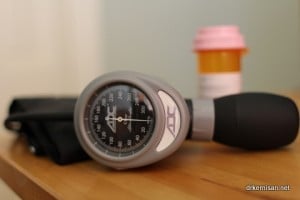
    1.Check the older person’s blood pressure, and know what his/her systolic BP is. The best way to do this is to use a high-quality BP machine, and to have the BP checked at the same time of day, for 3-7 days in a row. If possible, check twice a day instead of once a day. (For more on checking BP at home, see this post.) 

    • Since blood pressure is constantly changing a bit within the body, a series of measurements gives a more accurate idea of where a person’s BP usually is.
    • Home-based BP checks have been shown to correlate better with a person’s true BP than occasional office-based BP checks.
    • If there have been any falls, or if systolic BP is less than 120, consider checking BP both sitting and standing. If BP is dropping a lot when the person stands (which is a sign of orthostatic hypotension), you’ll want to ask the doctor to address this.

    2. Plan to talk to the older person’s doctor about reviewing the blood pressure treatment plan. This is especially important if:

    • Sitting systolic BP is less than 130mm Hg and you’re noticing a drop of 20 mm Hg or more when the older person stands.
    • Sitting systolic BP is less than 120 mm Hg and you’ve been worried about falls.
    • Sitting systolic BP is less than 110 mm Hg.
    • Sitting systolic BP is often over 150 mm Hg (in which case, we might be dealing with under-treatment of hypertension).
    Free Cheatsheet: Get a handy cheatsheet to help you check on an older person’s blood pressure treatment plan.  Click here.

    For more on how to figure out blood pressure treatment for people in their 60s, 70s, 80s, or 90s, see here: 6 Steps to Better High Blood Pressure Treatment for Older Adults.

    [This article was reviewed and updated in June 2026.]

    This post was originally published on this site.

  • 22 Must-Make Summer Dessert Recipes

    22 Must-Make Summer Dessert Recipes

    If your summer calendar looks anything like mine, it’s filled with BBQs, lake days, family get-togethers, and those last-minute texts asking, “Can you bring dessert?”

    Good news: this list of summer dessert recipes has you covered! These are the sweet treats that I make every summer – easy, crowd-friendly, and loved by everyone. Bars, pies, cookies, brownies, and more!

    My MOST favorite ones on the list: the Best Peach Cobbler and those S’Mores Bars. I make them multiple times every single summer. ❤️

    Here’s to long summer days and lots of treats! Hope you find your next fav!


    Favorite Summer Dessert Recipes

    Peach cobbler on a plate with ice cream.

    The Best Peach Cobbler

    Best summer dessert ever! Made with fresh peaches, sugar, and a topping that bakes like slightly underbaked cookie dough, with crunchy sugar broiled on top.

    246 reviews / 4.7 average

    S'mores bars stacked.

    Best S’mores Bars

    These really are the BEST S’mores Bars! Chocolate, peanut butter, and marshmallow sandwiched between two layers of a graham cookie crust. Everyone’s favorite summer snack (S’MORES, please!) in dessert bar form!

    133 reviews / 4.9 average

    Slice of banoffee pie.

    Banoffee Pie

    Absolutely my new favorite dessert. Salty-sweet graham cracker crust, silky caramel toffee filling, sliced bananas, and whipped cream on top. My family loves this easy dessert recipe!

    55 reviews / 4.8 average

    Party brownie with sprinkles on top.

    Party Brownies

    Brownies covered with a thick layer of fudge frosting and rainbow sprinkles. The best way to jazz up a box of brownie mix!

    19 reviews / 4.9 average

    Strawberry white chocolate cookie.

    Strawberry White Chocolate Cookies

    These are HUGE Strawberry White Chocolate Cookies speckled with creamy and rich white chocolate chips and beautifully balanced with tart freeze-dried strawberries. Grab your baking essentials and let’s go!

    452 reviews / 4.8 average

    Salted caramel rice krispie bars.

    Salted Caramel Rice Krispie Bars

    Salted Caramel Rice Krispie Bars! Perfectly chewy, crispy, caramelly, buttery, soft, and exactly as over-the-top as you need them to be.

    21 reviews / 4.8 average

    Puppy chow in a bowl.

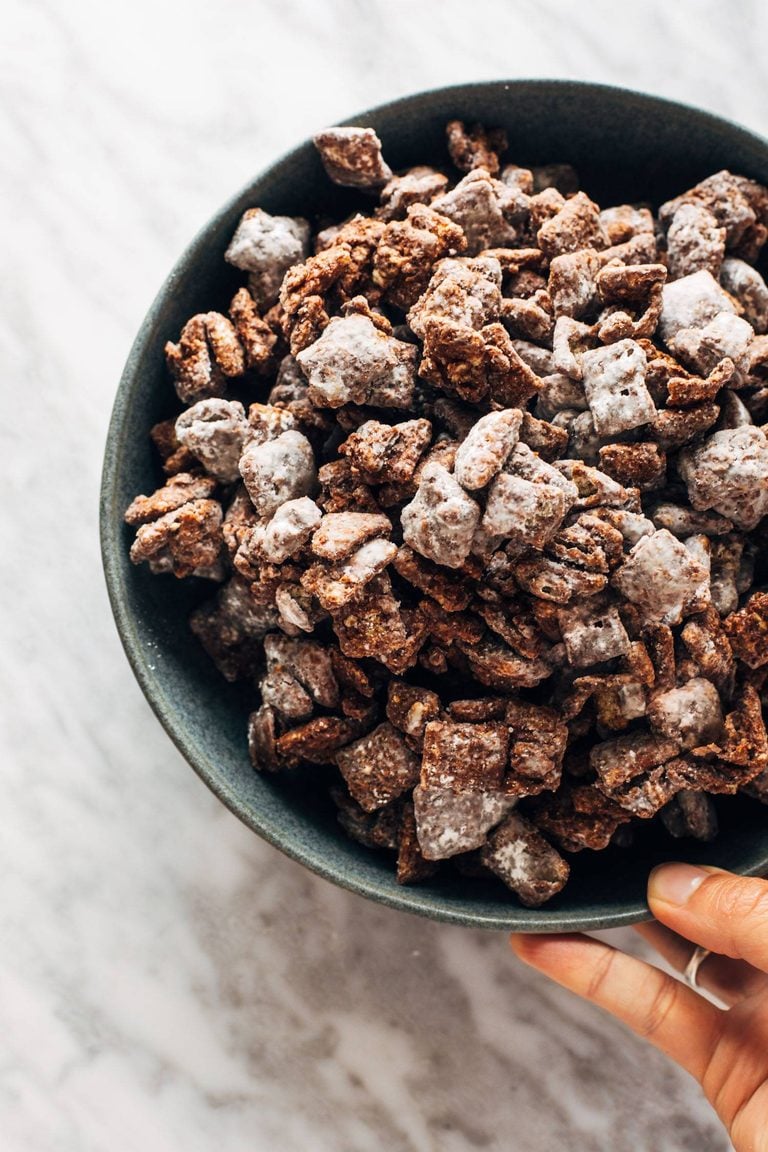
    Extra Good Puppy Chow

    Beautiful, chunky clusters of puppy chow with extra chocolate and peanut butter, and a coating of powdered sugar! Midwest summer bliss.

    26 reviews / 5 average

    Fruit pizza.

    Fruit Pizza

    This simple fruit pizza is beautiful and delicious! A soft sugar cookie crust with a cream cheese frosting and topped with sliced fruit. So simple and oh-so good!

    70 reviews / 4.8 average

    Pistachio loaf sliced.

    Pistachio Loaf

    It’s nearly springtime and we’re making this beautiful Pistachio Loaf! Grab your baking essentials – like butter, eggs, and sugar – plus a few extras, like pistachios and coconut flour, and get baking!

    435 reviews / 4.8 average

    Peanut butter pie with slice lifted out.

    The Best Easy Peanut Butter Pie

    The BEST Easy Peanut Butter Pie! A simple cookie crust under a layer of fluffy peanut buttery filling that is pillowy, light, and incredibly rich all at the same time.

    38 reviews / 4.8 average

    Almond butter zucchini bar.

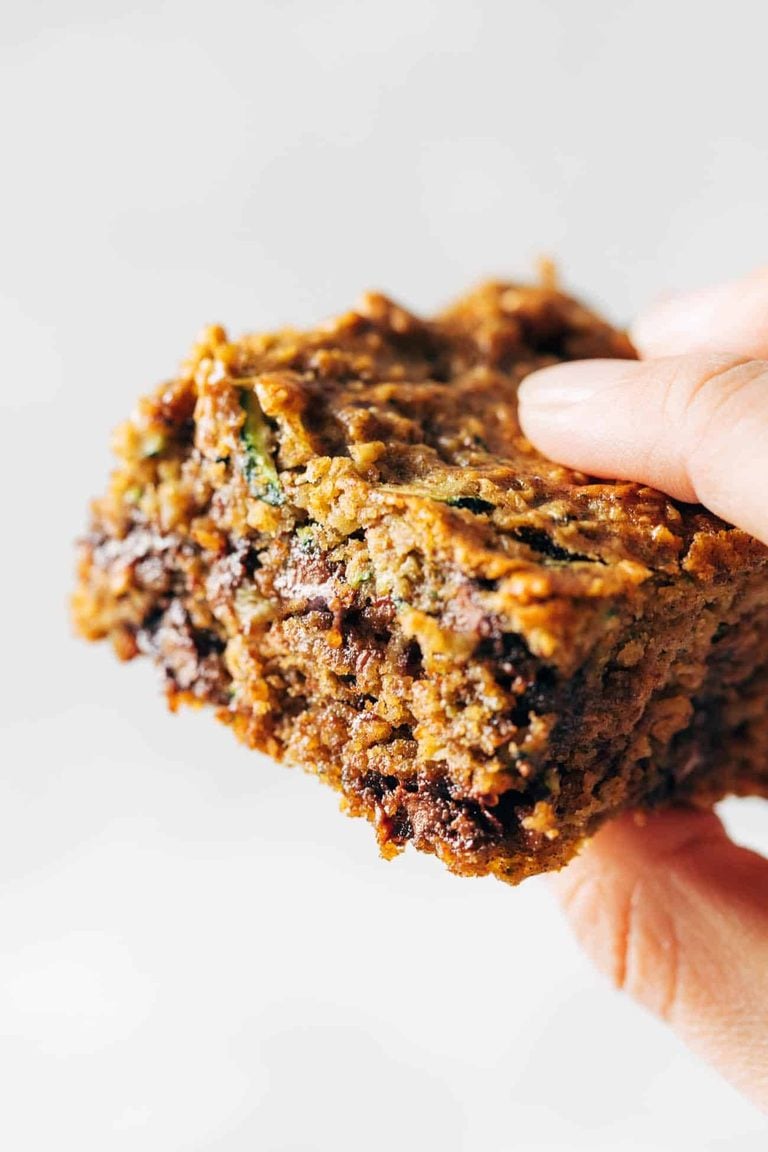
    Almond Butter Chocolate Chip Zucchini Bars

    These Almond Butter Chocolate Chip Zucchini Bars are wholesome and perfect and just everything your summer needs! Made with oats, almond butter, zucchini, dates, and maple syrup. So many feel-good ingredients packed into one bar!

    32 reviews / 4.9 average

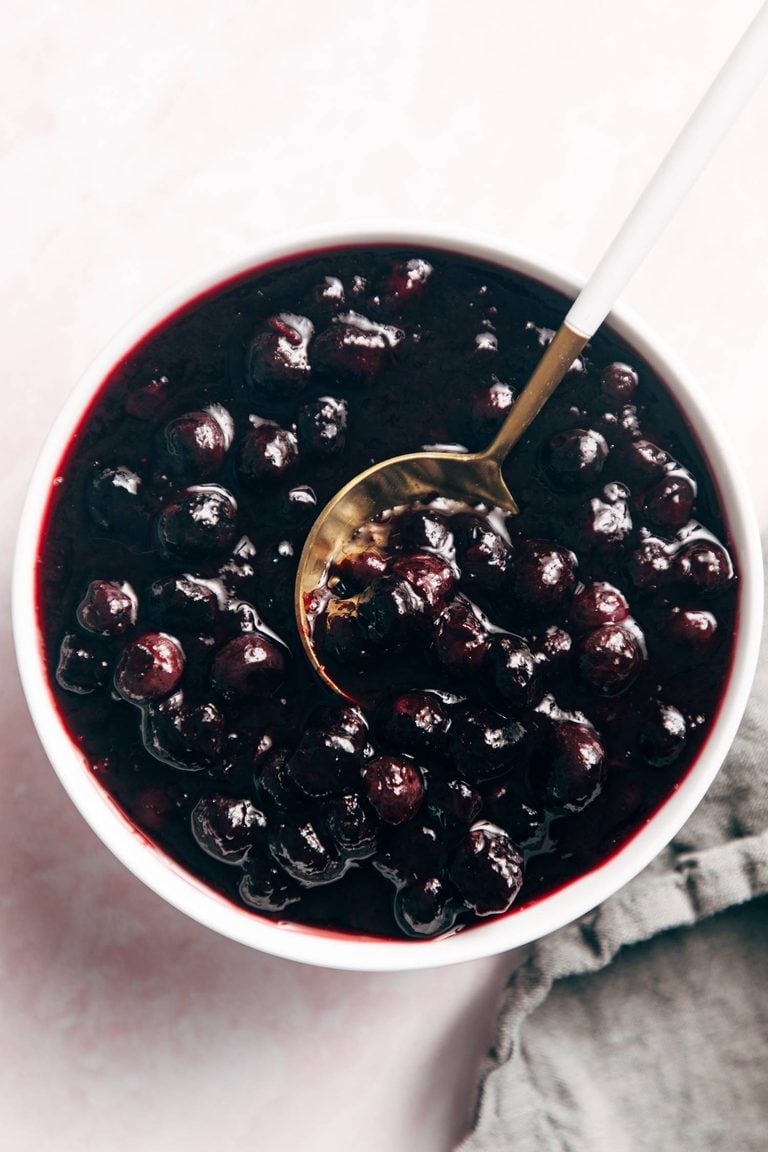
    Blueberry sauce in a bowl.

    Easy Homemade Blueberry Sauce

    This easy blueberry sauce is made with fresh blueberries, sugar, vanilla, and corn starch. Thick, sweet, and perfect for topping pancakes.

    66 reviews / 4.8 average

    Homemade oreos stacked together.

    Old School Homemade Oreos

    Life-changing Homemade Oreos that are soft, buttery, moist, perfectly dense chocolate cookies stuffed with cream cheese frosting. SO GOOD.

    7 reviews / 5 average

    S'mores bowl.

    Deep Dish S’mores Bowls For Two

    A graham-cracker loaded cookie base, top it with little squares of chocolate bars, piled high with marshmallows. An ooey-gooey, golden brown, melty, cookie-loaded miracle.

    14 reviews / 4.6 average

    Banana cream pie in jars.

    Two-Person Banana Cream Pies

    Two-Person Banana Cream Pies! Low maintenance, high enjoyment, unfussy banana cream pies in jars are yours for the taking.

    17 reviews / 4.8 average

    Chocolate chip cheesecake bars.

    Peanut Butter Chocolate Chip Cookie Cheesecake Bars

    These peanut butter chocolate chip cookie cheesecake bars are just as extreme as they sound. SO GOOD.

    58 reviews / 4.8 average

    Raspberry crumble in a ramekin.

    Two Person Raspberry Crumbles

    The BEST easy summer dessert – for two! A layer of oat-brown-sugar crust, juicy, sticky, bubbly raspberries, and topped with a buttery crumble that’s baked to perfection.

    26 reviews / 4.9 average

    Blender lemon pie.

    Blender Lemon Pie

    Blender Lemon Pie! Eggs, butter, sugar, and a WHOLE LEMON blended up and poured into a crust. Springy, custardy, simple lemon magic.

    61 reviews / 4.3 average

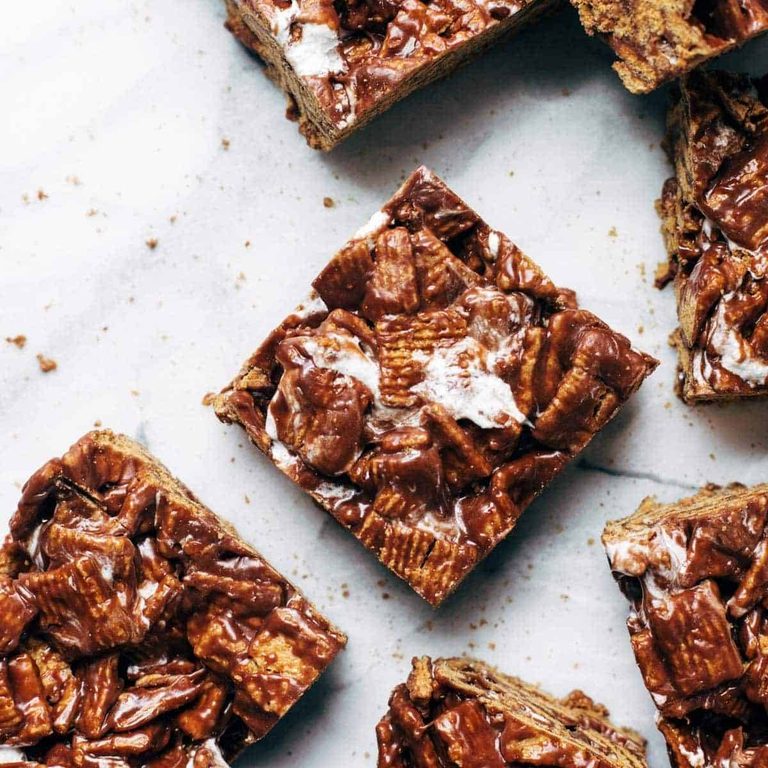
    Golde grahams bars.

    Golden Grahams Bars

    Crunchy, chocolatey, and made with just FIVE ingredients. Even better: it’s no-bake a super easy to make. Winning!

    25 reviews / 4.9 average

    Mocha peanut butter pie.

    Mocha Peanut Butter Pie

    Mocha Peanut Butter Pie! A mocha cookie crust filled with creamy peanut butter cheesecake and topped off with chocolate ice cream and plenty of peanut butter cups. My new favorite dessert!

    16 reviews / 5 average

    Raspberry crumble bars.

    Raspberry Crumble Bars

    These Raspberry Crumble Bars are THE BEST! So soft, buttery, and delicious. My favorite summer dessert.

    110 reviews / 4.8 average

    Vegan chocolate pie.

    Mind-Blowing Vegan Chocolate Pie

    This vegan chocolate pie is a five-ingredient, no-bake miracle. The ultra-thick and creamy chocolate pie filling is made with (wait for it)… tofu, almond butter, almondmilk, and melted chocolate. Easy!

    103 reviews / 4.7 average


    Bonus: Really Good Summer Snacks

    Summer is snack time in our house! Whether we’re running out the door to the park, having last-minute friends over in the backyard, or hosting a playdate, these are the snacks and apps I reach for.

    • Boursin Appetizer with Pistachios and Honey: My all-time fav! Ridiculously easy to pull together at the last-minute and SO good.
    • Cookie Dough Energy Bites: I keep these on hand in the fridge/freezer all summer long. Easy to make, extremely transportable to all kinds of activities, and my kids love them.
    • 2-Minute Creamy Avocado Dip: Another one that’s fast and easy. Love to put this on the table with chips for an easy pre-dinner snack.
    • Elote Corn Queso: A little more involved but very much worth it. Perfect use for all that summer corn!
    • Pickled Strawberries: An unexpected little treat! I love these on sourdough toast with goat cheese and honey.

    The post 22 Must-Make Summer Dessert Recipes appeared first on Pinch of Yum.

    This post was originally published on this site.

  • 7 Unique Experiences of Galapagos Cruises

    7 Unique Experiences of Galapagos Cruises

    Original content owned & copyrighted by Green Global Travel.

    As word of the remarkable diversity of Galapagos Islands animals continues to spread, the Ecuadorian archipelago has emerged as one of the world’s most popular ecotourism hotspots. 

    In recent years the area has attracted well over 150,000 annual visitors on average, most of them concentrated on San Cristobal and Santa Cruz Islands. 

    As a means of limiting the negative impacts of mass tourism, the Galapagos National Park Authority established new rules in 2011.

    These regulations changed the route frequencies of Galapagos cruises, which encouraged tour operators to visit some of the lesser-known islands in the area. 

    Having taken Galapagos cruises both before and after the changes were implemented, I personally believe they were ultimately for the better. 

    Not just for the local ecosystems and residents, but for travelers as well. It meant smaller crowds, better animal interactions, and opportunities to visit off-the-beaten-path attractions that land-based travelers never get to see.

    Here’s a look at seven unique experiences only small ship Galapagos Islands cruises can offer…

    READ MORE: 30 Amazing Galapagos Islands Animals

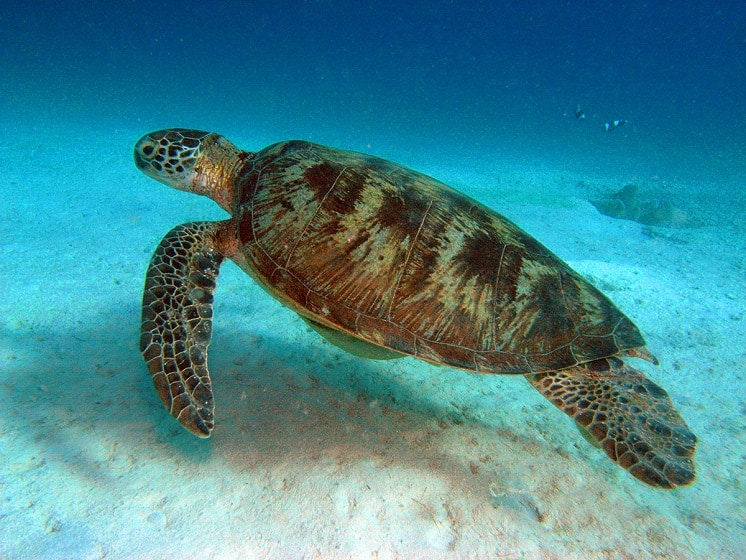
    Scuba Diving With Sea Turtles in Coron, Palawan
    Scuba Diving With Sea Turtles

    1. Scuba Diving Off the Coast of Wolf Island 

    Due to its unique, extraordinarily diverse array of marine life, the Galapagos Islands is one of the world’s most popular diving destinations. But some of its most impressive dive sites are also among its most remote. 

    Take Shark Point, off the coast of Wolf Island, as an example. It’s located some 100 miles northwest of Isabela. It has no permanent population, and the Galapagos National Park authority does not allow boats to land there.

    In short, a Galapagos cruise or live-aboard dive boat is the only way to visit. 

    The Scuba diving there is world-renowned. Divers are primarily drawn by the massive Whale Sharks that inhabit the area. But you can also find large numbers of marine animals such as Dolphins, Galapagos Sharks, and Hammerhead Sharks.

    Just keep in mind that, due to strong currents and limited visibility, this Scuba diving site is recommended for experienced divers only. 

    READ MORE: 21 Fascinating Facts About the Galapagos Islands

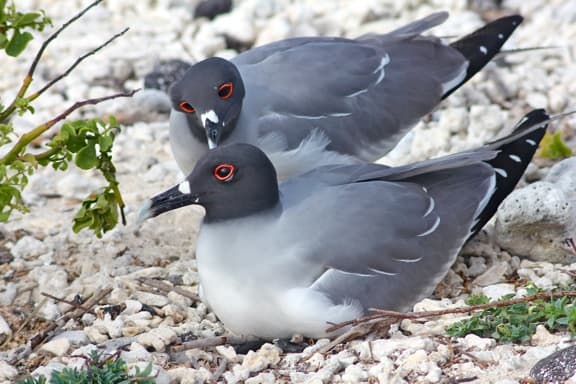
    Galapagos Birds: A Mating pair of Swallow Tailed Gulls on Genovesa Island
    Mating pair of Swallow Tailed Gulls on Genovesa Island

    2. Get a Bird’s Eye View on Genovesa Island

    The Galapagos Islands is a world-renowned haven for bird lovers, because it boasts around 56 native species (45 of which are endemic) and 29 migratory species.

    But Genovesa, which is nicknamed “Bird Island,” is remarkable for providing a chance to see so many of them within a very short walking distance. 

    The island spans five square miles, and includes a great hiking trail at Prince Philip’s Steps. But the most intense action for us happened right near the horseshoe-shaped beach. We didn’t walk more than a few hundred yards in total, yet the diversity of birds we saw along the way was positively mind-blowing. 

    In a span of a few hours we saw Darwin’s Finches, a Galapagos Hawk, Galapagos Mockingbirds, Magnificent Frigates, Nazca and Red-footed Boobies, Swallow-tailed Gulls, Storm Petrels, and more. 

    There were babies and juveniles nesting right alongside the trail, not to mention the ubiquitous Galapagos Sea Lions. As a wildlife photographer, it was one of the greatest days of my life!

    READ MORE: Galapagos Birds: 25 Species You Can See on a Galapagos Cruise

    Post_office-Bay in Floreana Island Galapagos
    photo by ProfessorX via CC BY SA 3.0

    3. Mail a Postcard at Post Card Bay on Floreana Island

    Floreana is a fascinating island. In the 1920s, Ecuador encouraged colonists to set up homesteads in the Galapagos by offering free plots of land, hunting and fishing rights, and no taxes for the first 10 years. 

    Some Europeans answered the call to start over in paradise, including numerous German expats looking to escape the dramatic political and economic instability of their homeland. 

    Floreana became the site of the notorious “Galapagos Affair” murder mystery. But its human presence dates back to the whaling era of the 1800s, when sailors set up a barrel in what became known as Post Office Bay.

    The homesick whalers (who were often at sea for years at a time) would leave letters to home there. Other passing sailors would deliver the letters to their ports of call.

    The tradition continues today: Thousands of Galapagos travelers visit Post Office Bay each year and leave postcards for friends and family. Other visitors will deliver them to the intended recipient, sometimes by hand!

    READ MORE: Darwin’s Paradise: Galapagos Islands Animals, Ecotourism & Adventure

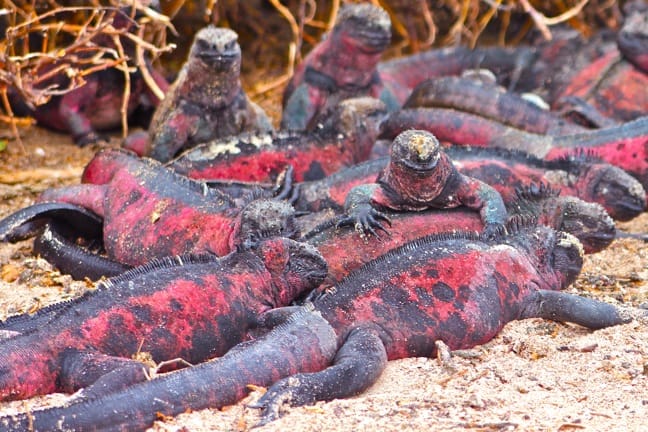
    Marine Iguanas, Galapagos Islands
    Marine Iguanas, One of Many Galapagos Species Found Nowhere Else

    4. Marvel at Marine Iguanas on Fernandina Island

    This endemic species can be found pretty much everywhere in the Galapagos.

    But they really seem to love congregating on the islands’ lava-strewn shores, where they can rapidly absorb heat from the sun to warm their bodies after a swim. 

    In terms of sheer numbers, the best place to see Marine Iguanas is Fernandina Island, where you’ll find hundreds of them gathered en masse. Up close they look a little like miniature Godzillas, hissing and sneezing in order to expel excess salt from their nasal glands. 

    Their flattened tails, shortened snouts, and spiked dorsal fins make them a wonder to behold in the water.

    It’s bizarre to be snorkeling and see a 3-foot long lizard feeding on algae 25 feet below you, then shimmying its prehistoric-looking body to swim to the surface for air. They’re an odd mixture of creepy, cuddly, and cool!

    READ MORE: 7 Important Life Lessons I Learned in the Galapagos Islands

    5. See the Unique Wildlife Around Wolf Volcano

    Like the Hawaiian Islands, the volcanic Galapagos archipelago is thought to have been created by a mantle plume.

    Situated on the north end of Isabela Island, Wolf Volcano is the area’s tallest peak (5,600 feet), and erupted in 2015 after 33 years of inactivity. 

    Named after 19th century German geologist Thomas Wolf, what’s most interesting about the volcano is the fact that the wildlife around it is incredibly unique. Not only from that of other islands in the archipelago, but from that of neighboring volcanoes on Isabela Island! 

    It has its own subspecies of Galapagos Tortoise, which has a saddleback shell. It has other tortoise subspecies that were abandoned there over the years, including some with DNA similar to the late Lonesome George’s. Scientists are attempting to use that DNA to bring back the extinct Pinta Island Tortoise. 

    It’s also home to the rare Pink Land Iguana, a new species discovered there in 2009.

    READ MORE: Interview with Charles Darwin Foundation Exec. Director Swen Lorenz

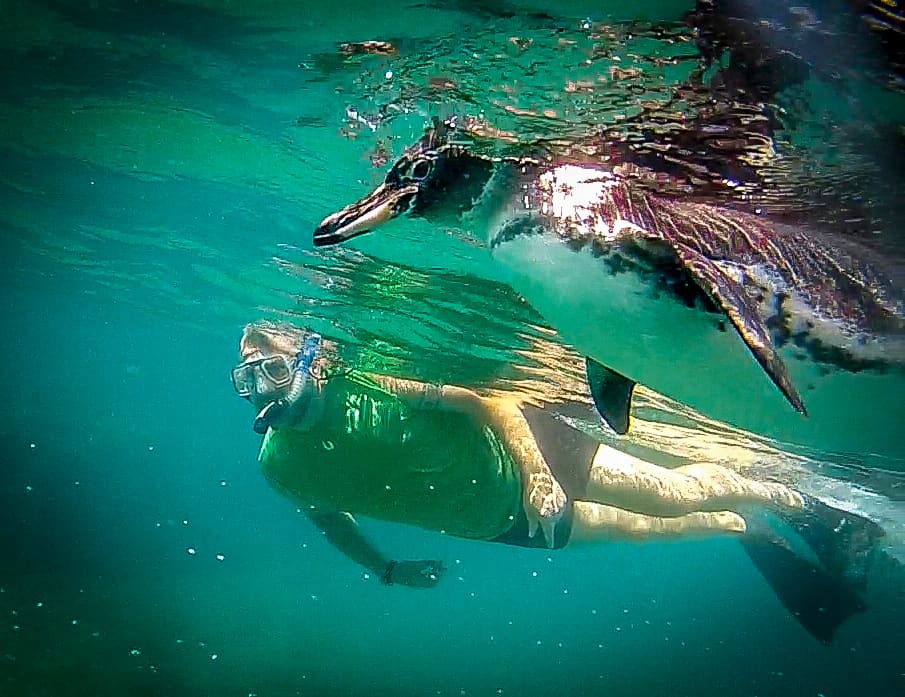
    Bret Love of Green Global Travel Swimming with Galapagos Penguins
    The author swimming with Galapagos Penguins

    6. Swim with Galapagos Penguins on Isabela Island

    Located directly across from Fernandina on Isabela Island, Tagus Cove is another Galapagos attraction with historic ties to sailors. This natural harbor was used by whalers and pirates centuries ago, and many of them either carved or painted the names of their ships on the surrounding rocks. 

    But these days Tagus Cove is better known as one of the best places in the Galapagos for snorkeling, especially if you want to see the rare Galapagos Penguin. 

    Swimming with Galapagos Penguins isn’t easy: You’ll most often see them zipping through the water like turbo-fueled rockets, racing to run down favored prey such as Krill, small crustaceans, and fish. 

    But if you’re lucky and keep a respectful distance, you might just find a penguin curious enough to swim around you for a closer look. We spent nearly 25 minutes swimming with a pair during our Galapagos cruise, and it remains one of the greatest wildlife encounters of my life!

    READ MORE: Secrets to Swimming With Galapagos Penguins

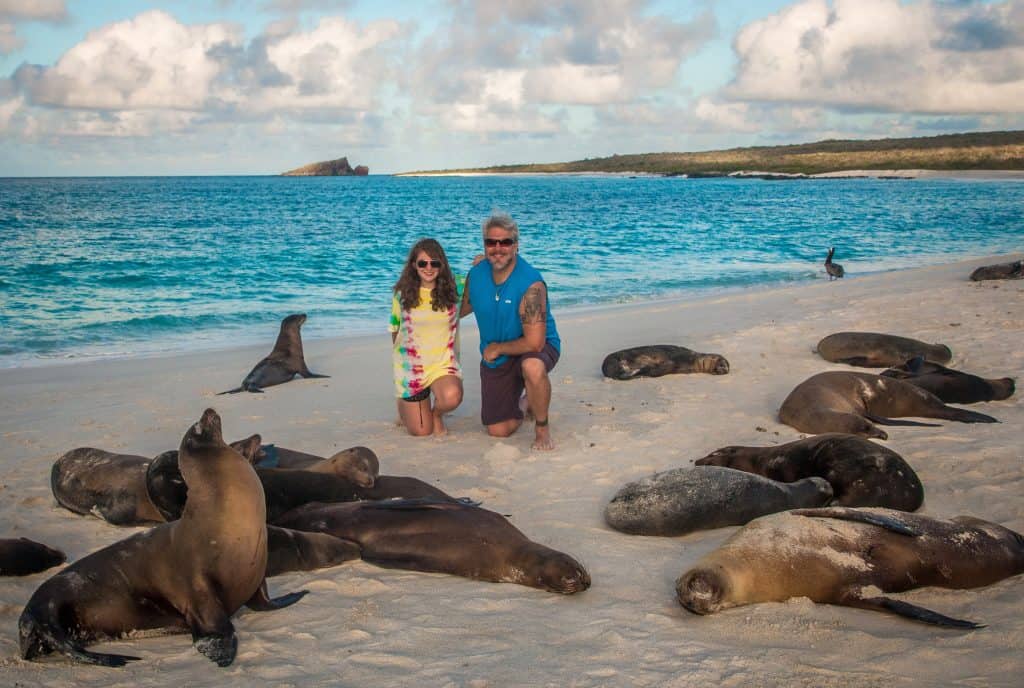
    Galapagos Islands Animals: Galapagos Sea Lions
    Sea Lions on Gardner Bay Beach in the Galapagos Islands

    7. Visit the Sea Lion Colony on Española Island

    Visiting Gardner Bay on Española Island remains one of my favorite Galapagos Island experiences.

    The setting couldn’t possibly be more picturesque, with gorgeous white sand, brilliant blue waters, and stunning rock formations just offshore. 

    But the main attraction here is the huge Galapagos Sea Lion colony, which typically ranges from dozens to over a hundred animals. 

    You’ll see baby Sea Lions feeding contentedly; adolescents frolicking in the surf; mamas watching over their young; and massive males battling for territory and breeding rights. 

    It’s an incredible place to take a selfie, snorkel, or simply sit and watch one of the most beautiful sunset vistas we’ve ever been fortunate enough to see. –Bret Love; all photos by Bret Love & Mary Gabbett unless otherwise noted

    The post 7 Unique Experiences of Galapagos Cruises appeared first on Green Global Travel.

    This post was originally published on this site.

  • Netflix’s “Nobody Wants This”– Filming Locations to Visit in Los Angeles

    Netflix’s “Nobody Wants This”– Filming Locations to Visit in Los Angeles

    When you live in the entertainment capital of the world, it’s hard not to talk about movies and shows. In Los Angeles, filming locations are part of everyday life: you drive past familiar facades, then suddenly recognize them on screen. The same happened with Netflix’s “Nobody Wants This,” a fresh romantic comedy set in LA whose filming locations …

    The post Netflix’s “Nobody Wants This”– Filming Locations to Visit in Los Angeles appeared first on Travel Notes & Beyond.

    This post was originally published on this site.

  • A New Senior Living Model for the Middle Market?

    A New Senior Living Model for the Middle Market?

    I recently toured Opus, an inspiring new senior living development in Newton, Massachusetts, and then had a conversation with its founder, Amy Schectman, on my Risking Old Age in America podcast.

    Amy explained to me how she had helped develop both a high-end senior living development, NewBridge on the Charles, and lower-income senior housing, Brown Family Life. With Opus, she was seeking to create housing for the often-overlooked middle market. She said that she and her team worked through many challenges in making the economics work without the prices they could bring for the higher-end market nor the subsidies available for lower-income housing. She feels that they can repeat this prototype elsewhere.

    Excerpts from Our Conversation

    Risking Old Age in America (ROA): The people at NewBridge, of course, have more wealth and there’s more money there, so I assume they are offered more services than at the other two places?

    Amy Schectman: No, I would not say that. They pay for it differently but, if you look at the core services, they are at all three places.

    What might be different? Newbridge has three dining facilities. You can eat in the deli or at one of two dining rooms. At Opus, you have one physical facility, but you’re going to have different kinds of meals. So it’s a little bit different, but I wouldn’t say more [services] at all.

    I think what we have done at 2 Life Communities is to define the paths to optimal aging. And we feel like we provide that entire package. I don’t think you can do more than that.

    ROA: So what are the parts of that path?

    Schectman: You need three…critical components to age optimally. The first is lifetime affordability. Housing is the biggest budget item [in] any…older person’s portfolio, but you have to think about what are you going to need later on too. They say [a large majority] of baby boomers are going to need significant home care for [a number of] years…If you’re in a private home, that’s really expensive because the minimum home health shift you can buy is four hours or five hours. So, at all of our places, we always make sure to structure the economics so that people have enough for their entire lives.

    The second piece that everyone has to have is social connection. If you don’t want to be lonely in your eighties and nineties, you have to be in a place where you’re making new friends and new connections. It’s inevitable that your networks otherwise shrink over time.

    And the third piece is navigating the home and healthcare system. I wish we had a system where nobody had any problems advocating for themselves to get all the care they need, but we don’t. At all of our campuses including Opus Newton, we have care navigators. When you need help, say coming home from [the hospital after] a hip replacement, or I don’t know whether I’m supposed to get help with meals, or how am I supposed to organize myself if I have a knee injury. Somebody that’s your partner helps you put all those pieces in place.

    A second level of how we organize things is all the activities that allow everyone to find their path into community. For you, it might be a book club, it might be a music event, for somebody else, it’s going be a dining program or a fitness program.

    You have to have an array of opportunities so everyone can find their way into community. That’s a constant at all of our campuses. At Opus Newton, we have an additional element, which is that everyone has agreed to volunteer at least 10 hours a month. Some of the ideas people have come up with, I would say [provide residents with more options] than any place in the country: We have two theater troupes, one that’s doing storytelling, one that’s putting on plays. We have a chorus. We have a canasta club, bridge club, mahjong club. We have a class on nature. All resident-led.

    My Concluding Thought

    During our conversation, Schectman also explained to me how it took her and her team eight years to develop a model that would work for the “missing middle.” They recognized that this group, at least in the Boston area, often has substantial home equity but is scared of a long-term financial commitment. So they worked to keep the monthly carrying costs moderate while the buy-in is substantial, but partially refundable at death or upon moving out. Now that they have created the model, they hope to replicate it in other locations.

    Listen to our entire conversation here.

    For more from Harry Margolis, check out his Risking Old Age in America blog and podcast.  He also answers consumer estate planning questions at AskHarry.info.  To stay current on the Squared Away blog, join our free email list.

    This post was originally published on this site.

  • 12 Cruise Drink Package Mistakes You’re Probably Making (Do This Instead)

    12 Cruise Drink Package Mistakes You’re Probably Making (Do This Instead)

    Whether you enjoy pina coladas by the pool, beer at the brewpub, specialty coffee at the cafe or all of the above, cruise drink packages can be economical if you think you’ll consume enough to make the purchase of one worth the expense. But are you using yours correctly?

    Even if you’re a seasoned beverage package pro, we’re willing to bet there are still some mistakes you’re making. Here, we’ve compiled a list of ways you might be paying too much, committing etiquette faux pas or simply not drawing as much value as you could be from your investment. We’re also offering some cruise drink package tips to help fix those mistakes.

    Not Budgeting for a Drink Package if You Want One

    Cruise drink packages are not cheap. In fact, they’re crazy expensive. For the most inclusive options with some of the biggest cruise lines, you could be looking at an extra $100 per person, per day, which amounts to more than $1,200 for two adults on a weeklong voyage – as much as the cost of another cruise.

    Some lines then charge an additional mandatory gratuity of up to 20% on top of the cost of the package. Then you’ll have to factor in any additional local taxes that might be levied on drinks you order with your package while the ship is docked in port.

    You should work all of this into the bottom line of your vacation budget as you’re planning so you’re not left with serious sticker shock.  

    Assuming You Have to Have a Package

    Cruise beverage packages are a given for many passengers, but you should never feel obligated to buy one if you’re not a big drinker and don’t think you’ll use it enough to at least break even. At that point, it’s just a waste of money. This applies even if your cruise line includes a drink package in your fare.

    Why would you care about opting out if it’s free? Because, as mentioned above, you could still be looking at gratuities and taxes on the estimated value of the “free” package, as is the case with NCL’s Free at Sea promotion, and those can amount to hundreds of dollars. So, if you don’t think you’ll get enough use out of the included package, see if you can choose not to accept it.

    Not Knowing What Your Package Covers

    One of the best cruise drink package tips is to simply read a package’s list of inclusions ahead of buying it or opting into it if it’s a freebie. It sounds obvious, but we’re always shocked when someone tells us they didn’t know they’d have to pay extra for bottled water, specialty tea and coffee, high-end beer or top-shelf spirits with packages that don’t include them.

    If you know what you’re getting into ahead of time, you’ll be less surprised by additional charges, and you can better determine if it would make the most financial sense for you to skip the package and order a la carte, keep a basic package for what you need or upgrade to a premium offering.

    Icon of the Seas Cruise Review

    Overlooking Other Package Types

    If you’re a bigger fan of smoothies, energy drinks or specialty coffee than booze, check to see which other kinds of drink packages your cruise line sells besides ones that include alcohol. Most have coffee packages or punch cards; zero-proof packages that roll smoothies, milkshakes, bottled water and fancy coffees and teas into the equation; and basic soda packages, too. If you can tailor your package to exactly what you want, it could end up costing you less than splurging on one that includes everything.

    Not Considering Your Itinerary

    One of our biggest cruise drink package tips is this: To best calculate whether or not a cruise drink package is a good financial decision, don’t forget to take your itinerary – specifically, the number of sea days versus port days – into account. If you’ll be spending most of your time ashore, you’re unlikely to draw maximum value from a package, especially one that includes alcohol.

    Don’t forget to add cruise lines’ private destinations to your tally because many – including Royal Caribbean’s Royal Beach Club Paradise Island, Carnival’s Half Moon Cay and Celebration Key, and Norwegian’s Harvest Caye – don’t allow you to use your shipboard alcohol packages when you’re ashore.

    Trying to Share Packages

    Stop using your alcohol package to order drinks for someone else. We still hear about people trying to do this, and it bothers us. Behavior like that is why most lines now require everyone sharing a cabin to have a beverage package if even one person in the room has one.

    Instead, have others in your group plan on budgeting for their own packages or to buy drinks a la carte.

    Buying a Package if You’re Traveling With Kids

    Think adults are the only ones who must have their own beverage packages if another adult in their cabin has one? Think again. Children sharing the room also are required to have packages – the zero-proof kind. Unless your kids regularly consume an alarming number of soft drinks or your teen downs specialty coffees like they’re going out of style, they shouldn’t need a beverage package of any kind.

    When you’re cruising with kids, the only way purchasing an alcohol package for yourself would be worth the cost is if what you’d expect to spend on a la carte drinks without one would exceed the cost of both your package and your kiddos’.

    Additionally, if you limit your children’s sugary drink intake, you probably won’t want them to have a drink package. Otherwise, if they’re out and about on the ship by themselves, they can purchase soda, milkshakes and other beverages at any time without your knowledge.

    Attempting to Order More Than One Drink at a Time

    Most cruise lines won’t allow this if you have a package. It’s to prevent you from sharing with others in your group who didn’t purchase one. Be aware of your cruise line’s policy before sidling up to the bar and having the bartender tell you they can’t fulfill your request. Some cruise lines will make the exception for ordering a bottle of water alongside an alcoholic beverage.

    Making Faux Pas With Personal Drinkware

    We know Stanley cups are, like, so trendy right now. Although we personally don’t understand the appeal of bringing them on a cruise, lots of people do it. Just don’t ask the bartender to fill your own personal cup, mug or tumbler when you head to your favorite onboard haunt. It’s unsanitary. They’ll likely refuse and, instead, give it to you in one of the ship’s clean glasses from which you can then transfer it if you’d like. The same applies to filling your thermos in the buffet. Use clean glassware at the beverage station and then transfer it to your personal drinkware.

    The only time it’s acceptable and actually necessary to use your own cup is if you’re getting soda from the Freestyle machines on Royal Caribbean ships using the cup they gave you. The cups are what activate the machines. Just be sure to wash yours occasionally during your voyage.

    disney cruise line beverage station fountain soda

    Forgetting There’s Other Free Alcohol Onboard

    Thinking of skipping the beverage package? There are other ways to score free alcohol and mocktails onboard. When you book a suite with some cruise lines, they’ll give you a complimentary beverage package or amenities like a free welcome bottle of sparkling wine, Champagne or a spirit of your choice.

    If a suite isn’t in your budget, check your loyalty status. Some brands offer access to exclusive cocktail hours or lounges where crew serve drinks to attendees. Other lines offer beverage vouchers as perks.

    If you don’t have high-tier status, look for events like art auctions or the captain’s welcome reception, which are open to everyone and often serve complimentary alcohol. It also pays to be a joiner, as winners of onboard game shows often receive drink vouchers or bottles of Champagne or sparkling wine as prizes.

    Ultimately, you can take advantage of these free drinks in addition to the ones you’re entitled to in the event you do decide to purchase a beverage package.

    Exceeding Your Limits

    Don’t become so obsessed with getting your money’s worth out of your drink package that you drink to excess. Many cruise lines have daily limits on the number of alcoholic drinks your package will cover. It’s partially to help them save money and partially to keep passengers safe.

    Not only can binge drinking be dangerous for you and the people around you, but you could miss out on valuable vacation time if you get sick or find yourself hungover the next day. Take the time to do the math to see if a drink package is right for you. Above all, know your limits, and don’t worry about maxing out your beverage allotment. In addition to being one of the best cruise drink package tips, it’s also solid advice that will help you avoid embarrassing yourself.

    Not Hydrating Enough

    You might be drinking a ton with your package, but are you hydrating? Alcohol can dehydrate you quickly, especially if you’re sailing someplace warm and aren’t taking in enough other fluids – especially those with electrolytes.

    Make sure to drink plenty of water, and consider bringing a 12-pack of your favorite sports drink onboard if your cruise line allows it. A good rule of thumb is to ask for a bottle of water after every alcoholic drink or two.

    Carnival Vista bars with menus

    Bottom Line

    Ultimately, only you can decide if a cruise beverage package is right for you. To recap of our cruise drink package tips, remember to calculate the cost of the package, plus any gratuities and taxes you’re likely to be charged. Budget accordingly when planning your sailing, remembering to consider the fact that, if you purchase a package, everyone in your cabin will likely be required to do the same. Also take the length of your sailing and the number of sea days versus port days into consideration to see if the investment is worth the expense.

    If you do opt for a package, make sure to know your limits; hydrate between beers, cocktails or glasses of wine; and remember the rules. Don’t try to order more than one drink at a time, don’t order drinks for others who don’t have packages, and don’t ask the bartender to fill your personal drinkware.

    Finally, never feel pressured to buy an alcohol package you don’t think you’ll need. There are other ways to find free drinks onboard. Worst case, you can pay a la carte; if you’re someone who only enjoys a couple of drinks a day, this is almost always a less expensive way to go than a drink package purchase is.

    Comments

    Have you made any of these cruise drink package mistakes? Do you have any other drink package tips or hacks to add to our list? Drop us an anchor below to share whether or not you think a beverage package is worth it on a cruise.

    The post 12 Cruise Drink Package Mistakes You’re Probably Making (Do This Instead) appeared first on EatSleepCruise.com.

    This post was originally published on this site.

  • Podcasts for Family Caregivers: Get Informed and Empowered

    Podcasts for Family Caregivers: Get Informed and Empowered


    Podcasts for Family Caregivers: Get Informed and Empowered

    Few of us feel prepared to care for our elderly parents, but life circumstances sometimes demand we step into this role. Caregiver burnout is all too common among family caregivers. We can easily feel overwhelmed, fall prey to scams, and lose time or money to inferior elder products and services. Family caregivers need more support, and caregiver podcasts have found this growing audience.

    Recently, we listed some of the most relevant and popular podcasts for seniors; now, let’s talk about senior caregiver podcasts that can help family caregivers provide excellent care for their loved ones without growing exhausted.

    Why Podcasts About Caregiving?

    ● Caring for elderly or disabled loved ones can feel isolating. The day can fill up so much that friends fall by the wayside, and life can get lonely when no one around you is going through the same thing. Podcasts for caregivers can help reduce feelings of isolation and offer strategies to balance life.
    ● Even when someone is going through the same thing—in the same family!—relationships can change. Sibling conflict and resentments can be difficult to navigate as there are disagreements about a parent’s care or the siblings’ individual responsibilities. Podcasts by creators who have been through this (or by experts, such as professional mediators) can bring ideas, hope, and a reality check.
    ● Caregivers can carry guilt about their weariness or frustration. Compassion fatigue can develop, leaving caregivers irritable and pessimistic about the future. Podcasts on the subject help normalize these feelings and guide you through them.
    ● Podcasts on your loved one’s particular illness or condition can help you grow knowledge of symptoms and effective care, so you can feel more confident caring for them at home and advocating with their doctor.
    ● Lastly, podcasts may discuss or review options for home care, home health, assistive technology, and other services or products that might make care easier or safer.

    The following are some of the best-loved family caregiver podcasts, covering a wide range of relevant topics with grace, humor, and candor. Note: While most links will take you to particular listening platforms, some podcasts are available on more than one platform.

    (On the same subject, be sure to check out our list of books for caregivers.)

    Practical Podcasts

    Caring for Your Aging Parents   (link). Covering topics from assisted living to spotting dementia early, this podcast is well-rounded and accessible to family caregivers.

    All Things Seniors (link). Another option with wide-ranging subjects, this show ended a few years ago, but the available episodes are still worth a listen.

    The Caring Generation (link). This one offers advice on many topics, but especially on long term medical care and legal/financial planning matters.

    From Overwhelmed to Relieved: The Senior Caregiving Podcast (link). If you enjoy our blog covering a variety of subjects related to aging and caregiving, you’ll enjoy this podcast published by Clark County Senior Resources in Washington State.

    The Dementia Care Partner Podcast (link). Homing in on one of seniors’ most challenging, mysterious diagnoses, this podcast covers many aspects of dementia care for a family caregiver audience.

    The Caregiver Resource Network Podcast (link). Episodes address a spectrum of topics from helpful smart home technology to preventative health for caregivers.

    Podcasts for Moral Support

    The Caregiver Cup (link). Caregivers must fill their own cup to pour into others. Host Cathy VandenHeuvel teaches us how to do just that.

    Caregiver-2-Go (link). Brought to you by the Veterans Health Administration’s Office of Caregiver Support, this newer podcast speaks to caregiver mental health and self-care needs.

    Caregiver Chats (link). Can caregivers date? Can caregiving be joyful? This podcast tackles the everyday, important experiences of family caregivers.

    Champions Corner (link). This show from caregiving.com takes a realistic view of caregiving challenges, bringing solutions and encouragement.

    Caregiver SOS (link). With a bent towards caring for loved ones with dementia, this popular podcast is relatable to any caregiver, at any stage of their care journey.

    Happy Healthy Caregiver (link). Real caregivers tell their stories of building happy, healthy lives while caring for loved ones.

    Caregiver Compass (link). Speaking especially to “sandwich generation” caregivers, this one is a resource for those figuring out a parent’s next phase while also raising children, nurturing a marriage, or growing a career.

    Caregiver Chronicles (link). Another with a sandwich generation focus, this podcast was created by a CNA caring for different family members with dementia, while also raising two sons on the autism spectrum.

    The Cancer Caregiver (link). Cancer is often a frightening diagnosis with long, exhausting treatment. This podcast recognizes the ups, downs, and “mehs” of caring for someone with cancer.

    Confessions of a Reluctant Caregiver (link). Hosted by sisters caring for their mom with Parkinson’s, this show features stories from listeners who are standing in the care gap for their families.

    Podcasts to Dig Deeper

    Daughterhood, the Podcast (link). More “moral support” than “practical podcast,” this one is uniquely courageous in tackling hard subjects like caring for a narcissistic parent and processing their end-of-life.

    In Sickness (link). While most caregiver podcasts focus on caring for an elderly relative, this one is hosted by two Millennials caring for chronically ill spouses, offering a slightly different perspective.

    The Heart of Hospice Podcast (link). This podcast turns attention to palliative care and hospice, offering support and insight to an often confusing and difficult experience for caregivers.

    Hospice Explained (link). Another hospice-focused show, this one has bite-sized episodes and interviews with hospice professionals.

    Grief Out Loud (link). Grief is complex and can be intimidating to those around us. This podcast shines a light on the different ways people grieve through creativity, ritual, and just plain honesty.

    Podcasts have become a popular form of media due to the wide range of subjects covered and the simplicity of listening while you do chores or drive to work. For family caregivers—new and experienced—they can also be a lifeline to hope and a sense of stability.

    If your loved one needs home care, our VetAssist mission is to make home care easily and quickly accessible for those who qualify through the VA Pension with Aid and Attendance benefit. Veterans Home Care can help you determine whether you or your loved one will be eligible to receive the benefit, which can cover some or all of the cost of home care, and we make it easy to apply. Chat with us via our website, or call us at (888) 314-6075.

    The post Podcasts for Family Caregivers: Get Informed and Empowered appeared first on Veterans Home Care – VA Aid and Attendance Pension Benefit.

    This post was originally published on this site.