Category: Uncategorized

  • How Much Will Your Long-Term Care Needs Cost? It Depends on How Average You Are

    How Much Will Your Long-Term Care Needs Cost? It Depends on How Average You Are

    The consulting firm Milliman recently published its 2025 Long-Term Care Index, calculating that – on average – 65-year-olds should set aside $135,000 for their future high-intensity long-term care needs.

    Great Variability

    While an average figure can be a helpful anchor point, Milliman’s estimates show substantial variability based on gender, location, and health status, among other factors. For instance, the average cost for women is $171,000 and that for men is $98,000, largely because women live longer. As a result, they may need care for a longer period of time and are less likely to have a spouse available to assist them at no cost.

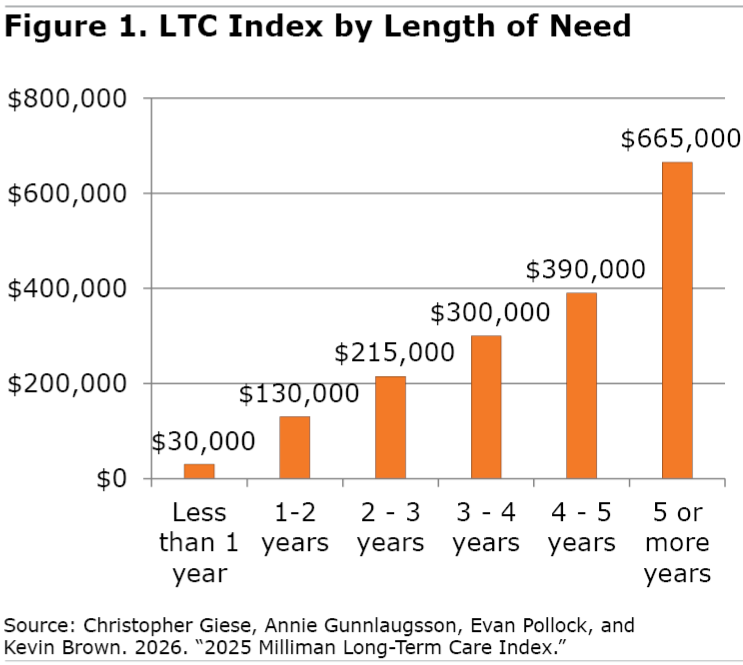
    According to Milliman, almost half of men and four out of ten women will need no paid care at all during their lives. Another quarter of men will receive less than a year of paid care, leaving just 29 percent requiring more than a year of paid care. Women, on the other hand, are much more likely to need care for an extended period with 41 percent facing more than a year and 14 percent needing five years or more, which will on average cost them $665,000 (see Figure 1).
    I should note that the Milliman figures assume all care is paid care. The Center for Retirement Research at Boston College has estimated that families typically provide at least half of the care hours, even for those with high needs. Milliman also doesn’t say how these costs are paid, in particular whether they include Medicaid-covered care or only amounts paid out-of-pocket.

    Location, Location, Location

    Costs vary considerably by type of care needed – home health, assisted living, or nursing home – and by location. Location matters not only in terms of costs of care but also longevity and health. People live longer (and, thus, may need care longer) in some states – such as Hawaii, California, Washington, Florida and New Hampshire – than others – such as Mississippi, Alabama, West Virginia, Louisiana and Kentucky.

    On the other hand, people who are healthier tend to need care for less time. Milliman highlights Colorado, Montana and Hawaii as states where residents are least likely to need any paid long-term care and Montana, again, along with Arizona and Oklahoma as the states where people need the shortest duration of care. At the other end of the spectrum, those with care needs in Hawaii, Connecticut and New York receive care for the longest periods of time.

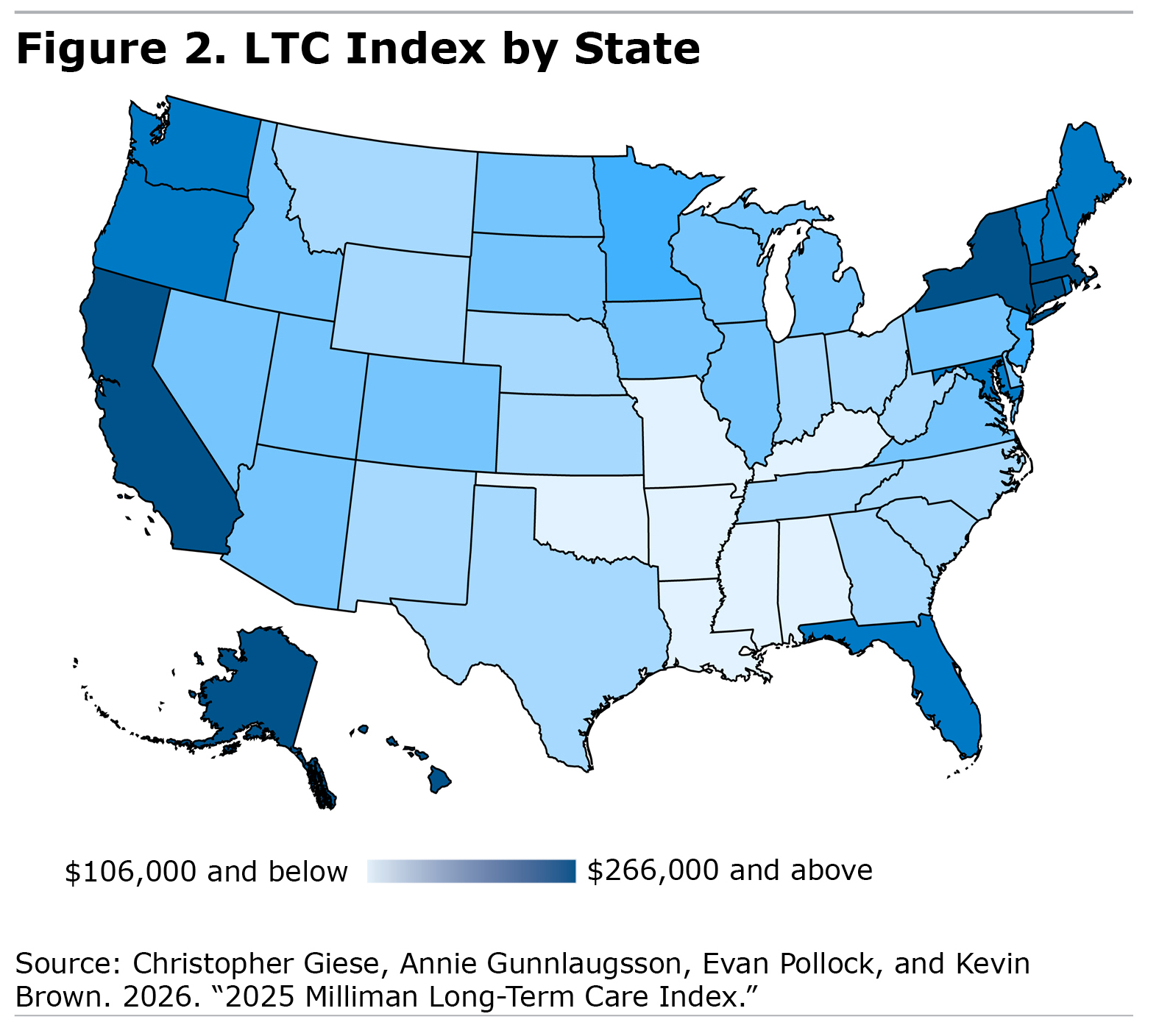
    Combining all these factors – so that the cost of LTC services, the likelihood of needing services, and the duration of the needs are accounted for – Figure 2 shows Milliman’s ranking of the average long-term care costs per state (see Figure 2).

    The most expensive states (dark blue) are on the West Coast and in the Northeast, where average costs are about twice the national average. The least expensive are largely in the South-Central region (light blue).

    A further variation on how much 65-year-olds need to set aside for their care is the anticipated rate of return. The $135,000 average is based on an average investment return of 4.35 percent. Using a higher figure of 7 percent, the average 65-year-old would only need to set aside $74,000, but using a lower return of 3 percent, they’d need $187,000 in the bank.

    What Does This Mean for You?

    For individuals and families planning for future long-term care costs, it can be difficult to anticipate the need. I’ve written before about the factors that affect the need for paid long-term care, including overall health, family history, and family situation.

    But the $135,000 figure seems like a good starting point. Increase that number if you live in a high-cost state, have a family history of dementia or other illnesses that may require a long period of assistance, or if you do not have family members who could help.

    Your existing health may affect the figure both positively and negatively. If you are already suffering from a debilitating chronic disease that you could live with for many years, such as Parkinson’s, you can anticipate needing more money. But if you have a form of cancer that may shorten your life but not lead to a long period of disability, you may need considerably less.

    An Insurance Solution?

    My biggest take away from the Milliman report is that we need a universal long-term care insurance program since we have great uncertainty about individual needs combined with relative certainty about those of the entire elder population. In addition, while a small minority of seniors can afford the cost of their care, whatever it may be, a majority cannot.

    According to the Federal Reserve, the median retirement savings of 65- to 74-year-olds in the United States is $200,000, meaning that half have less than this amount. Individuals ages 75+ have median savings of just $130,000. In short, most baby boomers likely do not have enough money to pay their future long-term care costs.

    The cost for covering long-term care needs would be significantly less if we started contributing at an earlier age through a national insurance plan. At its 4.35-percent rate of return, Milliman calculates a 35-year-old would only have to set aside $38,000, on average, to cover their future long-term care costs, almost $100,000 less than a 65-year-old. Of course, few 35-year-olds are thinking about their future care needs, but collectively we can approach this challenge. In fact, Washington State has set up such a program, which provides a base layer of long-term care protection for its workers (up to $36,500); and it is exploring ways to allow people to buy additional long-term care insurance at a group rate. Several other states, including Massachusetts, are already exploring similar programs.

    For more from Harry Margolis, check out his Risking Old Age in America blog and podcast.  He also answers consumer estate planning questions at AskHarry.info.  To stay current on the Squared Away blog, join our free email list.
    This post was originally published on this site.

  • When veterans take the pen, war stories start to change

    When veterans take the pen, war stories start to change

    This post was originally published on this site.


    Hollywood has never lacked war stories. But it has often lacked veteran storytellers telling them.

    For years, military narratives on screen have gravitated toward spectacle or trauma. Either elite raids and explosions, or the aftermath: PTSD, divorce, isolation. What gets squeezed out is the middle ground — bureaucracy, boredom and dark humor — where most service members actually live.

    Three veterans now working in television say that changes when people who have worn the uniform are inside the writers’ room, shaping the story from page one.

    Greg Cope White, a Marine veteran and longtime television writer, built a decades-long career after leaving active duty. His memoir, “The Pink Marine,” later became the basis for the Netflix coming-of-age series “Boots,” about a closeted gay teenager enlisting in the Marine Corps in the ’90s.

    Veterans are often misunderstood in writers’ rooms, White told Military Times in a recent interview.

    “One of the things veterans might fear about going into the writers’ room is that that’s all the experience people are going to want from them,” he said. “Just give me the military stuff and shut up.

    “That’s not what I have found at all.”

    For White, the value of veterans extends far beyond accuracy. “Our worldview is instantly expanded the day we enlisted,” he said. “We saw things, and we’re exposed to people and situations that a normal college-age student wouldn’t be exposed to.”

    That exposure influences tone and informs how characters handle pressure. It shapes what feels authentic when a unit fractures or rallies on screen.

    When working on “Boots,” authenticity mattered, but not as trivia. “You don’t want something like someone in their dress blues with scruff. That’s going to take a lot of people out right there,” White said.

    Marine Corps veteran Greg Cope White's memoir served as the basis for the Netflix coming-of-age series

    For “Boots” story editor Megan Ferrell Burke, a Marine veteran who served from 2007 to 2011 and deployed to Iraq and Afghanistan as a direct air support officer, authenticity debates often collide with visual storytelling.

    Hollywood is a visual medium, noted Burke, who, after leaving the Corps, worked her way through assistant roles on “Army Wives,” served as a writers’ assistant on the World War II drama “Manhattan” and was staffed on “Outlander.” Sometimes what is correct is not what reads best on camera.

    In “Boots,” for example, recruits were scripted to sit on their packs during a break, as they would in real life. On set, production placed them on logs.

    “In any sort of universe, recruits would not be sitting on logs and talking,” Burke said. “But who cares? It’s so much better visually.”

    For her, the issue is not perfection; it is intention. “I’m very okay with being inaccurate,” she said. “I just want to know when we’re being inaccurate, and I want to make that choice actively.”

    Burke said she braced for backlash from veteran viewers over creative choices in “Boots,” including decisions about timeline accuracy. Instead, she found that many viewers accepted the show’s choices once they understood they were deliberate.

    Over her 15 years in the industry, Burke said she has seen shifts in how military stories are framed. Early portrayals often defaulted to stoic archetypes. Later, she said, many projects focused almost exclusively on trauma.

    “If you look out on the landscape and look for the stories of well-adjusted veterans, they’re a little bit harder to come by,” she said.

    Burke does not dismiss PTSD narratives. “It is incredibly important to advocate for the very real experiences of service members dealing with trauma,” she said. But she believes the picture is incomplete.

    “I feel like I’m the best version of myself because of the experience that I had,” she said.

    Joshua Katz, a Navy veteran, worked as a showrunner’s assistant on the CBS sitcom “United States of Al” and later founded Katzmar Tactical Consulting with his spouse, also a Navy veteran. (Courtesy Joshua Katz)

    Joshua Katz, a Navy veteran who served from 1999 to 2003 as a gunner’s mate and missile technician, entered the industry through multiple avenues, including stunt work, tactical consulting and writers’ room support. He worked as a showrunner’s assistant on the CBS sitcom “United States of Al” and later founded Katzmar Tactical Consulting with his spouse, also a Navy veteran.

    Katz offered a more direct assessment of Hollywood’s priorities.

    “They care about one thing, and that’s making a profit,” he said.

    In his experience, veteran status may help secure a meeting, but it does not guarantee advancement. “It will never be because you’re a veteran,” he said. “It opens the door, but it doesn’t necessarily push you through it.”

    Still, Katz credited certain showrunners with fostering supportive environments and taking veteran perspectives seriously when storylines demanded it.

    He also pointed to story gaps he believes remain underexplored.

    “You don’t see below decks,” he said of Navy life. “It’s almost always from an officer’s perspective.”

    He would like to see more character-driven stories set in military environments without defaulting to combat or scandal. He also cited the VA hospital as a compelling setting where veterans from different eras intersect.

    Across all three writers, humor emerged as a defining difference. Veterans understand that laughter often exists alongside stress, not in spite of it.

    “It’s the only way I can tell my story,” White said of using comedy to frame his experience.

    Humor, he argued, allows audiences unfamiliar with military life to enter the world without being overwhelmed. “There’s nothing more hilarious than that frailty of the human condition,” he said.

    For those considering the leap from the uniform to the writers’ room, none of the three offered easy encouragement.

    “It is not a career for the faint of heart,” Burke said. “The good times are great, and the bad times are really hard.”

    White urged writers to focus on craft. “Write the story you want to tell,” he said, rather than chasing what seems marketable.

    Katz emphasized persistence and preparation. “You’ve got to have the writing sample to go with it,” he said. “It’s never going to be just because you’re a veteran.”

    When veterans become writers, war stories shift. The story moves toward lived ambiguity, and service is not reduced to a single narrative.

    The difference is not cosmetic. It is tonal. And audiences, especially those who have served, can tell.

  • How to Take an Easy Day Trip from Salerno to Paestum

    How to Take an Easy Day Trip from Salerno to Paestum

    Last Updated on May 8, 2026 by Sarah Wilson If you’re staying in Salerno and want a simple, low-stress day trip, Paestum is an excellent and rewarding choice. With well-preserved Greek temples, a relaxed archaeological park atmosphere, and an excellent museum, it’s one of the easiest excursions you can do by train. This guide covers […]

    The post How to Take an Easy Day Trip from Salerno to Paestum appeared first on LifePart2andBeyond.com.

    This post was originally published on this site.

  • How MREs inspired today’s meal-delivery industry

    How MREs inspired today’s meal-delivery industry

    This post was originally published on this site.


    Long before cardboard boxes filled with frozen gel packs and prepackaged ingredients started appearing on suburban porches, the U.S. military had already solved the problem of feeding people who could not make it home for dinner.

    The Meal, Ready-to-Eat, better known as the MRE, was designed for war. It had to survive heat, cold, impact and time. It had to deliver calories and consistency in places where kitchens did not exist. And it had to do all of that at scale.

    Sound familiar?

    Today’s meal-delivery industry, from subscription kits to fully prepared microwavable trays, operates on many of the same principles: Portion control, modular packaging and optimized logistics. Veterans who open a cardboard box filled with premeasured ingredients often recognize the parallels immediately.

    The evolution of military rations shows just how deliberate that system became. From older field staples to modern retort pouches, MREs were engineered to balance durability and nutrition. A look back at MREs through the years illustrates how packaging and contents changed to meet operational demands. Meals had to withstand long storage and rough transport while still delivering predictable fuel.

    That predictability is central.

    Each MRE is structured around caloric requirements and mission profiles. A standard menu includes an entree, side, snack, dessert, beverage powder and accessory packet. Nothing is random. It is a calculated intake designed to support performance.

    Modern meal-delivery companies market the same precision. Protein totals are highlighted. Calorie counts are featured prominently. Macro breakdowns are listed like briefing slides. For service members who once identified meals by menu number rather than flavor description, the emphasis on data feels familiar.

    Behind the scenes, the logistics mirror each other even more closely. Feeding deployed troops requires a supply chain that can move millions of individually packaged meals across continents. As recently as last year, the Department of Defense refined packaging dimensions, pallet configurations and distribution systems to reduce waste and maximize efficiency. Those lessons now underpin commercial food distribution networks that ship insulated boxes nationwide on strict timelines.

    Inside the development process, the parallels become even clearer. Military food scientists test taste, texture and shelf life inside controlled environments before a menu ever reaches a unit. A visit to the kitchen where MREs are created shows how rigorously meals are evaluated for stability and performance. The civilian meal kit industry uses similar controlled testing to ensure consistency across thousands of shipments.

    Convenience may be the most obvious link. MREs were built for speed. Open. Heat if you can. Eat if you cannot. No dishes, no prep, no grocery run. The civilian market reframed that efficiency as lifestyle optimization: 10-minute dinners with minimal cleanup and reduced food waste.

    There is also a psychological component. Field rations were never just about calories; they provided routine. In austere environments, opening a sealed meal at a predictable time created a small anchor in an otherwise unstable day. Modern marketing leans on the same promise: reliability, dinner handled and one less decision to make.

    Of course, today’s meal kits are designed for aesthetics and convenience, not survival in a combat zone. No one is building a subscription box around instant coffee and wheat bread snacks.

    Still, the blueprint is unmistakable. Long before venture capital discovered the efficiency of meal delivery, the military had already tested the model under far harsher conditions.

    For veterans, the comparison is less surprising than ironic. What once arrived in a case bound for a forward operating base now shows up with a friendly logo and a discount code.

  • Vietri sul Mare in Winter: An Easy Day Trip from Salerno

    Vietri sul Mare in Winter: An Easy Day Trip from Salerno

    Last Updated on March 2, 2026 by Sarah Wilson Vietri sul Mare is often treated as the start of the Amalfi Coast rather than a destination in its own right. In summer it can feel busy and rushed, but in winter it slows down. I visited in January, did the town in the morning and […]

    The post Vietri sul Mare in Winter: An Easy Day Trip from Salerno appeared first on LifePart2andBeyond.com.

    This post was originally published on this site.

  • The military’s complicated history with tobacco

    The military’s complicated history with tobacco

    This post was originally published on this site.


    For decades, cigarettes were as common in uniform as a canteen and a helmet liner.

    In World War II, tobacco was not treated as a vice; it was a comfort item. Cigarettes were packed into rations as morale boosters, something that could steady nerves between missions, the Imperial War Museums note. The image of a soldier lighting up in a muddy trench or on the deck of a ship became inseparable from the mythology of the American warfighter. The phrase “smoke ‘em if you got ‘em” became a broader cultural idiom, according to the Army Historical Foundation.

    That normalization lasted for generations. Smoking was woven into daily military life. A cigarette break punctuated patrols and long nights on guard duty. The smoke pit became a place where rank blurred slightly, and information flowed freely. For young troops far from home, nicotine offered routine in environments defined by uncertainty.

    But the same institution that once distributed cigarettes eventually had to reckon with the consequences.

    As medical research sharpened the link between tobacco use and long-term health problems, the Department of Defense shifted its posture. Smoking inside military facilities was banned in 1994, and recruits arriving at basic training found tighter restrictions around tobacco use than their predecessors.

    In 2016, the Pentagon moved to eliminate discounted tobacco sales in on-base exchanges, raising prices to match civilian markets in an effort to remove financial incentives.

    Despite that shift, nicotine use has not disappeared; it has adapted. A recent report found that soldiers are significantly more likely to use modern nicotine pouches than civilians, underscoring how quickly habits evolve inside the ranks.

    Today’s service members are less likely to be seen with a cigarette and more likely to carry a vape or a can of tobacco-free nicotine pouches, which have been linked to oral and dental health issues and cardiovascular disease risk. Marketed as cleaner, smokeless and discreet, these products fit easily into field environments and office settings alike. They also sidestep some of the social stigma attached to traditional smoking.

    The military has responded by expanding resources for quitting tobacco. Tricare covers tobacco cessation counseling and prescription medications, while military treatment facilities offer nicotine replacement therapy such as patches and gum. The Defense Department also promotes health coaching programs as part of its broader force health protection strategy.

    Still, anyone who has served knows the smoke pit has not vanished. It remains a gathering place, a bond that only those who don the uniform can truly understand. It is where junior enlisted troops vent about leadership, where NCOs gauge morale and where small frustrations surface before they grow larger. In many units, stepping outside for a smoke remains one of the few unofficial breaks in a tightly structured day.

    That cultural role complicates enforcement. Leaders must balance individual autonomy with readiness standards. Smoking and nicotine use are tied to higher injury rates, slower recovery times and long-term healthcare costs, all of which affect deployability. At the same time, troops operate under sustained stress, long hours and frequent moves. For some, nicotine functions as a coping mechanism that is accessible and socially reinforced.

    The military’s relationship with tobacco reflects a broader evolution. What began as a morale staple, packed alongside rations, has become a regulated health concern measured against mission impact. The products may look different in 2026 than they did in 1945, but the underlying tension remains.

  • Robert Duvall, ‘Apocalypse Now’ actor and Army veteran, dead at 95

    Robert Duvall, ‘Apocalypse Now’ actor and Army veteran, dead at 95

    This post was originally published on this site.


    LOS ANGELES — Robert Duvall, the Oscar-winning actor of matchless versatility and dedication whose classic roles included the intrepid consigliere of the first two “Godfather” movies and the over-the-hill country music singer in “Tender Mercies,” has died at age 95.

    Duvall died “peacefully” at his home Sunday in Middleburg, Virginia, according to an announcement from his publicist and from a statement posted on his Facebook page by his wife, Luciana Duvall.

    “To the world, he was an Academy Award-winning actor, a director, a storyteller. To me, he was simply everything,” Luciana Duvall wrote. “His passion for his craft was matched only by his deep love for characters, a great meal, and holding court. For each of his many roles, Bob gave everything to his characters and to the truth of the human spirit they represented.”

    The bald, wiry Duvall didn’t have leading man looks, but few “character actors” enjoyed such a long, rewarding and unpredictable career, in leading and supporting roles, from an itinerant preacher to Josef Stalin. Beginning with his 1962 film debut as Boo Radley, the reclusive neighbor in “To Kill a Mockingbird,” Duvall created a gallery of unforgettable portrayals. They earned him seven Academy Award nominations and the best actor prize for “Tender Mercies,” which came out in 1983. He also won four Golden Globes, including one for playing the philosophical cattle-drive boss in the 1989 miniseries “Lonesome Dove,” a role he often cited as his favorite.

    In 2005, Duvall was awarded a National Medal of Arts.

    He had been acting for some 20 years when “The Godfather,” released in 1972, established him as one of the most in-demand performers of Hollywood. He had made a previous film, “The Rain People,” with Francis Coppola, and the director chose him to play Tom Hagen in the mafia epic that featured Al Pacino and Marlon Brando among others. Duvall was a master of subtlety as an Irishman among Italians, rarely at the center of a scene, but often listening and advising in the background, an irreplaceable thread through the saga of the Corleone crime family.

    “Stars and Italians alike depend on his efficiency, his tidying up around their grand gestures, his being the perfect shortstop on a team of personality sluggers,” wrote the critic David Thomson. “Was there ever a role better designed for its actor than that of Tom Hagen in both parts of ‘The Godfather?’”

    In another Coppola film, “Apocalypse Now,” Duvall was wildly out front, the embodiment of deranged masculinity as Lieutenant Colonel Bill Kilgore, who with equal vigor enjoyed surfing and bombing raids on the Viet Cong. Duvall required few takes for one of the most famous passages in movie history, barked out on the battlefield by a bare-chested, cavalry-hatted Kilgore: “I love the smell of napalm in the morning. You know, one time we had a hill bombed, for 12 hours. When it was all over, I walked up. We didn’t find one of ‘em, not one stinkin’ dink body.

    “The smell, you know that gasoline smell, the whole hill. Smelled like — victory.”

    Coppola once commented about Duvall: “Actors click into character at different times — the first week, third week. Bobby’s hot after one or two takes.”

    Honored, but still hungry

    He was Oscar-nominated as supporting actor for “The Godfather” and “Apocalypse Now,” but a dispute over money led him to turn down the third Godfather epic, a loss deeply felt by critics, fans and “Godfather” colleagues. Duvall would complain publicly about being offered less than his co-stars.

    Fellow actors marveled at Duvall’s studious research and planning, and his coiled energy. Michael Caine, who co-starred with him in the 2003 “Secondhand Lions,” once told The Associated Press: “Before a big scene, Bobby just sits there, absolutely quiet; you know when not to talk to him.” Anyone who disturbed him would suffer the well-known Duvall temper, famously on display during the filming of the John Wayne Western “True Grit,” when Duvall seethed at director Henry Hathaway’s advice to “tense up” before a scene.

    Duvall was awarded an Oscar in 1984 for his leading role as the troubled singer and songwriter Mac Sledge in “Tender Mercies,” a prize he accepted while clad in a cowboy tuxedo with Western tie. In 1998, he was nominated for best actor in “The Apostle,” a drama about a wayward Southern evangelist which he wrote, directed, starred in, produced and largely financed. With customary thoroughness, he visited dozens of country churches and spent 12 years writing the script and trying to get it made.

    Among other notable roles: the outlaw gang leader who gets ambushed by John Wayne in “True Grit”; Jesse James in “The Great Northfield Minnesota Raid”; the pious and beleaguered Frank Burns in “M-A-S-H”; the TV hatchet man in “Network”; Dr. Watson in “The Seven-Per-Cent Solution”; and the sadistic father in “The Great Santini.”

    “When I was doing ‘Colors’ in 1988 with Sean Penn, someone asked me how I do it all these years, keep it fresh. Well, if you don’t overwork, have some hobbies, you can do it and stay hungry even if you’re not really hungry,” Duvall told The Associated Press in 1990.

    In his mid-80s, he received a supporting Oscar nomination as the title character of the 2014 release “The Judge,” in which he is accused of causing a death in a hit-and-run accident. More recent films included “Widows” and “12 Mighty Orphans.”

    Ungifted in school, gifted on stage

    Robert Selden Duvall grew up in the Navy towns of Annapolis and the San Diego area, where he was born in 1931. He spent time in other cities as his father, who rose to be an admiral, was assigned to various duties.

    The boy’s experience helped in his adult profession as he learned the nuances of regional speech and observed the psyche of military men, which he would portray in several films.

    Duvall reportedly used his Navy officer father as the basis for his portrayal of the explosive militarist in “The Great Santini,” based on the Pat Conroy novel. He commented in 2003: “My dad was a gentleman but a seether, a stern, blustery guy, and away a lot of the time.” Bobby took after his mother, an amateur actress, in playing a guitar and performing. He was a wrestler like his father and enjoyed besting kids older than himself.

    He lacked the concentration for schoolwork and nearly flunked out of Principia College in Elsah, Illinois. His despairing parents decided he needed something to keep him in college so he wouldn’t be drafted for the Korean War. “They recommended acting as an expedient thing to get through,” he recalled. “I’m glad they did.” He flourished in drama classes.

    “Way back when I was in college,” Duvall told the AP in 1990, “there was a wonderful man named Frank Parker, who had been a dancer in World War I. We did a full-length mime play and I played a Harlequin clown. I really liked that.

    “Then, I played an older guy in ‘All My Sons,’ and at one point I had this emotional moment, where this emotion was pouring out. Parker said at that moment he didn’t think acting can be carried any further than that. And this guy was a very critical guy. So I thought, at that moment at least, this is what I wanted to do.”

    After two years in the Army, he used the G.I. Bill to finance his studies at the Neighborhood Playhouse in New York, hanging out with such other young hopefuls as Robert Morse, Gene Hackman and Dustin Hoffman. After a one-night performance in “A View From the Bridge,” Duvall began getting offers for work in TV series, among them “The Naked City” and “The Defenders.”

    Between his high-paying jobs in major productions, Duvall devoted himself to directing personal projects: a documentary about a prairie family, “We’re Not the Jet Set”; a film about gypsies, “Angelo, My Love”; and “Assassination Tango,” in which he also starred.

    Duvall had been a tango dancer since seeing the musical “Tango Argentina” in the 1980s and visited in Argentina dozens of times to study the dance and the culture. The result was the 2003 release about a hit man with a passion for tango.

    His co-star was Luciana Pedraza, 42 years his junior, whom he married in 2005. Duvall’s three previous marriages — to Barbara Benjamin, Gail Youngs and Sharon Brophy — ended in divorce.

    Former Associated Press Hollywood correspondent Bob Thomas, who died in 2014, was the primary writer of this obituary

  • Medicaid Coverage of Home Health Care is Growing: But Will the Trend Last?

    Medicaid Coverage of Home Health Care is Growing: But Will the Trend Last?

    Most seniors want to stay in their own homes when and if they need care. In response to this desire and the generally lower cost of home health and assisted living services compared to nursing home care, Medicaid has expanded its coverage of home-and-community-based services (HCBS) over time.

    According to the Centers for Medicare & Medicaid Services, in 2023, 8.4 million Medicaid beneficiaries received assistance paying for care at home or in assisted living facilities – a substantial increase of 8 percent from 7.8 million in 2022. In comparison, 1.5 million beneficiaries received institutional care – mostly in nursing homes – a more modest 3-percent increase over 2022. However, the overall costs for institutional services grew by 17 percent compared to 13 percent for HCBS.

    Growing HCBS Coverage

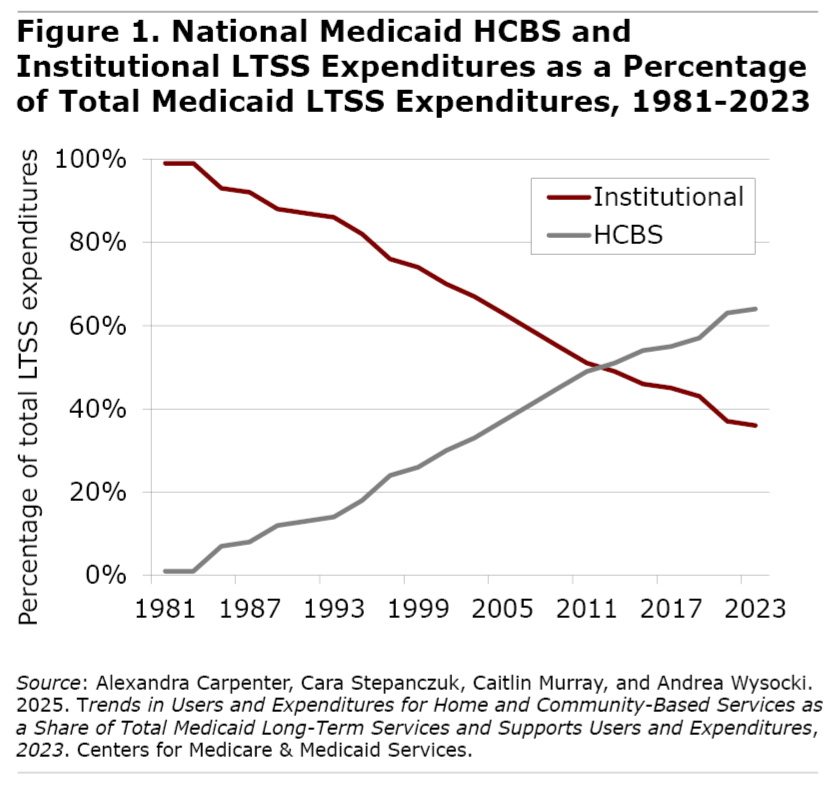
    HCBS accounted for almost two-thirds of all spending on long-term services and supports (LTSS). For historical perspective, in 1981 only one dollar out of a hundred spent by Medicaid for LTSS went to HCBS, rising to half of LTSS spending by 2013 and continuing to grow thereafter (see Figure 1).

    State Variation

    Large variations exist in Medicaid coverage of HCBS by state in large part because such coverage is discretionary, in contrast to nursing home coverage, which is mandatory. Ninety-nine percent of Medicaid beneficiaries in Oregon and Wisconsin receiving LTSS were doing so at home or in assisted living facilities, in contrast with just 56 percent in Kentucky and 61 percent in Mississippi.

    In terms of spending, Medicaid costs for HCBS constituted 95 percent of LTSS costs in Wisconsin as compared to just 36 percent in Arkansas. In other words, only 5 percent of Wisconsin’s expenditures on LTSS are going to nursing homes in contrast with 64 percent of Arkansas’ spending.

    The Future?

    Many people who work on long-term care policy are concerned that the $900 billion in Medicaid cuts in the “One Big Beautiful Bill” will reverse the trend towards more coverage of HCBS. While a lot of the bill’s cuts are aimed at younger beneficiaries, in large part by instituting work requirements, others, such as limitations on so-called provider taxes, are not. States will have to find ways to make up the shortfall in revenue or reduce services. One way may be to cut home health and assisted living coverage, since they are optional under the federal Medicaid rules.

    For more from Harry Margolis, check out his Risking Old Age in America blog and podcast.  He also answers consumer estate planning questions at AskHarry.info.  To stay current on the Squared Away blog, join our free email list.

    This post was originally published on this site.

  • Senior Heart Health: Ailments, Care, and Prevention

    Senior Heart Health: Ailments, Care, and Prevention


    Senior Heart Health: Ailments, Care, and Prevention

    February is American Heart Month, and those of us who care for seniors use it as an opportunity to raise awareness about one of the leading ailments in the elderly: cardiovascular disease.

    Heart health for seniors takes on increasing importance as the cardiovascular system ages. Older people deal with more arrhythmia (irregular heartbeat), blood clots, thickening walls of the heart and blood vessels, and less efficient blood flow through the body. These problems often start quietly in middle age and accelerate as we get into our 60s, 70s, and 80s.

    While aging is itself a risk factor for heart disease, some risk factors are within our control. The following covers essential information to discuss with your elderly loved one and their healthcare providers.

    Cardiovascular Disease in the Elderly

    The term “cardiovascular” reminds us that we are talking about ailments of both the heart and all the vessels that work with it—arteries, veins, and capillaries. While individuals of any age can suffer from cardiovascular disease, it becomes more common as we get older. Common heart problems in elderly patients include, but are not limited to:

    High blood pressure: Also known as hypertension, this very common condition increases the risk of many other cardiovascular problems, including stroke and heart attack. What’s difficult about hypertension is that, day to day, it’s not that noticeable. This can lead to ignoring its very real risks. Contributing factors to high blood pressure are diets high in saturated fat and sodium, chronic stress, obesity, lack of exercise, poor sleep (including with apnea), using tobacco or alcohol, and certain health conditions like kidney disease.

    Coronary artery disease (CAD): When there is damage to the arteries from high blood pressure, high cholesterol, diabetes, and other conditions, plaque can build up in the arteries, blocking normal blood flow. This plaque buildup is also called atherosclerosis and is made up of cholesterol, other fats, and calcium. CAD is the leading cause of angina (chest pain) as well as heart attacks.

    Arrhythmia: This is experienced as an irregular heartbeat and is caused by damage to the heart’s electrical system. Contributing factors are age itself (due to tissue damage and deterioration), hypertension, diabetes, thyroid disease, and sleep apnea. Arrhythmia can also result from dehydration or electrolyte imbalance (from missing nutrients like potassium), and it can be a side effect of some medications. Arrhythmia increases the risk of stroke and heart failure.

     Myocardial degeneration: This is when heart tissue thickens and weakens, leading to reduced blood flow throughout the body. In an individual, this can look like shortness of breath—even when sitting down—fatigue, and edema (swelling in parts of the body, often legs or feet, because of pooling blood and other fluids). Causes include certain infections, nutritional deficiency, drinking alcohol, stress, and sometimes genetics.

    Arteriosclerosis: This is similar to myocardial degeneration, but for the blood vessels instead of the heart.

    Congestive heart failure: This is a chronic condition that happens when a damaged heart cannot pump adequate blood through the body. Fluid builds up in the lungs and/or legs and arms. Heart failure is often the result of chronic cardiovascular disease/damage, or it can begin after a heart attack. It is more common in those over 75 years of age.

    Aneurysm: Aneurysms happen suddenly and are frequently fatal. They occur when part of a weakened artery widens abnormally and then bursts. Prevention of an aneurysm is focused on general blood vessel health, as well as medical screening.

    Heart attack: Medically known as a myocardial infarction, a heart attack happens when a blockage (usually a blood clot triggered by plaque buildup) stops blood from flowing normally to the heart. When this happens, heart tissue quickly begins to die. Signs of a heart attack include shortness of breath, nausea or vomiting, extreme fatigue, dizziness, a cold sweat, and intense chest pain. Different symptoms are more common in women vs. men.

    Stroke: This is similar to a heart attack, but affecting the brain instead. In addition to a clot, it can be caused by brain bleeding (hemorrhage). Signs of a stroke include severe headache, vision problems, confusion, difficulty speaking, and sudden numbness. It is common to lose control over one half of the body.

    Other common conditions include varicose veins, deep vein thrombosis, and aortic stenosis.

    Preventive Care for Heart Disease

    Much of senior heart disease prevention is focused on keeping the heart and blood vessels strong and clear. This means preventing the strain caused by hypertension, safely exercising the cardiovascular system, and making lifestyle choices that promote healthy arteries.

    First, be sure your loved one visits their doctor regularly. Blood tests can assess cholesterol levels and catch problems early, including high blood sugar or other diseases that impact cardiovascular health. Their medical office will take their blood pressure, but this is something you can also do at home. You can also monitor pulse; a normal heart rate for an elderly individual is 60-100 beats per minute when they are at rest, with an average in the 70s. If resting heart rate falls outside this window, bring it up with their doctor.

    If your loved one is prescribed medications to manage cholesterol or hypertension, make a plan to ensure they take it exactly as prescribed. Encourage them to speak up about side effects or changes they notice, and don’t be shy about bringing issues promptly to their doctor.

    The most important lifestyle change your loved one can make for their cardiovascular health is to quit smoking, since it severely damages bodily tissue. Beyond this, avoiding alcohol and adopting a heart healthy diet are effective ways to preserve the health of their heart and blood vessels. Speak to a doctor or registered dietician about foods to emphasize and foods to avoid. Also find out the healthy target weight range for your loved one and get assistance with diet planning to help them stay within it.

    Stress is hard on the whole body, so managing it becomes crucial. Help your loved one find enjoyable activities for relieving stress, whether that is chair yoga or playing a musical instrument. Facilitate their social life; this may mean helping them with rides or with technology to stay in touch with friends and family. If their stress is intense and possibly diagnosable as a mental health disorder, help them find resources such as a counselor or support group.

    Exercise is important at every age, but seniors may not be able to safely do all the activities they once did. Talk to their doctor or an occupational therapist about simple, appropriate exercises to maintain flexibility and balance, increase blood flow, and strengthen muscles. This is important for cardiovascular health, but has the side benefit of helping to prevent falls.

    Check in with your senior loved one about any cardiovascular symptoms they may be experiencing—shortness of breath, easy tiredness, chest pain, pain in arms or legs, dizziness, or trouble sleeping. Encourage them to see their doctor regularly and to make lifestyle choices that help prevent heart disease in old age.

    If you need support in caring for your elderly loved one, our VetAssist mission is to make home care easily and quickly accessible for those who qualify through the VA Pension with Aid and Attendance benefit. Veterans Home Care can help you determine whether you or your loved one will be eligible to receive the benefit, which can cover some or all of the cost of home care, and we make it easy to apply. Chat with us via our website, or call us at (888) 314-6075.

    The post Senior Heart Health: Ailments, Care, and Prevention appeared first on Veterans Home Care – VA Aid and Attendance Pension Benefit.

    This post was originally published on this site.

  • Best Things to Do in Salerno 

    Best Things to Do in Salerno 

    Last Updated on May 8, 2026 by Sarah Wilson If you’re drawn to the Amalfi Coast but want something more authentic, affordable, and less crowded, Salerno is an excellent alternative. Located at the eastern edge, it offers history, sea views, and everyday Italian life, without the inflated prices or crowds of places like Positano or […]

    The post Best Things to Do in Salerno  appeared first on LifePart2andBeyond.com.

    This post was originally published on this site.