I’m not very good at relaxing on vacation. Invariably, I bring a new book, determined to spend quiet time reading. I imagine myself sitting back, soaking up the sun, dozing off here and there to the lullaby of lapping waves. And the book comes back unopened. It never even leaves the bag. Instead, my camera roll is loaded with photos of activities and adventures, and I often need time to recover from my vacation.
So when we booked a cruise to Tahiti, I found myself asking … What are we going to do on the cruise?
What I didn’t know at the time, was that this was no ordinary cruise. We had booked Windstar’s Dreams of Tahiti, a seven-day sailing from Papeete on Star Breeze, a small ship hosting up to 312 people, and I was about to discover that a voyage around the islands definitely had an adventurous side. (Editor’s Note: Wind Star, the line’s 142-passenger sail class ship, will also be sailing this itinerary from March 2027).
Our week aboard Star Breeze was by all means luxurious, indulgent, rejuvenating, and yes, relaxing. But it was also full of activity with countless opportunities to get off the ship, onto land and into the water, and to make the most of this magnificent spot in the South Pacific.
We took full advantage of the activities offered. Each one was perfectly planned, led by expert and local guides. With every detail set in place, we only had to show up, board the tender on time, and set out for a new adventure custom made for us. As this was a first-ever Polynesian cruise for my wife and me, we chose a perfect itinerary for neophytes to the region. Dreams of Tahiti’s weeklong length (we intend to make our next cruise there a longer one now that we’re hooked) involved calls at places like Moorea, Huahine and an overnight in Raiatea, where Windstar guests celebrate an evening at the private Motu Mahaea in nearby Tahaa. And there’s an overnight in Bora Bora.
There was never a dull moment.
In Bora Bora: one afternoon, a tranquil lagoon, and the ride I still think about
The peaks of Bora Bora/
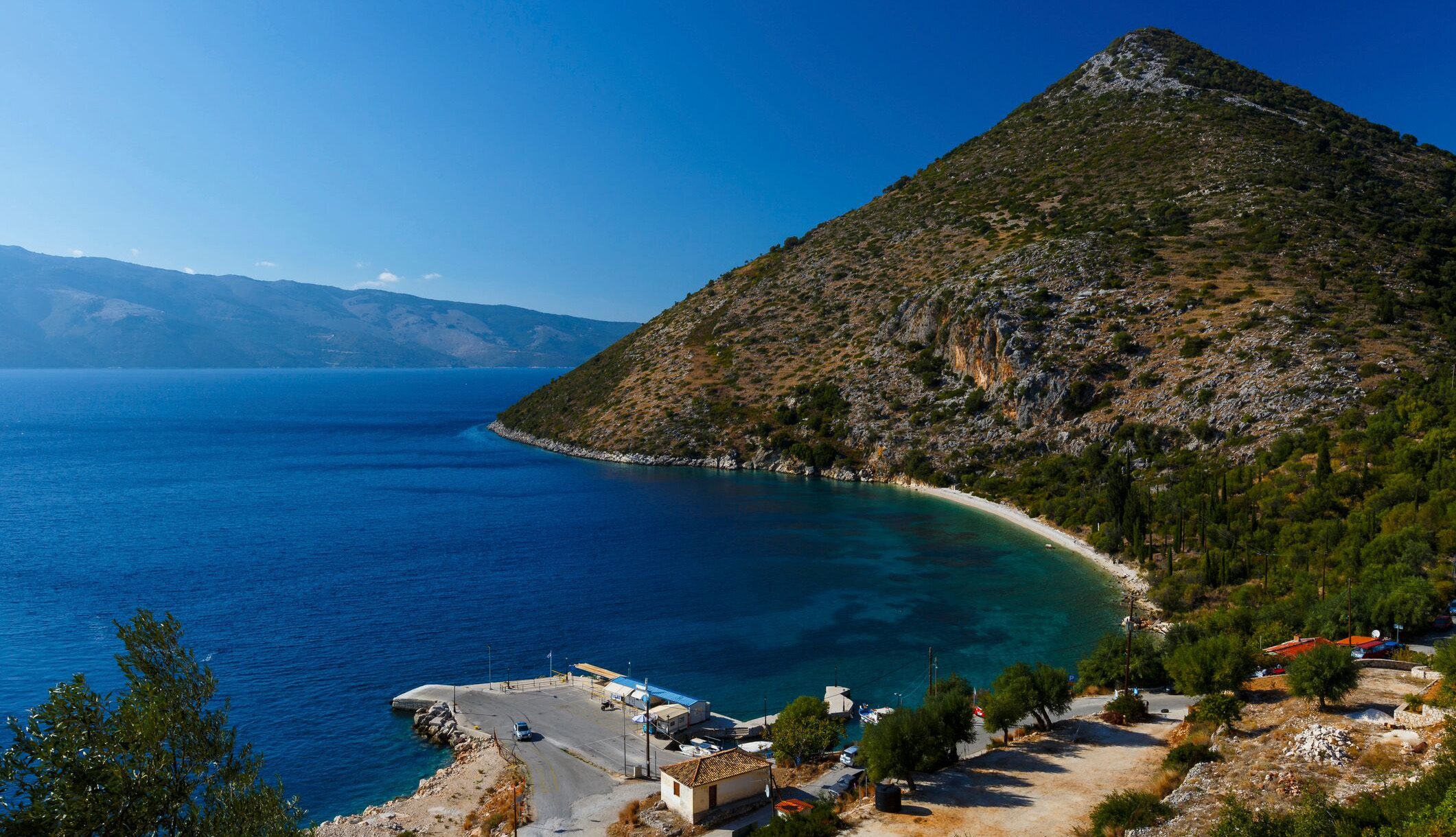
A towering figure in life and lore, Bora Bora is a stunning spire rising from the sea. An ancient volcano, the island is all that I had imagined: lush, rugged jungle lifted straight from a postcard. The best way to see the island of Bora Bora is from the lagoon, a glassy expanse of aquamarine water sheltered by a coral reef. And what better — and more fun — way to explore the lagoon than on a jet ski?
A small ship experience means Star Breeze and Wind Star (which begins sailing from Tahiti in March 2027)are the perfect size for exploring French Polynesia’s intimate Society Islands like Raiatea, Bora Bora and Moorea.
On each 7- to 10-night voyage, a pair of Destination Discovery events offer culinary and cultural immersion. Held on private motus (islands) with gorgeous beaches and forests, these include a lunchtime barbecue and a Polynesian dinner and a high-speed, acrobatic fire-dance performance in local culture
Want to stretch your visit? You can combine your cruise with overwater bungalow stays on Bora Bora.
We met our local guide Maui at the pier, and after a short lesson and game of keep up, we went full throttle and found ourselves somehow gliding across a kaleidoscopic sea. Colorful coral beds dotted the white sands underwater as we zipped around the lagoon. The views of this otherworldly island shifted as we went, seeing different angles and stopping at different spots. We took a break on a small motu across the water, where Maui cracked fresh coconuts, a gentle rain passed, and we awed at the surreal scenery.
Eventually, we would make a full circle of the island on this four-hour excursion. And we’d return to the ship having a hard time believing what we’d just experienced.
In Tahaa, we discover that its coral gardens will make you forget the surface exists
Snorkeling off Tahaa in a magical underwarter wonderland./Brendan Harrington
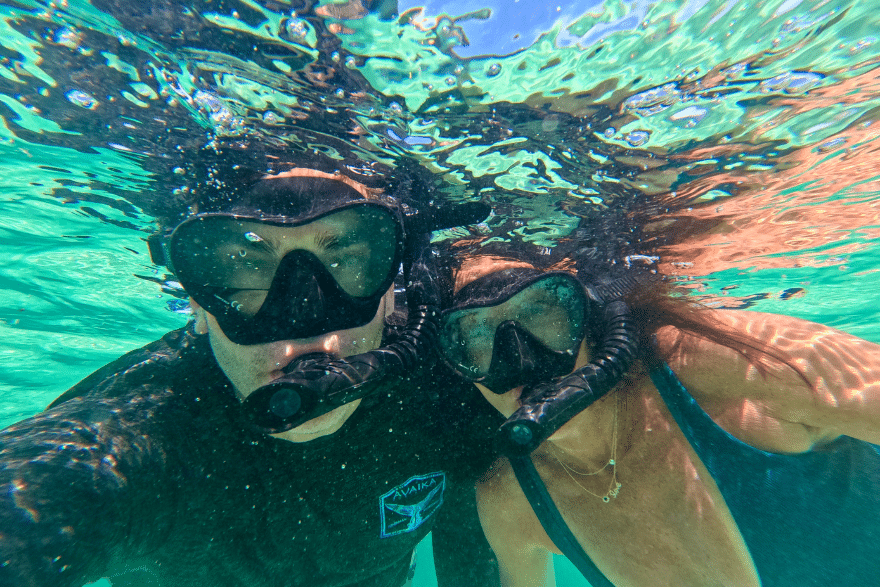
Often, the most colorful coral beds are found in shallow water, and the coral gardens at Tahaa, are no exception. After a short boat ride to the far side of this island, we walked across an uninhabited motu and masked up for a magical tour of this underwater wonderland.
Flowing with the current, we drifted through small canyons of coral reef, with an amazing array of bright and spirited fish peeking out from the folds and gliding around us. The reef’s shades of purple and red and green resembled a technicolor film. While we were carried on the current, we had to be careful not to touch the coral. And at the end of the canyon, we were able to walk back and do it again.
Snorkeling in this type of water is a special experience. And this particular spot is unique in all of Polynesia for its pristine reef and colorful variety of tropical fish.
How an e-bike unlocked Huahine, French Polynesia’s most underrated island
On his first cruise, Brendan Harrington (and his wife Stephanie) explored the Tahitian islands by water and on land./Brendan Harrington
While it’s great to get into the water in French Polyne a, it’s also fun to explore the islands and experience a slice of local life on land. Not as steep and mountainous as the other islands, there is something very special about Huahine. It feels so real, so relaxed. From the friendly French woman who had left Paris to raise her family in this paradise, to the warm greetings we received from people tending their gardens, to the school boys jumping off the dock and playing in the sea together. We were treated to a slice of local life here. It’s a peaceful place, lost in time, and unbothered by the mass tourism found in large ports in other parts of the world.
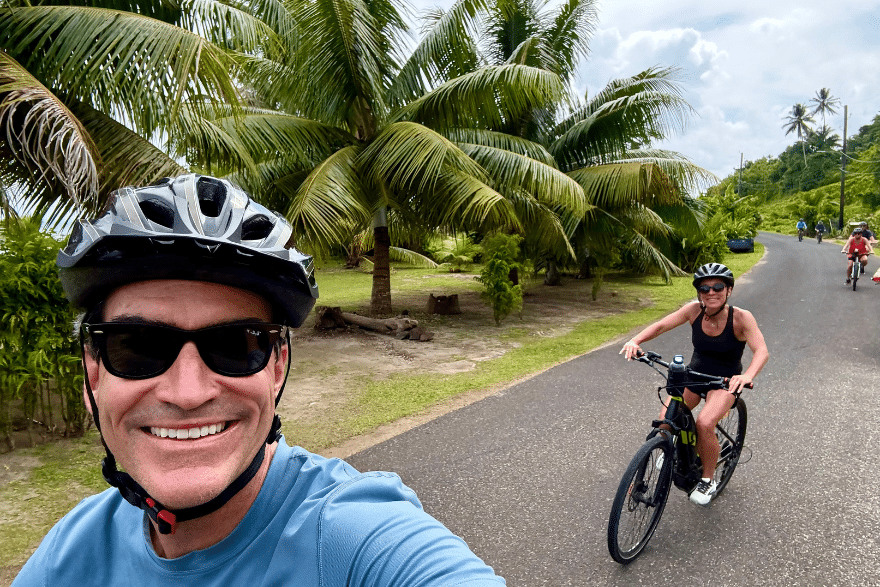
Here on Huahine we joined a small group tour with eight other passengers to ride e-bikes around the island. With just one road circumnavigating it, we glided along the coast under towering palms and past colorful homes, as residents tended to their gardens, fed their chickens and went about their daily lives.
The scenery changed from flat coast to rocky coves. We easily climbed hills to spectacular sea views. We stopped for a fresh fruit juice and chance to wade in the crystal clear shallows. And from the top of the island, the Windstar small-ship difference was clear, as we were able to see our ship, anchored alone in a small cove.
With the motorized bikes, it was as easy as pushing a button and enjoying the ride. Whether you want a physically demanding outing or an easy island ride, just about anybody can enjoy the three-hour e-bike tour. It was an amazing way to see the island up close.
The underwater side of Bora Bora and Raiatea is where the real luxury hides
In Bora Bora and Raiatea, scuba diving outings included travelers with all skill levels./
And then, of course, there was the scuba diving. With a number of outings available — including beginner courses and shallow introductory dives for beginners — I chose two different two-tank dives, at Raiatea and at Bora Bora (where we had an overnight stay and so had a couple of days to play). With the dive guides and gear already set up, I simply had to show up and jump in.
After a stop at the small local dive shop, we motor to the outside of the reef for a 50-foot dive along the coral wall, surrounded by dozens of tropical fish of every shape, color and size. Parrotfish, pufferfish, wrasse, and more slowly swam by, as curious about us as we were about them. A half dozen black tip reef sharks circled, harmlessly approaching within arm’s reach to have a look. It was a great first dive and introduction to the area.
The dives at Bora Bora were even more wonderful. A shallow dive to the manta ray cleaning station found us admiring these giants up close as they slowly glided by, just five feet above. And the deeper dive took us into sea floor canyons where large schools of fish moved in perfect unison through streaking rays of sunlight. Moray eels, crabs, and bright red fish the size of my thumb played hide and seek in the coral.
Our fellow divers were all very experienced and had come on this trip specifically for the diving. It’s an experience I’ll always remember, as much for what we saw under the waves as for where we were when we came back up.
Absolutely in paradise.
If you go
Off the coast of Hiva Oa, in the Marquesas Islands, we celebrate Windstar’s deck party, onboard Star Breeze, with performers from the island./Carolyn Spencer Brown
In 2026, Star Breeze sails year-round in Tahiti, offering a blend of great-for-first-timers options, such as Dreams of Tahiti, and more exotic forays to the Marquesas Islands and the Cook Islands. In 2027, Windstar’s 148-guest motor sailing yacht Wind Star will join Star Breeze in the region, offering two special ships on which to experience French Polynesia.
With two ships in French Polynesia in 2027 and 2028, Windstar can offer a wide variety of itineraries in the region. Among them?
The seven night Dreams of Tahiti itinerary is, as author Brendan Harrington notes above, the perfect introduction to French Polynesia. There’s another great option for new-to-Tahiti travelers, too. The 10-night Māori Storytellers and French Polynesian Treasures offers insights into South Pacific cultures in the Cook and Society Islands.
For a broader regional experience, consider the 13-night Flowers of the Pacific cruises between Fiji’s Lautoka and Tahiti, with stops along the way in the Cook Islands. Craving an even more in-depth experience? Windstar’s 20-night Star Collector Star Collector, Legends of the Pacific includes additional immersive experiences in Fiji’s lesser-visited ports such as Taveuni, Savusavu, and Dravuni, along with Tonga. You’ll also take in the Cook Islands and French Polynesia’s marquee destinations, like Raiatea, Bora Bora, Rarotonga and Moorea.
One of our best ever experiences on Windstar in French Polynesia was a trip to the oh-so-remote Marquesas Islands. The two-week Star Collector: Extended Tahiti & Tuamotu Adventures voyage, roundtrip from Tahiti, includes visits to the Marquesas’ Hiva Oa and Fatu Hiva, as well as the Society Islands of Moorea, Fakarava, Raiatea, Huahine, and Bora Bora.
Erin Moriarity bought her first stock at 8 years old: Campbell Soup, because she liked the kids on the label. Disney came second. By the time she passed her CFP exam in 2016, she’d studied personal finance for decades.
Her YouTube channel, Erin Talks Money, has grown to more than 390,000 subscribers. The audience skews 55 and older: experienced DIY investors working through Social Security timing, withdrawal strategies, and the harder question of how to spend what they’ve built.
Erin joined Boldin CEO Steve Chen on the Boldin Your Money podcast to talk about what she’s learned, what she keeps returning to, and why financial independence has always felt personal to her.
What Is Erin Talks Money?
Erin Talks Money is a YouTube channel where Erin Moriarity covers Social Security strategies, retirement income planning, and the psychology of spending down savings, for an audience that’s mostly 55 and older.
She launched the channel six years ago, and it took more than a year and a half for her to monetize it. Erin quit twice, and her brother and husband talked her back both times. Her earliest videos barely got any views. Her brother, a physician, would walk hospital halls opening her videos on every computer he passed just to give her a view.
Erin has since built a thriving community. “My community is incredible,” she said. “DIYers. They’re very well researched themselves, they’re very informed. They impress me every single day.”
The questions in her comments run to Roth conversion timing, Social Security delay strategies, and how much to leave the kids. “My community is very financially literate,” she said. “This is not the people who are paycheck to paycheck.”
Erin has no Instagram page, no TikTok account, and no Telegram group. “I want to go live my life,” she said. YouTube is where she works, and comments and email are how she connects.
What Made Financial Independence Personal for Erin Talks Money?
Erin Moriarity’s drive for financial independence came from watching her mother pick the last savings bond out of the savings box when she was 7 years old. “I looked at her, I’m like, what do we do now? Like, how do we get groceries?” she recalled.
Her grandmother inspired her to invest. Born in 1927, raised during the Depression, married to a miner, she worked as a seamstress and built real wealth over a lifetime.
“The dining room was just always full of grandma’s papers,” Erin recalled. “Grandma’s papers were from the brokerage houses and like her stock certificates… we would just leaf through these and whenever it was time for the grandkids to eat we had to like shift off all of her papers and put them on the floor.”
Her grandmother had been investing since the 1950s. She taught Erin’s mother to save and handed Erin something sharper: the conviction that money is something you pay attention to.
Her father taught a different lesson. A dentist who held tight control over the family’s finances, he fired Erin’s mother after the divorce and stopped paying child support. Erin would go with her mother to collect workers’ compensation in person. She watched the savings bonds run out.
That period gave Erin a specific kind of clarity. “I saw my dad be very, very, very controlling over my mom, over myself, over my brother,” she said. “And it very much left this impression that I don’t want someone else to control my financial life.”
Why Erin Talks Money Keeps Coming Back to Social Security
Social Security timing is the most consequential financial decision most retirees make. Erin Moriarity believes most people approach it with far less strategy than it deserves.
She found her way to it through a book her father brought home, Get What’s Yours by Lawrence Kotlikoff. It was originally meant to help Erin’s mother maximize her benefits, but Erin read it herself.
What she found surprised her: a system far more complex than the SSA’s own materials suggest, full of claiming strategies, timing tradeoffs, and spousal decisions that most people never learn about.
“This system is fascinating,” she said, “and also a lot of people don’t seem to know a lot about it.” She saw the space between how much Social Security rewards preparation, and how little most people prepare.
Years later, it became her first YouTube video, and it’s still a topic she’s passionate about. Her 55-plus audience is making claiming decisions now, and the income floor Social Security builds shapes everything else in a retirement plan.
What does Erin Talks Money recommend for Social Security timing?
Delaying Social Security as long as you can cover the shortfall tends to produce the highest lifetime income for most retirees. Erin makes this case above all for married couples, where the surviving spouse keeps whichever benefit is larger.
Her core argument: delay builds the income floor. Claiming early shrinks it for life. She has little patience for the claim-early-and-invest argument. “Show me your 8% risk-free,” she tells people who make it. “Because the 8% is guaranteed.”
The delayed retirement credit also comes with inflation adjustment.
Should you worry about the Social Security trust fund running out?
The 2032 trust fund depletion date means a potential benefit reduction, not a program shutdown. Erin Moriarity thinks Congress will act before it gets there, just as it did in 1983.
She’s watched fear push people to claim at 62, locking in a reduced base before anything has changed.
“I think they’ll wait till the last minute,” she said, “but they’ll do something. It’s not going to run dry.” In 1983, lawmakers struck a deal just weeks before the deadline. She thinks the political cost of letting benefits fall for tens of millions of voters will force action again.
Erin Talks Money Makes the Case for an Income Floor First, Portfolio Second
Erin Moriarity’s retirement income strategy starts from one principle: cover your essential expenses with guaranteed income before you draw from your portfolio.
“There’s really only a handful of ways to fund a retirement,” she said. A pension if you have one. Social Security, timed to maximize the monthly benefit. An annuity if you want to build a pension-like income without one. Part-time work to make up the difference. A portfolio withdrawal strategy once the floor is set.
The order matters. Getting the guaranteed income sources right gives the portfolio a different job to do. Building the floor means:
Entering retirement with as little debt as possible, so essential expenses stay low
Using pension income or an annuity to cover what Social Security doesn’t
Making sure guaranteed income covers the basics before the portfolio gets touched
“I like the idea of having as many of your essential expenses covered by guaranteed income streams,” she said.
The distinction matters in concrete terms.
“If the market does well and you look at it and you say, ’Hey, we can take three vacations this year,’ as opposed to no vacations, that’s a much easier position to be in,” she said.
The other scenario is the one she wants her audience to avoid. “If the market performance is deciding whether or not I can pay my property tax,” she said, “that’s a very vulnerable position for me.”
Her personal preference is, “Home paid off, car paid off, no credit card debt, no outstanding debt. So my expenses are as low as essential.” After that, the portfolio becomes a source of choice.
Does Erin Talks Money recommend annuities in retirement?
Erin sees annuities as one way to build a guaranteed income floor. “If you want to make your own pension with an annuity because that brings you a sense of security, great,” she said.
It’s not a blanket recommendation. At 38, she holds the view loosely and expects it to change. “Ask me when I’m 65,” she added.
For retirees without pension income who want their essential expenses covered by something that doesn’t depend on markets, an annuity can fill that role.
What’s the difference between a bucketing strategy and a balanced portfolio withdrawal approach?
A bucketing strategy holds a cash or short-term reserve, insulating it from market swings. A balanced portfolio approach accepts more volatility in exchange for a potentially higher long-term withdrawal rate. Erin doesn’t favor one over the other.
“Do you want more of a bucketing approach so you have this cash buffer set aside that’s really insulated from market volatility,” she asks, “or are you okay with having a more balanced portfolio that is more exposed to volatility and having a lesser withdrawal rate on the total portfolio?”
Her answer: either can work. “I don’t really think there’s a wrong way to approach retirement,” she remarked. “I think it’s about aligning it with your risk tolerance, with your perspective.” Self-knowledge about how you respond to drawdowns matters more than the choice of strategy.
Most people don’t find out which approach fits their risk tolerance until a bad year tests it. The Boldin Planner lets you model your income floor, compare Social Security claiming ages, and stress-test your plan against a decade of poor returns, so you can see what holds before you’re depending on it.
What Erin Talks Money Says About Going DIY vs. Hiring a CFP
Erin Moriarity thinks most people don’t need a financial advisor while they’re building wealth. Her baseline is simple. “You don’t need a financial advisor,” she notes. “You don’t need someone telling you how to create the optimal portfolio. What you need is to just put money away.” She also has a caveat most people miss. “You don’t want to just hand everything over to a CFP,” she said. “You want to be actively involved in that.” Whoever you work with, the goal is to understand the plan well enough to own it.
You own a business or carry estate complexity that intersects with your retirement
You’re in your 70s and want a professional in your corner before cognitive decline can become a financial risk
That last point moved her the most. Her father developed vascular dementia. His second marriage ended partly because his wife didn’t want to take on his care. By the time Erin saw what was happening, she had no standing to step in. He fell into a Ponzi scheme, and moved a substantial portion of his assets into gold. He also bought an annuity without grasping the terms.
“Money is kind of the first place it shows up,” she said of cognitive decline. “If he had been working with a CFP,” she said of her father, “there would have been a lot less blowback.”
Why Erin Talks Money Keeps Coming Back to the Hardest Part of Retirement
The hardest part of retirement, for Erin Moriarity, isn’t building the money. It’s spending it.
“We spend 30, 40 years accumulating wealth,” she said, “and then people enter into retirement and they’re so afraid to spend it.”
The fear isn’t abstract. “They’re so afraid that what they’ve worked these three or four decades for is ultimately going to run out and it would run out at the worst possible time, right?” she said. “When you’re 80 or 90 and you can’t go back to work at that point.”
That fear persists even when the numbers look solid. It doesn’t dissolve when the income floor is in place, or go away when the balance crosses a threshold.
Part of what she’s trying to do is close that distance. “What’s most interesting for my audience and for me,” she said, “is to maybe nudge people to spend what they’ve worked so hard for safely.”
She read Die with Zero by Bill Perkins, and has mixed feelings. “I love it on the one hand,” she said. “This idea that you should spend everything you’ve worked so hard for. I’m fully on board with that message.” The literal advice to take on debt in your 20s to fund your lifestyle is where she parts ways. “I don’t want debt. I don’t want to owe anybody anything.”
What she wants for her audience is to reach retirement with obligations cleared, essential expenses covered by guaranteed income, and a plan they’ve stress-tested. The goal is to reach a point where spending is a decision you can make rather than a risk you’re afraid to take. After that, the portfolio is yours to spend.
Frequently Asked Questions About Erin Talks Money
Who is Erin Moriarity of Erin Talks Money?
Erin Moriarity is the creator of the Erin Talks Money YouTube channel, where she covers Social Security strategies, retirement income planning, and the psychology of spending down savings for investors who are mostly 55 and older. She holds a master’s in personal finance and passed the CFP exam in 2016. Her channel has more than 340,000 subscribers.
What topics does the Erin Talks Money YouTube channel cover?
The Erin Talks Money channel covers Social Security timing, retirement income floor construction, withdrawal strategies including bucketing and balanced portfolio approaches, and the emotional challenge of spending what you’ve saved. Erin Moriarity also addresses when to hire a CFP, how to think about annuities in retirement, and what the Social Security trust fund situation actually means for people planning retirement now.
What does Erin Talks Money say about Social Security timing?
Delaying Social Security for as long as you can fund the gap tends to produce the highest lifetime income for most retirees. The delayed retirement credit is guaranteed and adjusts for inflation. That makes the claim-early-and-invest argument hard to sustain in most cases. For married couples, the case for delay is stronger still: the surviving spouse collects whichever benefit is larger, so delay on the higher earner’s benefit protects against a long widowhood.
When does Erin Talks Money say you need a financial advisor?
A financial advisor adds limited value when a financial life is straightforward: consistent savings, a simple account structure, no major estate or tax complexity. The case for a CFP grows when life gets complicated. Erin Moriarity also makes the case for having a professional in your corner by your 70s, when cognitive decline can become a financial risk before anyone realizes it’s happening.
What does Erin Talks Money recommend for retirement spending?
The foundation of retirement spending is a high income floor. This means Social Security delayed as long as feasible, minimal debt entering retirement, and essential expenses covered by guaranteed income streams. With those covered, the portfolio becomes a source of choice rather than a lifeline. That shift is what makes spending feel safe rather than reckless, and it’s the piece most retirees find hardest to build without seeing their full plan laid out in front of them.
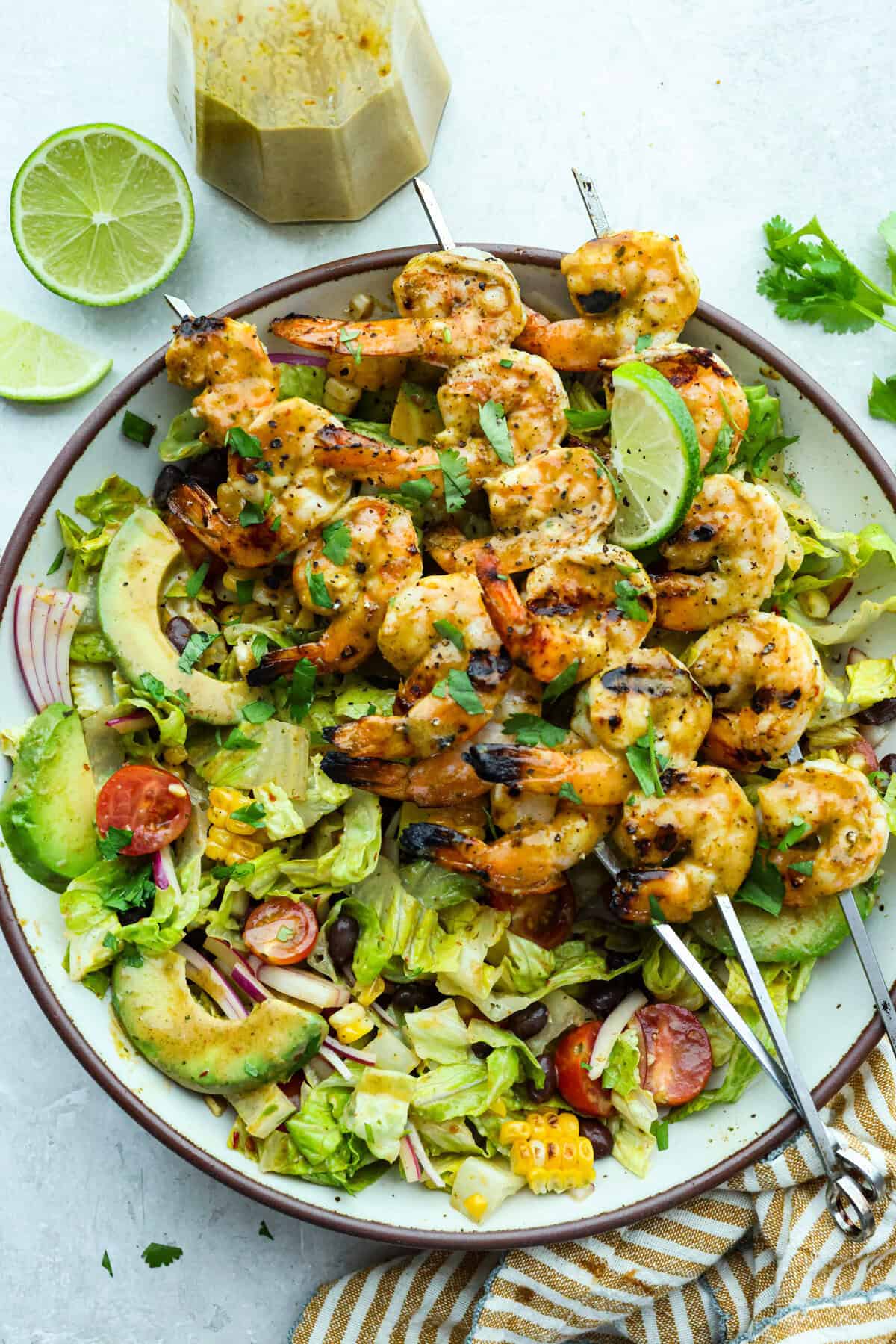
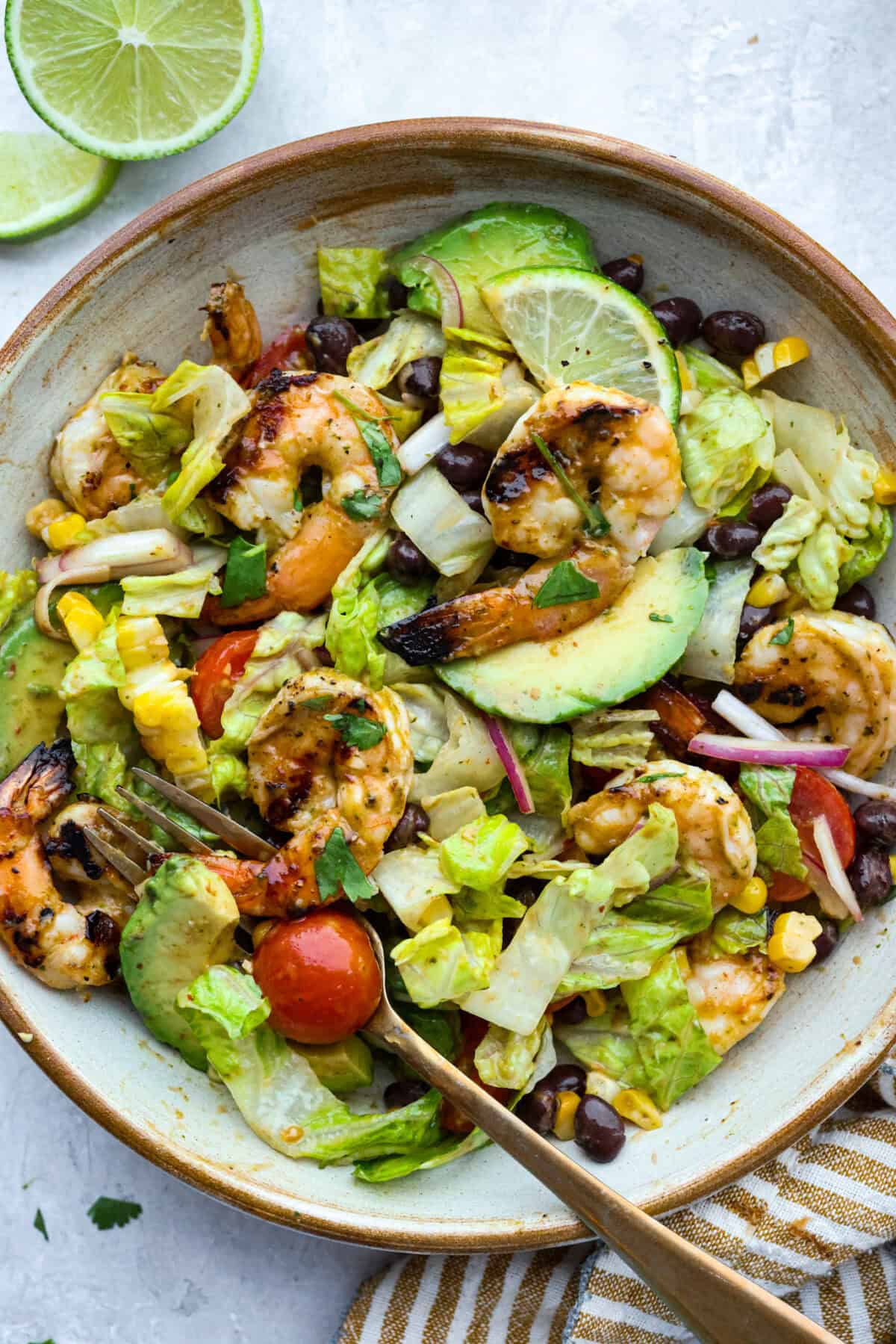
I love salads in the summer, and this grilled shrimp salad is such a good one. It’s fresh, colorful, and filling without feeling heavy. And the dressing? Oh my gosh. The chipotle-lime flavor is so good, you’ll want to pour it on everything.
Why This Salad is ‘Shrimply’ the Best
Big grilled flavor: The shrimp cook quickly on the grill, giving them that smoky, charred flavor while keeping them juicy and tender.
That Dressing! The chipotle-lime dressing works as both the shrimp marinade and the salad dressing, so every bite has bold, fresh flavor.
It’s hearty enough for dinner: With shrimp, black beans, avocado, grilled corn, and crisp romaine, this salad is light and fresh but still filling.
A Reader’s Review
The dressing is awesome and can be used on many other dishes! Great flavor and made for a very satisfy dinner!!
Jeff
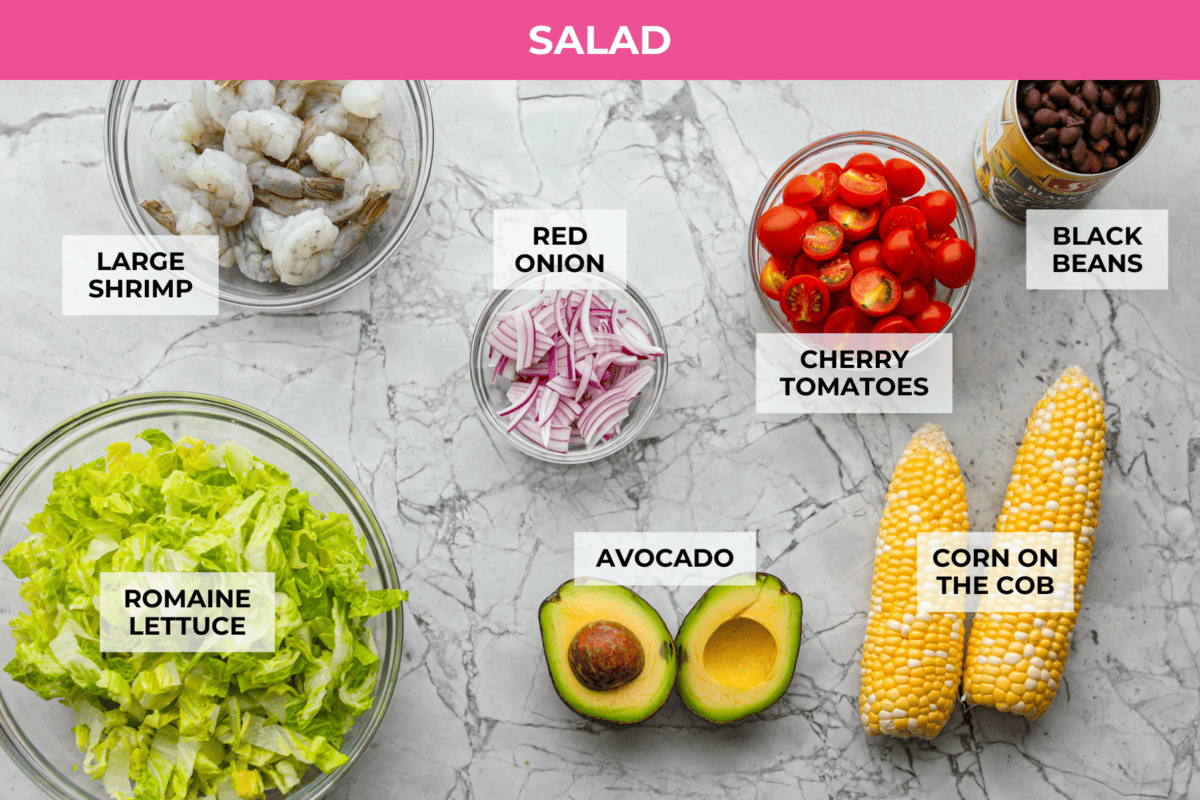
Ingredients For Grilled Shrimp Salad
Corn Tip: Use canned corn to make this salad faster and easier.
Shrimp Size: Any size shrimp works. Smaller shrimp cook faster, and larger shrimp may need 1–2 extra minutes.
Don’t Overcook: Shrimp is done when it turns opaque and feels firm with a little spring.
Frozen Shrimp: Thaw frozen shrimp before cooking. Let it sit overnight in the fridge or run the sealed bag under cold water.
How to Make Grilled Shrimp Salad
Eating salad in the summer is my go-to, and this grilled shrimp salad is always on repeat! It has so much flavor, and I just love shrimp. Make it on its own for lunch, or add garlic bread, watermelon salad, and Brazilian lemonade for a complete dinner.
Dressing
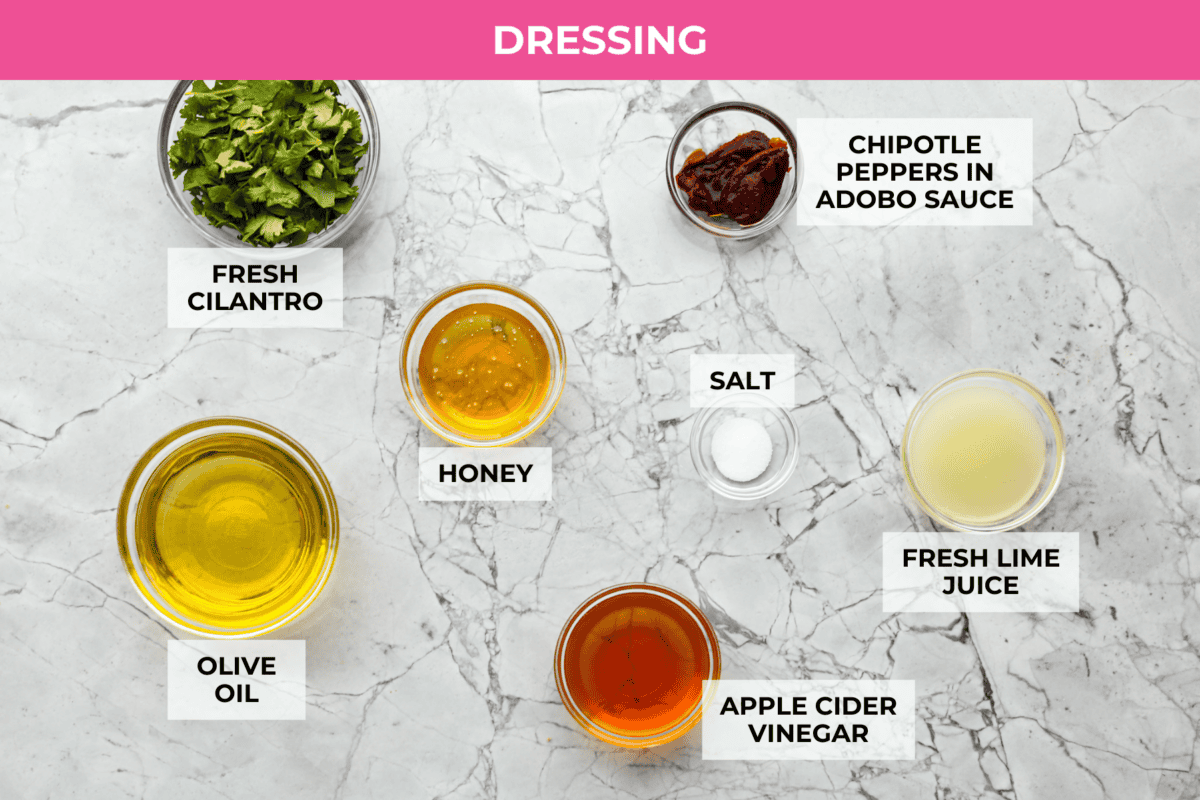
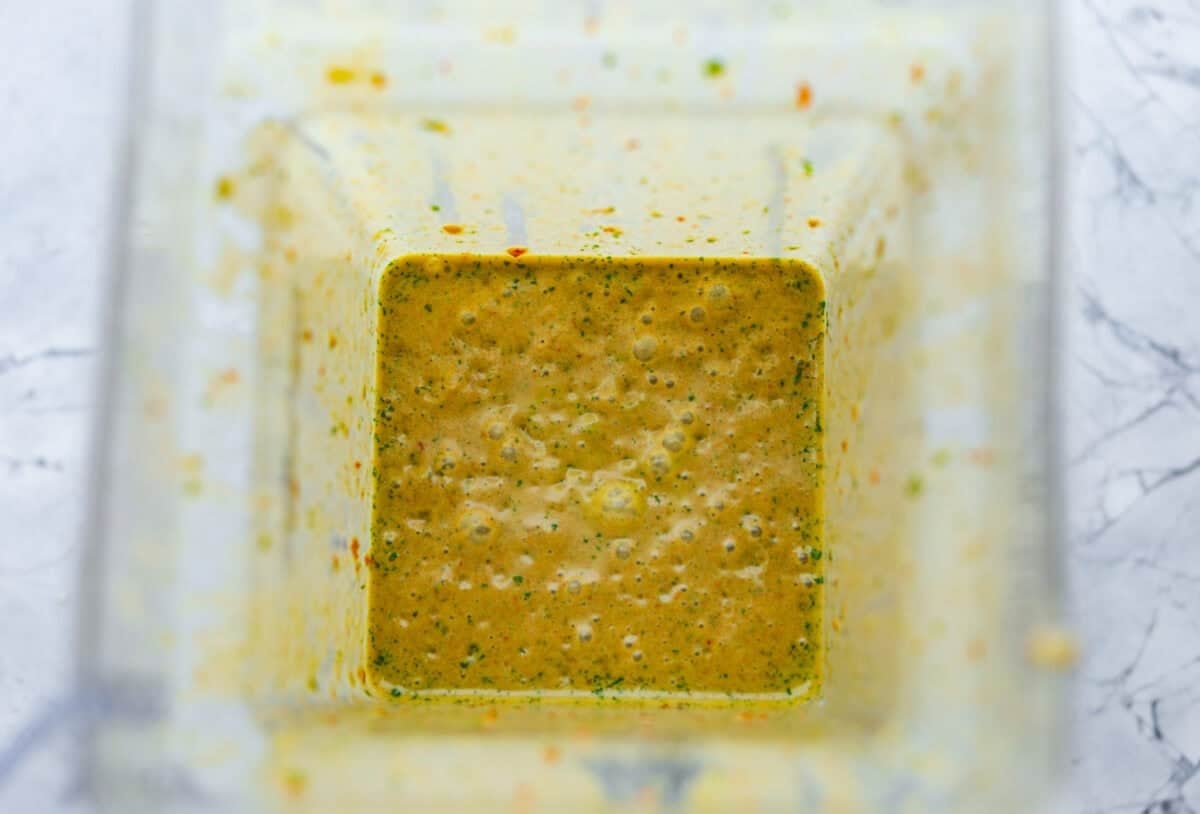
Chipotle Lime Dressing: Add olive oil, cilantro, apple cider vinegar, lime juice, honey, chipotle peppers in adobo sauce, and salt to a blender and blend until smooth and combined. Taste and adjust the salt as needed.
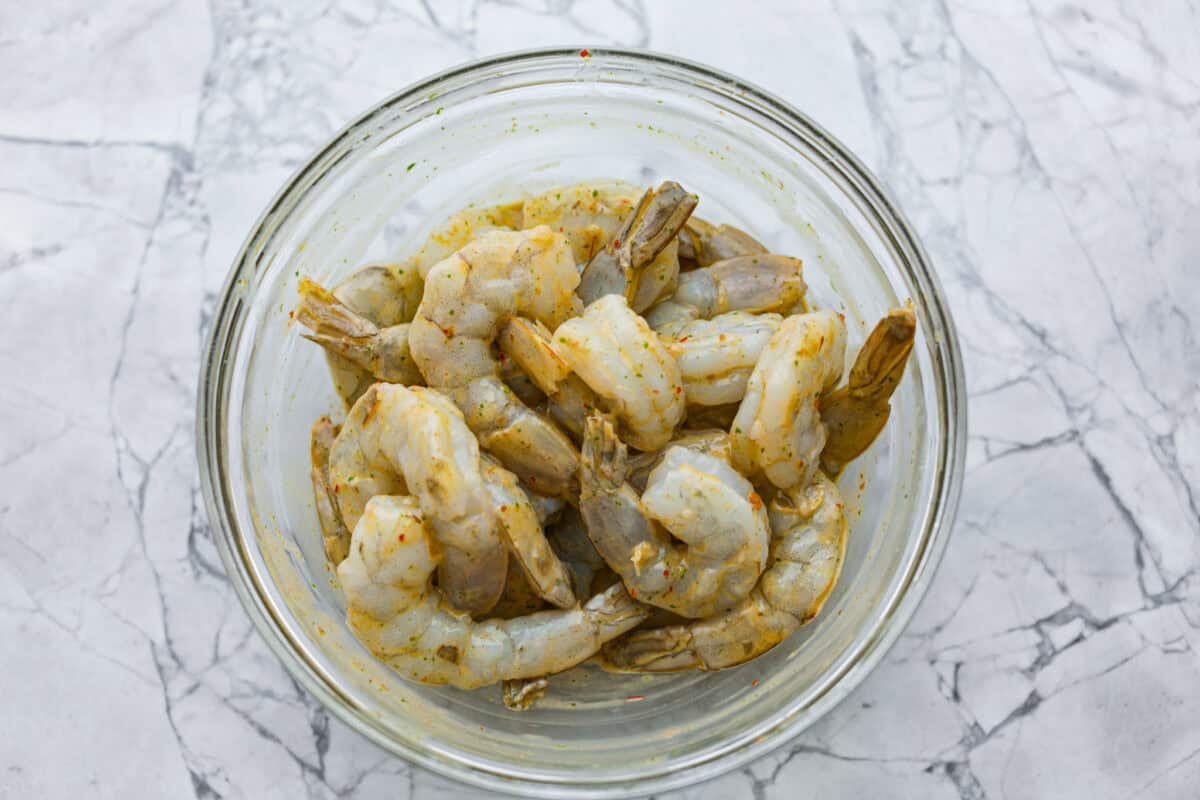
Marinate: Add ¼ cup of the dressing to a bowl with the peeled shrimp to marinate for 15 minutes. Set the remaining dressing aside.
Grilled Shrimp Salad
Cook Corn: Heat the outdoor grill to medium heat. While the shrimp marinates, place the corn onto the grill and cook for 10-12 minutes, rotating a few times.
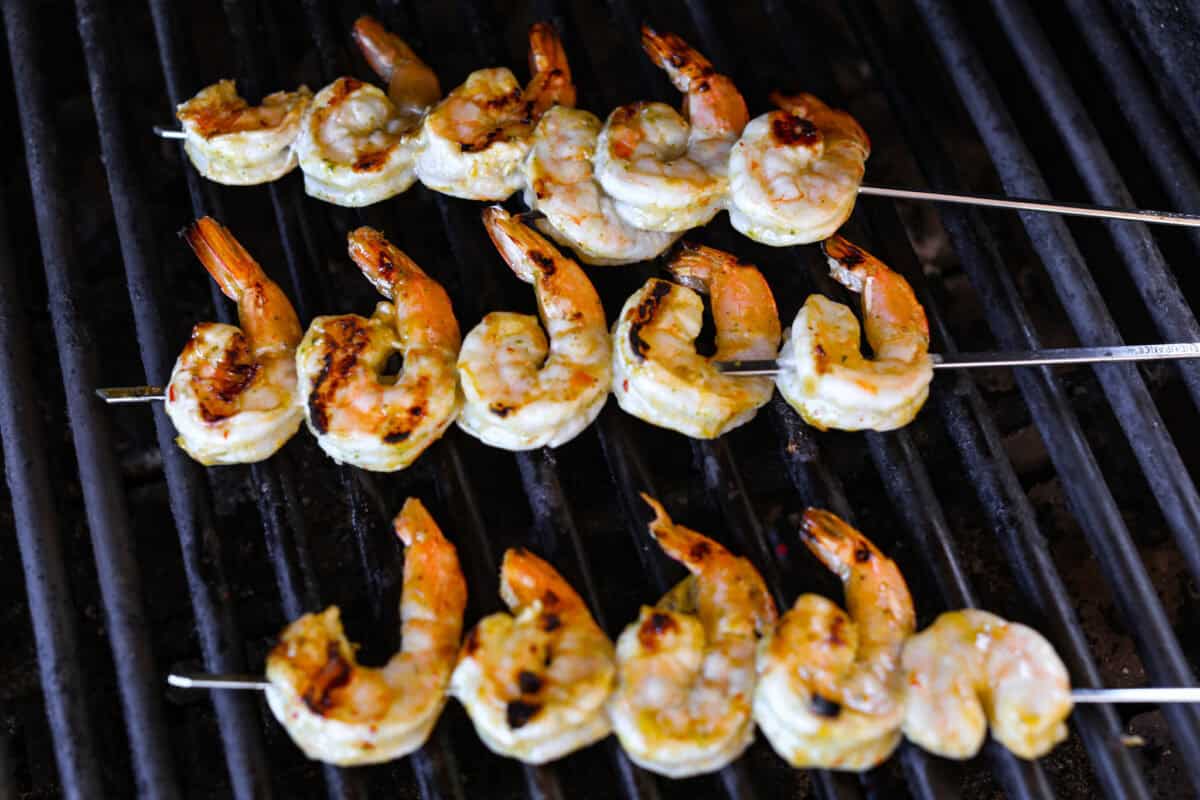
Cook Shrimp: Thread the marinated shrimp onto metal skewers, then grill for 2 minutes per side. Remove the shrimp skewers and corn from the grill.
Cut Corn: Carefully cut the kernels off the cob.
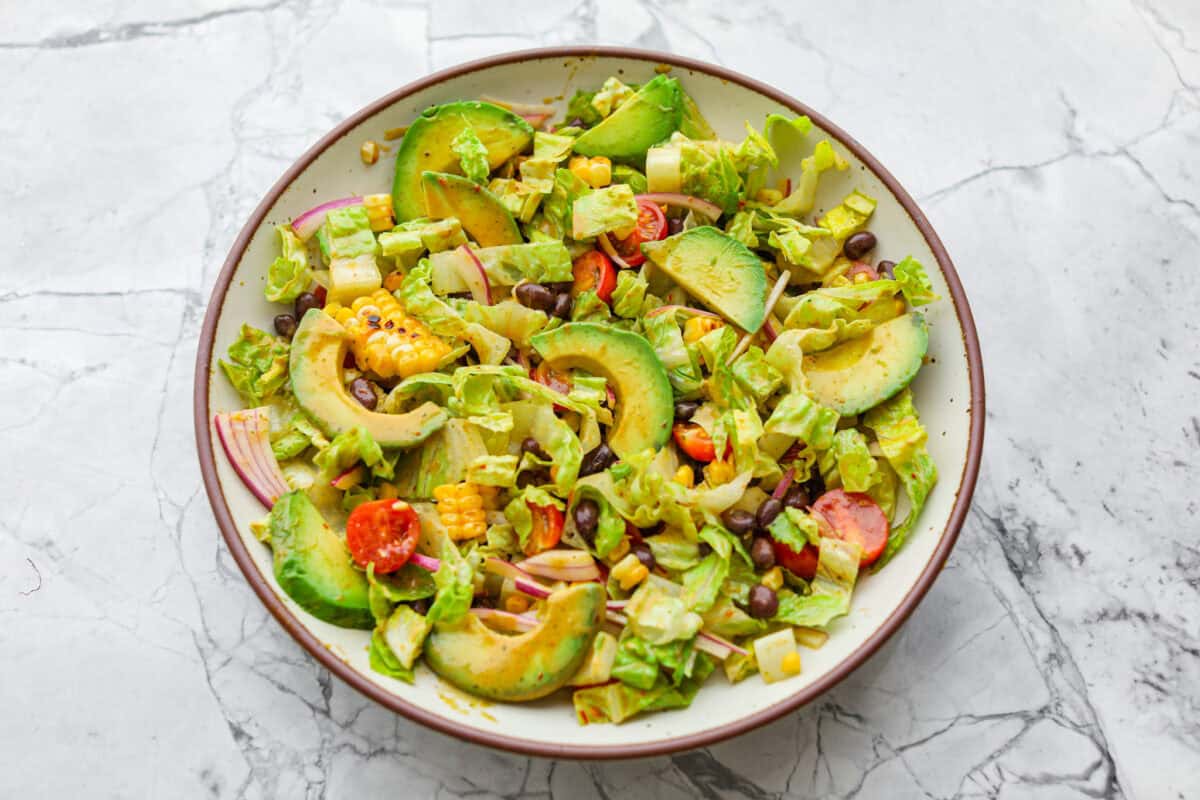
Assemble Salad: Toss romaine lettuce hearts, black beans, avocado, red onion, cherry tomatoes, and corn kernels. Then drizzle it with the dressing. Top with the shrimp and serve immediately.
Stainless Steel Skewers: Hold the shrimp together so they’re easy to grill and flip. Note: If you use wooden skewers, soak them in water for 20 min prior to cooking.
2mediumears of sweet cornshucked, or 1 (14-ounce) can drained and rinsed sweet corn
½cupthinly sliced red onionhalf a medium onion
1pinthalved cherry tomatoes
Instructions
Dressing
Add ¾ cup olive oil, 1 cup fresh cilantro, ⅓ cup apple cider vinegar, 3 tablespoons fresh lime juice, 3 tablespoons honey, 2 chipotle peppers in adobo sauce, and ½ teaspoon salt to a blender and blend until smooth and combined. Taste and adjust the salt as needed.
Add ¼ cup of the dressing to a bowl with 1 – 1 ½ pounds large deveined and peeled shrimp to marinate for 15 minutes. Set the remaining dressing aside.
Salad
Heat the grill to medium heat.
While the shrimp marinates, place 2 medium ears of sweet corn onto the grill and cook for 10-12 minutes, rotating a few times.
After it is done marinating, thread the shrimp onto metal skewers and place them on the grill. Cook for 2 minutes, then flip the skewers and cook for 2 additional minutes. Remove the shrimp and the corn from the grill.
Carefully cut the kernels off the cob.
Assemble the salad by tossing 2 roughly chopped romaine lettuce hearts, 1 (14-ounce) can drained and rinsed black beans, 1 cup diced avocado, ½ cup thinly sliced red onion, 1 pint halved cherry tomatoes, and the corn kernels with the dressing.
Top the salad with the shrimp and serve immediately.
Notes
Leftover, Make Ahead & Meal Prep Instructions
In the Refrigerator: Once tossed with dressing, the salad is best eaten within 1 day. The shrimp can be stored separately in an airtight container for up to 4 days.
Make Ahead: Keep the salad, shrimp, avocado, and dressing separate until serving. Wait to cut the avocado so it doesn’t brown.
Meal Prep Tip: For longer storage, keep the dressing on the side. The salad and dressing can last up to 4 days when stored separately.
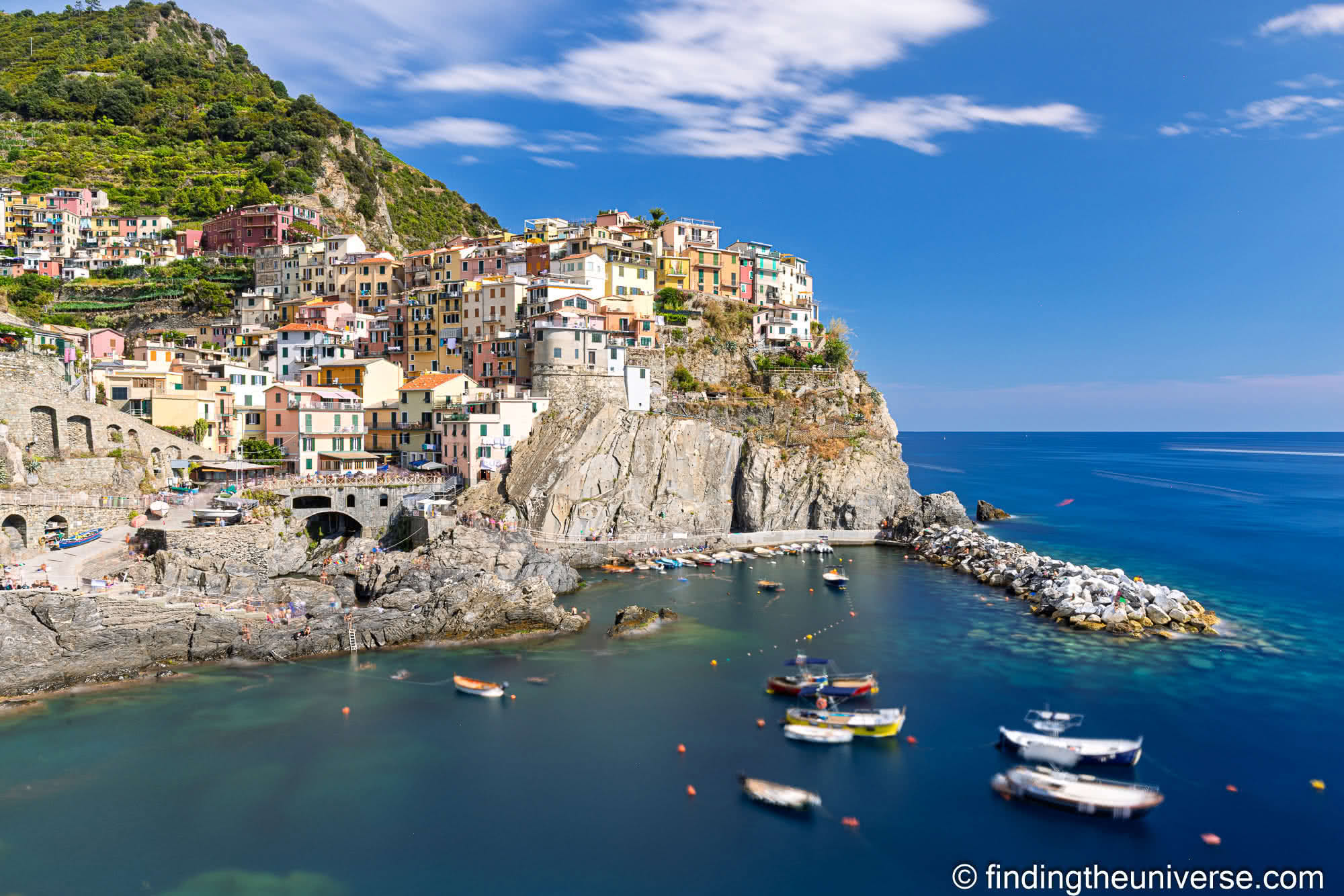
I’ve been to Cinque Terre more than once, and I can tell you exactly where I’ve stayed: Manarola, at a small five-room guesthouse called Arpaiu, with a rooftop terrace that looks straight across the harbour and out to sea. I’ve walked the villages end to end, including the steep mountain path over the headland from…
In this episode of Boldin Your Money, host Steve Chen sits down with bestselling author, behavioral expert, and former Stanford lecturer Nir Eyal to explore the psychology behind human behavior, decision-making, and the beliefs that shape our lives.
Nir shares insights from his bestselling books Hooked, Indistractable, and his latest book, Beyond Belief, explaining why people often fail to follow through on the things they know they should do. From financial habits and productivity to technology, AI, and entrepreneurship, this conversation dives into the hidden beliefs that influence how we think, act, and ultimately build better lives.
Steve and Nir also discuss the future of artificial intelligence, entrepreneurial thinking, why society fears new technologies, the importance of challenging limiting beliefs, and how changing the stories we tell ourselves can unlock lasting personal growth.
Steve Chen (00:00) Hi folks. Steve Chen, founder of Boldin. I’m here with Nir Eyal, and we’re going to chat a little bit about his books, behavior, and the psychology of money. Nir is a bestselling author, former Stanford lecturer, and one of the leading thinkers on psychology, technology, and behavior. His first book, Hooked, was a playbook on how products capture our attention. We’re going to chat about the pros and cons of that, and how it’s sometimes used against people as well. His follow-up, Indistractable, teaches people how to take their attention back, and how very often people are trying to escape bad feelings. So it’s not necessarily technology that’s the core issue here, but our own emotions. And then we’re going to get into his new book, Beyond Belief. So with that, Nir, welcome to our show. Appreciate you making the time to join us.
Nir Eyal (00:55) Thanks, Steve. Great to be with you.
Steve Chen (00:57) Yeah, so you were just saying in the preamble that you’re joining us from London right now. That’s awesome. How’s the book tour going?
Nir Eyal (01:02) That’s right. I’m on book tour for Beyond Belief. Great. It’s done really well. We hit the New York Times, and the reviews have been fantastic. I wrote the book for me to solve my problems, but it’s really great to see that it’s helping other people as well.
Steve Chen (01:17) Yeah, well, I think that’s how great stuff is created. Many entrepreneurs and creators are solving problems they experience firsthand.
Nir Eyal (01:26) Yeah. Was this your experience as well? Was that why you created your product?
Steve Chen (01:31) Yeah, really. The story is, my brother and I saw this in our own lives. My mom had some money challenges and came to us to ask for help. We tried to find a really good financial advisor or a way to help her solve her problems, and the reality was she just wasn’t rich enough. So we ended up doing it on spreadsheets, and then we were like, “God, why does everybody worry about money, and how come this isn’t easy to solve when everyone’s worried about it?” It’s kind of been a long-running problem. That became the product, the platform, the community, and everything else.
Nir Eyal (02:07) Very cool. Excellent. Tell me about the name, by the way. I was wondering about the name. How’d you come up with that?
Steve Chen (02:14) Boldin? Or NewRetirement? Yeah, we were originally called NewRetirement. The reason for NewRetirement was that my mom was in advertising, and I remember her telling me as I grew up that the one word that sells more than anything else is the word “new.” So I was like, we’re solving your retirement problem. And this is the most common question we get, by the way. A lot of people are thrown off by our name. The whole idea was that we wanted to expand the market to think more comprehensively about life and money.
Nir Eyal (02:28) Yeah. No, that product makes sense. I understand that name. What’s Boldin?
Steve Chen (02:43) The idea is to help people build financial confidence so they can be bold in life. It’s about helping people have more agency and feel more confidence in their lives. That was the idea, to evoke something. And it’s also shorter. Not necessarily easier to spell, though. We get people spelling it wrong, but we got the URL as well.
Nir Eyal (02:58) Yeah. And you got the URL, so that’s helpful. Makes sense.
Steve Chen (03:08) But yeah, in the age of AI, everything’s changing. Will people even be going to these websites, or are they going to just chat with their agents and everything gets solved for them? We’ll see. But I wanted to get from you, on your side, your books have been informed, it sounds like, by your life experience. How did you become interested in these topics of psychology and behavior, and how they affect how we use our resources, especially time?
Nir Eyal (03:16) Yeah, I think if you understand human psychology, then you can predict other people’s behavior and your behavior better. That’s really why I was always fascinated by it. I used to be clinically obese, and I remember at one point feeling like food controlled me. I used to love to blame the food companies, McDonald’s, the food industrial complex, and blah, blah, blah. It wasn’t until I really sat with why I was overeating. If you talk to people who are obese and struggling with their weight, what they’ll tell you is that we eat our feelings. I think all of us do. You don’t have to be obese to feel that. We eat when we’re bored, when we’re lonely, when we’re ashamed about how much we had just eaten. At least that’s the cycle I was on. It wasn’t until I understood a few things. One, your behavior is at least partially manipulated by outside factors, because that’s what products are supposed to do. We say manipulation is a bad thing, but I kind of want to eat a Krispy Kreme donut, and I want it to be delicious because that’s what I paid for. That’s why I bought the Krispy Kreme donut. I’m not going to complain to Krispy Kreme for making donuts too delicious. That’s stupid. So what I wanted to understand was that yes, those things can influence us, and in fact do influence us, but it’s not something that’s necessarily outside of our control. It’s only outside our control when we believe we don’t have control. I kind of worked through this conclusion backwards because my latest book is all about beliefs. We only give up control when we believe we don’t have control. When we believe there’s nothing we can do, what do we do? Nothing.
Steve Chen (05:04) Yep. Right.
Nir Eyal (05:05) And we see that in every domain. We see that with the food we eat. We see that with how much we scroll online. We see that with all kinds of things where people say, “There’s nothing I can do. I’m addicted.” Some people are addicted. Very, very few. But not every product that’s addictive addicts everyone. Lots of people have a glass of wine with dinner. We’re not all alcoholics. We have sex. We’re not all sex addicts, are we? Not everything that’s potentially addictive addicts everyone. So when we talk about bad tech habits, bad money habits, all these things that are difficult, they’re not necessarily a walk in the park, or else everyone would master them, but they are definitely under our control. I think my life experience informed this pendulum swinging back and forth in my life between, “It’s all corporations’ fault. They’re doing it to me,” to, “No, it’s all my fault. I’m doing it to me,” back to, “No, now there’s this new thing that’s doing it to me.” But eventually, “No, I think I can do something about this.” The truth is that there are two parties here. There’s nuance. It’s not that simple. When you better understand the psychological mechanisms that influence your behavior, you can also mount a defense to make sure that you live without regret.
Steve Chen (06:09) That’s really interesting, and it’s interesting to hear your own personal story. I’m curious, in your own life, at what period of time were you clinically obese, and how did you come to these conclusions? Were you studying this stuff already, or what drove all of this?
Nir Eyal (06:27) Yeah, I didn’t really get into the psychology side of it until my second company. At my first company, I started a solar energy business, and that kind of got us on our feet financially. We sold that successfully. Then I went to business school. My last company was at the intersection of gaming and advertising, and I had this front-row seat. This was back in 2007, so the iPhone App Store wasn’t even available yet. This was the year the iPhone came out. At that last company, I saw so many businesses, clients, colleagues, and people in Silicon Valley come and go. I went to Stanford, so I was in the middle of Silicon Valley. The defining trait of who succeeded in this age of the smartphone and this small screen we were now adopting was habits. If you could get people to come back, there was always a chance to monetize. Whereas if you couldn’t get people to change their behavior and keep coming back, then you were sunk. They would forget you. So I wanted to figure out how you do that. How do you keep people coming back so we can help them change their lives? I didn’t want to join a social media company. I didn’t want to work for a video game company. I wanted to figure out how we get people as hooked to saving money, like you do, or to exercising, or to learning a new language. Why is it only the gambling companies, social media companies, and video game companies that get to have all these secrets? So what did I do? I studied the psychology behind what makes those kinds of products so sticky. I stole their secrets and put them in a book that I sold to consumers. That’s what Hooked is all about. That also turned into a class that I ended up teaching for quite a while at the Stanford Graduate School of Business and later at the Hasso Plattner Institute of Design. The whole idea was to democratize those techniques. It’s not just the social media companies and gaming companies. Companies like you can get people hooked to saving money. Fitbod gets people hooked to exercise. Duolingo gets people hooked to learning a new language. That was really the motivation behind writing Hooked. Then Indistractable was the other side. If Hooked is about how you build good habits with technology, Indistractable is about how you break bad habits. Not to the same products. It’s not Hooked and Unhooked. It’s Hooked and Indistractable because we want to get hooked to Boldin, right? We want to get hooked to new money habits. And we also want to stop the bad habits that lead us to regret in our lives. Different products. Exactly.
Steve Chen (08:40) Yeah. Different orientation. I remember reading Hooked, and it was awesome. Do you feel like it’s been net positive? I hear what you’re doing, which is, I agree with you, gambling, prediction markets, all these things have these random, unpredictable rewards, and you kind of codified that. Do you think more good companies and individuals are using this? Or do you think it made it possible for companies like Robinhood and social media companies to take these lessons and really productize this like crazy?
Nir Eyal (09:32) Yeah. Is it net positive? Yeah, I think it’s net positive because if you look at what you can do with your technologies these days, I would much rather live in the world we live in today, where we have information at our fingertips and endless entertainment. These are all good things. What I’m still struggling with is how much personal freedom we should allow people. With social media, there are all kinds of things we can improve. I’m not an apologist for the tech industry. Regulation around how kids use it, echo chambers, if that even exists, there are all these things. It’s debatable, because echo bubbles or echo chambers existed long before. If you look at the stats, Fox News, CNN, and Al Jazeera have a much higher impact on political polarization than Instagram and Facebook do. But nobody talks about that because that’s old technology. So I’m not as concerned with social media because, look, what would people do if social media suddenly didn’t exist? They would go back to watching soap operas, sports, and all kinds of other mumbo jumbo that we use to spend our time. So who am I to say that social media and video games are bad, but watching golf on TV and cable news is good? Why? What’s the difference? Now, what I am concerned about, and this is an industry that I think doesn’t get anywhere near enough scrutiny and that I refuse to work for, is gambling. I don’t work with gambling. I don’t work with pornography. I don’t work with alcohol. I don’t work with tobacco. I think gambling has gone off the cliff. I think we have made a major mistake with gambling and cannabis. I used to be for legalization of both of those things, and I think it has been a tragic mistake. I think legalized gambling is decaying our country. Remember, when you use these tactics to get people hooked to how they spend their time, people spend their time on all kinds of frivolity. But when it comes to money, you can’t get that back. You are destroying people’s livelihoods. I think we’ve destroyed sports because of all this sports betting. It is rotting us to the core, from young men starting in high school who are getting on these sites, and it is bleeding them dry. And you know what? We don’t talk about it. We talk about social media and video games being bad for you and AI being bad for you. Right under our nose, the government has become addicted to legalized gambling. The governments don’t talk about it. The politicians don’t talk about it because they know it bankrolls their state budgets. I think that is a much, much more dangerous problem that nobody is talking about.
Steve Chen (12:14) Yeah, it feels like we’re always behind. If you ask the average American, “What’s Polymarket? What’s Kalshi?” they’re probably like, “I don’t know.” But if you ask a 20-year-old male, they’re probably going to know what’s going on. A lot of people don’t know how much time is being spent. I think now we’re realizing and taking action with social media. Let’s not give kids smartphones. Let’s keep them off social media until they’re 16 or whatever, which I think is generally a good idea. But they’re onto other things. Gaming is a big thing, and around that, these prediction markets and stuff like that. I will say prediction markets are interesting as a source of information because they do predict things. People have insights, and they share them because they’re incentivized to make money.
Nir Eyal (12:44) Yeah. But the pure gambling stuff, like the coin toss on an athletic event, I think that stuff is not games of skill. A lot of this is total chance, and it’s nothing more than straight-up gambling.
Steve Chen (13:16) One thing I’ve observed over the course of my career is that, in general, we have more free time. We’re becoming a more productive society, and it creates space. Why do we spend all this time on social media and these games? How can people afford to do it? Clearly, they’re surviving somehow. In the age of AI, you start feeling like, is more work going to be highly automated, and what does that mean for society in the future? Actually, before we go there, I would love your take on this: do you see a world where agents know us and can watch what we’re doing? An analogy I use is getting fit. I’m going to do way more push-ups if I’m sitting there with a trainer or in a class than if I’m watching a show at night trying to knock out push-ups. Is there a world where AI is watching our behavior and saying, “Hey, Nir, you’ve been scrolling Instagram for an hour. Maybe that’s not what you want to do”?
Nir Eyal (14:15) Yeah, I spoke about this years and years ago. I called this a Jiminy Cricket. Did you ever see the movie Pinocchio when you were a kid? Jiminy Cricket was Pinocchio’s conscience, and he would tell him, “Is this what you want to do? Are you sure that’s the way you want to do things?” I can’t wait. I want a Jiminy Cricket AI with me at all times that says, “Hey, before you eat those fries, just so you know, if you’re trying to be in a caloric deficit, those fries are going to push you over. Or if you eat half the fries, you’ll still be within range.” Or even better, your Jiminy Cricket AI hears what you just said to your wife and says, “You may want to take a minute and reconsider how you said that.” I would love that personal coach on my shoulder. As long as privacy is kept and we don’t have data breaches, I think it’s possible, and I can’t wait. I think it’s going to be great. Of course, that gives the providers of those tools immense powers, but this is nothing new. As Sophocles said, nothing vast enters the life of mortals without a curse. Is the internet good? Yeah. Is the internet bad? Hell yeah. Is social media good? Yeah. Is AI good? Yeah. Is AI bad? Yeah. It’s both, so it’s going to be about how we use it. I think what we always do with this kind of stuff is we stumble through. We figure out the bads as we go along. What doesn’t work is this preemptive principle of, “It’s really scary, and we don’t know what’s going to happen, so let’s shut it down.” That tends not to work well. One of the psychological quirks we have is that we think about sins of commission versus omission. We think about the things that you do. If a technology kills somebody, that’s terrible. But if the technology was never invented to save someone’s life, nobody notices. Same life, same life, but we can’t quantify the lives that were never saved.
Steve Chen (16:13) Yep. Right. It does feel a little inevitable right now. I don’t know if you’ve read the AI 2027 stuff, but we’re getting into this race condition where we’ve got the frontier models. We’ve seen these technological waves, and this one feels different and faster. It definitely feels like stuff is faster, and in some ways inevitable. We are building things much more quickly, and the future you just described, I could totally see it. You’ve got an Oura Ring on. You’ve got your phone or whatever glasses. It’s seeing, hearing, and sensing your body. “Steve, you’re getting elevated. Maybe you should pause and take a deep breath before whatever you’re going to say next comes out of your mouth.” All the behavioral coaching stuff that we describe now feels like science fiction, but it’s happening.
Nir Eyal (17:09) Yeah, it’s happening. Look at us right now. If you would have told me as a kid, I don’t know, how old are you, Steve?
Steve Chen (17:18) I’m older than you are. I’m in my mid-50s.
Nir Eyal (17:28) Mid-50s. Not that much older. I’m 48. I remember going to Epcot Center and seeing, “This is what the future is going to look like. You’re going to have video phones.” And look, we’re doing it right now. We’re literally living in the future. What is that saying? Pessimists sound smart, and optimists get rich. Pessimists always sound smart: “But it could do this, and it could do this, and look at the children, think about the women.” Literally every technology. It’s always “save the women and children.” Sometimes it’s justified. I’m not saying it’s not justified. Sometimes we do need to look at the consequences. But it’s never about the stuff we think about. The stuff that’s terrifying is the fact that millions of people still die in car accidents because of human error. That’s what we should be worrying about. Super boring. How about the fact that people in the year of our Lord 2026 still smoke? Steve, what the actual hell? We’re worrying about AI when millions of people every year die of preventable smoking-related deaths. Are you kidding me? What’s wrong with us? That’s what we should be putting our eye on. But of course it’s boring. It’s much sexier to think about an AI apocalypse than it is about the actual apocalypse happening right now to people who are smoking when they don’t have to.
Steve Chen (18:38) Right. This goes to your work. It’s like data versus beliefs. There’s data that a Waymo is ten times safer than a human-driven car, but still we’re like, “Wow, these robot cars seem super dangerous to me, and maybe we shouldn’t have that.” The same thing with data centers. Data centers do have a cost, and it looks like AI could be solving huge problems, finding medical advances, and discovering all kinds of stuff that would take us forever. The net positive benefit to society could be massive, but we’re like, “We’ve got to slow-roll this.”
Nir Eyal (19:28) Yeah. The water. Think about the water, Steve. What about the water? I think the problem is that people are really bad at understanding what the job of technology is. People think technology is about solving problems, and if it creates problems, that’s bad. Shut it all down. But technology doesn’t solve problems. As Thomas Sowell says, it gives us better problems. That’s what technology does. Of course we’re going to have new problems. Every technology creates problems. And what do we do? We create even better solutions to fix the last generation of problems, and it goes on and on. What we need to do is encourage more people to enter technology, not be afraid of it. This is why beliefs are so powerful. Beliefs literally help a society flourish or destroy itself. If you believe in a positive future, we see this all the time now, where some people say, “How could you bring a kid into the world?” because they’re so concerned about the future. They think the future is so dangerous that they choose not to have children because of how terrible the world is going to become. And yet they’re living in that very world right now and having a modestly good time of it. Our beliefs are super impactful in terms of what we’re able to do with our lives. We need to be very careful about assessing those beliefs because they have an amazing power to feel like facts. But beliefs are not facts.
Steve Chen (20:43) Yeah. Right.
Nir Eyal (20:46) A fact is an objective truth. It is something that is true whether or not you believe it. A belief is a conviction that is open to revision based on evidence. That’s a big, big difference there.
Steve Chen (20:59) I was going to make a comment on this, which is related. I interviewed Annie Duke, one of the top female poker players, and one of my favorite quotes from her is “strong beliefs, loosely held,” which I think is great. Just like you were saying, “I thought legalizing cannabis was good, I thought gambling was good, and now maybe that’s less good,” and your beliefs have changed.
Nir Eyal (21:10) Held loosely. Yeah, that’s right. I categorize it as the difference between faith, fact, and belief. Faith is a conviction that is not open to revision based on evidence, so it does not require evidence. “God rewards the righteous.” What evidence could I possibly present to somebody who believes God rewards the righteous if that’s something they believe? That is a matter of faith. You’re not looking for evidence, and that’s fine. Nor should you. It’s a matter of faith. A fact is something that is true whether or not you believe in it. It’s objectively true. But beliefs are something that we can and should change. Unfortunately, in our culture, when someone disagrees with you, even think of that statement right there. We don’t say, “Someone disagrees with my idea.” We say someone disagrees with me. It’s personal. We can’t help it. If I disagree with you, it feels like a personal attack. That’s the big problem. Changing my beliefs is my love language. I love it. There’s nothing better than when someone helps me see reality more clearly.
Steve Chen (22:23) Feels like you’re in the one percent of that. Most people are probably like…
Nir Eyal (22:25) Well, it’s changed. I’ll tell you what, it’s changed since writing this book because I didn’t realize how bad we all are at seeing reality. Your brain currently is absorbing 11 million bits of information per second. That is the equivalent of reading War and Peace every second, twice. Imagine 2,000 pages of text every single second. It’s a tremendous amount of information. The light entering your eyes, the sound of my voice in your ears, the ambient temperature of the room, your brain is absorbing all that information. But your conscious awareness can only process 50 bits. Fifty bits is one sentence per second. So 2,000 pages of text versus just one sentence. What your brain is absorbing, what you call the real world, is not the real world. It’s a simulation projected through your beliefs. You don’t see things as they are. You see them as you believe them to be. We’ve all heard seeing is believing. Actually, believing is seeing. What you believe is literally what you are able to see. This isn’t a metaphor. For example, people who are on a diet see food as larger. People who are afraid of heights see distances as farther away. Entrepreneurial people literally see things the rest of us can’t see. It’s called entrepreneurial alertness. Knowing that your beliefs dictate what you are able to see should give us all pause. We don’t see reality clearly, so we should put a lot less weight in what we think is a fact.
Steve Chen (24:04) Yeah, so much of this is so interesting in this conversation. I feel like society is learning some of these higher-EQ ideas and understanding more about how we think, but it’s not evenly distributed at all. Some people have high self-awareness and much more open minds, and they’re willing to have their beliefs changed. And then I think you’re also seeing a whole bunch of people where there’s a lot of faith in how things are. There’s not a lot of willingness to rethink. It’s interesting. In some ways, I think a lot of people feel safer that way. It’s like, “This is true, so I can believe in this,” especially in a world where a lot of things are changing.
Nir Eyal (24:34) Yeah, that’s right. We hear it all the time. Oftentimes, it’s the people who consider themselves the most tolerant and open-minded who think other people are very closed-minded: “They won’t change their minds, but me? No, no, no. I see reality.” The way we need to think about limiting beliefs is that they’re like our face. We all have a face, but if I asked you, “Steve, look at your face,” you can’t look at your face the way you can look at your hands or your feet. You can’t see your own face, just like you can’t see your own limiting beliefs. Interestingly, we can see everyone else’s limiting beliefs. You can see your kids’, your colleagues’, your boss’s, your neighbors’. You can see all their limiting beliefs. But you can’t see your own, just like you can’t see your own face. In order to see our limiting beliefs, in order to see our face, we have to reflect. We need a mirror. We need something outside of us to systematically show us our own limiting beliefs.
Steve Chen (25:47) Given your perspective on this, do you see the world changing for the better in these areas? Do you think self-awareness, and the understanding of faith versus beliefs versus facts, is getting better in the world? Are we as a society making better choices? I’m sure this varies wildly by country and other factors, but are we generally doing better? Are we on a good path? Or do you feel like we’re going to see a K-shaped world, where some people are killing it and some people are not doing that great?
Nir Eyal (26:25) Yes. It’s complicated. There’s always nuance. At a societal level, I think long term we will do what we always have. Past returns are no predictor of future returns, but if you look at the long arc of history, as Obama told us, it bends toward justice. We seem to see that through all the bumps, tribulations, and trials of humanity, we tend to come out pretty well. There are some big problems we haven’t figured out. I’m not worried about the problems we know how to fix. For example, believe it or not, we actually know how to fix climate change. There are lots of ways to fix climate change, so that’s not as existential as I think people believe. Nobody has any idea how to fix population collapse. We can have a pristine environment, and we will have a pristine environment, with almost nobody to enjoy it. If I told you that by the end of this century, the nation of Japan will have 40 million fewer people, you would ask, “What happened? Was there a thermonuclear war?” There must have been some terrible disaster. No. It’s just math. Those people won’t exist because they won’t be born. They’re not replacing themselves. They’re not having enough babies, and nobody has any clue what to do. Those are the kinds of problems that actually keep me up at night.
Nir Eyal (27:37) You would say, “What happened? Was there a thermonuclear war? What happened?” There must have been some terrible disaster. No. It’s just math. Those people won’t exist because they won’t be born. They’re not replacing themselves. They’re not having enough babies, and nobody has any clue what to do. Those are the kinds of problems that actually keep me up at night. Most other problems, it turns out, the world is becoming more educated, more tolerant, more democratic. There are greater rights for women, better education, and better healthcare.
Nir Eyal (28:06) There’s a wonderful book everyone should read called Factfulness by Hans Rosling. It’s one of my favorite books. Why are you laughing?
Steve Chen (28:14) Because I tell people about this book all the time. I love this book. Things are getting better, and people are always like, “No, they’re not getting better.” I’m like, “They’re getting better. Poverty’s tanking.”
Nir Eyal (28:16) You do? Okay, awesome. I knew I liked you. Nobody believes you. Again, this is one of those matters of faith. “No, you don’t understand. There’s a guy on my corner who is homeless, and therefore the world is getting worse. There’s crime, and I knew somebody who took drugs.” It’s all anecdote. But when you actually look at the statistics, and this is exactly what Hans Rosling did, he gave an exam to the most educated people on earth: college professors. He asked them this standard exam about the state of the world: healthcare, education, female empowerment, democracy, all these things people care about. It turns out the professors scored worse than monkeys. Literally worse than monkeys. Worse than chance. That’s what blows people’s minds: the world is actually getting better, but slowly and bumpily.
Steve Chen (29:00) Right. Our own bias.
Nir Eyal (29:11) Over the long term, most of these things get better. Those kinds of problems I know we can fix. We will fix. We are fixing them. But I don’t know how we replace ourselves. That’s a much bigger challenge.
Steve Chen (29:18) Right. It’s super interesting listening to you, because literally I knew you were going to say Factfulness right before you said it. We think about a lot of the same things. I talk about Japan all the time. I think Japan has roughly 130 million people, and it’s on its way to something like 80 million people. When you think about the reality of that, I tell my kids or other people, “Imagine you’re in Northern California, where I live, and a third of the people are gone. What happens to housing? What happens to businesses? What does traffic look like?”
Nir Eyal (29:54) What happens to Social Security? Everything. We’ve never recovered from that type of loss. There’s no model for that.
Steve Chen (30:01) Yeah. If you look at the really long-term trends of population, it went like this. We’re all familiar, at least in Silicon Valley land, with exponential growth. Exponential is great, but it goes the other way. If you stop replacing people, and then there are two fewer people to have more people, it can come down very fast.
Nir Eyal (30:07) It crashes fast. Do you have any ideas, by the way? You seem to have read a lot about this. Any ideas that seem plausible? One is the Japan model. You go to Japan, and even though their population continues to decline, millions fewer babies are born, and yet they have this kind of managed-decline system. They have a ton of debt, of course, but I don’t know. Do you have any ideas how we get through it?
Steve Chen (30:42) I do not, but I’m well aware of the birth rate problems. I’m curious what you think about why this is. I’m with you. I’m in the abundant future camp. Solar or renewable energy, endless energy. If we get boundless energy, guess what? We can solve water because we can desalinate the ocean and things like that. We’re on this path of getting rid of fossil fuels because of the economics. The world will get better, but why are people having fewer children? Why are we on the decline, potentially as a species? That’s what I’m curious about.
Nir Eyal (31:11) Why? I think it’s a collapse of beliefs. There used to be, I think, a faith, and I think there still is. Look at what countries and civilizations today have birth rates above replacement. It turns out where it’s highest is in countries where your children are your Social Security system.
Steve Chen (31:47) Yeah, their replacement rate or whatever it is.
Nir Eyal (31:57) Right. They are your safety net. The more kids you have, the more each one of them will send you a few bucks every month, and that’s going to sustain you in your old age. That becomes your retirement account. When the government guaranteed us Social Security, we didn’t need to have a bunch of kids in order to survive old age. As Peter Zeihan says, kids became economically useless and emotionally priceless. That’s what happened. I’ve seen estimates that it costs over a million dollars to raise a child from zero to 18 to college, and then you’ve got to pay for college. It became very expensive because they’re emotionally priceless and yet economically worthless. That didn’t used to be the case. It used to be that you had a bunch of kids because they were economically useful to you. “Be fruitful and multiply.” The fruitful part gets forgotten. That’s how you assured your retirement. The more kids you had, the more boys could protect your village and the more women would produce your heirs. That was how society sustained itself. That’s just not the case anymore. Children aren’t necessary. They’re a lot of work, so what do people do? They get dogs instead of having kids.
Steve Chen (33:02) Do you think younger people feel this? I definitely see this. There are a lot of young men, I forget what Scott Galloway calls them, but they’re not employed, educated, or being trained. They’re basically playing video games, they’re on Polymarket, and they’re not fully engaged in society. I wonder if it’s because they’re not necessary. It’s kind of daunting. It is getting harder for younger people to find work right now, that’s for sure. Or at least that’s a belief that’s true.
Nir Eyal (33:38) That’s a belief. Yeah. I think this is what we need to replace. The closest I’ve ever come to some kind of solution is this, and I’ll back up. Part of the problem is that it sounds cold, because we think children are emotionally priceless and economically useless. So we don’t value having children enough. We think just having kids is its own reward. I don’t think that’s true. I think it’s a lot of work, and it’s not recognized work. I think there should be something like a baby bond or something. I’m just tossing this out here. What do I know? I’m not a political scientist. I’m certainly not someone who writes legislation. But we should bring back what works. The only system that gets people to have more kids is when you think your kids are for your future retirement. What if we had some kind of scheme, like let’s call it a baby IRA? In a baby IRA, for every child you have, you get a portion of their future income, which should be a taxable projection. We should say every additional worker is going to give the government X number of dollars, and without that person being born, that money is not being generated. We generate income tax based on income, based on work. We should have, instead of, or in addition to, the traditional Social Security system, something that says the more people you bring into the world who pay taxes, you should make part of that money. Now, caveats, caveats, asterisks everywhere. I know it’s not a perfect system, but it’s a lot better than inevitable decline.
Steve Chen (35:10) Yeah. Well, we kind of have that in Social Security for what it’s worth. People are paying into it, and then we take it out as we get older.
Nir Eyal (35:18) But on a macro level. It’s not one for one. Frankly, women bear the brunt of this. They’re the ones who make less money over their lifetimes because they exit the workforce to have babies. Biologically, I wish I could, but I can’t. A woman has to exit the workforce, and she’s not properly compensated, I think, for the value she’s created for society.
Steve Chen (35:29) One hundred percent. And women live longer. The other challenging thing that’s happening here is if AI starts to replace human labor, which there’s a hypothesis is starting to happen, our tax code creates an interesting thought experiment. Our GDP is driven mostly by people. More people means they do more work and produce goods. In a world where that’s done by AI and not people, you’re going to have to start taxing the labor of AI to capture that value. Otherwise, you could get into this downward spiral, the doomerism thing, where AI is producing stuff and we’re getting more stuff, but people have fewer jobs, so they have less income and can’t afford to buy it.
Nir Eyal (36:40) Yeah, I get it. I don’t understand practically how that’s done because it’s software. I can understand how you could tax the value generated by that software, but AI is just software. We have a bunch of robots, but a robot doesn’t have a Social Security number that we can send a tax return to. I don’t exactly understand how you would do that. What I do understand is that you need a lot of people to want to buy stuff from the companies producing the software, and then that creates net income, which can be taxed. That I understand. I want to live in a world with lots of AI and lots of people to enjoy it.
Steve Chen (37:13) A hundred percent. One of my suggestions for the future is that we need to get really good at creating new things. We need to get everyone thinking like an entrepreneur. As a father of kids who are entering the workforce, and seeing their friends have difficulty, they’re all going to good schools, NYU, USC, and they come out saying, “Man, it is not simple to get a job out here.” You need to get good at thinking, “I might need to start a company. What does that look like?” and thinking pretty expansively. That will be good for society because it will hopefully lead to a Cambrian explosion of new businesses. But it’s going to be incentive-driven.
Nir Eyal (37:55) Totally. I think that’s very much belief-driven. We know there’s this trait called entrepreneurial alertness, where people who have this trait see hundred-dollar bills all over the place that the rest of us can’t see. I think that’s a big part of it. The more entrepreneurs you have, that’s what makes Silicon Valley such a special place. You see everybody working on stuff, and that helps change your belief set of what you think is possible. I’ve been in a lot of other countries where there’s much more of a tall poppy syndrome. “Who the heck do you think you are? You think you’re just going to start a business and make money? What are the rest of us, idiots? We don’t see your business idea and do it already? Who do you think you are?” Those beliefs, those cultural beliefs, and what is culture but codified beliefs, can be very, very impactful. I think that’s part of what makes America so exceptional. It’s why I’m a very proud American who is an American by choice. I naturalized. It is the one place, I think more than any other, where the real entrepreneurial spirit lives. If you want to come make it for yourself, America still, for all its faults and all its warts, is the place you’ve got to come.
Steve Chen (38:50) It’s interesting. I came to Silicon Valley, and I didn’t know anything about it. But when I got here, I was like, “This is where I belong.” I continue to see this. It is hard. I see all these places around America and even Japan, like we were talking about. I’m going to Tokyo on Thursday, and we actually have Japanese investors. Nippon Global invested in the fund that invested in us, and part of it is that they set up an outpost in Silicon Valley to study what the heck is happening here. All these places want to recreate this for their own economies, and it is hard to recreate because there’s a critical mass. It’s a whole ecosystem. It’s a whole culture. People here know and persist. You come here, you start a company, and you think, “Okay, there’s something here.” Everyone tries. Most people fail, but that’s part of the culture. The ones that succeed reinvest in it. Then you’ve got these founders who have money and have done it, and they’re like, “Okay, I just made $100 million. I’m putting $10 million in venture capital.” Bang, it starts all over again.
Nir Eyal (40:13) That’s so unique to Silicon Valley. It’s kind of crazy when you think about it. You could be fresh out of college, 22 years old, and people will give you millions of dollars. You could run off to the Bahamas, and they never see you again, but that almost never happens. People take those millions of dollars and think they can turn them into billions of dollars. It happens, and it keeps happening. There’s nowhere else in the world that you could do that.
Steve Chen (40:39) I also think, back to your tall poppy comment, it’s very merit-driven. I’ll be at meetups and meet someone who’s 20 years old who just came from Norway, and they’re like, “Yeah, I left it all. I’m here. I’ve got this idea, and I’m going for it.” I take these people dead seriously because that’s who wins. In other places, they’re not as welcome. Here, it’s like, “Hey, great.” By the way, that’s where I started. I came here in my early 20s. I knew nothing, but people were nice and supportive, and I remember those conversations. This has been an awesome conversation. We’re talking about everything. For our audience, the problem we’re trying to solve is that people worry about these problems, especially retirement and the future. They’re like, “I know I should be doing more. I could live a long time, and there’s all this uncertainty with the markets, inflation, health, and everything else.” And yet most people don’t do anything. I would love your take on helping people understand why they don’t do these things. We’ve talked about beliefs and all that. What can they do to get started? Outcomes are like your story. “I’m clinically obese.” But you don’t get fit just by understanding it. You had to make these changes. You had to realize it, get educated, and take action. What are some practices people can put into place to make positive change in their lives?
Nir Eyal (42:24) I think it starts from understanding these scripts we have picked up in our lives that we didn’t choose: our family, upbringing, culture, past experience, or something someone said to us. These limiting beliefs are not your fault, but they are your responsibility. We keep carrying around these limiting beliefs that are not making our life better. “Money is hard to make.” “People like me don’t get rich.” “Wanting money makes me greedy.” “I’m bad with money.” We carry these limiting beliefs forward with us. What do they do? What’s the definition of a limiting belief? A limiting belief is a belief that decreases your motivation and increases your suffering. What does a person do when they believe, “I’m bad with money,” or “Getting rich means you’re greedy”? What does your motivation look like to save, to invest, to learn, to balance your checkbook? You’re literally self-sabotaging. When you believe those things, your motivation decreases and your suffering increases. I think that’s such a fundamental place to look. My frustration, having researched and written three books over 16 or 17 years, is that even when I tell people exactly what to do, like with Indistractable, here’s a 250-page book. It tells you exactly what to do. You could read the entire book in maybe three or four hours, and I’m telling you, you would become indistractable. Not everybody, and I mean, the books have done great, so no complaints. They’ve sold over half a million copies. But some people, even though the solution is right there, would prefer to complain and wait for the government to fix the problem. “Please, Facebook, stop making the product so good.” “Netflix, stop making your movies so interesting.” They’d rather complain and think they’re powerless when they’re not, because it’s so much easier. The biggest thing to realize is that you have far more control than you know. The only time you don’t have power is when you believe you don’t. Understanding those limiting beliefs, putting them out there, figuring out what it is that you believe, will empower you to actually put the information to use. Frankly, Steve, I find the problem is not that people don’t know. If you want to be rich, you save money for a very long time. That’s it. We can talk about investing and how you invest, but that’s detail. Big picture, the big problem is not that people don’t know what to do. It’s that people don’t follow through on the things they know they should do. That’s the problem. It’s not information. It’s beliefs.
Steve Chen (45:12) It’s so interesting. Back to culture, where you live, and how you came up. One of my son’s friends was visiting, and he’s going to school in Kentucky. He grew up in Northern California, and he was saying, “My friends are getting married and having kids at 21.” It’s a totally different world. We grow up in families, and those families teach us beliefs we have about ourselves. If you grow up less wealthy, one of the really huge reasons I’m so into this work is that I know us getting more financially secure and being entrepreneurs affected our family. My oldest son is an entrepreneur probably because he watched his parents do this stuff and thought, “This is possible. I shouldn’t be afraid to try this.” Conversely, if you grow up thinking, “We’re poor, and we’ve been poor for generations, so I’m probably going to be poor,” right?
Nir Eyal (46:11) Yeah. “Money doesn’t grow on trees.” These are limiting beliefs we tell ourselves all the time, and we think we’re doing ourselves a favor. A belief like “money doesn’t grow on trees,” what are you saying? You’re saying, “Don’t take risks. Don’t try.” There are all these reinforcing beliefs that we tell ourselves, and we don’t even realize whether they’re serving us or hurting us.
Steve Chen (46:32) I’m a big believer in community and groups as a way of changing behavior. But if you’re living somewhere and you have these beliefs, I guess you have to realize you have limiting beliefs. That’s job number one, which is not necessarily simple. Then you have to have a mechanism for changing those limiting beliefs. How do you see that come to life in people who make it work?
Nir Eyal (46:47) That’s what Beyond Belief is about. I love how, with five minutes left to go, we finally get here. This is awesome. It’s actually the sign of a great conversation. Typically, people say, “Okay, what’s your book about?” and I talk about my book for an hour. But this is great. I love that we’ve had such a great conversation. This is exactly what the book is about. It’s how you look at yourself in that proverbial mirror to find your limiting beliefs when you think they are facts, and when you think those beliefs have served you, because they have. Why do we have limiting beliefs? Why would we have software in our brains that limits us, decreases motivation, and increases suffering? It’s because your brain is just doing its primary job. Your brain’s primary job is not for you to get rich. It’s not for you to meet your potential. It’s not for you to be happy. Your brain’s primary job is to keep you safe. It’s to keep you alive. That’s it. That’s all the brain really cares about. Whatever you’ve been doing, whatever you’ve been thinking, whatever you’ve been believing got you here, didn’t it? So the best bet your brain can make is to keep you doing whatever you have done and whatever you’ve believed before. Your brain is doing its job. Step number one is realizing that your brain is constantly pulling you toward passivity. Your brain is going to give you every excuse, tooth and nail, to say, “No, no, no. You don’t need to change. Just keep doing what you’re doing. That’s safe. People like you can’t get rich. Wanting money totally makes you greedy. Money is hard to make.” Your brain is going to keep telling you these lies because that’s what got you this far. Step one is knowing your brain doesn’t see reality clearly and that your brain is pulling you toward passivity. Then we have a process to follow to take out these limiting beliefs, where we say to ourselves, “Where is this suffering in my life? What is an area of my life where I’m struggling?” Maybe it’s my personal finances. Maybe it’s a relationship. Maybe it’s my career. Whatever it might be. Then we walk through a process called inquiry-based stress reduction. I didn’t make it up. It’s been scientifically validated in several studies. I walk people through exactly how to make that very easy to follow. At the end of that process, what you walk out with are new liberating beliefs. Liberating beliefs are the opposite of limiting beliefs. A liberating belief is a belief that increases your motivation and decreases your suffering. The idea is that once you recognize those limiting beliefs and discover those liberating beliefs, you reinforce them again and again until they crowd out the limiting beliefs. That’s how we process long-term behavior and belief change.
Steve Chen (49:32) That’s awesome. Do you use Strava? Do you know Strava?
Nir Eyal (49:36) I know Strava, yeah.
Steve Chen (49:32) I use Strava. It’s activity tracking and things like that. You build a community, and you do these good things, like, “Okay, I went for a hike. I went for a bike ride.” I’ve always wondered if there could be a Strava for doing good in the world, or maybe for something like this: “How do I change my beliefs? How do I reorient myself and share that with other people, see other people doing that, and be inspired by it?” I feel like a lot of this work is so important, and for many people it’s done either by themselves or maybe with small groups.
Nir Eyal (50:12) Book clubs I highly encourage. If you can get a few people together, maybe a couple of family members, three or four people, to read a book like this together, it can make a world of difference.
Steve Chen (50:23) Yeah, it’s awesome. All right. Well, Nir, this has been awesome. It’s great to get your perspective, and I have so many additional questions, but maybe we’ll have to have a second follow-up one. For folks listening, definitely check out Nir’s new book, Beyond Belief. You can find it online at geni.us/beyondbelief. Also go to NirAndFar.com. I saw you’re on YouTube, so that’s pretty cool. Hopefully that’s going well. All reviews are welcome. All feedback is welcome, as both Nir and I are working on building our respective platforms. So with that, thank you very much. Nir, thanks again for joining us.
Nir Eyal (50:59) My pleasure, Steve. Thanks for having me.
Pasta salads are one of my favorite recipes to make during the warm summer months. Primarily because I’m a huge pasta lover, but also because I love the combination of chilled pasta mixed with veggies and covered in a tangy vinaigrette dressing. These pasta salad ideas are extremely versatile, easy to make, and they hold up very well in the fridge, which makes them perfect for leftovers. And these recipes make pretty large servings, so they’re great for parties, potlucks, and cookouts too!
These cold salad ideas are made with a range of typical pasta types, as well as orzo, cous cous, and noodles. So every pasta gets its time to shine! Short pasta shapes work best, but they’re pretty interchangeable in these salads, so don’t be shy!
Here I’ve gathered 27 of the best pasta salad recipes for you to enjoy at your next family gathering, or simply all by yourself – no judgment here. 😉
When I talk about pasta salads, this classic pasta salad recipe is what I’m thinking of! It’s filled with fresh veggies and a zesty Italian dressing. Ideal for any family gathering or cookout, it induces satisfied smiles and enthusiastic “yums” every time!
This summer vegetable pasta salad is my go-to when I want a big, cooling bowl of bowties, crunchy broccoli, zucchini, squash, roasted red peppers, and tangy red wine vinaigrette. It also holds up in the fridge, so it’s great for cookouts, potlucks, or easy lunches all week!
This orzo salad is a bright and flavorful delight for the taste buds! The tiny pasta, crisp bell peppers, tomatoes, sweet corn, and dried cranberries all get tossed in a bright homemade vinaigrette.
Our tomato mozzarella pasta salad is basically Caprese salad on a budget, with tender pasta, juicy tomatoes, mozzarella, and a creamy Parmesan balsamic vinaigrette. I like it for hot days because it’s light, refreshing, and easy to make ahead.
This lemony cucumber couscous salad is one I’d bring to every summer BBQ, mostly because pearl couscous has the best bouncy texture, and fresh lemon zest makes the whole bowl taste extra bright. It also keeps well for days, which is always helpful!
Tortellini salad gives you built-in cheesy pasta flavor, so the fresh vegetables, herbs, greens, and zesty vinaigrette don’t have to work hard to make it delicious. It feeds a crowd and comes together in about 15 minutes.
This Classic Tuna Pasta Salad is cool, creamy, and filling enough to be a meal on its own. It’s easy to make with tender pasta, canned tuna, sweet peas, and a simple dressing for lunches, potlucks, or hot summer nights.
This tuna pasta salad is cool, creamy, and hearty enough for lunch, with mini shells, canned tuna, sweet peas, and a tangy dressing. I like how the shells catch the tuna and dressing, so every forkful feels extra satisfying.
This Dill Pickle Pasta Salad is loaded with crunchy pickles, cheddar, bacon, and a creamy homemade dressing. Tangy, fresh, and perfect for BBQs or picnics!
Dill pickle pasta salad is unapologetically for pickle people, with chopped pickles, pickle juice in the creamy dressing, sharp cheddar, bacon, and red onion. I’d make it ahead so all that tangy dill flavor has time to settle in.
This easy Ditalini Pasta Salad is packed with roasted summer veggies, tossed in pesto, and finished with a sprinkle of feta. Delicious & meal prep friendly!
This ditalini pasta salad tastes like summer in a bowl, with tiny pasta tubes, golden roasted zucchini, bell pepper, eggplant, pesto, and a little feta. I like that store-bought pesto keeps it easy, but homemade can be even more budget-friendly.
This Sweet Corn Salad combines fresh corn, crisp vegetables, creamy avocado, pasta shells, and a tangy lemon vinaigrette for a simple and refreshing side dish.
Fresh sweet corn on the cob is one of the best parts about summer. Take advantage of the season and make this summer sweet corn salad with a simple and fresh lemon-Dijon vinaigrette!
Macaroni salad is the classic creamy cookout side for a reason, and this one keeps it crunchy AND colorful with celery, bell pepper, red onion, hard-boiled eggs, and sweet pickle relish. I’ll happily tuck this next to burgers, veggie skewers, or basically any summer dinner.
This easy Elote (Street Corn) Pasta Salad is made with smoky corn, zesty lime, and creamy queso fresco for a fresh BBQ, potluck, or weeknight side dish!
Our elote pasta salad brings smoky street corn flavor to a budget-friendly pasta salad with charred frozen corn, poblano, chipotle, lime, creamy dressing, and queso fresco. I’m all for a BBQ side that tastes this bold and still costs just a few bucks!
Antipasto pasta salad turns the snacky Italian platter idea into a hearty bowl with pasta, cured meats, cheese, olives, artichokes, mozzarella, and zesty dressing. It’s a smart way to use leftover party nibbles and still end up with a proper lunch.
A big bowl of this BLT pasta salad gives you the creamy, tomatoey, bacony flavor of the sandwich in a cold summer salad. The creamy ranch pasta salad dressing is my favorite part of this simple recipe!
Cold peanut noodle salad is the no-reheat meal prep I want when lunch needs to feel fresh but still filling. The peanut-lime dressing is sweet, tangy, creamy, and so very good with crunchy cabbage, carrots, cilantro, green onions, and peanuts.
Calling all broccoli lovers! This easy and delicious broccoli pasta salad features a homemade tomato vinaigrette dressing and lots of creamy feta cheese. I like that the rotini grabs the dressing in all those little twists!
This pizza pasta salad is the easiest way to turn leftover pizza toppings into a fridge-friendly lunch. Our one is made with pepperoni, mozzarella, peppers, olives, onion, banana peppers, and Parmesan Italian dressing, but use whatever ingredients you have on hand!
Turn your pasta salad into a full meal with this Greek chicken pasta salad recipe. The chicken gets marinated in half of the tangy dressing, giving it an extra boost of flavor!
This hearty, delicious, big kale pasta salad is a cold meal salad I’d happily eat for lunch all week. The kale is massaged until tender, then tossed with pasta, chickpeas, grape tomatoes, red onion, Parmesan, and balsamic vinaigrette. And because kale holds up beautifully in the fridge, the leftovers are actually something to look forward to!
Throw together meals like this “Sweep the Kitchen” Pasta Salad are my favorite way to use up leftovers in the kitchen. Easy, versatile, and never boring!
Got some leftover veggies in the fridge? Give this Sweep The Kitchen pasta salad a try! Use what you already have available and add a simple dressing or diced chicken if you want to make it a complete meal!
Filling enough to serve as a light meal, but light enough to act as an easy side dish, this Italian Orzo Salad is a versatile addition to your weekly meal prep.
A little pasta, a lot of vegetables, and maybe some beans make the best combos for pasta salads. This Italian orzo salad is no exception. It’s perfect as a side dish and also great as a light meal.
Grilled vegetable pasta salad gets so much flavor from smoky, fire-licked vegetables and a creamy balsamic vinaigrette. I love that the flavor deepens even more in the fridge, making tomorrow’s lunch even better than today’s.
This simple spinach and orzo salad packs in a lot of flavor from the sun-dried tomatoes, creamy feta cheese, and the homemade balsamic vinaigrette dressing. It works great as a light lunch or the perfect side to those summer BBQ cookouts!
Fresh, zesty, and easy on the budget, this cucumber dill pasta salad is ready in about 30 minutes, so lunch is ready fast. It’s packed with pasta, cucumber, tomatoes, artichokes, feta, and a creamy yogurt dill dressing. The lemony, garlicky flavor makes it hard not to sneak a forkful from the fridge.
I usually save this butternut squash pasta salad for the fall, when fresh butternut squash is in season and readily available at the market. Paired with sage, dried cranberries, and Parmesan, it has a cozy autumn flavor. I like orecchiette pasta for this salad!
This pasta salad with pepperoni is heavy on the salad side, with plenty of fresh greens and vegetables in the mix. It’s a great option when I want a relatively healthy lunch that helps me clear out my fridge!
These dragon noodles are the ultimate weeknight dinner when you’re craving big flavor fast. Tender noodles, spicy-sweet sauce, and savory pork come together for a dish that is fast and seriously addictive.
Why This Skillet Always Wins
Faster and Cheaper Than Delivery: In just 15 minutes, you’ve got a flavor-packed dinner that beats takeout every time. It also uses minimal and budget-friendly ingredients. So affordable!
Sweet Heat Obsession: The chili-garlic sauce and brown sugar combo creates a saucy coating with the perfect balance of flavor.
One Pan Wonder: Everything cooks in one skillet for easy cleanup and zero dinner stress.
Ingredients for Dragon Noodles
Type of Noodle: Dragon noodles are typically made with ramen noodles. I love the Buldok brand and discard the seasonings. Linguine or spaghetti work great as well.
Ground Pork: Adds rich, savory flavor, but you can also use ground beef, turkey, or chicken. It is also very common to use scrambled eggs as the protein in this dish!
Nuts: Cashews are a great alternative if you prefer something other than peanuts.
Chili Garlic Sauce: It’s easily adjustable, but it is a key ingredient in this dish! You can use sriracha if thats what you have on hand.
Add Veggies: Feel free to toss in extras like bell peppers, carrots, snap peas, or cabbage to bulk the dish up and add color.
How to Make Dragon Noodles
My family loves these dragon noodles! I love them too because they are fast, easy, and full of flavor. We usually eat them on their own, but they also go well with veggie egg rolls, edamame, or a simple cucumber salad.
Cook Noodles: Cook the ramen noodles according to the package directions. Drain the noodles in a colander and set aside. Ramen noodles cook fast; I only cook mine for 3 minutes!
Cook Pork: In a large skillet, add sesame oil and ground pork. Cook over medium-high heat for 7-8 minutes, or until no longer pink.
Make Sauce: In a medium bowl, whisk together chili garlic sauce, soy sauce, brown sugar, and ginger paste.
Add Sauce: Stir the sauce and peanuts into the cooked pork to combine. Simmer the pork and sauce for 3 minutes.
Serve: Add the cooked ramen noodles to the skillet and toss to coat everything in the sauce. Top Dragon Noodles with sliced green onions and serve!
A 270-foot medium endurance cutter offloaded approximately 7,720 pounds of cocaine and 4,000 pounds of marijuana Friday at Port Everglades in Florida, amounting to more than $63 million in allegedly smuggled drugs.
My crispy parmesan garlic chicken with zucchini is a weeknight dinner hero. You get golden chicken with the best garlic parmesan crust. The tender zucchini cooks right in the same pan, so dinner is easy and full of flavor.
Why You’ll Be Obsessed
Ready Fast: It’s quick, family-friendly, and has just enough crispy, buttery goodness to make everyone forget they’re eating vegetables.
One Pan Wonder: Crispy chicken, garlic butter zucchini, and only one skillet to wash? Yes please.
That Crust Though: The chicken is coated in breadcrumbs and parmesan. Then it cooks until golden, crispy, and so good.
A Reader’s Review
This is one of my staple recipes – I absolutely LOVE it and everyone I serve it to gives it rave reviews. This will be a family favourite for years to come!
– Cayla
Garlic Chicken with Zucchini Ingredients
Breadcrumbs: Plain breadcrumbs work too! Just add Italian seasoning, garlic powder, salt, and pepper.
Chicken Breast: Use thin, even chicken breasts so they cook fast and cook evenly.
Zucchini: Swap it with yellow squash, broccoli, or Brussels sprouts if that’s what you have.ve.
How to Make Parmesan Garlic Chicken with Zucchini
If your garden is full of zucchini, this is such a good way to use it up! The crispy parmesan chicken makes it filling enough for dinner. The garlic zucchini keeps it fresh and perfect for summer.
Bread the Chicken: Melt 4 tablespoons of butter in a shallow dish. In another shallow dish, mix the breadcrumbs, parmesan cheese, and flour. Season the chicken breasts with salt and pepper. Dip the chicken in the butter, then coat it in the breadcrumb mix.
Cook the Chicken: Heat 2 tablespoons of butter and olive oil in a large skillet over medium-high heat. Once hot, add the breaded chicken. Cook each side for 3-4 minutes, until the outside is crispy and the chicken is cooked through. Set it aside on a plate.
Sauté the Zucchini: Add the last 2 tablespoons of butter back to the skillet. Add the garlic and zucchini, then sauté until tender. Season with salt and pepper, then add 1 tablespoon of parmesan.
Serve: Add the chicken back to the skillet with the zucchini. Heat for about 1 minute, then serve it right away.
Alyssa’s Pro Tip
Keep That Crispy Coating: Make sure the butter and oil are hot before adding the chicken. Once the chicken hits the pan, let it cook on one side before you flip it. This helps the breading get crispy and stay on.
4thin chicken breastsor 2 thick chicken breasts sliced in half
8tablespoonsbutterdivided
½cupItalian bread crumbs
½cupplus 1 tablespoon grated parmesandivided
¼cupflour
2tablespoonsolive oil
2mediumsliced zucchini
2minced garlic cloves
salt and pepperto taste
Instructions
Melt 4 tablespoons of butter in a shallow dish. In another shallow dish, combine breadcrumbs, Parmesan cheese, and flour. Lightly season the chicken breasts with salt and pepper. Dip the chicken in the butter and then coat it in the breadcrumb mixture.
Heat 2 tablespoons of butter and olive oil in a large skillet over medium-high heat. Once hot, add the breaded chicken. Cook on each side for about 3-4 minutes until the outside is crispy and the chicken is cooked throughout. Set aside on a plate.
Add the remaining 2 tablespoons of butter back to the skillet and sauté the minced garlic and zucchini until tender. Season with salt and pepper to taste and add 1 tablespoon Parmesan.
Add the chicken back to the skillet with the zucchini and heat for a minute or so. Serve immediately.
Video
Notes
Leftover Instructions
Fridge: Store in an airtight container in the fridge for up to 4 days.
Freezer: In an airtight container, store your chicken and zucchini for up to 2 months. Thaw overnight before reheating. Reheat in a skillet over medium heat until heated through.
My family and I cannot get enough of this versatile summer vegetable! Take advantage of zucchini being in season and try out some of my other favorite zucchini recipes!
Featured image: See the Northern Lights in Whitehorse with a Canadian company / Photo provided by Mosaic Earth Travel
14 Canadian-based companies to travel with
by JourneyWoman Staff
As we celebrate Canada Day on July 1, there has never been a better time to support Canadian-owned and women-owned travel businesses. These businesses offer tours within Canada to Indigenous communities, small ship trips to the Arctic and soul-nourishing retreats in Canada’s wilderness. But these entrepreneurs also share their expertise outside of Canada too, with adventure, wellness journeys and longer trips to Bali, Indonesia, India and other regions of the world. As a Canadian company, JourneyWoman is proud to support Canadian businesses and travel to Canada, as told through the eyes of our Canadian writers. Make sure to visit our Guide to Canada when you’re planning any travel to our stunning, welcoming country.
Travel tip: Make sure you are protected when you purchase a trip. In Ontario, look for a TICO-registered company. TICO stands for the Travel Industry Council of Ontario and is mandated by the Ontario government to regulate all travel agencies, websites, and tour operators in the province. TICO’s primary purpose is to protect consumers and administers a fund that provides reimbursement up to $5,000 per person if an agency or tour operator goes bankrupt or insolvent. We vet all of our partners to ensure they are members. You can search for an Ontario-based travel company here.
14 Canadian Tour Companies from our Women’s Travel Directory
1. Mosaic Earth Travel, Vancouver, B.C.
Mosaic Earth Travel was founded by sustainability expert Pam McGarel in 2020 and specializes in crafting immersive multi-day itineraries for destinations in rural and remote areas of Western Canada, with a focus on regenerative tourism.
“We create small-group adventures that connect travellers with nature and Indigenous cultures,” says McGarel. “As a female entrepreneur, I deeply value the power of community and connection with other women, and travel is one of the best ways to cultivate those communities.”
Our top pick: Yukon Aurora Adventure (December to March) Venture to the far north on this 4-night winter package, which includes guided Northern Lights viewing, half-day dogsledding with huskies tour, a city tour of Whitehorse, a visit to the Eclipse Nordic Hot Springs, and the Yukon Wildlife Preserve.
2. Grit & Grace Adventures, based in Toronto, Ontario
Founded by entrepreneur Penny Light, Grit & Grace focuses on culturally immersive experiences in extraordinary destinations: Morocco’s ancient medinas and vibrant souks. Thailand’s temples and shorelines. Botswana’s transformative bush. Bhutan’s rare and protected kingdom. Japan’s precision and beauty. The Galapagos and Ecuador’s magnificent natural world. Bali’s culture and ceremony. India’s ancient, overwhelming spirit. And Colombia, one of the world’s most underestimated destinations.
“I believe in the transformative power of travel with the kind of conviction that only comes from living it,” Light says. “When you step outside your familiar world and into something vastly different, three things happen simultaneously. You connect to a world that is bigger, more generous, and more extraordinary than your everyday life allows you to see. You connect to the women beside you in a way that only shared experience makes possible. And you reconnect to yourself, the version of you that exists beneath the roles, the obligations, and the noise. For women in midlife that triple connection is not a luxury. It is a necessity. Grit & Grace Adventures exists to make it possible.”
Our top pick:India: A Pilgrimage to the Soul, February 2 – 20 , 2027, an invitation to explore the vibrant markets of Delhi, the sunrise reflections on the Ganges, and the soft, golden light of Jaipur.
After a 25-year career as an Emergency Room physician, Dr. Angela Clark retired from medicine and changed direction to pursue her lifelong interest in travel, exploring over 58 countries across six continents. With over 10 years of experience hosting adventure tours for her ringette team, founding WGT was a natural progression to share her passion for travel with a broader audience.
“For me, travel is more than just ticking off destinations on a list,” Clark says. “It’s about creating meaningful experiences that make a positive impact on myself and the places that I visit. Before each trip, I prioritise thorough research on my destination’s history, culture, food, and local customs. I approach each new destination with curiosity and a spirit of adventure, seeking genuine experiences to enrich my knowledge of different cultures and locations, all whilst endeavouring to travel ethically, sustainably, and responsibly.”
Our top pick: Discover the Azores: A Journey Through Volcanic Wonders and Atlantic Culture, June 2027: Explore dramatic volcanic craters, steaming fumaroles, and serene crater lakes that reveal the islands’ fiery origins. Wander through towns like Ponta Delgada, where traditional Portuguese charm blends with bustling markets and historic architecture.
Adivuvm hosts retreats at Le Monastere des Augustines in Quebec City / Photo provided by Le Monastere des Augustines
4. Advivum Journeys, based in Ottawa, Ontario
Advivum Journeys, created 20 years ago by transformational coach Tania Carriere, blends travel, coaching lasting personal transformation, and storytelling and theatre to support women in living their best selves. One of Advivum’s flagship experiences is “The Cherished Self” at Le Monastère des Augustines, Québec City, Canada from Sept 27-30, 2026. (Read our review of this retreat here.)
“Midlife is the time to re-imagine, re-vitalize and celebrate,” says Carriere. “Retreats are a way to discover yourself and the world in the company of community that shares your sense of adventure and curiosity.”
Our top pick: In 2027, Advivum is traveling to Kent England to stay in the home that Jane Austen wrote Pride and Prejudice.
Brenda Holder from Painted Warrior Retrreat near Calgary, Alberta / Photo by Travel Alberta and Brenda Holder
5. Wild Women Expeditions, based in Newfoundland, Canada
Since 1991, Wild Women Expeditions has been empowering women to travel, transform, and thrive with epic adventures and soul-stirring travel experiences. CEO Jennifer Haddow is focused on gender equality and supporting local women through employment, training and other opportunities.
“All of our trips support the empowerment of local female guides, porters and businesses wherever possible, and we’re particularly proud to create opportunities for women in countries where there have historically been many barriers to women in this, and other types of work,” Haddow says. “Wild Women supports local women where they have typically struggled to have equal rights in Peru, Egypt, Tanzania, Jordan, India and Nepal. We were one of the first to champion female guides and porters on the Inca Trail in Peru, and we have women guides in Morocco who were the first in their villages to become employed as a tour guide. We will continue to promote and empower women guides all around the world.”
Our top pick: We love Wild Women’s Women’s Wilderness Retreat, which offers transformative spiritual retreat designed by Indigenous guides Tracey Klettl and Brenda Holder. Held in July and August 2026 at Painted Warriors Ranch, this six-day retreat has a physical rating of ‘easy’ and is near Calgary in Alberta, Canada.
Stay connected here with an Airalo eSIM. Use code JOURNEY10 for 10% off.
The Greek Islands / Photo provided by Sacred Earth Journeys
6. Sacred Earth Journeys, based in Vancouver, B.C.
Sacred Earth Journeys is dedicated to providing a more meaningful and rewarding travel experience, specializing in sacred sites tours and spiritual travel. With journeys to Egypt, Peru, Mexico, India, Ireland, Italy, Greece, Morocco, these tours combine respect and reverence for ancient wisdom traditions with the joy of exploring some of the most beautiful landscapes in all the world, while forging lifelong friendships. Sacred Earth Journeys was the winner of the 2004 and 2005 Inspiration Entrepreneur of the Year Award in the Tourism Category, presented by the BC Urban Entrepreneurial Development Association.
Founder Helen Tomei says: “We work closely with our passionate tour leaders to create sacred travel programs that will further your own inner journey while guiding you through the mythic heart of each country we visit. Our itineraries are infused with personal contacts and resources that draw on our years of experience and local knowledge.”
Our top pick: The Wisdom of The Odyssey: A Journey to Greece with Phil Cousineau, in September 2026, to visit the legendary sites of Homer’s greatest heroes, Odysseus and Penelope.
7. ROOT44 Culinary Journeys, based in Toronto, Ontario
Founded by culinary expert Wanda Srdoc, a 4th generation truffle specialist and dual Croatian-Canadian citizen, ROOT44 curates unforgettable experiential events and travel experiences that elevate your love for food, culture, and exploration.
Over the past decade, Srdoc has had the pleasure of curating private, all-inclusive, small-group tours throughout Croatia. These experiences offer an authentic, behind-the-scenes look at the country’s most captivating places, vibrant people, and exquisite cuisine. A private truffle hunt stands out as a highlight, followed by a decadent tasting at the host’s family truffle estate in Istria.
“There’s an undeniable comfort, peace, and sense of community when women come together, creating effortless laughter, shared stories, and deep respect for our unique experiences,” Srdoc says. “There’s also a profound joy that arises when women allow themselves to embrace the present moment fully. For over five years, my mission in curating authentic, small-group culinary and cultural tours for women in Croatia has been to offer an environment where every woman feels welcomed as though she were part of my own family—a space that celebrates the art of being pampered and inspired every day.”
Our top pick:Authentic & Dreamy Island Exploring, Food & Wine, UNESCO Hertiage Adventure Must-Dos: Dubrovnik -Split to Šibenik: Explore the Dalmatian Coast from the historic city of Split, Island of Hvar, Dubrovnik, Trogir, and Šibenik.
Radwomen’s 12-day trip to Georgia and Albania includes Geghard Monastery in Armenia, a UNESCO World Heritage Site famous for its structures partially carved into the surrounding cliffs / Credit Radventures
8. Radventures, based in Banff, Alberta
Founded in 2020 in Banff, Canada by world traveler Dale Schober, Radventures began by offering immersive experiences in the Canadian Rockies and has since grown to deliver adventure travel around the globe. Radwomen adventures, which encourage women to step outside their comfort zones, reconnect with themselves, and return home stronger, more confident, and inspired by what they are capable of, include the Canadian Rockies, Albania, Iceland, New Zealand and South Africa.
“Travel is one of the most powerful tools for confidence-building, perspective-shifting, and personal growth, and women deserve spaces where they can explore boldly, safely, and without compromise,” says Sierra Searing. “When women travel together, something unique happens: barriers fall away, self-belief rises, and lifelong friendships are formed.”
Our top pick: Radwomen Albania and Georgia, September 2026: This small group, women-only adventure blends immersive food and wine experiences with easy scenic walks through mountains, valleys, and timeless villages. Together, we’ll explore ancient monasteries carved into cliffs, taste natural wines at family-run cellars, and connect with locals through hands-on cooking classes and shared feasts.
Founded by renowned Bali expert Cathy Gotfried in 2002, Babes in Balihas introduced over 500 women of all ages and walks of life to this exotic and dream-inspiring destination. Cathy personally escorts each trip and insightfully curates a unique and intimate experience for each individual that will inspire and create personal memories to last a lifetime. Culture, spirituality, spas, yummy food, divine shopping, ancient temples, glorious beaches, breathtaking snorkelling, and gorgeous hotels are all part of what Cathy has to share with you.
“With my love of the beauty, culture and people of Bali, you know you’ll be in good hands,” Gotfried says. “Bali is a place of wonder (not to mention incredible shopping, spas and culinary experiences!) and I am confident that you’ll share this feeling after our first few days of exploring the countryside and enjoying the gracious hospitality of the people of this magical tropical paradise.”
Our top pick: Cathy’s trips are always sold out, so contact her directly!
10. India for Beginners, Based in Toronto, Ontario (and India)
Founded by award-winning Canadian travel blogger Mariellen Ward, India for Beginnners is a partnership between Mariellen, who knows what it’s like to travel as a foreign woman in India, and a Delhi-based travel company with many years of knowledge and experience. India for Beginners tours are especially designed for solo female travellers, first time visitors to India, and people with a “beginner’s mind” who want to see India in a new way, with a focus on sustainability and authenticity.
“I’m a long-time solo female traveller so I know how rewarding it is,” Ward says. “But I also know how challenging it can be for some women to get up the courage to get out and see the world! I want to support women in their personal journeys and help make their travel dreams come true. And I want to help them travel safely and well.”
Our top pick: Any of the custom trips, like ‘Shopping, Crafts, and Artisans’. India is a shopper’s paradise. There is an astonishing variety of dazzling clothes, fabrics, shawls, shoes, jewellery, spices, rugs, pottery, furniture, and much, much more.
Derwentwater in the English Lake District / Credit Envato by NaturesCharm
11. Senior Discovery Tours, based in Toronto, Ontario
With 50 years in business, Senior Discovery Tours has become Canada’s largest and most trusted operator of guided tours for travellers over 55. With SDT’s tours, everything is included: flights, hotels, most meals and excursions, taxes and tips. Plus, all prices are guaranteed in Canadian dollars, so the price is the price, period.
“At Senior Discovery Tours, we’re proud to empower women over 55 to explore the world through enriching group travel experiences,” says Danny Shay, President. “Travelling with like-minded people, our expertly guided tours take care of every detail, with four activity levels and eight tour types to match every pace and passion.”
Our top pick: Lakes District & Yorkshire Dales, a 14-day hiking trip with a choice of up to 3 daily walks of varying difficulty levels, including gentle walks of only 5 – 7 kms. The trip starts with 7-night stay in Derwentwater, often referred to as the “Queen of the Lakes”, with some of the most breathtaking scenery in the Lakes District. This idyllic location provides easy access to a variety of landmarks, including the fells (hills) of Cat Bells, Walla Craig and Latrigg. To the south, lies the entrance to the stunning Borrowdale Valley.
12. The Polar Adventure Company, based in Newfoundland, Canada
Founded by polar industry veterans Clayton Anderson, Jason Hillier, and Thomas Lennartz, Polar Adventures specializes in Arctic and Antarctic expedition cruises and land-based safaris and is a trusted resource for the travel community seeking expert advice, unbiased guidance and unforgettable polar experiences.
“Embracing and supporting women’s travel is essential because it aligns with the values of inclusivity, adventure, and empowerment,” Lennartz says. “These regions, known for their extreme conditions and breath-taking landscapes, offer transformative experiences that challenge personal limits and create lasting memories.”
ElderTreks’ Java and Bali tour runs in October 2026 / Photo Credit: ElderTreks
13. ElderTreks, based in Toronto, Ontario
Since 1987, ElderTreks has led small-group adventures for travellers aged 50 and over. We design every trip with mature explorers in mind. Our focus is comfort, safety, and enriching experiences—without losing the thrill of discovery.
“We place a special focus on empowering women travellers, providing a welcoming and supportive environment where confidence, curiosity, and camaraderie thrive,” says founder Gary Murtagh. “Whether travelling solo or with friends, women can feel secure, inspired, and encouraged to step outside their comfort zones and embrace bold, transformative adventures that leave a lasting impact.”
Our top pick: Java and Bali in October-November 2026: Discover the wonders of Indonesia on an unforgettable journey through Java, Bali, and Komodo. Explore the cultural heart of Java in Yogyakarta, visit the magnificent Borobudur Temple, and witness a spectacular sunrise over the iconic Mount Bromo volcano.
Founded in 1990 by social entrepreneur Bruce Poon Tip, G Adventures is a pioneer of community tourism and leader in small group travel, offering more than 750 life-changing trips in 100 countries on all seven continents. Recognizing that older women are among its most important guests, G Adventures has launched a full suite of new, cost-effective adventure experiences for women over 50, including new ‘Classic’ trips include safaris in Africa and multi-country trips in Central America that were only previously available to travellers aged up to 39.
“At G Adventures, we’re committed to travel that is a two-way exchange,” says Poon Tip. “This means not only do travellers have the time of their lives, but local people in the destinations we visit benefit, too. Did you know that two thirds of our travellers are women, and of those two thirds are solo travellers?”
Our top pick: Solo-ish Egypt, which JourneyWoman’s Carolyn Ray travelled on in June 2025.
JourneyWoman, the world’s first resource for solo women travellers established in 1994, hosts the JourneyWoman Women’s Travel Directory as a free service to help women plan safe, women-friendly solo travel, while supporting women-owned and small tourism businesses around the world. The Directory includes hundreds of curated and vetted multi-day tours, retreats, small ships and train experiences. Featured categories include adventure travel, wellness, hiking and walking, special interest trips, as well as accessible, LGBTQ+ and Indigenous tours. Within the Directory, there is a ‘Places to Stay’ resource where women can find and share safe, affordable women-friendly hotels, hostels and other accommodation options. JourneyWoman vets each business and provides a JourneyWoman badge to those that meet certain criteria.