Category: Uncategorized

  • Why a TERA Concession Does Not Guarantee VA Disability Approval

    Why a TERA Concession Does Not Guarantee VA Disability Approval

    This post was originally published on this site.

    BLUF: A TERA concession helps your VA disability claim, but it doesn’t automatically win it.

    Many veterans are surprised to learn that a Toxic Exposure Risk Activity (TERA) concession does not guarantee service connection or VA disability benefits.

    While a TERA concession is a favorable finding that acknowledges your exposure to potentially harmful substances during military service, it only satisfies one part of the service-connection equation. The VA still requires evidence of a current diagnosis and a medical nexus linking your condition to that exposure. 

    As a result, you may receive a decision letter stating that participation in a TERA was conceded, yet your claim is still denied.

    Understanding why it happens and what evidence the VA needs can help you build a stronger claim.

    Summary of Key Points

    • A TERA concession confirms exposure to a toxic substance or risk activity during military service.
    • A TERA concession does not automatically establish service connection.
    • Veterans must still have a current diagnosed condition and a nexus between the condition and the toxic exposure.
    • Many TERA-related claims are denied because the VA determines the medical evidence does not support a connection.
    • Additional medical evidence, including nexus letters and independent medical opinions, may help strengthen a denied claim.

    What is a TERA Concession?

    A TERA concession is a favorable finding by the VA that acknowledges a veteran was exposed to potentially hazardous substances, environments, or activities during military service.

    Examples may include:

    When the VA concedes a TERA, it means the agency accepts that the exposure occurred based on military records, service locations, occupational duties, or other evidence.

    It makes sense that veterans might interpret this favorable finding as proof that the claim should be approved. Unfortunately, that’s not how the VA disability system works.

    TERA Concession vs. Presumptive Service Connection

    One of the biggest sources of confusion among veterans is the difference between a TERA concession and presumptive service connection.

    Although both can strengthen a VA disability claim, they’re not the same.

    • TERA concession acknowledges that you were exposed to a qualifying toxic substance or hazardous environment during military service.
    • Presumptive service connection goes a step further by allowing the VA to presume that certain conditions are related to service when specific eligibility requirements are met.
    Factor  TERA Concession  Presumptive Service Connection 
    What it establishes  Exposure occurred during military service  Exposure and nexus are generally presumed 
    Favorable finding?  Yes  Yes 
    Must prove current diagnosis?  Yes  Yes 
    Must prove toxic exposure occurred?  Usually no  Usually no 
    Must prove medical nexus?  Often yes  Usually no 
    Can VA still deny the claim?  Yes  Yes, if eligibility requirements aren’t met 
    Applies to all conditions?  No  No 
    Strength of evidence provided  Moderate  Strong 
    Automatically results in service connection?  No  Not necessarily but improves the likelihood 

    Why This Difference Matters

    A TERA concession is like the VA saying, “We agree you were exposed.”

    Presumptive service connection is like the VA saying, “We agree you were exposed, and for this specific condition, we’ll generally presume the exposure caused it.”

    That’s a significant distinction.

    For example, a veteran may receive a TERA concession for burn pit exposure but still need medical evidence linking that exposure to sleep apnea, hypertension, or another non-presumptive condition. 

    Conversely, if a veteran develops a condition that qualifies for presumptive service connection under applicable toxic exposure laws, the nexus requirement may be substantially reduced or eliminated. 

    Pro Tip for Veterans

    When reviewing a VA decision letter, look carefully at the favorable findings section.

    Ask yourself:

    • Did the VA concede exposure?
    • Did the VA concede a diagnosis?
    • Did the VA concede service connection?
    • What element of the claim is still missing?

    In many denied TERA claims, the missing piece is not exposure but the medical nexus.

    Why Veterans Misunderstand TERA Favorable Findings

    One of the most common misconceptions is that a favorable finding automatically leads to service connection.

    In reality, a favorable finding simply means the VA accepts a specific fact without requiring further proof.

    For example, if a rating decision states, “Participation in a Toxic Exposure Risk Activity has been conceded,” that statement only confirms the exposure occurred.

    It doesn’t mean the VA agrees that:

    • The exposure caused your condition
    • Your diagnosis is related to military service
    • Service connection has been established

    A favorable finding is valuable because it removes one evidentiary hurdle, but additional evidence is often required.

    The Three Elements Required for Service Connection

    To understand why TERA claims can still be denied, it helps to understand the three elements generally required for service connection.

    1. A current diagnosis — You must have a current diagnosis of a VA recognized or medical condition. Without a current diagnosis, your claim may be denied regardless of toxic exposure.

    2. An in-service event, injury, illness, or exposure — This is where a TERA concession helps. The concession establishes that a qualifying toxic exposure occurred during military service. For many veterans, this eliminates the need to prove the exposure independently.

    3. A medical nexus — The nexus is often where TERA claims succeed or fail. A nexus is medical evidence showing that the current condition is “at least as likely as not” related to military service or toxic exposure.

    Even when exposure is conceded, the VA may deny the claim if it determines the evidence does not support a causal relationship.

    Why the Nexus Opinion Still Matters

    The nexus requirement is frequently the deciding factor in toxic exposure claims.

    A veteran may have a current diagnosis, a conceded TERA exposure, and extensive treatment records, but still receive a denial.

    Why?

    Because the VA may conclude that the medical evidence doesn’t establish a connection between the diagnosed condition and the toxic exposure.

    In many cases, VA examiners cite factors such as:

    • Lack of supporting medical literature
    • Alternative risk factors
    • Age-related conditions
    • Family history
    • Occupational exposures after service

    When this occurs, the claim may be denied despite the TERA concession.

    Common Reasons TERA Claims Get Denied

    The Condition Is Not Presumptive

    Some conditions qualify for presumptive service connection under specific laws and regulations, and others don’t.

    If your condition isn’t presumptive, you generally need to establish the nexus (link) with medical evidence.

    Negative VA Medical Opinion

    A compensation and pension (C&P) examiner may conclude that the condition is “less likely than not” related to toxic exposure.

    The VA often relies heavily on these opinions while making determinations.

    Insufficient Medical Evidence

    Claims may be denied when treatment records, medical studies, or physician opinions don’t support a connection.

    Alternative Causes Identified

    The VA may determine that another factor is more likely responsible for the condition than military toxic exposure.

    No Current Diagnosis

    Even with documented exposure, service connection generally requires a current diagnosed disability. 

    How to Strengthen a Denied TERA Claim

    If your claim was denied despite a TERA concession, additional evidence may improve your chances upon appeal or supplemental review.

    Potential evidence may include:

    • Independent Medical Opinions: An independent medical opinion can address deficiencies in the VA’s rationale and explain why toxic exposure likely contributed to the condition.
    • Nexus Letters: A strong nexus letter can connect the veteran’s diagnosis to the specific toxic exposure event.
    • Medical Literature: Peer-reviewed research and scientific studies may support the relationship between certain exposures and medical conditions.
    • Treatment Records: Long-term treatment records can help establish frequency and severity.
    • Exposure Documentation: Additional records may help clarify the extent, duration, and nature of toxic exposures.

    When a Nexus Letter May Help

    A nexus letter can be particularly valuable when:

    • The condition isn’t presumptive
    • A VA exam resulted in a negative opinion
    • Medical literature supports a relationship
    • The exposure history is well documented
    • Multiple risk factors exist and require clarification

    >> PRO TIP: The strongest nexus letters explain not only why the condition is related to your service, but also why alternative causes are less likely.

    Conclusion

    A TERA concession is an important favorable finding, but it is not the same as establishing service connection.

    You’ll still need a current diagnosis and a medical nexus linking your condition to your military service.

    If your claim was denied despite a conceded TERA, the missing piece is often medical evidence connecting the exposure to the diagnosed condition.

    Understanding the difference between exposure and causation can help you identify weaknesses in your claim and build a stronger case moving forward.

    FAQs | Frequently Asked Questions

    Does a TERA concession mean my VA claim will be approved?

    No. A TERA concession only confirms that a qualifying toxic exposure occurred during military service. The VA still requires evidence of a current disability and a nexus connecting the condition to that exposure.

    Can the VA deny my claim even if toxic exposure is conceded?

    Yes. Many claims are denied because the VA determines the medical evidence doesn’t establish a connection between the exposure and the diagnosed condition.

    What is the difference between a TERA concession and service connection?

    A TERA concession acknowledges exposure. Service connection requires evidence showing that the exposure caused or contributed to a current disability.

    What conditions qualify under TERA?

    TERA can apply to a wide range of toxic exposures. For non-presumptive conditions, a TERA concession may help establish in-service exposure, but veterans typically still need evidence linking their condition to that exposure.

    What if my C&P examiner gave a negative opinion?

    You may be able to challenge the opinion by submitting additional medical evidence, a nexus letter, or an independent medical opinion that addresses the examiner’s conclusions.

    Do I need a nexus letter for a TERA claim?

    Not always. However, a nexus letter can be helpful when the condition is not presumptive or when the VA has issued a negative medical opinion.

    Can I appeal a TERA-related denial?

    Yes. Veterans may pursue options such as a Supplemental Claim, Higher-Level Review, or Board Appeal depending on the circumstances of the denial.


    What We Believe

    Our WHY

    We believe millions of veterans feel overlooked, lowballed, denied, or lost in the VA claims process.

    Our purpose is to help underrated disabled veterans rated 0% to 90% create real life change by pursuing the VA disability benefits they legally, morally, ethically, and medically deserve.

    We are INSIDERS.

    Our HOW

    We make the VA disability process easier through expert-level education, proven resources, and veteran-to-veteran support.

    You are never alone in this fight.

    Our flagship program, VA Claims Insider Elite, connects each veteran with an expert-level Veteran Coach who guides them through our proprietary 8-step process.

    That process is built around our SEM Method:

    Strategy + Education + Medical Evidence = VA Rating You Deserve!

    Our WHAT

    We help underrated disabled veterans rated 0% to 90% win, service connect, and increase their VA rating through a smarter strategy, better education, and stronger medical evidence.

    YOU SERVED. YOU DESERVE.

    You Served You Deserve Image

    Do you have the VA rating you were given…or the VA rating you actually deserve?

    Because getting a decision from the VA does not always mean you got the right decision from the VA.

    If you are rated anywhere from 0% to 90% and feel stuck, frustrated, underrated, denied, or overlooked, I am speaking directly to you.

    And if you have never filed because you thought other veterans deserved it more, because you got denied before, or because you assumed it was too late, do not let those myths make your decision for you.

    At VA Claims Insider, we help underrated disabled veterans create real life change by getting the VA rating and compensation they deserve!

    Here’s a sliver of what you get when you join us:

    • A Veteran Coach by your side, so you never have to fight the VA alone.
    • A smarter, personalized strategy for your claim.
    • Better VA disability education, so you know what to do next.
    • Stronger private medical evidence (DBQs, Nexus Letters, Mental Health Evaluations, and more) at members-only rates to support the rating you deserve.
    • And a proven battle plan toward VA claim victory.

    But maybe you’re wondering: Will this actually work for me?

    That is a fair question.

    • At VA Claims Insider, we have helped 50,000+ veterans fight for the VA disability benefits they earned.
    • Our internal data shows an average *33% VA rating increase for veterans who complete our Elite program.
    • Our internal data also shows veterans in our programs get their claims approved *25% faster on average than the VA’s published average claim-processing timelines.
    • Veterans in our community have left 7,000+ total reviews, with a 4.6 out of 5 average rating.
    • More than 5,500 reviews are 5 stars ⭐⭐⭐⭐⭐, and 92% of all veteran customer reviews are either 4 or 5 stars.

    *Based on VA Claims Insider internal data for veterans who completed the Elite program. Average results shown; individual results vary. No guaranteed outcome or faster claim processing.

    If you are ready for a better battle plan, a smarter strategy, and the right path to the VA rating and compensation you deserve, we’ve got your six.

    📞 Call us now at 737-295-2226 or click the red button below to get started:


    About the Author

    Katie McCarthy Author Bio.


    Katie McCarthy

    Katie McCarthy is a writer and editor with experience in daily news and digital and print magazine publishing. She honed her editorial (and firearms) skills at Guns & Ammo before helping launch Black Rifle Coffee Company’s Coffee or Die Magazine as the managing editor. She holds degrees in English (BA) and public administration (MPA). Katie is a military spouse and word nerd who enjoys reading, hiking, camping, gardening, and spending time with her family.

  • Blueberry Cookies

    Blueberry Cookies

    These Blueberry Cookies are one of my favorite summery treats, and because they start with frozen blueberries, I can enjoy them any time of year. But let me tell you, they’re still one of the best ways to celebrate farmers market season and the warm summer nights. This easy no-chill cookie recipe makes 3 dozen chewy, jammy cookies with brown sugar, white chocolate chips, and just the right amount of cinnamon for a cozy-sweet blueberry flavor. These beauties are summer vacation in cookie form! Get ready for your new favorite way to use blueberries.

    Soft and Chewy Blueberry Cookies

    These blueberry cookies remind me of long summers as a kid growing up in New England. They really are a special treat; I love it when food evokes such strong (happy!) memories. They’ve got the soft, chewy center I want in a homemade cookie, little pockets of juicy blueberry, creamy white chocolate chips, and a hint of cinnamon that makes the berries taste even sweeter and fuller.

    I get the best texture when the blueberries go into the dough fully frozen, even when I’m starting with fresh berries from the farmers’ market or grocery store. The colder, firmer berries are much easier to fold in without smashing. This means the dough doesn’t turn too wet or streaky before it hits the oven. They still bake into those jammy little pockets, but the cookies hold their shape better and stay chewy instead of spreading too much. If you’re in a fruity cookie mood, my strawberry cookies are another fun one to try next!

    Recipe Success Tips

    1. Keep the blueberries fully frozen. Add them to the dough straight from the freezer. If you’re starting with fresh berries, fully freeze them first before using! Soft or thawed blueberries can burst as you fold them in, making the dough too wet and turning it blue or purple before baking.
    2. Fold gently once the berries go in. I use a spatula instead of a hand mixer so the blueberries and white chocolate chips stay mostly intact. A few blueberry streaks are totally fine, but crushed berries throughout the dough can make the cookies bake up wetter than you want.
    3. Don’t overmix after adding the flour. Mix just until the dry ingredients disappear and a sticky dough forms. Overmixing develops the gluten in the flour, which can make the cookies tougher instead of soft and chewy.
    4. Watch the edges, not just the timer. These cookies are done when they’ve spread, and the tops or edges are just starting to turn lightly golden. I like to pull them on the earlier side because the centers keep setting as they cool, which gives you a softer, chewier cookie.
    5. Bake the dough right away. Like I mention in my peaches and cream cookies, I don’t recommend making this cookie dough ahead once the fruit is folded in. Even though the berries start frozen, they’ll thaw as the dough sits and release extra juice. This can make the dough too wet and affect how the cookies spread and bake.
    6. Make them bakery-style! For bigger, coffee shop-style cookies, stack two scoops of dough on top of each other, gently press them together, and leave extra room between each cookie on the baking sheet. This makes fewer cookies, so it’s less budget-friendly per serving, but they still cost way less than buying giant cookies from a bakery or coffee shop (and they make such a fun homemade gift!)

    Why Creaming the Butter and Sugar Matters

    If you’ve ever wondered why cookie recipes don’t tell you to add everything to the bowl at once, this is why. I know it’s tempting to skip it, but taking a few minutes to mix the butter and sugars makes a big difference in the final texture. Here’s what’s happening in the bowl:

    • Creaming creates tiny air pockets. As the sugar is beaten into the softened butter, it creates tiny air pockets throughout the dough. When the cookies hit the oven, the baking powder releases carbon dioxide, which expands into those pockets, helping the cookies bake up softer, thicker, and less dense.
    • Sugar starts dissolving into the butter. Creaming allows the sugar to dissolve into the butter rather than remaining gritty in the dough. That helps the cookies bake more evenly, with soft centers and edges that don’t spread too quickly.
    • It gives the egg a smoother base to blend into. Butter is mostly fat, and eggs add liquid, so they need a little help to emulsify (combine) into one smooth mixture. When the butter and sugar are creamed first, the egg and vanilla mix in more cleanly, making the dough smooth instead of separated.
    • The flour can be mixed gently. Once the flour is added, overmixing can make cookies tough. I like to get the butter, sugar, egg, and vanilla properly combined first, then mix the flour in little by little just until the dough comes together.
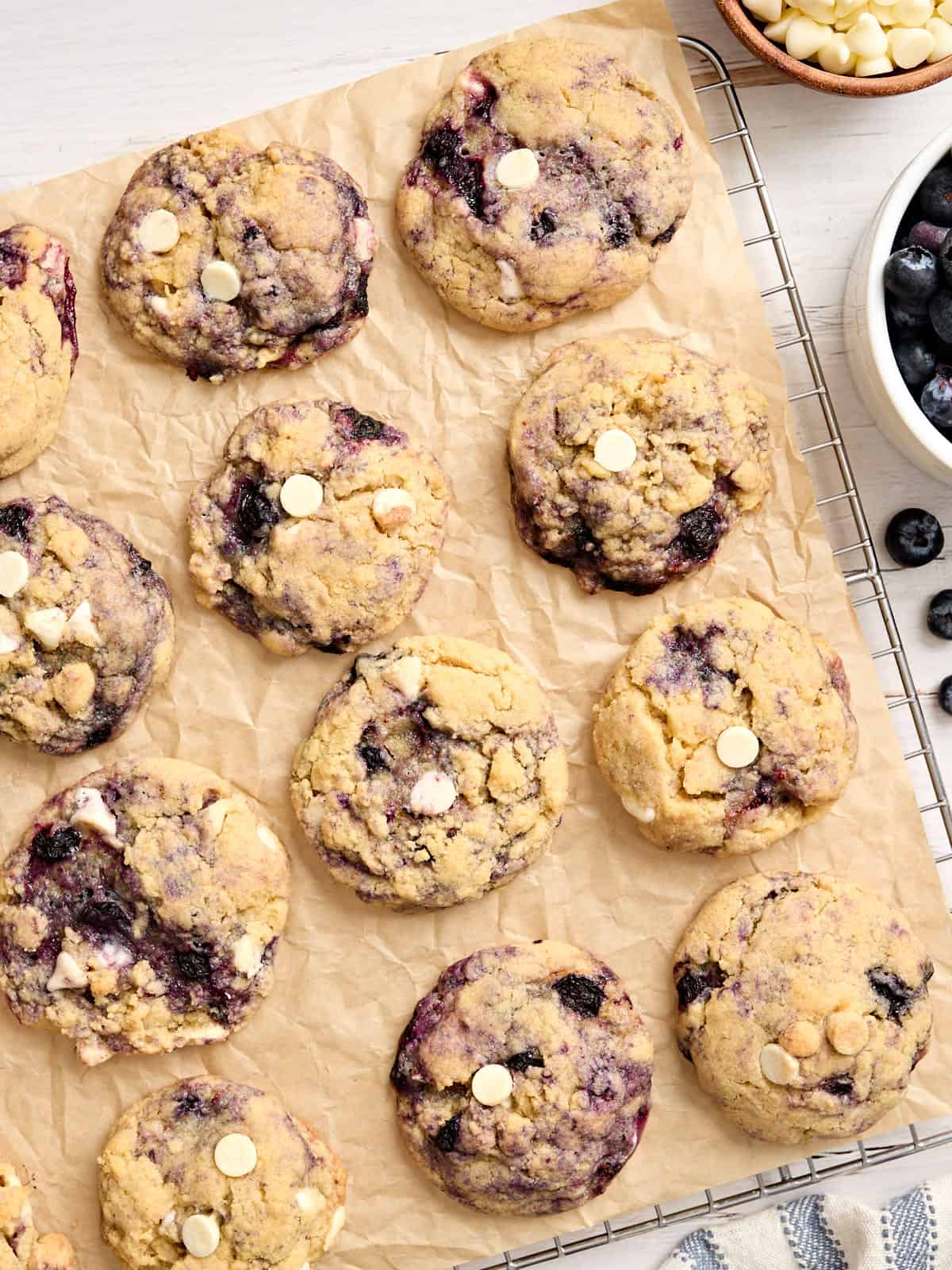
    Overhead view of blueberry cookies on parchment paper.

    Print
    Add to Collection Go to Collections

    Blueberry Cookies

    These easy Blueberry Cookies are soft, chewy, and jammy with frozen blueberries, white chocolate chips, and a hint of cinnamon. No chilling needed!
    Course Dessert
    Cuisine American
    Total Cost $4.77 recipe / $0.13 serving
    Prep Time 15 minutes
    Cook Time 15 minutes
    Total Time 30 minutes
    Servings 36 cookies (1.25oz cookie scoop)
    Calories 97kcal
    Author Jess Rice
    Cost $4.77

    Equipment

    • 2 Large Cookie Sheets
    • Parchment Paper
    • Mixing Bowls
    • Hand Mixer
    • 1.25 oz Cookie Scoop

    Ingredients

    • 10 Tbsp salted butter (1 stick + 2 Tbsp) softened, $1.17
    • 1 cup light brown sugar packed, $0.68
    • ½ cup granulated sugar $0.17
    • 2 cups all-purpose flour $0.24
    • 1 tsp sea salt $0.05
    • 1 tsp baking powder $0.04
    • 1 large egg $0.12
    • ½ tsp cinnamon $0.04*
    • 1 tsp vanilla extract $0.65
    • ½ cup frozen blueberries $1.04**
    • ¼ cup white chocolate chips $0.57

    Instructions

    • Gather ingredients and preheat oven to 350℉. Prepare 2 large cookie sheets with parchment.
    • Combine room temperature butter, brown sugar, and granulated sugar in a large mixing bowl and mix until creamy and well-combined.
    • In a separate bowl, combine flour, salt, and baking powder. Whisk until combined.
    • Beat together the large egg, cinnamon, and vanilla extract. Add it to the creamed butter and sugar. Mix with a hand mixer until combined.
    • Little by little, add some of the dry flour mixture to the wet mixture until a sticky dough forms and all of the flour mixture has been used up.
    • Gently fold in the frozen blueberries and white chocolate chips.
    • Using a cookie scoop (I use a 1.25 oz. cookie scoop), portion out cookies on the lined baking sheets, leaving 2 inches of space between cookies.
    • Baking in the middle rack of 350℉ oven for 15-20 minutes, or until the cookies have spread out and have just a touch of golden color around the edges. (In my oven, they took 15 minutes. In the Budget Bytes oven, they took 20 minutes!) I like my cookies a little chewy, so I pull them right when I start to see them looking a little golden on the tops or edges.
    • Transfer to a cooling rack and let cool 10-15 minutes before you enjoy!

    See how we calculate recipe costs here.

    Notes

    *The cinnamon didn’t make it into my ingredient photo, but it’s a must! It really makes the flavor of the blueberries shine, so don’t forget it.

    **Make sure your blueberries (even if you’re using fresh) are fully frozen when you add them to the dough! If they are soft, they will squish as you fold them in and the dough will become too wet. I like to use the big bags of Wyman’s wild blueberries for these cookies because the berries are a bit smaller and easier to handle, but any variety of blueberry will do. I can find these berries at both my local Kroger and Walmart with ease.

    For the best results, follow the mixing steps in order. Cream the butter and sugars together first, then add the egg, cinnamon, and vanilla. Only then should the remaining dry ingredients be added. This creates the best blueberry cookies with a soft, chewy middle and lightly crisp edges!

    Add a few extra white chocolate chips on top: To achieve showstopping, beautiful cookies, press a couple of extra white chocolate chips into the top of each ball just before baking!

    Make the dough fresh: I don’t recommend refrigerating the mixed dough once the blueberries are folded in, because the berries can thaw and release juice.

    Nutrition

    Serving: 1cookie | Calories: 97kcal | Carbohydrates: 15g | Protein: 1g | Fat: 4g | Sodium: 106mg | Fiber: 0.3g

    how to make Blueberry Cookies step-by-step photos

    The ingredients to make blueberry cookies.

    Gather all your ingredients and preheat the oven to 350°F. Also line 2 large cookie sheets with parchment paper.

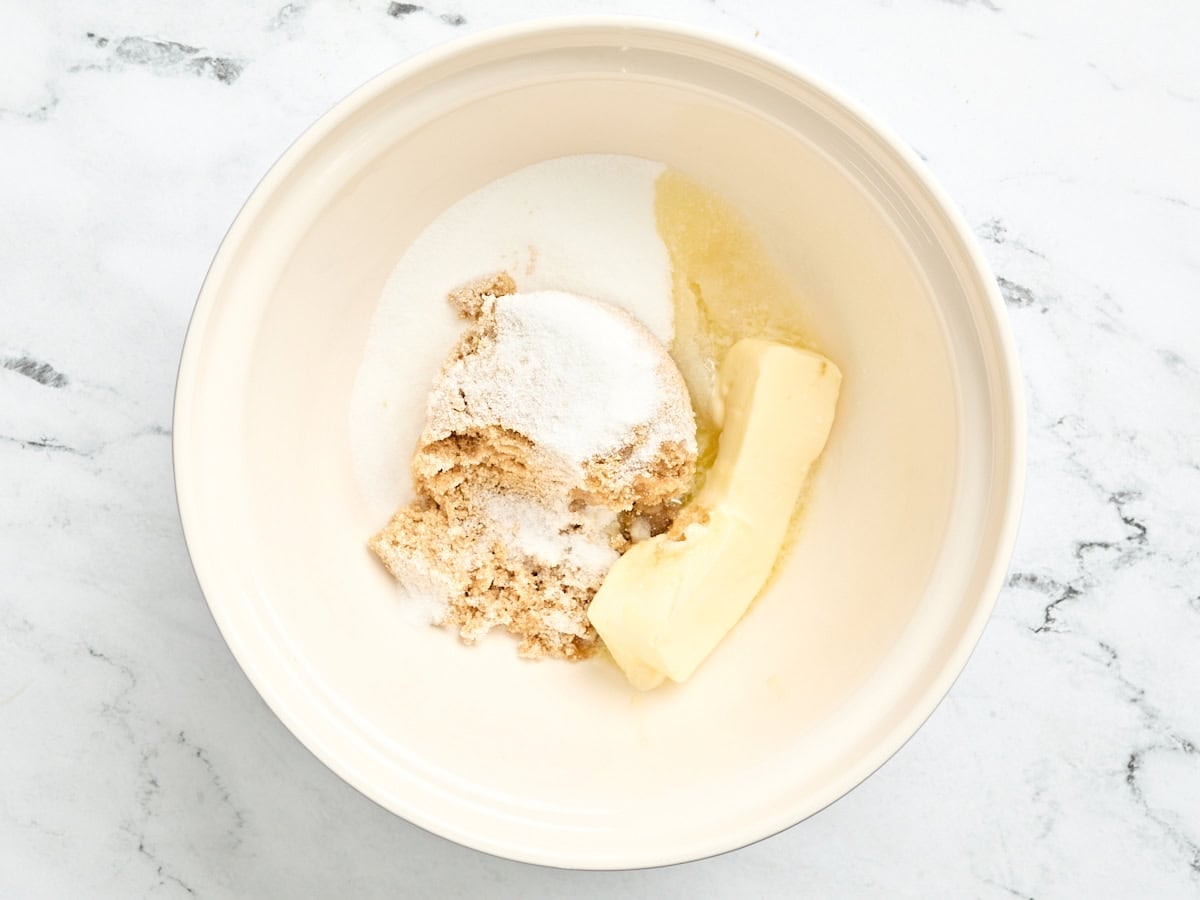
    White and brown sugar in a bowl with butter.

    Cream the butter and sugars: Add 10 Tbsp salted butter (1 stick + 2 Tablespoons) softened to room temperature), 1 cup packed light brown sugar, and ½ cup granulated sugar to a large mixing bowl. Beat until the mixture looks creamy, fluffy, and well combined, scraping down the sides of the bowl as needed.

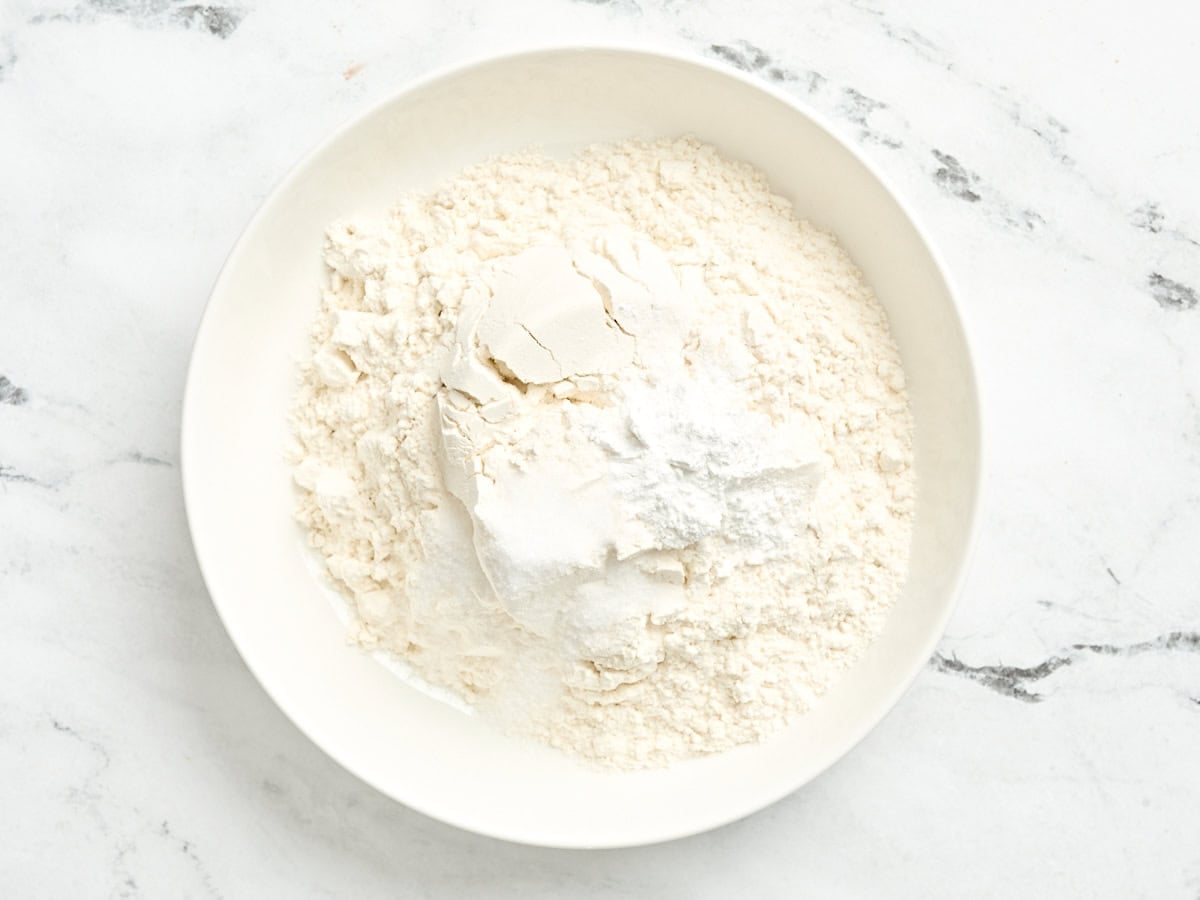
    Dry ingredients for blueberry cookies in a bowl.

    Combine the dry ingredients: In a separate bowl, whisk together 2 cups all-purpose flour, 1 tsp sea salt, and 1 tsp baking powder until evenly combined. This helps the salt and baking powder distribute evenly through the dough.

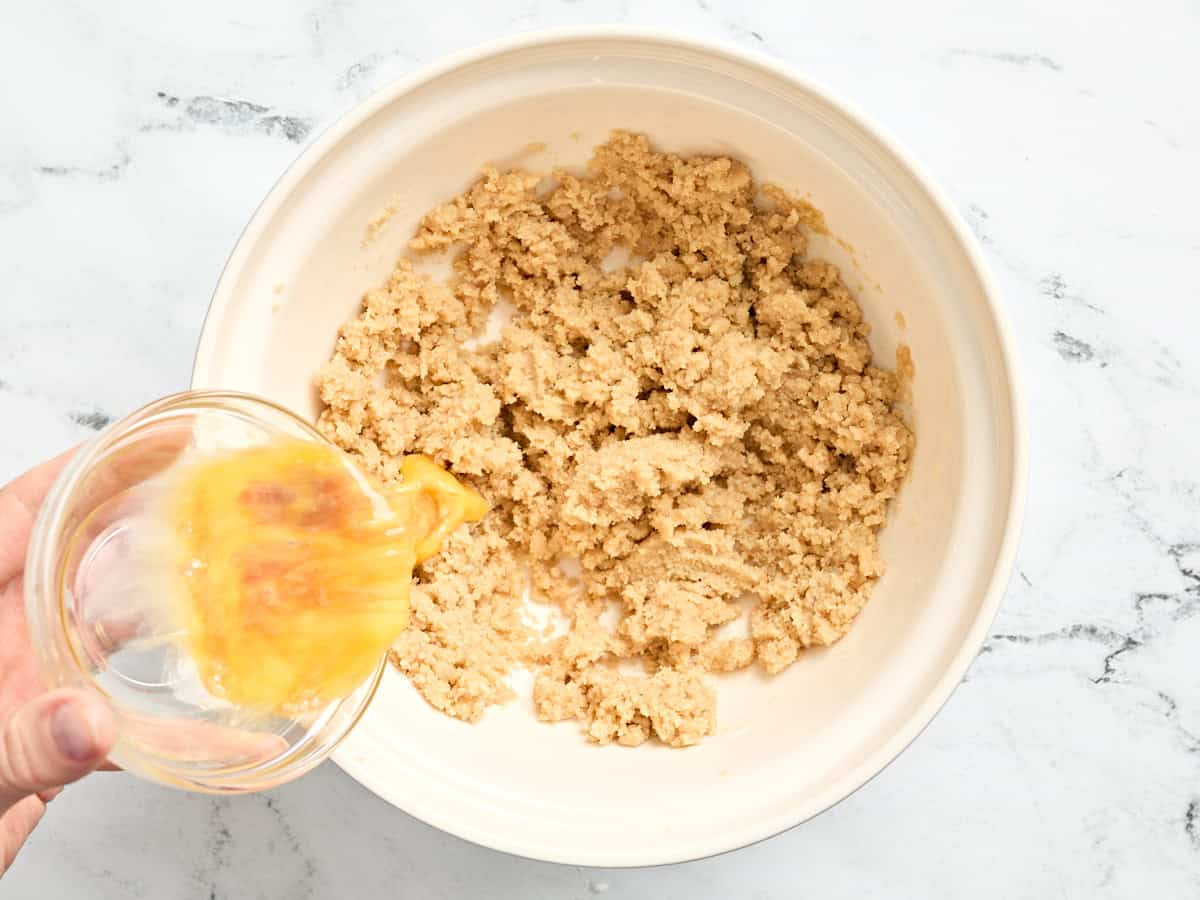
    Egg and vanilla being poured into creamed butter and sugar.

    Add the egg and flavorings: In a small bowl, beat together 1 large egg, ½ tsp cinnamon, and 1 tsp vanilla extract. Pour the egg mixture into the creamed butter and sugar, then mix with a hand mixer until smooth and combined. The dough will smell sweet and lightly spiced from the cinnamon and vanilla.

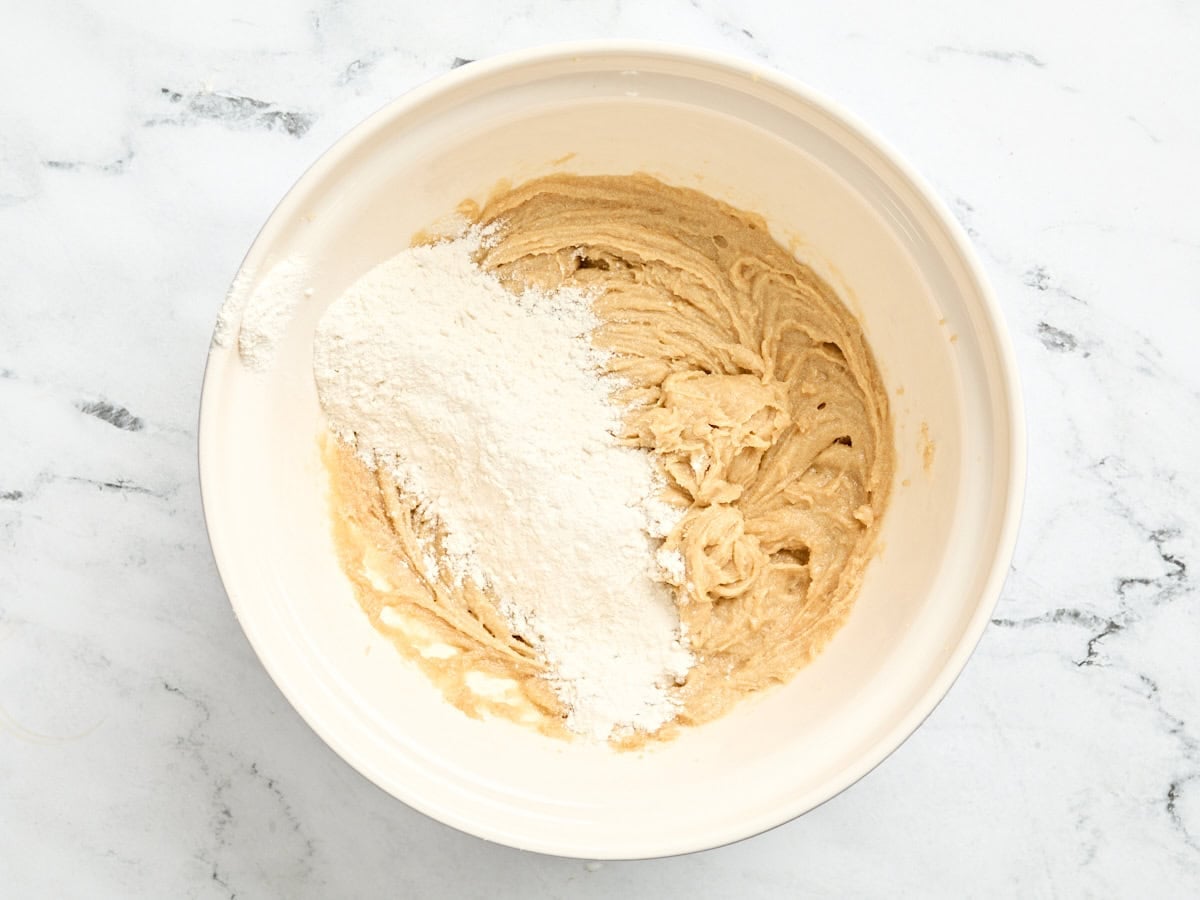
    A little flour added to creamed butter, sugar and eggs in a bowl.

    Make the dough: Add the dry flour mixture to the wet mixture a little at a time, mixing on low speed after each addition. Continue until a soft, sticky cookie dough forms and no dry streaks of flour remain. Try not to overmix once the flour is added, or the cookies can turn out tough once baked.

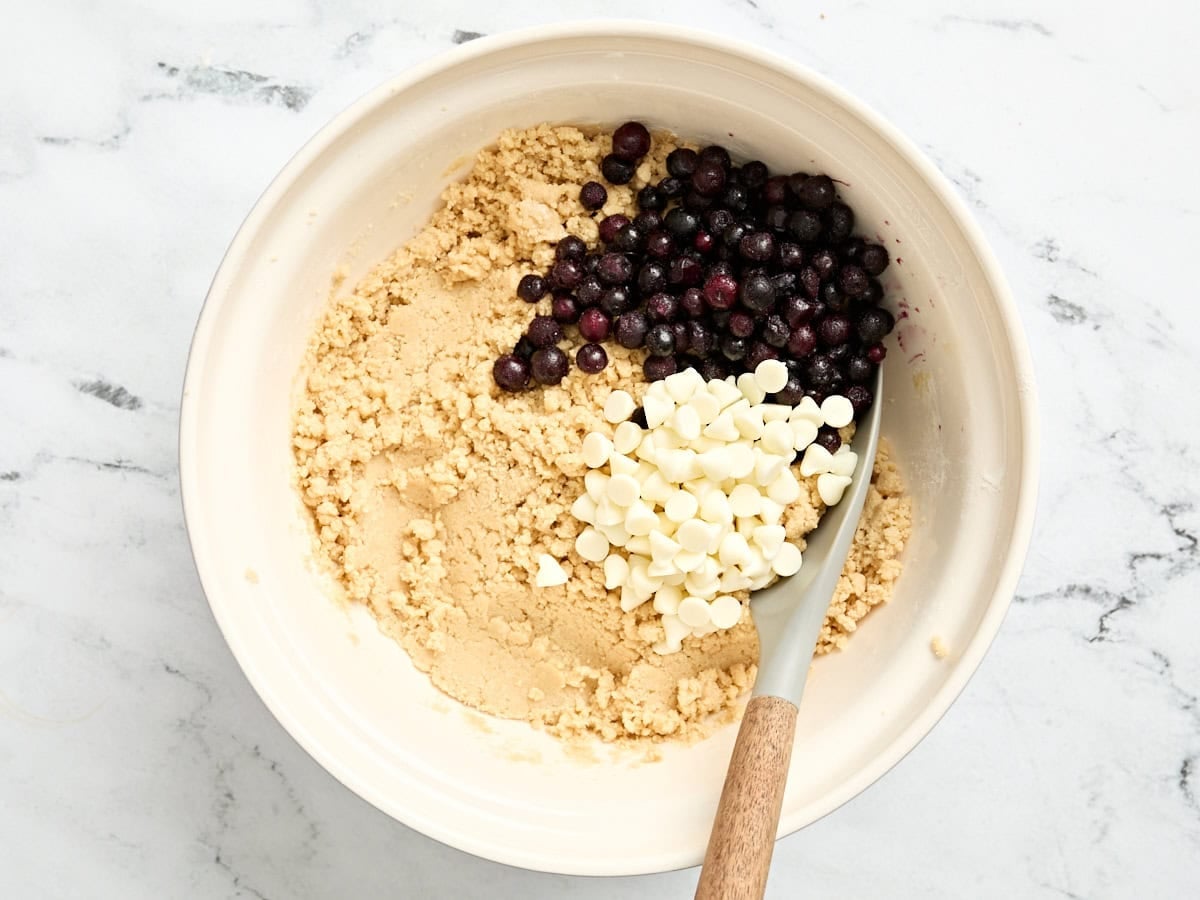
    Blueberries and white chocolate chips added to a bowl of cookie batter.

    Add the blueberries and chocolate: Gently fold in ½ cup frozen blueberries and ¼ cup white chocolate chips. Keep the blueberries frozen and fold carefully so they don’t burst too much or turn the whole dough purple. A few blue streaks are totally fine and make the cookies look pretty!

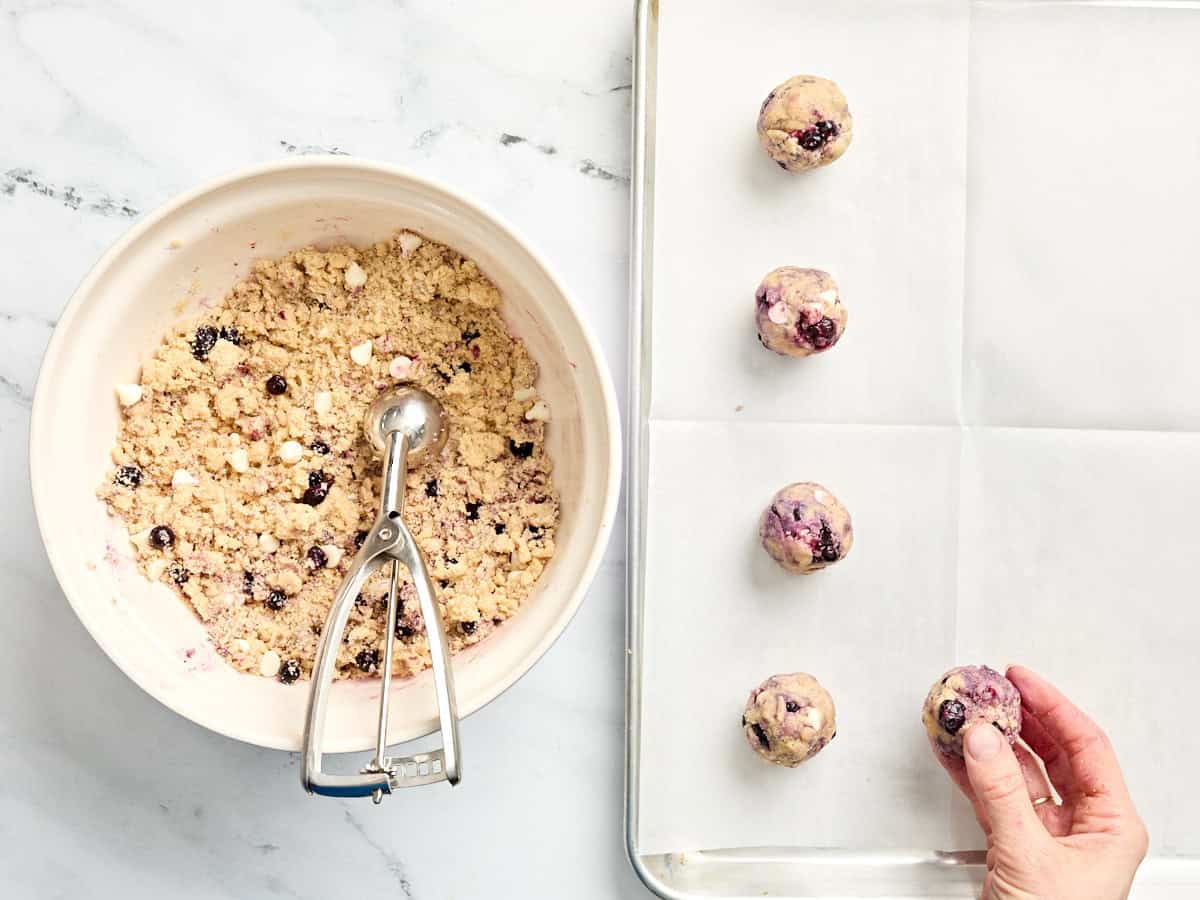
    A bowl of blueberry cookie dough in a bowl with a scoop, next to the balls of cookie dough on a baking sheet.

    Portion the dough: Use a cookie scoop (I use a 1.25 oz scoop), to portion the dough onto the prepared baking sheets. Leave about 2 inches of space between each cookie so they have room to spread in the oven.

    Balls of cookie dough on a baking sheet.

    Bake the cookies: Bake on the middle rack of the 350°F oven for 15-20 minutes, or until the cookies have spread and the edges are just lightly golden. The centers should still look soft and slightly puffy. In my oven, they took about 15 minutes, but in the Budget Bytes oven, they needed closer to 20 minutes, so start checking early.

    I like these blueberry cookies a little chewy, so I pull them right when I start to see them looking a little golden on the tops or edges.

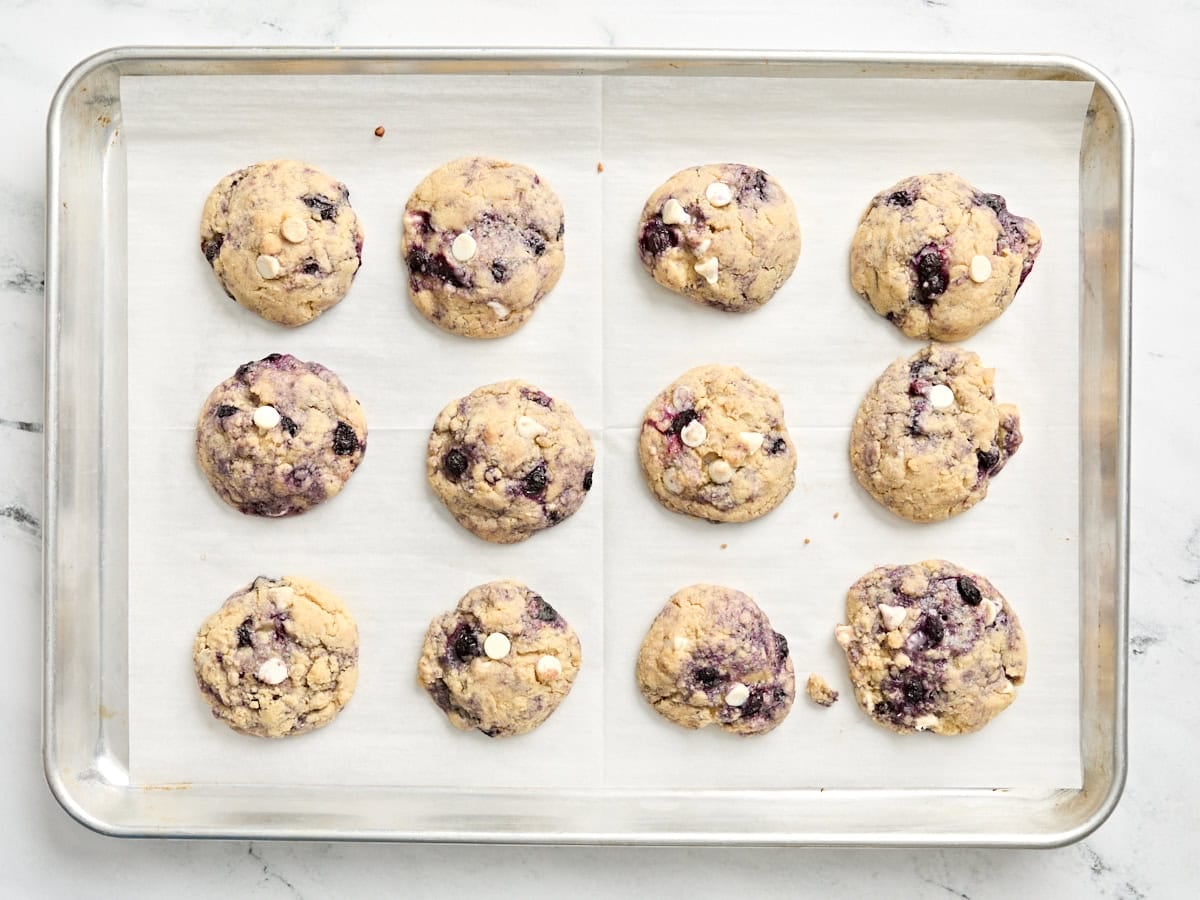
    Blueberry cookies on a baking sheet.

    Cool and serve: Let the blueberry cookies cool on the baking sheet for 10-15 minutes so they can firm up, then transfer them to a cooling rack. The white chocolate will be melty, the blueberries will be jammy, and the cookies will finish setting as they cool. Enjoy!

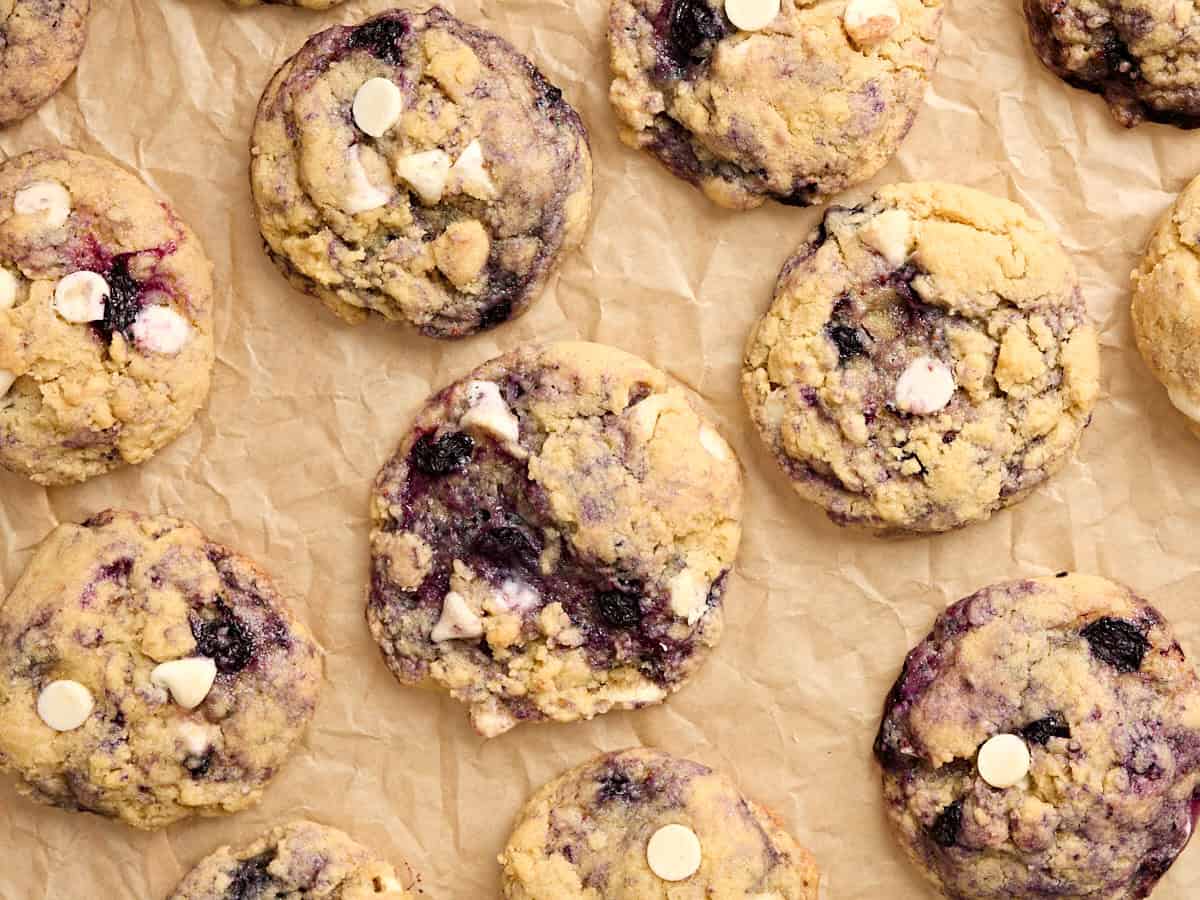
    Overhead close up view of blueberry cookies on parchment paper.

    Serving Suggestions

    I’ll happily eat these chewy blueberry cookies straight from the cooling rack! They’re a fun treat for summer cookouts, birthdays, or gifting to friends, but they’re also so easy to turn into a summery dessert. Sandwich a scoop of vanilla ice cream between two cooled cookies for the cutest blueberry cookie ice cream sandwiches. The jammy blueberries and white chocolate chips taste so, so good with the creamy vanilla. These cookies also perfect with an iced coffee or cold brew in the afternoon!

    Storage Instructions

    Store the fully cooled cookies in an airtight container at room temperature for up to 2 days. I like to place parchment paper between layers to keep the soft blueberry spots and white chocolate chips from sticking together. Because these cookies have juicy berries baked into them, make sure they’re completely cool before storing, so extra steam doesn’t get trapped in the container and make them too soft.

    Fridge

    For longer storage, you can refrigerate these blueberry cookies in an airtight container for up to 1 week. The fridge will make them a little firmer, so let them sit at room temperature for a few minutes before serving if you want a softer texture.

    Freezer

    Freeze the cooled blueberry cookies in a freezer-safe bag or container for up to 3 months. I recommend freezing them in a single layer first, then stacking them with parchment between layers once firm, so they don’t stick together. Thaw at room temperature, or warm one cookie in the microwave for a few seconds for that just-baked feel!

    Love Blueberry Treats? Try These Recipes Next!

    The post Blueberry Cookies appeared first on Budget Bytes.

    This post was originally published on this site.

  • 4th of July Menu Plan

    4th of July Menu Plan

    Get ready for a fun-filled 4th of July with my easy and delicious menu plan, complete with a handy shopping list! From zesty BBQ chicken to refreshing strawberry pie, I’ve got everything you need for the perfect holiday!

    Easy 4th of July Menu Plan

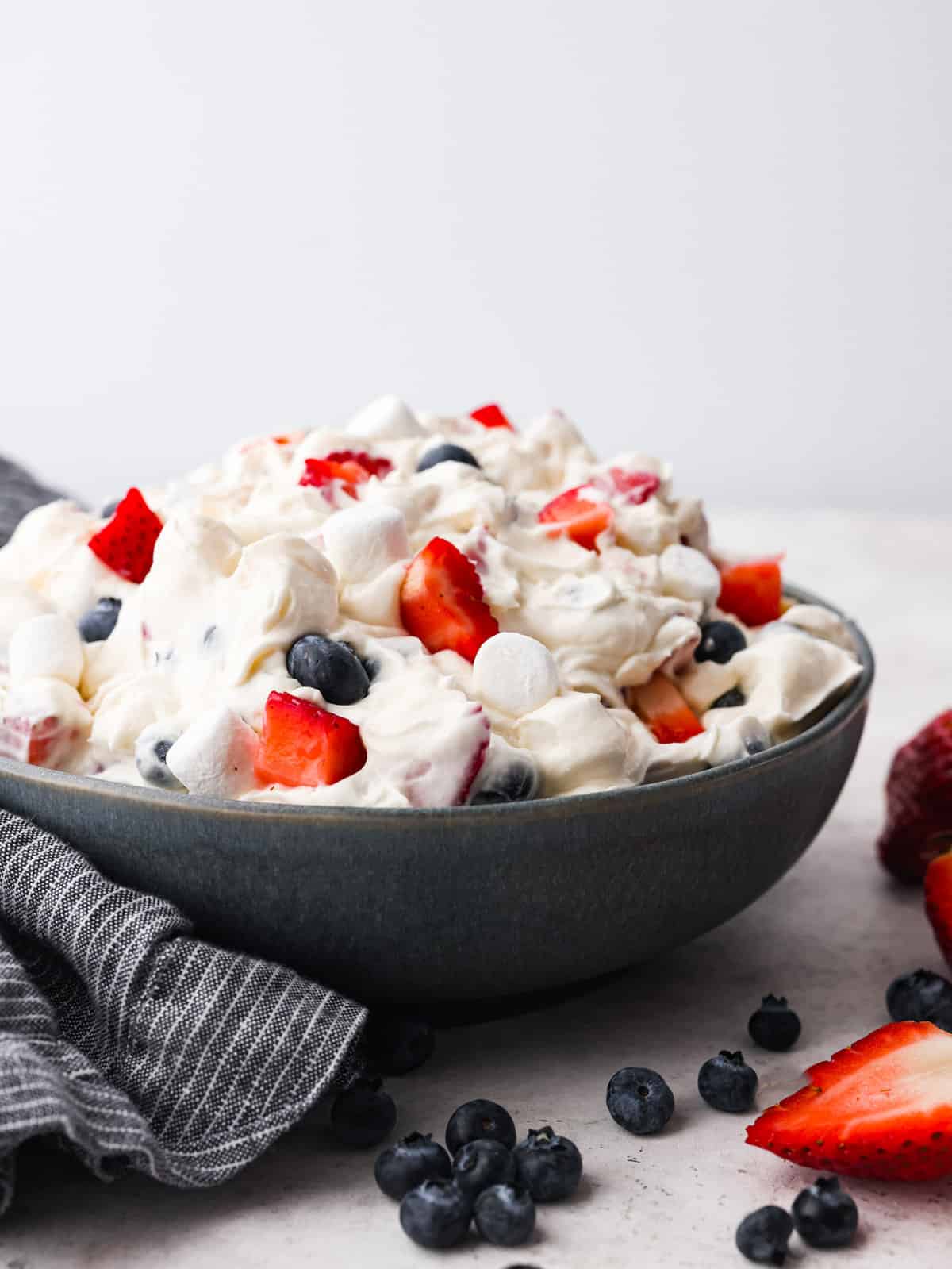
    This easy menu plan takes the stress out of feeding everyone for the 4th, so you can enjoy the parades, pool time, and sparklers. Add some extra red, white, and blue fun with my Red, White, and Blue Cake or Cream Cheese Strawberries, and don’t miss all of my 4th of July recipes for even more festive ideas!

    How Many Does This Feed?

    Each recipe in this 4th of July Day meal plan is meant to serve about 6 adults, so if you are making all of them, this amount of food should easily feed 15+ people. More if it’s a combination of adults and kids!

    Zesty BBQ Chicken

    No ratings yet
    This zesty BBQ chicken is an easy crockpot recipe that only takes 5 ingredients to make! The slow-cooked tender pulled chicken is dripping in a tasty BBQ sauce. Perfect for busy weeknights or to feed a crowd!

    View Recipe

    Instant Pot Baby Back Ribs

    4 from 1 vote
    These Instant Pot ribs are fall off the bone tender, easy to make, and loaded with flavor! Enjoy straight them out of the pressure cooker slathered with your favorite bbq sauce!

    View Recipe

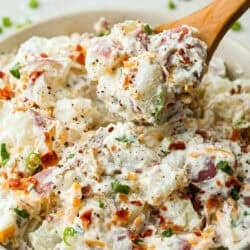
    Bacon Ranch Potato Salad

    5 from 4 votes
    A creamy and delicious potato salad with amazing ranch flavor and bacon! This is the perfect side to take to a potluck and is sure to be a huge hit!

    View Recipe

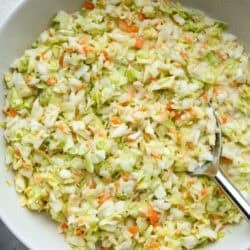
    Copycat KFC Coleslaw

    4.75 from 4 votes
    Copycat KFC Coleslaw is the perfect summer side dish and tastes exactly like the real thing!

    View Recipe

    Fresh Strawberry Pie

    5 from 14 votes
    This fresh strawberry pie is loaded with juicy strawberries in a flaky pie crust and chilled until perfectly glossy, sweet, and sliceable.

    View Recipe

    Firework Bundt Cake

    5 from 1 vote
    This firework bundt cake is exploding with colors and flavor! It not only looks impressive but it tastes so delicious that you will definitely be making this for every Fourth of July! 

    View Recipe

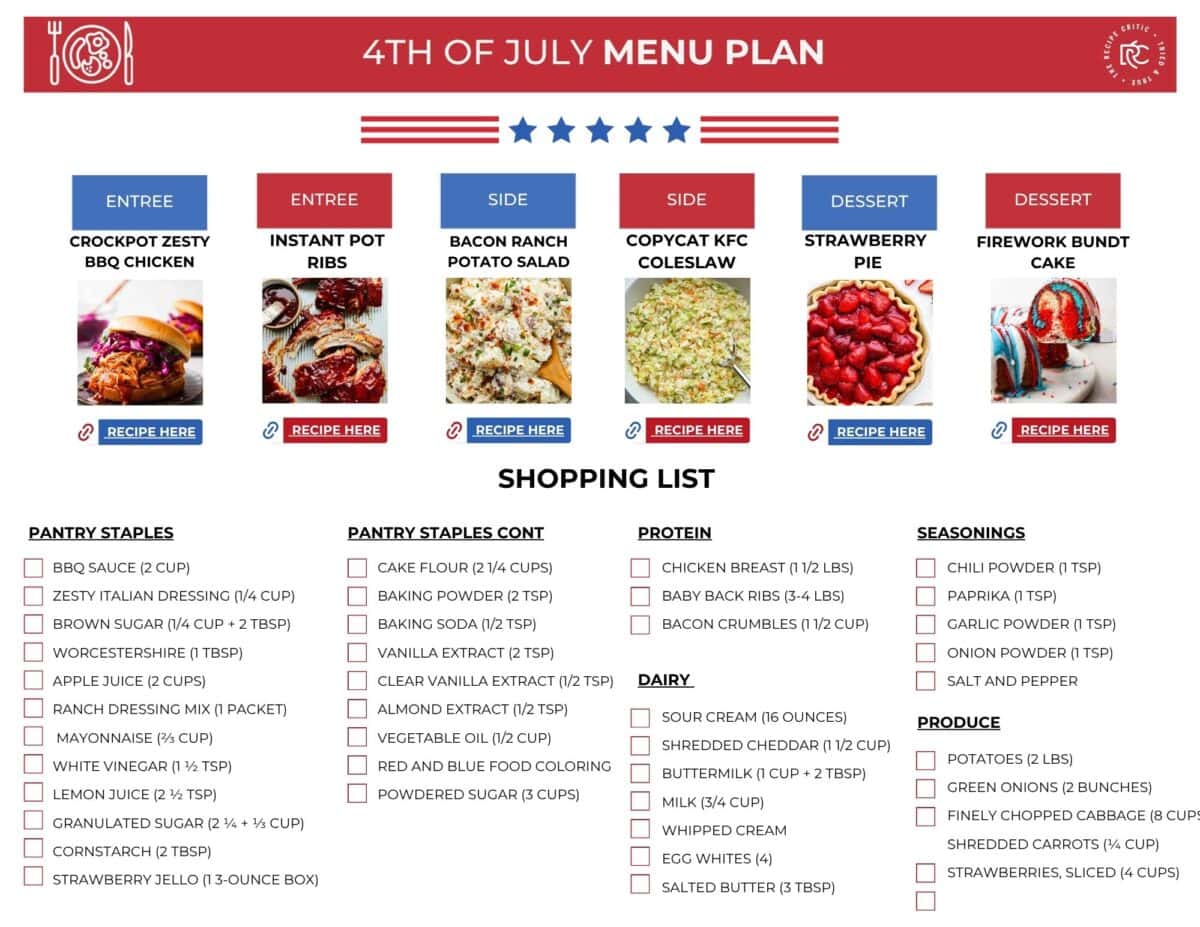
    My weekly menu meal preps always include a printable shopping list that is measured out and ready to go. It makes things so easy! If you don’t see something you like, check out my other weekly meal plans here.

    Picture of the free shopping list for the 4th of July menu plan.

    4th of July Leftovers

    I only meal plan Monday-Friday because we usually have plans over the weekend! And I always have leftovers we can use to finish off the week! If you do have leftovers, make sure to store them properly in an airtight container in your fridge.

    More Red, White, and Blue Recipes

    You can never have enough treats and patriotic snacks on the 4th of July.

    This post was originally published on this site.

  • Q&A: How to Prevent, Detect, & Treat Dehydration in Aging Adults

    Q&A: How to Prevent, Detect, & Treat Dehydration in Aging Adults

    Q: How can we get my older mother to drink more water? She is susceptible to urinary tract infections and seems to be often dehydrated no matter what we do. We were also wondering if coffee and tea are okay, or should they be avoided to reduce dehydration? And what are symptoms of dehydration in older women that we can look out for?

    A: Dehydration is indeed an important problem for older adults. It can be common even when it’s not hot outside.

    Helping an older person increase her fluid intake, as you’re trying to do, is one of the best ways to reduce the risk of dehydration.

    Now how to actually do this? Studies — and practical experience — suggest that the best approaches include:

    1. Frequently offering the older person a drink, preferably on a schedule,
    2. Offering beverages the person seems to prefer,
    3. Not expecting older adults to drink a large quantity at a single sitting,
    4. Addressing any urinary incontinence issues that might be making the person reluctant to drink often.

    But your question brings up other issues in my mind. Has frequent dehydration been confirmed? (Dehydration can be hard to correctly diagnose.) Have you been able to measure how much your mother drinks, and how does this amount compare to the recommended daily fluid intake for older adults?

    Also, is the real goal to prevent or manage frequent urinary tract infections, and is increasing her hydration likely to achieve this?

    So let’s review the basics of dehydration in older adults, the symptoms of dehydration in elders, and what’s known about helping older adults stay hydrated. I will then share some additional tips on helping your mother maintain hydration. I also made a video on this subject on my Youtube channel, you can watch it here:

    The Basics of Dehydration

    What is dehydration and what causes it?

    Dehydration means the body doesn’t have as much fluid within the cells and blood vessels as it should.

    Normally, the body constantly gains fluid through what we eat and drink, and loses fluid through urination, sweating, and other bodily functions. But if we keep losing more fluid than we take in, we can become dehydrated.

    If a person starts to become dehydrated, the body is designed to signal thirst to the brain. The kidneys are also supposed to start concentrating the urine, so that less water is lost that way.

    Why are older adults at higher risk for dehydration?

    Unfortunately, the body’s mechanisms meant to protect us from dehydration work less well as we age. Older adults have reduced thirst signals and also become less able to concentrate their urine.

    Other factors that put older adults at risk include:

    • Chronic problems with urinary continence, which can make older adults reluctant to drink a lot of fluids
    • Memory problems, which can cause older adults to forget to drink enough, or forget to ask others for something to drink
    • Mobility problems, which can make it harder for older adults to get something to drink
    • Living in nursing homes, because access to fluids often depends on the availability and attentiveness of staff
    • Swallowing difficulties

    Dehydration can also be brought on by an acute illness or other event. Vomiting, diarrhea, fever, and infection are all problems that can cause people to lose a lot of fluid and become dehydrated.

    COVID-19 has also been linked to dehydration in older adults (although it’s hard to say whether that’s because the virus itself dehydrates them versus people drinking less when they are weak and sick). And of course, hot weather always increases the risk of dehydration.

    Last but not least, older adults are more likely to be taking medications that increase the risk of dehydration, such as diuretic medications, which are often prescribed to treat high blood pressure or heart failure. (Diuretics are also sometimes prescribed for leg swelling due to aging veins, but research shows they don’t work well for this purpose. Learn more here: Leg Swelling in Aging: What to Know & What to Do.)

    A UK study of older adults in residential care found that 46% had impending or current dehydration, as diagnosed by blood tests.

    How is dehydration diagnosed?

    For frail older adults, a simple preliminary check, if you’re concerned about dehydration, is to get the older person to drink some fluids and see if they perk up or improve noticeably. (This often happens within 5-10 minutes.)

    This is not a clinically-proven method, but it’s easy to try. If drinking some fluids does noticeably improve things, that does suggest that the older person was mildly dehydrated.

    For a truly accurate diagnosis in older adults, the most accurate way to diagnose dehydration is through laboratory testing of the blood. Dehydration generally causes abnormal laboratory results such as:

    • Elevated plasma serum osmolality: this measurement relates to how concentrated certain particles are in the blood plasma
    • Elevated creatinine and blood urea nitrogen: these tests relate to kidney function
    • Electrolyte imbalances, such as abnormal levels of blood sodium
    • Low urine sodium concentration (unless the person is on diuretics)

    (Doctors often sub-classify dehydration based on whether blood sodium levels are high, normal, or low.)

    Dehydration can also cause increased concentration of the urine — this is measured as the “specific gravity” on a dipstick urine test. However, this is not an accurate way to test for dehydration in older adults, since we tend to lose the ability to concentrate urine as we get older. This was confirmed by a 2016 study, which found that the diagnostic accuracy of urine dehydration tests in older adults is “too low to be useful.

    What are the symptoms of dehydration in elders?

    There are also a number of physical symptoms associated with dehydration. However, a 2015 study of older adults found that the presence or absence of dehydration symptoms is not an accurate way to diagnose dehydration.

    Physical symptoms of dehydration may include:

    • dry mouth and/or dry skin in the armpit
    • high heartrate (usually over 100 beats per minute)
    • low systolic blood pressure
    • dizziness
    • weakness
    • delirium (new or worse-than-usual confusion)
    • sunken eyes
    • less frequent urination
    • dark-colored urine

    Symptoms of dehydration in women are generally the same as in men.

    But as noted above: the presence or absence of these physical signs are not reliable ways to detect dehydration. Furthermore, the physical symptoms above can easily be caused by health problems other than dehydration.

    This study published in 2019 confirmed that commonly used symptoms do not accurately detect dehydration in frail older adults: Signs and Symptoms of Low-Intake Dehydration Do Not Work in Older Care Home Residents—DRIE Diagnostic Accuracy Study.

    In 2020, a European group working on diagnosing dehydration in nursing home residents proposed a diagnostic approach that is summarized here. It involves a combination of medical history, physical signs, and laboratory testing.

    In short, there is no easy simple way to confirm (or rule out) dehydration in an older person.

    So if you are concerned about clinically significant dehydration — or about the symptoms above — blood tests results may be needed. A medical evaluation for possible dehydration should also include an interview and a physical examination.

    What are the consequences of dehydration?

    The consequences depend on how severe the dehydration is, and perhaps also on how long the dehydration has been going on.

    In the short-term, dehydration can cause the physical symptoms listed above. Especially in older adults, weakness and dizziness can provoke falls. And in people with Alzheimer’s or other forms of dementia, even mild dehydration can cause noticeable worsening in confusion or thinking skills.

    Dehydration also often causes the kidneys to work less well, and in severe cases may even cause acute kidney failure.

    The consequences of frequent mild dehydration — meaning dehydration that would show up as abnormal laboratory tests but otherwise doesn’t cause obvious symptoms — are less clear.

    Chronic mild dehydration can make constipation worse. Otherwise, a 2012 review found that the only health problem that has been consistently associated with low daily water intake is kidney stones.

    A 2013 review on fluid intake and urinary system diseases concluded that it’s plausible that dehydration increases the risk of urinary tract infections, but not definitely proven.

    A 2020 review on the effect of increasing fluid intake to prevent UTIs also noted that “Patients with UTI are often advised by clinicians to keep adequately hydrated or drink more fluids. However, the evidence base for this recommendation remains unclear.”

    Speaking of urinary tract infections (UTIs), if you are concerned about frequent bacteria in the urine, you should make sure this reflects real UTIs and not simply a sign of the older person’s bladder being colonized with bacteria.

    This is a very common condition known as asymptomatic bacteriuria, and incorrectly diagnosing this as a UTI can lead to pointless overtreatment with antibiotics. (More on this issue below, or see Q&A: Why Urine Bacteria Doesn’t Mean a UTI Needs Antibiotics.)

    How is dehydration treated?

    The treatment of dehydration depends on:

    • Whether the dehydration appears to be mild, moderate, or severe
    • What type of electrolyte imbalances (such as high/low levels of sodium and potassium) appear on laboratory testing
    • If known, the cause of the dehydration

    Mild dehydration can usually be treated by having the person take more fluids by mouth. Generally, it’s best to have the person drink something with some electrolytes, such as a commercial rehydration solution, a sports drink, juice, or even bouillon. But in most cases, even drinking water or tea will help.

    Mildly dehydrated older adults will often perk up noticeably after they drink some fluids, usually within 5-10 minutes.

    Moderate dehydration is often treated with intravenous hydration in urgent care, the emergency room, or even the hospital. Some nursing homes can also treat dehydration with a subcutaneous infusion, which means providing fluid through a small IV needle placed into the skin of the belly or thigh. This is called hypodermoclysis, and this is actually safer and more comfortable for older adults than traditional IV hydration.

    Severe dehydration may require additional intervention to support the kidneys, and sometimes even requires short-term dialysis.

    How to prevent dehydration in older adults?

    Experts generally recommend that older adults consume at least 1.7 liters of fluid per 24 hours. This corresponds to 57.5 fluid ounces, or 7.1 cups.

    What are the best fluids to prevent dehydration?

    I’m unaware of any research or guidelines clarifying which fluids are best to drink. This is probably because clinical research hasn’t compared different fluids to each other.

    As to whether certain fluids are dehydrating: probably the main fluid to be concerned about in this respect is alcohol, which exerts a definite diuretic effect on people.

    The effect of caffeine on causing people to lose excess water is debatable. Technically caffeine is a weak diuretic. But real-world studies suggest that people who are used to drinking coffee don’t experience much diuretic effect.

    Now, caffeine may worsen overactive bladder symptoms, so there may be other reasons to be careful about fluids containing caffeine. But as best I can tell, coffee and tea are not proven to be particularly dehydrating in people who drink them regularly.

    The safest approach would still be to drink decaffeinated drinks. But if an older person particularly loves her morning cup of (caffeinated) coffee, I’d say to consider accommodating her if at all possible.

    How to help older adults to stay hydrated?

    A 2015 review of nursing home interventions intended to reduce dehydration risk concluded that “the efficacy of many strategies remains unproven.” Still, here are some approaches that are reasonable to try:

    • Offer fluids often throughout the day; consider doing so on a schedule.
    • Offer smaller quantities of fluid more often; older adults may be reluctant to drink larger quantities less often.
    • Be sure to provide a beverage that is appealing to the older person.
    • See if the older person seems to prefer drinking through a straw.
    • Supplement fluids with water-rich fruit (e.g. watermelon) or other foods with high water content.
    • Identify any continence concerns that may be making the older person reluctant to drink. Keeping a log of urination and incontinence episodes can help.
    • Consider a timed toileting approach, which means helping the older person get to the bathroom on a regular schedule. This can be very helpful for people with memory problems or mobility difficulties.
    • Track your efforts in a journal. You’ll want to track how much the person is drinking; be sure to note when you try something new to improve fluid intake.
    • Offer extra fluids when it’s hot, or when the person is ill.

    Practical tips for family caregivers

    Let’s now return to the issues brought up in the question.

    Family caregivers are often concerned about whether an older person is drinking enough. Since dehydration is indeed very common among older adults, this concern if very important.

    However, before expending a lot of energy trying to get your mother to drink more, I would encourage you to consider these four suggestions:

    1.Measure how much your mother is actually drinking most days.

    This can require a little extra effort. But it’s very helpful to get at least an estimate of how much the person drinks. This can confirm a family’s — or doctor’s — hunch that the person isn’t taking in enough fluid, and can help the care team figure out how much more fluid is required.

    Again, the recommendation for older adults is to consume at least 1.7 liters/day, which corresponds to at least 57.5 fluid ounces. In the US, where a measuring cup = 8 ounces, this is equivalent to 7.1 cups/day.

    Keep a journal to record how much fluid your older parent is drinking. It’s generally important to track anything you want to improve.

    2. Confirm that your mother is, in fact, often dehydrated.

    As noted above in the section on diagnosing dehydration: physical symptoms and urine tests are not enough to either diagnose dehydration or rule it out.

    Instead, consider these two approaches to confirming clinical dehydration. One is to see if her energy and mental state perk up when she drinks more. The other is to talk to the doctor and request blood tests to confirm dehydration.

    Now, you don’t necessarily want to request blood tests every time you suspect mild dehydration. But especially if your mother’s dehydration has never been confirmed by a serum osmolality test, it might be useful to do this at least once.

    3. If frequent urinary tract infections (UTIs) are a concern, learn about asymptomatic bacteriuria and try to determine whether these are real UTIs versus a colonized bladder.

    Sometimes I’ve seen families hellbent on increasing hydration or taking other measures, because they are concerned about repeated or persisting urinary tract infections (UTIs).

    But UTIs are a bit like dehydration. A UTI is a common problem in older adults and is potentially very serious. But it’s also easily misdiagnosed, even by professionals.

    Sometimes, when an older person keeps being diagnosed with a UTI repeatedly, the problem is actually that the older person has asymptomatic bacteriuria. This is a very common condition in which an older person’s bladder becomes colonized with bacteria. It probably happens because people’s immune systems get weaker as they age.

    So how is this different from a UTI? Both conditions will cause a positive urine culture, meaning that bacteria is in the urine. The main difference is that in asymptomatic bacteriuria, the older person doesn’t experience pain, inflammation, increased confusion, or other symptoms of infection.

    In a young person, bacteria in the urine is very uncommon and almost always corresponds to a clinically significant infection. But in an older person, bacteria in the urine is common.

    So you cannot diagnose a UTI in an older person just on the basis of a positive urine culture. Instead, the family and clinician must note other signs of infection, such as pain or delirium.

    Families are often surprised to learn that clinical trials have repeatedly found that it is not helpful to treat asymptomatic bacteriuria, but it’s true. In fact, a 2015 study found that treating asymptomatic bacteriuria with antibiotics increased the likelihood of later having a real UTI, and that the real UTI was more likely to be antibiotic-resistant.

    For more on this topic, see Q&A: Why Urine Bacteria Doesn’t Mean a UTI Needs Antibiotics.

    4. Talk to your mother to get her perspective on drinking more (and to find out if continence issues are a concern for her).

    Before you keep pressuring her to drink more: have you spent some time talking to her to learn more about her perspective on drinking more, and on avoiding dehydration?

    The more we learn about how an older person sees a situation, the better equipped we are to try to assist them.

    In particular, inquiring about how an older adult feels about drinking sometimes reveals that they are concerned about worsening their urinary continence symptoms. (Learn more about managing these here: Urinary Incontinence in Aging: What to know when you can’t wait to go.)

    5. Pay attention to figure out which fluids your mother prefers to drink and try scheduling frequent small drinks.

    Ultimately, there’s no substitute for paying close attention, keeping track of your observations, and doing some trial and error to figure out what seems to improve things.

    No doctor has a magic formula to get an older person to drink more. So, identify the drinks your mother prefers, start tracking how much she drinks, and then start experimenting to figure out what works.

    Usually, a combination of the following three approaches will improve fluid intake:

    • Offer a beverage the person likes,
    • Offer small-to-moderate quantities of the beverage on schedule,
    • Address any urinary incontinence concerns.

    You can also increase fluid intake by offering foods that contain a lot of water, such as watermelon, or perhaps soups.

    Helping an older relative stay hydrated can be challenging, especially when you’re already managing many other health and caregiving concerns. Learn more about the Helping Older Parents Membership, where you can receive ongoing eldercare guidance from me and my team of geriatric care managers.

    This article was last reviewed in June 2026.

    This post was originally published on this site.

  • 7 Toronto Parks You Can BBQ In With Your Own Grill

    7 Toronto Parks You Can BBQ In With Your Own Grill

    Looking for the best parks in Toronto for a BBQ? Discover where you can bring your own grill, the city’s top picnic spots, permit requirements, and practical tips for planning the perfect summer cookout.

    The post 7 Toronto Parks You Can BBQ In With Your Own Grill appeared first on Going Awesome Places by William Tang.

    This post was originally published on this site.

  • 45 Light + Bright Healthy Summer Dinners

    45 Light + Bright Healthy Summer Dinners

    Summer just has a way of making healthy eating feel… actually easy? Like, when tomatoes look like that at the farmers market, and corn is practically begging to be thrown on the grill, you really don’t need much convincing to eat well. Fresh produce does most of the heavy lifting and honestly, the meals kind of make themselves.

    These recipes are some of my favorites to make in the summer when I want things to feel light and breezy. They’re bright, they’re colorful, they’re the kind of dinners that feel good when you eat them and look beautiful on the dinner table, and not a single one feels like you’re trying to be “healthy.” It’s just good food that happens to be exactly what you’re craving right now. ❤️


    Healthy Summer Dinner Recipes

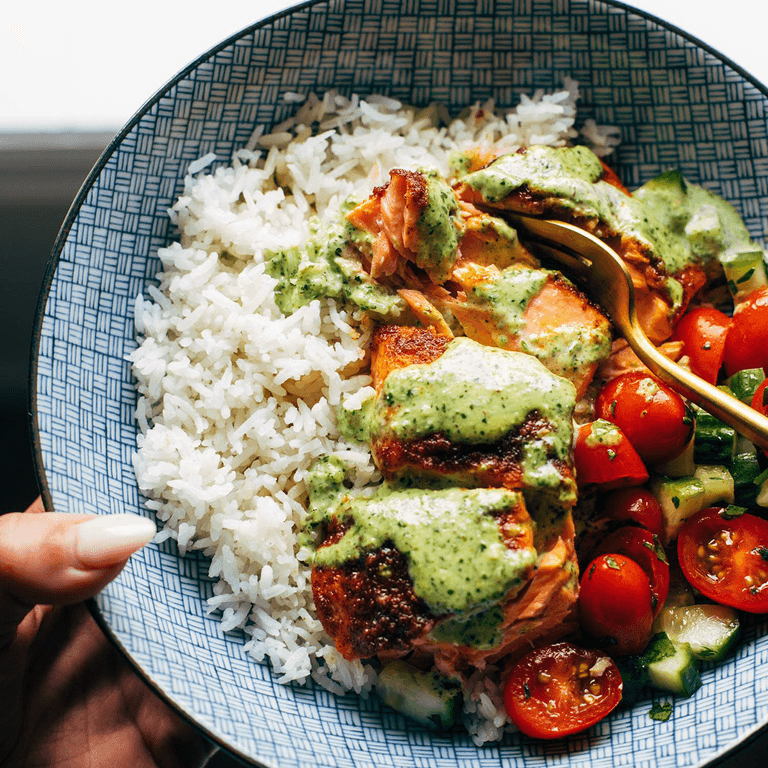
    Salmon with basil sauce.

    Salmon with Basil Sauce and Tomato Salad

    We’re making a summery salmon with a beautiful, big-flavored basil sauce that is so good, you’re going to want to just drink it. Perfectly-spiced, fresh, and a dinner for everyone!

    66 reviews / 4.9 average

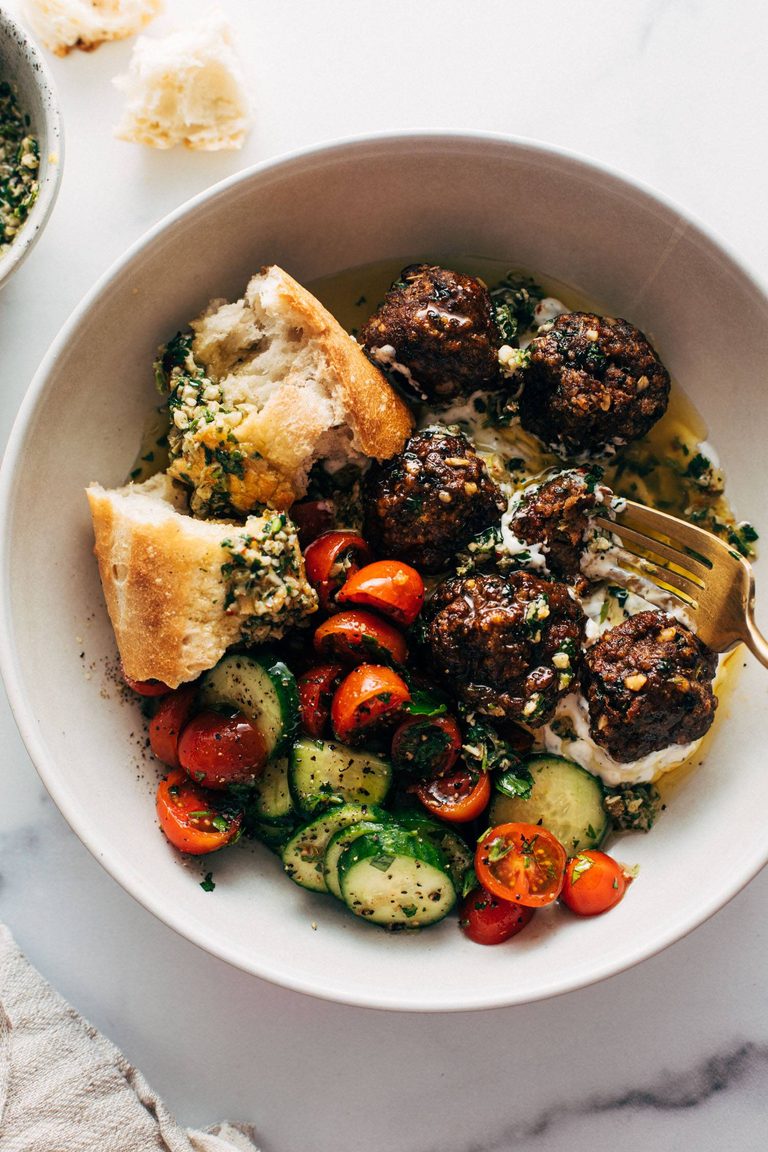
    Sheet pan meatballs with tomato salad.

    Sheet Pan Meatballs with Tomato Salad and Green Sauce

    Juicy little sheet pan meatballs that are salty, zesty, briney, and so so delicious. Pile them on tzatziki, spoon some punchy green sauce over top, and serve with a simple salad and crusty bread.

    50 reviews / 5 average

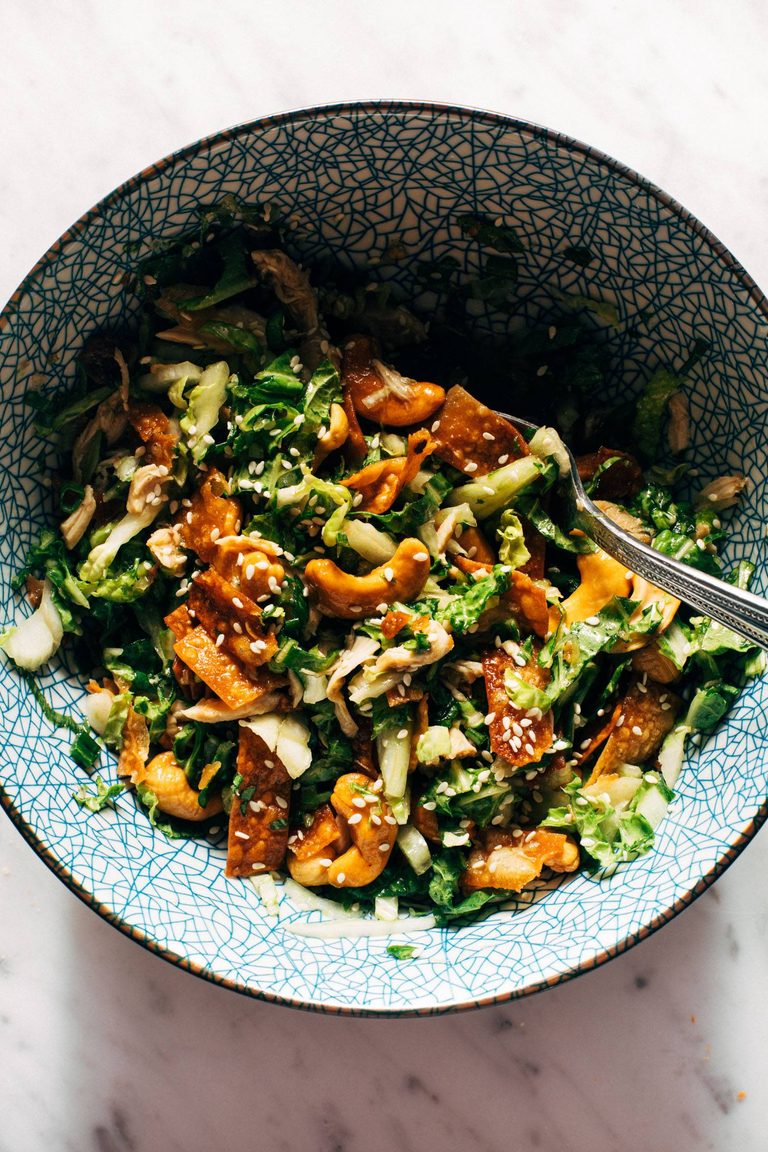
    Napa chicken salad in a bowl.

    Napa Chicken Salad with Sesame Dressing

    This Napa Chicken Salad is crunched up to the MAX! Fresh napa cabbage, juicy rotisserie chicken, a super easy homemade sesame dressing, and crunchy handfuls of cashews, fried wonton strips, dried ramen noodles, crispy fried onions, or sesame sticks…the choice is yours!

    21 reviews / 4.7 average

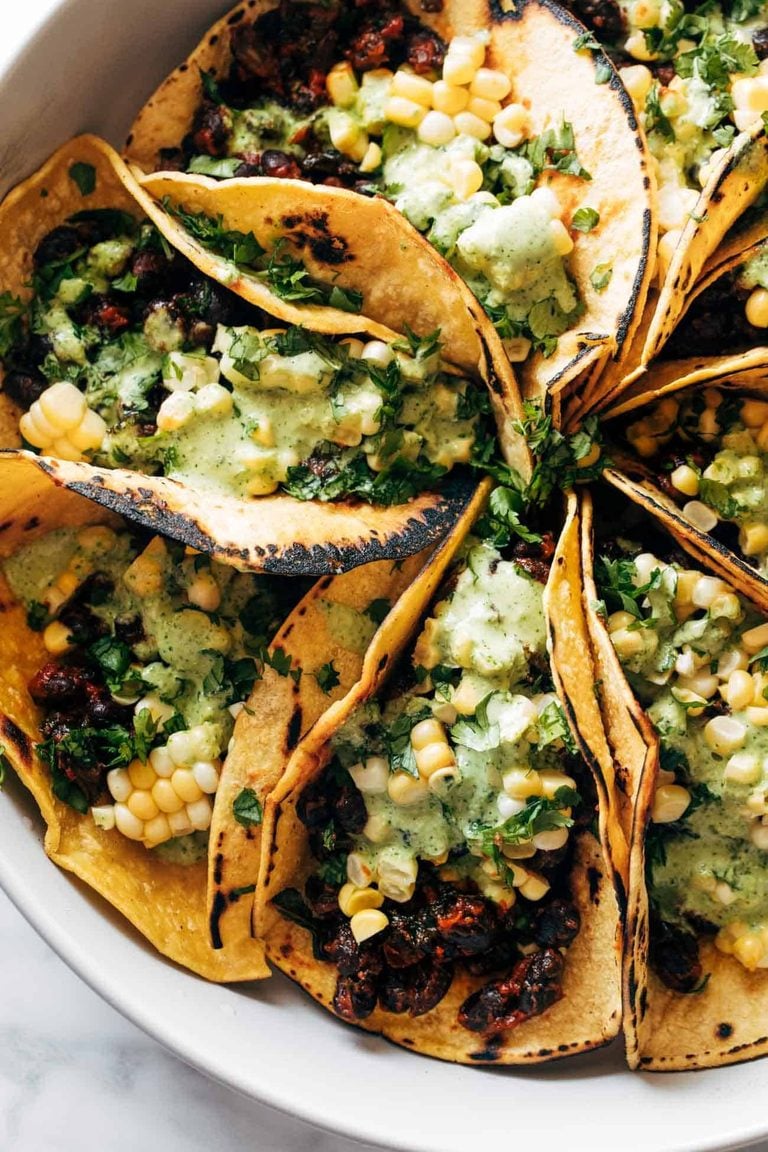
    Smoky beans and greens tacos.

    Smoky Beans & Greens Tacos with Aji Verde

    Three cheers for summertime eating! Smoky black beans sautéed with kale and garlic and spices, tucked into charred corn tortillas, and topped with the best feisty, punchy green sauce – Aji Verde!

    71 reviews / 4.9 average

    Lemongrass vermicelli salad.

    Lemongrass Vermicelli Salad

    Lemongrass Vermicelli Salad – a summer showstopper! A twirl of vermicelli noodles, pan-fried tofu, fresh herbs and veggies, and a lime-and-lemongrass-based sauce that just slips all over the plate.

    23 reviews / 4.8 average

    Couscous summer salad in a bowl.

    Couscous Summer Salad

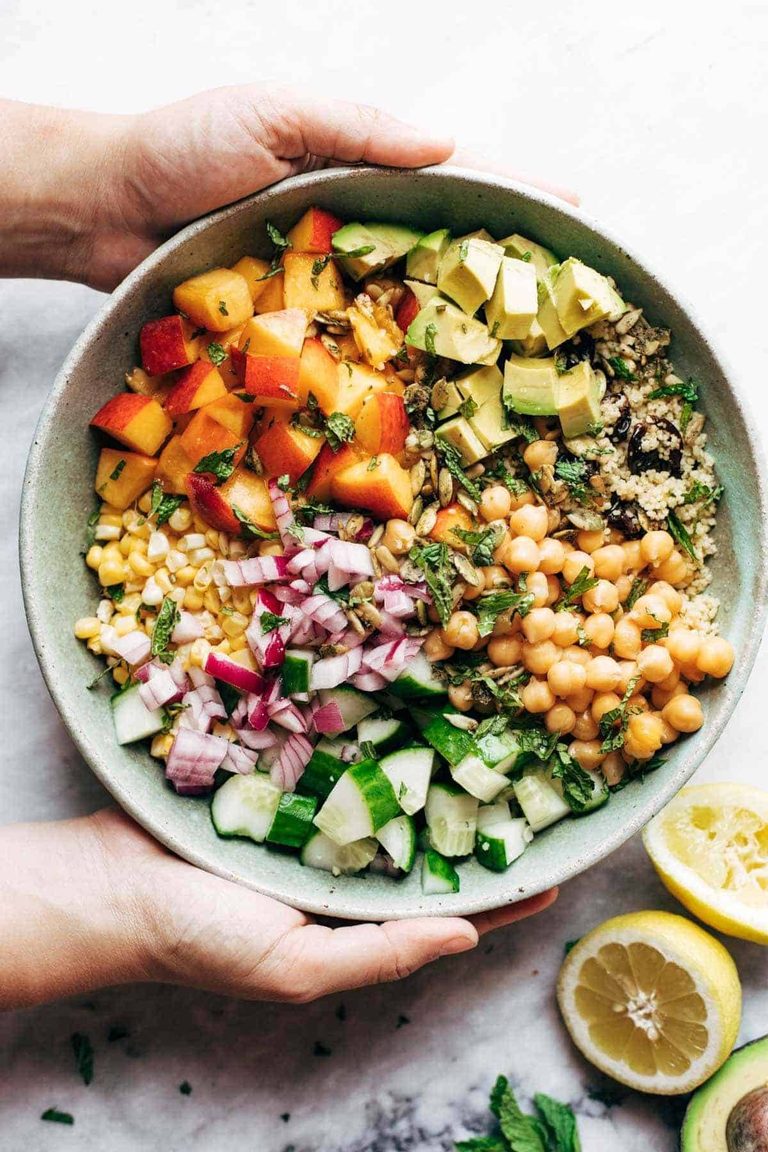
    Couscous Summer Salad! Spiced couscous, juicy nectarines, crunchy cucumber, avocado, chickpeas, cherries, sweet corn, and mint. It’s sunshine in a bowl!

    39 reviews / 4.7 average

    Chipotle chicken cobb salad.

    Summer Chipotle Chicken Cobb Salad with Cilantro Vinaigrette

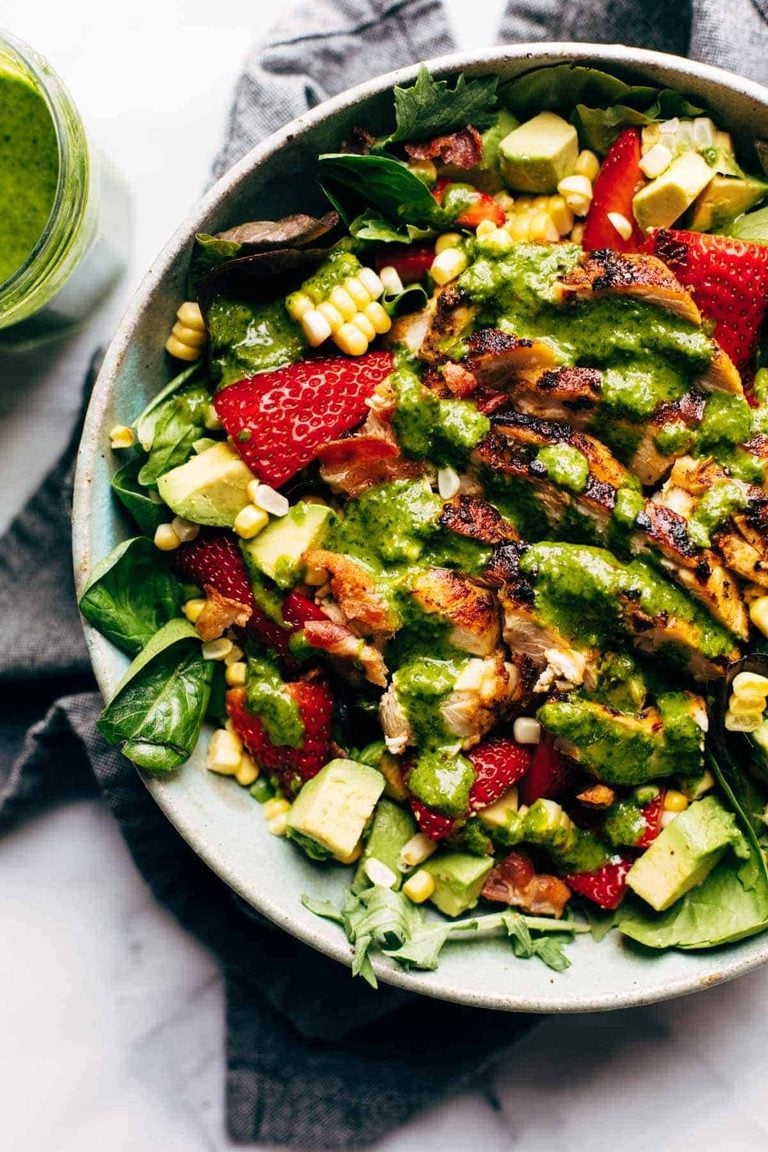
    This juicy salad tastes like summer! With chipotle chicken, sweet corn, avocado, cilantro vinaigrette, bacon crumbles, and fresh strawberries for a pop of sweetness.

    83 reviews / 5 average

    Roasted cauliflower burrito bowl.

    Roasted Cauliflower Burrito Bowls

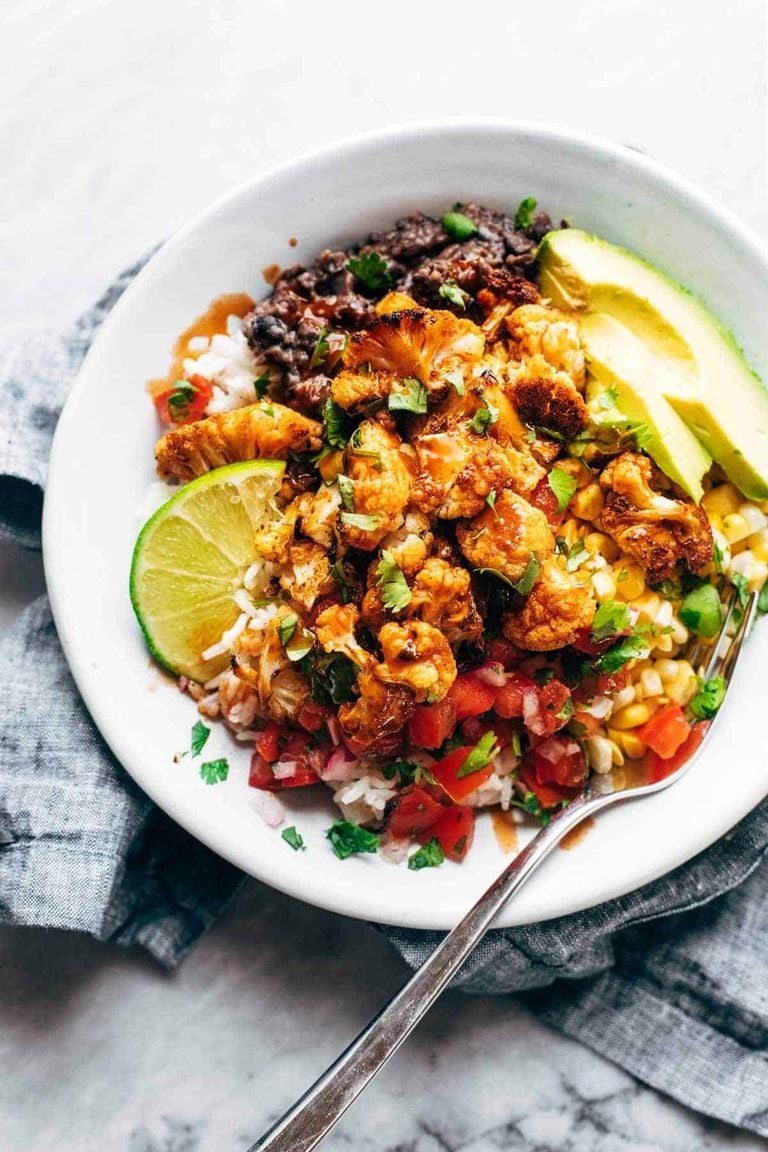
    Nothing fancy to see here – just a healthy, delicious, vegan burrito bowl combo featuring spicy roasted cauliflower, pico de gallo, creamy refried black beans, rice, corn, avocado, and a good lime drench.

    57 reviews / 4.9 average

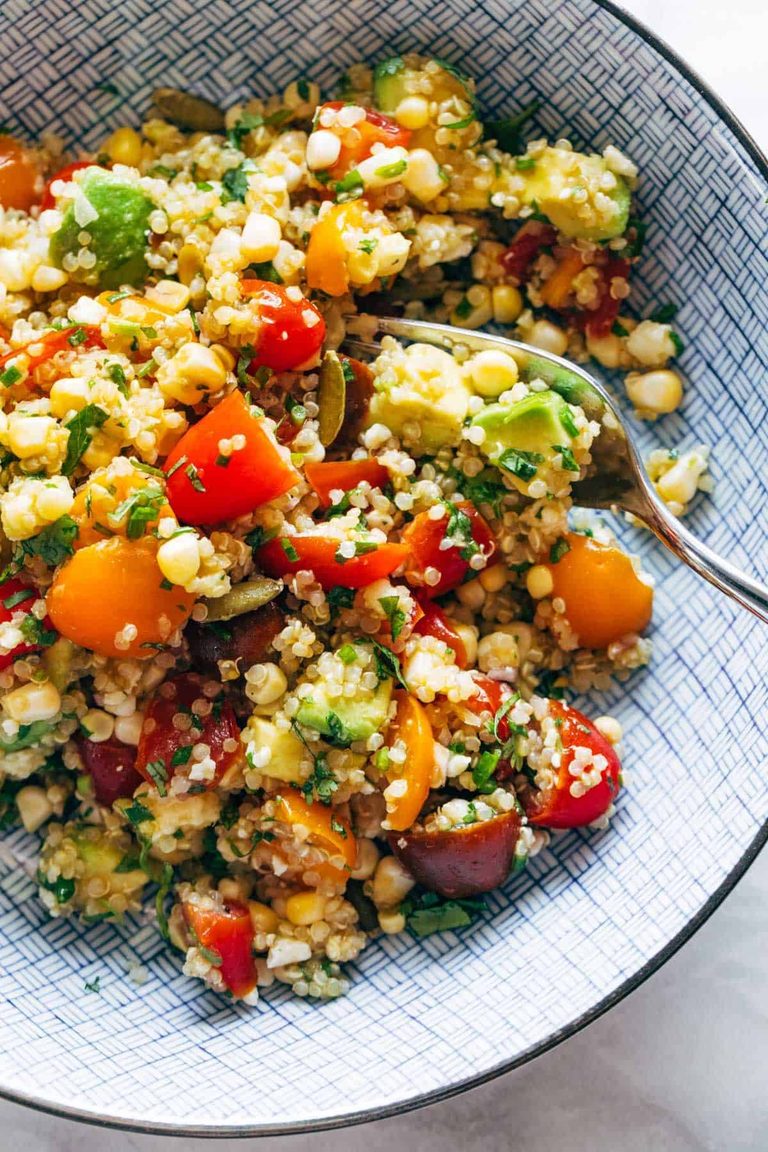
    Quinoa salad with tomatoes, corn, and avocado.

    Corn, Avocado, and Quinoa Salad with Marinated Tomatoes

    The perfect summery quinoa salad – fresh corn, buttery avocado, nutty quinoa, juicy marinated tomatoes, and tons of fresh herbs.

    43 reviews / 4.9 average

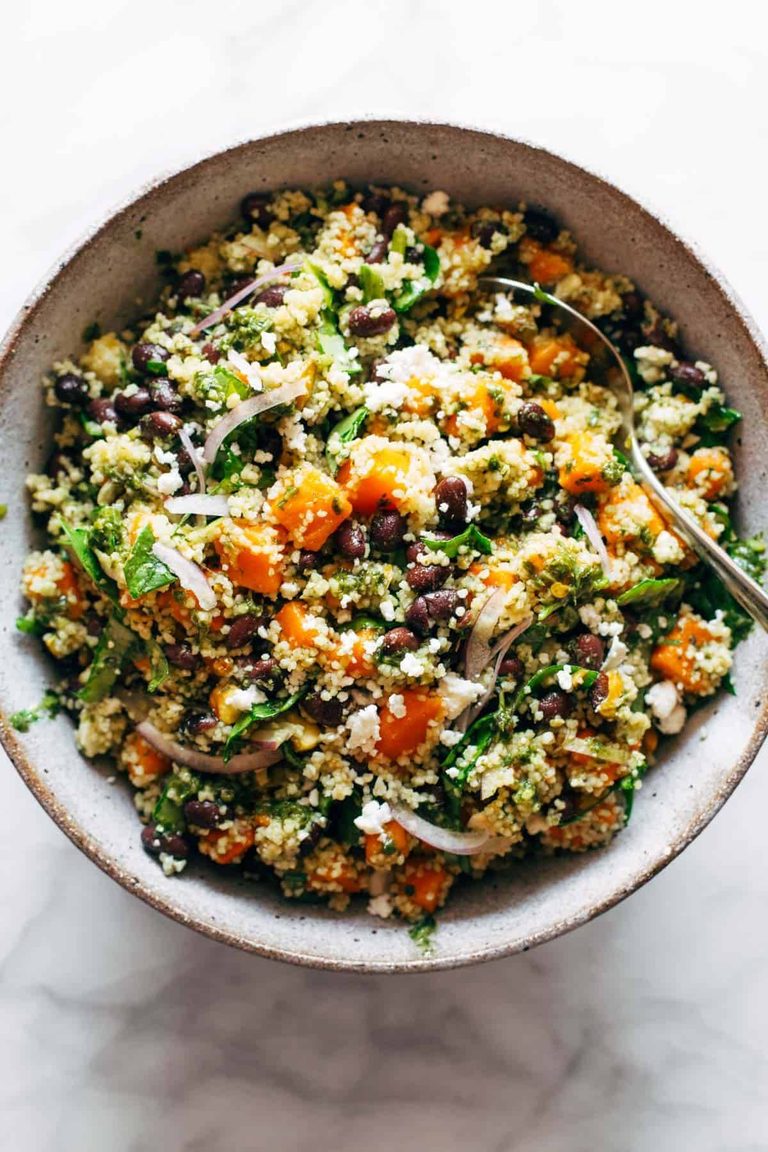
    Couscous salad in a bowl.

    Couscous Salad with Lime Basil Vinaigrette

    A bright, zippy, unexpectedly delicious couscous salad that’s packed with sweet potatoes, black beans, spinach, feta, and more – all tossed with a life-changing lime basil vinaigrette!

    74 reviews / 4.9 average

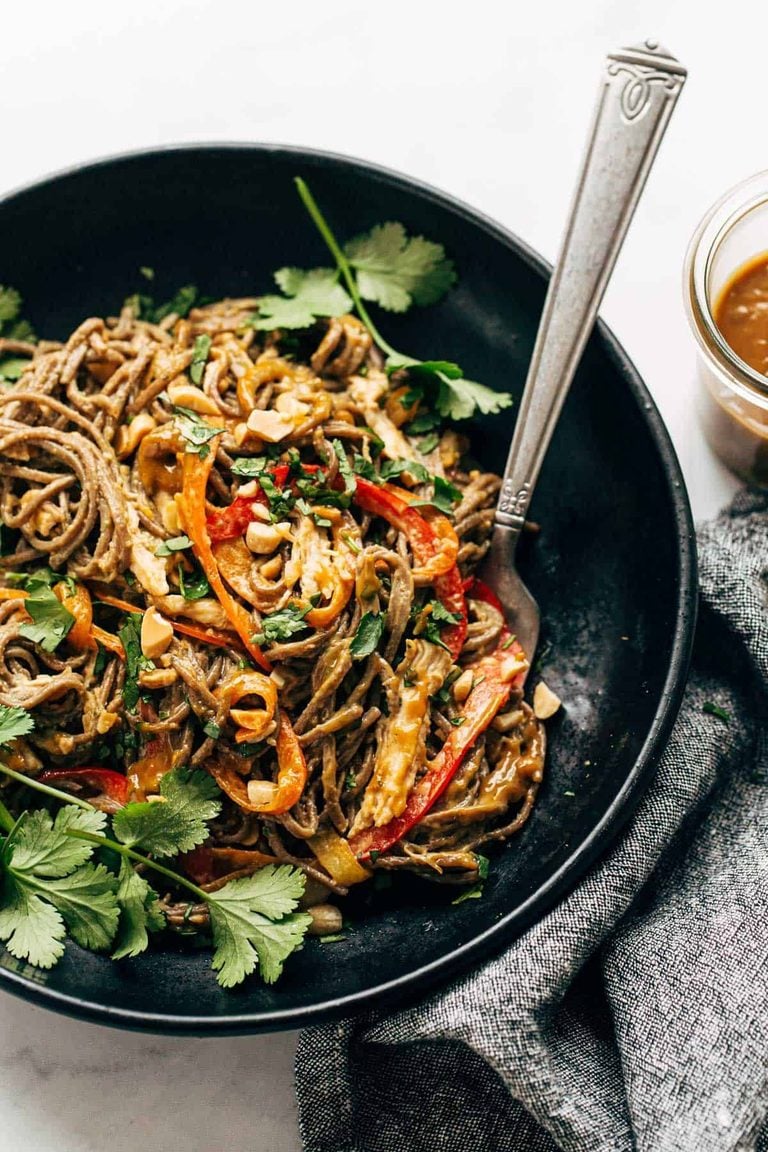
    Peanut soba noodle salad.

    Spicy Peanut Soba Noodle Salad

    This Spicy Peanut Soba Noodle Salad features red peppers, cabbage, chicken, soba noodles, and a quick homemade spicy peanut sauce. Salads don’t get much yummier than this.

    91 reviews / 4.8 average

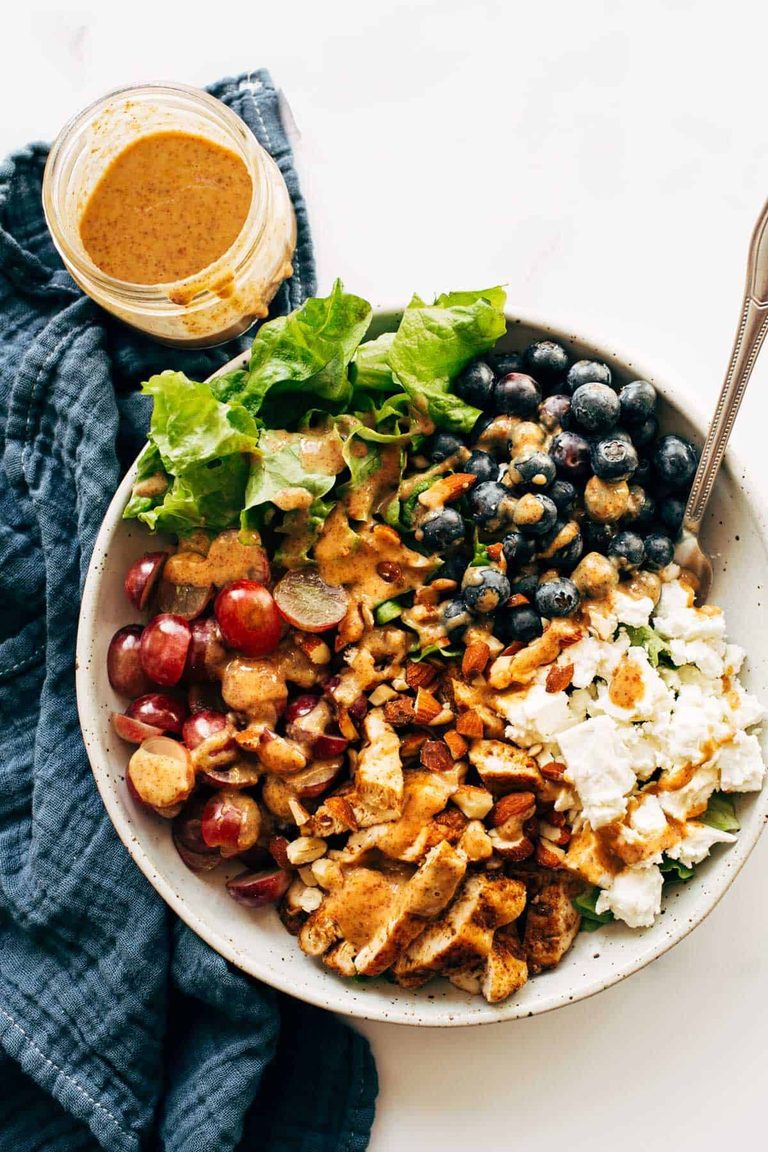
    Rainbow chicken salad in a bowl.

    Rainbow Chicken Salad with Almond Honey Mustard Dressing

    Tender chicken, plump grapes and berries, crisp lettuce, tangy feta cheese, crunchy almonds, and the real star – almond honey mustard dressing! Eat the rainbow and be glad, friends!

    61 reviews / 4.9 average

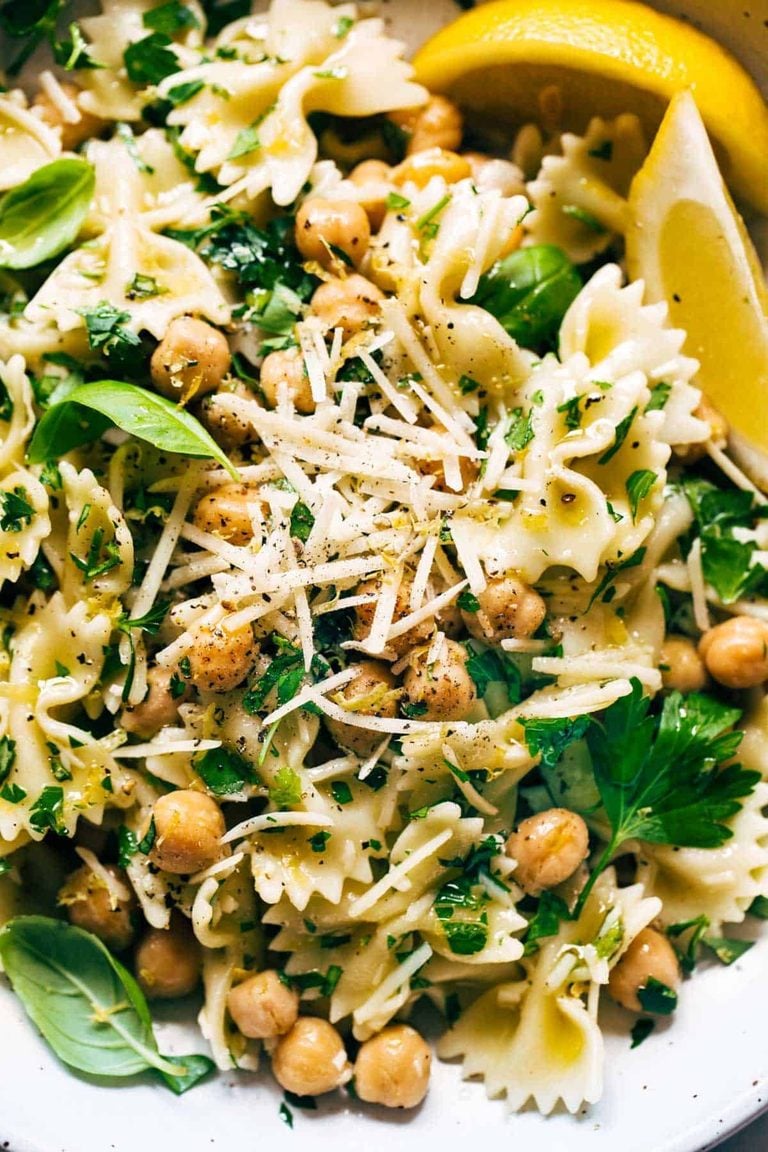
    Lemon herb pasta salad with chickpeas.

    Lemon Herb Pasta Salad with Marinated Chickpeas

    A super fresh, super summery Lemon Herb Pasta Salad! Packed with tangy marinated chickpeas, chewy pasta, lots of herbs and garlic, lemon juice and olive oil, and a handful of parmesan to top it off.

    47 reviews / 4.9 average

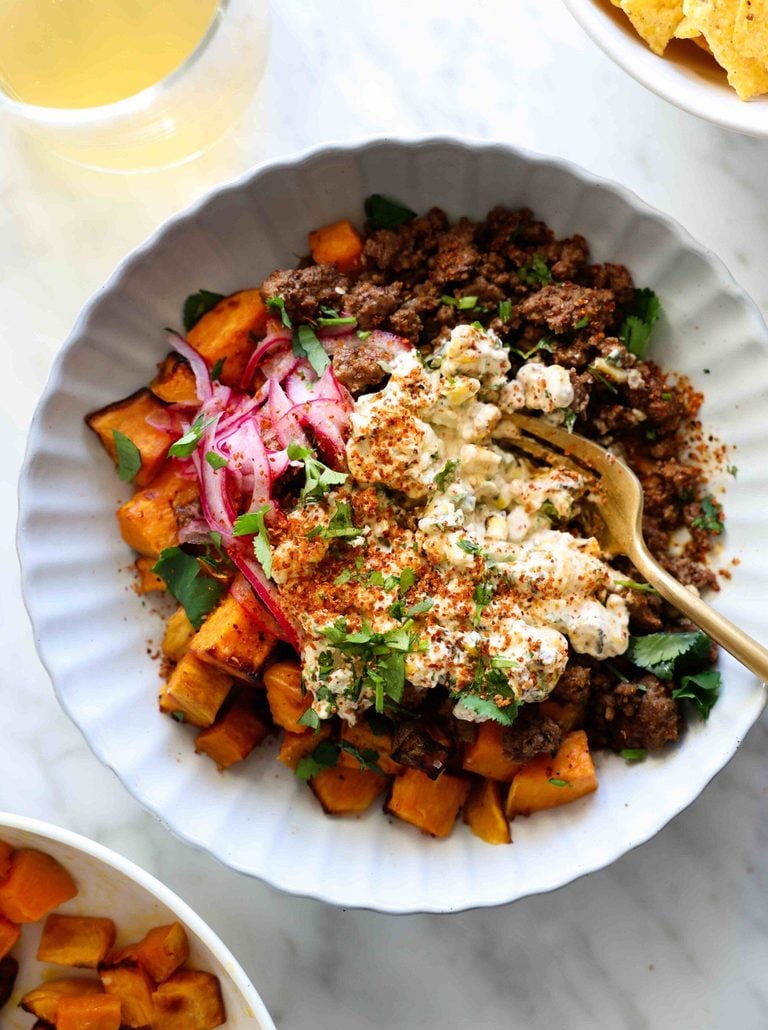
    Beef and sweet potato bowl with corn.

    Street Corn Beef and Sweet Potato Bowls

    One of my family’s favorite easy dinners that works SO well for meal prep! Sweet potatoes and ground beef get dolloped with a creamy high protein street corn style dip that is bonkers delicious.

    30 reviews / 4.9 average

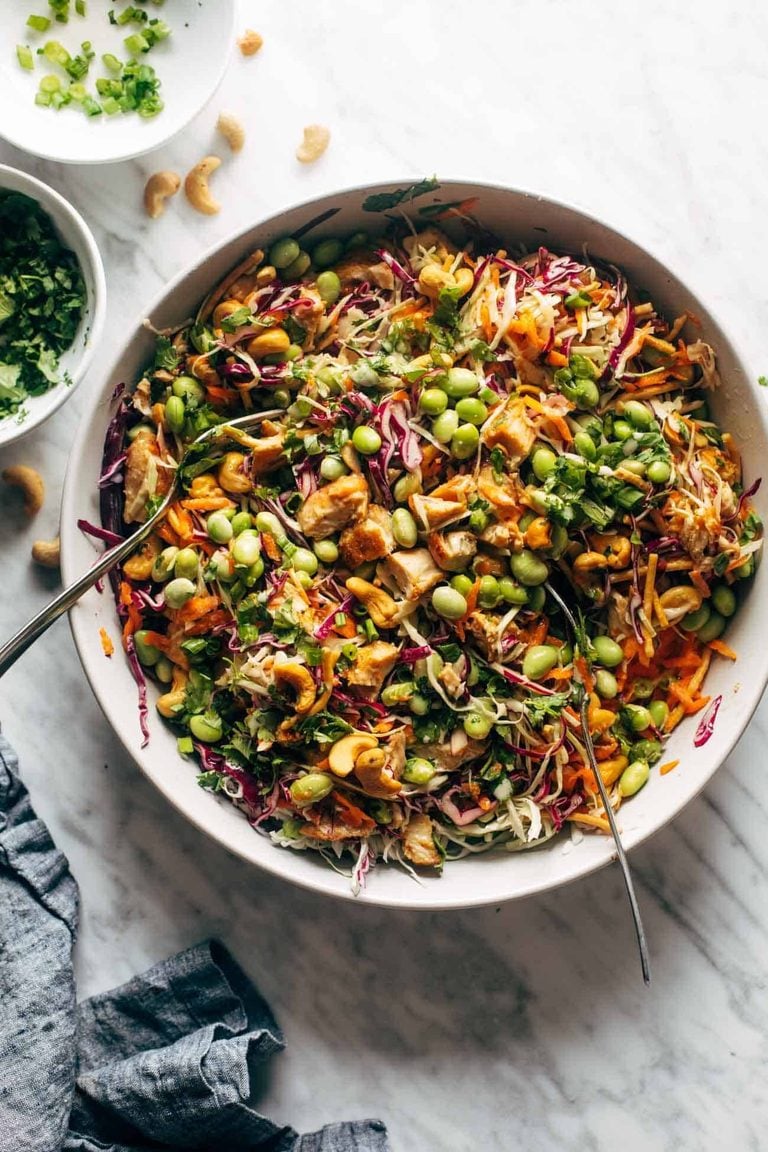
    Cashew crunch salad in a bowl.

    Cashew Crunch Salad with Sesame Dressing

    This Cashew Crunch Salad is loaded up with crunchy veg, chow mein noodles, edamame, and roasted cashews and it’ll make you ACTUALLY WANT TO EAT A SALAD. And the sesame dressing – OMG!

    124 reviews / 4.9 average

    Sesame noodle bowls in containers.

    Sesame Noodle Bowls

    Meal Prep Sesame Noodle Bowls! Fork-twirly noodles, an easy creamy sesame sauce, perfect browned chicken, and all the veg. YUM.

    50 reviews / 4.8 average

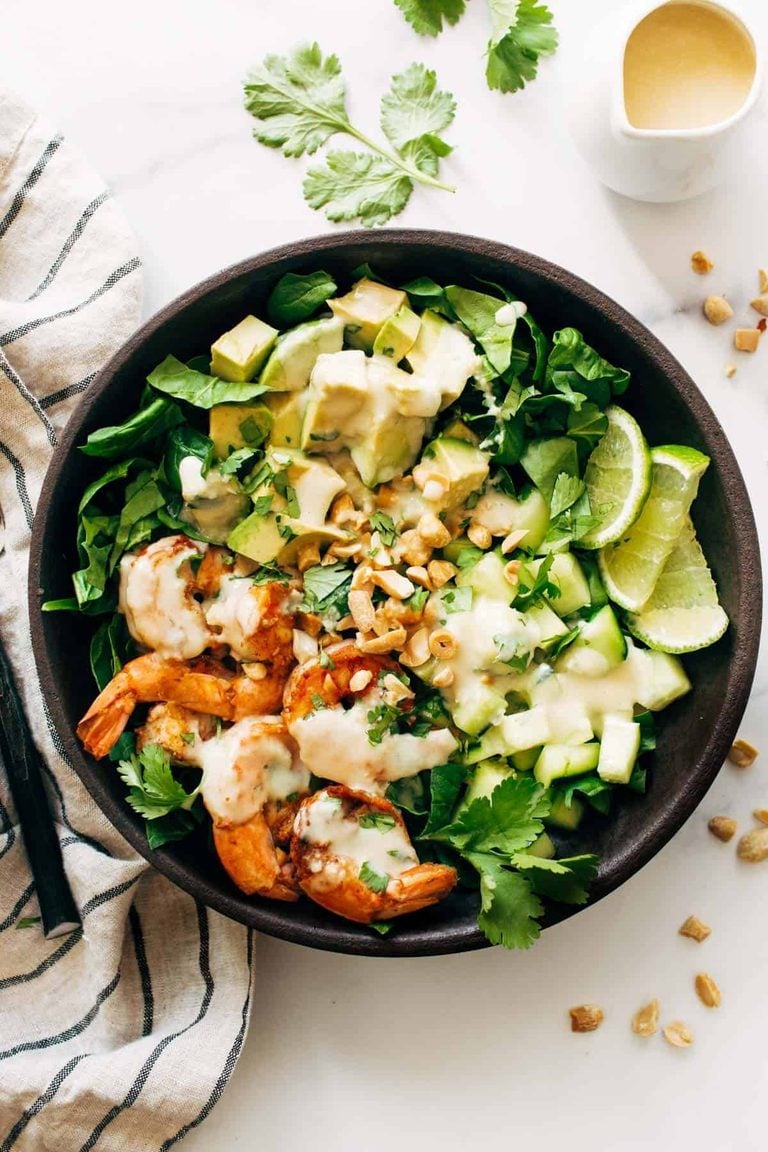
    Shrimp and avocado salad in a bowl.

    Shrimp and Avocado Salad with Miso Dressing

    This Shrimp and Avocado Salad is topped with spicy shrimp, crisp cucumbers, spinach, creamy avocado, and a generous drizzle of miso dressing. The happiest green salad ever!

    62 reviews / 4.8 average

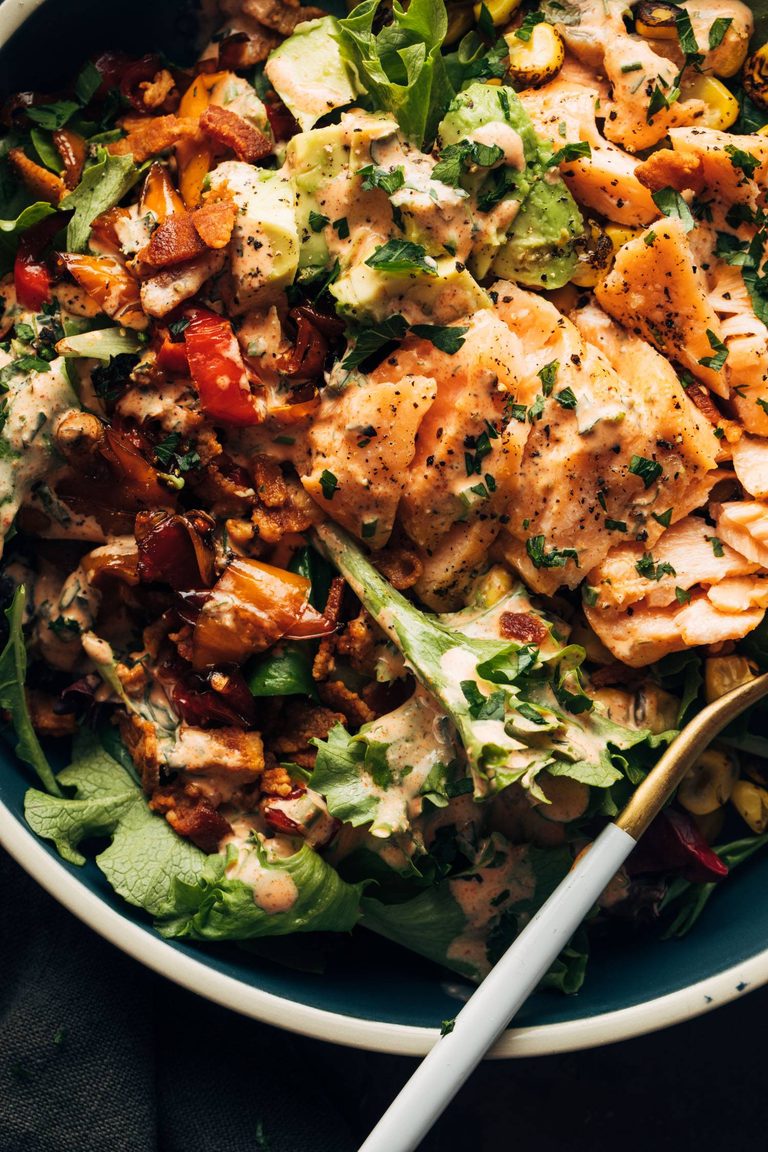
    Oliver's salad with salmon on top.

    The Oliver’s Salad

    We’re bringing you the most beautiful salad inspired by the restaurant Oliver’s in Minnesota. Tender salmon, savory peppers and garlic confit, buttery chunks of avocado, fire-roasted corn, bacon bits, and a river of homemade smoky ranch dressing.

    27 reviews / 4.9 average

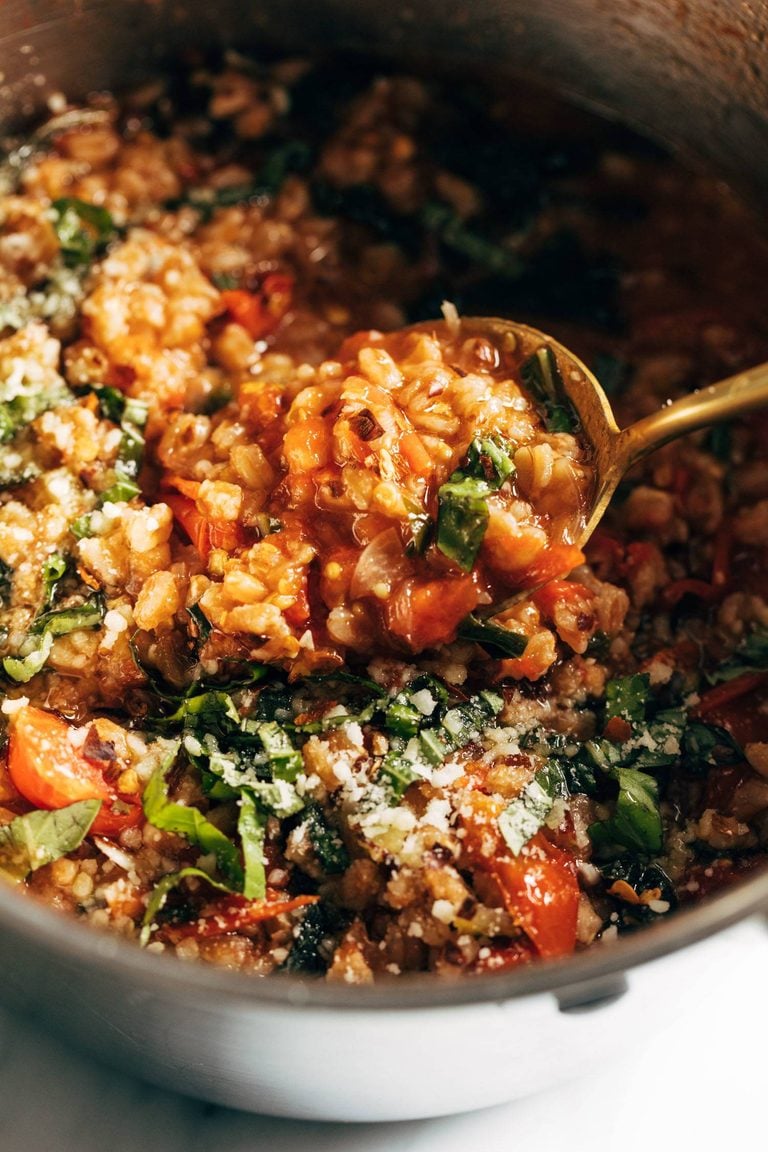
    One pan farro with tomatoes and kale.

    One-Pan Farro with Tomatoes and Kale

    This One-Pan Farro with Tomatoes and Kale is a straight-up DREAM! Rustic farro cozied up to cherry tomatoes, onions, garlic, and kale. So good and so wholesome!

    39 reviews / 4.9 average

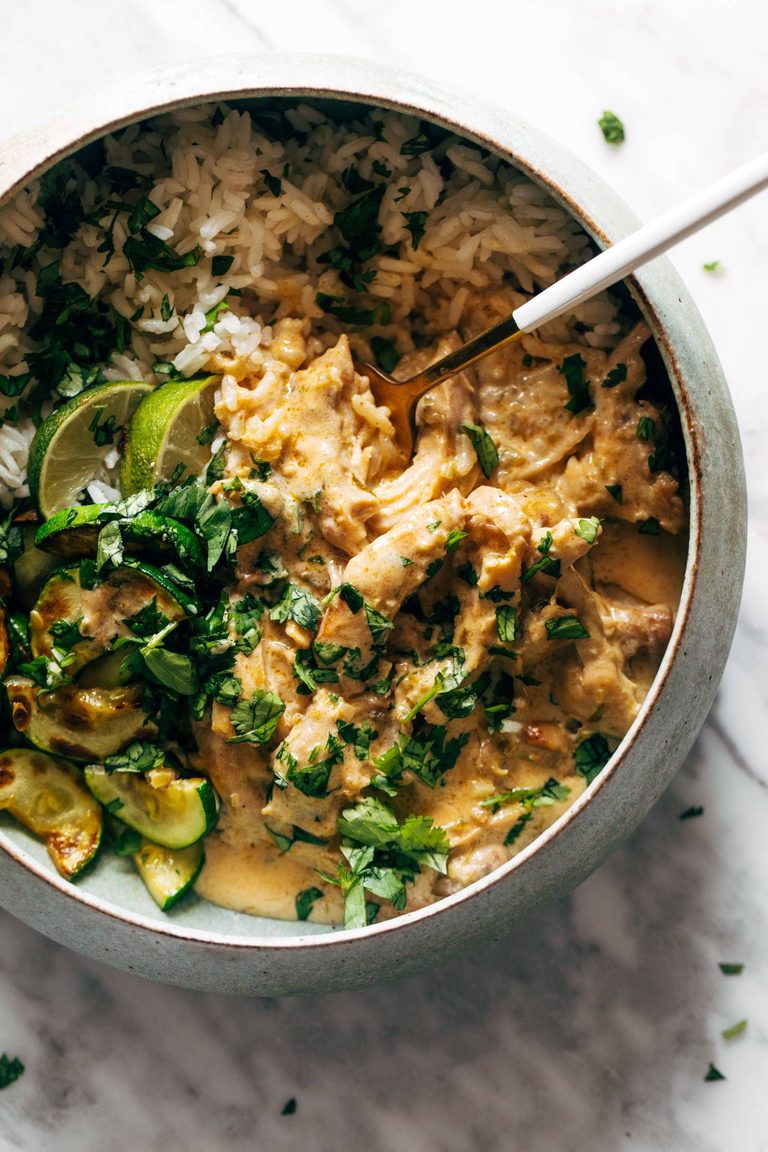
    Lemongrass chicken with rice and zucchini.

    Lemongrass Chicken with Rice and Zucchini

    This Lemongrass Chicken with Rice and Zucchini is OMG-level good! Tender chicken thighs, sautéed and then simmered in a creamy coconut and lemongrass sauce, sits next to a steamy pile of jasmine rice, fresh herbs, and your choice of veg.

    73 reviews / 4.9 average

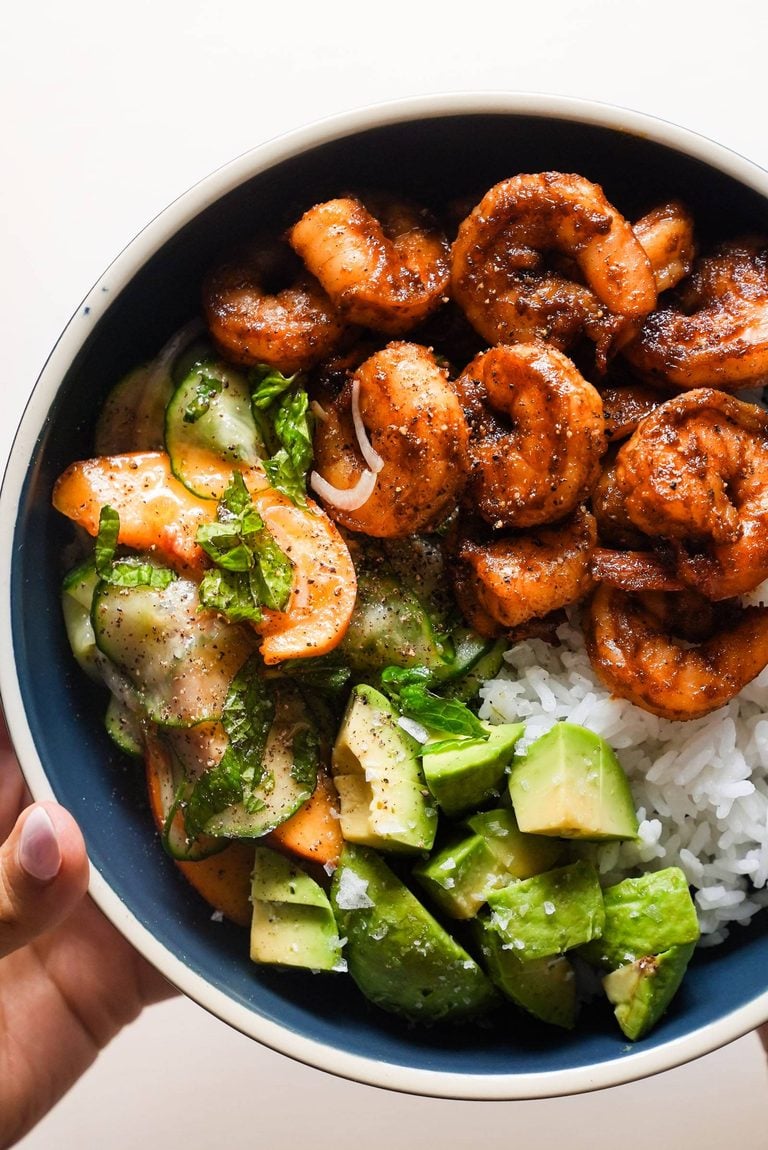
    Spicy shrimp in a bowl with rice and peach salad.

    Spicy Shrimp with Peach Salad

    This is summertime in a bowl! Spicy shrimp with all the delicious heat, smoke, and sweetness we want, alongside a fresh peach and cucumber salad.

    13 reviews / 4.9 average

    Crispy rice salad in a bowl.

    Crispy Rice Salad with Cucumbers and Herbs

    Paper-thin veggies, a shower of herbs, a pile of fried crispy red curry rice, and a limey garlicky vinaigrette all over top. This crispy rice salad is all I want to eat right now!

    50 reviews / 4.8 average

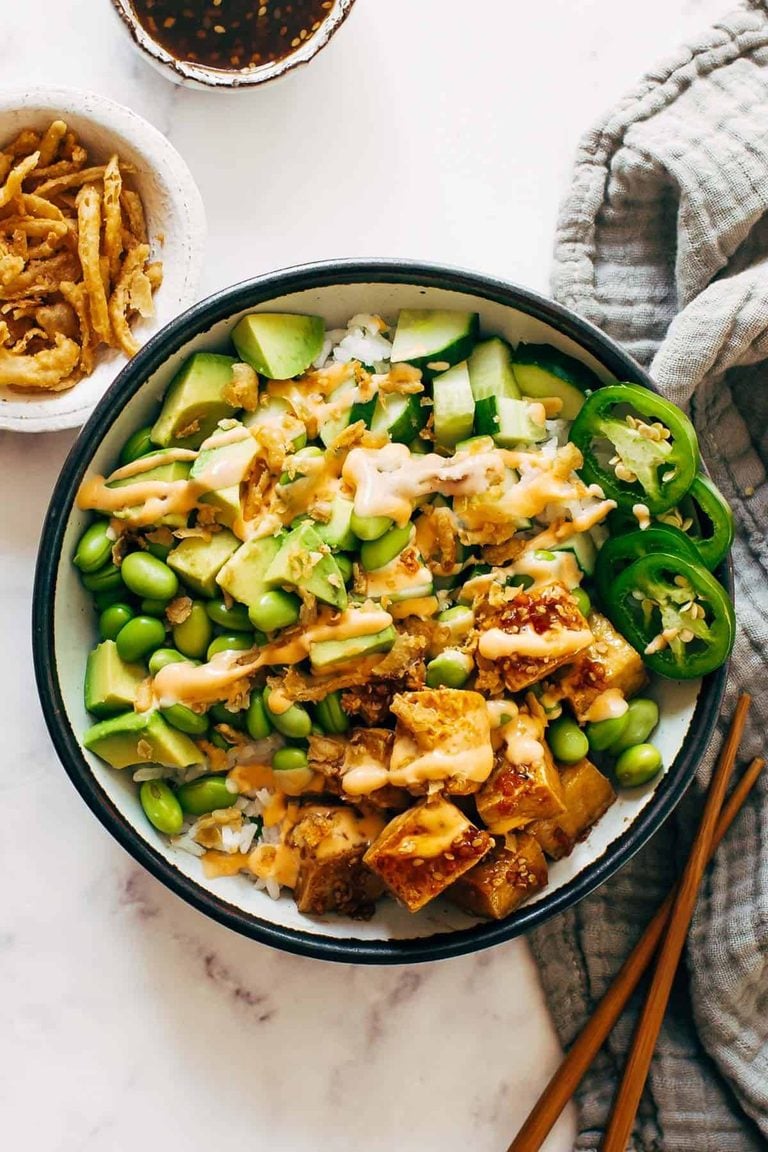
    Crunchy roll bowl.

    Crunchy Roll Bowls

    A block of tofu, nicely browned in teriyaki sauce, served on a bed of sticky rice with edamame, cucumber, avocado, jalapeño, and a handful of crushed-up crunchy onions, buried under a thick drizzle of extra teriyaki and spicy mayo. 

    475 reviews / 4.9 average

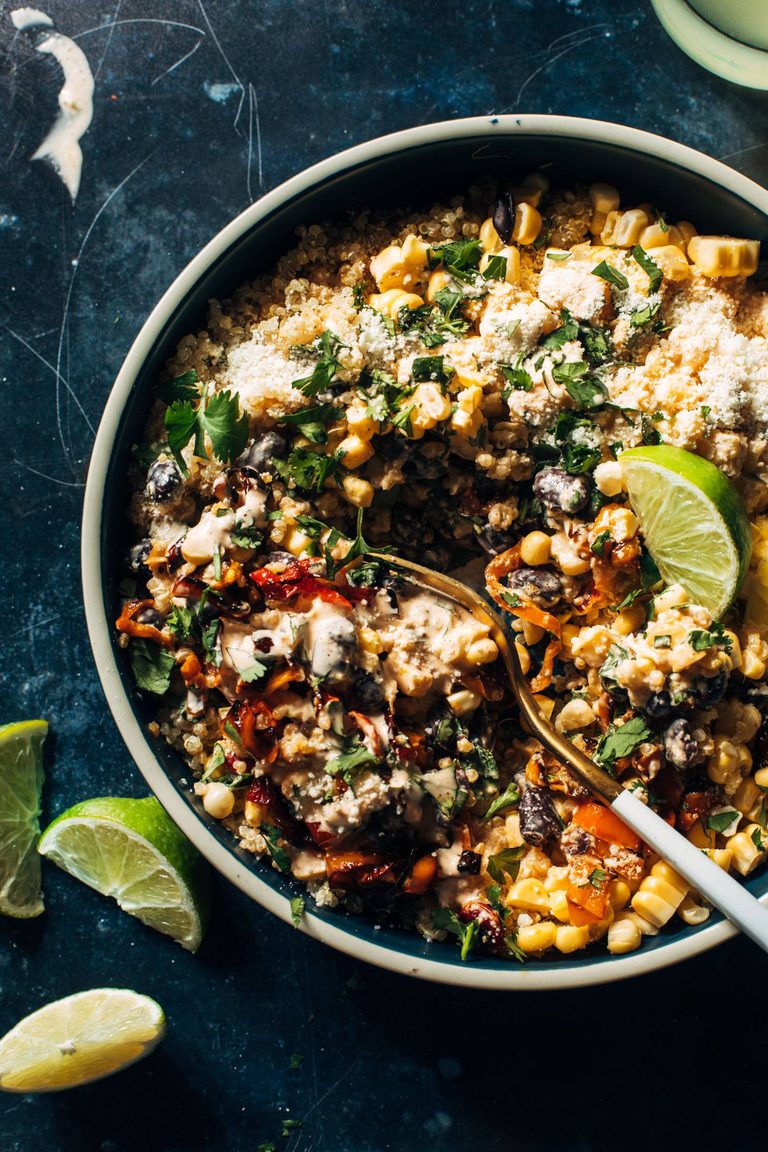
    Elote salad in a bowl.

    Elote Style Quinoa Salad

    Elote Quinoa Salad made with velvety peppers confit, juicy sweet corn, homemade dressing, cotija cheese, lime, and spices. Perfect for summer and so, so good!

    23 reviews / 4.9 average

    Sheet pan chicken pitas.

    Sheet Pan Chicken Pitas with Tzatziki

    Part bowl, part salad, part sandwich folded up into any kind of bread you like, and I’m here for it in every form.

    154 reviews / 5 average

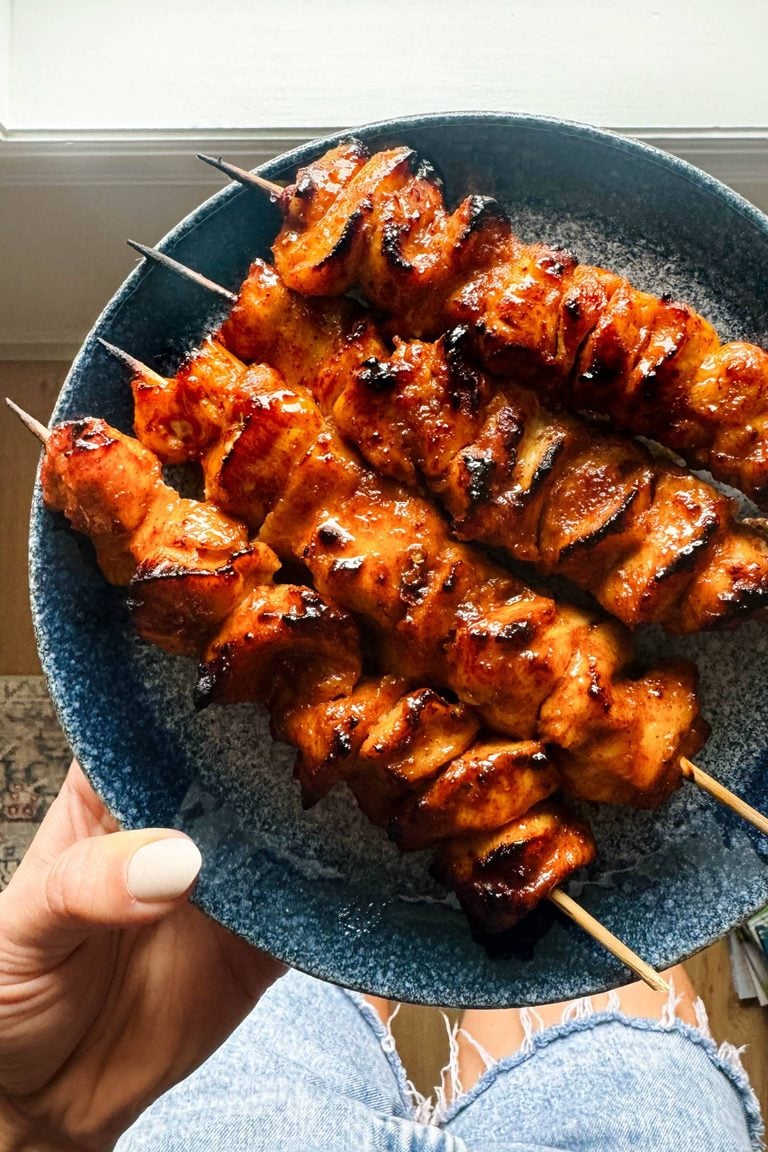
    Chicken skewers on a plate.

    Honey Chipotle Chicken Skewers

    These chicken skewers are a family favorite! Very easy, deliciously smoky, nice and sweet, with a good amount of spice and bite. Air fryer, grill, and oven-friendly!

    31 reviews / 4.9 average

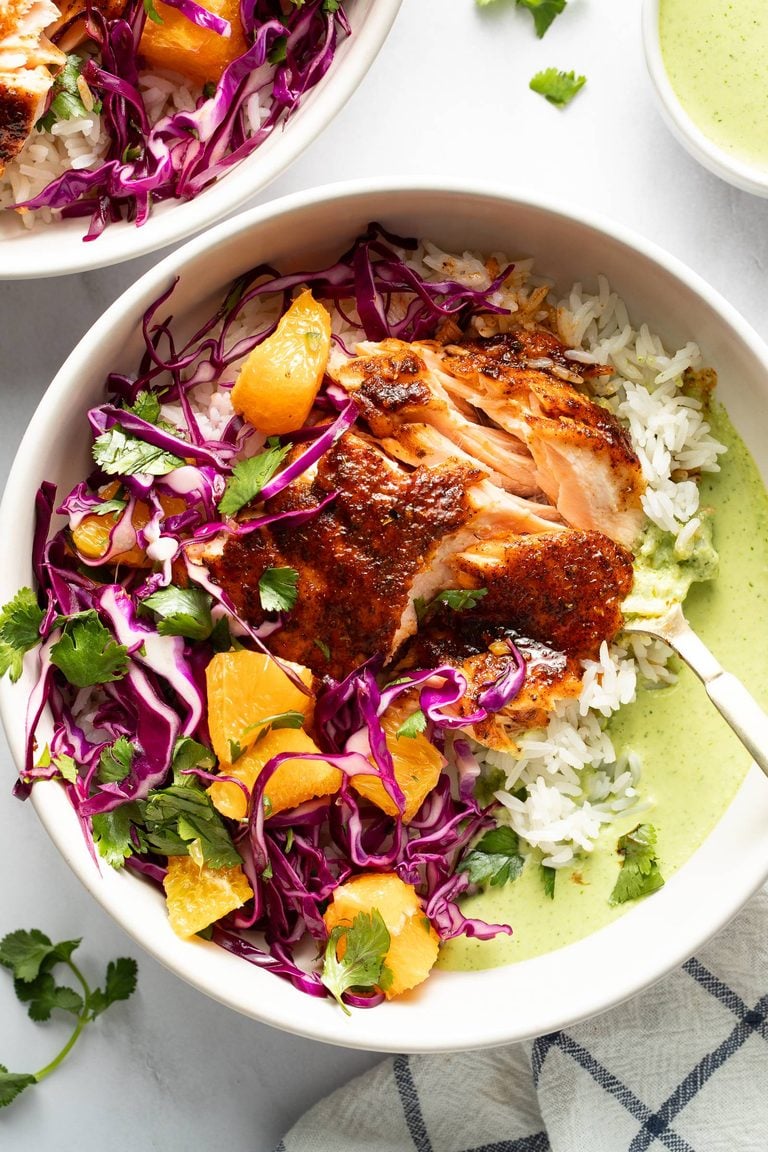
    Chipotle salmon with rice and aji verde.

    Chipotle Salmon with Orange Salsa and Aji Verde

    Sweet-and-smoky chipotle salmon topped with fresh orange salsa and creamy aji verde! An easy, delicious, restaurant-level salmon dinner.

    70 reviews / 5 average

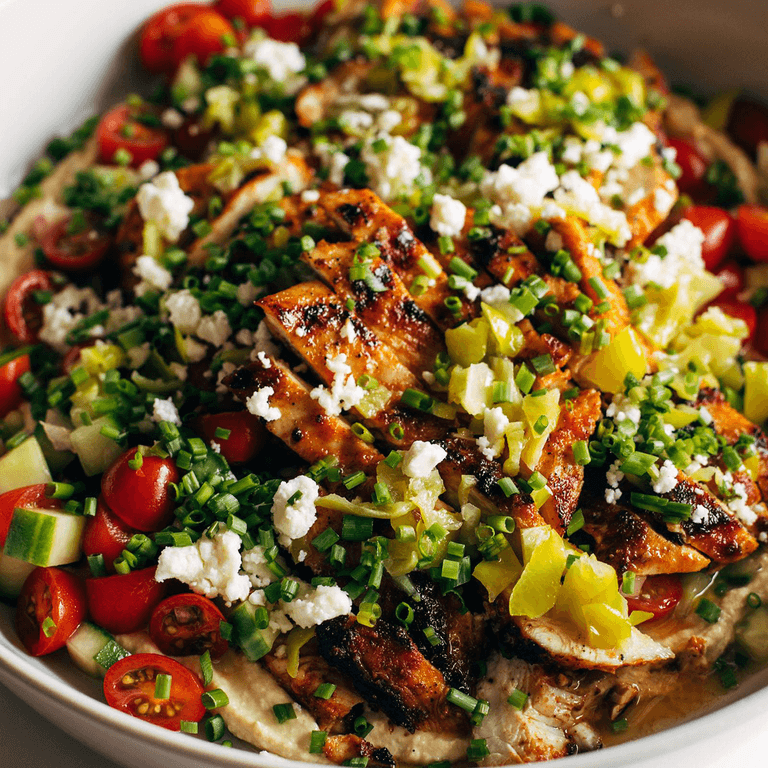
    Grilled chicken in a bowl with hummus.

    Grilled Chicken with Pepperoncini Garlic Butter

    This is such a fun one! Grilled marinated chicken, a quick tomato cucumber salad, tangy bits of feta, and a zippy pepperoncini garlic butter sauce poured over the whole thing.

    68 reviews / 5 average

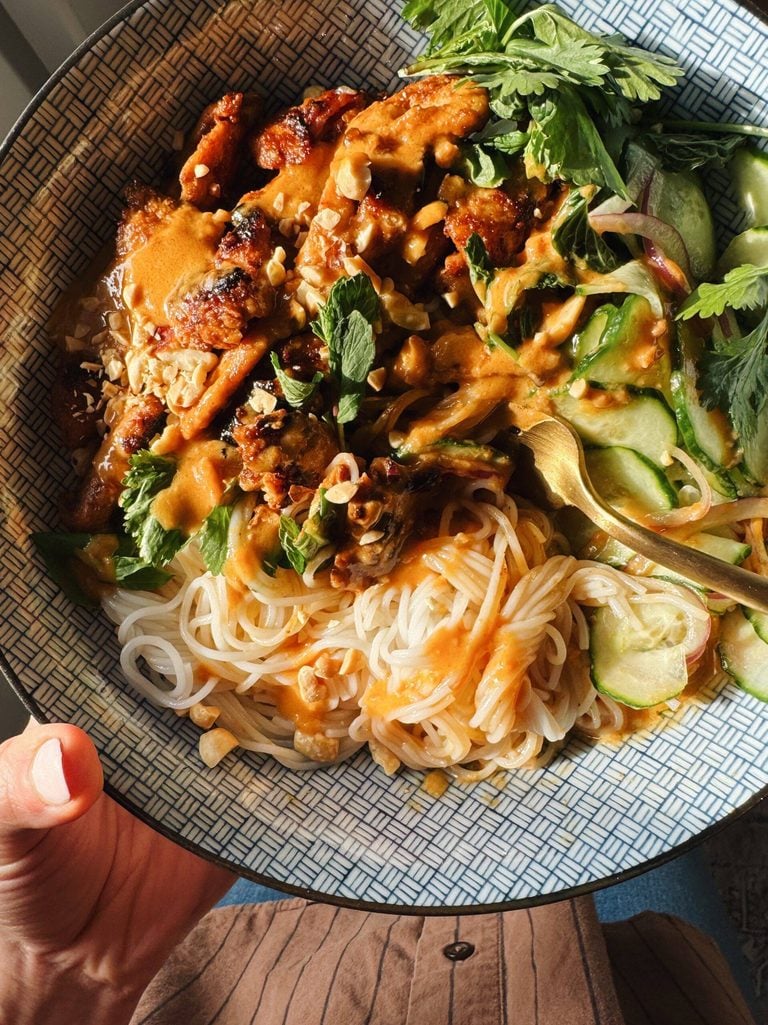
    Peanut chicken noodle bowls.

    Thai Peanut Chicken Bowls

    I love a shortcut dinner hack! These bowls feature caramelized peanut chicken, a tangle of vermicelli noodles, fresh herbs and cucumber salad, and peanut sauce all over top.

    30 reviews / 4.9 average

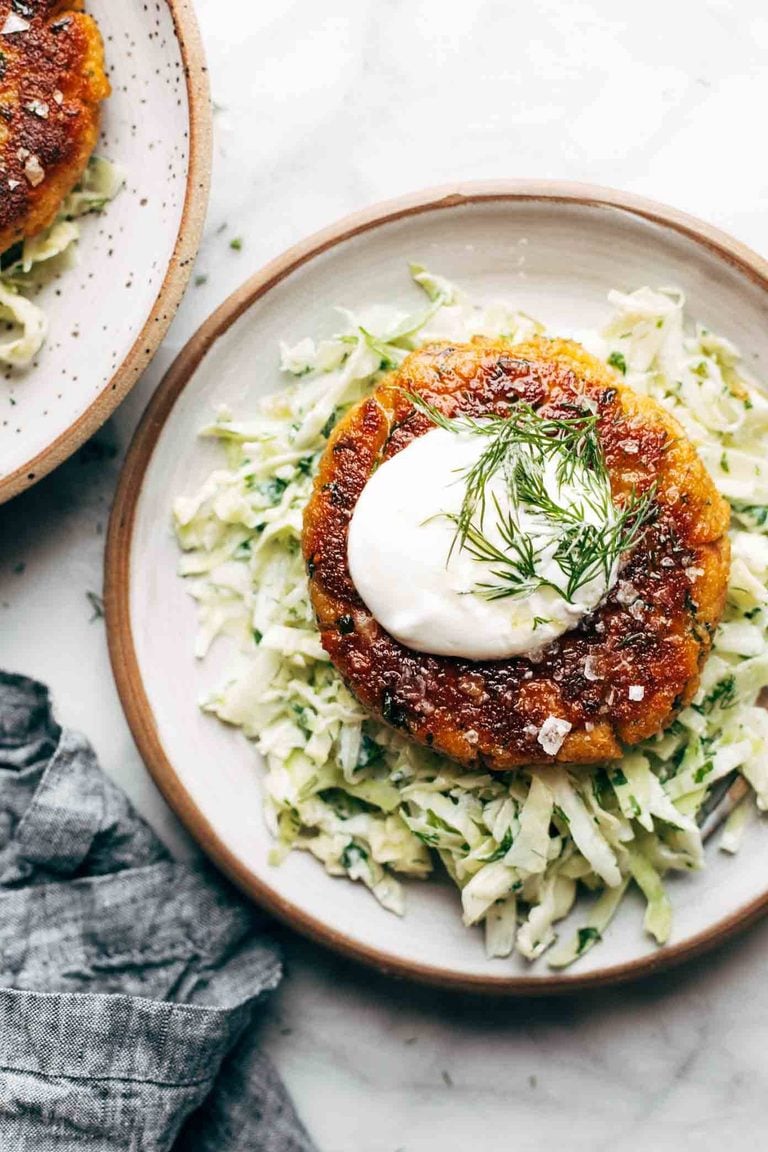
    Salmon burger on top of slaw.

    Yummy Salmon Burgers with Slaw

    These salmon burgers are THE YUMMIEST! and made with just five ingredients. The best for a quick + easy high protein lunch or dinner.

    109 reviews / 4.8 average

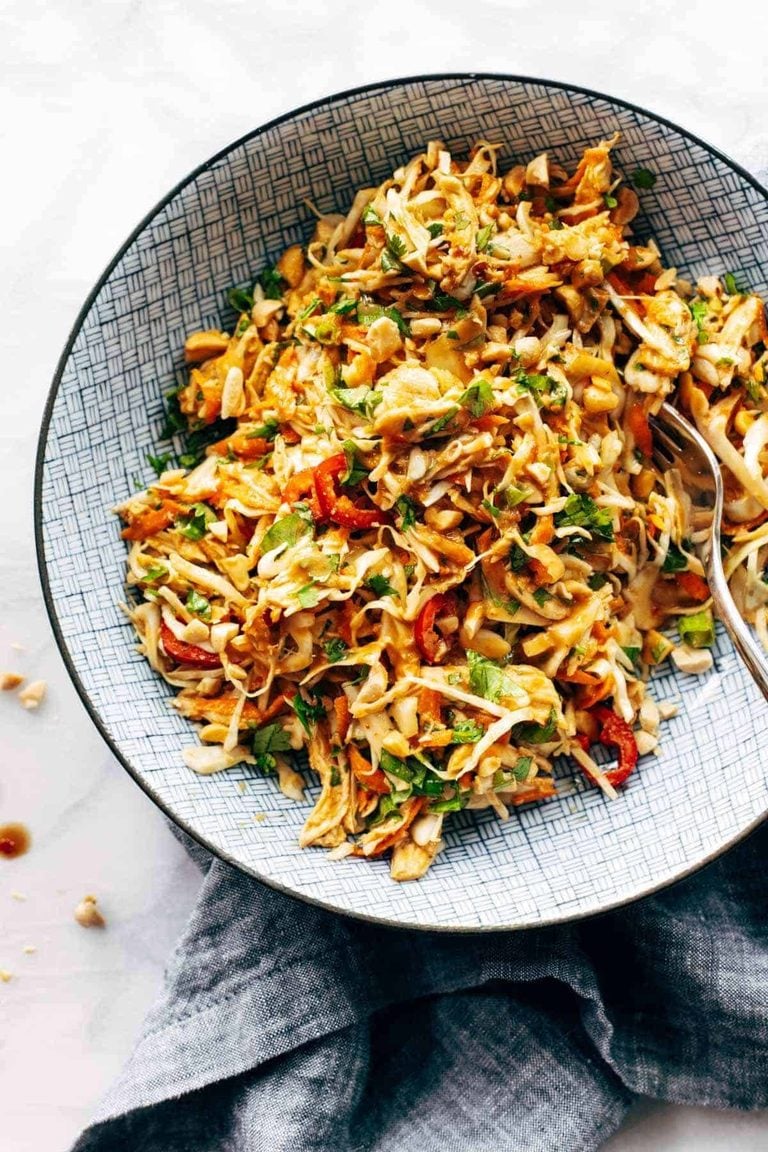
    Thai chicken salad.

    Chopped Thai-Inspired Chicken Salad

    This simple chopped Thai chicken salad has BIG flavors – peanut, lime, soy, chili, cilantro. Topped with a homemade peanut dressing! Healthy and fresh.

    146 reviews / 4.9 average

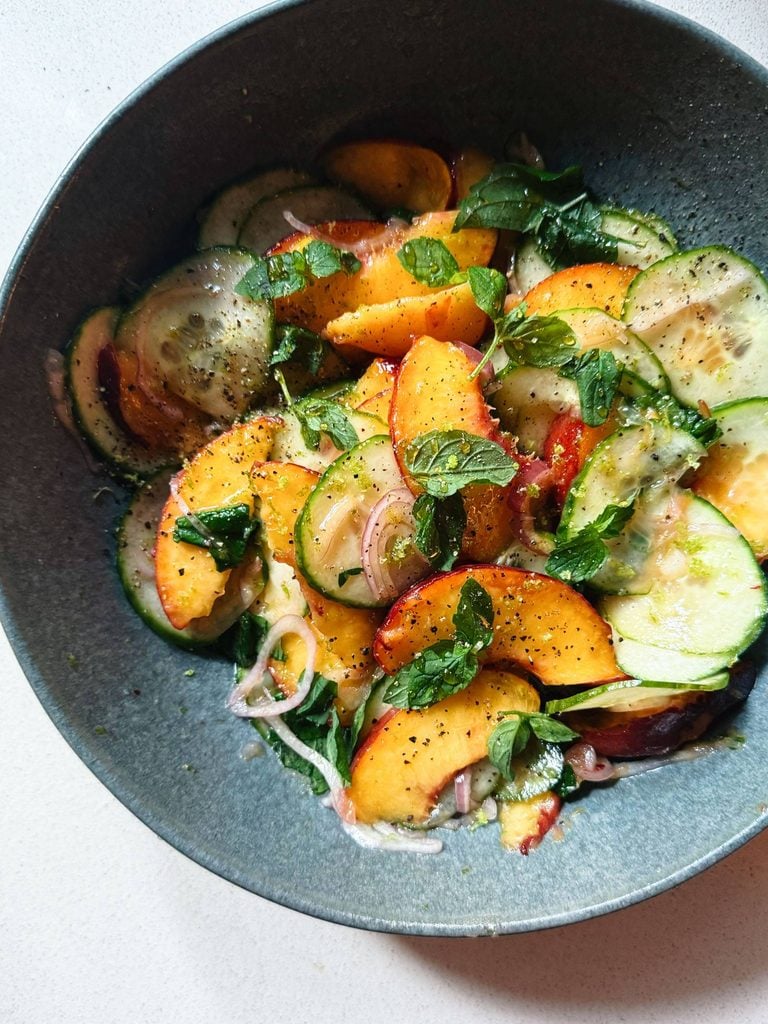
    Peach salad with cucumbers.

    Gorgeous Peach Salad

    Fresh cucumber, bitey shallots, cooling mint, and sweet fleshy peaches coming together in serious flavor harmony! I love this peach salad.

    16 reviews / 4.9 average

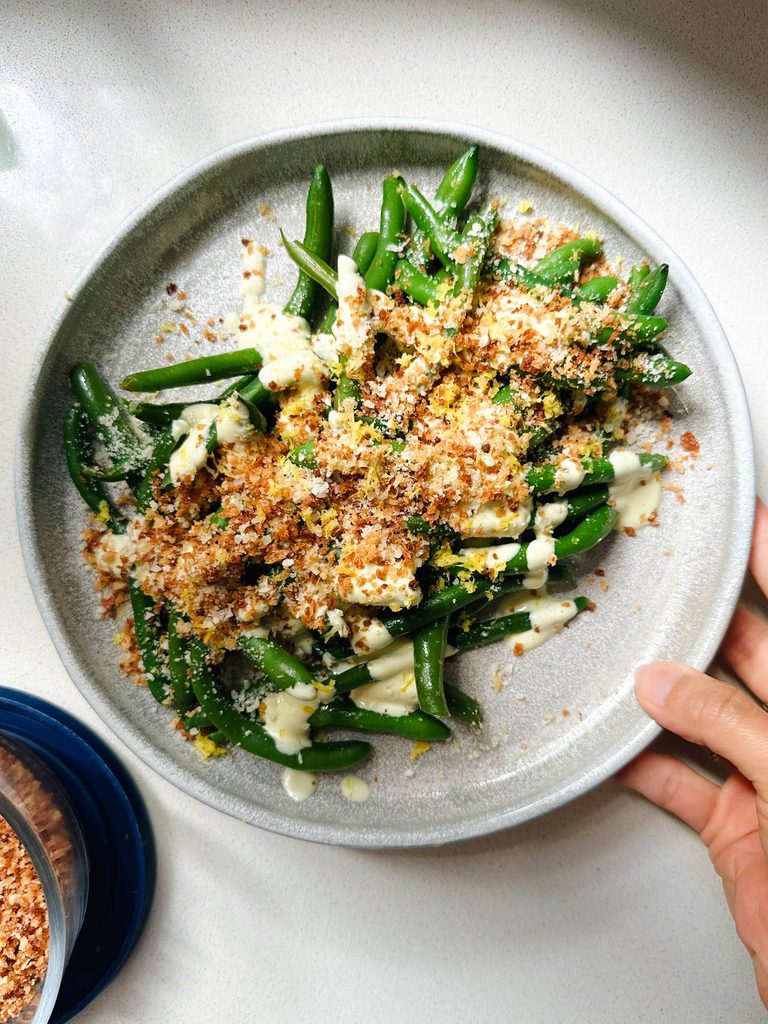
    Greens beans with avocado caesar dressing.

    Avocado Caesar Green Beans

    Grab a bag of green beans, blitz up a quick avocado caesar, toast some panko, and let’s go! This is some type of magic.

    21 reviews / 4.8 average

    Chicken wrap.

    Ang’s Chicken Wraps

    Hellllooo quick summer lunch! These chicken wraps have me hooked. Shredded chicken, crispy cheddar cheese, fresh veg like tomato, corn, and lettuce, some pickled red onion, and not one, but TWO sauces.

    18 reviews / 4.9 average

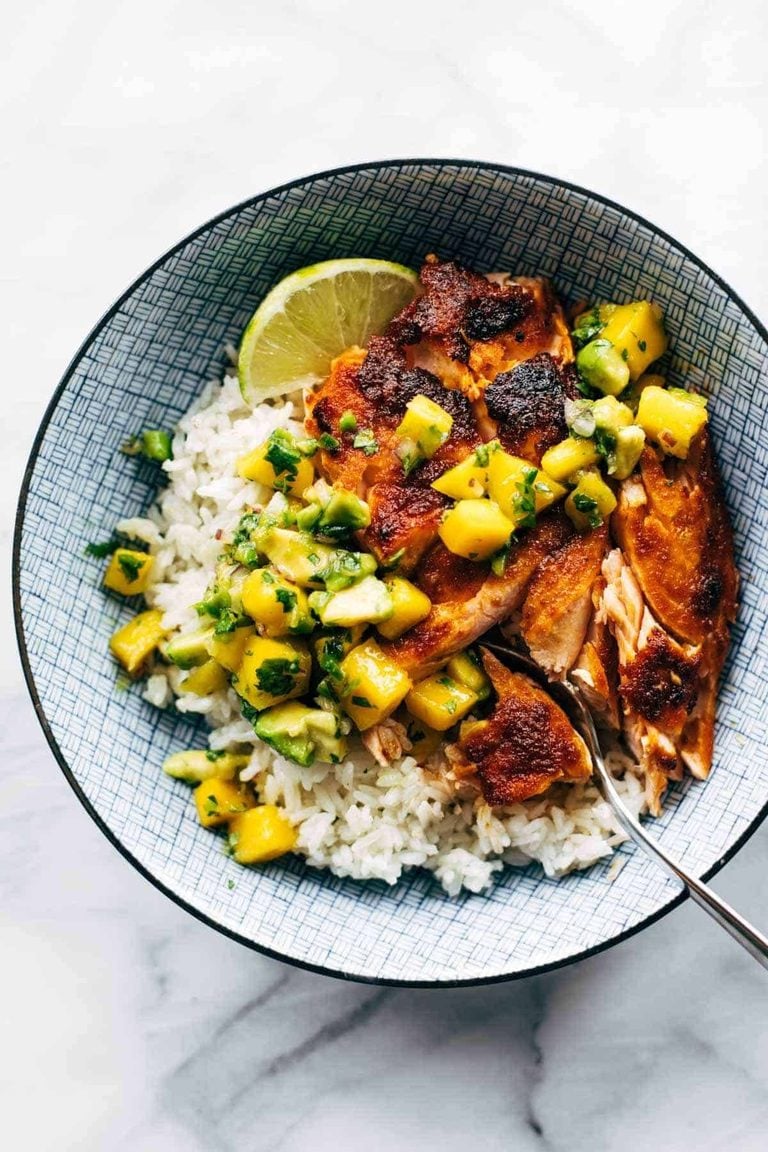
    BBQ salmon bowl with rice.

    BBQ Salmon Bowls with Mango Avocado Salsa

    BBQ Salmon Bowls with Mango Avocado Salsa! An easy and impressive dinner with yummy smoky-sweet flavor and a zip of zesty homemade salsa to take it over the top. The BEST weeknight dinner.

    191 reviews / 4.9 average

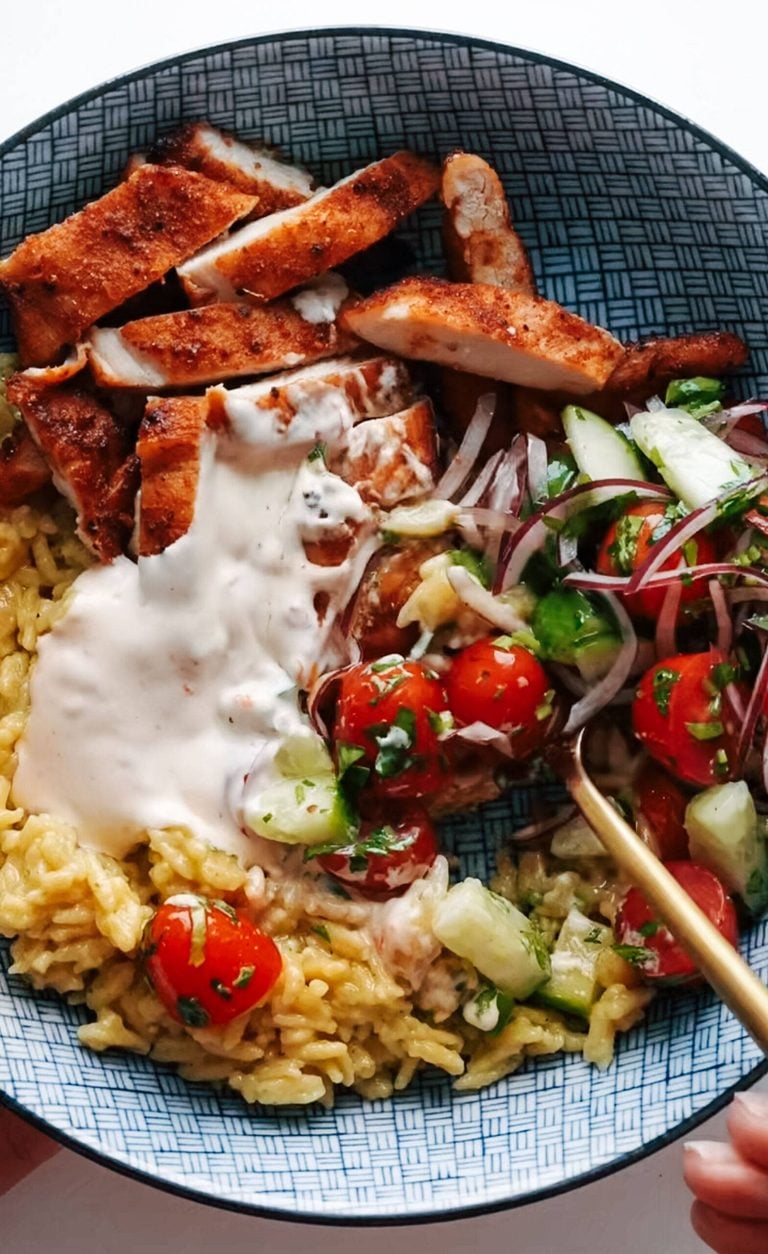
    Banza chicken bowl with salad.

    Banza Chicken Bowls with Calabrian Chili Sauce

    This bowl has it all! The crunch of the tomato cucumber salad, the thin slips of bitey red onion, the golden crisped air fryer chicken cut into tender little strips, a big pile of perfectly chewy Banza, and a dollop of tangy calabrian chile sauce on top.

    22 reviews / 5 average

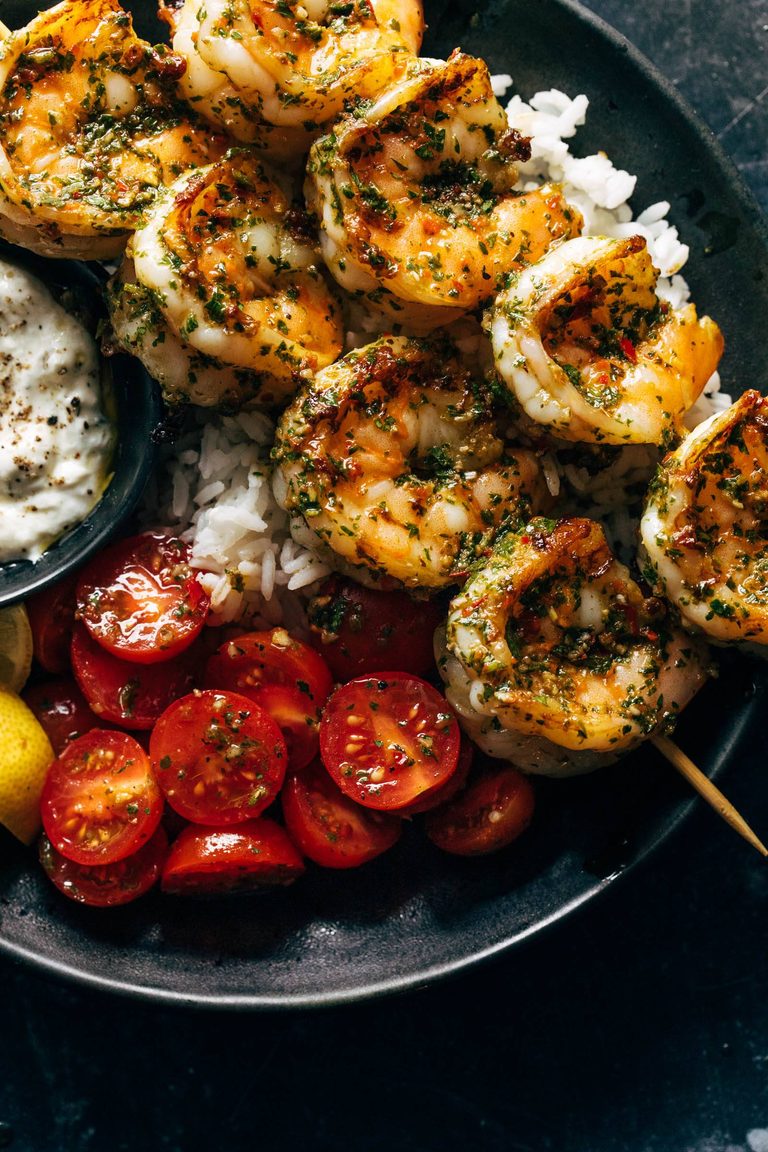
    Chimichurri shrimp with tomatoes.

    Chimichurri Shrimp with Tomatoes

    Saucy, punchy, and delightful Chimichurri Shrimp! Served with a tomato salad, a pile of hot steamy rice, and a dollop of creamy tzatziki.

    7 reviews / 5 average

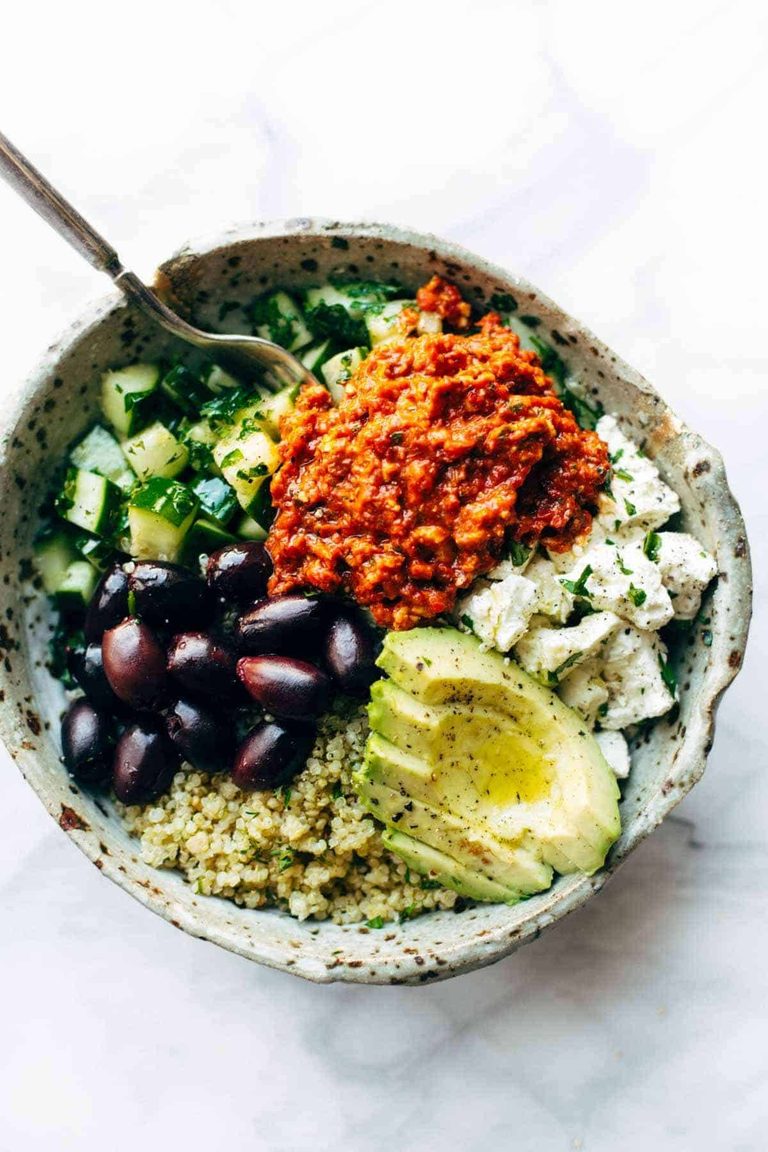
    Mediterranean quinoa bowls.

    Mediterranean Quinoa Bowls with Roasted Red Pepper Sauce

    Mediterranean Quinoa Bowls with Roasted Red Pepper Sauce! A mix of quinoa, cucumbers or kale or spinach, feta cheese, kalamata olives, and pepperoncini!

    82 reviews / 4.9 average

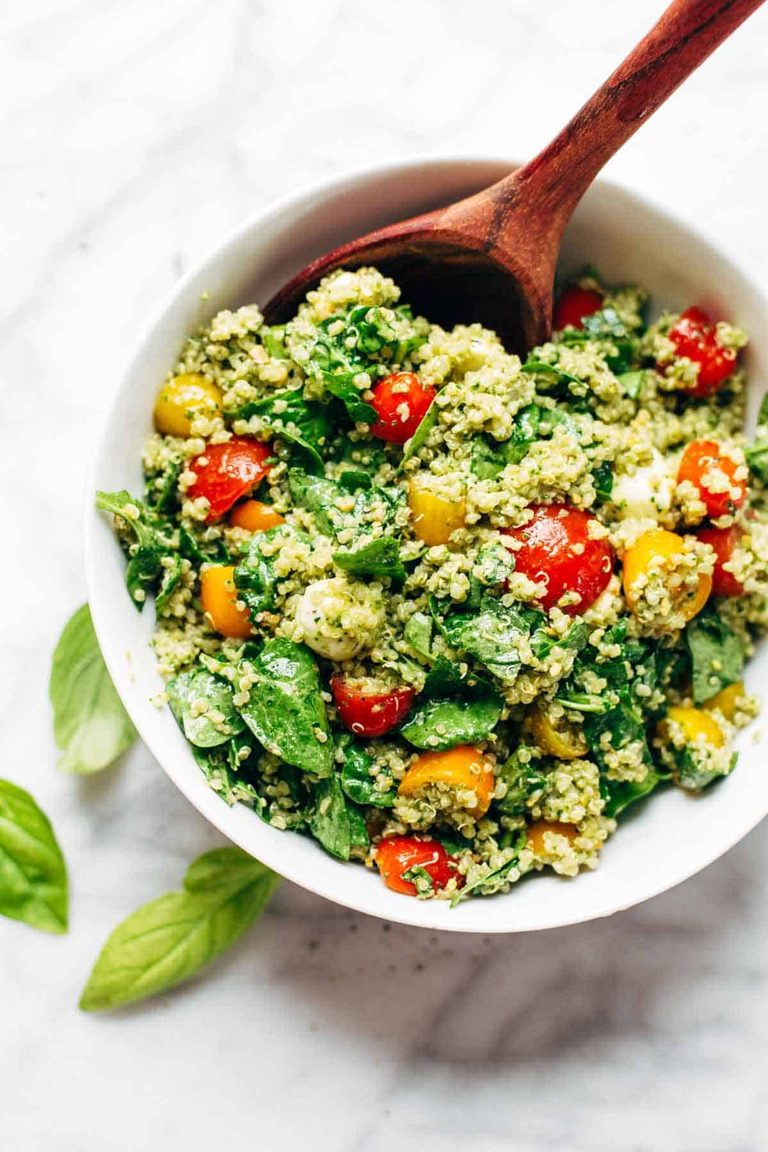
    Quinoa summer salad.

    Green Goddess Quinoa Summer Salad

    Green Goddess Quinoa Summer Salad – simple, healthy, and extremely adaptable to whatever veggies you have on hand! my family LOVES this recipe. vegetarian and can be made vegan.

    25 reviews / 4.8 average

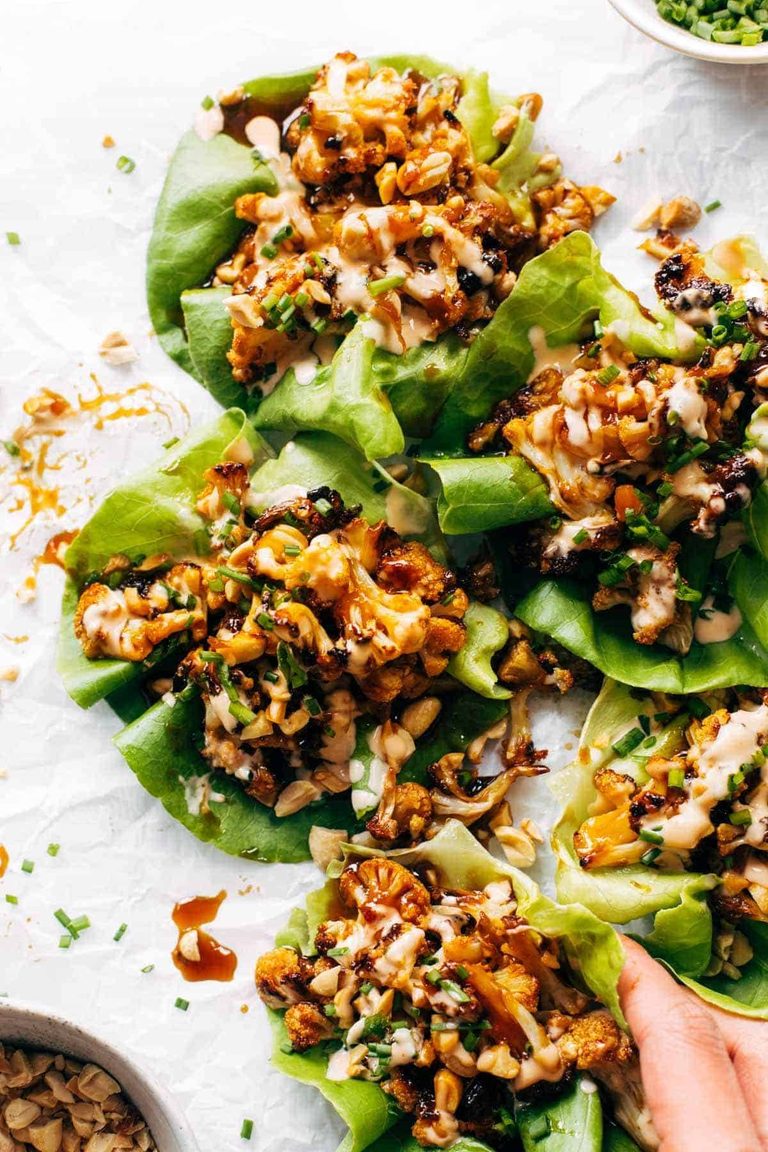
    Cauliflower lettuce wraps.

    Roasted Cauliflower Lettuce Wraps with Korean BBQ-Inspired Sauce

    Roasted Cauliflower Lettuce Wraps with Korean BBQ-Inspired Sauce! Roasted cauliflower tossed in a sweet and sticky sauce, all topped with chives, peanuts, and spicy mayo.

    35 reviews / 4.8 average

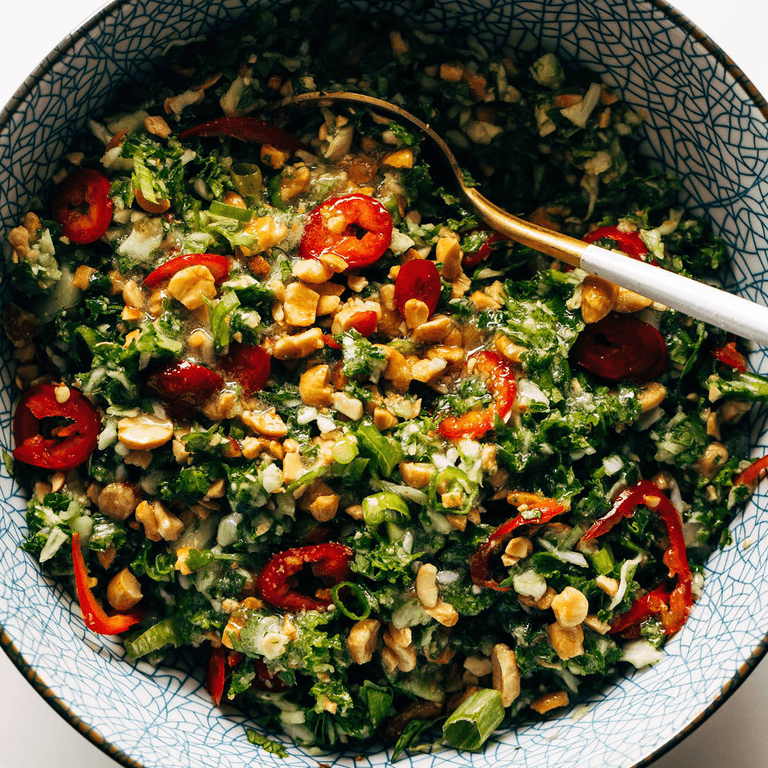
    Roasted peanut kale crunch salad.

    Roasted Peanut Kale Crunch Salad

    OOOH BABY, this salad is so good! Crunchy kale and cabbage, fresh herbs and fresno peppers, chopped peanuts, and a perfect roasted peanut vinaigrette that tucks into all the salad nooks and crannies.

    34 reviews / 4.9 average

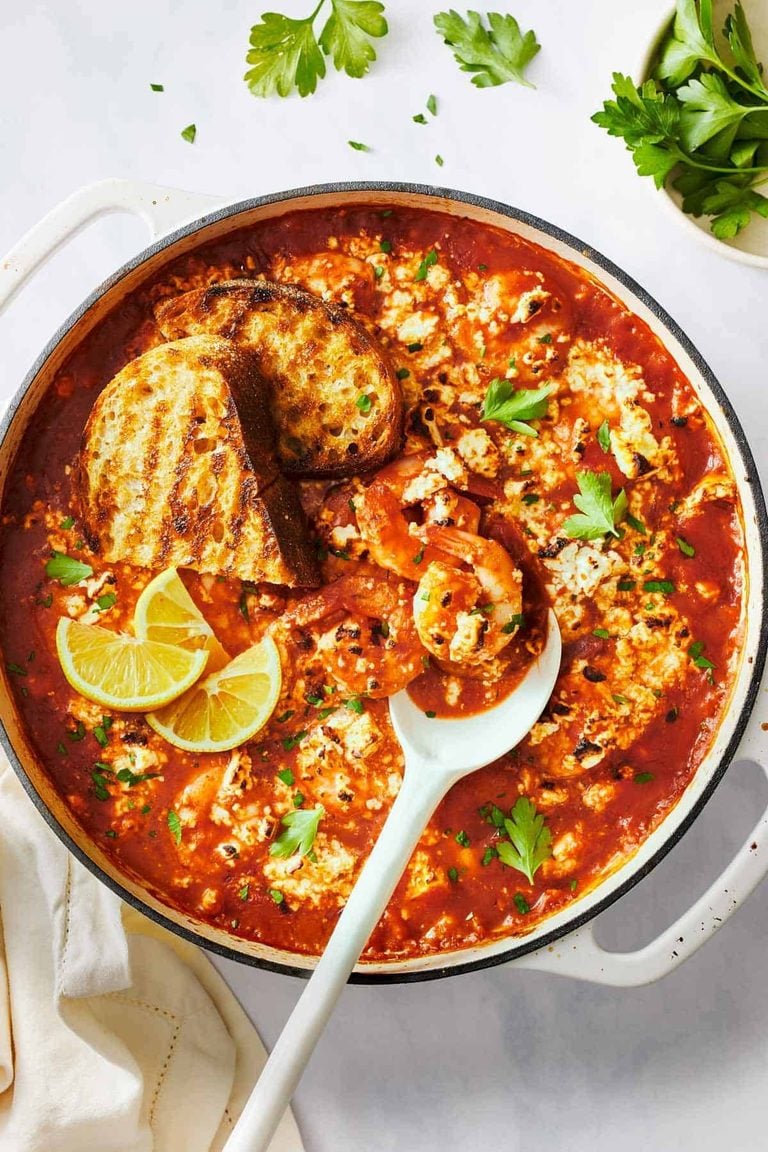
    Shrimp and grilled bread in a skillet.

    Baked Shrimp with Feta and Grilled Sourdough

    The yummiest Baked Shrimp with Feta and Grilled Sourdough! Bubble up some feta, garlic, shrimp, and tomato sauce in a pan, grill some buttery crispy bread, and dunk that right on in. The simplest fancy-ish dinner!

    19 reviews / 4.9 average

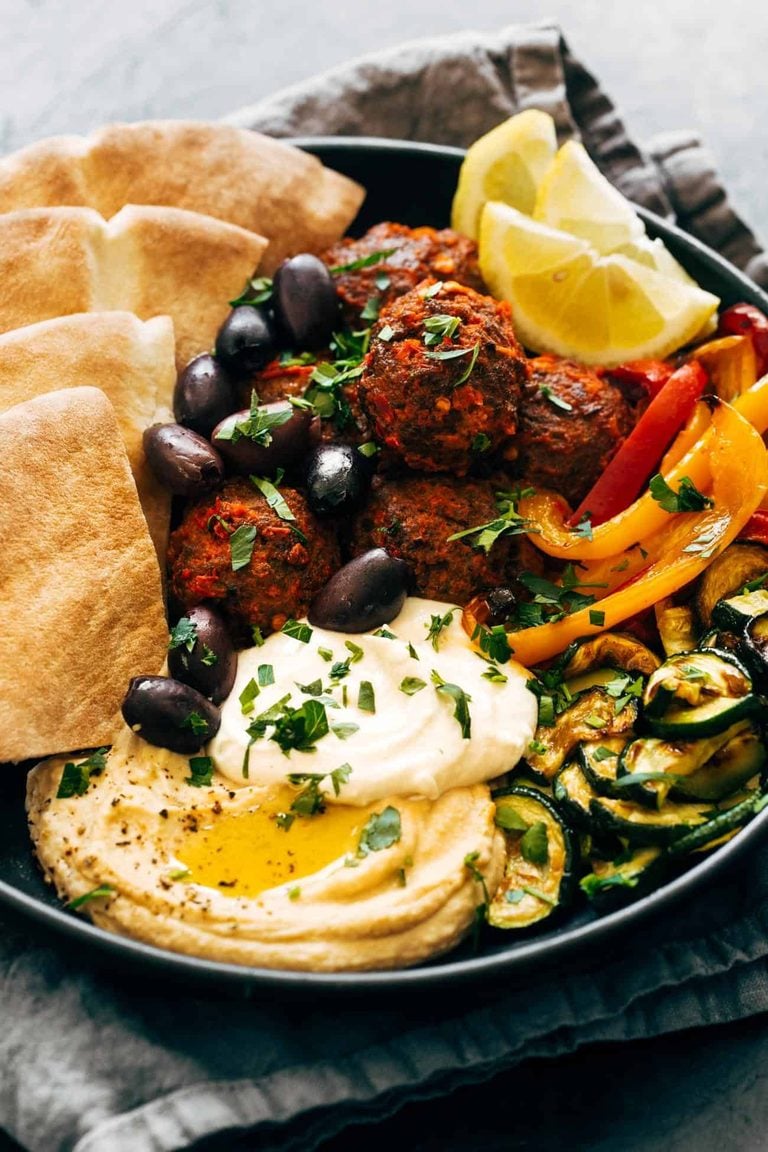
    Harissa meatballs on a plate with veggies and pita.

    Harissa Meatballs with Whipped Feta

    These Harissa Meatballs with Whipped Feta are perfect for an easy SOS dinner! Store-bought meatballs, bell peppers, zucchini, harissa, and whipped feta all in one bowl. YUMMY!

    39 reviews / 5 average

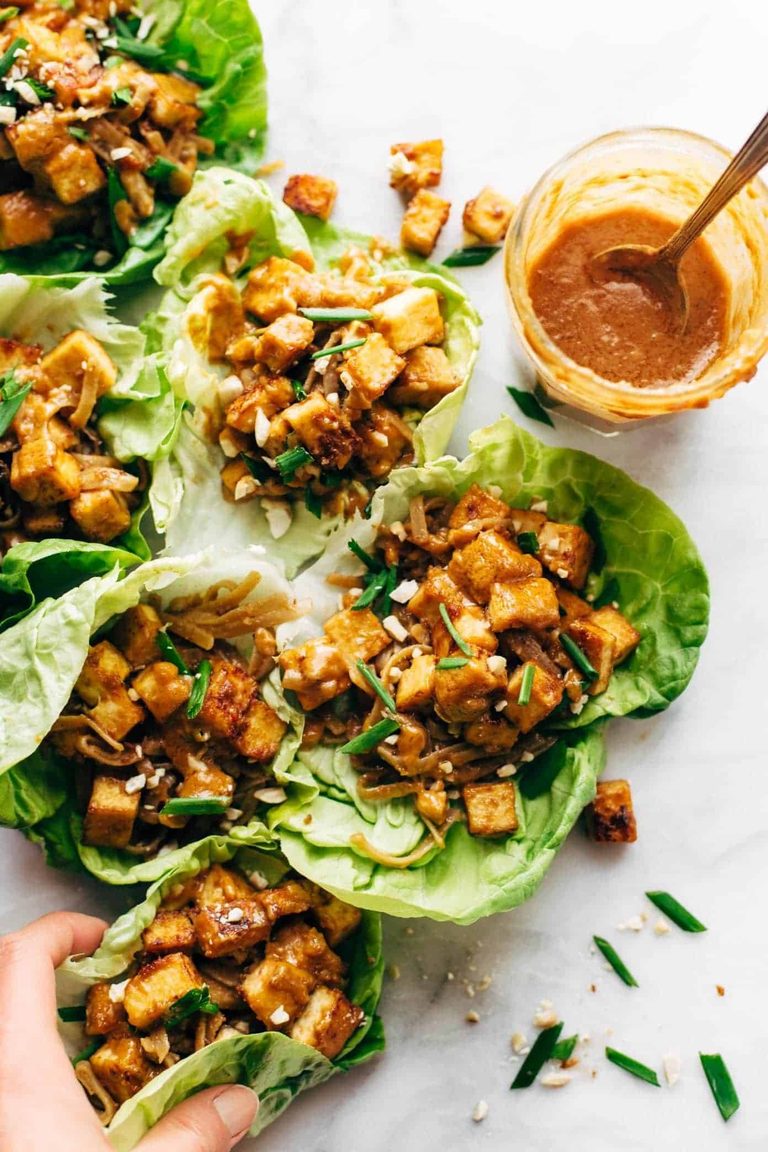
    Tofu and noodle lettuce wraps.

    Firecracker Vegan Lettuce Wraps

    HELLO YUM. Firecracker Lettuce Wraps that are happily vegan – with crispy tofu bits, saucy brown rice noodles, and a creamy sesame sauce.

    111 reviews / 4.8 average

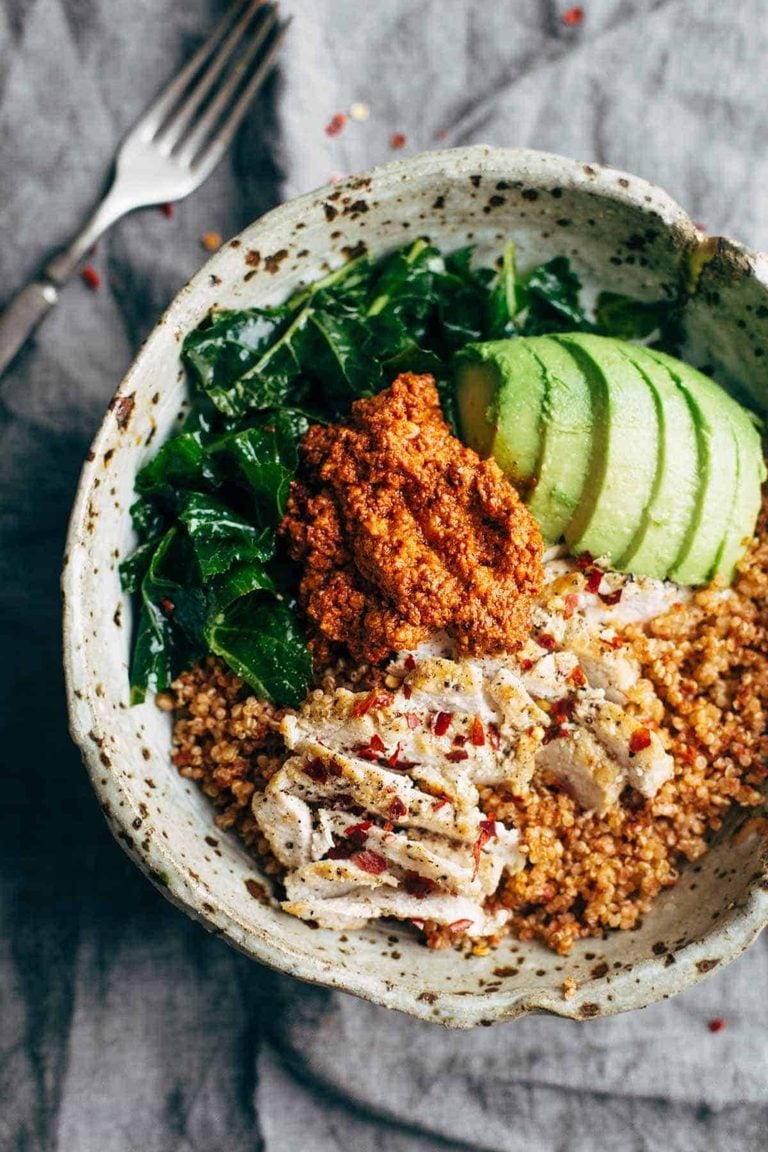
    Kale, chicken, and quinoa bowls.

    Marinated Kale and Chicken Bowls with Sun Dried Tomato Sauce

    Marinated Kale and Chicken Quinoa Bowl with Sun Dried Tomato Sauce! This recipe is clean, simple, and nutritious!

    33 reviews / 4.8 average


    Wholesome Summer Snacks

    I think my favorite part of summer might be all the snacking that presents itself – play date snacks, running-out-the-door snacks, car ride snacks, and just normal out-back-on-the-deck snacks. These are a few of my favorite healthy snacks for summer!

    The post 45 Light + Bright Healthy Summer Dinners appeared first on Pinch of Yum.

    This post was originally published on this site.

  • Things to Do in Vicenza: A Palladian Day Trip from Venice

    Things to Do in Vicenza: A Palladian Day Trip from Venice

    Vicenza is the Veneto city I’d push you towards if you care even slightly about architecture, and it’s the one most visitors skip on the train between Venice and Verona. I’ve been coming back to this part of Italy for thirty years, and Jess and I finally gave Vicenza a full day and a night…

    This post was originally published on this site.

  • Transatlantic Cruise Tips: What I Learned on My First Crossing

    Transatlantic Cruise Tips: What I Learned on My First Crossing

    I just got back from my first cruise across the Atlantic Ocean, and it was an unforgettable experience. The unique voyage started off with five full days at sea, followed by a mix of more sea days and port calls in beautiful locales. Throughout the sailing, I gathered knowledge on how transatlantic cruises work, what I did right, and what I’d do differently next time. With that in mind, I’ve put together this list of transatlantic cruise tips to help you plan a fun and memorable ocean crossing.

    1. Pack clothes for variable weather

    One of the most important things I learned on my first transatlantic crossing is that you need to pack for a variety of weather conditions. My sailing left New York City in April and arrived in Barcelona in May, and I was not prepared for how chilly most of the days during the crossing would be. Of course, your mileage will vary depending on what time of year you’re sailing and where your ship departs from/arrives into. But the conditions on my cruise ranged from cold and rainy to very warm and sunny, and everything in between.

    For most of the crossing, I was in pants and a sweatshirt whenever I was outside. I was glad I brought both warm-weather and cool-weather clothes, but I wished I had brought even more long-sleeve shirts and maybe one extra pair of pants. Also – bring a hat or knit headband to keep your ears warm. I saw people wearing full-on hats with pom-poms and I brought a thick knit headband, and I was very glad I did for those windy, chilly moments out on deck.

    virgin voyages transatlantic cruise tips

    2. Prepare for the motion of the ocean

    The waters can be more choppy on a transatlantic cruise than you’re probably used to in the Caribbean or Mediterranean. Even if you don’t normally need any seasickness medication or aids during a cruise, you might want to consider packing some for your transatlantic voyage. Whether you bring some acupressure wristbands just in case or put on patches ahead of setting sail, it’s better to be prepared than unprepared and wishing you had thought ahead.

    If you’re prone to motion sickness or are worried it might affect you on the voyage, you should also take that into consideration when choosing your stateroom. To minimize movement, go for a cabin towards the middle of the ship on a lower deck. Aft and forward cabins, as well as those on higher decks, are more likely to feel the effects of the ocean.

    valiant lady virgin voyages transatlantic cruise review

    3. Be aware of the gradual time change

    Just like if you were driving cross-country, the time zones you’re in will change gradually as you cross the Atlantic Ocean. If you’re heading east, you’ll lose time as you cross. If you’re heading west, you’ll gain time. During my transatlantic cruise, we lost an hour each night for most days — but not all — of the initial crossing. We then lost another hour once we started visiting ports, specifically between the ports on the western side of the Strait of Gibraltar and the ports east of it in the Mediterranean.

    The good news is that you’ll only lose (or gain) one hour at a time, so your days aren’t thrown off too much. On my sailing, the shipboard time officially changed at 2 am each of the nights that we were set to lose an hour. I will say, despite only losing one hour at a time, I did feel it and was tired several mornings when the time had changed. It was also a weird feeling because we lost an hour almost every night for the first half of the cruise, so it took a while to feel “caught up” with the sleep we were losing. Despite that, it was great arriving in Europe without jet lag.

    4. Enjoy a pre and/or post-cruise stay

    If your cruise begins on the opposite side of the ocean from where you live, arrive in the homeport city at least 1-2 days before the cruise begins. If your transatlantic flight gets delayed or canceled, you don’t have as many timely options for rebooking a flight to make it to the ship in time. It’s best to have lots of leeway in case things don’t go exactly according to plan. Plus, it gives you the opportunity to start getting acclimated to the time zone change before you even board the ship.

    As well, it’s also fun to explore a new city if your cruise begins and/or ends in a place you’ve never visited before. Instead of heading straight to the airport, stay a few extra days to enjoy some of the best sights, food, and experiences there before heading home. Bonus: you won’t feel quite as sad to leave the ship, as your vacation won’t be over yet!

    5. Bring down-time activities

    You’ll have a lot more free time on a transatlantic cruise than you’re probably used to on other sailings. While there’s lots to do on board, from planned activities to the ship’s amenities, you’re still likely to have quite a bit of down time and lots of sea days. Most ships will have board games, puzzles, and maybe even a small library of books you can read. But it’s a good idea to bring some things of your own to stay occupied, too. You can bring things like books/an e-reader, card games, word puzzle books, or a journal. The list of potential items to bring that are small and easy to pack is a long one. Think about how you want to spend your down time on the ship, and pack accordingly.

    You might also be wondering how the ship’s wifi handled crossing the Atlantic Ocean. I was sailing aboard Virgin Voyages’ Valiant Lady using the ship’s Premium Wi-Fi connection, so I can only speak to the quality of my specific internet situation and ship. With that being said, I’m happy to report that it was fantastic. While there are always some little hiccups with cruise ship internet here and there (a moving ship connecting to satellite internet is not going to be the same as your internet at home!), overall the connection was fast and reliable. We were able to easily browse and upload to social media, send emails, browse the web, and even stream things like YouTube.

    6. See if your cruise line offers status matching

    If you have status with one cruise line but are taking your transatlantic cruise with another, check to see if the line you’re sailing with does status matching. For example, MSC Cruises offers status matching not only with other cruise lines, but with a number of hotel brands as well. Other cruise lines status match within their own company, like Royal Caribbean Group; if you have status with Celebrity, you can match into the equivalent status on Royal Caribbean.

    If you’re able to status match into a higher tier, you might receive very useful perks like a free bag of laundry or free alcoholic drinks. Other common loyalty perks include things like discounted wifi packages, free specialty dining meals, and priority boarding and reservations.

    Of course if you’re sailing with a line that you already have status with, be sure to take advantage of those benefits. They can become even more useful when taking a longer cruise like a transatlantic.

    MSC Seaside at Ocean Cay Bahamas

    7. Pack magnetic hooks for your stateroom

    Unless you’re sailing aboard Queen Mary 2, transatlantic cruises are long… usually 13-15+ nights long. And unless your ship has self-service laundry rooms or you get free laundry service, you might want to minimize how much you utilize the laundry service on board (if you use it at all). Therefore, you’ll probably be packing more clothing than you normally would on a cruise. If you’re sailing with at least one other person, storage space can run out quickly. This goes for other items too, such as backpacks, purses, hats, and belts — not to mention wet swimsuits, cover-ups, and robes.

    To help create more storage space, bring magnetic hooks. Your stateroom’s walls are most likely metal, which means bringing extra hooks creates more space for hanging things to keep them off other surfaces.

    Bonus Tip: Metal walls also mean that if you collect magnets from the different ports you visit, you can display them in your cabin throughout the voyage. It’s a great way to add some personal flair to your stateroom and start enjoying your souvenirs right away.

    8. Look for cruise fare deals

    Transatlantic cruises — and most repositioning cruises in general — tend to be cheaper per-night than regular voyages that sail round trip from one homeport. If you’re on a tighter budget, a transatlantic cruise can be a great option to enjoy a longer voyage at a discounted rate. You’ll find quite a few sailings that start at well under $100 per person, per night. It’s easy to find 2+ week transatlantic cruises that start at $2,000 or less for two people. Just remember that you’ll need to purchase airfare for at least one end of the cruise, if not both if you don’t live near either homeport.

    You should also consider working with a travel advisor, like our friends at MEI-Travel, who can help get you the best deal possible.

    valiant lady pool deck

    9. Research your cruise ship

    Since you’ll be spending so much time on your ship during a transatlantic cruise, you’ll want to ensure you pick the right cruise line and ship for you. Do you want a more adult-oriented, laid-back atmosphere? Do you want lots of bells and whistles for your family? Is food your focus? How important is quality entertainment? While the ship may not usually factor as much into your decision-making when planning a cruise, you’ll want to put more weight behind it for a transatlantic voyage.

    If you’re cruising on a budget, you also might want to consider how many dining venues on board are included in the cruise fare. Some lines have few included options aside from the buffet and main dining room, while others include all restaurants in the fare. The selection of included dining options might not matter as much on a short weekend cruise or a standard seven-night sailing in Alaska or the Caribbean, but you’ll probably want more variety when crossing the Atlantic and spending several days in a row at sea.

    10. Pick your itinerary thoughtfully

    In the same vein as choosing your ship carefully, you should also thoughtfully pick an itinerary that best fits your preferences and needs. Do you live in the northeast (or southeast) and want to depart close to home? Do you want to start in Europe so that you’re closer to home once the cruise ends? What are your must-visit ports? If you’re thinking about sailing in the winter (sailings mostly on Cunard), are you okay with choppier seas during the crossing?

    I took my transatlantic cruise out of New York City in April and the weather was chilly for most of the crossing. Had my voyage left from Florida or the Caribbean instead, it would have been warmer — especially at the beginning of the cruise. We chose the itinerary we did because we preferred the ports over the equivalent crossing that took a more southerly route, but that’s something to consider as well.

    Comments

    Have you sailed an Atlantic crossing itinerary? Do you have any other transatlantic cruise tips to add to this list? Drop us an anchor below to share your repositioning cruise experiences.

    The post Transatlantic Cruise Tips: What I Learned on My First Crossing appeared first on EatSleepCruise.com.

    This post was originally published on this site.

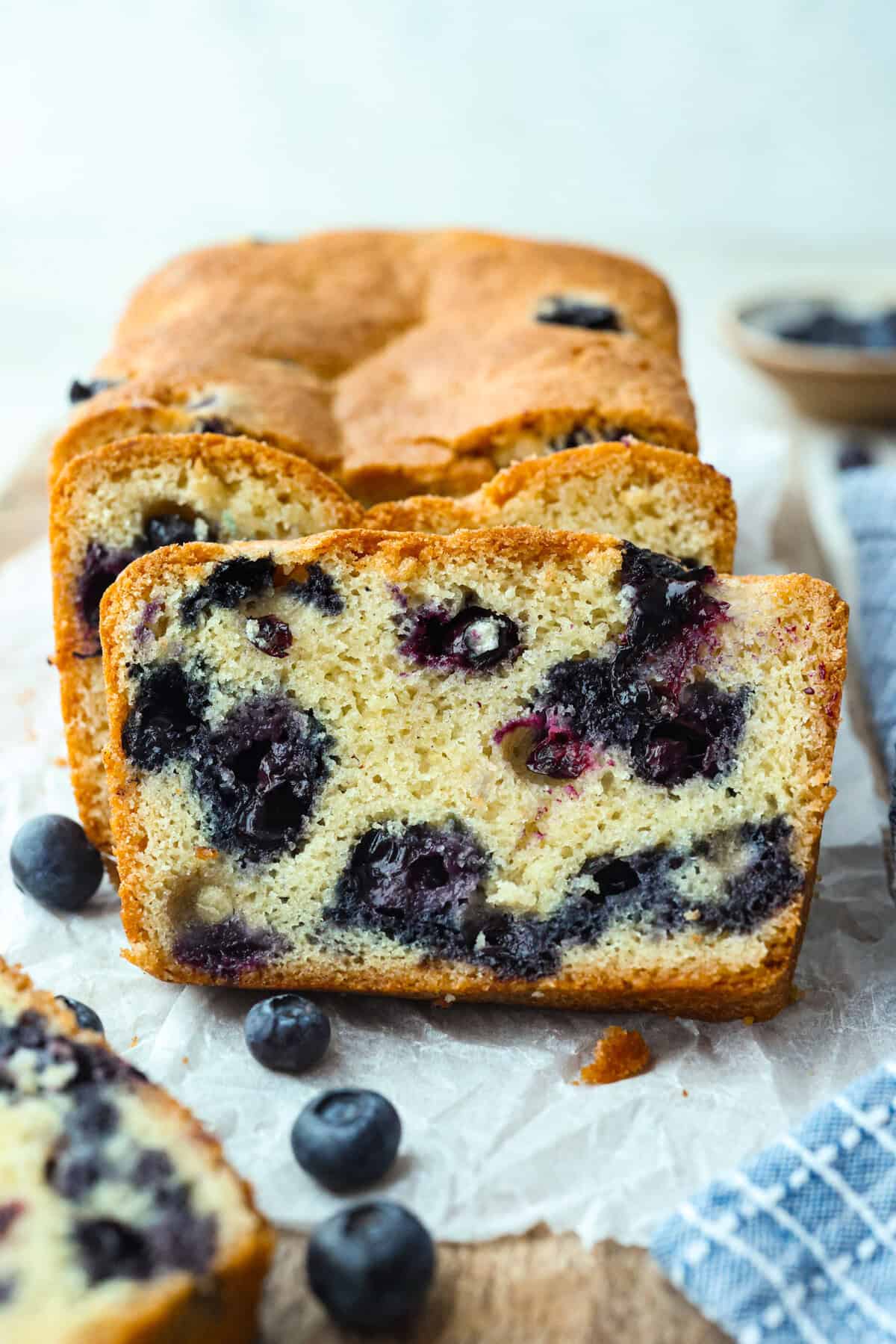
  • 5 Ingredient Blueberry Bread

    5 Ingredient Blueberry Bread

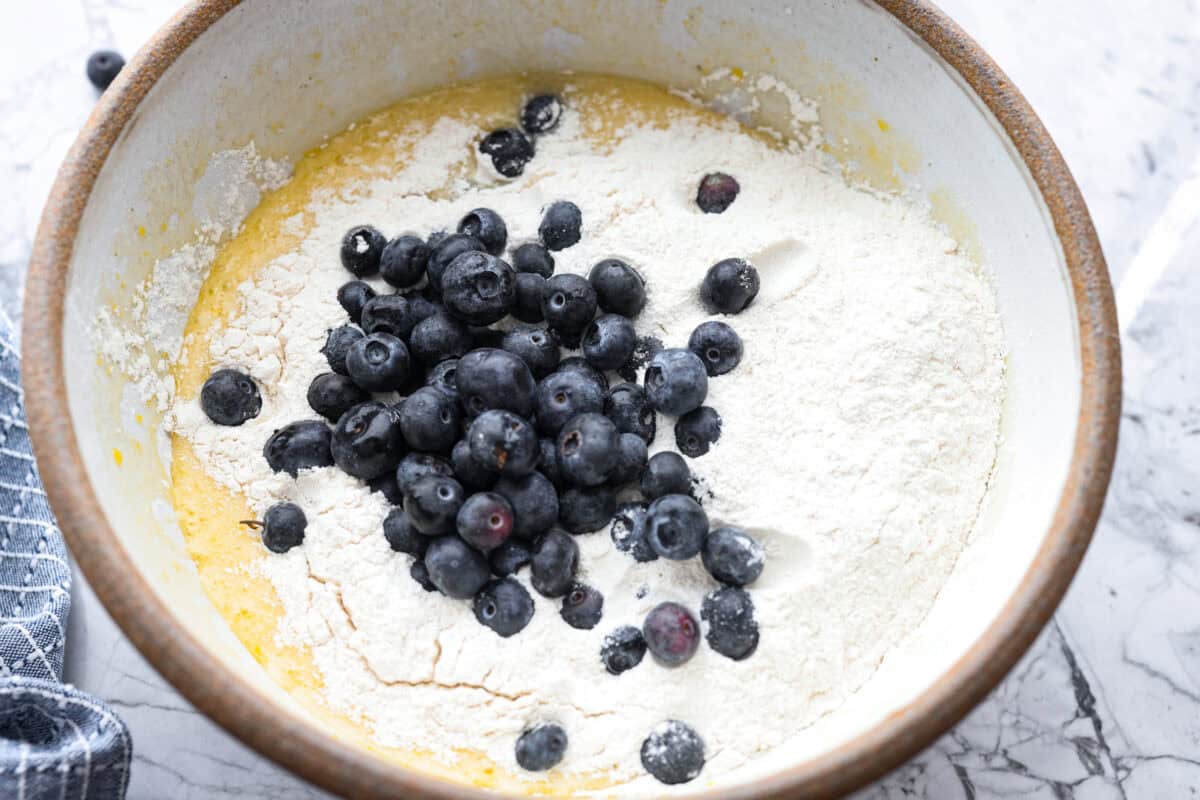
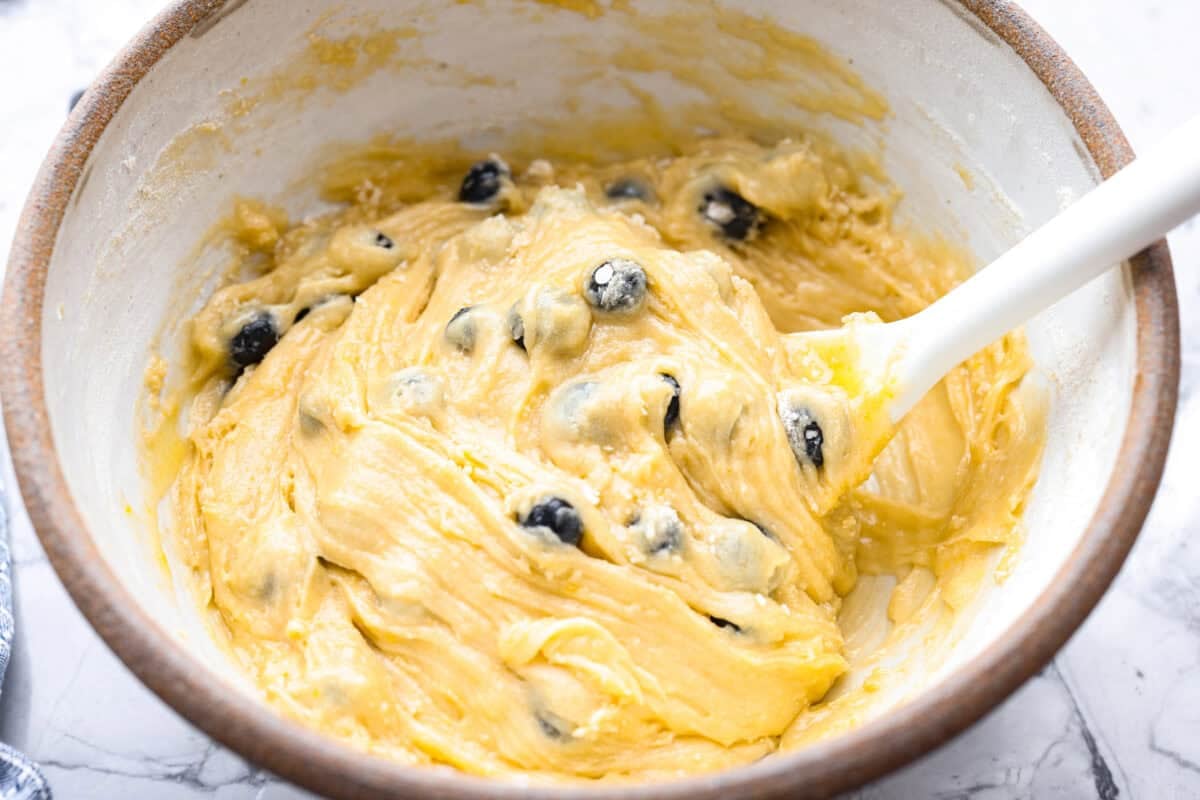
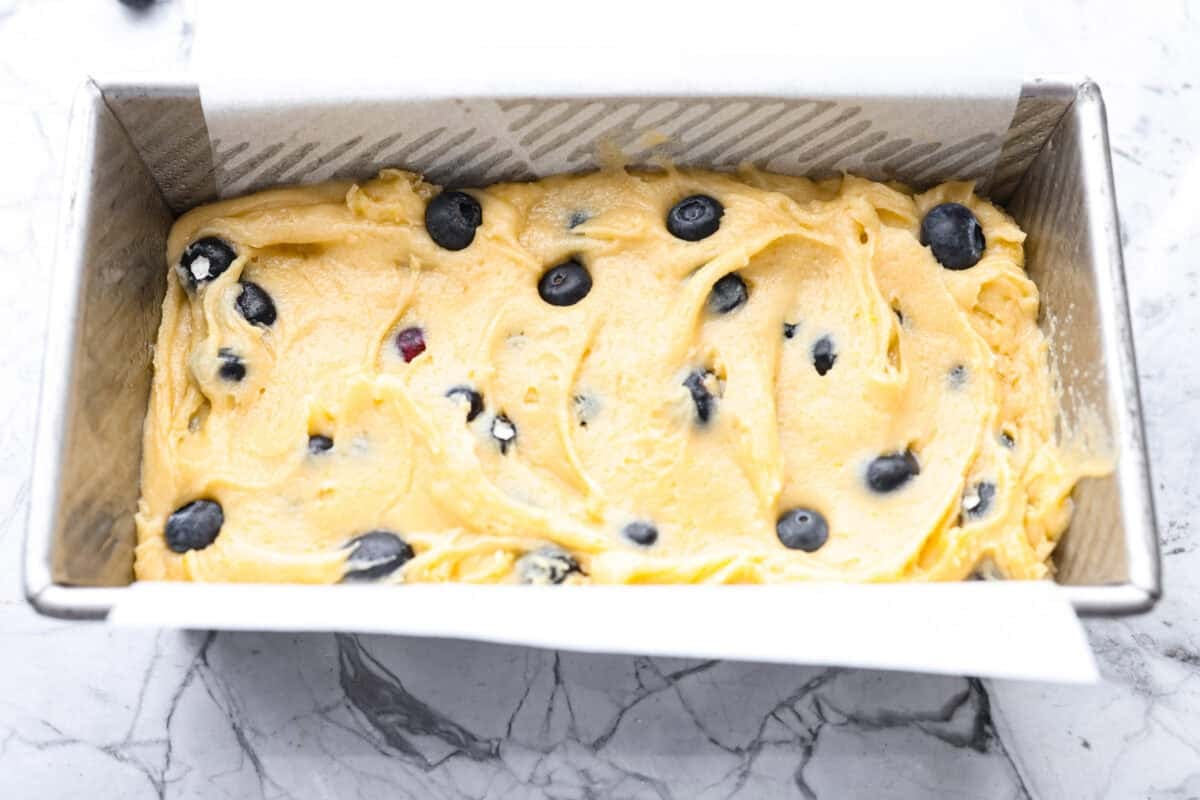
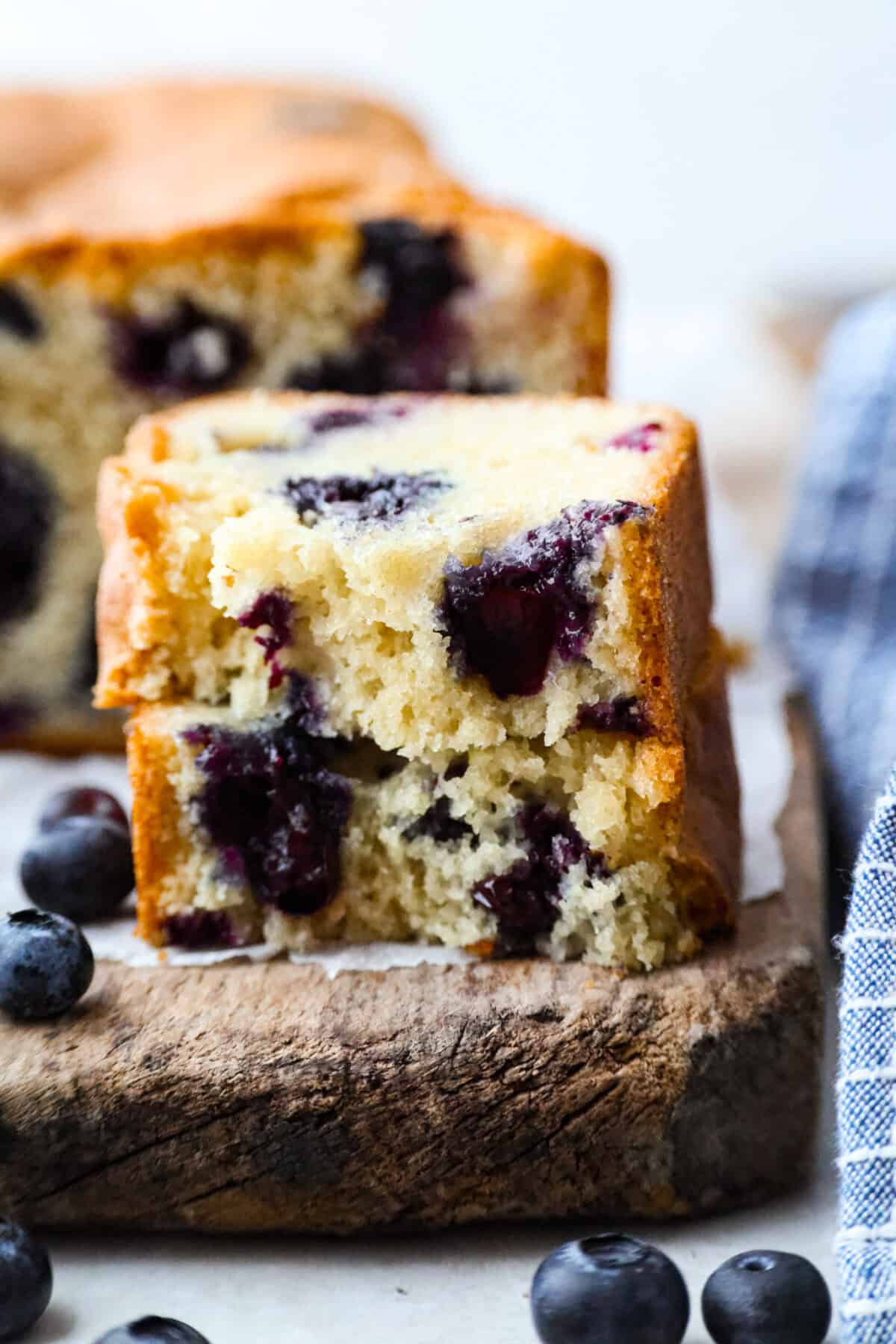
    This 5 Ingredient Blueberry Bread is the little shortcut loaf you’ll make once and then suddenly need every weekend. It’s soft, sweet, full of juicy blueberries, and comes together with only five simple ingredients.

    Lovely Little Loaf Secrets

    • Only 5 Ingredients: Bless! You only need a few pantry staples and blueberries to make this easy quick bread happen.
    • Perfectly Soft and Moist: This blueberry bread bakes up tender and sweet, with juicy berries in every slice.
    • Breakfast, Snack, or Dessert: Serve it warm in the morning, pack it for an afternoon treat, or add a little butter and call it dessert. I support you.

    5 Ingredient Blueberry Bread Ingredients

    Overhead shot of labeled ingredients.
    • Flour: If you don’t have self rising flour, you can make your own by combining 1 cup all purpose flour with 1 ½ teaspoons baking powder and ¼ teaspoon salt.
    • Add-Ins: For more flavor, add 2 teaspoons of vanilla extract or lemon zest to the batter.
    • Oil Option: You can use a neutral oil instead of melted butter. Oil makes the bread extra moist, while butter gives it a richer flavor.
    • Sweet Crunchy Top: Sprinkle the top of the bread with some granulated sugar before baking for extra sweetness.

    How to Make 5 Ingredient Blueberry Bread

    This easy blueberry bread recipe is one you can throw together quickly when that sweet tooth hits. If you love a good moist quick bread, you’ll also want to try my lemon, orange, or pineapple bread next!

    1. Prep: Preheat the oven to 350°F. Grease an 8.5 x 4.5-inch pan with nonstick cooking spray and line with parchment paper. Set aside. In a large bowl, add melted butter, sugar, and eggs. Whisk until well combined.
    2. Add: Add self rising flour and fresh blueberries to the bowl.
    3. Stir: Stir until just combined.
    4. Bake: Pour the batter into the prepared pan and bake for 55-60 minutes. You know when it’s done when a toothpick inserted into the center comes out clean. Cool 5 ingredient blueberry bread completely before slicing.

    Must Have Tools For This Recipe

    • Mixing Bowl: Holds the batter while you mix everything together.
    • Whisk: Helps combine the wet ingredients and smooth out the batter.
    • Loaf Pan: Gives the bread its shape and helps it bake evenly.

    Print

    5 Ingredient Blueberry Bread

    This 5 Ingredient Blueberry Bread is soft, moist, packed with juicy blueberries, and perfect for breakfast, snacking, or dessert.
    Course Breakfast
    Cuisine American
    Keyword 5 ingredient blueberry bread, 5 ingredient blueberry bread recipe, blueberry bread, blueberry loaf, blueberry quick bread
    Prep Time 10 minutes
    Cook Time 1 hour
    Total Time 1 hour 10 minutes
    Servings 12 slices
    Calories 246kcal

    Ingredients

    • ½ cup melted butter
    • 1 ¼ cups sugar
    • 3 eggs
    • 2 cups self-rising flour
    • 1 cup blueberries fresh or frozen

    Instructions

    • Preheat the oven to 350 degrees Fahrenheit. Grease an 8.5 x 4.5-inch pan with nonstick cooking spray and line with parchment paper. Set aside.
    • In a large bowl, add ½ cup melted butter, 1 ¼ cups sugar, and 3 eggs. Whisk until well combined.
    • Add 2 cups self-rising flour and 1 cup blueberries to the bowl, then stir until just combined.
    • Pour the batter into the prepared pan and bake for 55-60 minutes, or until a toothpick inserted into the center comes out clean. Cool completely before slicing.

    Notes

    Leftover & Make Ahead Instructions

    • Room Temperature: Store leftovers in an airtight container at room temperature for up to 3 days.
    • Freezer: Cool completely, then wrap tightly in plastic wrap and place in a freezer bag. Freeze whole or sliced for up to 3 months.
    • Make Ahead: Assemble the batter in the loaf pan, cover, and refrigerate for up to 24 hours before baking. Add about 5 minutes to the bake time.

    Nutrition

    Calories: 246kcal | Carbohydrates: 38g | Protein: 4g | Fat: 9g | Saturated Fat: 5g | Polyunsaturated Fat: 1g | Monounsaturated Fat: 2g | Trans Fat: 0.3g | Cholesterol: 61mg | Sodium: 77mg | Potassium: 48mg | Fiber: 1g | Sugar: 22g | Vitamin A: 303IU | Vitamin C: 1mg | Calcium: 13mg | Iron: 0.4mg
    Close up shot of a slice of a 5 ingredient blueberry bread slice cut in hlaf ans stacked.

    More Quick Bread Recipes

    This post was originally published on this site.

  • Visiting Ouidah: Voodoo Traditions, History, and a Very Unexpected Python Moment

    Visiting Ouidah: Voodoo Traditions, History, and a Very Unexpected Python Moment

    Last Updated on June 25, 2026 by Sarah Wilson After Togoville, I travelled on to Ouidah — a place known both for its deep spiritual traditions and its painful history. It turned out to be one of the most fascinating days of my trip, with moments I absolutely did not expect, such as a python around my neck, which […]

    The post Visiting Ouidah: Voodoo Traditions, History, and a Very Unexpected Python Moment appeared first on LifePart2andBeyond.com.

    This post was originally published on this site.