An air ambulance carrying six people may have been “coming in blind” with electrical problems when a storm loomed ahead of it early Saturday shortly before it vanished in the waters off Nantucket.
this site

An air ambulance carrying six people may have been “coming in blind” with electrical problems when a storm loomed ahead of it early Saturday shortly before it vanished in the waters off Nantucket.
this site

Three days is enough time to see Prague well, as long as you put the days in the right order. I first visited Prague back in the 2000s and returned to the city in September 2026 with Jess, on her first visit. We spent five nights in the Old Town and walked four full days…

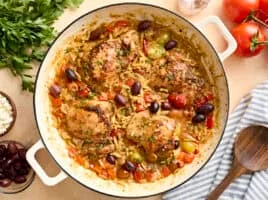
Greek Chicken Soup, or Avgolemono soup, is a bright, lemony chicken and rice soup with the silkiest broth (made without a drop of heavy cream!). The creaminess actually comes from eggs, which are whisked with fresh lemon and slowly blended into the hot broth. The method may be a little different from your usual soup, but it’s much easier to make than you’d think! I especially like the way the lemon brightens up the broth and keeps the whole soup feeling fresh. And with about 21 grams of protein per serving at just $1.16 each, it’s also an easy, budget-friendly way to cozy up on a chilly day!
If you’ve never heard of avgolemono, its name literally means ‘egg-lemon’ in Greek. It’s a traditional Greek sauce made by whisking eggs and lemon juice with hot broth, and it gives this soup its signature creamy texture. This recipe here is my weeknight-friendly take on the traditional Greek soup. Chicken, rice, and everyday vegetables cook together in one pot, then fresh lemon and dill give the broth its bright, distinctive flavor. That simplicity is one of my favorite things about this soup. You’re probably starting with ingredients you already cook with all the time, but the finished soup feels totally different. So if chicken noodle soup is usually on repeat once the cold weather hits, this is a delicious way to switch up your soup routine without filling your cart with a bunch of specialty ingredients.
But if the idea of adding eggs to hot soup has you a little worried, don’t be! The secret is tempering them first. I slowly whisk hot broth into the egg and lemon mixture before adding it back to the pot, which gently brings the eggs up to temperature so they blend smoothly into the soup instead of scrambling. Keep whisking as you add the broth (don’t rush this step), and keep the heat low once the egg mixture goes back into the pot. That’s really all there is to it! Then you’ll end up with the silky, creamy broth avgolemono soup is known for.
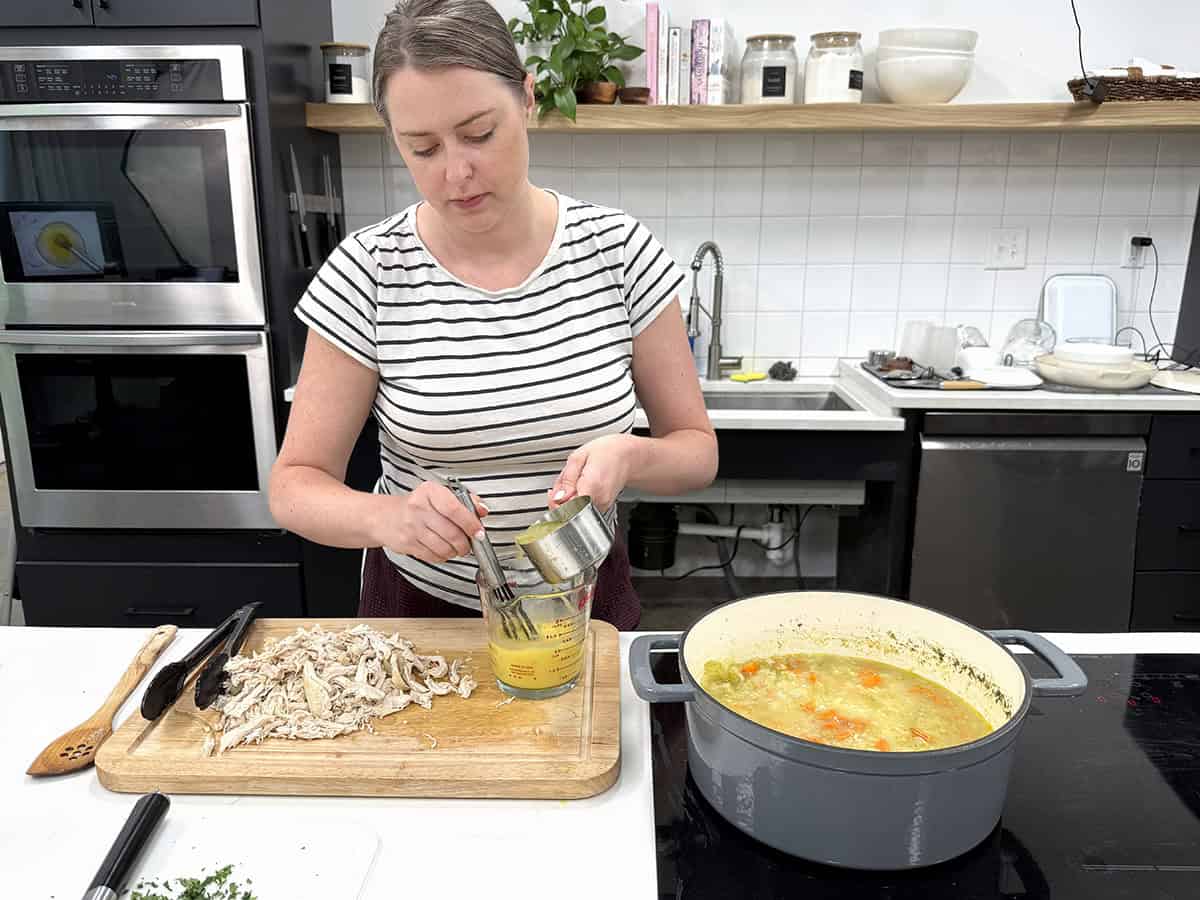
The egg, lemon, and broth mixture is what gives Greek chicken soup its creamy texture. I use a little whisking and gentle heat to help it blend smoothly into the soup. Read these tips before you get started:

Print
Add to Collection Go to Collections
See how we calculate recipe costs here.
**I tested and costed this recipe using Better Than Bouillon. If you use a different broth or stock, the salt level may vary. Taste the finished soup before adding more salt.
***Some avgolemono soup recipes use orzo instead of rice. I only tested this recipe with long-grain white rice, but if I made the swap, I’d use the same ½ cup of dry orzo and keep the broth at 6 cups. I’d add the orzo during the final 8-10 minutes of simmering, or follow the package directions, so it doesn’t overcook. The finished soup will have a softer, more pasta-like texture, and the orzo may absorb more broth as it sits.
****I use dried dill because it’s inexpensive, keeps well in the pantry, and is easy to find year-round. Fresh dill has a brighter flavor but usually costs more upfront. If you want to use fresh, try replacing the 1 tsp dried dill with about 1 Tbsp finely chopped fresh dill.
*****This recipe uses whole eggs for a straightforward, no-waste method. It adds the creaminess needed and doesn’t leave me with leftover egg whites!

Gather all of your ingredients: Have everything measured and ready before you start. Since the avgolemono mixture is added near the end, having everything prepped ahead makes the process easier and helps you move smoothly from the hot broth to the silky, creamy finish.

Prep the vegetables: Dice 1 yellow onion and 2 celery ribs, slice 2 carrots into half-moons, and mince 2 garlic cloves. Keep the vegetables roughly similar in size so they soften at the same rate.
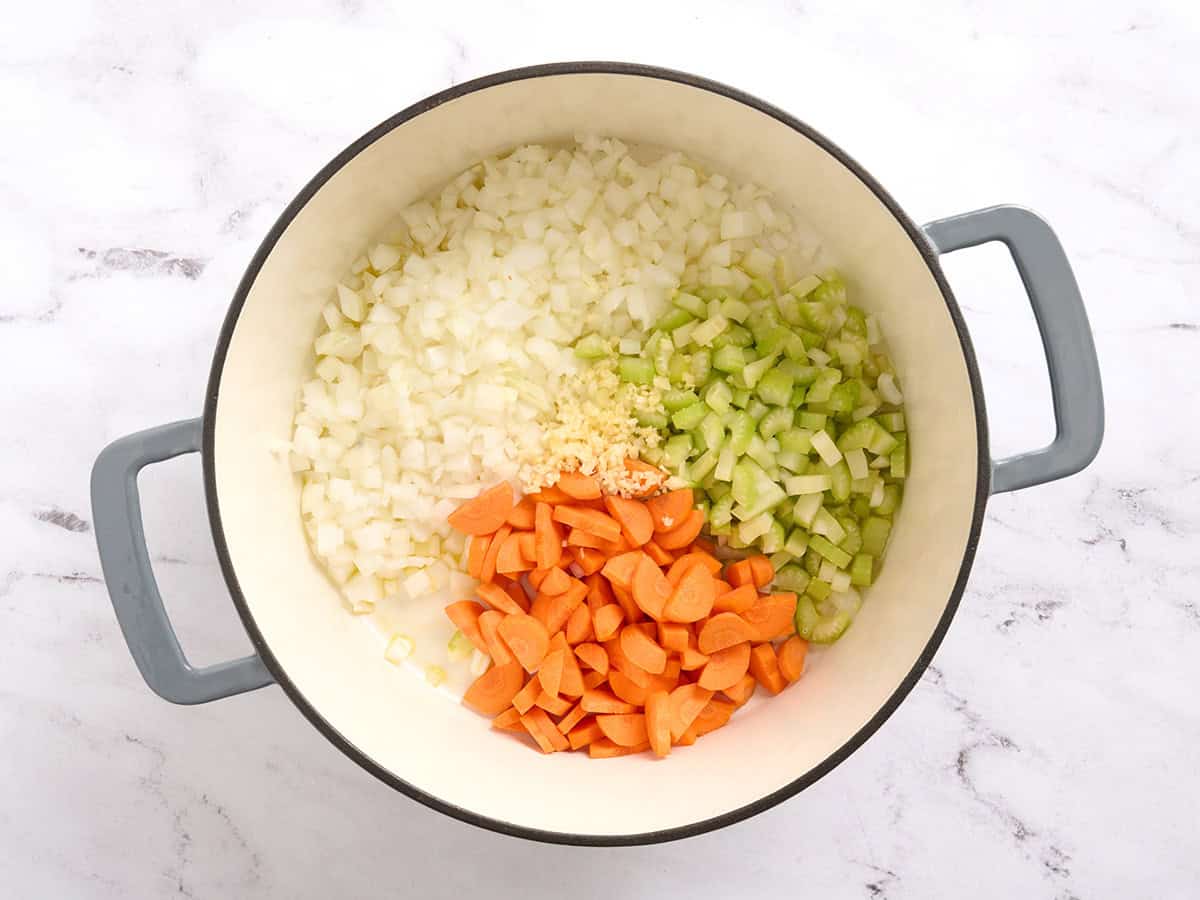
Soften the vegetables: Heat 1 Tbsp olive oil in a large pot over medium heat. Once the oil is shimmering, add the onion, carrots, celery, and garlic. Cook for 5-7 minutes, stirring occasionally. This builds flavor before we add everything else to the pot. The onion should look translucent, the garlic should smell fragrant, and the carrots and celery should be starting to soften. They’ll finish cooking in the broth.

Simmer the soup: Add 1 lb. boneless, skinless chicken breasts, 6 cups chicken broth, ½ cup uncooked long-grain white rice, 1 tsp dried dill, ½ tsp salt, and ¼ tsp black pepper. Increase the heat to medium-high and bring the broth to a boil.
As soon as the broth boils, reduce the heat to low and cover the pot. Simmer for 20-25 minutes. The rice should be tender, and the thickest part of the chicken should register 165°F. If the chicken is ready before the rice, remove it and let the rice finish cooking.
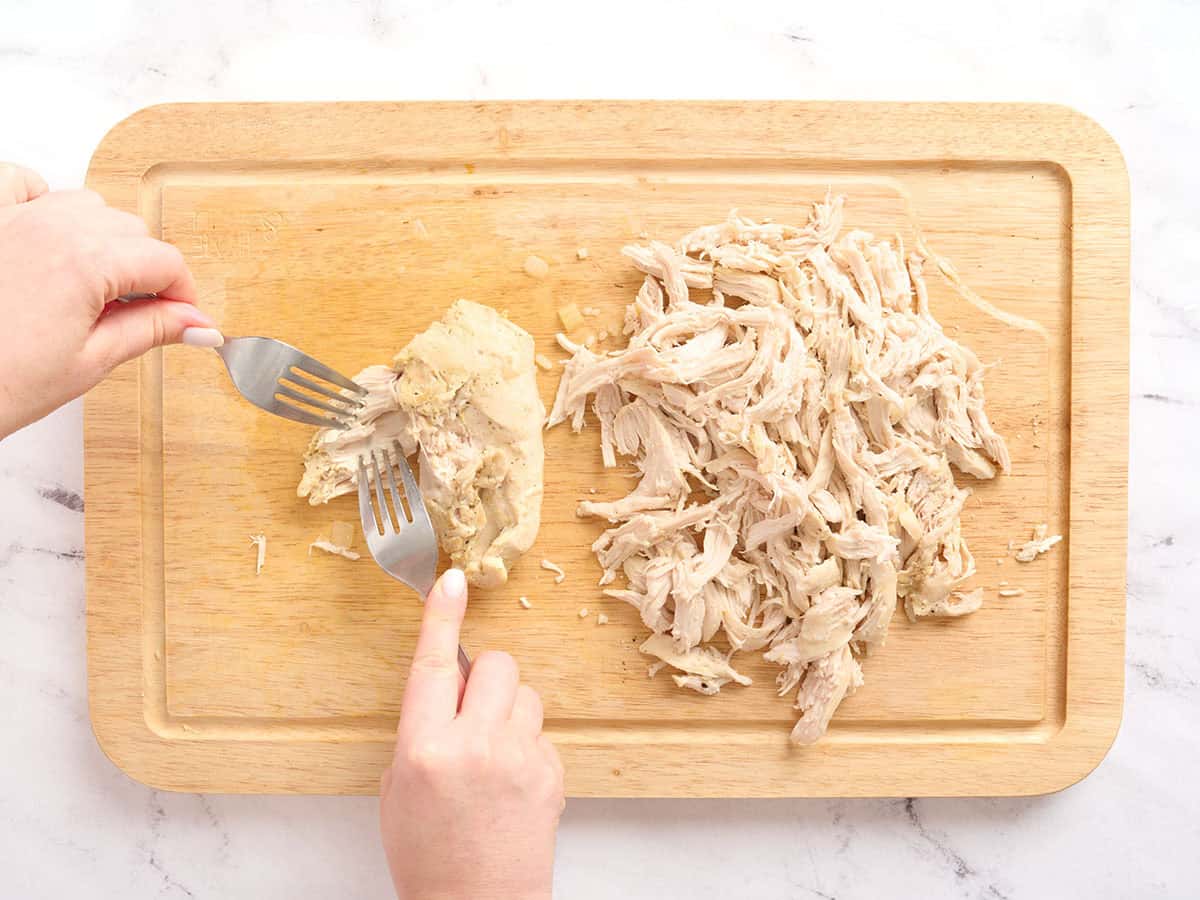
Shred the chicken: Transfer the chicken to a cutting board. Use two forks to shred it into bite-sized pieces, then set it aside. Keep the soup over low heat, and don’t let it return to a boil.

Juice the lemon: Juice 1 lemon into a measuring jug (you’ll need ¼ cup fresh lemon juice for this recipe). A room temperature lemon tends to yield more juice than a cold one!

Whisk the eggs and lemon: Add 2 large eggs and ¼ cup fresh lemon juice to a medium bowl. Whisk thoroughly until the mixture is smooth and well combined.
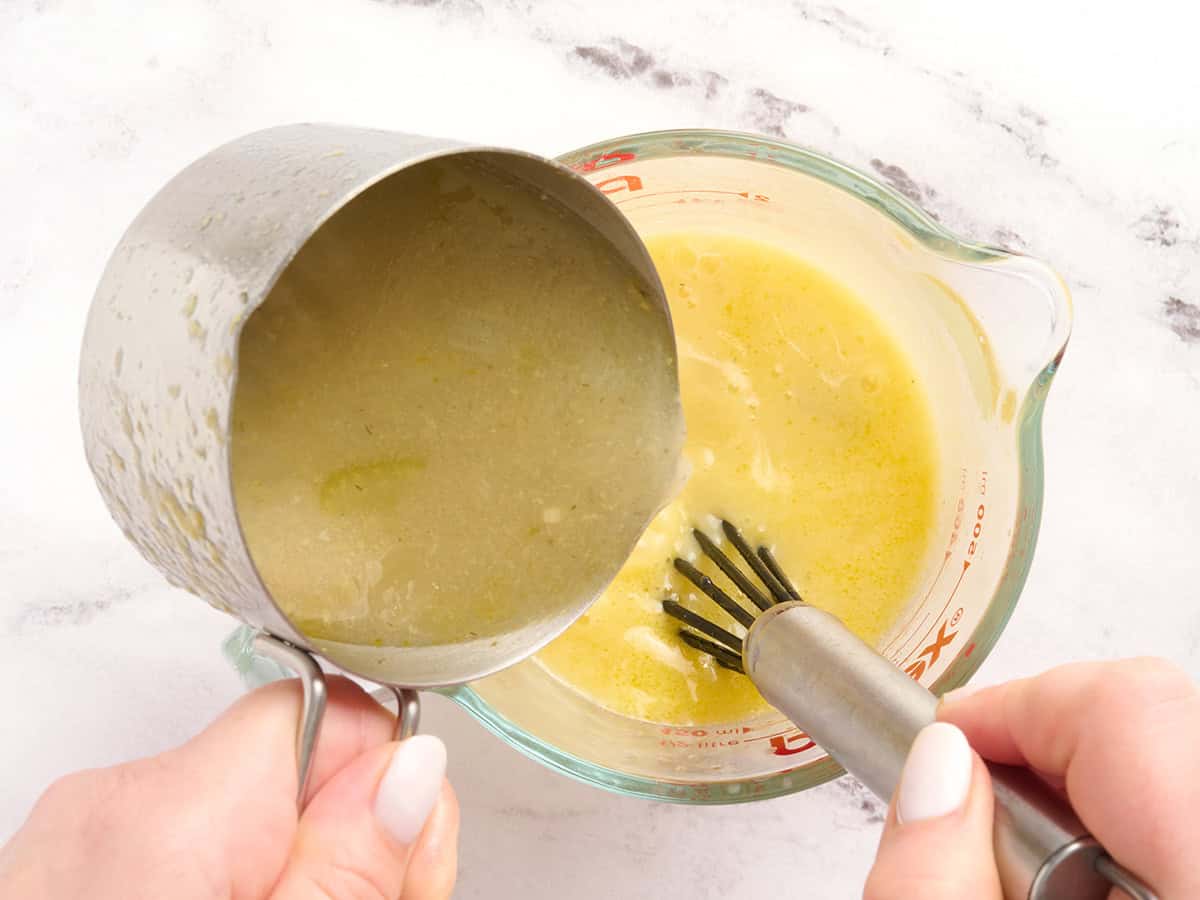
Temper the eggs: Whisk constantly as you slowly pour 1 cup of hot broth into the egg-lemon mixture. Once fully combined, gradually whisk in a second cup. The mixture should become warm but remain completely smooth. Adding the broth slowly prevents the eggs from cooking into small pieces.
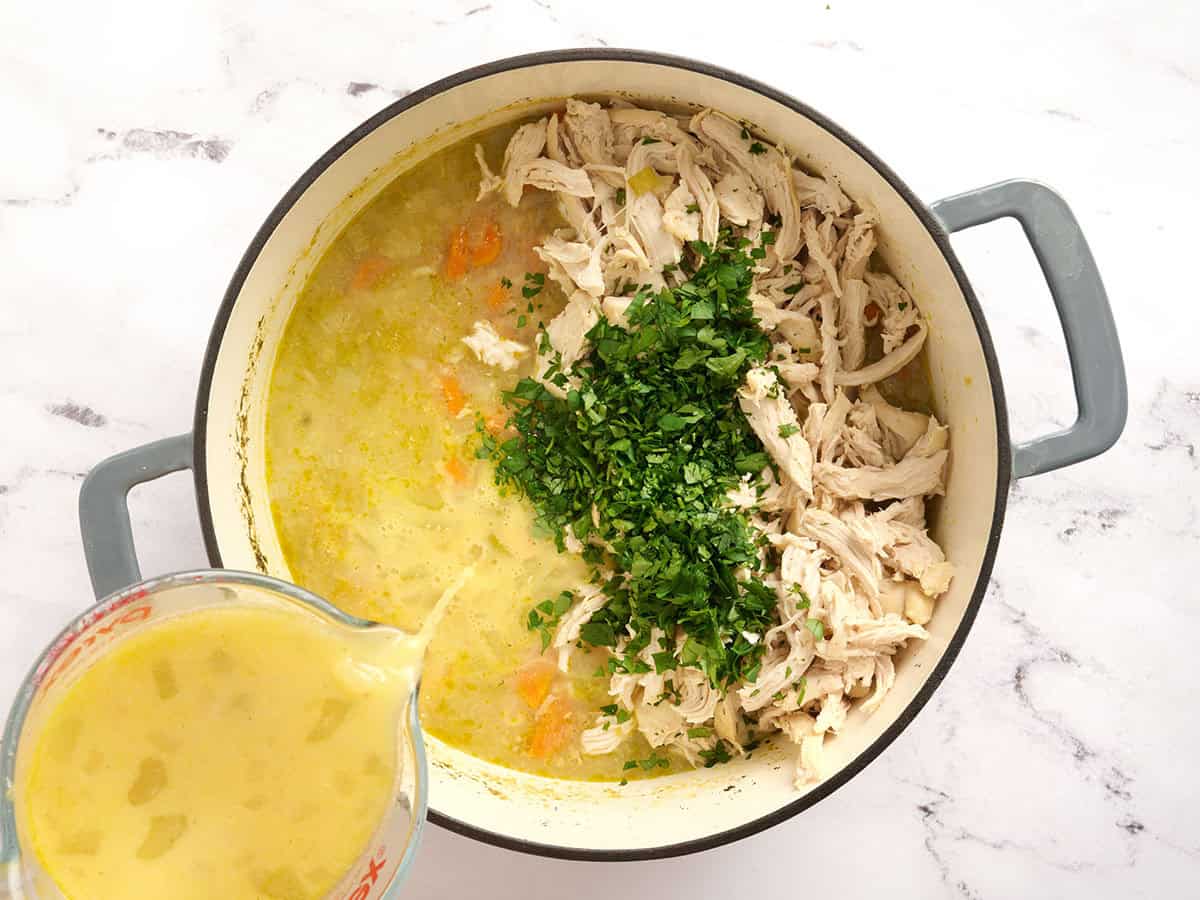
Finish the soup: Return the shredded chicken to the pot and add 2 Tbsp chopped fresh parsley. Slowly pour in the tempered egg mixture, stirring the soup continuously from the moment you begin pouring. Keep the spoon moving so the eggs blend into the broth. Cook over low heat for 2-3 minutes, stirring frequently, until the soup is warmed through and slightly creamy. Remove it from the heat before it begins to simmer or boil.
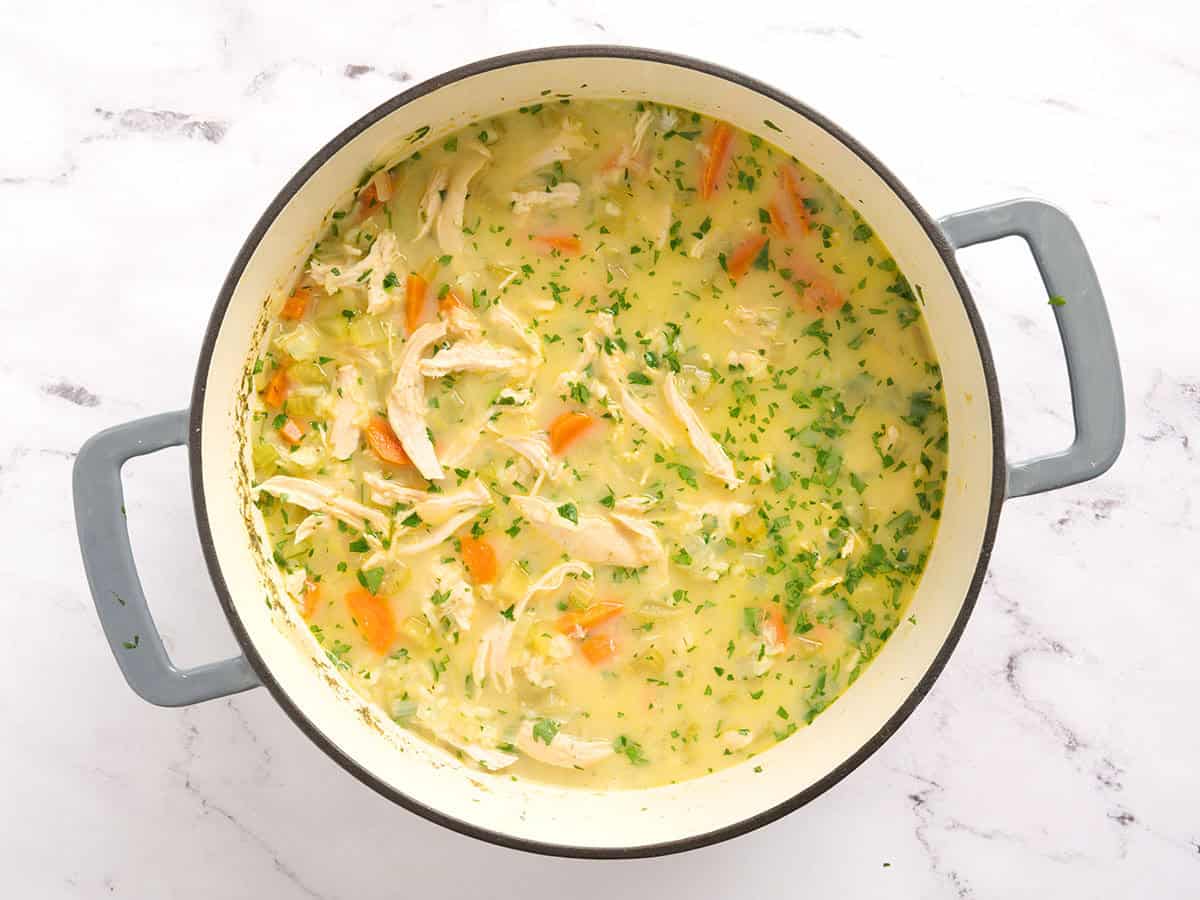
Serve: Let the soup rest for a few minutes, then taste and adjust the salt or pepper as needed. Serve warm with extra parsley and crusty bread, if desired.

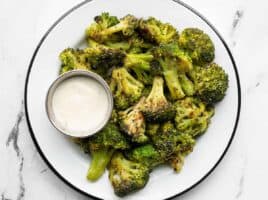
This recipe makes six servings, with 1½ cups per bowl. Between the chicken, rice, vegetables, and silky egg-lemon broth, it’s filling enough to serve as the main meal. But I’m a dunk-bread-in-my-soup person, so I’ll usually serve it with a warm pita bread or another type of flat bread! For a fresh side, I think an easy Greek salad would add a nice cool, crisp bite alongside the hot soup. If you want a cozier soup-and-sandwich dinner, you really can’t go wrong with a comforting air fryer grilled cheese! Or, for another veggie on the table, pop some broccoli in the oven; it takes about 30 minutes from start to finish, so it’ll be ready around the same time.
Store leftover soup in an airtight container in the refrigerator for up to 3-4 days. The rice will absorb the broth as it sits, so you may want to stir in a splash of chicken broth or water when reheating to loosen it up.
Reheat your Greek chicken soup gently on the stovetop over low heat or in the microwave at 50% power, stirring occasionally. Avoid bringing the soup to a boil, as high heat can cause the eggs and broth to separate.
I think this soup is best enjoyed fresh or refrigerated. Because of the egg and lemon mixture, freezing can change the texture of the broth, making it grainy or separated once thawed. If you’d like to freeze it, I’d freeze the soup before adding the tempered egg mixture, then prepare the egg and lemon mixture fresh when reheating. Freeze for up to 3 months and thaw in the fridge before reheating.
The post Greek Chicken Soup appeared first on Budget Bytes.
Featured image: Dr. Sian Proctor celebrating Space Camp graduation with the Proctor Foundation for Art and Science Space Camp Scholars (photo credit: Space Camp)
Some people see the world from the ground. Others see it from orbit, or through a camera lens, and share stories that change how the rest of us look at the world. In this candid Q&A, we’re bringing together two such women — astronaut and geoscientist Dr. Sian Proctor and travel photographer and storyteller Lola Akinmade Åkerström, who have spent their lives doing just that. They’ll share what they’ve learned about the power of storytelling, the value of diverse perspectives, and why, now more than ever, women should never give up on their dreams.
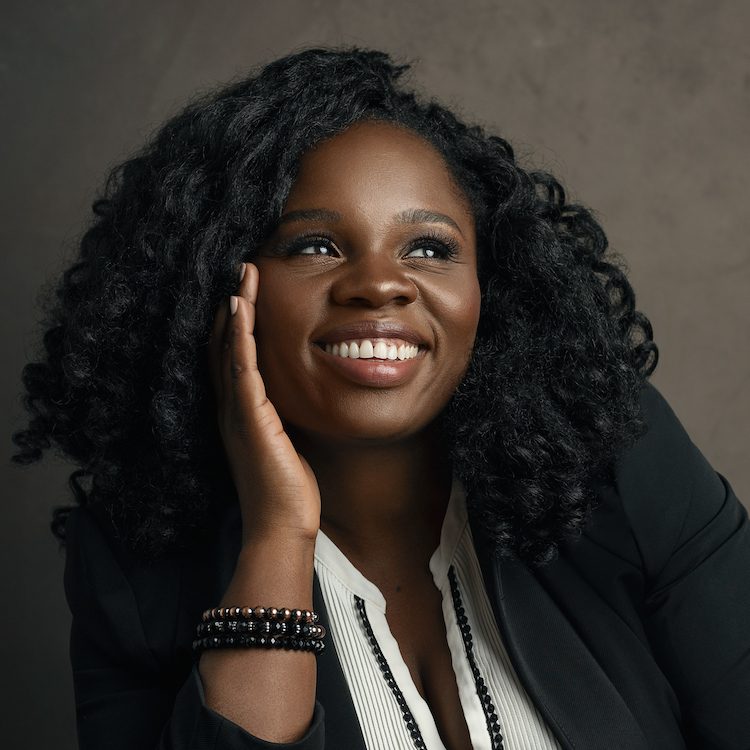
Dr. Sian Proctor’s life is full of firsts. She is the first artist and poet selected to be an astronaut. She’s also the first African-American woman to pilot a spacecraft on SpaceX’s Inspiration4 mission. Her accomplishments also include being a geoscientist and space artist. So, when it comes to the importance of travel, Proctor offers a perspective only a select group of humans can offer, one gained from viewing Earth from orbit.
“For as long as I’ve known Sian, she’s been creative,” says Lisa Young, Executive Director, The Proctor Foundation, which encourages community college students—with a special focus on Black, Indigenous, and People of Color—to pursue careers in human spaceflight and STEM through experiential learning that blends science with the arts and humanities. “Sian use her space to inspire, to bring joy and connection to people, through Space Camp Scholarships and STEM and Arts Integration. She champions a term called “J.E.D.I.” space (just, equitable, diverse, and inclusive), using art, poetry, and humanities to make science and space exploration accessible to everyone.”
Interviewing Dr. Proctor will be international author, photographer and visual storyteller Lola Akinmade Åkerström, who is the embodiment of the modern-day fearless, fantastic, inspirational globetrotter. She’s photographed and dispatched from more than 80 countries for a long list of publications, was one of eight Hasselblad Heroines in 2022, and in 2018 was the Travel Photographer of the Year Bill Muster Award recipient for SATW. She was recognized as one of the Most Influential People of African Descent (MIPAD) in Media & Culture, and she runs her own online academy, Geotraveler Media Academy, dedicated to storytelling.
Space to Inspire: Space Poet Dr. Sian Proctor shares her Wings to Soar poem at the Forbes Women’s Summit in 2026 / Credit Forbes
“Talking about dreams, how we achieve them, and how we expand them with a trailblazer in Dr. Sian is an absolute delight!” — Lola Akinmade
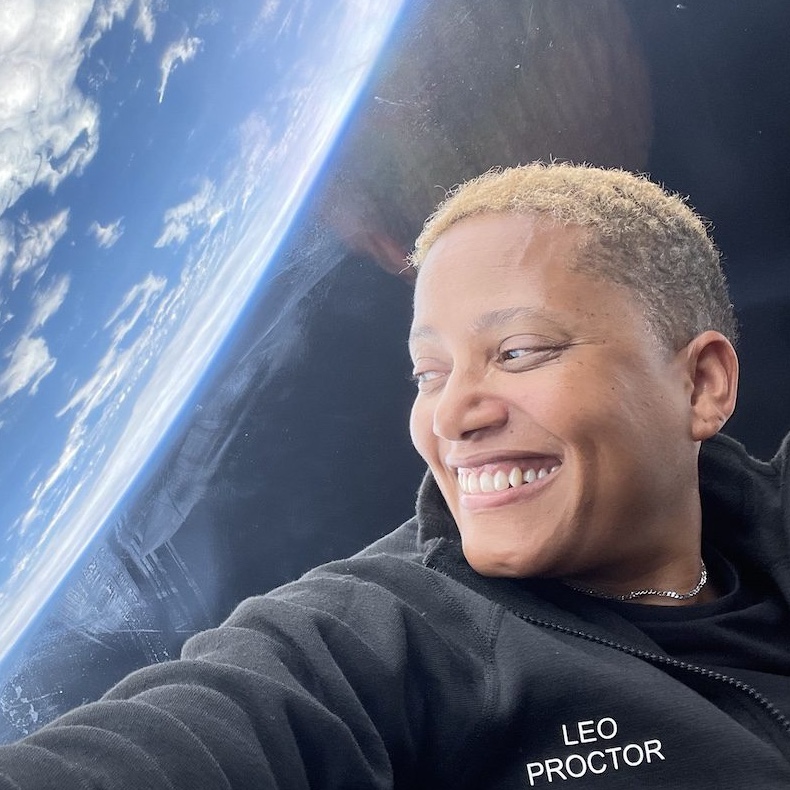
Sian looking at the Earth from space/ Credit Dr. Sian Proctor
Dr. Sian Leo Proctor is a visionary poet, artist, educator, and space explorer. In 2021, Dr. Proctor made history as the first artist selected to become an astronaut with the SpaceX Inspiration4 mission. She is also the first woman commercial spaceship pilot and the only African-American woman to be a mission pilot. She engages in strategic conversations that unlock clarity, alignment, and forward momentum—enabling individuals and organizations to let their EarthLight shine. From personal growth to nonprofit leadership and corporate innovation, She guides transformational thinking through creative insight, systems awareness, and intentional strategic momentum. She is an immersive artist creating engaging planetarium shows such as the renowned EarthLight World experience playing at the Boston Museum of Science. She is also an international speaker and was the 2024-25 U.S. Department of State Science Envoy for Space. Her SpaceX Inspiration4 spacesuit is currently on display at the Smithsonian Air and Space Museum in Washington, D.C.
Dr. Proctor is
Lola Akinmade Åkerström is an award-winning visual storyteller, international bestselling author, and travel photographer. She has dispatched from 70+ countries and her work has been featured in National Geographic, New York Times, The Sunday Times, The Guardian, BBC, CNN, Travel Channel, Travel + Leisure, Lonely Planet, Forbes, and many more. She has collaborated with commercial brands such as Dove, Getty Images, Mercedes Benz, Intrepid Travel, Electrolux, ASUS, and National Geographic Channel, to name a few – www.akinmade.com As a storyteller, Lola is on Condé Nast Traveler’s Women Who Travel Power List. She was named one of the Most Influential Women in Travel by Travel Pulse, a Hasselblad Heroine (partnership with prestigious Hasselblad camera brand) and Bill Muster Travel Photographer of the Year bestowed by the Society of American Travel Writers. She was also honoured with a MIPAD 100 (Most Influential People of African Descent) Award within travel, media, and culture and a Newsweek Future of Travel Storytelling Award, to name a few recognitions. She has also been featured in several solo and group exhibitions around the world, including most recently Hasselblad Foundation’s Fotosalongen, Liljevalchs Vårsalongen, and Photoville New York.
Her book, Due North, received the Lowell Thomas Gold Award for Best Travel Book, and she is also the author of international bestselling “LAGOM: The Swedish Secret of Living Well” available in over 15 foreign language editions. Her internationally-acclaimed novel, “In Every Mirror She’s Black”, was a Good Morning America (GMA) Buzz Pick, Apple Editors’ Pick, Amazon Editors’ Pick, and Independent UK “Best Thought-provoking Story”. Her novel, EVERYTHING IS NOT ENOUGH, is an NAACP Image Award Nominee for Outstanding Literature, Jennette McCurdy Book Club Pick, a Washington Post, Sunday Times, and Amazon Editors’ Pick, amongst others. Her novel BITTER HONEY was one of only 10 Amazon Audible UK Best of 2025, Glamour Magazine SA Pick, Amazon Editors’ Pick, People Magazine, Essence, and Stylist Best Book Pick. As an entrepreneur, she runs the Stockholm-based creative storytelling agency Geotraveler Media and the online academy, Geotraveler Media Academy, which runs travel experiences around the world and is dedicated to visual storytelling and helping the next generation of travel storytellers put the heart back into the craft. Learn more here.
“The Ageless Adventuress: Making Our Own Rules”, on November 14–15, 2026, is JourneyWoman’s first-ever virtual travel conference, created just for women over 50, supported by our partners Intrepid Travel, TourRadar and Airalo. We’ve curated travel industry leaders, trailblazing women, and fellow JourneyWomen This is the space we’ve always wished existed: two days dedicated entirely to why we travel, how we travel, and the incredible women doing it at every age — 50, 60, 70, 80, even 90. You’ll hear real stories, practical wisdom, and the kind of encouragement that makes you want to book the trip and go. Let’s face it: we’ve never waited for anyone’s permission and we’re not going to start now. Together with an extraordinary lineup of women from around the world, we’re redefining what it means to travel at every age.

The post Making Your Dreams Real: Lola Akinmade and Dr. Sian Proctor Share Inspiring Lessons From Space at JourneyWoman Virtual Summit in November 2026 appeared first on JourneyWoman.
Last updated on October 7th, 2026
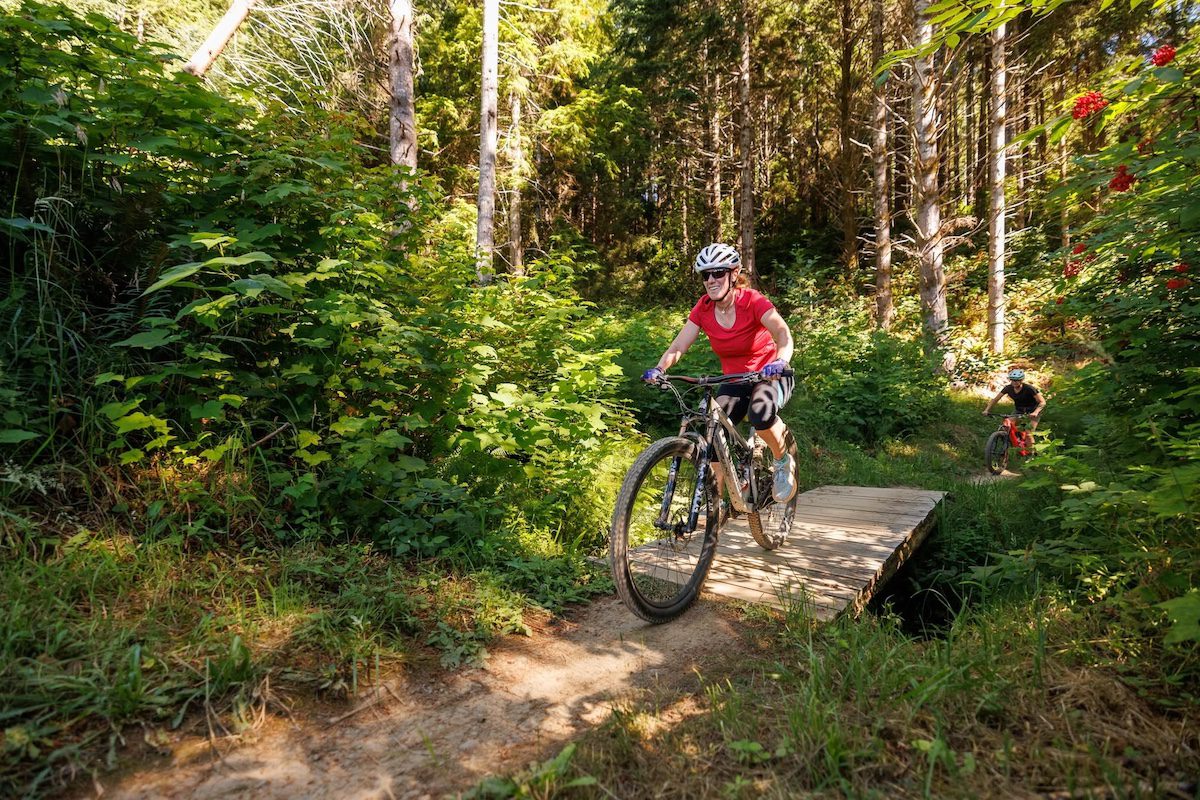
Featured image: Ariel Frager, pictured mountain biking, wants to see more women as outdoor adventure guides | Photo provided by Ariel Frager
by Ariel Frager
Staring up 600 feet of granite, I think to myself: “I don’t really like rock climbing.” I know I have a choice. I can either give rock climbing another try after a 30-year hiatus, or chill in the shade watching other people rise above the ground, as my supportive woman guide Anna Marie Alewine from the Pisgah Climbing School calmly explained. Her careful instructions and complete understanding helped me get back in the harness. As my body pressed against the smooth granite, I rose higher and higher until the expansive view spiralled out above the tree line. As I stood on the ledge at the top of my rope line, I might have hooted with joy a little bit on the way back down.
Trying out a new sport or outdoor adventure activity can be intimidating. Time and again, whether I am looking to deepen my skill level in a beloved sport or facing a totally new activity, women outdoor guides have cheered me on by creating an empowering and fun atmosphere that builds confidence and camaraderie. More women are embracing outdoor adventure sports to build positive, life-affirming benefits, strong social connections, physical and mental resilience, and overall feelings of well-being. Studies have shown that positive outdoor experiences lead to a dramatic increase in women’ s self-esteem and belief in their ability to lead.
However, traditional expectations around women and competence in outdoor activities, as well as traditional gender roles and societal pressure, often keep women from nature-based sports. We all need our comfort zone to rest and rejuvenate, but there is no growth in the comfort zone. Pushing ourselves can feel overwhelming if the support isn’t there.
For the first time in 2024, over half of American women participated in Outdoor Recreation, according to a report by the Outdoor Industry Association. As more women seek the life-affirming benefits of increased self-confidence, self-discovery, mental and physical well-being, the empowering knowledge that women are excellent outdoor leaders helps break long-held stereotypes about who gets to play outside.
Meredith Brandt is the CEO of Ladies AllRide, a mountain bike training program created for women by women. A certified mountain bike coach, Meredith was my coach during a weekend training camp in Bend, Oregon. She sees mountain biking as a perfect vehicle for personal empowerment.
“Outdoor sports are incredibly powerful because they teach women to trust themselves,” Brandt says. “Once you’ve navigated fear, uncertainty, challenge, and maybe a few sketchy switchbacks in the woods, other things in life suddenly feel more manageable too.”
My mountain bike skills were nearly as old as the bike I bought when I was in college. Ladies AllRide helped me jump back into a sport that I used to love. The combination of getting older, laziness and less-than-easy access to trails kept me away from the utter thrill of sailing over dirt paths at high speeds.
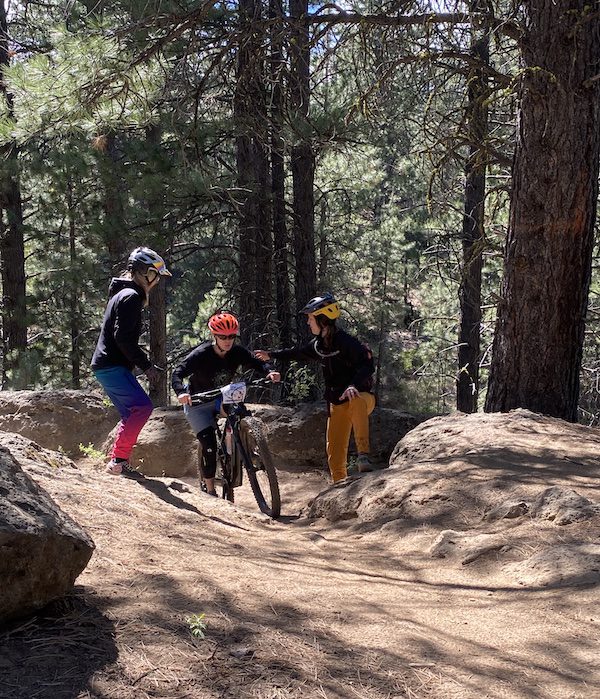
Mountain biking with Ladies AllRide / Photo by Ariel Frager
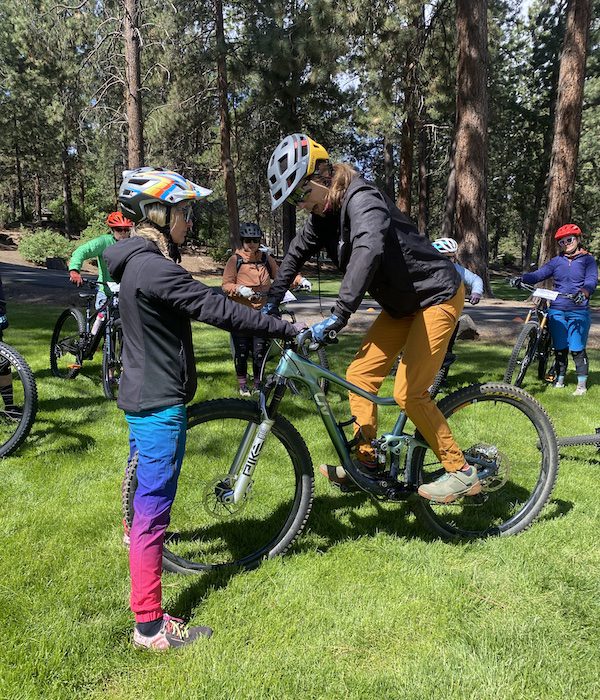
Learning to mountain bike / Photo by Ariel Frager
Sarah Elise Field, the owner and lead guide for Crystal Clear Vieques, a snorkeling tour company based in Vieques, Puerto Rico, actively cultivates a safe environment to not cause traumatic harm to their participants.
“We do not push people through their fear,” she says. “We help people calm their minds and eliminate the fear factor by taking the learning process a step at a time and teaching blue-mind techniques (the idea that being close to water can ease your mind into a meditative state) while doing so.”
The cheering I heard from my surf instructors during my Las Olas Surfing for Women camp, after catching a particularly awesome wave, boosted my spirits and kept me in the water even after missing dozens and dozens of other waves. My surf instructors made the entire experience fun, even though surfing is incredibly challenging to learn. Women are natural cheerleaders, and the sympathetic joy they felt for me was contagious. Empowerment comes from mastering both the emotional roller coaster of doing something new, and technical skills needed to get better.
Brandt explains: “For me, emotional support is part of technical instruction because mountain biking is never just about mountain biking. People show up thinking they’re learning cornering or wheel lifts, but often they’re actually learning how to trust themselves again.”
Giving the participants more control and no pressure helps build an environment where women can feel safe to take risks. Sometimes, it’s the setup of the experience that can help people feel comfortable, especially in the ocean. Vieques’ Field says: “We make it very clear to people that they can choose not to do the tour or choose to return early at any point during the tour. This is a huge reason why we only offer private tours. Private tours also allow people to express their fears and excitement more when they aren’t around a group of guests that are total strangers.”

Ariel surfing in Maui / Photo provided by Ariel Frager
Running in tandem with the rush of hard-core adventure sports, I am increasingly drawn to the solace and awe found in nature. Sometimes my sports, like cross-country skiing, or sitting on my surfboard waiting for a wave, or a mountain hike, will lead me to a moment of unparalleled beauty. No matter what set of technical skills or physical prowess I needed to get myself there, I appreciate the majesty all around me. I feel the vastness and divinity of being in nature and those slivers of time can be transcendent.
Beyond the empowerment and skill-building that come with learning something new, women know how to make things fun. Whether it’s being silly in the water, peals of laughter when trying something challenging, or a well-timed snack, women make for good outdoor companions and great teachers.
Brandt understands that learning new outdoor skills is more than just one thing.
“At Ladies AllRide, we’re not just teaching mountain biking,” she says. “We’re helping women build confidence, trust their instincts, and realize they’re capable of hard things. Also sometimes we’re just grown women screaming ‘Woohoo!’ At the end of the day, we’re adult women playing on bikes in the woods, and once people reconnect with that playful energy, their inner kid comes out and suddenly they don’t want to stop riding.”
Disclaimer: Our writers are often invited to experience activities described in this article firsthand. Ariel Frager paid for some of these experiences herself, and for others, she was hosted by either the tourism board or the travel companies. She was not compensated for her time spent researching, planning, and writing this feature, nor was JourneyWoman compensated for publishing it. In addition, the host organizations did not review this article before it was published, a practice that allows the writer to express her perspective with integrity and candor.

The post Who Gets to Play Outside? Why We Need More Women as Outdoor Adventure Guides appeared first on JourneyWoman.
Have you or an older parent been told that your A1C is too high — or that it’s time to add another diabetes medication?
If so, you may assume that the goal should be to get blood sugar as low as possible.
But when it comes to treating Type 2 diabetes in older adults, especially people in their 70s, 80s, and beyond, lower is not always better.
That’s because diabetes treatment has both benefits and risks. And some of the most important risks — especially hypoglycemia, or dangerously low blood sugar — become more concerning as people get older.
So in older adults, diabetes treatment often needs to be individualized. The right blood sugar target and medication plan can depend on whether someone is relatively healthy and active, or is living with frailty, memory problems, heart or kidney disease, or other health issues.
To explain how geriatricians approach this, I spoke with my UCSF geriatrics colleague Sei Lee, MD MAS, a Professor of Geriatrics who has studied diabetes in older adults for many years.
In this article, I’ll explain how diabetes treatment often needs to change with age, why a lower A1C isn’t always better, and which diabetes medications may be safer for older adults.
You may have heard healthcare professionals talk about getting diabetes under “tight control.”
This generally means maintaining relatively low blood glucose levels and a low hemoglobin A1C.
For many years, aiming for an A1C below 7% was commonly recommended.
But when treating older adults, we have to think about two important issues.
One reason to control blood sugar is to reduce the long-term complications of diabetes.
These can include:
The important thing to understand is that the benefits of very tight blood sugar control generally take many years to develop.
As Dr. Lee explained in our conversation, available research suggests that it may take at least eight years, and possibly much longer, for tighter control to provide certain long-term benefits.
That matters when treating an older adult who is already frail or has significant health problems.
If a treatment is unlikely to provide meaningful benefit for many years but can cause problems today, then the balance of benefits and risks changes.
The most important short-term danger of aggressive diabetes treatment is hypoglycemia, meaning blood sugar that becomes too low.
Certain diabetes medications can lower blood sugar too much, especially insulin and a class of medications called sulfonylureas.
For example, an insulin dose may work well when an older person is eating normally. But if they become ill and eat much less than usual, that same dose can push the blood sugar dangerously low.
Hypoglycemia can cause:
And older adults appear to be particularly vulnerable to serious episodes of hypoglycemia.
So in geriatrics, avoiding dangerously low blood sugar can be just as important as lowering high blood sugar.
There is no single ideal A1C for everyone over age 65.
Instead, the goal should reflect the older person’s overall health and the risks involved in getting to a lower number.
Current 2026 American Diabetes Association guidance generally recommends:
These are starting points, not rules.
A lower A1C may be perfectly reasonable if it can be achieved safely and easily.
For instance, an older person who has an A1C of 6.8% while taking only metformin and experiencing no problems is very different from someone who needs several medications and frequent insulin injections to maintain the same A1C.
So when considering an A1C goal, I recommend asking:
There is no single “best” diabetes medication for every older adult.
The best choice depends on the person’s overall health, kidney and heart function, risk of low blood sugar, weight, frailty, cost concerns, and other factors.
Still, some types of diabetes medication are generally more concerning than others when it comes to hypoglycemia.
For many people with Type 2 diabetes, metformin remains a good first medication.
Metformin helps the body respond better to insulin.
Its main advantages include:
For these reasons, Dr. Lee and I both often favor metformin as a starting medication when it is appropriate for the individual.
Of course, metformin isn’t suitable for everyone. Kidney function and gastrointestinal side effects need to be considered.
But in an older person who tolerates it well, metformin often offers a favorable balance of benefits and risks.
SGLT2 inhibitors are a newer group of diabetes medications.
Examples include:
These medications work through the kidneys. They reduce the amount of glucose that the kidneys reabsorb, causing more glucose to leave the body through the urine.
One important advantage is that SGLT2 inhibitors have a very low risk of causing hypoglycemia when used by themselves.
They can also provide important benefits for certain people with heart failure or kidney disease.
But there are some special concerns in older adults.
Because these medications cause more glucose to be excreted in the urine, they may increase the risk of genital or urinary infections.
They can also increase urination.
For a relatively healthy older person with diabetes and certain heart or kidney problems, an SGLT2 inhibitor may be particularly useful.
But I would be more cautious in someone who is frail and already has significant urinary incontinence or other problems that could be worsened by increased urination.
Few diabetes drugs have received as much attention recently as the GLP-1 receptor agonists.
These include:
There is also tirzepatide (Mounjaro or Zepbound), which works on both GLP-1 and GIP pathways.
These medications can:
These benefits can make them attractive for an older adult with Type 2 diabetes who is overweight and otherwise relatively healthy.
But there is an important issue to consider in later life.
Weight loss is not always beneficial for older people.
This is especially true for people who are already frail, thin, or losing weight unintentionally.
And when people lose weight while taking GLP-1 medications, they don’t necessarily lose only body fat.
They can also lose muscle mass.
Muscle is extremely important for maintaining health and independence in later life.
Loss of muscle can contribute to:
There is also concern that some bone mass may be lost along with weight.
So I would be particularly cautious about using medications that cause substantial weight loss in a frail older adult.
The situation can be quite different for someone in their late 60s or 70s who is significantly overweight, relatively strong and active, and has heart or metabolic risks that could improve with weight loss.
For people in between these two extremes, the decision often requires careful clinical judgment.
If an older person does use a GLP-1 medication, maintaining appropriate nutrition and physical activity — especially exercises intended to preserve strength and muscle — becomes particularly important.
Other downsides of GLP-1 medications can include:
So these medications can be very useful, but they aren’t necessarily the right choice for every older adult.
Sulfonylureas are an older class of oral diabetes medications.
One commonly used example is glipizide.
Sulfonylureas work by stimulating the pancreas to release more insulin.
Advantages include:
But there is an important disadvantage for older adults:
Sulfonylureas can cause hypoglycemia.
They may also contribute to weight gain.
These medications were used much more commonly in the past. Today, newer diabetes medications are increasingly preferred in many situations because some provide heart or kidney benefits without the same degree of hypoglycemia risk.
If an older person is taking a sulfonylurea and is having falls, dizziness, confusion, or documented low blood sugar, I would certainly recommend reviewing the medication with their health provider.
Pioglitazone is another older oral diabetes medication.
It belongs to a class called thiazolidinediones and works primarily by improving the body’s sensitivity to insulin.
Its advantages include:
However, pioglitazone can cause fluid retention and can be problematic for people with certain heart conditions.
For this reason, it has a more limited role in diabetes treatment today.
Examples of DPP-4 inhibitors include:
These medications generally provide relatively modest glucose lowering.
They were used more frequently before SGLT2 inhibitors and GLP-1 medications became widely available.
Today, they may still be reasonable for certain people, particularly if someone is already taking one successfully.
But when starting a new medication, other classes may be preferred because they can provide additional benefits for the heart or kidneys.
Insulin remains the most powerful medication available for lowering blood sugar.
It can also be used in situations where certain other diabetes medications cannot, including in people with serious kidney disease, although the insulin dose may need to be adjusted.
But insulin has an important downside:
It has the highest risk of hypoglycemia.
Insulin can also:
For these reasons, we generally don’t turn to insulin first when treating Type 2 diabetes.
There are several types of insulin, including:
When an older adult with Type 2 diabetes does need insulin, we often prefer to start with a simpler regimen involving long-acting insulin.
One advantage of long-acting insulin is that it tends to provide more gradual glucose lowering and does not usually require the same degree of meal-by-meal adjustment.
By contrast, short-acting insulin may have to be taken several times per day around meals and often requires much more frequent glucose monitoring.
That extra complexity matters in older adults.
Some people who use short-acting insulin adjust the dose according to how many carbohydrates they’re planning to eat.
This can work well for some people.
But it requires a fairly complicated set of mental tasks.
Someone has to reliably remember:
This can become risky when an older person develops memory loss or cognitive impairment.
Carbohydrate counting and complicated insulin regimens are generally most appropriate for older adults whom we are confident can reliably manage the process.
If cognition is declining, simplifying diabetes treatment often becomes an important safety goal.
A small improvement in A1C may not be worth a large increase in complexity or the risk of an insulin dosing error.
One of the most important considerations when choosing diabetes medications for an older adult is the risk of dangerously low blood sugar.
Among the medications discussed above:
Very low or low hypoglycemia risk when used on their own:
Higher hypoglycemia risk:
Highest hypoglycemia risk:
This doesn’t mean that insulin or sulfonylureas should never be used.
It means that we should pay special attention to their risks in older adults, particularly in someone who:
A continuous glucose monitor, usually called a CGM, uses a small sensor placed under the skin to continuously track glucose levels.
Depending on the device, the sensor may remain in place for around 10–14 days, and glucose readings can often be viewed on a smartphone or other device.
CGMs were initially developed for people with Type 1 diabetes.
They can also be useful for some people with Type 2 diabetes, especially those who need multiple doses of insulin.
One advantage is that a CGM provides much more information than an occasional finger-stick glucose reading.
It can help show:
CGMs can also potentially help answer a question that comes up frequently in geriatrics.
Suppose an older person has episodes of weakness or dizziness.
Is the problem:
Continuous glucose information can sometimes help clarify whether hypoglycemia is involved.
CGMs may also be useful for a limited period when someone is starting or changing diabetes treatment.
At the same time, not everyone wants or benefits from having constant glucose information.
Some people find it very useful and motivating.
Others find it intrusive or anxiety-provoking.
So the best glucose monitoring approach depends on the individual.
It’s easy for diabetes treatment to become very focused on numbers.
But a good A1C isn’t the only thing that matters.
In geriatrics, we also want to know whether the treatment is helping the older person stay safe, functional, and able to do the things that matter to them.
Useful questions include:
This last question is especially important.
A diabetes treatment plan that made perfect sense when someone was 60 may not still be ideal when they’re 80.
As people age and their health changes, their diabetes medications and treatment goals should be periodically reconsidered.
If you or an older relative is being treated for Type 2 diabetes, consider asking:
And if an older person is developing frailty, falls, memory problems, or difficulty managing a complicated insulin regimen, another very important question is:
Could we be treating the diabetes more aggressively than necessary?
When it comes to diabetes treatment in later life, the goal should not simply be to achieve the lowest possible blood sugar or A1C.
Instead, good diabetes care involves balancing the long-term benefits of lowering blood glucose against the immediate risks, side effects, and burden of treatment.
For many older adults:
Most importantly, diabetes treatment should evolve as the person ages.
The medication plan and blood sugar goals that were appropriate ten or twenty years ago may no longer provide the best balance of benefits, risks, and quality of life today.
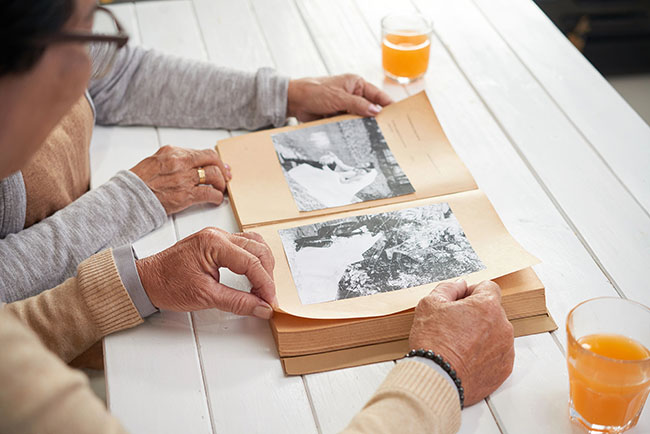

Photo: DepositPhotos
Every family has its shorthand. “We came over after the war.” “Grandpa worked at the mill for forty years.” “Your aunt was the one who kept everyone together.” These short versions get repeated at holidays and handed down almost word for word, until they start to feel like the whole story. But behind each one are choices, fears, and everyday details that rarely come out unless someone thinks to ask.
Preserving family stories does more than satisfy curiosity. These stories help relatives understand one another, recognize the experiences that shaped them, and feel part of something that reaches across generations. In research by Emory University psychologists Marshall Duke and Robyn Fivush, children whose families shared more coherent, emotionally open stories about challenging experiences showed better self-esteem, stronger social relationships, and less anxiety and stress. The findings show an association rather than proof that sharing family stories causes better mental health. As Fivush explains, “It provides a sense of continuity, of enduring relationships and values.”
The benefits flow in both directions. For older adults, looking back on a life and sharing it with someone who is listening can be meaningful in its own right. A 2024 analysis of 42 studies involving adults age 60 and older with depression found that structured life-review and reminiscence interventions reduced depressive symptoms, at least in the short term. A conversation at the kitchen table is not therapy. Sharing memories can still offer an opportunity to reflect and connect.
Still, many of these stories go unrecorded. In a 2025 AARP survey of adults 50 and older, 63 percent of grandparents said they had not recorded their stories. Memories fade, families scatter, and the chance to ask does not last forever.
Behind a familiar family story may be experiences that help us understand both our relatives and our own lives more fully. In the following excerpt from the Fall 2026 issue of Healthy Aging® Magazine, Vedad Taranin discovers the difficult choices behind the security he had always taken for granted.
By Vedad Taranin
When the war in Bosnia began in 1992, I was one year old. For most of my life, I carried a shortened version of what followed: we left, boarded a plane, and began again in Germany. That was how we lived, too. We looked ahead. I rarely stopped to ask what had come before.
During a recent drive, my father began filling in what that version had left out. He spoke about the uncertainty around our departure and the difficult choices my parents had faced when they were about my age now. More than anything, the conversation made me recognize how privileged I am to have grown up safe and supported, with the freedom to take that security for granted.
That conversation led me to preserve my family’s life stories.
What might one conversation reveal about your own family? Taranin’s full article in the Fall 2026 issue goes beyond his own story with practical guidance: how to invite memories without turning a visit into an interview, what to discuss before you press record, simple ways to preserve recordings and photographs, and seven questions to get the conversation started.

For nearly a decade, Army Veteran Geoff O’Neill fought to get his VA rating increased. His sleep apnea claim was denied 7 times, his claims paperwork grew to roughly 84 pages, and despite years of trying to navigate the process, he remained stuck at 80%.
Geoff retired as a Lieutenant Colonel after a 20-year Army career. Despite having almost no sick-call documentation from his time in uniform, he received an initial 60% VA disability rating. A later sinusitis claim connected to his deployment to Afghanistan brought him to 80%.
But two issues remained unresolved: a PTSD rating that had sat at 30% for years and the sleep apnea claim he had been fighting since retirement. Geoff even paid for a private sleep study in 2021, where he received a formal sleep apnea diagnosis, but he continued to struggle to prove service connection.
Geoff was still at an 80% VA rating when he joined the VA Claims Insider Elite Program in August 2026. Just six weeks later, he reached 100%.
This is his story.
Geoff grew up in Virginia. During his freshman year of college, his father—a Navy Veteran who had served in Vietnam—became seriously ill and was unable to work. Suddenly, the way Geoff had planned to pay for school disappeared.
Then a letter from ROTC arrived.
Have you ever considered the exciting opportunity?
Suddenly, the answer was yes.
Geoff signed up, received a scholarship, and eventually put together what he calls a “piecemealed” 20-year Army career. His assignments took him to Germany with the 1st Infantry Division, to Bosnia, and eventually to Afghanistan.
In Afghanistan, Geoff served as a Forward Operating Base mayor, responsible for the support structure of a FOB housing roughly 2,500 people. His responsibilities included dealing with the burn pits on the base.
He ultimately retired as a Lieutenant Colonel on July 31, 2016.
“I still am surprised,” Geoff says of the career that started with that ROTC letter, “because I had no intention of doing it.”
After two decades in the Army, transitioning back to civilian life was harder than Geoff expected. He’d spent much of his military career surrounded by other service members. Retirement meant suddenly leaving that community behind.
The transition also exposed another challenge as Geoff entered the VA disability process: he had almost no medical documentation from his years in uniform.
“You never went to sick call. Never,” he says.
He remembers injuring his ankle during a field exercise after jumping off a concrete slab into tall grass without seeing the broken cinder blocks underneath. He heard his ankle snap, laced his boot tighter, and kept going.
Later, on the first day of a five-day combatives course, he dislocated his shoulder. An instructor told him to hit it against a wall to pop it back in. Geoff finished the course even as his shoulder continued popping out throughout the week.
Neither injury produced a medical record.
“I had no notes, nothing,” he says.
Despite that lack of documentation, Geoff received an initial 60% VA disability rating around the time of his retirement.
But his VA claims journey was far from over.
A couple of years after retirement, Geoff pursued a claim for sinusitis connected to his time in Afghanistan, where his duties as FOB mayor repeatedly brought him around the burn pits.
The claim was granted, bringing his overall VA disability rating to 80%.
But that’s where Geoff got stuck.
His PTSD had been rated at 30%, and Geoff believed that rating didn’t reflect what he was experiencing. He was also trying to establish service connection for his sleep apnea.
Geoff described waking suddenly at night unable to breathe, sitting upright like, in his words, “Dracula coming out of the coffin,” waiting for his airway to open. He had mentioned his sleep problems during his retirement physical, but no sleep study was ordered.
For years, Geoff kept trying to navigate the process—sometimes on his own, sometimes with a VSO, and sometimes with help from others.
In 2021, he paid for a private sleep study and received a formal sleep apnea diagnosis. But establishing service connection felt next to impossible.
Geoff’s sleep apnea claim was denied seven times.
Over the years, his claims paperwork (supplemental filings, denial notices, and supporting documents) grew to roughly 84 pages.
“84 pages of supplementals, rejections. Here’s this, here’s that,” he says.
For a long time, Geoff thought he could figure it out himself.
Eventually, he realized he was missing something.
“I had no guidance.”
By then, Geoff described the experience as “10 years of banging my head on the wall.”
After years of trying to navigate the VA claims process, Geoff got his next lead from a fellow Veteran at a birthday party, who handed him a Post-it note with contact information.
“Call this guy,” the Veteran told him. “This guy helped me with my VA rating.”
Geoff decided to give it a shot.
He connected with VA Claims Insider, joined the Elite Program in August 2026, and was paired with his Veteran Coach Evan.
For Geoff, the way the referral happened reflected something he had seen throughout the Veteran community.
“Vets are passing information back and forth,” Geoff says. “One guy finds a good connection and if he’s a good dude, he’ll pass it on to the next one.”
One of the first instructions his coach gave was simple: submit an Intent to File.
From there, Geoff says the process became much more focused.
“When I went through it, it was like boom, boom, boom,” Geoff says.
After retiring as a Lieutenant Colonel, Geoff had a simple way of describing his new approach:
“I’m going in E1 mode and I’m just going to follow every step my coach says.”
They focused on two issues: increasing Geoff’s 30% PTSD rating and establishing service connection for sleep apnea.
For the sleep apnea claim, Geoff pursued it as secondary to his already service-connected sinusitis, with supporting medical evidence that included nexus documentation.
His coach also helped Geoff prepare for his C&P exams and stressed the importance of being open and honest about what he was experiencing.
“I know you’re probably not going to be comfortable talking about this stuff with a stranger,” Geoff remembers his coach telling him, “but it’s imperative if you want this to work that you have to be brutally honest about what’s going on.”
“And that was hard,” Geoff says. “But he was right.”
As Geoff moved through the filing process, his Veteran Coach continued guiding him through each step. By September 16, the decision letter was available in Geoff’s VA account.
The VA increased his PTSD rating from 30% to 70% and granted service connection for sleep apnea with a 50% rating.
Geoff’s combined VA disability rating had reached 100%.
After nearly a decade of trying to get there, the contrast wasn’t lost on him.
“10 years of banging my head on the wall about it to try to get to 100,” Geoff says. “The whole process with you guys took 6 weeks. Done.”
When Geoff got the decision, he immediately called his wife.
“When I got the letter I called my wife and read it to her twice,” he says. “She’s like, ‘Read it again. What? What? 100?’ And I was like, ‘Yeah.’”
Looking back, Geoff says one of the biggest differences was finally having someone to help him navigate the process.
“I didn’t figure it out on my own because I had no guidance,” he says.
Since reaching 100%, Geoff has already passed his Veteran Coach’s contact information along to other Veterans.
His message to Veterans who are frustrated with the claims process is simple: keep going—but don’t assume you have to figure everything out by yourself.
“It’s worth it to keep going forward, but you need to have the right person with you.”
For Geoff, having that support was what had been missing during the years he tried to navigate the process on his own.
“Doing it on your own, unless you’re a ninja, it just doesn’t work,” Geoff says. “You know, you need to have some support. You gotta have some kind of crew around you that knows what they’re doing.”
And after his own decade-long journey, Geoff has one final message for fellow Veterans:
“Ultimately, you do deserve your benefits. You work for them. You should get them.”
You may be wondering what’s possible for your own VA disability claim.
You don’t have to navigate the process alone. Learn how we can help you understand your options and take your next step.

Eric has written and worked in the field of Veterans Disability since 2020 and enjoys writing educational content for the veteran population. His prior work has been published in the Official Journal of the American College of Sports Medicine (ACSM). He holds a Degree in Health and Exercise Science.
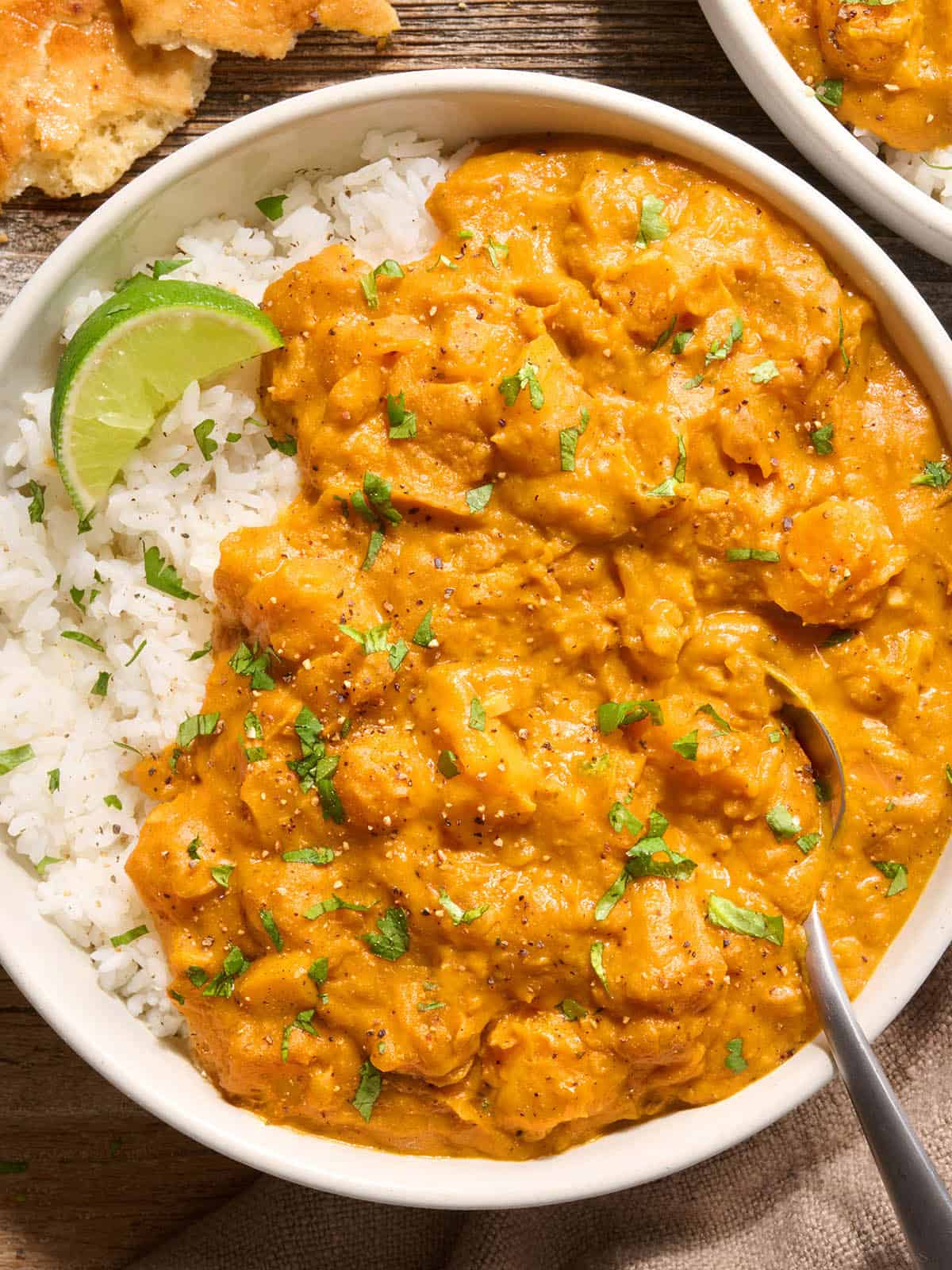
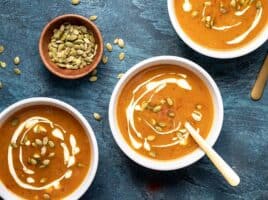
This Pumpkin Curry is thick, velvety, rich, and flavor-packed, with tender fresh pumpkin, warm spices, and creamy coconut milk. I love curry year-round, but there’s something special about those crisp autumn months that really makes me crave it, and this one does the trick! It’s a completely vegan meal that comes together in less than an hour, and at $2.74 per serving, it feels restaurant-worthy without the restaurant price. Serve it over a fluffy bed of rice (which is included in this recipe cost!), and you’ve got comfort in a bowl. I love this pumpkin curry so much, and honestly, I have a feeling I’ll be making it all season long!
If you’ve never cooked with fresh pumpkin, don’t worry, I’ve got your back! Grab a pie pumpkin and follow my step-by-step photos, taking your time and using your handy dandy chef’s knife. Breaking down the pumpkin is the most hands-on part of this recipe, but once it’s diced, the rest comes together pretty quickly. Can’t find a pie pumpkin? Don’t fret. Butternut squash can step in here (or try our butternut squash curry, which is another cozy option!)
Once the pumpkin is diced, I build serious flavor with simple ingredients like fresh garlic, ginger, tomato paste, and warm spices. I also use both fresh pumpkin and pumpkin purée in this recipe for a reason. The fresh pumpkin stays tender but still gives you a little bit of bite, and the purée helps create that rich, thick sauce I want in this curry. Sauté the pumpkin and onions until they start to soften, then add fresh garlic and ginger to build a fragrant base. Tomato paste helps deepen the flavor, and the warm spices and creamy coconut milk bring everything together. Then I finish it with a little brown sugar to balance the spices and add subtle, warm molasses notes. Give it one more taste, adjust the seasoning, and don’t be scared to add an extra splash of broth if needed. Personally, I like my curry thick and velvety. 😋
Instead of trying to peel a whole pumpkin, I cut it into wedges first. It’s much easier to handle, and it makes getting those even ½-inch cubes a lot simpler. All you need is a sturdy cutting board, a spoon, and a sharp chef’s knife to get your pie pumpkin curry-ready!


Print
Add to Collection Go to Collections
See how we calculate recipe costs here.
**Curry powder is a blend of spices rather than one single spice. Most curry powders include spices like turmeric, coriander, cumin, and fenugreek, but the exact blend varies by brand. You can use a mild, medium or hot curry powder.
***Make sure to use 100% pure pumpkin, not pumpkin pie mix. Pumpkin pie mix contains added sugar and spices.
****I like to use Better Than Bouillon to make broths to keep costs low.
Spice level: Using a medium or hot curry powder will make this curry noticeably spicier, and the exact heat can also vary slightly between garam masala blends. Use a mild curry powder if you’re sensitive to spice!
Seasoning options: I use a blend of spices including garam masala, curry powder, cumin, salt, and pepper. You can also use turmeric, coriander, chili powder, or even cayenne if you like it spicy. Or feel free to lean into the pumpkin vibes by adding cinnamon, nutmeg, or allspice.

Gather and prepare all ingredients. Cut 1 pie pumpkin in half from top to bottom, cutting alongside the stem. Scoop out the seeds and stringy pulp with a spoon, then trim away the stem and bottom ends. Set the halves cut-side down and slice into roughly ½-inch-wide wedges. Now carefully cut away the skin and dice the flesh into roughly ½-inch cubes (as shown in the pumpkin prep photo above).
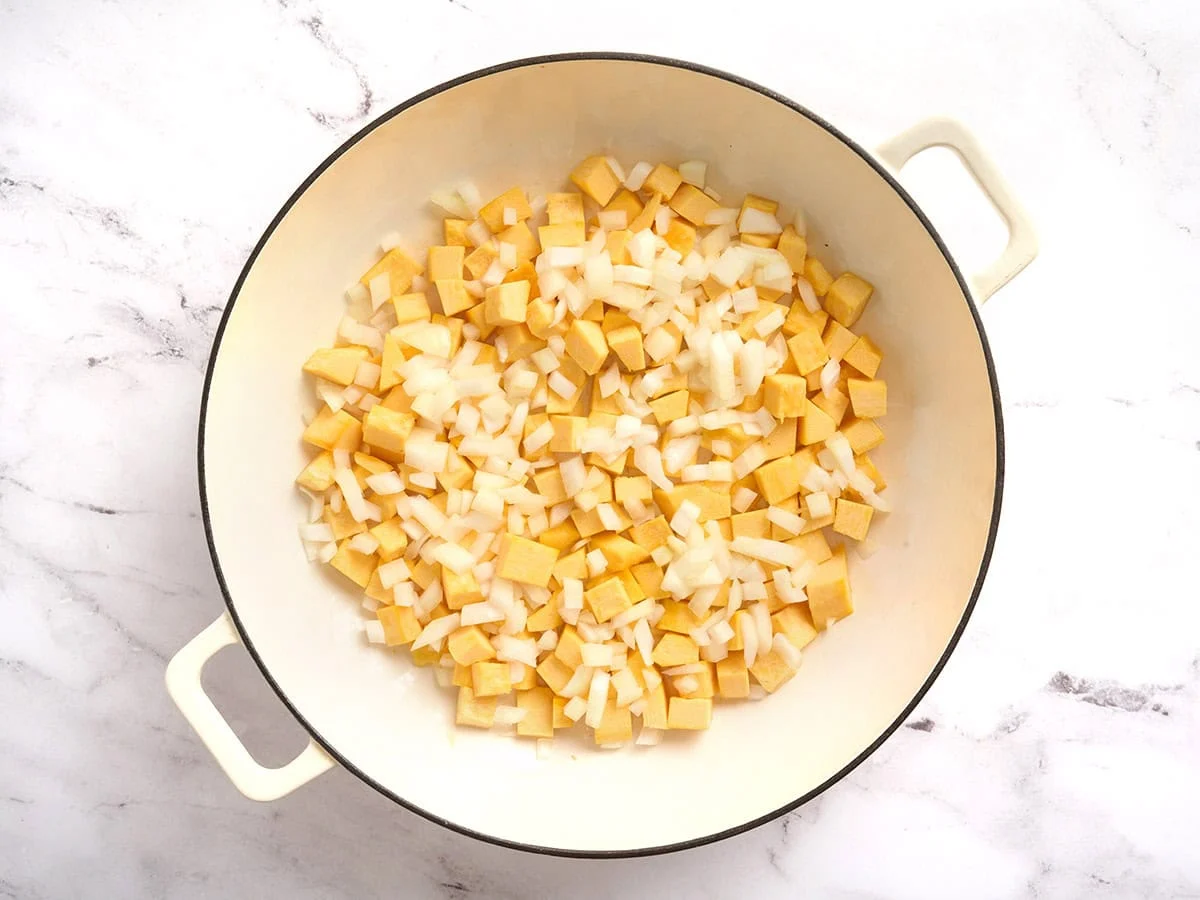
Sauté the pumpkin and onion: Heat 1 Tbsp vegetable oil in a large skillet or Dutch oven over medium heat. Once the oil is hot and shimmering, add the 4 cups diced pumpkin and 1 small diced onion (about 2 cups) in an even layer. Cook undisturbed for about 5 minutes so the pumpkin can pick up some color, then stir occasionally and continue cooking for about 10 minutes total. The onion should be softened, and the pumpkin should be starting to soften with some lightly browned edges.
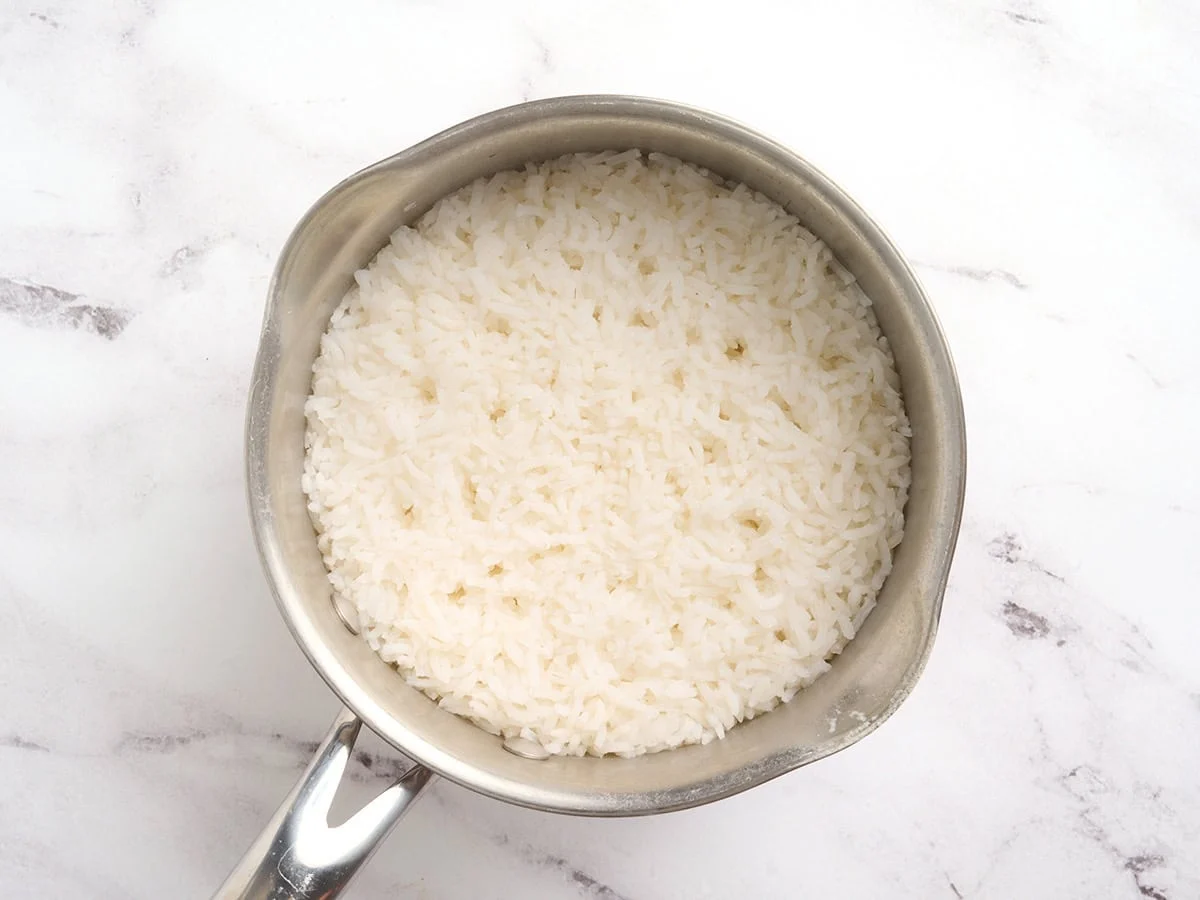
Cook the rice: While the pumpkin and onion cook, add 1 cup long-grain white rice and 2 cups water to a medium pot. Cook according to the package directions (or follow our step guide on cooking white rice!), then remove from the heat and set aside until serving.
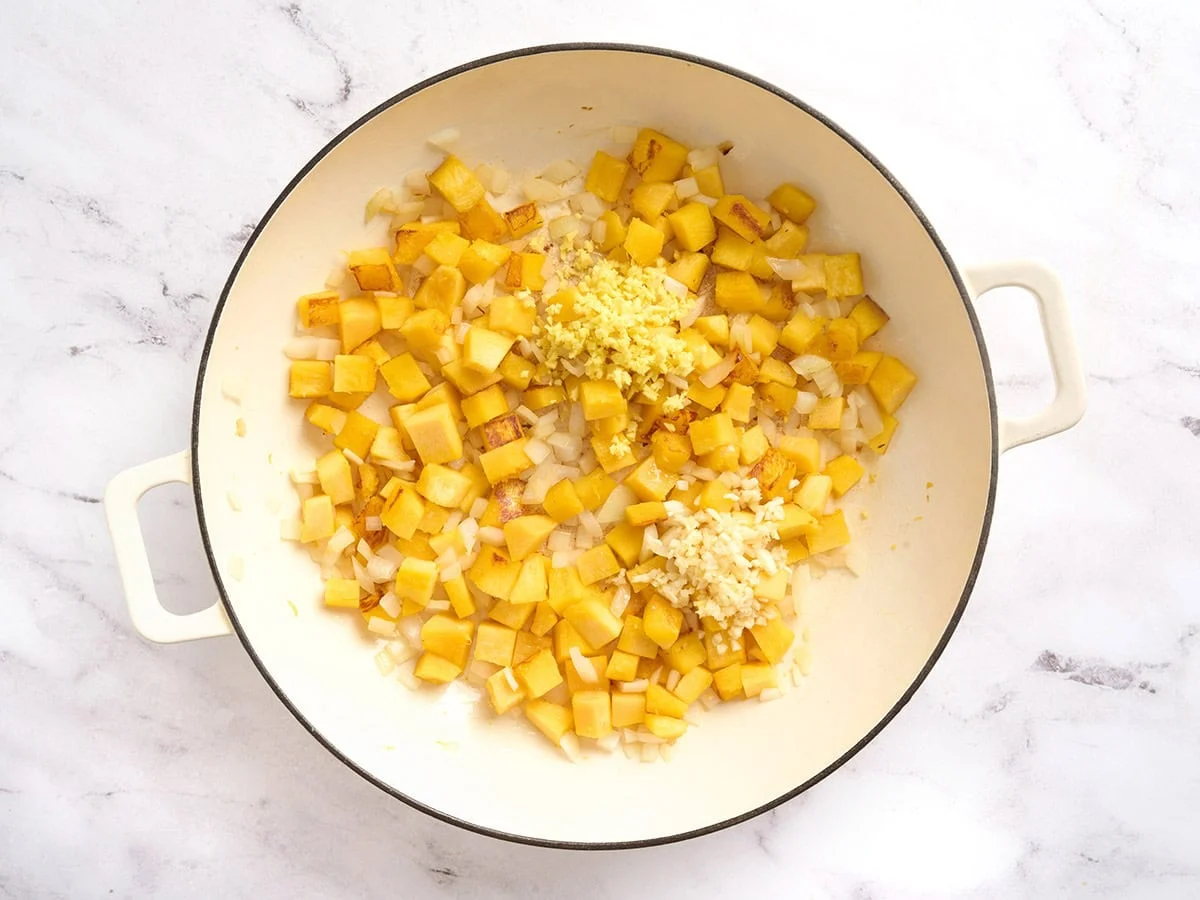
Add the garlic and ginger: Stir in 4 minced garlic cloves (about 2 Tbsp) and 1 Tbsp minced fresh ginger into the pumpkin and onion. Cook for 1-2 minutes, stirring often, until the garlic and ginger smell fragrant. Keep an eye on the garlic so it doesn’t brown or burn.
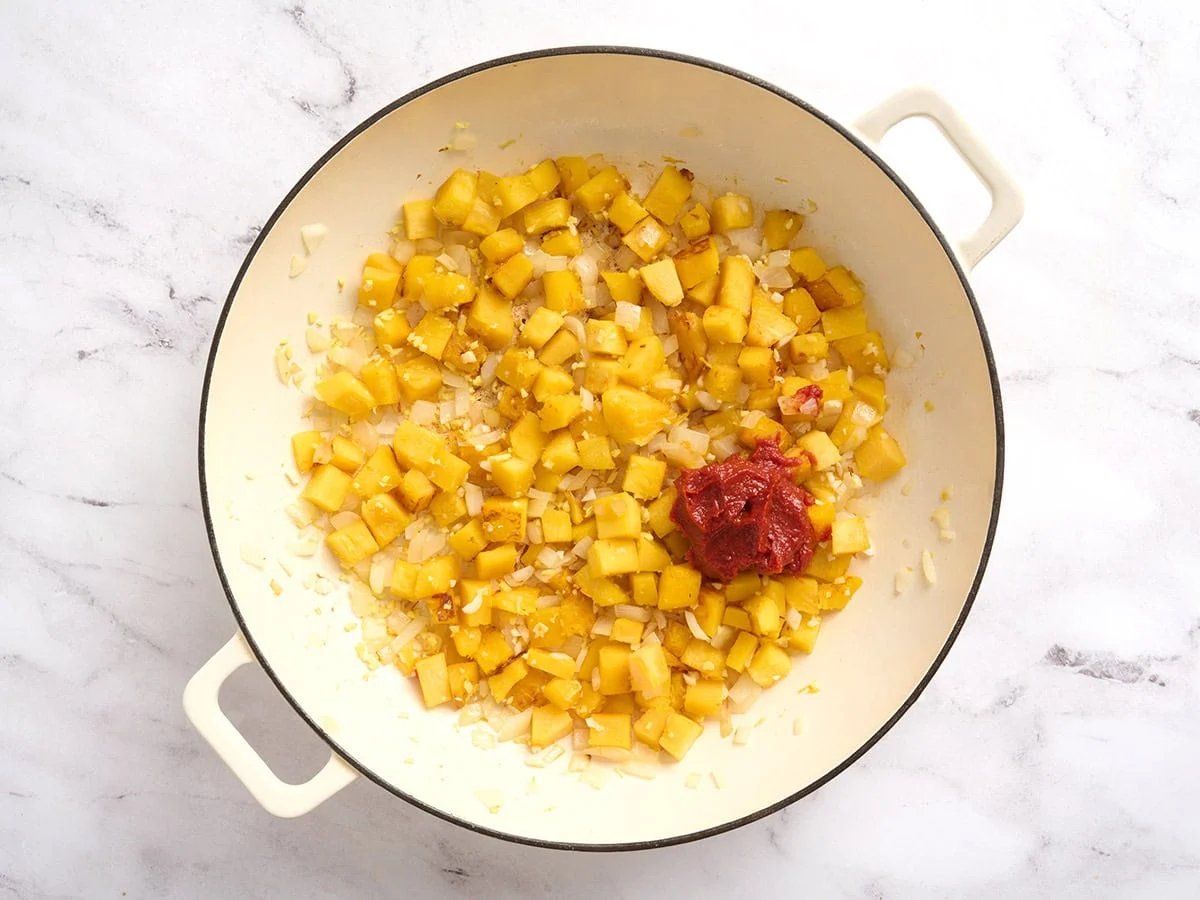
Cook the tomato paste: Add 2 Tbsp tomato paste and stir it through the vegetables. Cook for another 1-2 minutes, stirring frequently, until the paste coats the pumpkin and onion and deepens slightly in color.
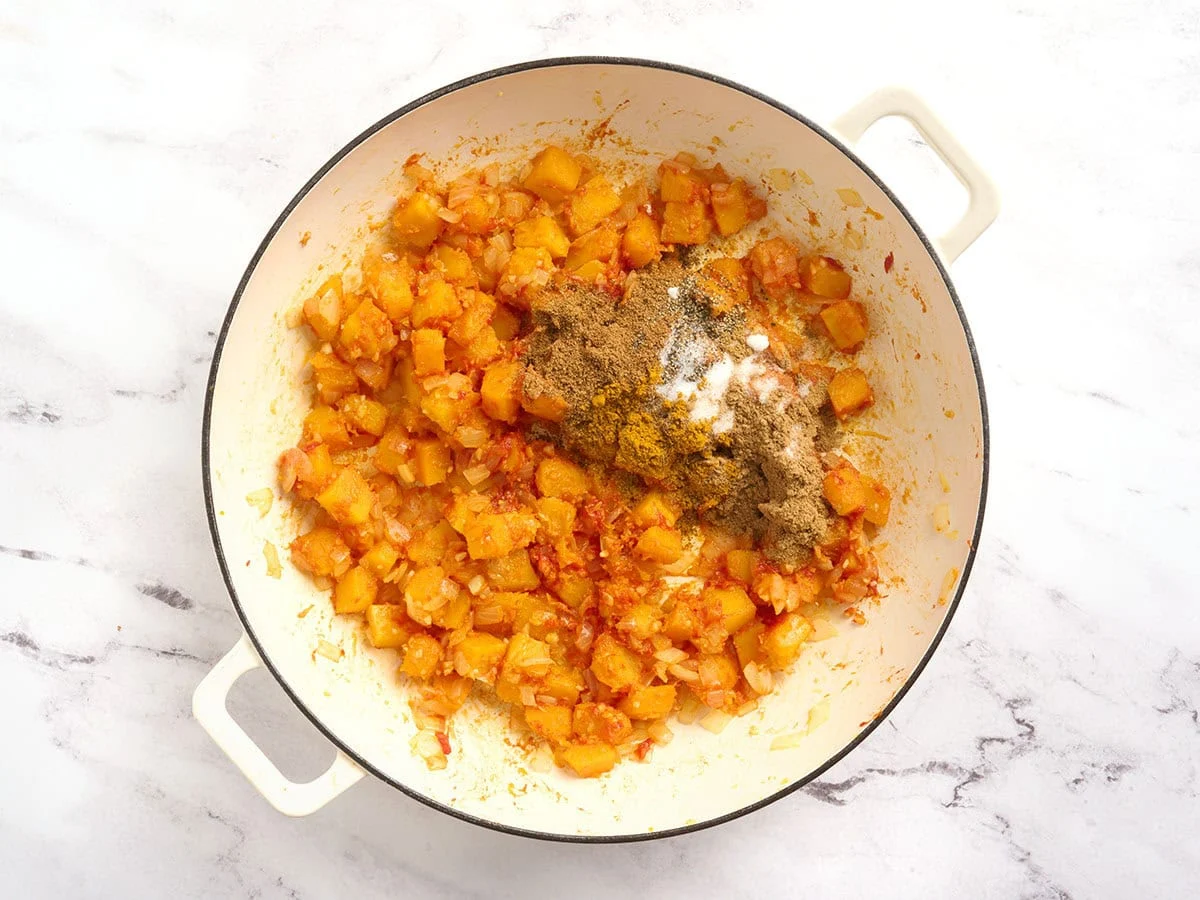
Add the spices: Now sprinkle in 1 Tbsp garam masala, 1 tsp curry powder, 1 tsp ground cumin, 1¼ tsp salt, and ½ tsp freshly cracked black pepper. Stir until the pumpkin and onion are evenly coated and the spices are well distributed.
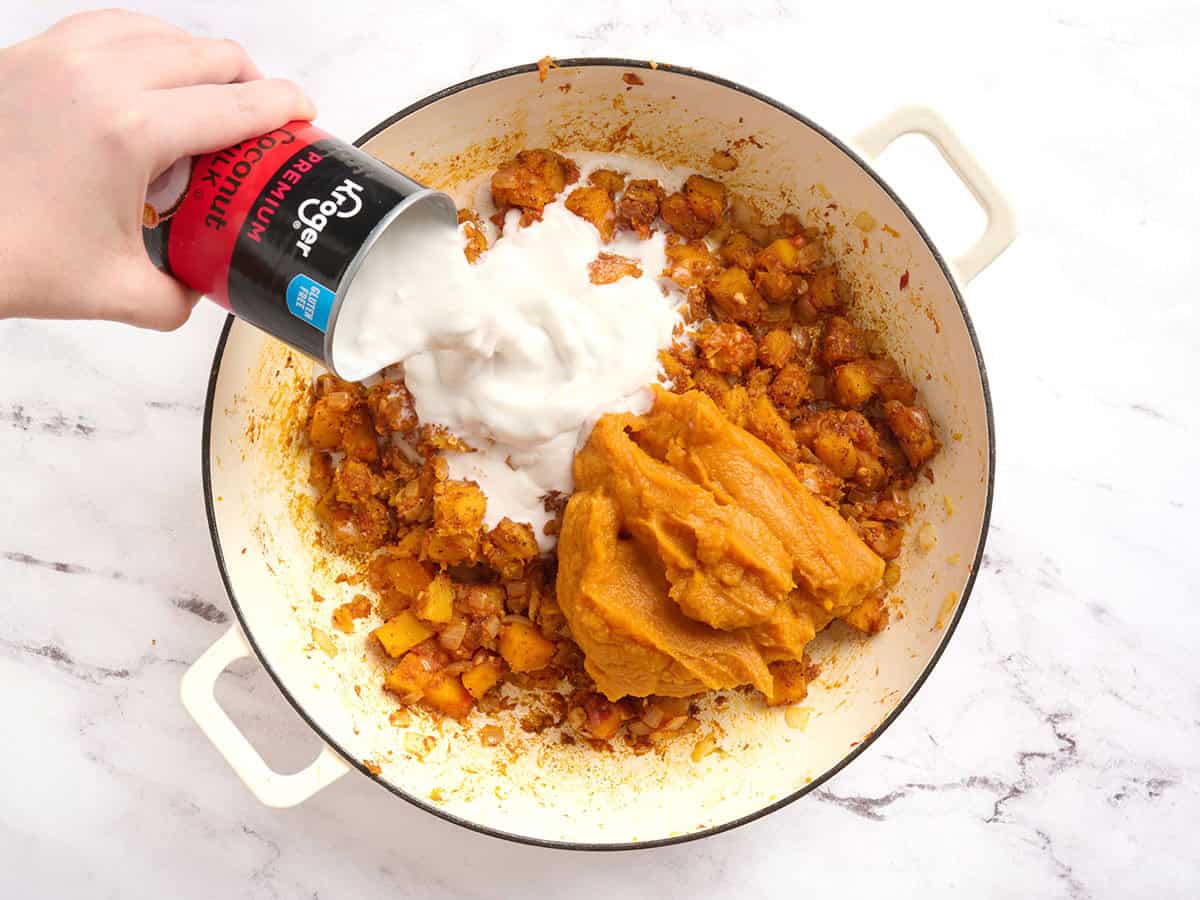
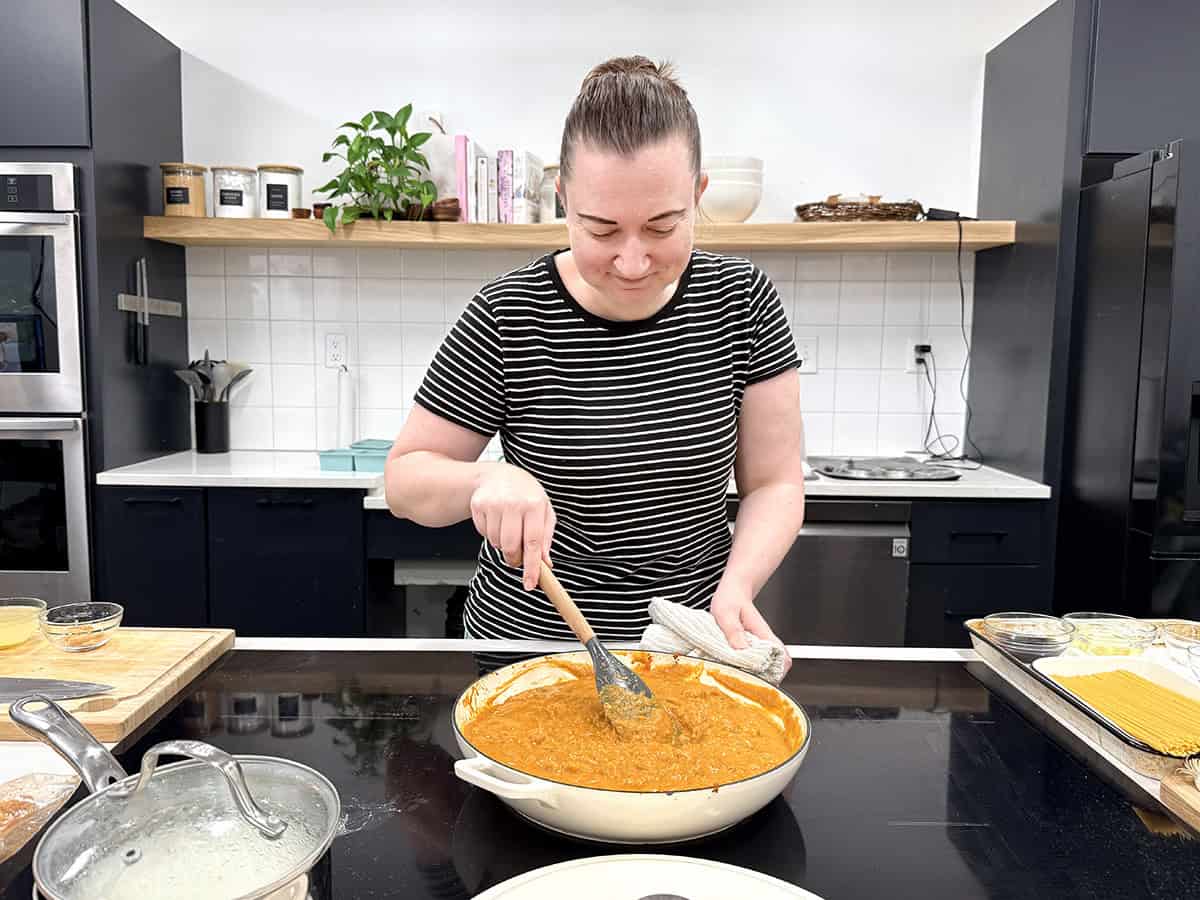
Build the curry sauce: Pour in 1 can (13.66 oz.) full-fat unsweetened coconut milk and 1 can (15 oz.) 100% pumpkin purée. Stir until the pumpkin purée is fully incorporated and the sauce looks smooth and evenly combined. Bring everything to a gentle simmer, then cook for about 10 minutes, stirring occasionally. The sauce should thicken, and the pumpkin should be tender enough to pierce easily with a fork, but the cubes should still hold their shape rather than falling apart.
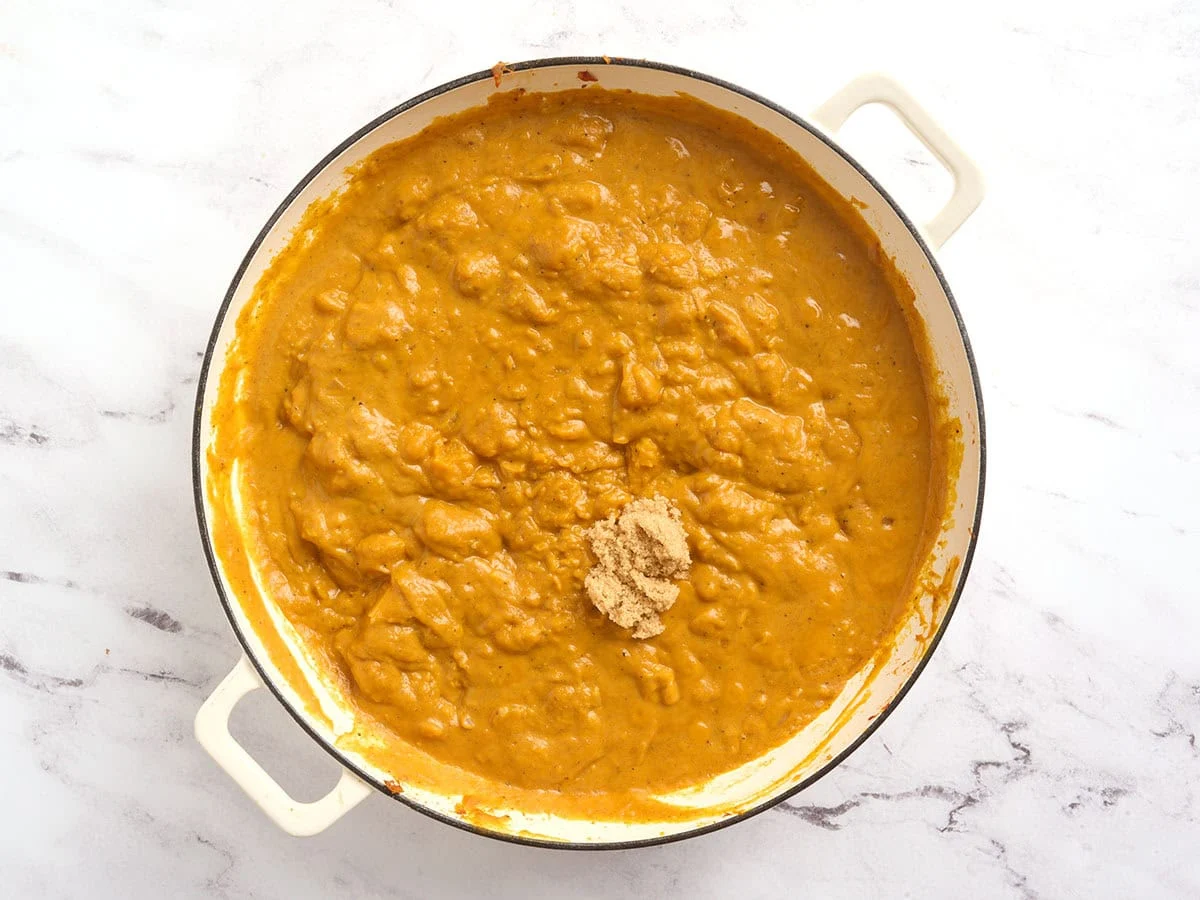
Balance the flavor: Stir in 1 tsp brown sugar until completely dissolved. Taste the pumpkin curry and adjust the seasoning if needed.
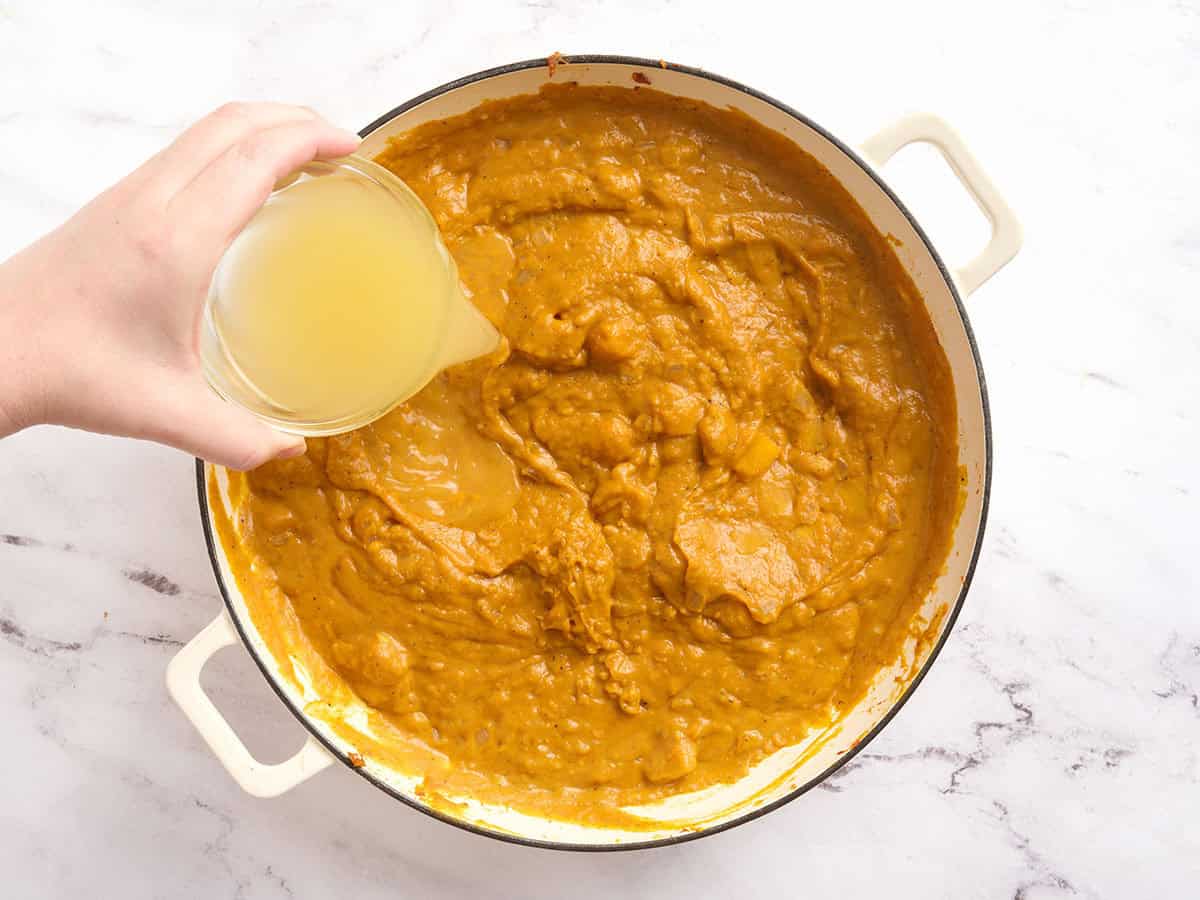
Adjust the consistency: Finally, stir in ¼ cup vegetable broth. The finished curry should be rich and spoonable, not watery! If you prefer a looser curry, add another small splash of broth until it reaches your preferred consistency.
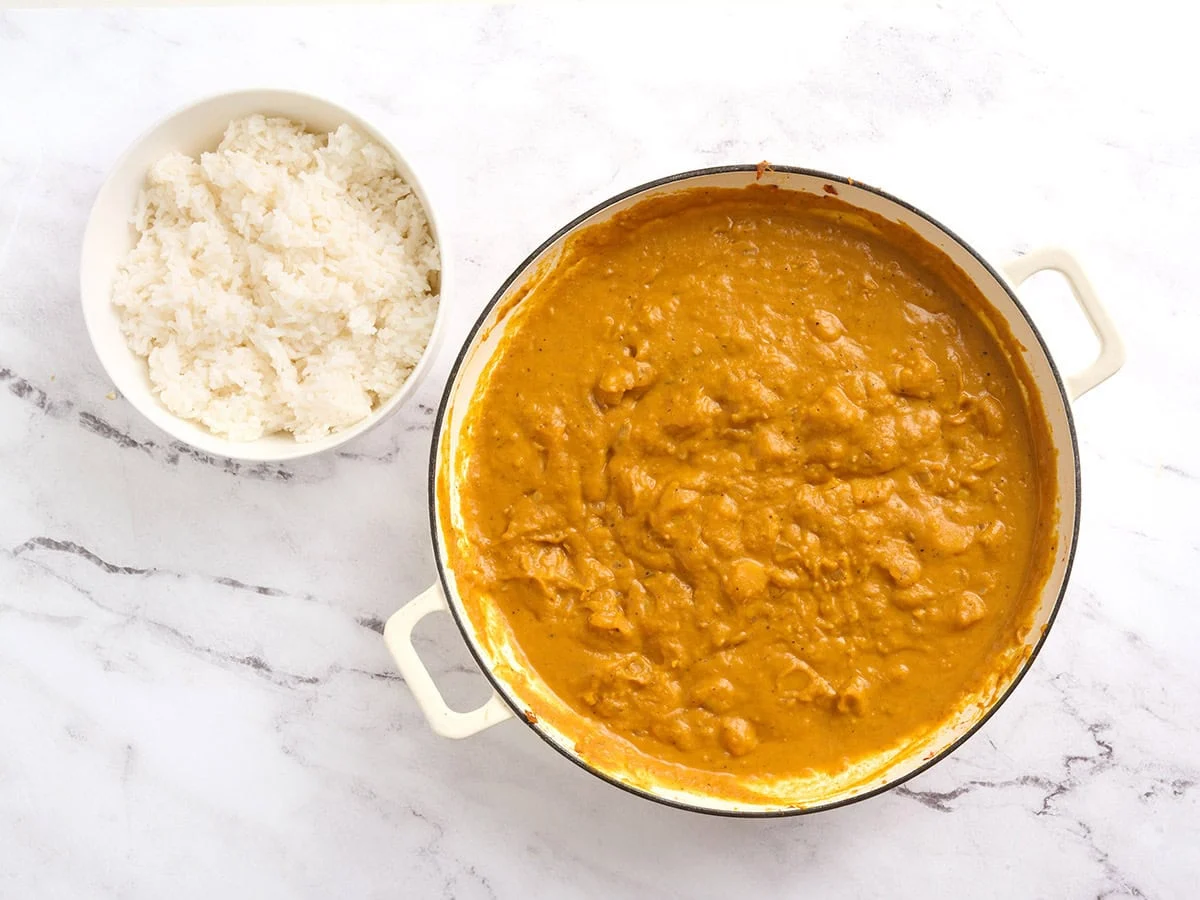
Serve over rice: Divide the cooked rice between bowls and spoon the pumpkin curry over the top. Add your desired toppings and serve warm. Enjoy!

I like to finish my pumpkin curry with fresh cilantro and a squeeze of lime. The cilantro adds a fresh, herby note, while the lime helps brighten up the rich coconut sauce. You can also try parsley or basil, chopped peanuts for a little crunch, or a dollop of sour cream for extra creaminess. And since you already have a fresh pumpkin on hand, save those seeds and make a batch of roasted pumpkin seeds to sprinkle over the top.
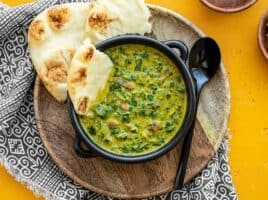
This curry is already a full meal with the rice, but I also like to start with my easy puff pastry samosas and onion chutney. They make such a good appetizer pairing, especially when you’re serving this curry to a group, and you’ll probably have a little chutney left to spoon over the curry, too. A side of naan is another one of my favorites for scooping up all that sauce. I also think this meal would be delish with a side of our Indian-style creamed spinach. It’s also vegan, uses several similar ingredients, and serves four, so the two fit together really nicely!
Store any leftover pumpkin curry separately from the rice so both keep their best texture. Once cooled, transfer each to an airtight container and refrigerate for up to 3-4 days.
For the curry, place the leftovers in a saucepan and warm over medium heat, stirring often, until heated through. The curry will thicken as it sits in the refrigerator, so add a splash of vegetable broth or water if needed to loosen the sauce.
For the rice, I’ll transfer it to a microwave-safe bowl and break up any clumps with a spoon. Add 1 tablespoon of water per cup of rice, cover with a damp paper towel, and microwave in 30-second intervals, stirring between each one, until warmed through.
I don’t recommend freezing this vegan pumpkin curry. The coconut milk can separate as it thaws, which may leave the sauce grainy or watery. I’d stick with refrigerating any leftovers and enjoying them within a few days.
The post Pumpkin Curry appeared first on Budget Bytes.