The Fall 2026 issue of Healthy Aging® Magazine is now available, bringing together fresh ideas about purpose, family, travel, food, fitness, financial well-being and making the most of what comes next.
On the cover is Tony Robbins, whose message of possibility and personal growth has reached millions for decades. In “Tony Robbins: Awaken the Giant Within — Again,” we take a fresh look at the ideas behind his work—and why challenging ourselves to keep growing does not have an expiration date.
Throughout the issue, that same spirit of curiosity and possibility takes many forms.
Plan a getaway with several generations in “The Family Vacation Grows Up.” Think about what success really means in “Whose Success Have You Been Chasing? Finding Real Purpose After 45.” Discover why one conversation can reveal more about your family history than you ever expected, and why it may never be too late to make a fresh career start.
There is practical advice, too—from rebuilding financial independence after suddenly becoming single to moving more comfortably when pain and stiffness get in the way, helping grandchildren develop a healthier relationship with technology, and deciding whether trading city life for the country might really be right for you.
And because fall is a perfect season for gathering around the table, this issue also brings plenty of food inspiration, including “Two New Cookbooks Worth Making Room For” and a reflection on the meaning—and memories—of the family dining room.
San Diego gives multigenerational families plenty of ways to spend a fall getaway, from beaches and waterfront adventures to museums, attractions and family favorites throughout the region. Photo: San Diego Tourism Authority.
Nine ways grandparents can play a positive role in a child’s life.
Author John Ota in Claude Monet’s famously yellow dining room in Giverny, France, one of the memorable stops on his quest to discover the perfect dining room. Photo courtesy of John Ota.
What to consider before trading city life for open spaces.
Plus, in every issue
Explore ideas for clearing out the belongings that weigh us down, discover the benefits of chair yoga, review important Medicare decisions for 2027, browse new books worth checking out and read the Fall Publisher’s Letter.
The Fall issue also arrives during September Is Healthy Aging® Month, now in its 34th year, with the 2026 theme, “Curiosity Has No Age Limit.”
This winter, escape it or embrace it; Either way, a small ship can get you there. Think warm-water classics like the Caribbean, the Panama Canal and Costa Rica, or island-hopping through Southeast Asia and the Canary Islands. Then there are the outliers: French Polynesia and Tahiti, where Windstar sails year-round through tropical waters, and the Mediterranean, our new favorite way to spend the season, minus the summer crowds.
Here’s where you can go and what you can see in winter with Windstar:
Caribbean
Blend beach time in the Caribbean with celebrations in the winter season./
When it’s best: Late October through mid-Mar
Our ships:Star Pride, Star Legend, Wind Surf, Wind Star (operates just one Caribbean sailing before repositioning to Costa Rica and the Panama Canal).
What we love: The variety. Every island is different — an experience in Aruba is light years from St. Barts, and they’re both fabulous. With three ships in the region this winter, you can choose a quick seven-night getaway focused on the British Virgin Islands; a cosmopolitan, French-influenced route with calls at Martinique, St. Barts and St. Martin; or a fun-in-the-sun itinerary through southern islands like Bequia, Curaçao and Barbados. One often-overlooked draw of the region: local cuisine blending fresh-caught seafood with African, Amerindian, European, Chinese and East Asian influences.
What we love: Stories of the Panama Canal’s construction and operation are legendary, and it remains a marvel of engineering. Voyages typically spend one day transiting the canal and the rest of the voyage in tropical Panama and Costa Rica, experiencing beaches, watersports, jungle adventures, horseback riding and small villages.
What isn’t as well known, as Windstar contributing writer Melinda Crow reports, is how much time is spent in Costa Rica itself: “I loved that on our Panama Canal cruise, the majority of our active days would be in Costa Rica, with rainforest tours, dolphin-watching boat rides and even an afternoon on Windstar’s floating marina set up at the stern of the ship.
“We continued south into Panama for a relaxing day on the beach with Windstar’s Signature Beach Barbecue, before our final excursion, an educational visit to the Emberá, an Indigenous Panamanian tribe critical to protecting the environment and the rivers feeding into the canal.”
Among the highlights: volcanoes (and the coffee plantations that thrive in volcanic soil), biodiversity ranging from marine life to butterflies, and ziplines — particularly at the Monteverde Cloud Forest Reserve.
Details: Itineraries focused on Panama, the Panama Canal and Costa Rica range from standard week-long voyages to Star Collector trips that combine multiple routes. You can even add a Monteverde Cloud Forest and Arenal Volcano land excursion. Some Caribbean itineraries also incorporate Panama and Costa Rica.
French Polynesia
Inland on French Polynesia’s islands, is often as gorgeous as its sea scapes.
When it’s best: Windstar sails from its Tahiti homeport year-round, but the region has real seasonality. Northern Hemisphere travelers visiting during their winter will find it warmer and drier, with tropical downpours rather than all-day rain — and landscapes at their lushest and most spectacular. Snorkelers will appreciate the warm waters, and since November–March is low season, the islands see fewer visitors.
Our ships: Star Breeze is based in Tahiti year-round; Wind Star joins it there beginning in March 2027, also year-round.
What we love: It’s always comfortably tropical in French Polynesia, making it an easy escape from winter weather — and what a place to escape to. Black- and white-sand beaches, serene blue-green lagoons, tropical fish and colorful coral beds define the coastline, while mountain trails offer hikes with views over volcanic valleys. The appeal extends beyond natural beauty to a vibrant culture and warm local hospitality. And Windstar’s exclusive Destination Discovery Event — a sunset barbecue with fire dancing on a motu off Bora Bora — is a highlight of every voyage.
Details: Learn more about cruising French Polynesia year-round here.
Southeast Asia
Thailand’s Phuket/
When it’s best: Windstar’s first Southeast Asia season in several years — focused on Vietnam, Thailand, Malaysia, Cambodia and Singapore — runs November through March.
Our ship: Star Seeker
What we love: Step into a watercolor scene: longtail boats drifting past the karst pillars of Halong Bay, water buffalo tilling verdant rice paddies, and Thai islands hand-picked from more than 1,400 to choose from — the ones worth the detour. Other itineraries move on to glimmering neon cities. Southeast Asia is a region where the food tells its own story: Peranakan fusion in Malaysia and Singapore, Khmer noodles in Cambodia. Overnight stays in Hong Kong, Hanoi, Ho Chi Minh City and Singapore mean real time in the night markets — not just a rushed shore excursion. And history anchors it all: Hoi An’s Ancient Town, where 18th-century merchant houses still stand.
Details: In Southeast Asia, travel options are built around core voyages, with extended Star Collector trips and land-based adventures also available.
Canary Islands
Colorful streets in colonial towns on Gran Canaria Island./Shutterstock
When it’s best: The Canary Islands are an archipelago of seven islands that are part of Spain (cruises also call at Portugal’s Madeira). A subtropical region just off the coast of Africa, the Canaries are delightful year-round, but Windstar’s November–January itineraries offer a great escape from winter.
Our ship: Wind Spirit
What we love: “There’s a reason they call these islands Europe’s Hawaii,” says Windstar president Chris Prelog. “From black-sand beaches to cities with Spanish and Portuguese influences, it always felt to me like it was everything you could want in a vacation destination.”
Most voyages homeport from lush Tenerife, with ports of call including the stark, almost moon-like Lanzarote; the volcanic San Sebastián de La Gomera; and Santa Cruz, on the island of La Palma, with its Spanish colonial history. On Fuerteventura, Puerto del Rosario is known for Corralejo Natural Park, a massive golden dune field meeting crystal-clear water. Madeira is the only Portuguese island on these itineraries.
A new addition to Windstar’s ports of call this winter is El Hierro. A UNESCO Biosphere Reserve with more than 100 plant and animal species, it’s considered Europe’s Galápagos.
On Venice’s Grand Canal in January (the woman’s fur coat was decidedly not necessary on this balmy day)./Carolyn Spencer Brown
When it’s best: It’s not necessarily best in winter or summer — it depends on your preferences. In winter, summer stalwarts like Santorini, St. Tropez, Portofino, Split and Kotor step back, and cosmopolitan cities such as Florence, Nice and Genoa — typically more crowded in warm weather — step in. Some cities, like Venice, Dubrovnik, Athens, Rome and Barcelona, are fabulous year-round. “Sunshine in the Mediterranean doesn’t take a holiday in the winter,” says Janet Bava, Windstar’s chief commercial officer, who first proposed the line’s year-round Mediterranean cruises three years ago. She’s right.
These itineraries run January–March (2026) and November–March (2027).
Our ships: Windstar’s new Star Explorer debuts in late December this year and stays in the region through winter 2027–2028, when it will be joined by Star Legend.
What we love: Ships spend more time in port during winter’s “locals” itineraries, including overnights and later departures. Weather can be unexpectedly pleasant, with temperatures in the 60s (read our guide on tips for enjoying a winter cruise in the Mediterranean). Itineraries focus on larger cosmopolitan cities like Nice, Naples, Genoa and Dubrovnik during locals season, a time when they belong not to tourists but to the people who live there — an energy that’s quieter and stiller, yet still bustling and lively.
Details: To see all the options, from Venice to Rome’s Civitavecchia, Barcelona and more, go here.
He arrived in a box of cassette tapes my husband handed me when I was struggling with something that probably sounds familiar to anyone who has ever started a business: believing enough in the value of what I was doing to ask someone else to pay for it. I was growing my television production business, one sponsor at a time.
Tony’s words rang in my ears in those early days and became a catalyst for taking my business to the next level.
In 2017, I was thrilled to learn about his new book, Unshakeable: Your Financial Freedom Playbook. We featured Tony on the cover of Healthy Aging® Magazine that spring.
Fast forward to 2026 … and here he is again.
This time, Tony is back with a newly updated edition of Awaken the Giant Within, the book that has challenged millions of people to take a closer look at what they want from life—and what they’re willing to do to get there.
There is still much to learn from Tony. Hopefully, you’ll be inspired by our feature article … and, of course, by his book, too.
And since this Fall issue arrives during September Is Healthy Aging® Month, it seems like an especially good time to think about what we might still want to learn, try, change or do next.
Along with such kick-in-the-butt inspiration on how you can live life to its fullest, you’ll discover plenty of other ideas in this issue on how to age healthfully—from saying no to drugs and overcoming pain and stiffness without them to finding purpose later in life, starting a new career, tackling the whys and why-nots of decluttering, discovering the benefits of chair yoga, and knowing what Medicare decisions you may need to make for 2027.
We also give a big nod to the next generation … with ideas on how to be a better grandparent, demystifying the myriad of school choices so you can talk intelligently about them (if asked), preserving family history, helping build a healthier relationship with technology and, quite frankly, being a positive influence in your grandchild’s life.
And for fun, we tackle how you can create memories while keeping precious family bonds strong in The Family Vacation Grows Up.
For you foodies, we want to share two new cookbooks that I predict will become dog-eared and stained because you’ll use them so much.
Dig In! Over 100 Easy, Delicious and Stress-Free Recipes to Make on Repeat by Erin O’Brien earned a front-row spot on my shelf for its many recipes I’ve tried several times—all perfect for family gatherings, guests, or when it’s just you alone or with your significant other. Yes, you will definitely “make them on repeat!”
My favorites include One-Pan Sicilian Baked Cod with Roasted Tomatoes & Olives, Seared Scallops with White Wine Butter Sauce & Crispy Pancetta, and No Mayo Esquites (Mexican Street Corn).
The second is More Please! Feel-Good Meals for Busy Families and Their Picky Eaters by Rachel Mansfield. I loved her Yogurt-Marinated Chicken Skewers served with two sauces.
And, for those who celebrate family rituals as we do, such as the family dinner, you’ll love John Ota’s article on his search for the perfect dining room. His odyssey stirred up my own reflections on our family’s dining room and the experiences around that table – both growing up and as a parent.
“I love the dining room!” he explains … and so do we. Some say the dining room is dead—not for him and not for us!
So, we hope you enjoy the latest issue of Healthy Aging® Magazine as much as we did putting it all together.
Former U.S. Coast Guard contractor Peter Souders is allowed to proceed with his First Amendment lawsuit against the Trump administration, claiming he was fired over posts related to the shooting death of conservative activist Charlie Kirk.
Today we’re covering a touchstone resource for geriatricians: the “Beers List” of medications that older adults should avoid or use with caution.
(Technically, it’s called “The AGS Beers Criteria® for Potentially Inappropriate Medication Use in Older Adults.” I personally think of it as the list of “risky medications” for older adults.)
If you want to know which medications older adults should be careful about, this is the list!
This list gets updated every few years, so the Beers Criteria published in May 2023 is about as up-to-date as you can get for this type of guideline document.
You should know that experts in geriatrics and in medication safety go through a very careful process of reviewing the research on medications, and of updating this list of medications that older adults should avoid or use with caution.
So in this article, here’s what I’ll be sharing with you:
What is the Beers Criteria?
What’s in the 2023 Beers Criteria?
What’s in the Alternative Treatments to Selected Medications in the 2023 Beers Criteria?
How experts decide what to include in the Beers Criteria
How should health providers be using the Beers Criteria
Risky medications that I particularly pay attention to
What you can do, to be proactive about medication safety in aging
You can also check out my YouTube video to learn more:
The story of the Beers Criteria
If you spend enough time with geriatricians and other experts in aging health, you’ll notice pretty soon that we spend a lot of time reviewing medications, and considering whether to deprescribe them.
Medications are, of course, a mainstay of modern medicine. They are often key to how we manage a variety of health conditions, whether that’s by relieving a distressing symptom, reducing the risk of a future serious health event, or even helping the body correct a life-threatening illness.
But medications also come with risks and side-effects.
Aging makes people more susceptible to these downsides of all medications. And, over the years, geriatricians have noticed that some medications, in particular, are more likely to cause problems or create extra risks.
These types of observation led a geriatrician named Mark Beers to publish a scholarly paper in 1991, identifying several categories of medication that seemed to be especially risky for nursing home residents.
Dr. Beers worked with various colleagues and organizations over the years to refine his list, which soon expanded its scope to consider which medications are potentially inappropriate for older adults who aren’t necessarily frail enough to be in nursing homes.
Dr. Beers died in 2009, but his “Beers Criteria” lives on. Since 2011, the process of reviewing and updating the list has been overseen by the American Geriatrics Society (AGS), which published updates in 2012, 2015, 2019, and most recently, in May of 2023.
What’s in the Beers Criteria
Technically, it’s “The AGS Beers Criteria® for Potentially Inappropriate Medication Use in Older Adults.” The 2023 update is here.
This is essentially an extensive list of “potentially inappropriate medications” that should be avoided or used with caution, when it comes to the health care of adults aged 65 and older.
About “potentially inappropriate” medications in older adults
“Potentially inappropriate” means that in most older adults, the likely risks of using the medication outweigh the likely benefits, especially when compared with other available treatment options.
It’s important to know that just because a medication is “potentially inappropriate,” this does not mean that it’s always “wrong” to prescribe it to an older person.
But, since these are riskier medications for older adults, it’s important to
Take extra care before prescribing them,
Make sure that safer alternatives have been considered
Confirm that for a specific patient, the likely benefits of the medication outweigh the likely risks
Ideally, the risks of the medication would also be discussed with the older person and with family (when family is closely involved).
Research has repeatedly confirmed that these riskier medications are often prescribed to older adults, and that in many cases, it’s not clear that the risks were explained to the patients or that safer alternatives were offered.
What’s in the 2023 Beers Criteria
Recent versions of the Beers Criteria have organized potentially inappropriate medications into categories. The 2023 update’s categories include:
Medications that are potentially inappropriate in most older adults (Table 2)
These are grouped by therapeutic category (meaning, they name what organ or type of condition the medication is used for), and include a rationale for why the medication may be inappropriate.
The recommendation for most medications in this long list is “avoid”.
Medications that are potentially inappropriate in older adults with certain conditions (Table 3)
The conditions listed include syndromes more common in older adults (e.g. history of falls, delirium, dementia or cognitive impairment) and also specific health diagnoses (e.g. Parkinson’s disease, kidney disease, heart failure).
Medications to be used “with caution” in older adults (Table 4)
This list identifies drugs for which there is some cause for concern, but for which the evidence is not yet sufficient to merit inclusion in the main “medications that are potentially inappropriate” list.
Clinically important drug-drug interactions to be avoided in older adults (Table 5)
This list highlights combinations of medications that are especially common among older adults, and can be particularly risky.
Medications to be avoided or used in reduced dosage, for older adults with reduced kidney function (Table 6)
Since reduced kidney function is common among older adults (many of whom may not realize they are affected by this), this list specifies medications to avoid, or use in reduced dosage.
A list of “Drugs with Strong Anticholinergic Properties” (Table 7)
Since “anticholinergics” as a group are referenced in several different tables within the Beers Criteria, Table 7 provides a list of specific medications to avoid or use with caution.
The 2023 Beers Criteria also include additional tables, summarizing changes relative to the prior 2019 update of the Beers Criteria.
What’s in the Alternative Treatments to Selected Medications in the 2023 Beers Criteria?
This is a super practical resource! It is organized by condition (e.g. diabetes, heart failure) for which Beers Criteria medications are often prescribed, and then lists safer non-pharmacological and pharmacological treatment options.
So for instance, for diabetes, sliding scale insulin is a relevant Beers Criteria medication. If you or your older relative is on sliding scale insulin, you can use this Alternative Treatments resource to identify safer options to ask your health providers about.
How experts decide what to include in the Beers Criteria
To review, revise, and update the Beers Criteria, the American Geriatrics Society convenes an expert panel which includes physicians, pharmacists, and nurses, all with special expertise in geriatrics and in reviewing scientific literature.
This review process is very careful and takes 18-24 months to complete.
During this time, the experts review the available scientific research, and decide on what changes to make to the Beers Criteria. They also consider how to organize and present the material, to be most useful to the clinicians who are the primary intended users of the Beers Criteria.
In short, this is a very careful, thoughtful, and evidence-based process.
How health providers (and others) should use the Beers Criteria
The Beers Criteria is a terrific resource, when used appropriately.
This editorial outlines these seven key principles to help clinicians and others appropriately use the Beers Criteria:
Medications in the AGS Beers Criteria® are potentially inappropriate, not definitely inappropriate.
Read the rationale and recommendations statements for each criterion. The caveats and guidance listed there are important.
Understand why medications are included in the AGS Beers Criteria®, and adjust your approach to those medications accordingly.
Optimal application of the AGS Beers Criteria® involves identifying potentially inappropriate medications and where appropriate offering safer nonpharmacologic and pharmacologic therapies.
The AGS Beers Criteria® should be a starting point for a comprehensive process of identifying and improving medication appropriateness and safety.
Access to medications included in the AGS Beers Criteria® should not be excessively restricted by prior authorization and/or health plan coverage policies.
The AGS Beers Criteria® are not equally applicable to all countries.
In general, this editorial falls short of instructing clinicians on how to prescribe safely to older adults, or how to use the Beers criteria. As the authors note, the Beers Criteria is not meant to be the definitive word on prescribing, but rather is an important resource that fits into a “larger picture of improving prescribing for older adults.”
But, the gist is this: they suggest health providers take extra care when prescribing these medications to older adults, and also be vigilant for side effects, since older adults have a higher risk of experiencing these or being harmed by them.
Risky medications that I pay particular attention to
Everything in the Beers List is important, but in truth, some medications on the list feel much more relevant to me than others.
That’s because some of these medications are widely used by lots of older adults, most of whom have no idea they are taking a potentially inappropriate medication. Whereas other medications, such as barbituates, are on the list but are hardly ever used anymore.
So, without copying too much out of the Beers Criteria, here’s a brief list of the risky medications that I consider especially relevant to most older adults:
The 4 types of medications that affect brain function. These are listed in depth in my article on this topic, and are also included in the 2023 AGS Beers Criteria’s Table 3, in the list of medications to avoid in people with dementia or cognitive impairment. They should also be avoided when older people have delirium. They are:
Anticholinergics
Benzodiazepines
Non-benzodiazepine sedatives
Antipsychotics
Non-steroidal anti-inflammatory drugs (NSAIDs).
These include common over-the-counter painkillers such as ibuprofen and naproxen (brand names Advil and Alleve), as well as prescription-strength NSAIDs, which are often prescribed for arthritis and other pain. I explain the risks of these medications in this article.
Aspirin for prevention (in adults age 70+ who have NOT had a heart attack, stroke, or other cardiovascular event).
These are medications that reduce stomach acid, such as omeprazole (Prilosec). They are not recommended for chronic use of more than 8 weeks, unless there are compelling reasons to continue.
Medications to avoid or use with caution if there is a history of falls or fractures.
This is an important list since falls are really common in older adults.
The AGS 2023 Beers Criteria list for this includes:
Antiepileptics (also known as anticonvulsants; these are sometimes used off-label for difficult dementia behaviors, see here.)
Antipsychotics
Benzodiazepines
Non-benzodiazepine sedatives
Antidepressants
Opioids
Note: in my own list of medications to review for fall prevention, I also include medications related to blood pressure (recommended by the CDC guidelines) and blood sugar (common sense; low blood sugar is common in older people on diabetes medications and is definitely associated with falls). For more, see here.
There are more medications in the 2023 AGS Beers Criteria to be mindful of, to be sure. But the drugs above are the ones that I most commonly encounter and work on deprescribing when possible.
What you can do about medication safety in aging
So if you’re an older adult, or if you’re involved in the medical care of an aging relative, what can you do?
The advice of Dr. Michael Steinman, who is on the committee that updates the Beers Criteria, is shared in this podcast episode: be proactive.
Although we do have a lot of information available regarding which medications are risky for older adults, and how to manage medications more safely, it’s still very common for older adults to experience inappropriate prescribing and also harms from their medications.
Most health providers are well-intentioned and caring. But they’re also often lacking the time, resources, and supportive systems they need to be more careful about medications.
So for now, if you want to improve your chances of using medication carefully, here are some suggestions:
Review your medications, and try to find out if any are listed in the Beers Criteria. Pharmacists can be a good resource, if you want help spotting these medications.
Always ask questions when a new medication is being prescribed, to make sure you understand why a medication is being prescribed and to confirm that it makes sense to proceed with this medication. Good questions for older adults to consider asking include:
Could this medication affect my balance or my thinking?
Is this medication listed in the Beers Criteria?
Can you please review with me what is the expected benefit of this medication, and what are the likely risks?
Are there any safer or non-drug approaches to treatment that I should be aware of?
Are there any particular side-effects I should look out for?
Ask to review medications after hospital discharge or a move from one healthcare location to another. Many medications prescribed during hospitalization may not need to be continued long-term.
Your usual health provider will be more likely to carefully review your post-discharge medications if you request this.
If you don’t have a usual health provider, you can still request an appointment with a doctor, nurse, or pharmacist, to carefully review medications and discuss whether each is still likely to be beneficial.
Ask to schedule regular medication reviews with your health provider. Most experts recommend regular medication reviews for older adults.
I suggest yearly medication reviews, especially for older adults who are taking any medications listed in the Beers Criteria, or who take more than 5 medications.
I share a five-step process to help you prepare for a useful medication review here.
Regularly ask about deprescribing. Remember that when it comes to older adults and medications, less is often more. Deprescribing means reducing or stopping medications that may not be beneficial or may be causing harm, to maintain or improve quality of life.
For more on deprescribing, see this article, which includes links to a series of excellent consumer guides to help older adults discuss deprescribing of benzodiazepines, NSAIDs, proton-pump inhibitors, antipsychotics and more.
Deprescribing is much more likely to happen when older adults and families ask about it. So ask!
I know it can seem a bit daunting to start asking a lot of questions about your medications, or your older parents’ medications.
I also know that although many health providers will welcome your questions and be glad to see you participating in your care, others might give you a hard time, because they’re busy or maybe they just aren’t used to having to think over what they are prescribing.
Nonetheless, I want to encourage you to do it anyway! Yes, it can be a little extra work, but it’s your health and safety at stake. (Plus there’s your wallet, paying all those co-pays.)
Many older adults do need to be on medication. And, many of them are on more medication than is truly necessary.
Even if you don’t get a copy of the most recent AGS Beers Criteria, you can follow the suggestions listed above.
Find out if any of your medications are listed in the Beers Criteria. Ask about alternatives. (Use the Alternative Treatments resource!) Review medications regularly. Get medications deprescribed when possible.
With just a little bit of effort, I know that you will vastly improve the odds that whatever medications you — or your older relative — are taking are truly serving your health, and not exposing you to unnecessary risk.
Retired Coastie and New York native, Keiyon McCoy, and his boatcrew who were patrolling the Hudson River when terrorists struck the World Trade Center. Twenty-five years later, he recounts the harrowing scene of the attack and how more than one hundred mariners answered the Coast Guard’s call for volunteers to aid in the rescue of half a million people trapped on the shores of lower Manhattan.
Thanks for watching!
Interested in joining the U.S. Coast Guard?
Visit: http://www.gocoastguard.com
Connect with the U.S. Coast Guard online:
Web: https://www.uscg.mil
MyCG: https://www.mycg.uscg.mil/
Facebook: https://www.facebook.com/UScoastguard
Twitter: https://twitter.com/uscg
Instagram: https://www.instagram.com/uscg
If you served at a U.S. or Royal Thai military base during the Vietnam era, listen up.
For years, veterans who served in Thailand were often forced to prove they worked on or near the base perimeter before the VA would concede Agent Orange exposure.
Yep. Even if you were stationed on the base, your claim could still get denied because your military job didn’t put you close enough to the fence line.
Under current law, veterans who served at a U.S. or Royal Thai military base in Thailand during the qualifying period can now receive presumptive herbicide exposure regardless of where they worked on the base or what their MOS was.
That’s a BIG deal.
And if you had an Agent Orange-related VA claim denied years ago because you couldn’t prove perimeter duty, your claim may deserve another look.
In this article, I’ll break down exactly what changed, who qualifies, what evidence you need, and what to do if VA denied your Thailand Agent Orange claim under the old rules.
Summary of Key Points
Thailand service is now a real statutory presumption, not just an informal concession policy — thanks to a specific PACT Act amendment.
Proof of perimeter or security duty is no longer required as a matter of law — the statute now covers Thailand service “without regard to” where on base you served or your job specialty.
The old seven-base list still shows up in denials and competitor content, but current law doesn’t require naming a specific base at all.
The regulation hasn’t formally caught up to the statute yet — a proposed rule has been pending since Feb. 2024 — but the VA is already applying the presumption under the statute regardless.
An old denial isn’t automatically reopened — you’ll generally need a new or Supplemental Claim citing the change in law, and Higher-Level Review usually isn’t the right tool here.
Table of Contents
The Old Rule vs. the Current Rule
Before the PACT Act, Thailand wasn’t covered by a formal regulatory presumption the way Vietnam boots-on-ground service was. Instead, the VA used a sub-regulatory adjudication policy — guidance in its M21-1 manual — that would concede herbicide exposure only for veterans whose duties placed them at or near a base’s security perimeter: security police, military police, security patrol dog handlers, and similar roles at a defined list of bases.
Prove that specific job and location, and the VA would concede exposure. Fall outside it, and you were often out of luck, regardless of how much time you actually spent on that base.
The PACT Act changed this directly. Section 403 amended 38 U.S.C. § 1116(d)(2) to define qualifying Thailand service as service at any U.S. or Royal Thai base during the qualifying window, “without regard to where on the base the veteran was located or what military job specialty the veteran performed.”
That’s not a minor tweak — it’s the difference between an informal, narrow concession policy and an actual statutory presumption, the same legal structure that covers Vietnam and Korean DMZ service.
One honest caveat: the regulation the VA normally points to for presumptive herbicide locations, 38 CFR § 3.307, has not yet been formally amended to add this Thailand language — a proposed rule to do so has been pending since February 2024. The VA’s own public materials already describe and apply the presumption as settled, but the regulatory paperwork is still catching up. That’s worth knowing if you ever see a denial that leans on the old, narrower framework.
Do You Qualify? Dates and Locations
The qualifying window for Thailand service is January 9, 1962 through June 30, 1976 — service at any U.S. or Royal Thai military base during that period. (A separate, narrower window, January 9, 1962 through May 7, 1975, applies only to a different benefit — spina bifida benefits for children of Thailand veterans — so don’t confuse the two if you’re researching for a dependent.)
You’ll still see a specific list of bases repeated across older VA decisions and competitor articles — U-Tapao, Ubon, Nakhon Phanom, Udorn, Takhli, Korat, and Don Muang. That’s a real list, but it comes from the old M21-1 manual guidance, not from current law. Under today’s statute, no base needs to be named at all — “any United States or Royal Thai base” during the qualifying window is enough.
Base (Historical M21-1 List)
Status Under Current Law
U-Tapao
Named in older guidance; not required to be named under the current statutory presumption.
Ubon
Same as above.
Nakhon Phanom
Same as above.
Udorn
Same as above.
Takhli
Same as above.
Korat
Same as above.
Don Muang
Same as above.
One correction worth flagging: An eighth base, Nam Phong, could not be verified in the authoritative sources checked for this article, and it’s been left off — if your service was at Nam Phong specifically, that’s a good reason to get your individual record reviewed rather than rely on any base list at all, since current law doesn’t hinge on a specific base name in the first place.
Why This Matters More Right Now
Thailand isn’t the only location the PACT Act reshaped. The same law expanded presumptive herbicide-exposure recognition to Laos, parts of Cambodia, Guam and American Samoa, and Johnston Atoll — locations that (like Thailand) sat outside the original Vietnam boots-on-ground presumption for decades.
If you served at any of these locations and were told in the past that your service didn’t qualify, that answer may no longer be accurate, and it’s worth checking again rather than relying on what you were told years ago.
There’s also a practical reason Thailand claims are getting more attention from claims-assistance organizations right now: it’s one of the last major herbicide-exposure locations where large numbers of veterans were denied under a proof standard that no longer applies.
Vietnam boots-on-ground and Blue Water Navy claims have had formal presumptions for years; Thailand’s shift from an informal concession policy to a real statutory presumption is comparatively recent, which means there’s likely a meaningful population of veterans whose old Thailand denials were correct under the rules at the time, but would come out differently under today’s law.
Presumptive Conditions That Apply
Once Thailand herbicide exposure applies, you get the same Agent Orange presumptive-disease list as any other qualifying veteran — including diabetes, ischemic heart disease, Parkinson’s disease, several cancers, hypertension, and others. The Agent Orange presumptive conditions list covers the full current roster; nothing about the Thailand-specific rule changes which diseases are on that list, only which veterans can reach it based on where they served.
Evidence and Records Checklist
Because the current rule no longer requires proof of a specific job or perimeter duty, what you mainly need to establish is that you served at a qualifying base during the qualifying window. Gather:
Your DD-214 or other separation documents — these sometimes show enough detail on their own, but often don’t specify exact base locations.
Personnel or unit records showing your specific assignment location and dates, if your DD-214 doesn’t clearly show it. These can be requested from the National Personnel Records Center using Standard Form 180.
Orders, performance evaluations, or morning reports placing you at a qualifying base during the window — useful corroborating evidence, especially for older or incomplete personnel files.
If your records are incomplete, VA’s duty-to-assist obligations can include reaching out to the Joint Services Records Research Center to help corroborate your service location — worth specifically asking about if your personnel file has gaps.
Keep in mind that record requests through the National Personnel Records Center can take weeks to months to process, so it’s worth starting that request early rather than waiting until the rest of your claim is ready to file.
If your Thailand claim was denied years ago because you couldn’t prove perimeter duty, that denial doesn’t get automatically reopened just because the rule has since changed. Which pathway makes sense depends on why the claim was denied in the first place.
Your Situation
Best Option
Why
Denied for lack of perimeter-duty proof, no new evidence needed
New claim or Supplemental Claim, citing the PACT Act’s change in the law
A change in law can support a Supplemental Claim on its own — VA reviews it as new grounds, not as an error in the old decision.
Denied, and you now have better personnel/unit records
Supplemental Claim, submitting the new records
New and relevant evidence is exactly what this pathway evaluates.
You believe VA ignored evidence already in your file at the time
Higher-Level Review
HLR reviews the existing record for an error under the rules that applied then — it won’t help just because the law changed since.
Higher-Level Review is worth understanding clearly here: it only looks at the record that already existed, checking for an actual mistake in how the old rules were applied. If your original denial correctly applied the pre-PACT-Act perimeter-duty standard — meaning the VA didn’t make an error, the law was just stricter back then — HLR won’t produce a different result. A new or Supplemental Claim citing the statutory change is almost always the more effective route.
Effective Dates: What to Expect
If you file a new or Supplemental Claim today citing the PACT Act’s Thailand change, the general effective-date rules apply: the date of your new claim, or up to one year earlier if you file within a year of the relevant change taking effect. Reaching further back — to your original claim’s effective date — generally requires a successful Clear and Unmistakable Error (CUE) motion, which requires showing the original decision was undebatably wrong under the law and facts as they stood at the time.
A denial that correctly applied the stricter pre-PACT-Act standard is usually not CUE just because the law later changed in your favor — that’s a hard, narrow standard, not a routine option.
A Hypothetical Example
Imagine a veteran who served at a Royal Thai Air Force base in 1970 in a supply role, filed an Agent Orange-related diabetes claim in 2015, and was denied because his duties didn’t involve perimeter security and he couldn’t document exposure under the old policy.
If that veteran files a new claim today citing his base and dates of service, current law no longer requires him to prove his job was perimeter-related — service at the base during the qualifying window is enough.
His new effective date would generally run from today’s filing, not back to 2015, unless he can separately show the 2015 decision was clearly and unmistakably wrong under the rules that existed then — which, if the VA correctly applied the old perimeter-duty standard in 2015, it likely was not.
How This Differs From a Vietnam Boots-on-Ground Claim
It’s worth understanding why Thailand claims historically felt harder, even though the underlying presumptive-disease list is identical. Vietnam boots-on-ground service has been formally presumed since the original Agent Orange Act framework — simply showing you served in-country during the qualifying window was enough.
Thailand, by contrast, spent decades under a policy that required proof of a specific job and location on base, which meant two veterans who served at the very same base during the very same year could get opposite outcomes depending on their military occupational specialty.
The PACT Act closed that gap by extending the same “service in a qualifying place during a qualifying window is enough” standard to Thailand that Vietnam veterans have had for years. If your denial predates that change, the comparison is worth keeping in mind: you’re not being asked to prove something harder than a Vietnam veteran has to prove — under current law, you’re being held to the same standard they always have been.
Common Mistakes Veterans Make
Assuming a specific base must appear on an old, informal list — current law covers any U.S. or Royal Thai base, named or not.
Filing a Higher-Level Review when the real issue is a change in law rather than an error in the original decision.
Citing Combee v. Brown as Thailand-specific authority — it’s a radiation-exposure case and doesn’t address herbicide exposure at all.
Giving up after an old denial without realizing the underlying legal standard has since changed in the veteran’s favor.
What To Do Next
Here’s the bottom line, fellow veterans:
If you served at a U.S. or Royal Thai military base in Thailand between January 9, 1962 and June 30, 1976, you no longer have to prove that you worked security, patrolled the perimeter, or performed some specific job near the fence line.
The PACT Act changed that.
And if you have a current diagnosis for an Agent Orange presumptive condition, you could now have a much stronger path to VA disability benefits than you did under the old rules.
Even better, don’t assume an old denial means the door is closed.
If VA denied your claim years ago because you couldn’t prove perimeter exposure, it may be worth taking another look under today’s law and determining whether a new claim or Supplemental Claim makes sense.
Pro Tip: Don’t rely on an old VA denial (or outdated information online) to tell you what you qualify for today. The rules have changed dramatically for Thailand veterans.
You served. You earned the right to file. You earned the right to be heard. And you earned the right to pursue every VA benefit you legally qualify for.
So here is the real question:
Do you have the VA rating you were given, or the VA rating you truly deserve?
Want Expert-Level VA Claim Help? WE GOT YOUR SIX!
VA Claims Insider helps educate and empower veterans to get the VA rating they deserve.
Work directly with a VA Claims Insider Coach who can help lead you to VA claim victory.
50,000+ disabled veterans served in our membership programs since 2016.
33% average rating increase for veterans who complete our Elite program.
Is Agent Orange exposure in Thailand a real VA presumption now?
Yes. The PACT Act amended 38 U.S.C. § 1116(d)(2) to make Thailand service a statutory presumption, covering any U.S. or Royal Thai base during the qualifying window, regardless of the veteran’s specific job or location on base.
Do I still need to prove I worked near the base perimeter?
No. That requirement came from an older, informal VA policy. Current law specifically states exposure is presumed “without regard to” where on base you served or your job specialty.
What dates qualify for Thailand service?
January 9, 1962 through June 30, 1976. A different, narrower date range applies only to spina bifida benefits for children of Thailand veterans.
Does my base need to be on a specific list to qualify?
No. Older VA guidance named seven specific bases, but current law covers any U.S. or Royal Thai base during the qualifying window — you don’t need to match a named list.
My Thailand claim was denied years ago. Can I get it reopened automatically?
No. You’ll generally need to file a new claim or Supplemental Claim citing the PACT Act’s change in the law. Higher-Level Review usually won’t help, since it only reviews the existing record under the rules that applied at the time of the original decision.
What evidence do I need if my DD-214 doesn’t show my exact base?
Personnel or unit records showing your assignment location and dates, which you can request from the National Personnel Records Center using Standard Form 180. The VA’s duty-to-assist process can also help corroborate service through the Joint Services Records Research Center.
Does this same PACT Act change apply to other locations besides Thailand?
Yes. The PACT Act separately expanded presumptive herbicide-exposure recognition to Laos, parts of Cambodia, Guam, American Samoa, and Johnston Atoll, each with its own qualifying dates. If you served at one of these locations, the same “no perimeter-duty proof required” principle generally applies, though the specific qualifying window differs by location.
About the Author
Brian Reese
Brian Reese
Brian Reese is a world-renowned VA disability benefits expert and the #1 bestselling author of VA Claim Secrets and You Deserve It. Motivated by his own frustration with the VA claim process, Brian founded VA Claims Insider to help disabled veterans secure their VA disability compensation faster, regardless of their past struggles with the VA. Since 2013, he has positively impacted the lives of over 10 million military, veterans, and their families.
A former active-duty Air Force officer, Brian has extensive experience leading diverse teams in challenging international environments, including a combat tour in Afghanistan in 2011 supporting Operation ENDURING FREEDOM.
Brian is a Distinguished Graduate of Management from the United States Air Force Academy and earned his MBA from Oklahoma State University’s Spears School of Business, where he was a National Honor Scholar, ranking in the top 1% of his class.
BLUF: The Patient Health Questionnaire (PHQ-9) is CVN’s primary measurement-based care screener, used at each clinical session with all adult clients. These data describe one of the ways this critical tool is used as part of our comprehensive suicide risk management ecosystem to identify suicide risk in real time to optimize client safety.
Suicidal thoughts are reported at higher rates among US veterans & military members and also among those seeking mental healthcare.
PHQ-9 is used by CVN clinicians to briefly assess and reassess adult clients at each encounter. It includes item #9 which screens for suicide risk.
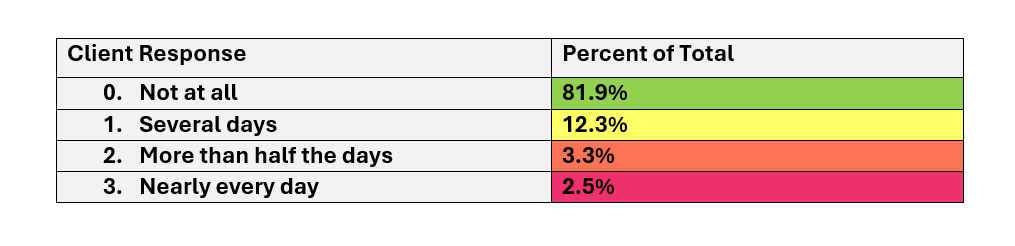
Table 1. PHQ-9 item 9 [“How often you have been bothered by thoughts that you would be better off dead or of hurting yourself in some way”] responses in CVN client data
Almost 1 in 5 (18.1%) of CVN clients endorsed being bothered by these thoughts for several days or more.
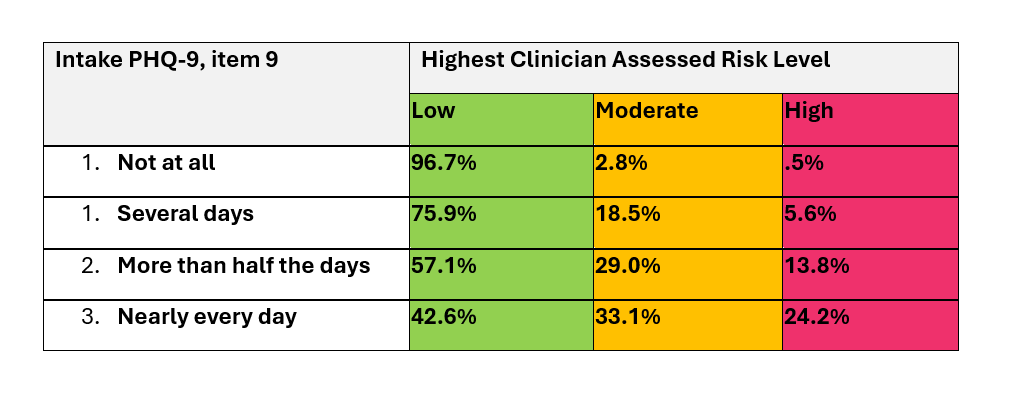
PHQ-9 item 9 scores are strongly linked with clients being identified as either moderate or high risk, with clients reporting “nearly every day” (3) almost 50x more likely to be assessed as high risk than those endorsing “not at all” (0).
This is important given previous research findings which indicated that these responses are valid predictors of suicidal behavior. Louzon & colleagues (2016) found that,
A response of “more than half the days” was associated with a 115% increased risk of suicide.
A response of “nearly every day” was associated with a 185% increased risk of suicide.
Simon and colleagues (2016) reported rates of suicide death 5-7 times higher among those endorsing “nearly every day ” vs “not at all” over two years.
Together, these findings demonstrate that using the PHQ-9 at intake and each subsequent encounter can play a key role in identifying and supporting military connected clients at increased risk.
References
Kim, S., Lee, H.-K., & Lee, K. (2021). Which PHQ-9 Items Can Effectively Screen for Suicide? Machine Learning Approaches. International Journal of Environmental Research and Public Health, 18(7), 3339. https://doi.org/10.3390/ijerph18073339
Louzon, S. A., Bossarte, R., McCarthy, J. F., & Katz, I. R. (2016). Does Suicidal Ideation as Measured by the PHQ-9 Predict Suicide Among VA Patients?. Psychiatric services (Washington, D.C.), 67(5), 517–522. https://doi.org/10.1176/appi.ps.201500149
Simon, G. E., Coleman, K. J., Rossom, R. C., Beck, A., Oliver, M., Johnson, E., Whiteside, U., Operskalski, B., Penfold, R. B., Shortreed, S. M., & Rutter, C. (2016). Risk of suicide attempt and suicide death following completion of the Patient Health Questionnaire depression module in community practice. The Journal of clinical psychiatry, 77(2), 221–227. https://doi.org/10.4088/JCP.15m09776
Bone fragments from the sword hand of a medieval Russian prince who won a famous victory over the Mongols have been sent to the front in Ukraine to raise army morale in the Russian Orthodox Church’s latest show of support for President Vladimir Putin’s war.
The sarcophagus of Grand Prince Dmitry Donskoy, who died in 1389 and is revered by Russian nationalists for defeating the Mongol Golden Horde at the 1380 Battle of Kulikovo, was uncovered this summer during restoration work at Moscow’s Cathedral of the Archangel inside the Kremlin.
Putin personally inspected what experts said were the prince’s well-preserved remains in August, hailing them as “an absolutely unique and marvellous discovery” which reinforced the foundations of Russian history.
The Russian Orthodox Church, which has backed Putin throughout the conflict, said it had dispatched a fragment of Donskoy’s right hand to Donetsk, one of four Ukrainian regions Putin said he had incorporated into Russia in 2022, a move Kyiv rejected as an illegal land grab.
Referring to Donskoy as “the holy commander,” the Moscow Patriarchate of the Russian Orthodox Church said part of his remains had been sent to the front to stand invisibly shoulder-to-shoulder with Russian troops.
“A fragment of the Grand Prince’s right hand – the very same right hand with which he wielded his sword on Kulikovo Field – has been sent to the front to strengthen the soldiers’ spirits,” it said in a statement.
The relic, held in a small ornate casket beneath toughened glass, will be shown to Russian combat units along the more than 1,000-km front line, it said.
Donskoy, whose name was given to a Soviet tank column funded by the church in World War Two, was declared a saint by the Russian Orthodox Church in 1988.
Patriotic push
The carefully choreographed effort to use his remains in a public relations exercise to boost patriotism and morale comes ahead of a parliamentary election later this month.
Russian military and church officials have presented the discovery as a fortuitous find that could help Russian forces prevail in Ukraine, now in the fifth year of a grinding war.
The tour also comes as Russian forces seek full control of the Donetsk region in eastern Ukraine and as diplomatic efforts to end the war have yet to yield a breakthrough.
Donskoy’s relics were carried through the streets of Moscow at the weekend in a huge Orthodox procession.
At a ceremony at a World War Two memorial in Donetsk on Tuesday, Sergei Kiriyenko, Putin’s first deputy Kremlin chief of staff, joined military commanders and the Russian-installed regional head in kissing the relic and making the sign of the cross as a priest read a prayer.
“Both our military personnel and the people who live in Donbas need strengthening from above, need God’s help and the blessing of our saints,” Metropolitan Vladimir of Donetsk and Mariupol, a senior Moscow-appointed cleric, said. Donbas is a broader area incorporating Donetsk and neighbouring Luhansk which Russia controls almost in its entirety.
Elsewhere, commanders have presented Donskoy’s remains as evidence that God is on Russia’s side.
The Defence Ministry on Wednesday released footage of troops in the Sverdlovsk region attending a church service carrying icons and Orthodox flags, alongside an interview with a commander who said the relics would support Russia’s victory.
Critics, however, have accused the Church of breaking with religious protocol to please the Kremlin. They have also questioned why Donskoy’s remains, whose location was broadly known for decades, were recovered and venerated only now, 38 years after he was declared a saint.
“By the fifth year of war, the Church leadership in Moscow began to wonder what else it could do to show its support for what Russia terms its ‘special military operation’,” Alexander Zanemonets, an Orthodox priest and historian based outside Russia, wrote in a note for the Carnegie Russia Eurasia Center whose director Russia has designated a “foreign agent.”
“It had already sent priests to the front lines, instituted mandatory prayers for Russian victory in every church, and flown icons over cities. A state embroiled in war will try to compel all institutions, including religious ones, to participate in it.”