From the iconic Duomo and designer shopping streets to the canals of Navigli, discover the best neighbourhoods to stay in Milan and find the perfect base for your Italian city break.
What should you do if an older person complains of insomnia, or is not sleeping well at night?
Experts do believe that “normal aging” brings on some changes to sleep. (See this post for more on how sleep changes with aging.) Basically, older adults tend to get sleepy earlier in the evening, and tend to sleep less deeply than when they were younger.
So it’s probably not realistic to expect that as you get older, you’ll sleep as long or as soundly as when you were younger.
That said, although aging by itself does change sleep, it’s also quite common for older adults to develop health problems that can cause sleep disturbances. So if you’re older and aren’t sleeping well, you’ll want to make sure you’ve been checked for these. Figuring out what’s going on is always the first step in being able to improve things.
And remember, getting enough good quality sleep helps maintain brain health, physical health, and mood.
In this article, I’ll cover the top causes of sleep problems in older adults. I’ll also tell you about what approaches have been proven to work, to help treat insomnia and sleep problems in older adults.
Last but not least, if you (or your older relative) have experienced the very common combination of waking up to pee at night and difficulty sleeping, I highly recommend listening to this podcast episode, which features a geriatrician who is an expert on this: 092- Interview: Addressing Nighttime Urination & Insomnia in Aging.
5 Common Causes of Sleep Disturbances in Older Adults
1. Sleep disturbances due to an underlying medical condition
Although older adults do often suffer from what’s called “primary” sleep disorders, many sleep problems they experience are “secondary” sleep problems, meaning they are secondary to an underlying medical condition whose main symptoms are not sleep related.
Common health conditions that can disrupt sleep in older adults include:
Heart and lung conditions which affect breathing, such as heart failure and chronic obstructive pulmonary disease
Gastroesophageal reflux disease, which causes heartburn symptoms and can be affected by big meals late at night
Painful conditions, including osteoarthritis
Urinary problems that cause urination at night; this can be caused by an enlarged prostate or an overactive bladder
If an older person is having difficulty sleeping, it’s important to make sure that one of these common conditions isn’t contributing to the problem. Treating an underlying problem — such as untreated pain at night — can often improve sleep. It can also help to talk to a pharmacist about all prescription and over-the-counter drugs, to make sure that these aren’t contributing to insomnia.
Alzheimer’s and related dementias pose special considerations when it comes to sleep, which I write about in this post: How to Manage Sleep Problems in Dementia.
2. Snoring, Sleep Apnea, and other forms of Sleep-Related Breathing Disorders
Sleep-related breathing disorders (“SRBD”; it’s also sometimes called sleep-disordered breathing) is an umbrella term covering a spectrum of problems related to how people breathe while asleep.
Sleep apnea is a common condition which is important to diagnose since it’s been associated with many other health problems (especially in middle-aged adults). In sleep apnea, a person has frequent pauses in their breathing during sleep. The most common form is obstructive sleep apnea (OSA), in which the breathing pauses are due to obstructions in the breathing passages. OSA is often associated with snoring. A less common form is central sleep apnea, in which the breathing pauses are related to changes in the brain.
How common it is: The likelihood of having sleep-disordered breathing disorders goes up with age. It’s also more common in men, and in people who are overweight. In one study of 827 healthy older adults aged 68, 53% were found to have signs of SRBD, with 37% meeting criteria for significant sleep apnea. Interestingly, most participants did not complain of excess sleepiness.
Why it’s a problem: Studies have found that untreated OSA is associated with poor health outcomes including increased mortality, stroke, coronary artery disease, and heart failure. However, studies also suggest that these associations are strongest in people aged 40-70, and weaker in older adults. For older adults with symptomatic OSA, treatment can reduce daytime sleepiness and improve quality of life.
What to do if you’re concerned: Helpguide.org’s page on sleep apnea has a useful list of common symptoms and risk factors for sleep apnea. You can also ask the doctor about further evaluation if you’ve noticed a lot of daytime sleepiness. To be diagnosed, you’ll need to pursue polysomnography (objective sleep testing) either in a sleep lab or with a home sleep testing kit.
Whether or not you pursue an official diagnosis for SRBD, avoiding alcohol (and probably other sedatives) is likely to help.
3. Restless leg syndrome (RLS)
This condition causes sensations of itching, crawling, or restlessness as a person is trying to fall asleep. The symptoms are unpleasant but not usually painful, and improve with movement. The exact biological underpinnings of this problem remain poorly understood, but it seems to be related to dopamine and iron levels in the brain. Most cases are not thought to be related to neurodegeneration. That said, RLS is associated with a small increased risk of eventually developing Parkinson’s disease.
How common it is: Studies suggest that 5-15% of the general population meet criteria for RLS, but only 2.5% of people are thought to have clinically severe symptoms. Poor health, older age, low iron levels, and being female are some risk factors. It also tends to run in families.
Why it’s a problem: RLS has been associated with depression, anxiety, and sleep-onset insomnia. It can also get worse with certain types of medication.
This condition is not easily treatable, but I’m listing it since I’ve discovered it’s much more common than I realized. PLMS causes intermittent movements while asleep, usually in the lower limbs. It can affect the toes, ankles, knees, or hips. The movements may or may not wake the person up; they can be annoying to a bed partner.
How common it is: Studies estimate that 45% of older adults experience PLMS. Many such older adults are otherwise healthy. However, PLMS is also often associated with other sleep problems, such as restless legs and sleep apnea. Experts believe that it’s fairly rare for people to experience clinically significant sleep disturbances solely due to PLMS.
Is it a problem? PLMS can be an issue mainly because it’s associated with other sleep problems. Most people who experience PLMS don’t notice it much, although some do find it bothersome. Only a few studies have attempted to treat isolated PLMS, and it’s not clear that there is a reliable way to treat this.
5. Insomnia
Insomnia means having difficulty falling asleep or staying asleep, despite the opportunity to do so (e.g. being in bed), and experiencing decreased daytime function because of this. I consider this the grand-daddy of all sleep problems, because it affects so many people in middle-age and older age.
How common is it: Very common, and it becomes even more common with aging. One study found that 23-24% of older adults reported symptoms of insomnia.
Why it’s a problem: Insomnia has been associated with anxiety, depression, fatigue, worse quality of life, cognitive decline, and a variety of other worse long-term health outcomes.
What to do if you’re concerned: The main thing to do is assess the problem, by tracking sleep and using a sleep journal. And then seek help. For older adults, it is especially important to not simply rely on prescription or non-prescription (e.g. alcohol, over-the-counter pills) substances to help with sleep. That’s because all such substances worsen brain function and increase the risk of cognitive decline. (See “4 Types of Brain-Slowing Medication to Avoid if You’re Worried About Memory” for more details.)
Proven Ways to Treat Insomnia in Older Adults
Insomnia is a very common complaint among family caregivers and older adults. Fortunately, research has shown that it’s possible to treat insomnia effectively, although it does often take a little time and effort.
Why Sleeping Pills Aren’t the Way to Go and Proven Ways to Taper Off Them
Before I go into the recommended treatments, let me say it again: you should only use sedatives as a last resort. That’s because most medications that make people sleepy are bad for brain function, in both the short-term and long-term.
Benzodiazepines such as lorazepam, alprazolam, diazepam, and temazepam (Ativan, Xanax, Valium, and Restoril) are also habit-forming. It can be a lot of work to wean people off these drugs, but research has proven it’s possible.
For instance, in this randomized control study, many older adults who had been on benzodiazepines for sleep (mean duration of use was 19.3 years!) were able to taper off their sleeping pills. 63% were drug-free after 7 weeks. (Yeah!)
Plus, in my own personal experience, it becomes extremely difficult once a person has started to develop a dementia such as Alzheimer’s, because then their behavior and thinking can get a lot worse if they are a little sleep-deprived or anxious. (In the short-term, almost everyone who tapers off of sedatives has to endure a little extra restlessness while the body adapts to being without the drug.) But letting them continue to use their benzodiazepine puts us in a pickle, because it also keeps them from having the best brain function possible, is associated with faster cognitive decline, AND increases fall risk.
I hope you see what I’m getting at. If either you or someone you care for are taking benzodiazepines for sleep or anxiety, and you aren’t dealing with a dementia diagnosis, now is the time to do the work of trying to get off these drugs. (If you are dealing with a dementia diagnosis, you should still ask the doctors for help trying to reduce the use of these drugs, but it will all be harder. It’s still often possible to at least reduce the doses being used.)
The key to successfully stopping sedatives for sleep is to very slowly taper the drug under medical supervision, plus add cognitive-behavioral therapy or other sleep-improving approaches if possible.
For more on this topic, and for a handy (and research-proven) consumer handout that helps older adults stop benzodiazepines, see “How You Can Help Someone Stop Ativan.” This article also addresses the question of whether it’s ever okay for an older person to be on benzodiazepines.
Now, let’s review some proven approaches to improving sleep in older adults.
Proven ways to treat insomnia in older adults:
Cognitive-behavioral therapy for insomnia (CBT-I). This means special therapy that helps a person avoid negative thought patterns that promote insomnia, along with regular sleep habits, relaxation techniques, and other behavioral techniques that improve sleep. It has a good track record in research, as described in this NPR story. A new study also confirmed that CBT-I also benefits people who have insomnia combined with other medical or psychiatric conditions.
CBT-I can be done in person, and is also effective when done through online programs. Two online programs with proven clinical efficacy are Sleepio (see here for the study) and SHUTi.
CBT-I may incorporate several techniques such as stimulus control, and sleep restriction therapy. This Mayo Clinic page has a nice list of specific behavioral therapy components that might be included in CBT-I for insomnia.
Brief behavioral treatment of insomnia (BBTI). This is a shorter variant of CBT-I; it’s designed to be delivered in 4 weeks. It also has a good track record in research.
Mindfulness meditation. A randomized control trial published in April 2015 found that mindfulness meditation was more effective than “sleep hygiene,” to improve the sleep of older adults with a variety of sleep disturbances. Older adults assigned to mindfulness completed a weekly 2-hour, 6-session group-based course.
Local in-person courses to learn mindfulness are often available; search online to find one near you. They may also be available at certain senior centers.
An online version of the course used in the study is available here.
Several smartphone based apps propose to help people with mindfulness. They are reviewed in the scholarly literature here. I personally have used Headspace in the past and liked it.
Exercise. Exercise is often thought of as a treatment for insomnia, but the evidence seems weaker than for CBT-I. A review article published in 2012 concluded that the effect is modest. A more recent randomized trial comparing CBT-I to tai chi, for insomnia in older adults, found that CBT-I was more effective.
Although exercise is obviously very important to health, don’t rely on it as the primary way to try to solve sleep problems.
It’s also possible that exercise may help insomnia, but a fascinating small study suggested that in people with chronic insomnia, it can take a few months for exercise to have an effect on sleep.
The above approaches should always be combined with good “sleep hygiene,” which includes:
Observing a consistent sleep schedule (e.g. consistent bedtime and wake up time)
Keeping the bedroom dark and cool
Limiting caffeine in the afternoon and evenings, limiting alcohol in the evening
Avoiding meals (especially large ones) late at night or close to bedtime
Avoiding TV, computers, and other forms of screentime at least an hour before bedtime
Are there any medications or supplements that are safe and effective?
Benzodiazepine drugs and sleeping medications such as zolpidem (brand name Ambien) are definitely risky for older adults, as they dampen brain function and worsen balance. If you or your loved one is depending on such medications to sleep, I recommend you get help tapering off, as described above. Most older adults can learn to sleep without these medications, although it can take a little effort to wean off the drug and learn to get to sleep without them.
Many over-the-counter (OTC) medications that make people sleepy are also a problem, because most of them are “anticholinergic,” which means they interfere with a key neurotransmitter called acetylcholine. A very commonly used anticholinergic is diphenhydramine (brand name Benadryl), a sedating antihistamine that is included in most night-time analgesics, but many prescription medications are anticholinergic as well.
Older adults should be very careful about using anticholinergics often for sleep, or really for anything. That’s because they worsen brain function, and in fact, chronic use of these medications has been associated with developing Alzheimer’s and other dementias. (For more on this, see 7 Common Brain-Slowing Anticholinergic Drugs Older Adults Should Use With Caution.)
So those are the medications to avoid if possible.
Now here are a few medications that seem to be less risky, and are sometimes used:
Melatonin: Melatonin is a hormone involved in the sleep-wake cycle. Several studies, such as this one, have found that melatonin improves the sleep of older adults and does not seem to be associated with any withdrawal symptoms. A 2023 review found that melatonin has a “favorable safety profile” in older adults. However, in the U.S. melatonin is sold as a poorly-regulated supplement, and studies have found that commercially sold supplements are often of questionable quality and purity. So melatonin may work less reliably here than in Europe.
Ramelteon: Ramelteon is a synthetic drug that mimics the effect of melatonin. A 2009 study reported that ramelteon did not impair middle-of-the-night balance or memory in older adults. However, its efficacy has been questioned; a 2014 meta-analysis concluded that the clinical effect appeared to be “small.”
Trazodone: Trazodone is an older weak anti-depressant that is mildly sedating. It has long been used by geriatricians as a “sleeping pill” of choice, as it is not anticholinergic and seems to be less risky than the alternatives. A small 2014 study found that trazodone improved sleep in Alzheimer’s patients.
People are also now asking me fairly regularly about CBD and other cannabis products. The short answer is that use of these substances has really taken off in recent years (due to legalization in many states), however, we still don’t have much high-quality research to guide us. A recent review suggests that CBD-only products don’t help with sleep but other cannabis formulations might. The effect on falls and cognition is not yet known, so I don’t currently recommend cannabis as a “safe” sleep aid.
For information on evaluating and managing sleep problems in people with Alzheimer’s or other dementias, see this article: How to Manage Sleep Problems in Dementia.
This article was last updated by Dr. K in September 2026.
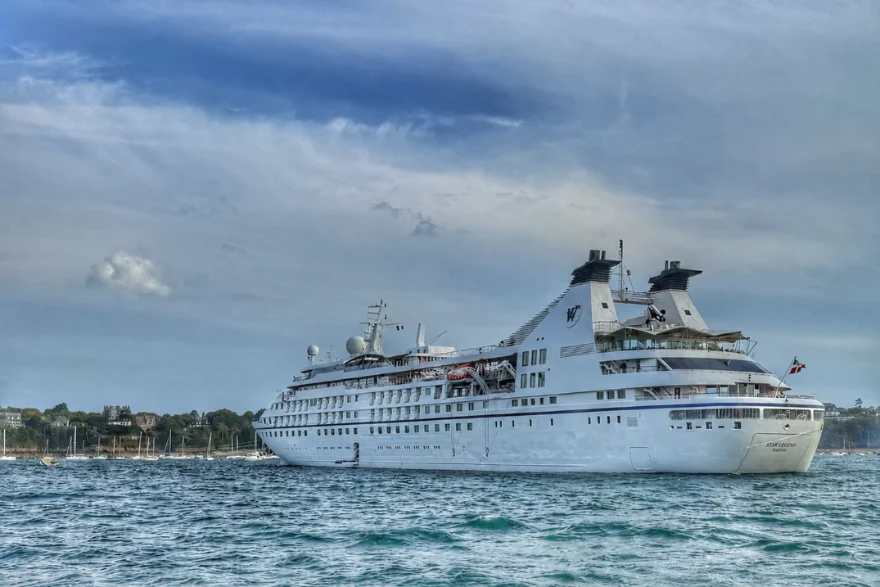
It seems fitting that our 7-night cruise from Rouen to Bordeaux was also designated a James Beard Foundation voyage. Windstar has partnered with the foundation for 11 years now, sailing its award-winning chefs alongside guests and folding their dishes into Amphora menus, and this trip felt like a perfect showcase of why. So many of the ports we visited were immersed in a world-class way in either culinary arts or wine — and often both. It started in Rouen, on the Seine River. It’s a city I’d guess a lot of us weren’t that familiar with, but one that’s been named a UNESCO Creative City of Gastronomy. And our voyage finished in Bordeaux, by way of Honfleur, Guernsey, and St. Malo.
What stuck with me most wasn’t the food itself — it was how little distance there was between us and the person making it. Chef Gabriel wasn’t a name on a menu; he was someone you bumped into at the market, traded trekking stories from our visit to Mont-Saint-Michel, or chatted with by the pool. Here’s where that showed up.
Our guest chef
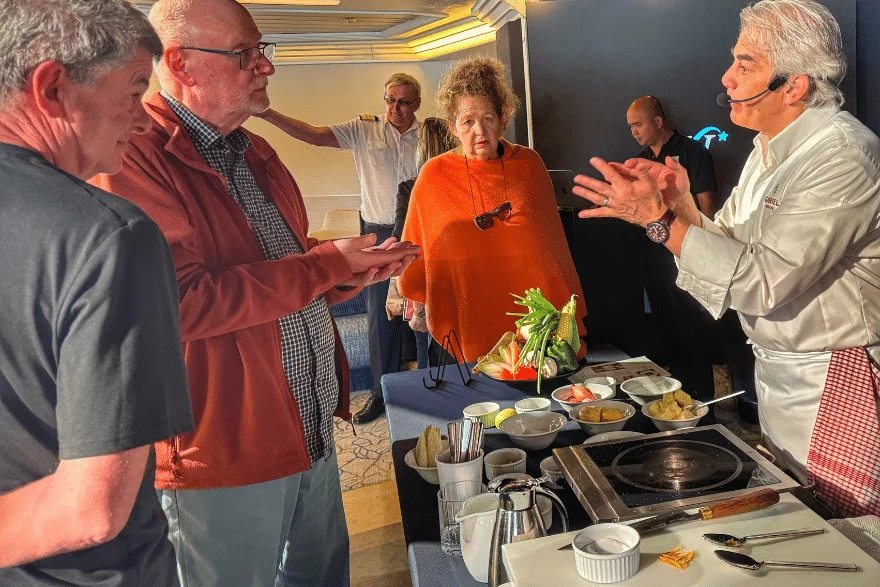
James Beard Foundation Chef Gabriel (center) prepares for his first presentation, Sea Bream with Green Tomato Marmalade./Carolyn Spencer Brown
Chef Gabriel Kreuther, a restaurateur in Manhattan who has earned two Michelin stars, was born and raised in France’s Alsace — a nice connection, even though it’s on pretty much the opposite side of the country. Early in the week, I sat in on a cooking demo where he prepared a sea bream with the most incredible green tomato marmalade (later that night, the dish was on every restaurant menu onboard). He didn’t just tell us how to make the marmalade — he shared his farm upbringing, about how at the end of summer his mother needed to find a way to use up the last, often not-quite-ripe, tomatoes. As he wove his family story into the recipe, I was entranced, both by the dish and the storytelling. How often do we get a private audience, as we did on Star Legend, with a James Beard award-winning chef?
The price tag for James Beard activities onboard? Zero.
James Beard Foundation guest chef Gabriel Kreutzer(left) and Star Legend’s head chef Renato are shopping for fresh products at the food market in Deauville./Carolyn Spencer Brown
They’re simply part of the cruise experience. This voyage was the fourth of five onboard partnerships this year; there’s one more to come in October. Does this program offer superb value for the money? You bet. And a PS: Windstar will announce its 2027 lineup in October.
Chef-led voyages also spotlight crew and culinary staff
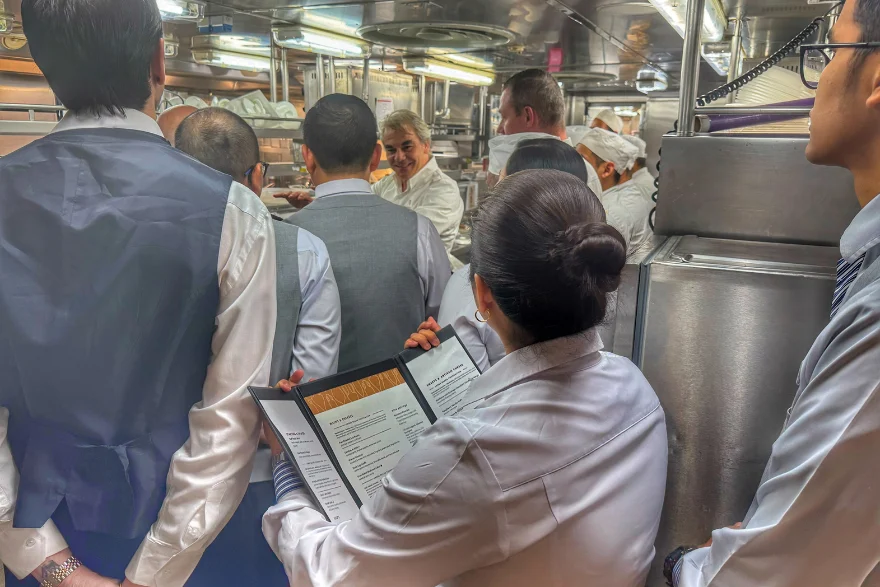
Members of Star Legend’s waitstaff learn about Chef Gabriel’s dishes-of-the-day/Carolyn Spencer Brown
Guest activities got the spotlight, but the crew benefited too. It was wonderful to learn that the kitchen team and Amphora waitstaff got their own time with him. The onboard chefs cooked his dishes alongside him, while the waitstaff joined tastings so they could speak knowledgeably about his menu with guests. For them, working with a James Beard award-winning chef who’s also earned two Michelin stars was the chance of a lifetime.
The onboard chefs cooked his dishes alongside him, while the waitstaff joined tastings (and sampled dishes) so they could speak knowledgeably about his menu with guests.
Making friends
Speaking of participating, the entire week with Chef Gabriel felt, for me and many others, like making a new friend who just happened to be a superstar chef. I overheard one passenger saying they’d taken a hiking excursion with he and his family, and that he was great to talk with. He, like many of us, complained about a few aches and pains after the trip up towering Mont-Saint-Michel. He joked with us, sat down for quick get-to-know-you conversations, and patiently answered every question we had during and after his cooking demos. My favorite interaction with him was at the Deauville Market, where the Frenchman could identify exotic dishes and explain how they were put together, while Star Legend’s executive chef, Renato, was busy buying fresh ingredients for all of us to try back onboard.
Something to enjoy for every level of culinary enthusiast
On Star Legend’s market tour, you didn’t have to be a hardcore foodie to make fabulous discoveries, like these fresh strawberries./Carolyn Spencer Brown
You don’t have to be a passionate foodie to have a blast on these chef-hosted cruises. You can pick and choose where you participate. You get to eat really great dishes that you can also make at home (or not — your choice). You can wander off to soak in a hot tub, read a book by the pool, or spend time in port just poking around. The ambience couldn’t have been more relaxed.
And one of the nicest realizations during my first James Beard Foundation-hosted cruise was this: Chef Gabriel’s dishes remain on the menu for future guests to enjoy, alongside selections from previous JBF chefs. It’s an inspiring (and delicious) way to celebrate Windstar’s 11-year partnership and the incredible collection of chefs who have graced its kitchens over the years.
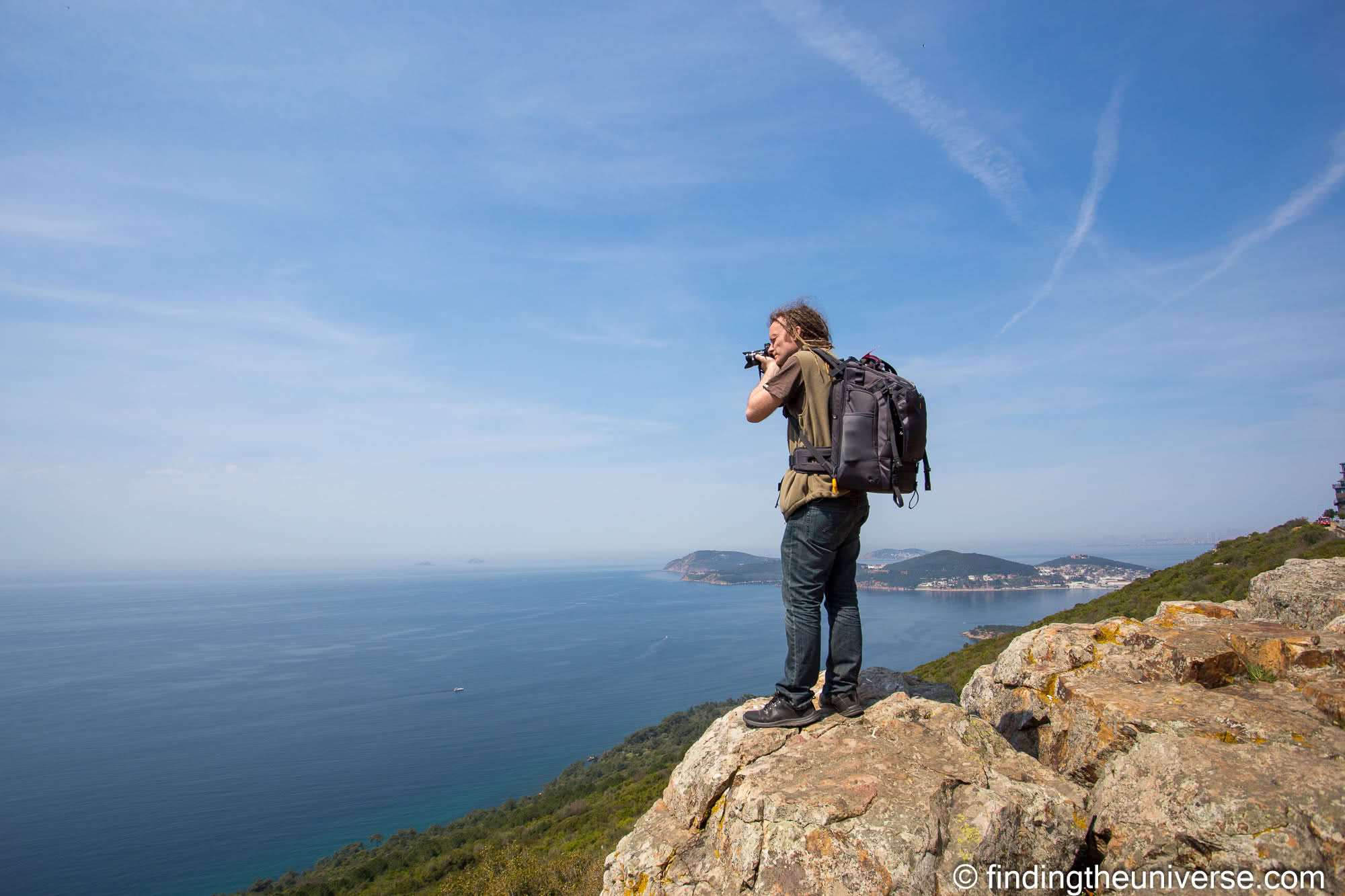
I’ve been carrying cameras up hills for over fifteen years as a professional travel photographer, on moorland in Cornwall, on waterfall hikes in Iceland where it rained more or less continuously, and on day hikes across the US. For most of that time I’ve done it with two very different setups: a dedicated camera backpack…
Picture yourself on a warm winter cruise with a Latin beat, filled with bucket list sights to see along with dreamy beach days. My first Panama Canal cruise made me feel like we had broken free from our regular lives. There’s a slower pace, a strong sense of culture, and a pull on your heart to see more.
Windstar’s small ship cruises let you see both iconic and lesser-known monuments and attractions in Latin America and the Panama Canal. It’s possible to escape for just a week or immerse yourself on a multi-week, two-ocean sojourn. Costa Rican cruises feature a local naturalist onboard to expand your knowledge of the region. Many Latin America cruises have options to lengthen your trip with cruise tours and back-to-backs, all with ample time for relaxation. Think multi-colored beaches edged by lush greenery. And then there’s the ship’s watersports marina, providing easy access to clear blue waters.
With 35 distinct Latin America and Panama Canal itineraries, it can be a challenge to choose the perfect one. Are you primarily interested in the canal itself, or are you looking for a cruise that’s as easy to plan as one in the Caribbean, but with some new-to-you exotic ports of call? Perhaps you haven’t given it much thought at all. Read on as we look at the options for exploring Central America and its surrounds with Windstar.
Experience the Panama Canal
Panama Canal cruises on other cruise lines have historically been long cruises, often fourteen nights or more. And they’re often showcased as repositioning cruises (moving ships between Alaska and the Caribbean, for instance). Windstar breaks free of both patterns, offering an entire season of crossings and also giving guests the chance to tailor the cruise your way. Go long if you want — or go short.
The absolute best itinerary for seeing the canal on a short cruise is the 7-night voyage. This is a through-the-canal cruise. Depending on the date, you will either begin on the Atlantic side in Colon, or on the Pacific side in Puerto Caldera.
Getting to these cruises involves easy non-stop flights from either Miami (three hours) or Houston (four hours). Flights to and from cruises starting in Colon are through Panama City (PTY). Transportation between the cruise terminal in Colon and the Panama City airport can be arranged by bus, shuttle or private car. The closest airport to Puerto Caldera is Santamaria International (SJO), which is roughly forty minutes from the airport.
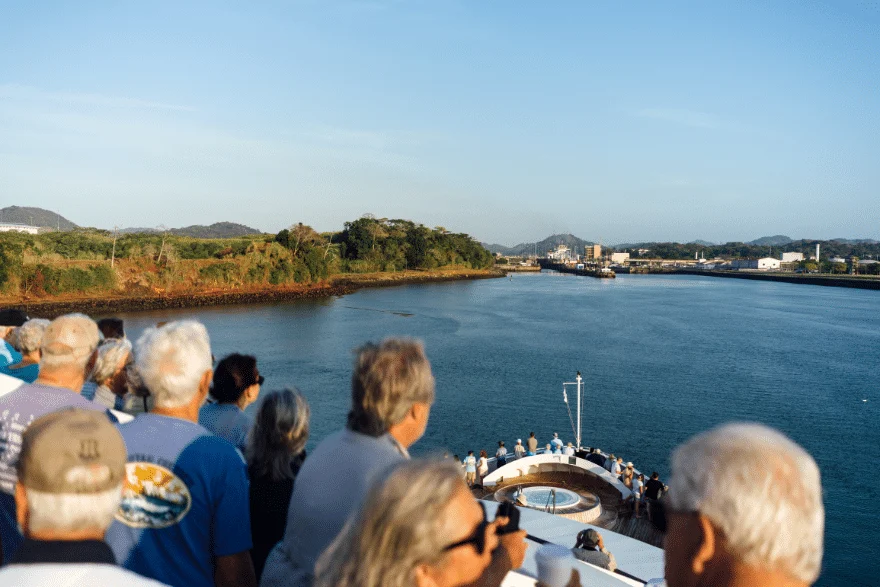
Whether you’ve been through the canal or not, seeing it from the perspective onboard Windstar’s small ships is both fascinating and relaxing. You won’t have to fight a crowd for a view as the ship passes through the locks because there is no crowd. Onboard local guides narrate the transit throughout the day.
Your Windstar ship essentially becomes a river cruise ship for the day. You kick back and enjoy the feat of engineering and the lush Panamanian scenery pass by throughout the day. Ship choices on the seven-night itinerary include both sailing vessels and Windstar’s motor yachts.
Passengers and crew cheer the clearance in the dark of early morning and again on the opposite end in evening twilight. Talk about photo ops!
Insider hints
Flight options will generally require at least one day of advance arrival pre-cruise. No matter which direction your cruise travels though, the old town in Panama City is worth exploring with an additional overnight.
Latin America’s lush wilderness adds to the appeal of a cruise transit through the Panama Canal./Harry Tarbuck
If the Panama Canal itself isn’t as important to you as exploring ports of call in Central America, specifically those on the Pacific coast, you might consider Naturally Costa Rica: Puerto Caldera to Panama City. This is a seven-night itinerary between Balboa, Panama and Puerto Caldera, Costa Rica, with stops in both countries. The first thing to know is that there will be beaches. And if beach days aren’t your thing, there is plenty of time to explore the rainforest on excursions.
Ports of call include exotic spots like Isla Parida where excursion choices are a bit adventurous, ranging from snorkeling, fishing, and hiking, to wildlife viewing (and yes, there will be monkeys). Next up is Golfo Dulce where you can do a sloth walk excursion or try some kayaking. Quepos offers a lot of choices, with more options for hiking and wildlife viewing, but also plenty of culinary treats to sample.
Insider hints
For water lovers, this cruise offers six potential watersports marina days. And for those, like me, who are always looking for places to scuba dive, this cruise offers the opportunity to book dives independently in most of the ports of call. I easily found dive operators all along the way. Days in ports are long enough to go out on your own for a couple of boat dives, then return to the ship for a leisurely afternoon.
Cultural deep dives
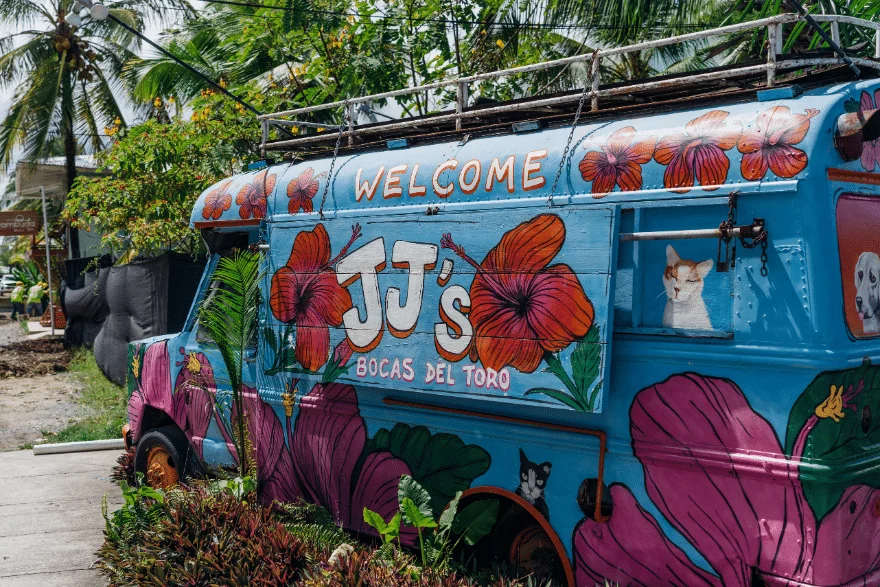
In Latin America, food trucks bring culinary treasures to the islands./Harry Tarbuck
For those driven to experience the culture of this region in-depth, there are over a dozen Star Collector Series cruises, ranging from thirteen to 55 nights. These offer the opportunity to stay aboard longer, experiencing multiple segments of the region (and often beyond). Choosing a Star Collector comes with a bonus perk of complimentary daily laundry, allowing you to travel a bit lighter.
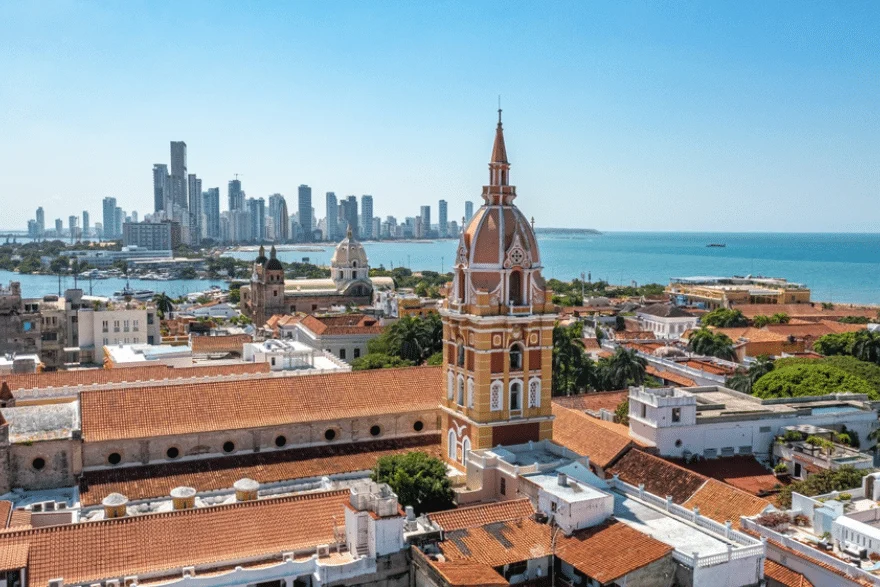
Colombia’s Cartagena offers an historic old town, a gleaming metropolis, and fabulous white sand beaches./Shutterstock
Mixing the Caribbean and Latin America
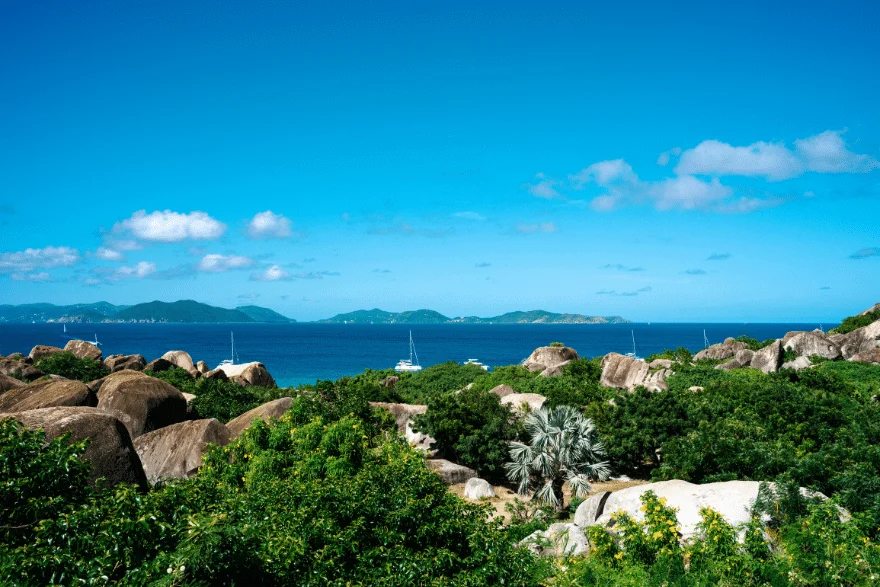
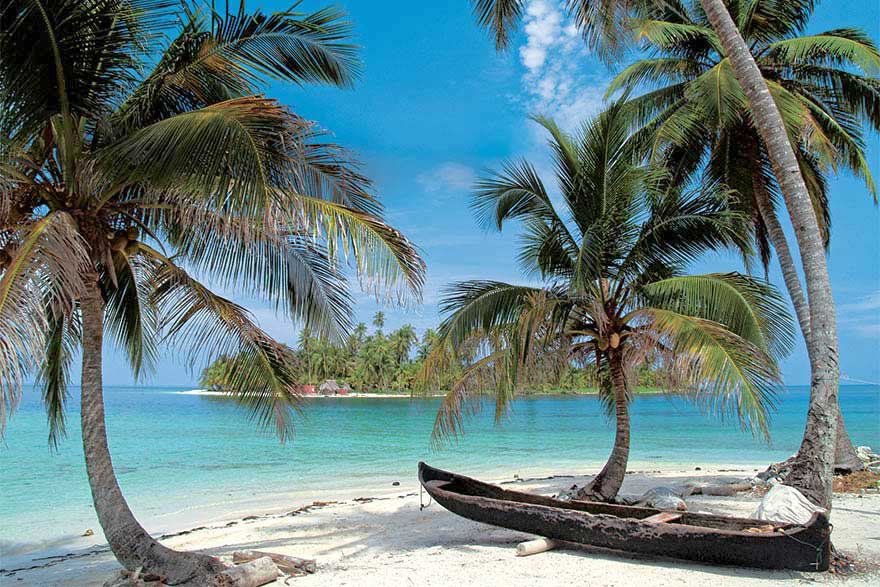
If you love remote islands in the Caribbean, San Blas’ isles, part of Panama, are mostly uninhabited.
Don’t fancy giving up your Caribbean winter adventures? It’s okay, there are options that combine Latin America with some of the Caribbean’s most delightful island escapes. Take the previously mentioned six-day hop between Aruba and Balboa, including a transit through the canal if you’re trying to squeeze it all into a weeklong cruise.
Insider hint
Melinda Crow admits that the Caribbean’s Bequia is one of her favorite places in which to return.
If you’re like me and can’t bear the thought of being so close, yet missing out on the other two islands of the ABCs (Bonaire and Curacao), start your Star Collector in Bridgetown, Barbados on Windward Ways and Tobago Cays. This seven-night addition hits the best of the Southern Caribbean: Bequia, Mayreau, St. Lucia, Bonaire, Curacao, and ends in Aruba. It would be hard to ask for more.
In a recent Risking Old Age in America podcast, I had a fascinating discussion with Israel (Issi) Doron, chair of the Department of Gerontology at the University of Haifa in Israel, about the differences in the systems of elder care in our two countries. Unlike the United States, Israel provides up to 20 hours a week of free home health care for all but its most affluent residents.
Here are some excerpts from our conversation:
ROA: You and I have talked before about the differences between Israel and the U.S. in elder care — how it’s provided, how it’s paid for. Could you talk a bit about how that all works in Israel?
Doron: Elder care is a challenge all across the world, so the challenges are common in most developed countries…including the U.S. and Israel.
I will share [two] key issues about how Israel handles elder care and how it compares to the U.S. The first point is the fact that Israel, unlike the U.S., has universal healthcare coverage. So every resident of Israel from birth to death is covered. In the U.S., the federal program of Medicare does provide a sort of universal healthcare for older adults.
However, as we know, aging is a life course issue. So if in your 20s, 30s, 40s or 50s you didn’t receive adequate healthcare, when you reach your 60s, 70s, 80s, and 90s, it’s in some perspectives a little bit too late. So Israel provides a better starting point for older adults in the sense that when they reach age 65 or 67, they have experienced relatively adequate and good healthcare coverage on a universal basis.
The second element, which used to be unique to Israel, is that Israel was one of the first countries in the world that legislated and anchored in its Social Security legislation, what we called community-based long-term care insurance. Every resident of Israel who pays into the social insurance system is eligible for this coverage [of 20 hours of home health care a week]. There is a financial needs assessment, but it’s 1.5 times the average income, so the vast majority of older adults in Israel are entitled to receive that community-based support.
ROA: Has this program always been available?
Doron: It was enacted in the 1980s as one of the first such programs in the world at the time. Since then, many countries…have adopted similar programs and added them to the traditional social insurance and social security programs as part of a national coverage to provide answers to the rising needs of the aging populations.
And from a financial perspective, it’s cheaper and more financially viable to provide the care for older adults in the community. And that’s what they prefer, rather than to opt for traditional institutional based long-term care services, which are quite expensive and not what older people really want.
ROA: So, who provides the care?
Doron: So once again, this is a fascinating issue and a challenge. To begin with, like the U.S. and most developed countries, the vast majority of care for older adults is provided by family members. It doesn’t matter which system you have, that’s still what happens in the vast majority of the world. Family members…are the initial point of reference to provide care.
But once we move into the community-based long-term care services, it’s low-paid and the workforce is mostly women, often older themselves. After the fall of the former Soviet Union, we had a significant immigration of Jews…to Israel and a very significant portion of the care workforce were women…from the former Soviet Union.
More recently, there is a fascinating sub-sector of migrant workers from Asia, from Nepal, from the Philippines who come to Israel and basically provide 24/7 care for older adults at home. And you have a subgroup of Arab Israelis who work in this field. Unfortunately, it’s a low-paid job and not easy work to do.
For more from Harry Margolis, check out his Risking Old Age in America blog and podcast. He also answers consumer estate planning questions at AskHarry.info. To stay current on the Squared Away blog, join our free email list.
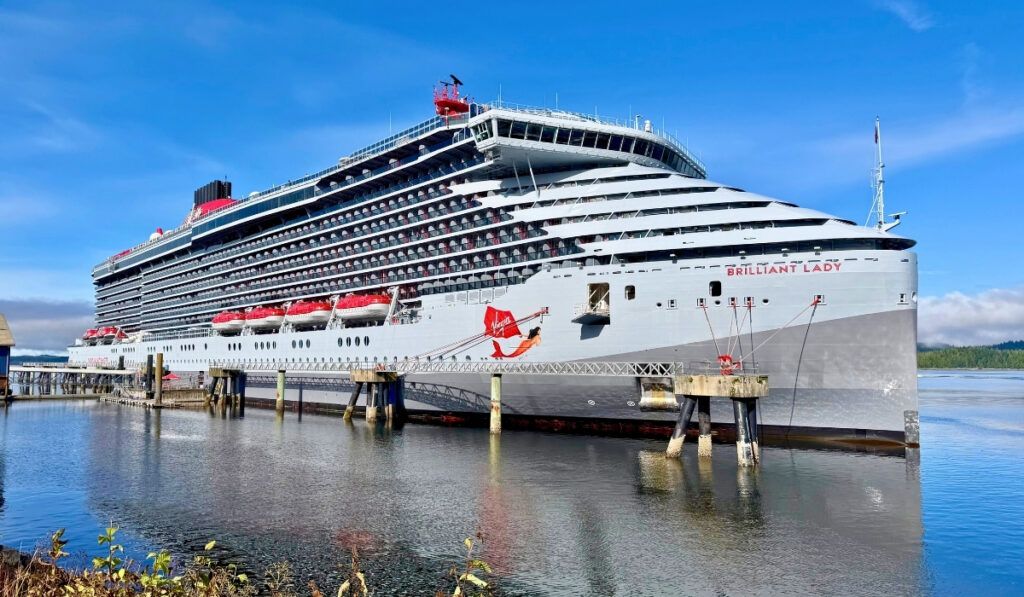
Since Virgin Voyages’ debut, the cruise line’s itineraries have been all about sun, fun, and party vibes. From Caribbean beach clubs to Mediterranean nights, the social atmosphere, eccentric entertainment, and no-kids policy made sense. So when Brilliant Lady headed north for Virgin’s first Alaska season, we had the same question you probably do: does an adults-only brand that set out to redefine the cruise vacation actually work in a region where lines like Princess and Holland America have been leaders for years?
We booked a sailing to find out. We’ve sailed Virgin five times before Alaska, so we know the product pretty well. We’ve also previously cruised to Alaska seven times — with Princess, Holland America, Norwegian Cruise Line, and Celebrity Cruises — so we know exactly what a good Alaska cruise looks like.
Does Virgin hold its own against the competition in the region? Is Virgin the right choice for your Alaska cruise? We’re sharing everything you should know before you put down a deposit and where we think the line shines (and falls short) in the Last Frontier.
If you want Alaska without kids, along with more complimentary food options and a trendier onboard atmosphere than the region’s norm, Virgin is a strong fit. If your Alaska bucket list includes Glacier Bay National Park, a cruisetour into the interior, or watching the scenery from a forward-facing glass observation lounge, this is not the line for you.
Pros of Virgin Voyages in Alaska
Adults-only in a family-friendly region
Alaska is a great destination for multigenerational families. The cruising season of May to September lines up nicely with school break and there’s something for every age group to enjoy. You’ll find plenty of kids sailing way up north on Royal Caribbean, Norwegian Cruise Line, and even Princess Cruises.
That’s why half the appeal of Virgin in Alaska is actually what’s missing! There’s no kids’ clubs, no children crowding the hot tubs, no chaos in the buffet. If the reason you’re drawn to the Last Frontier is the peacefulness, sailing it adults-only amplifies the experience.
Enrichment that pleasantly surprised us
We admit that we didn’t have high expectations for the enrichment component of the Virgin Alaska cruise experience. Princess and Holland America do a wonderful job of bringing the region’s history and culture to life with expert-led presentations on everything from the Gold Rush to Iditarod races and wildlife.
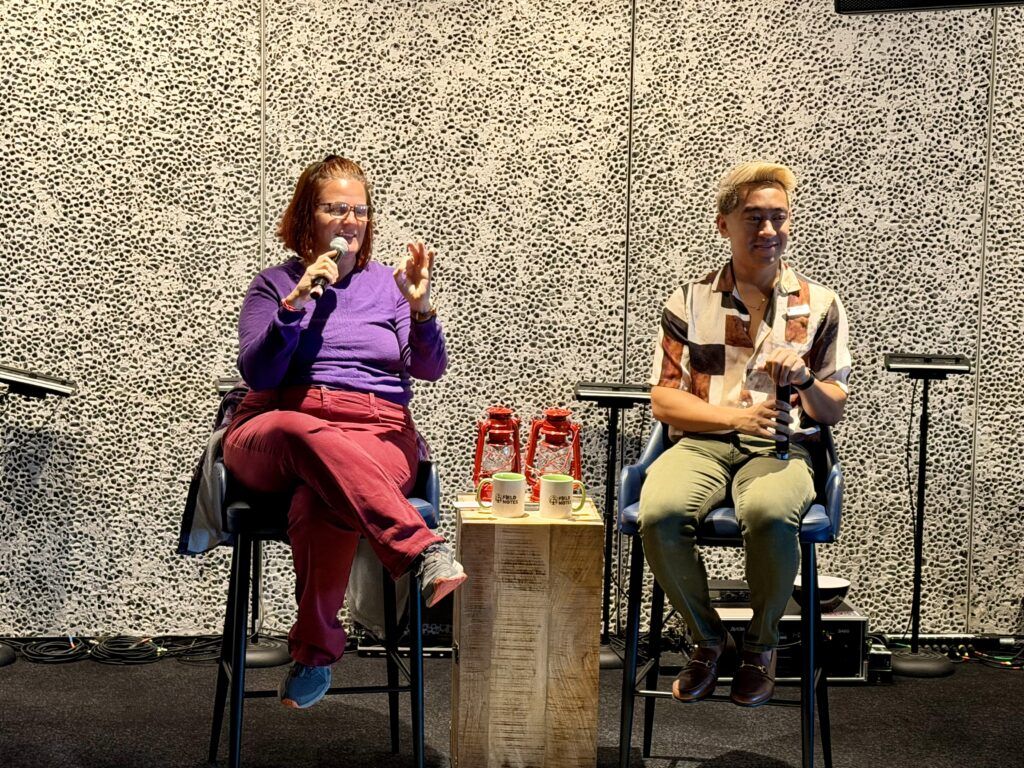
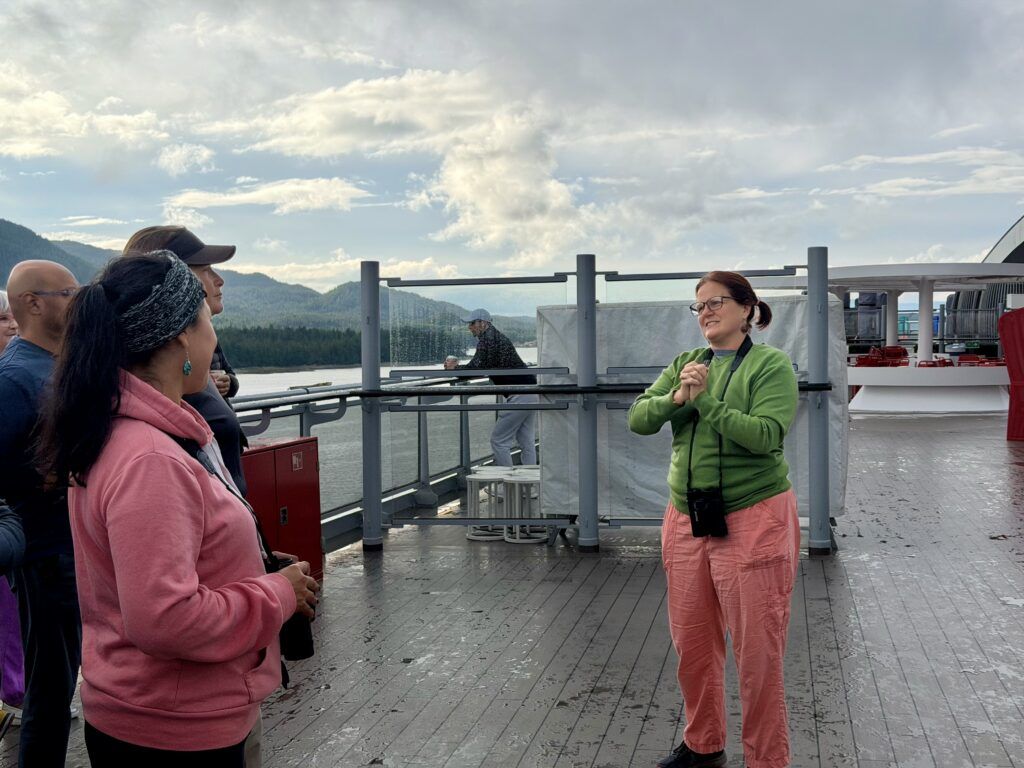
While somewhat different, we were pleasantly surprised with Virgin’s offerings. We had two experts on our sailing, a Naturalist and a Cultural Heritage Guide from Alaska Native Voices. Dr. Glo and Q offered a variety of sessions during the voyage. These ranged from the Honestly Alaska talk show and Primetime Ports presentation to the more informal Northern Narratives and Field Notes sessions. Both of these Alaska Happenings Cast members were knowledgeable and engaging, though we do wish there had been a few more formal presentations.
Some of the best food at sea, and it’s included
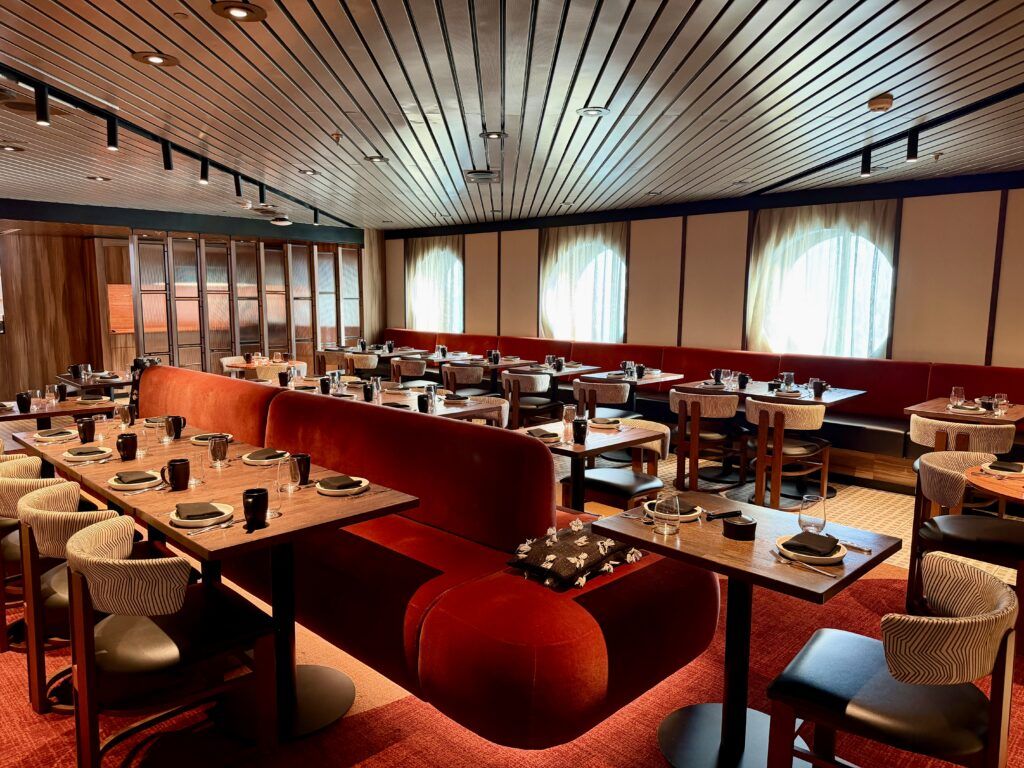
We’ve always felt that the food across the Virgin fleet is a strength, and Alaska is no exception. There’s no main dining room, no upcharges for specialty dining, and plenty of places to grab some casual eats. The food quality in the six complimentary sit-down venues holds up against lines charging specialty restaurant prices.
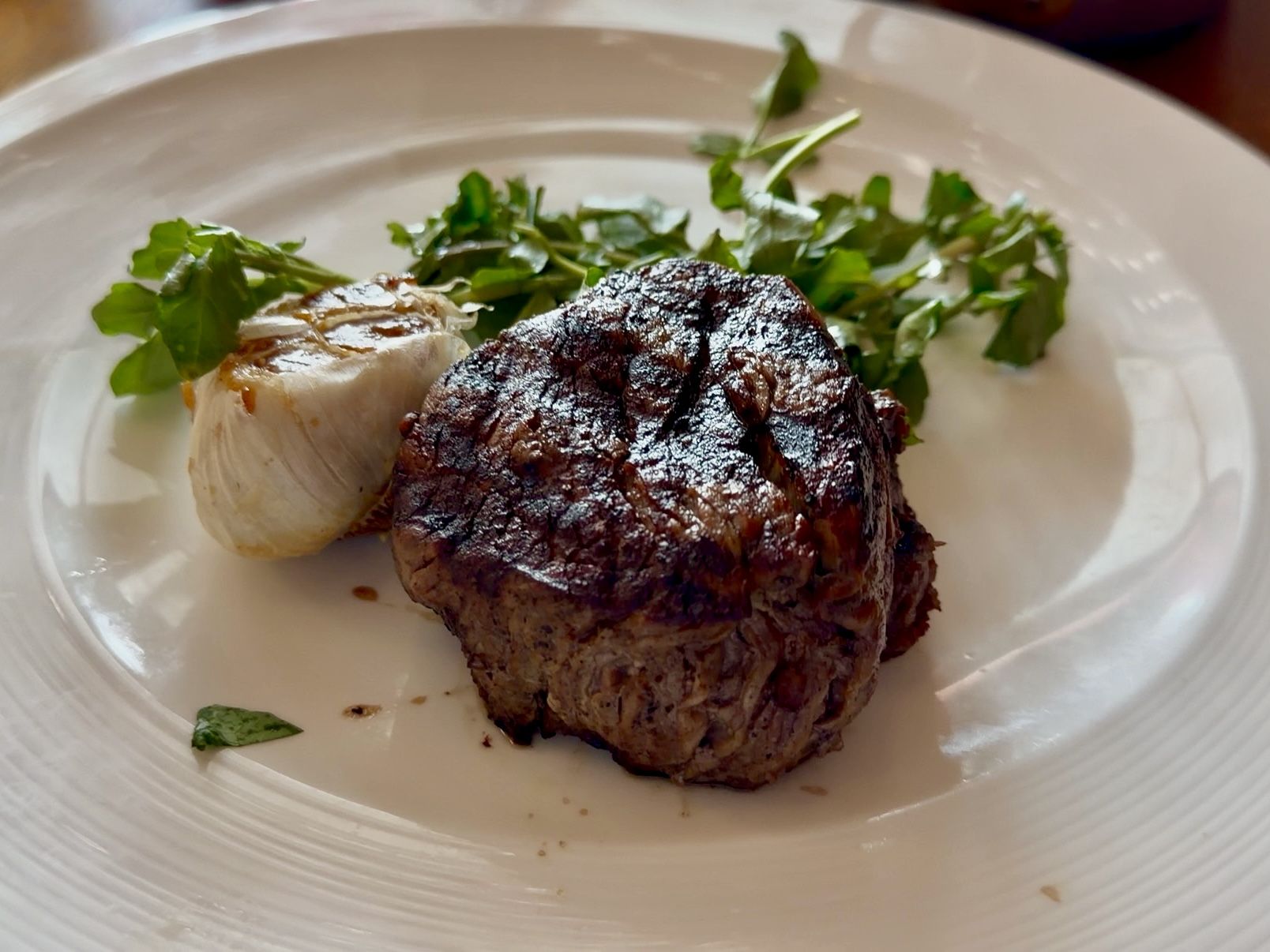
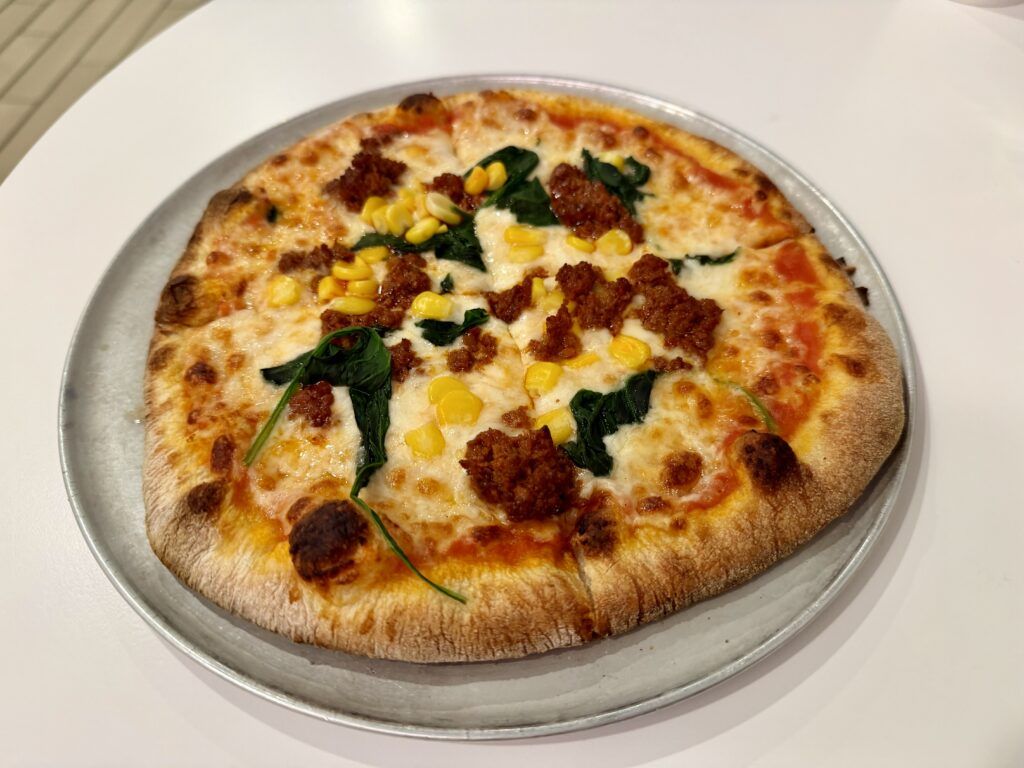
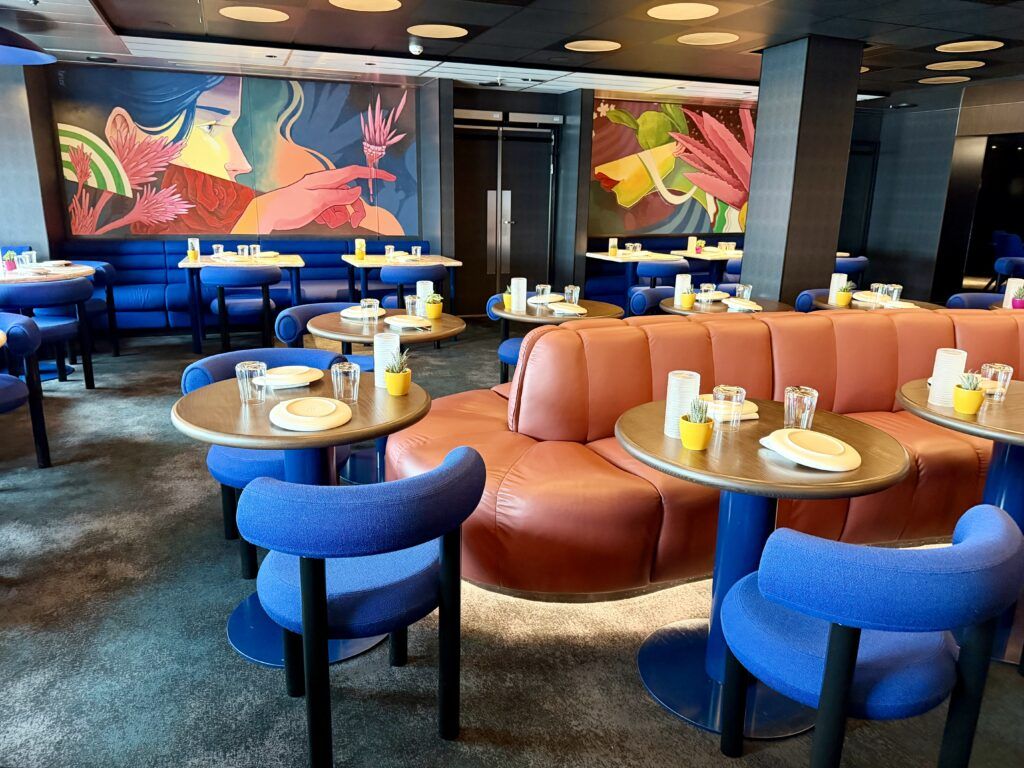
There’s lots of variety too: The Wake American steakhouse, Mexican at Pink Agave, Italian at Extra Virgin, Gunbae the Korean BBQ, and experimental cuisine at The Test Kitchen. Even the newest space debuting on Brilliant Lady, Rojo, did not disappoint. Not to mention, there’s always free pizza, gelato, chicken wings, and more.
Alaska-inspired dishes and cocktails
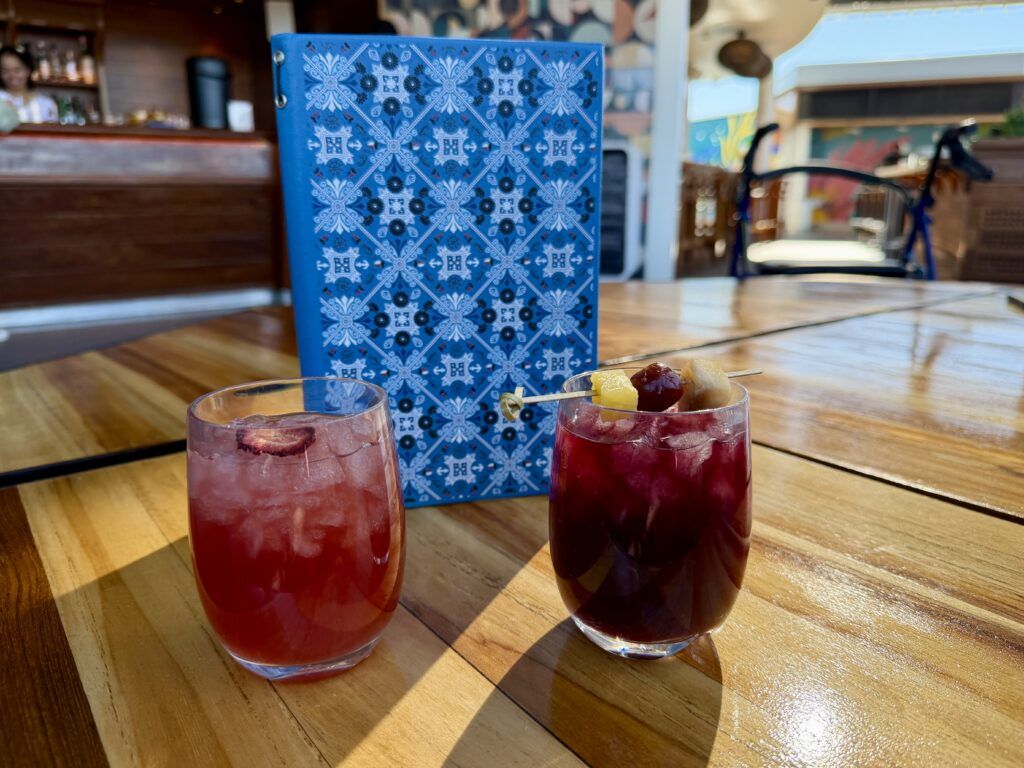
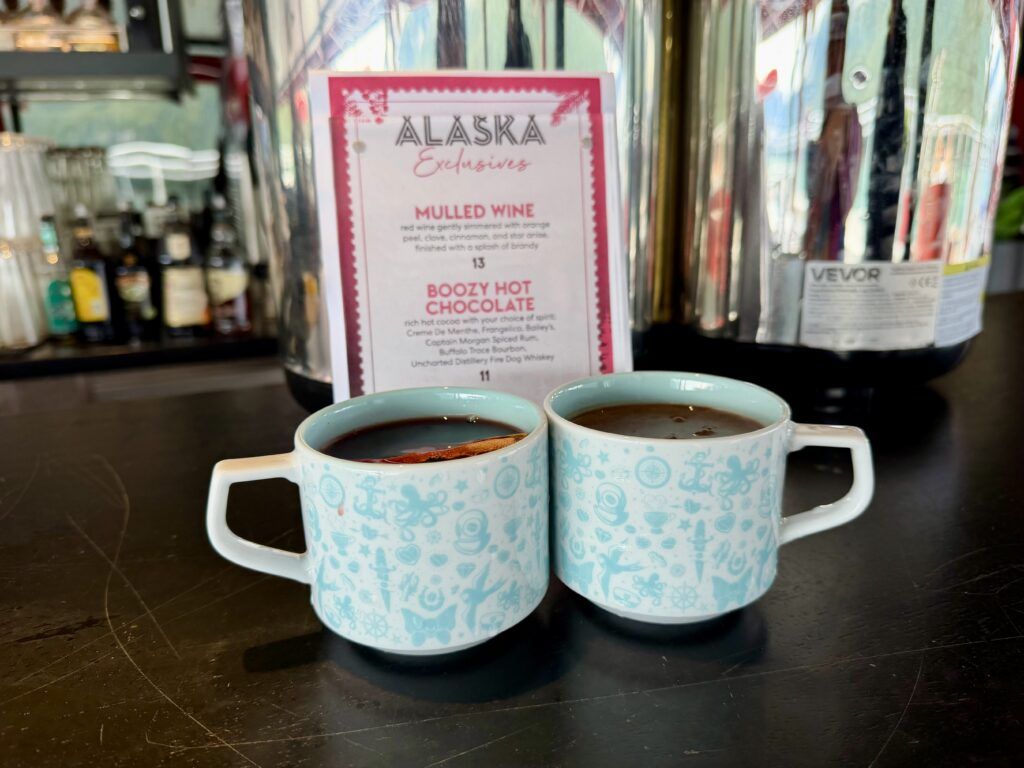
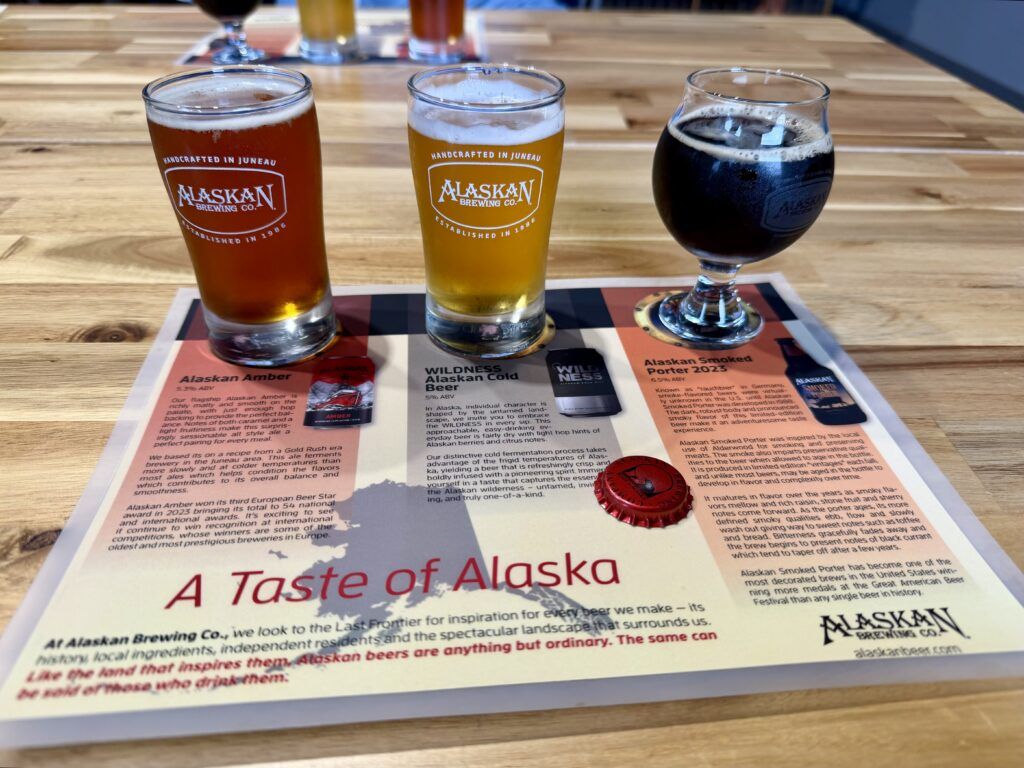
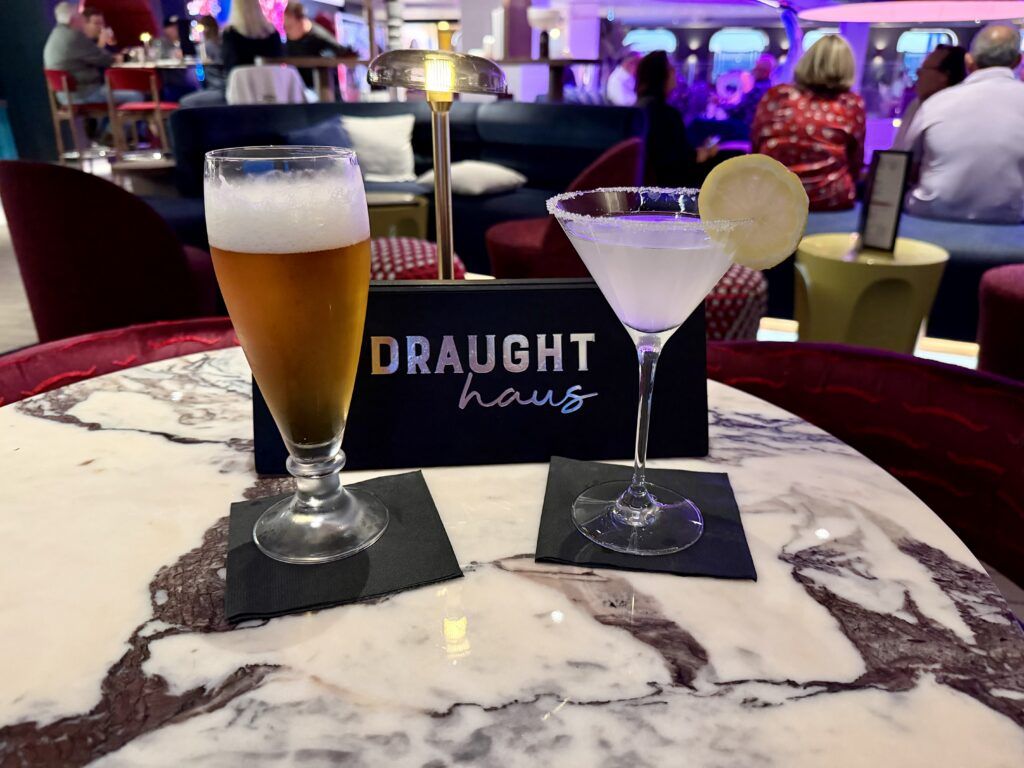
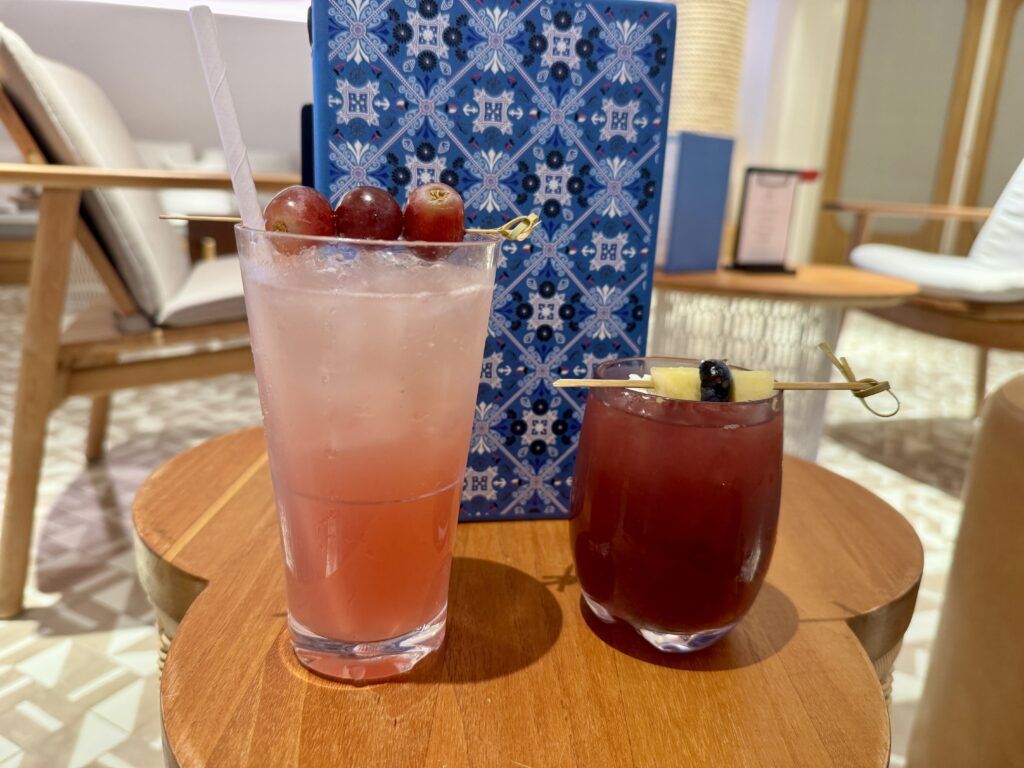
Beyond the already delicious food and drink offerings, several restaurants and bars feature Alaska-inspired dishes and regionally themed drinks. Just look for the bear icon on the menus. You can sip a Strawberry Rhubarb or Blueberry Mirlo sangria at The Dock, grab an Alaskan brew at The Loose Cannon, or warm up with exclusive mulled wine and boozy hot chocolate during glacier viewing. Select bars also serve local Alaska spirits and wines, like the Nutty Old Fashioned featuring fire dog whiskey from Uncharted Alaska Distillery.
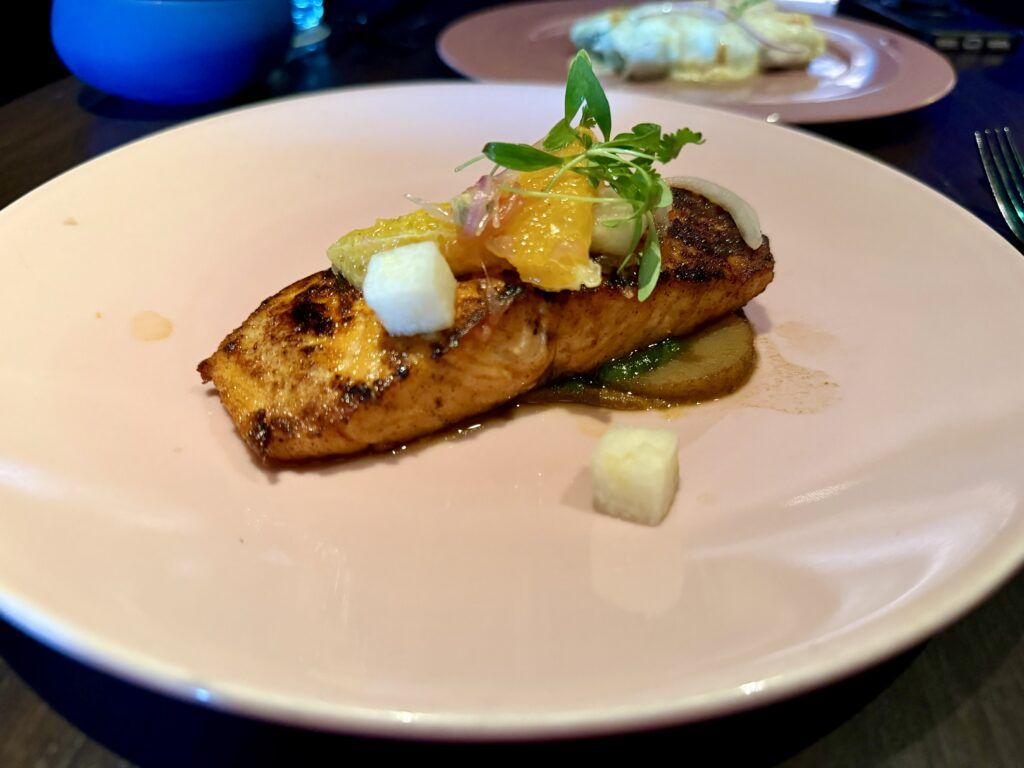
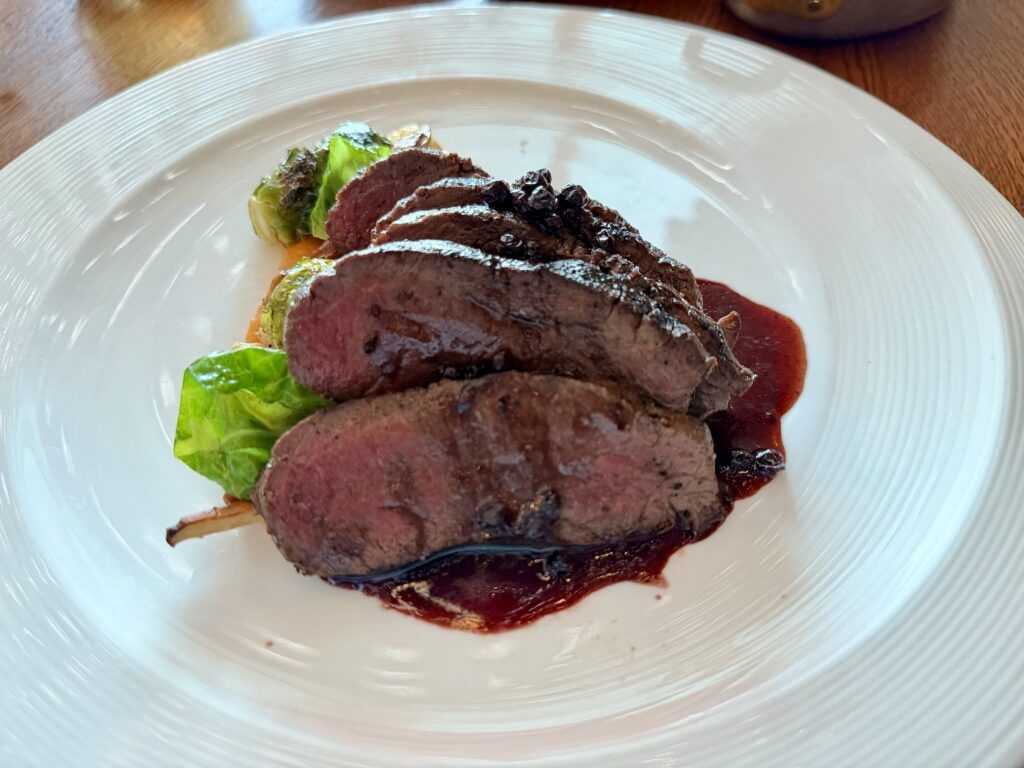
When it comes to food, you can sample items like Achiote Spiced Salmon at Pink Agave, Grilled Loin of Venison at The Wake, and Roasted Cod at Rojo. Don particularly enjoyed the salmon dish. There are also “Treat Yourself” items available for an upcharge on select menus, many featuring Alaskan King Crab.
Alaska activities with a Virgin twist
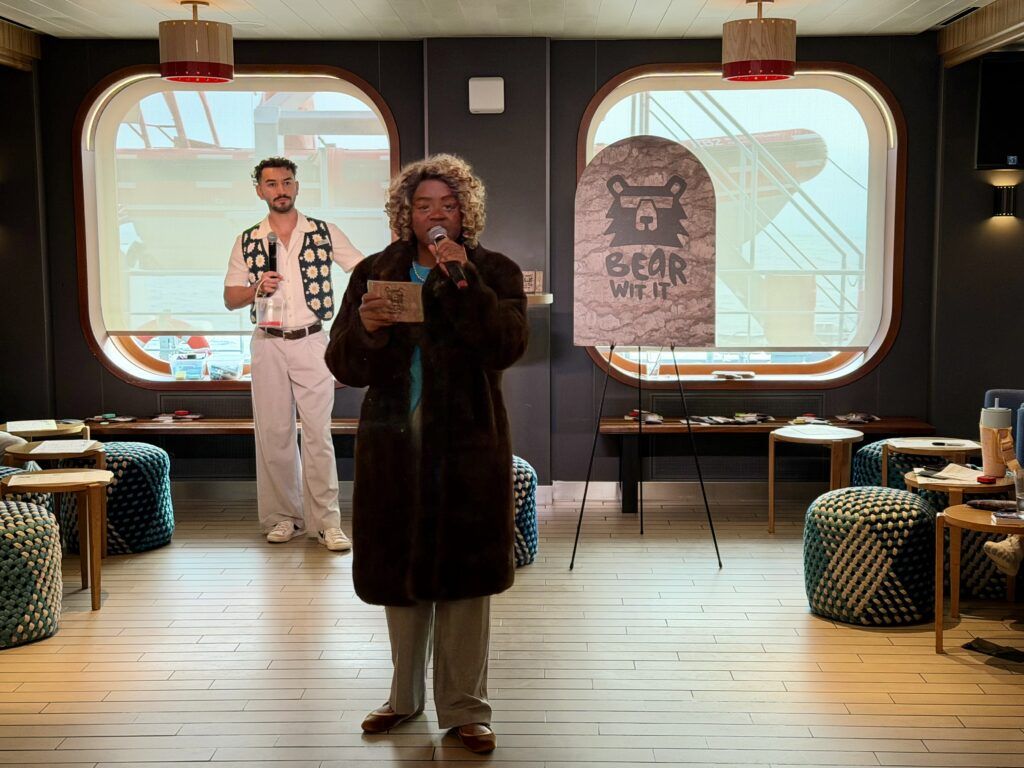
The onboard activity calendar leaned into the destination without losing Virgin’s quirky personality. In addition to the enrichment-type offerings, there were plenty of other activities to fill time between ports. Some of the Alaska-themed additions include Lumberjack Games, Bear Wit It trivia, Salty Trivia: Alaska edition, Crack the Crab, and Gold Rush Gamble ($50 buy in to play). These activities were a fun and creative way to pass time between the ports, and they were certainly more lively than what you’d expect on an Alaska cruise.
In addition, there are other Alaska-inspired up-charge activities including Drawn to the Wild, Northern Nightcaps, and Baking Alaska. While Baking Alaska sounded fun, and we did book it, it ended up taking place smack in the middle of glacier viewing so we decided to skip it.
A livelier onboard vibe than the region’s usual lines
Beyond the activities, the whole onboard vibe is more lively too. The atmosphere had energy that the region’s usual ships don’t match. If you think the evenings on Alaska cruises might be boring with many guests retiring to bed after dinner, that’s certainly not the case on Virgin Voyages.
There’s live music until 12 AM, Bingo After Dark, several production shows, parties in The Manor until late, the first night PJ Party, and Scarlet Night of course. There’s never a dull moment. In fact, we found it difficult to fit all the shows and parties into a 7-day cruise. Some of the production highlights for us were Murder in the Manor (requires a reservation), Duel Reality, Red Hot, and Out of Time. Actually, we’d argue that Brilliant Lady has the best entertainment in the Virgin fleet.
Trendy, modern ship spaces
It’s true that the newest and best ships in many cruise lines’ fleets don’t sail in Alaska, but that’s not the case for Virgin Voyages. Brilliant Lady is the newest lady ship, and she offers a trendy, modern premium feel. The design is contemporary and the spaces are social — a noticeable contrast with some of the Princess and Holland America hardware in the region that’s a decade old.
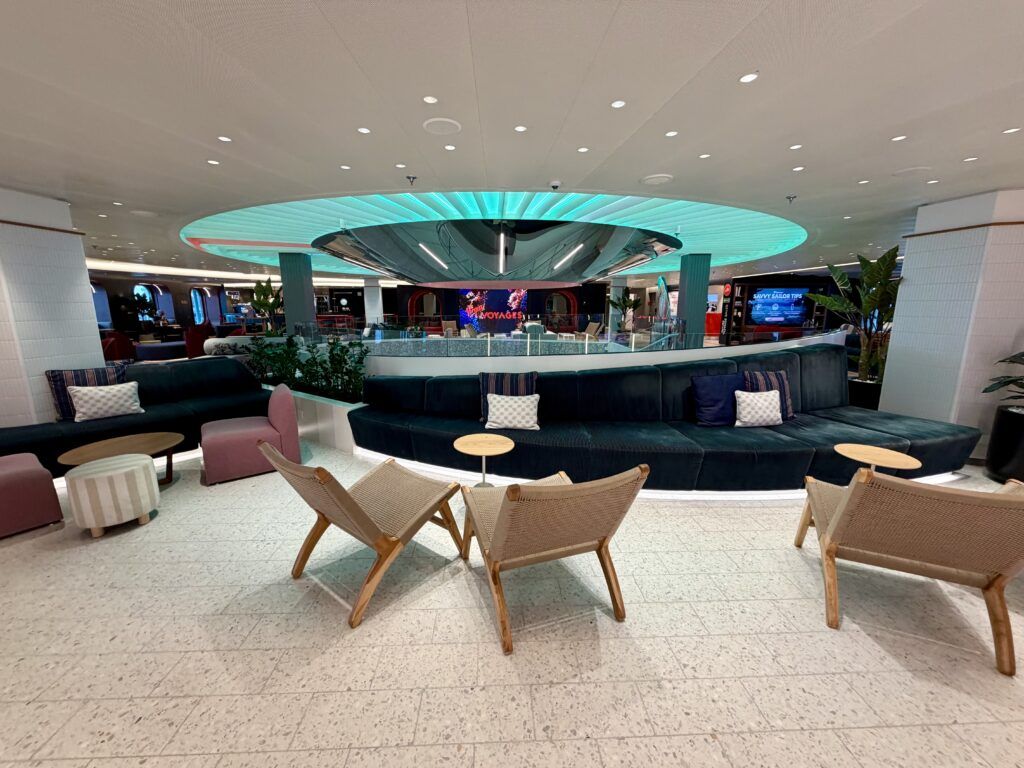
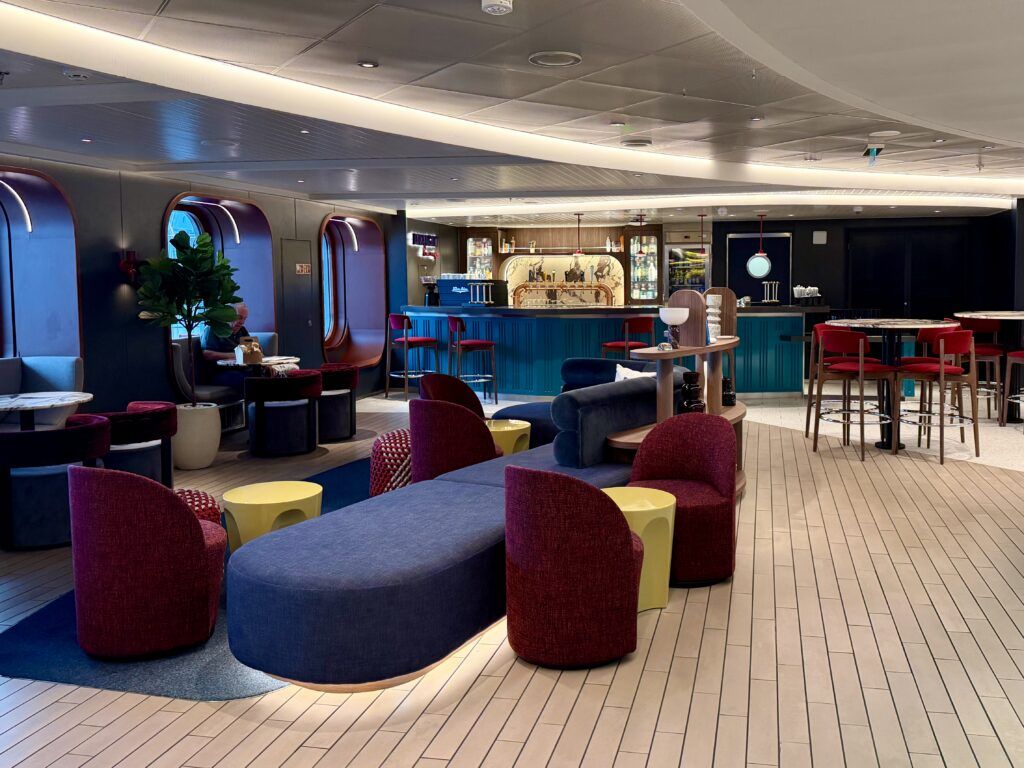
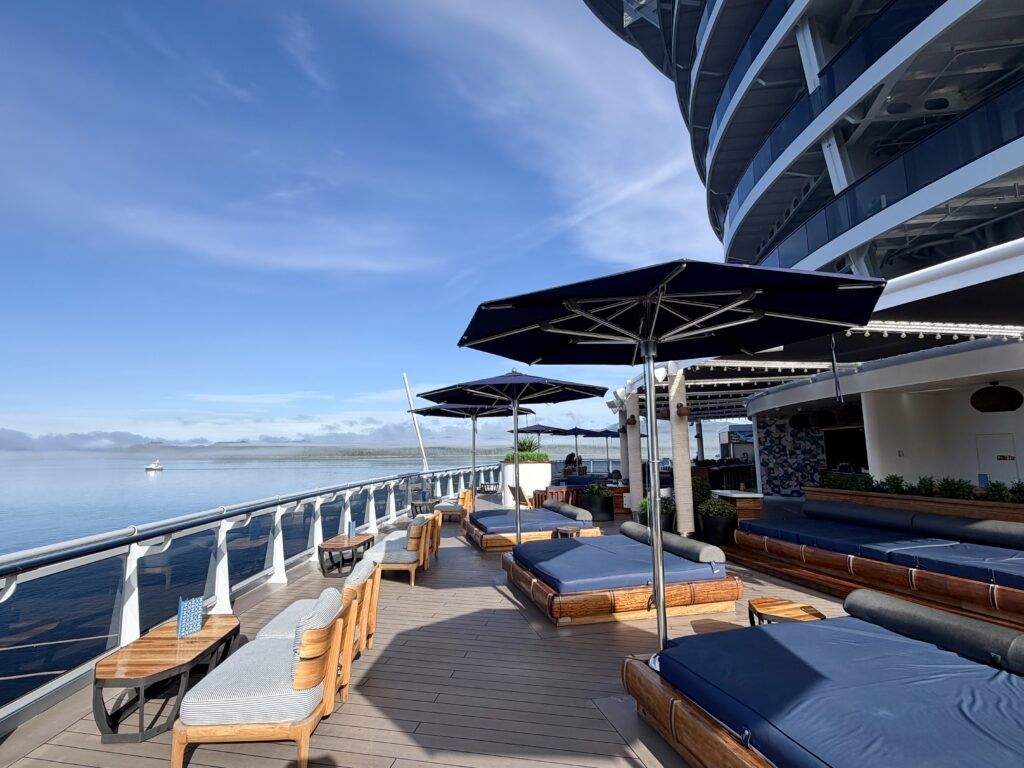
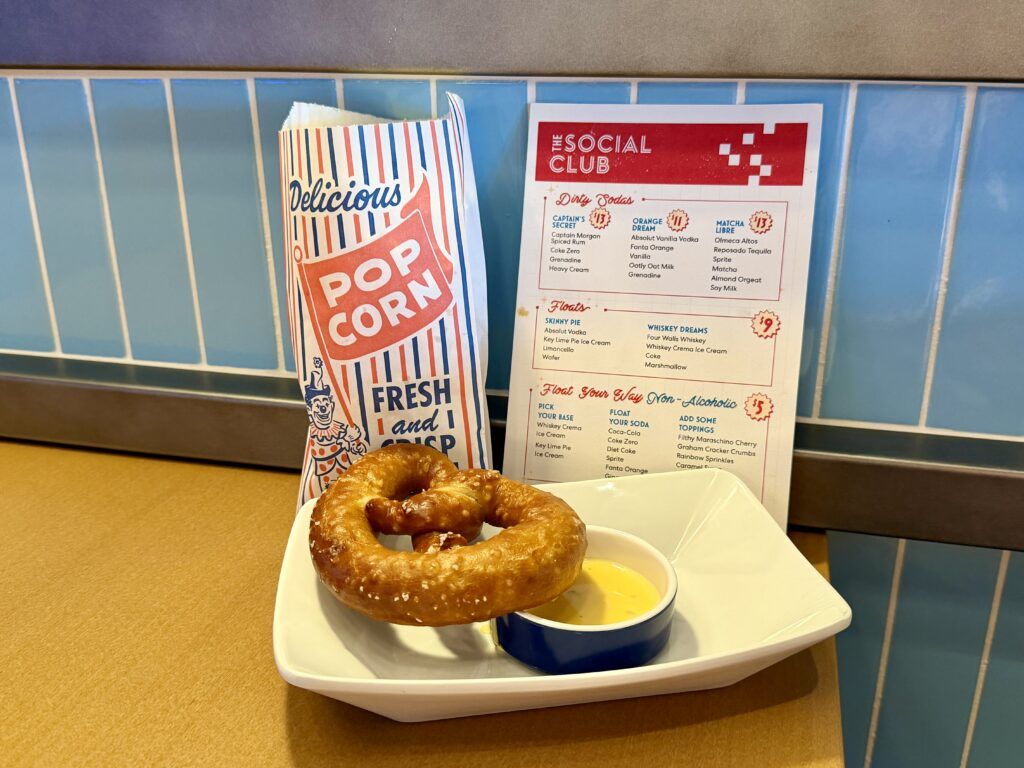
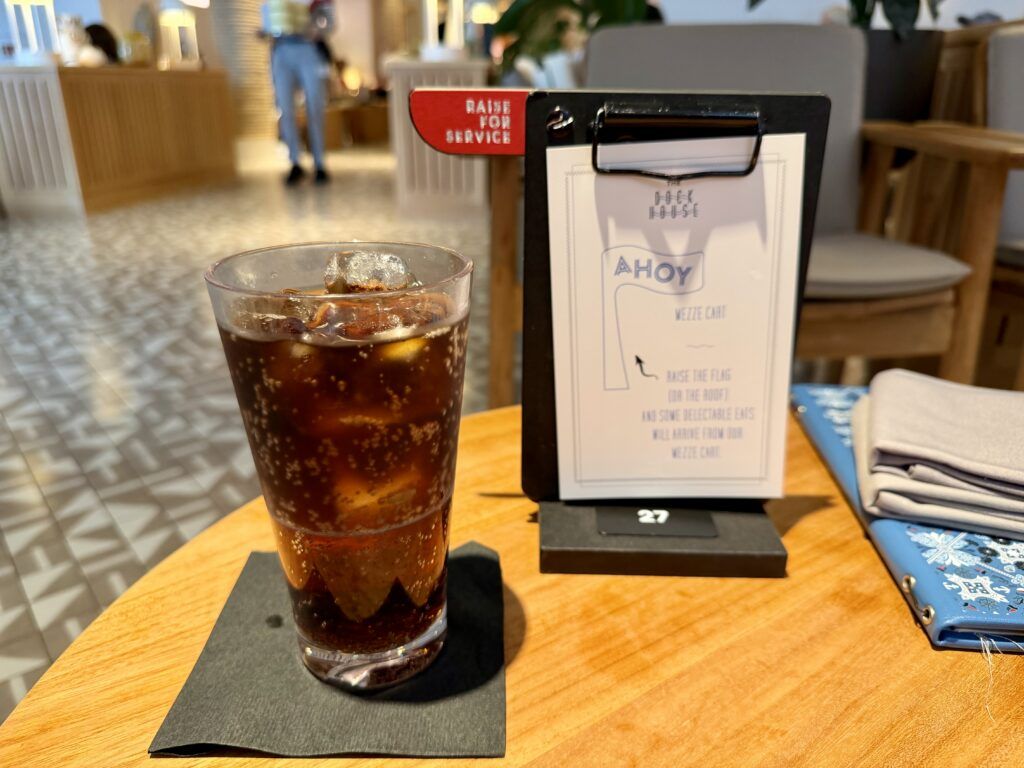
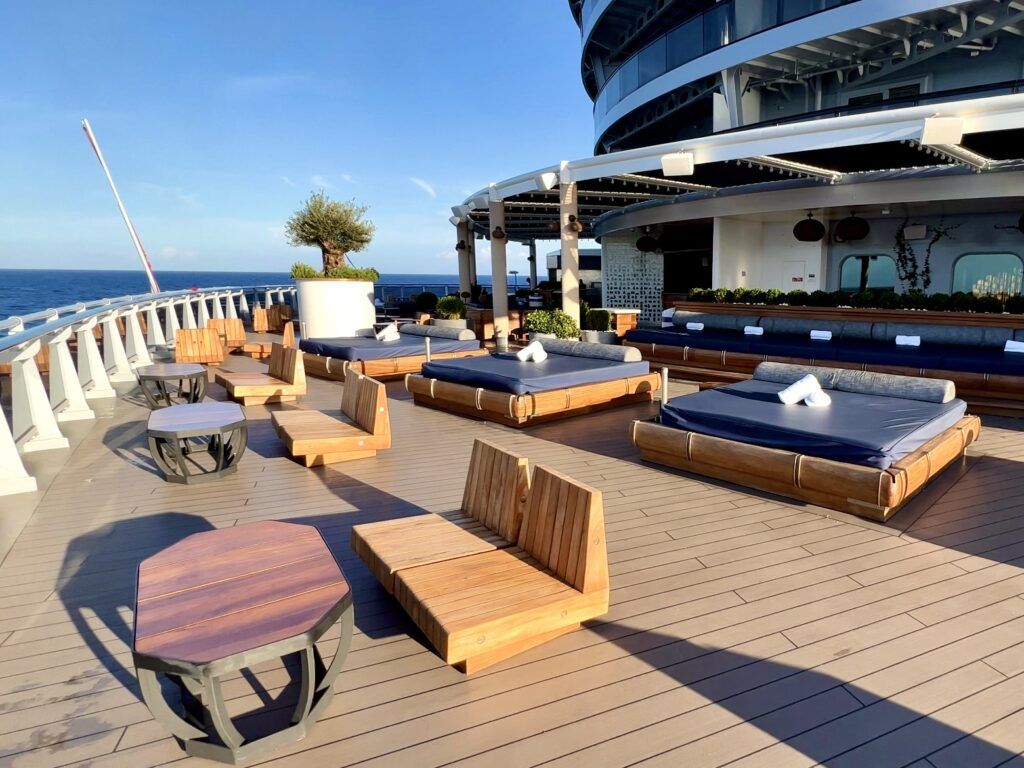
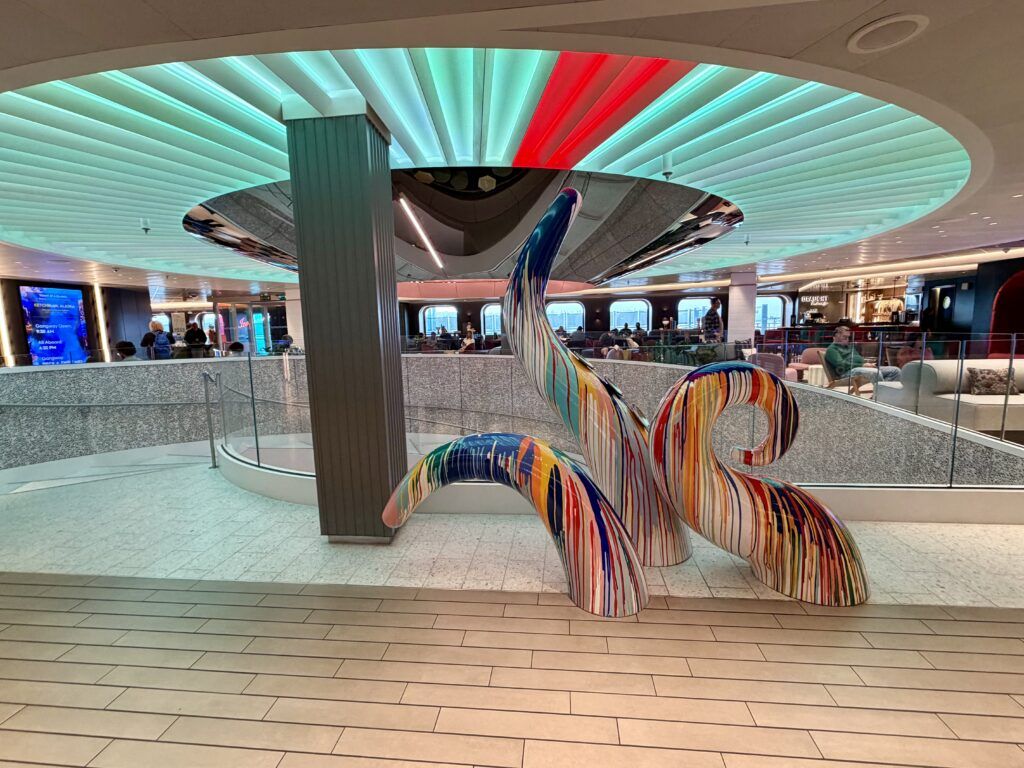
We particularly liked the redesigned Roundabout. Serving as the central atrium, this area feels more open and offers additional seating when compared to her sisters (even though it still doesn’t offer great views of the surrounding scenery). Our favorite spot on any Virgin cruise is The Dock and Dock House. These posh spaces are perfect for relaxing on a sea day, complete with tasty tapas and drinks. The Social Club is another fun hangout space for the kids at heart. It features free arcade games, board games, and snacks like pretzels and dirty sodas.
Inclusions that beat the competition on value
Basic WiFi, most dining, fitness classes, and soft drinks are all included in the Virgin cruise fare. This is where Virgin’s value shines. On paper the fares run comparable to the established Alaska lines, but once you start tacking on all the add-on costs, Virgin often lands cheaper.
For example, a 7-night Alaska cruise in May 2027 starts at around $900 per person (inside cabin) or $1650 (balcony cabin) on both Virgin’s and Princess’ newest ship. However, that doesn’t account for any specialty dining or WiFi on Princess Cruises. If you want to add those in, it’s $70+ per person, per day. The one caveat is that adding the Princess Plus or Premier package does include alcoholic drinks, whereas you’ll need to pay a la carte for those on Virgin. So, it’s important to do the math for your specific situation if you’re trying to get the best deal on an Alaska cruise.
A more diverse crowd than a typical Virgin sailing
If “adults-only Virgin” makes you picture a rowdy party crowd, we’re here to set the record straight. While that stereotype isn’t really true on any Virgin sailing, it’s especially inaccurate in Alaska. Yes, the atmosphere is more lively and there’s activities that run past 1 AM, but there’s also plenty of spaces to relax, read a good book, or just enjoy the views.
Further, the demographic on any Alaska cruise tends to skew a bit older than a Caribbean sailing, and that’s also true on Virgin. This itinerary seemed to pull a broader, more varied passenger mix than a typical Virgin sailing, with more range in age and travel style. We met plenty of fellow Sailors who had cruised other lines before but were drawn in by the idea of an adults-only Alaska trip. Plus, Virgin is known for being inclusive and solo-friendly.
Cons of Virgin Voyages in Alaska
No Glacier Bay and no Cruisetour add-ons
It took us three Alaska sailings until we landed on an itinerary that included Glacier Bay National Park, and we haven’t done anything else since…until now. While Alaska is spectacular no matter the itinerary, we’ll always stand by our opinion that the absolute best cruise experience in the Last Frontier includes scenic sailing in Glacier Bay. It’s a full day event, park rangers come onboard, there’s expert narration, and you have the chance to see 4-5 glaciers including the magnificent Margerie Glacier.
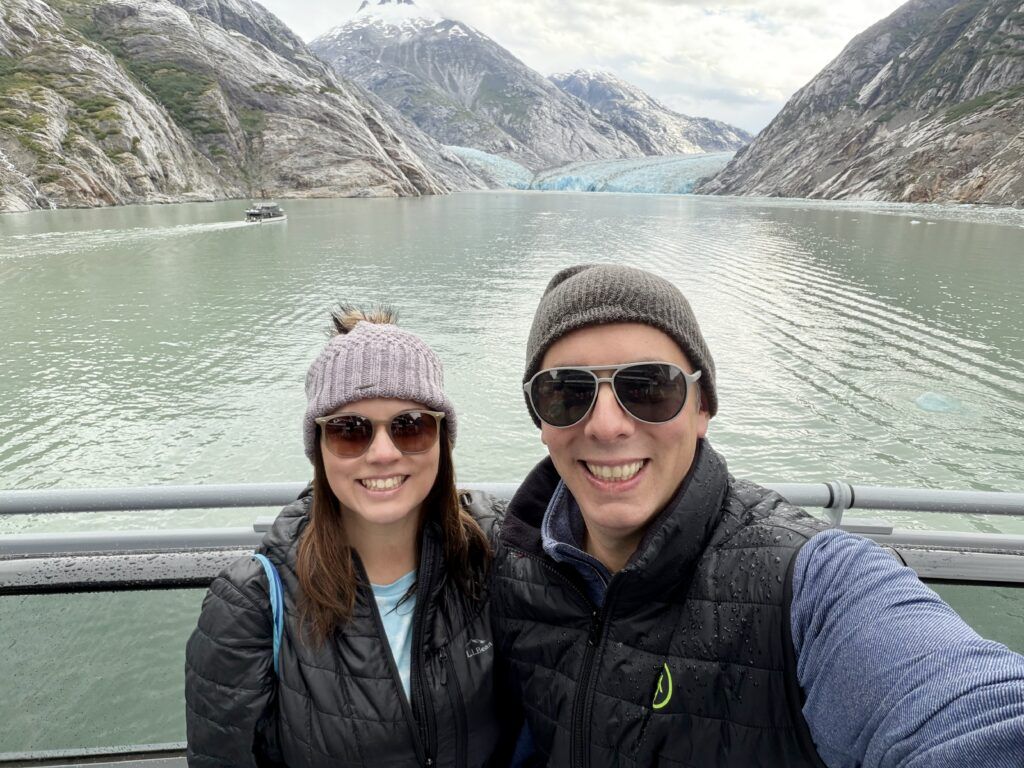
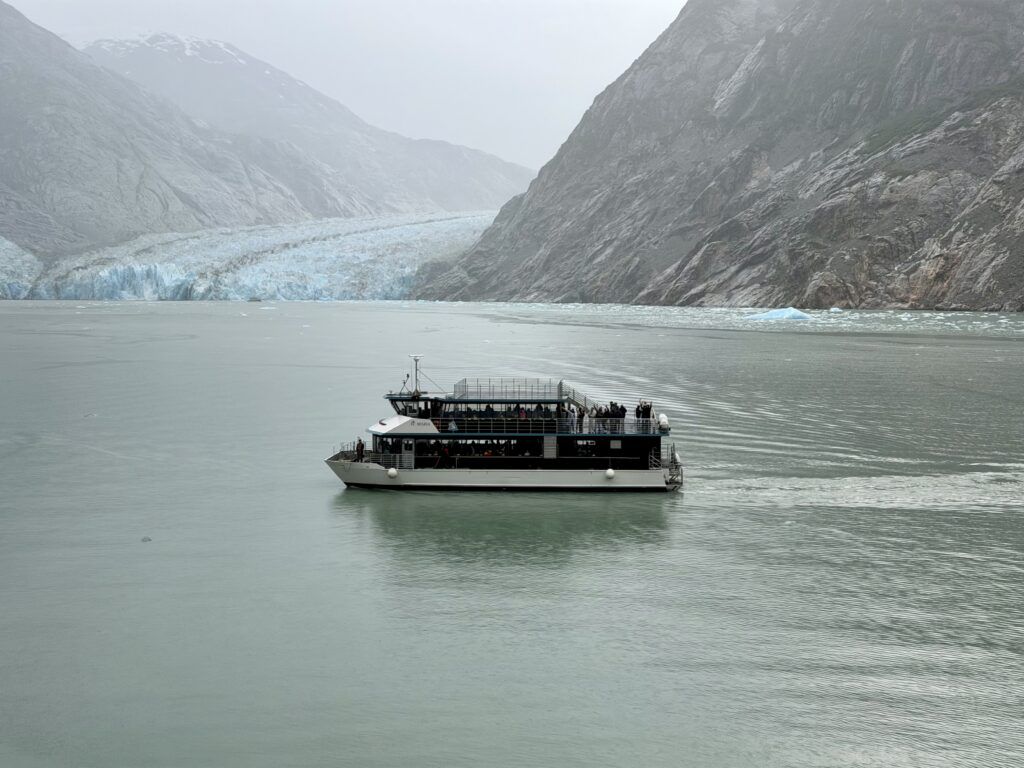
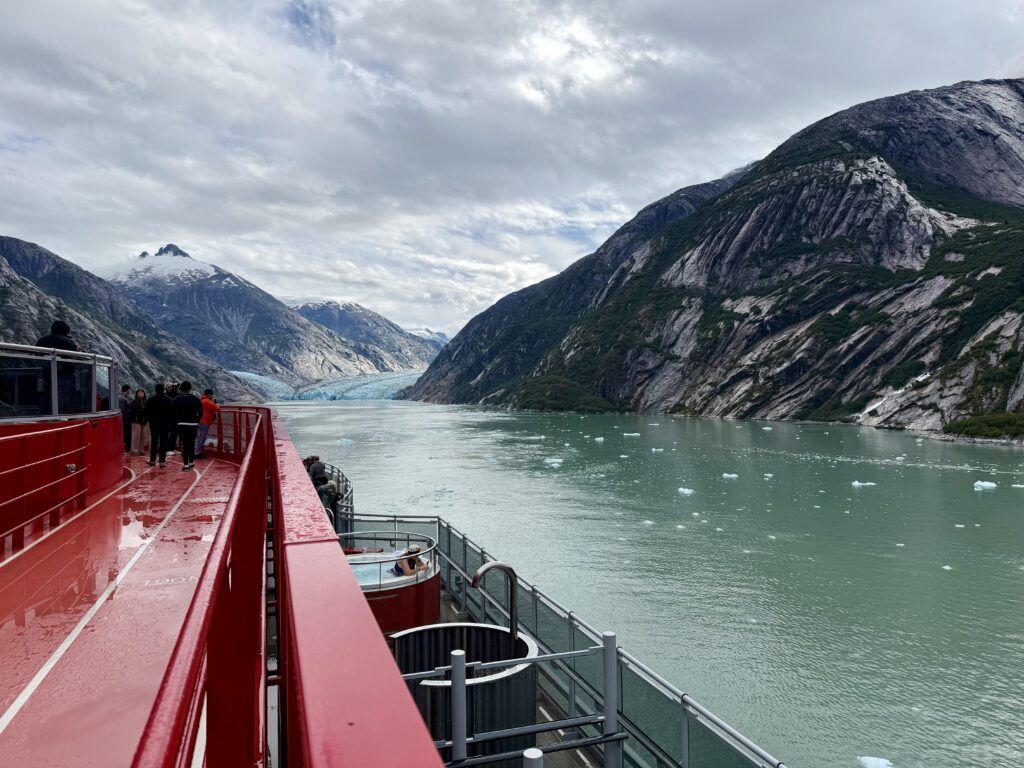
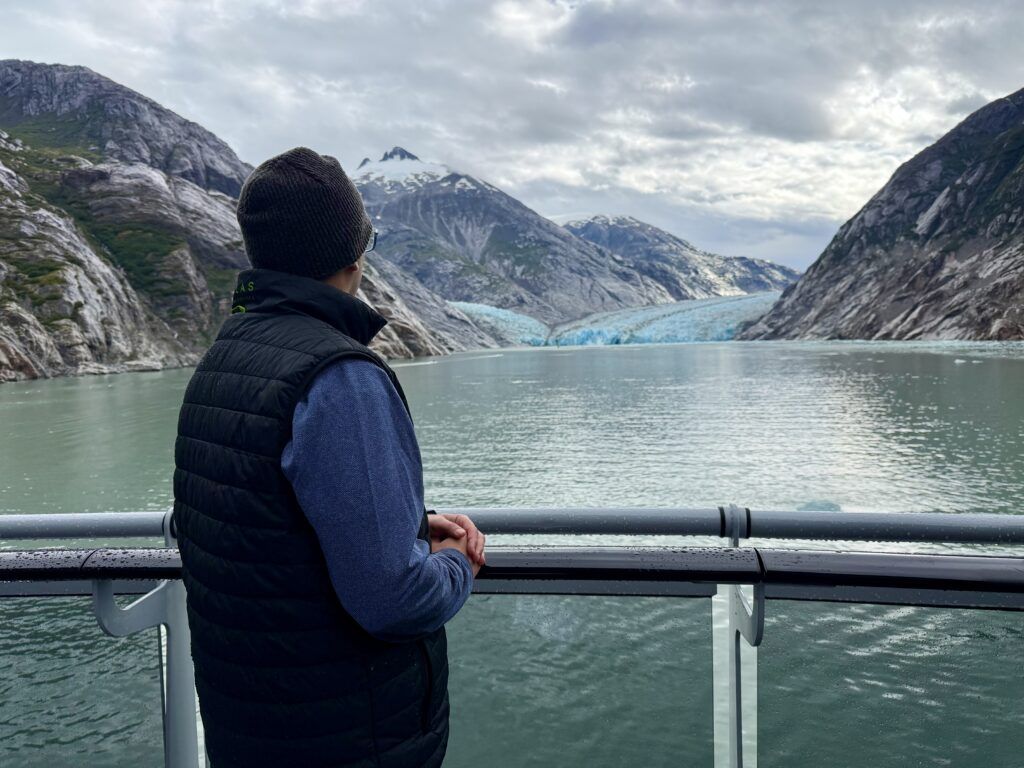
And unfortunately, Virgin Voyages does not sail into Glacier Bay. Only select cruise lines have permission to do so. Instead, Brilliant Lady visits Dawes Glacier, which is best seen from the pricey glacier explorer boat as the ship can’t get as close. Virgin Voyages does not offer any land add-ons either. We did our first Alaska Cruisetour last year, and highly recommend you consider one. It’s an easy way to combine an interior trip visiting Denali National Park with an Alaska cruise.
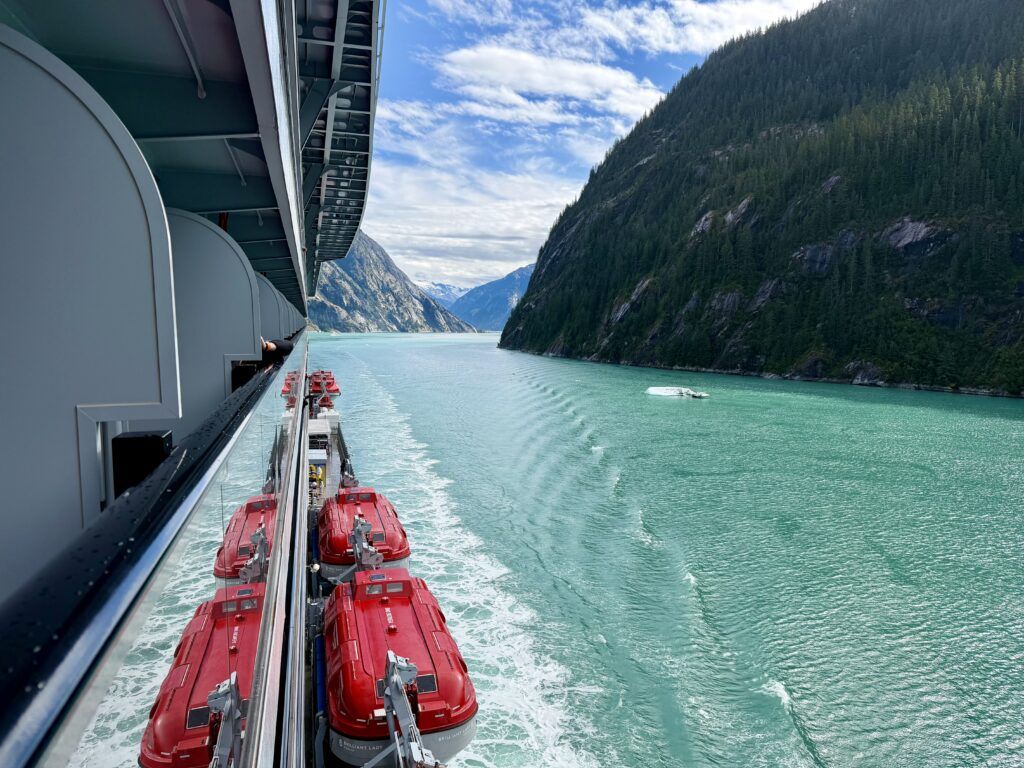
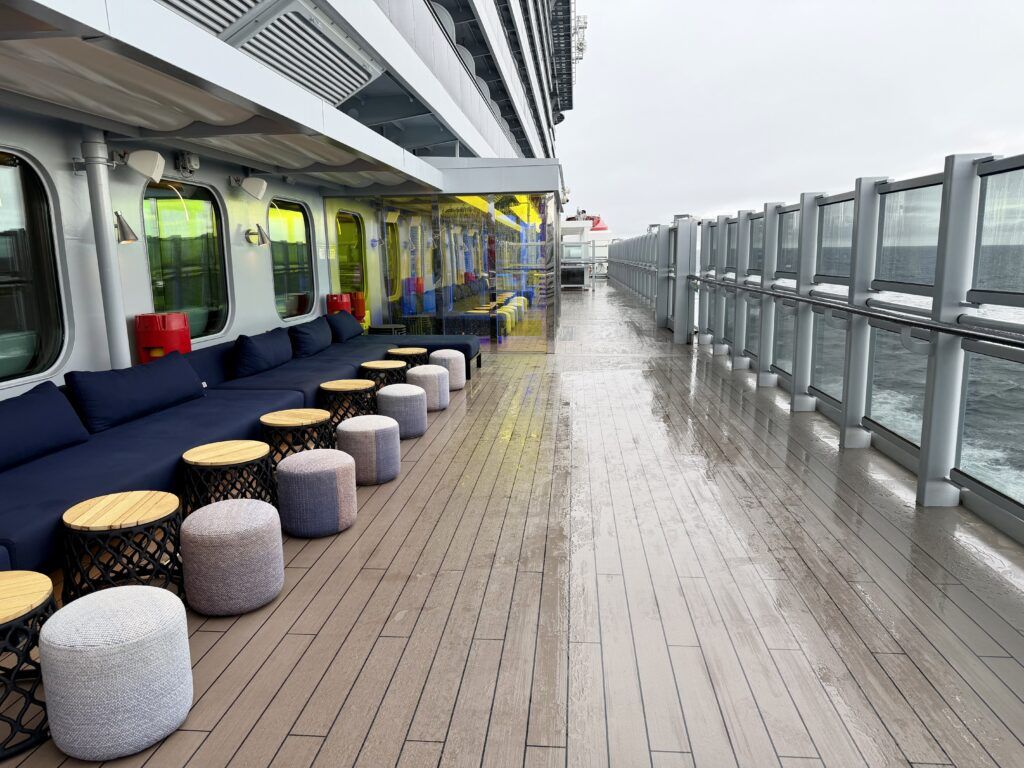
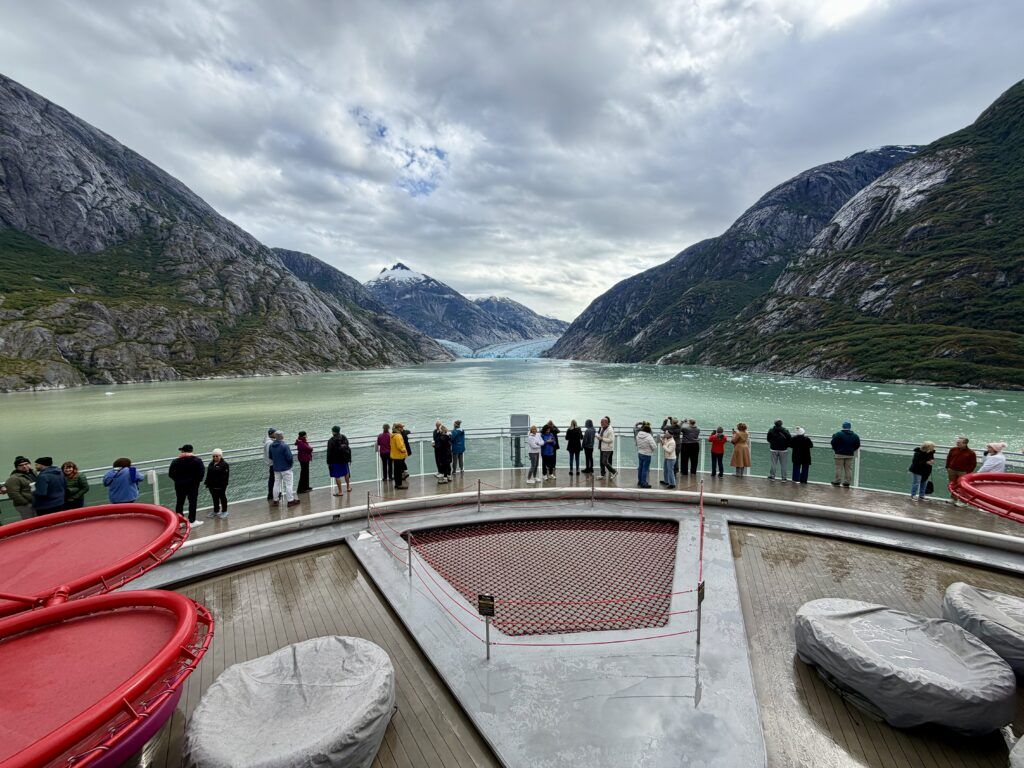
When considering Brilliant Lady, it’s important to know that all the prime scenic-viewing spots are aft (The Athletic Club and The Dock are the best locations). Unfortunately, there’s no ideal forward-facing vantage point (not even the bow, which some ships open during glacier viewing). And more importantly for Alaska, there’s no indoor observation lounge with panoramic glass windows. There’s also little in the way of covered viewing spots when it’s rainy outside. Further, while Richard’s Rooftop (the forward-located VIP sundeck for suite guests) and the outdoor promenade area on Deck 7 sound good in theory, the views are obstructed by tall glass walls.
No scenic sailing narration outside of a WhatsApp group
While some cruise lines go overboard with intercom announcements, Virgin is the other extreme and does not make any announcements. So, we did miss having some of the narration that we’re used to in Alaska like navigational updates, wildlife spottings, etc. There were no ship-wide announcements during scenic cruising to tell you what you were looking at or when to be out on deck for the best scenery.
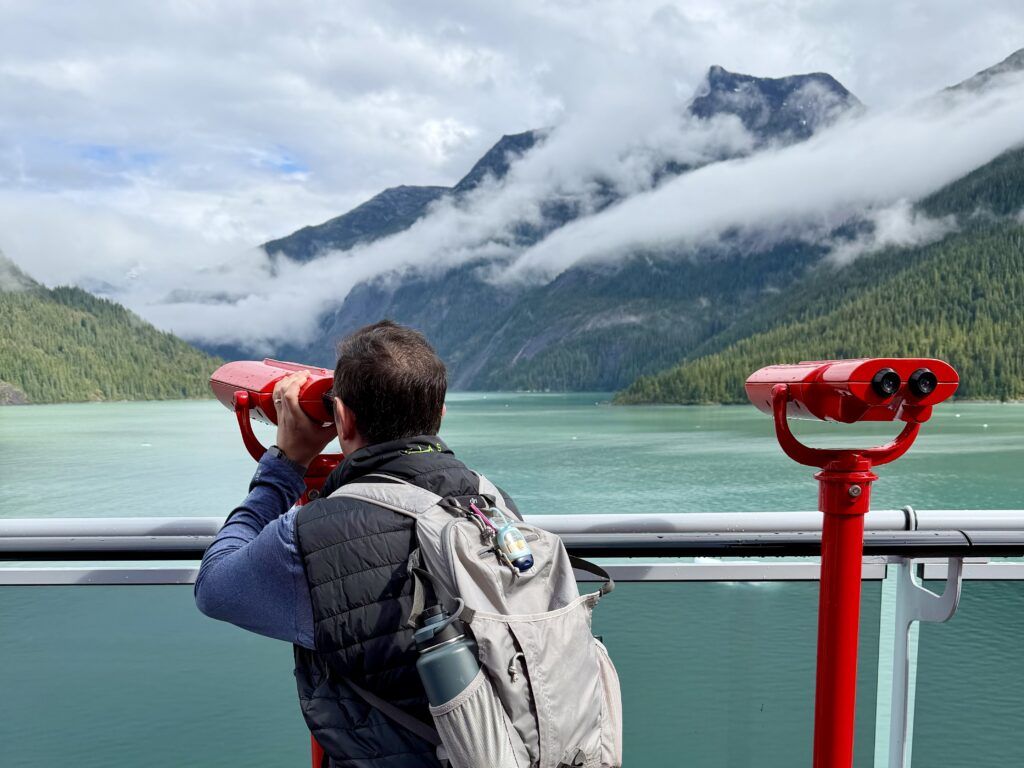
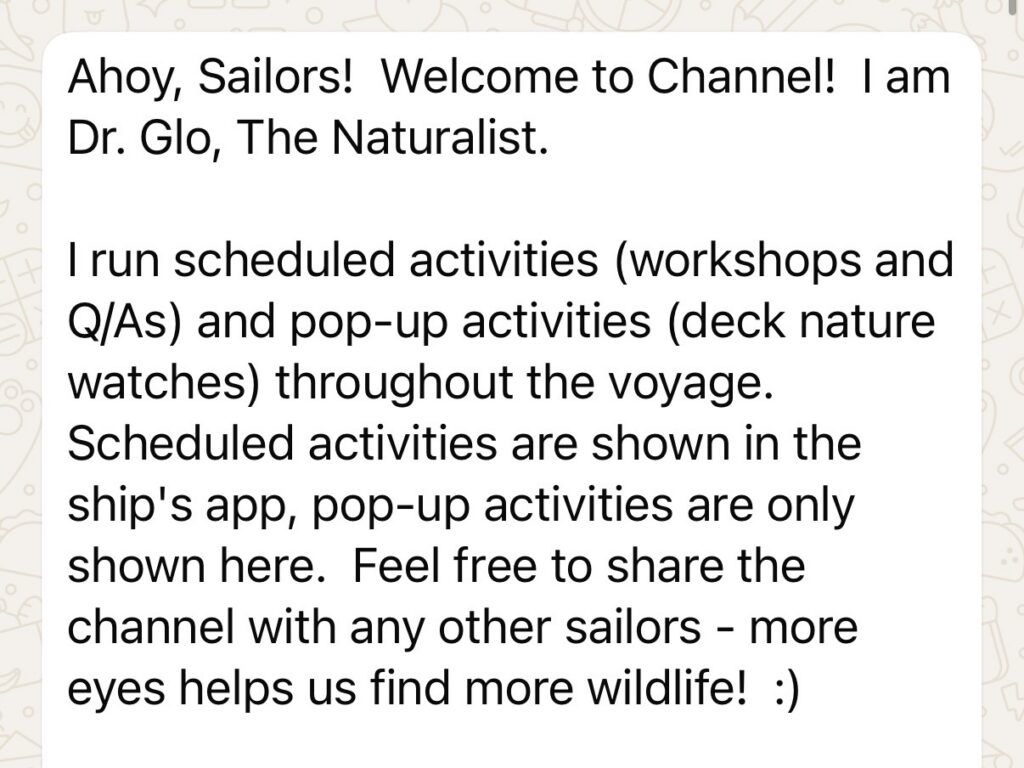
Instead, we had the option to join a WhatsApp group led by the Naturalist, Dr. Glo. This was the only way to get real-time updates. Personally, we ended up finding it distracting and stopped checking the group part way through the cruise. And the only other option for narration was the upcharge activity Headphones & Horizons. Think silent disco headphones, binoculars, and live commentary.
Cabins short on storage for Alaska layers
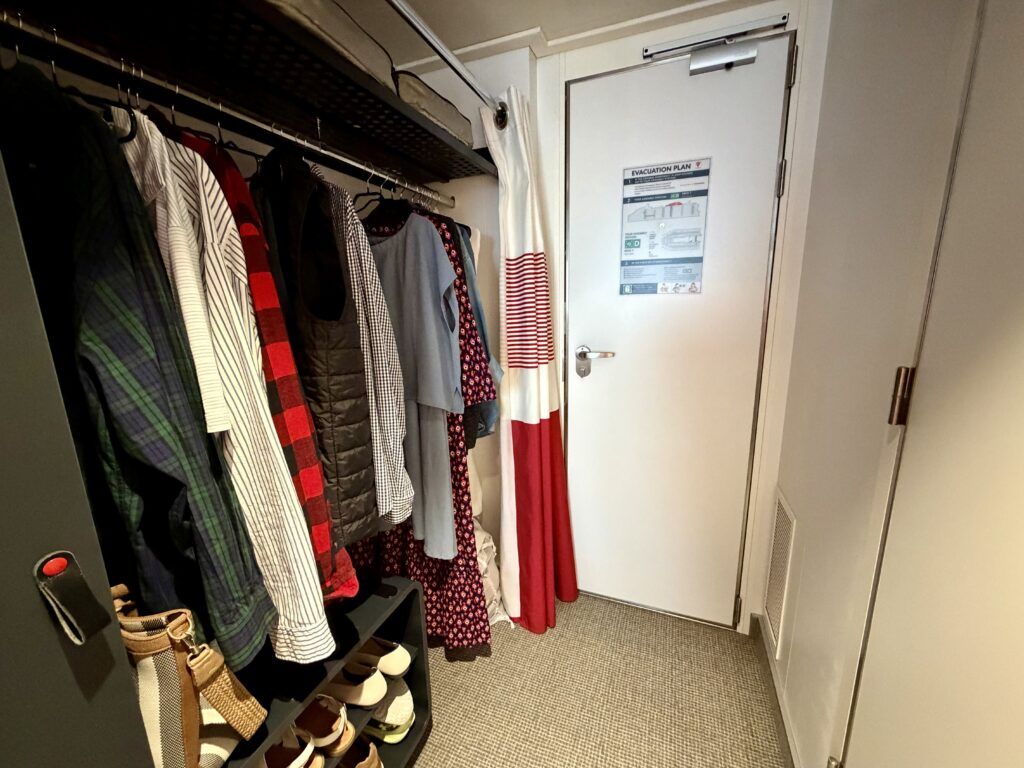
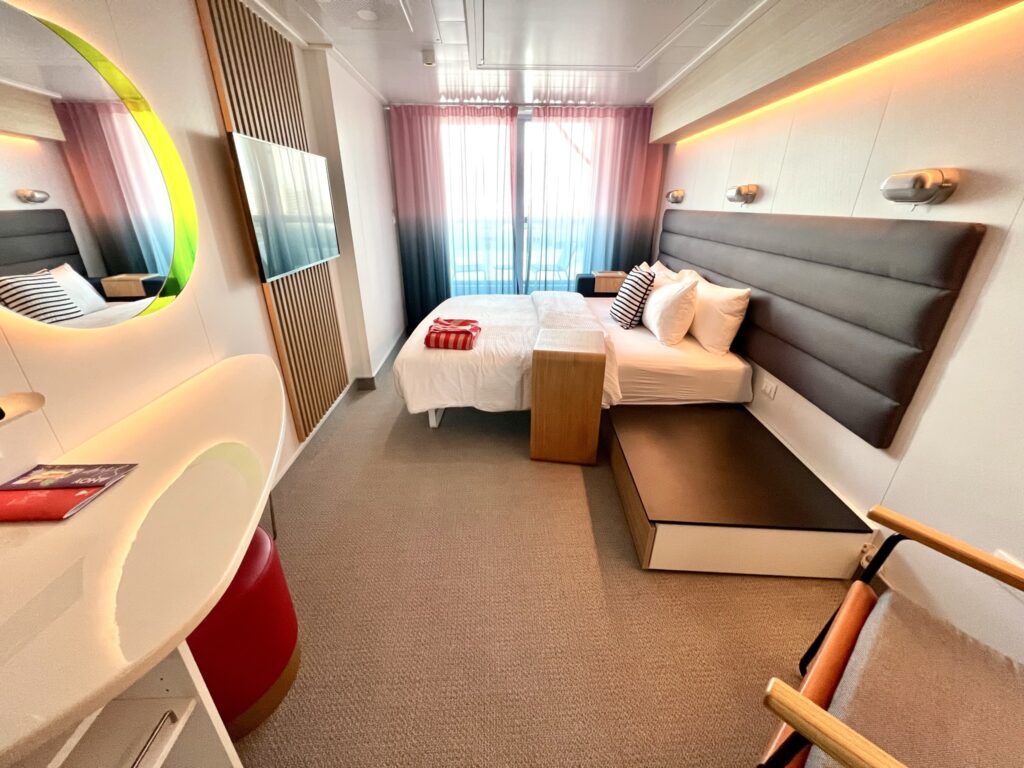
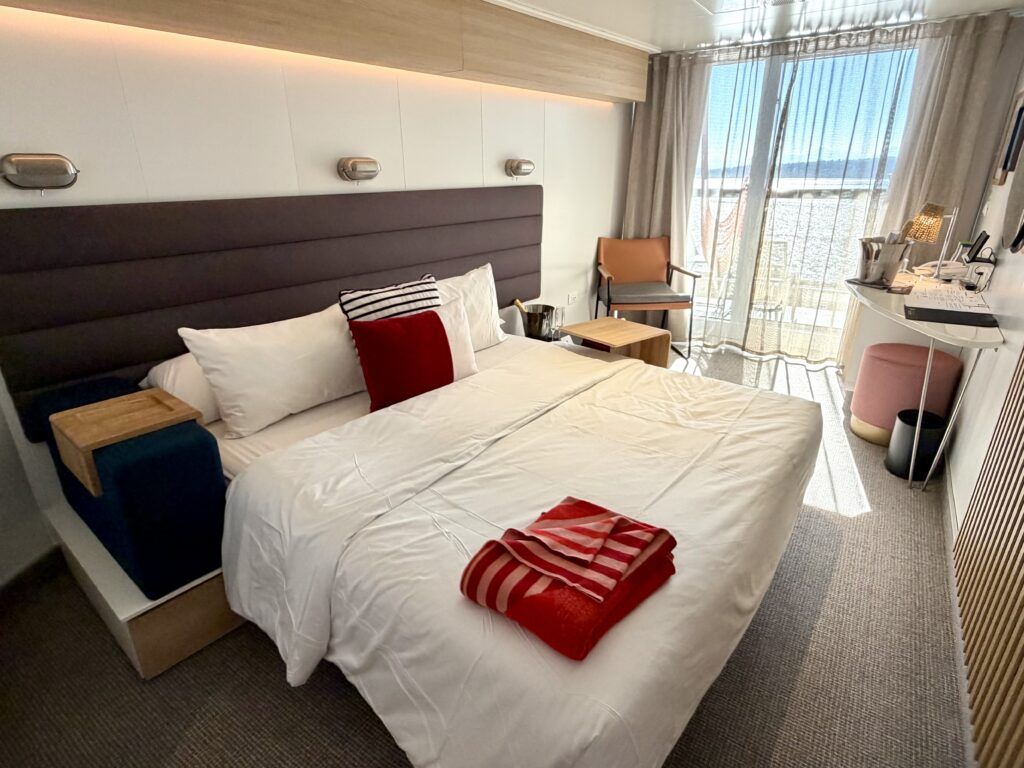
We’ve never really been fans of Virgin’s cabin design. The cabins are the least aesthetic area on the ship, the bathrooms are notoriously small, and there is very little storage. This is particularly problematic in Alaska where you’re packing bulkier than you would for the Caribbean. Think rain gear, layers, outerwear, and the like. We found ourselves struggling to make everything fit.
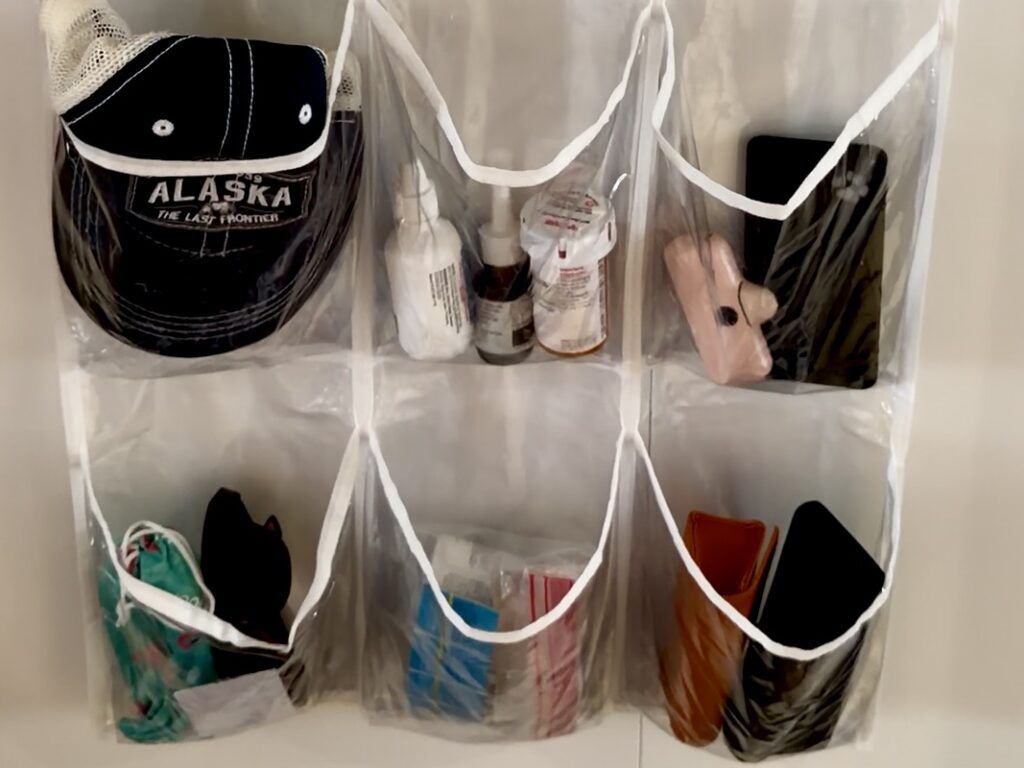
Thankfully, we use packing cubes, so we ended up leaving most of our daytime attire in them and stacked on the limited shelf space. We also always pack magnetic hooks which came in handy for hanging our wet rain coats, jackets, and day bags. Another one of our trusty cabin hacks is a hanging pocket organizer. Here, we stored toiletries, sunglasses, chargers and cords, accessories like gloves and hats, and more.
“Elevated” shore excursions that didn’t deliver
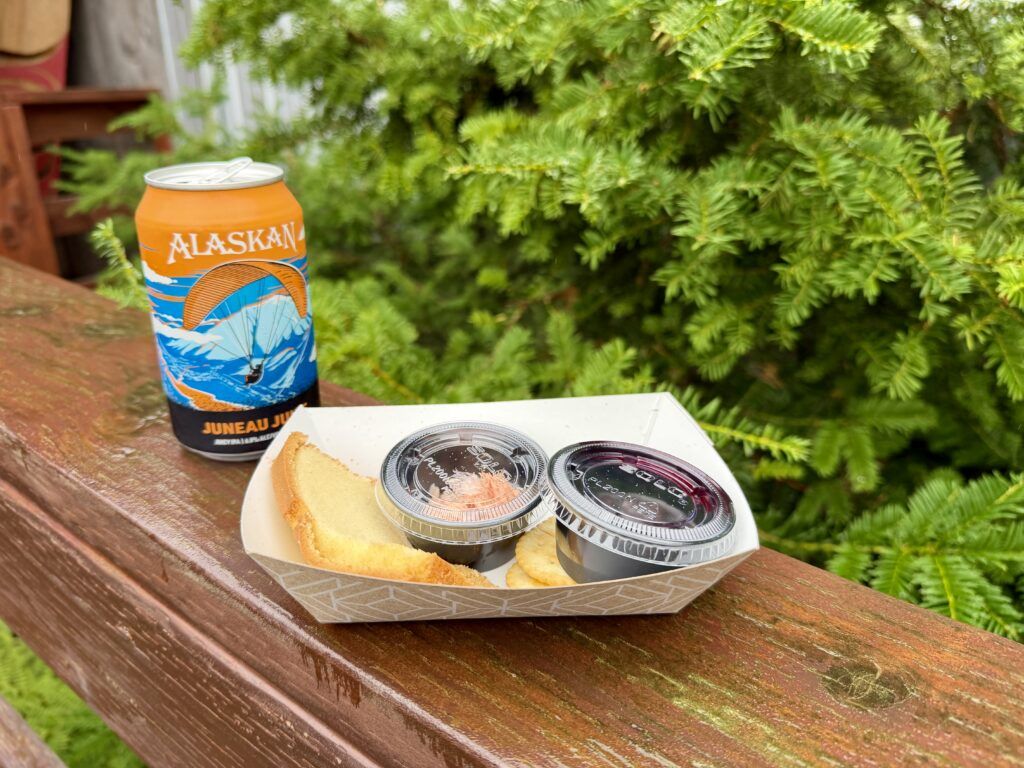
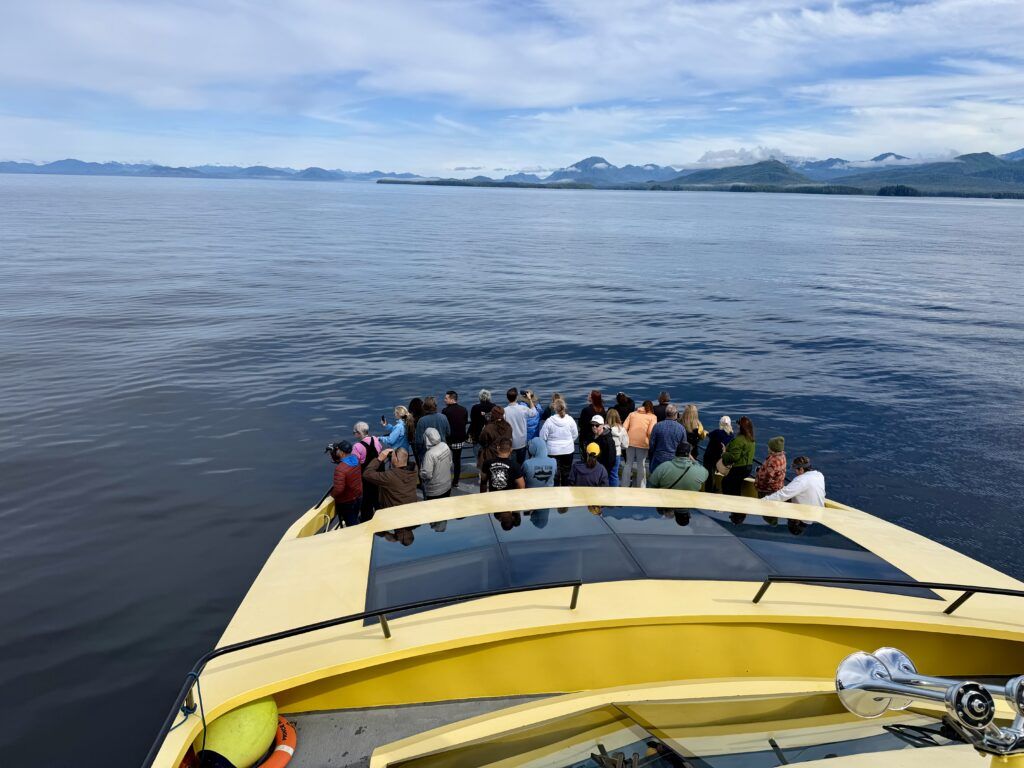
Virgin labels many of its shore excursions as elevated or exclusive, so we booked a few of them expecting an “elevated” or “exclusive” experience. But that wasn’t the case. While our Alaska Rainforest Sanctuary & Black Bear Viewing tour in Ketchikan and our Whale & Marine Life Discovery Cruise in Prince Rupert were great, they didn’t outshine the competition. In fact, we did the exact tour in Ketchikan previously and the only thing that was different was an included drink and snack at the end of the tour. That said, they’re certainly still worth booking, just don’t expect them to be different from the mainstream offerings.
But our exclusive Gardens and Good Cheer tour in Juneau was rather dull and not one that we’d recommend given the cost.
Beyond the excursions themselves, the whole Shore Things experience was a bit disorganized, especially in Juneau where tender operations were required.
PRO TIP: You can book shore excursions outside the cruise line and often get smaller group sizes and cheaper prices. Shore Excursions Group even offers a return-to-ship guarantee.
A thermal suite that’s wrong for scenery watching
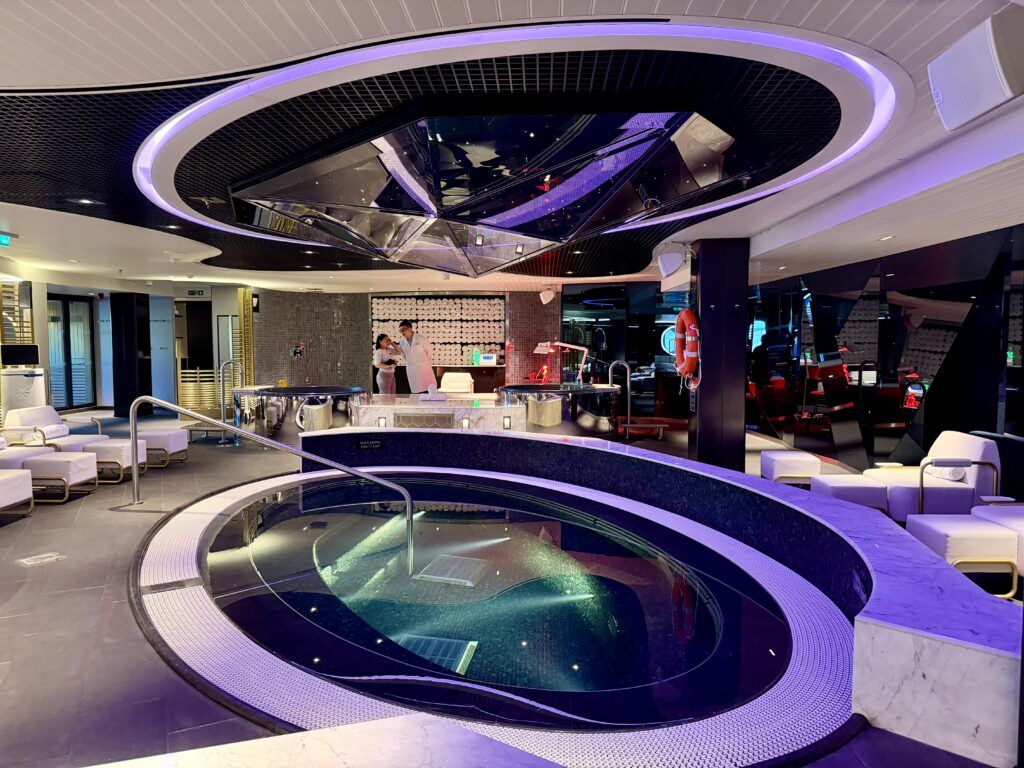
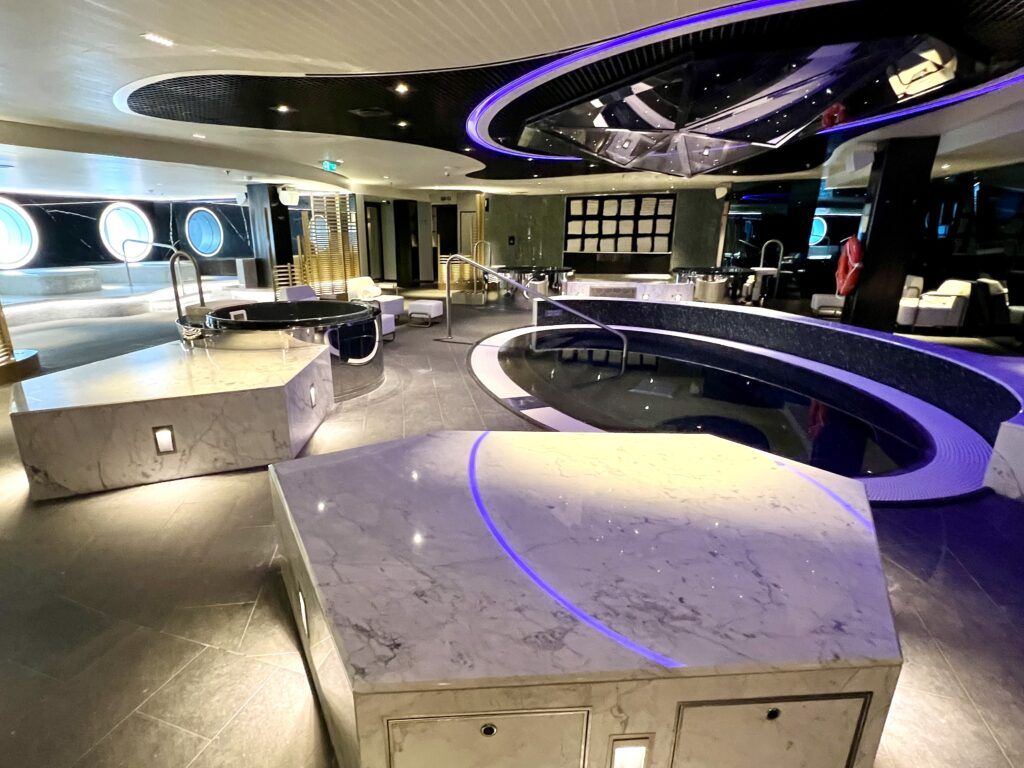
What could be better than watching fjords, waterfalls, and glaciers pass by while relaxing in a heated stone lounger? Well, if that’s the experience you envision, you won’t get it on Virgin. Unlike some NCL ships, whose thermal suite is primely positioned to double as a scenic-viewing space with floor-to-ceiling glass windows, Virgin’s Redemption Spa isn’t set up to fully take in the Alaska scenery while you use it.
Also different from our previous Virgin cruises, thermal suite passes on our sailing were only 2-hour blocks instead of 3-hour blocks for the same price of $59 on a port day and $79 on a sea day. While you honestly don’t need more than two hours to enjoy it, it still works out to be more expensive per hour to use.
A shared terminal in Seattle means a crowded embarkation
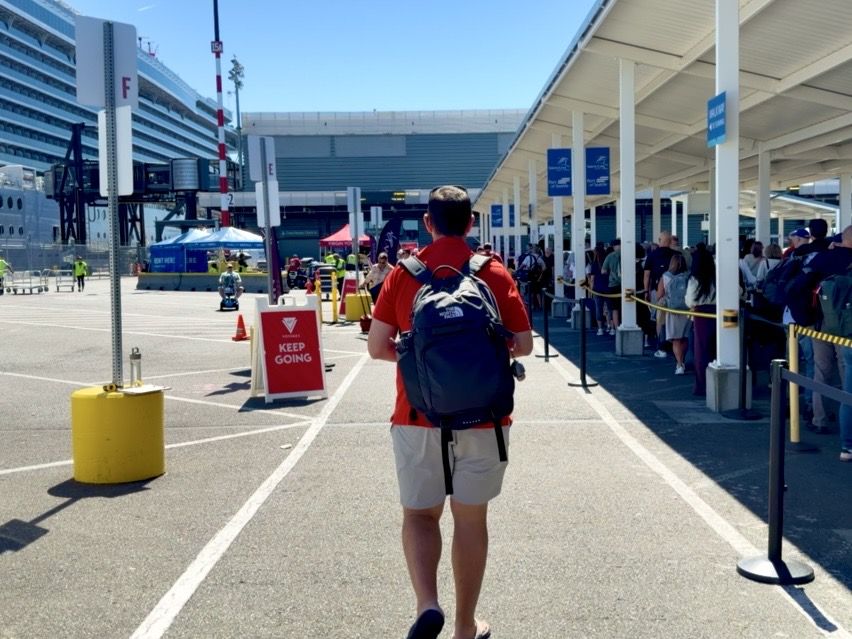
Embarkation in Seattle runs out of a shared terminal, and it makes for a more chaotic start to your Alaska cruise. If you’ve sailed Virgin out of Terminal V in Miami, you might be spoiled. In Seattle, Brilliant Lady shares the Smith Cove Terminal at Pier 91. This meant that we were embarking at the same time as a Carnival ship. With mass crowds and long lines everywhere, it took us a few moments to get our bearings and figure out where we needed to go to drop off our bags and check-in. Unfortunately, there weren’t many staff members around to direct people either.
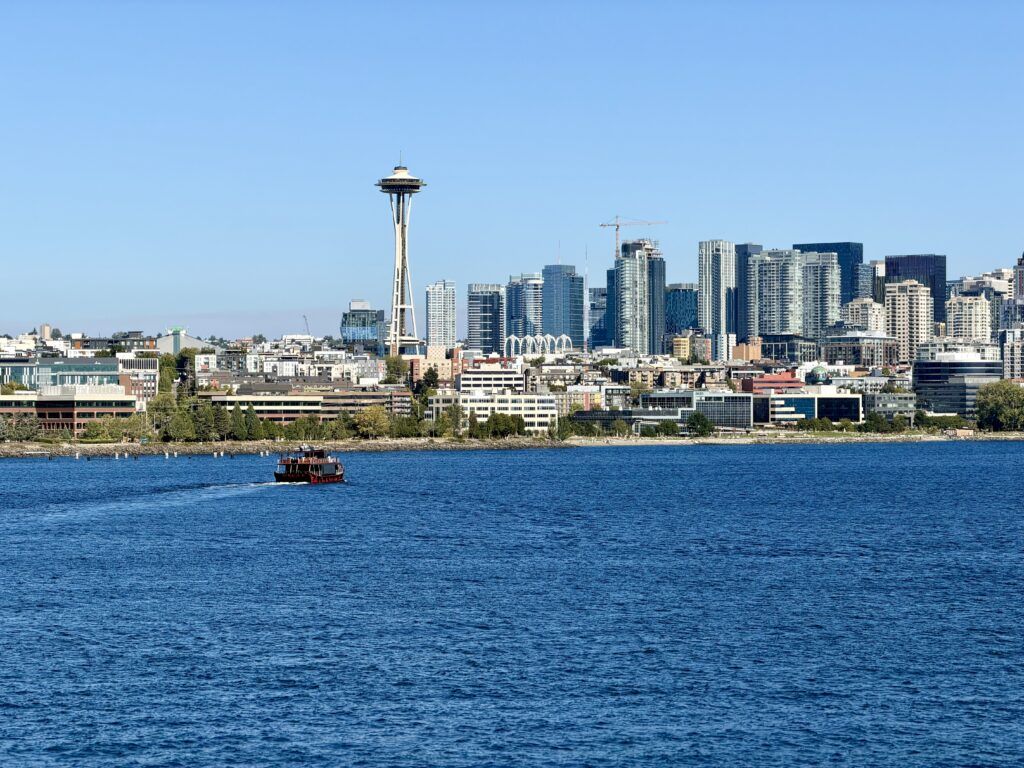
While also true for many other cruise lines departing from Seattle, another thing to keep in mind is that Pier 91 is not within walking distance to the major Seattle attractions. It’s about 3 miles away from the Seattle Waterfront and Pike Place Market. So, if you’re planning to spend some time in Seattle before your cruise, you may want to get a hotel near Pier 66 and just plan to get a rideshare or taxi to the port on embarkation day.
No drink packages to lock in a rate
While Virgin’s cruise fares are more inclusive than many other lines sailing in the region, it doesn’t include everything. The two primary add-ons that all cruisers need to budget for are gratuities and premium drinks like specialty coffee and cocktails.
And Virgin doesn’t sell traditional drink packages either. So, there’s no way to pre-pay and cap your bar spend at a known dollar amount. You can purchase a Bar Tab which gives you some bonus spend, but if you’re looking to walk away without any onboard expense, you’ll need to keep checking your account to see how much credit you have left. Whereas, Princess (Princess Plus and Premier) and Holland America (Have It All) both offer add-on packages for that all-inclusive feel which couples alcoholic beverages, gratuities, and more into the price.
New VoyageFair Choices change everything
Virgin has reworked its fare pricing into new tiers, and the rules and inclusions of each now differ from what returning Sailors may expect, so read the fine print before you book. The tier you choose not only affects the price but can change what’s actually covered and whether cancellations or changes are allowed once you’ve booked.
This is especially important to consider given that Alaska cruises tend to be pricier than other itineraries in the Caribbean or Mediterranean. Now, the cheapest price you see is the Base Fare, which is non-refundable, allows no changes, and your cabin can be assigned as late as 7 days before you sail. If you want the closest equivalent to Virgin’s old pricing, you’ll need to book the Essential tier. So, be sure to budget accordingly — and remember that Alaska excursions are more expensive than other regions too.
The Bottom Line
So, is Virgin Voyages worth it in Alaska?
After five Virgin sailings and seven previous Alaska cruises, we think Virgin Voyages is a good alternative for the right traveler. The food, the inclusions, and the adults-only atmosphere make a strong case. Add a ship that actually feels modern and trendy, livelier nights and entertainment than the region is used to, and enrichment that beat our expectations, and the Virgin experience holds its own against the competition.
However, you need to weigh the trade-offs. Virgin skips Glacier Bay, offers no cruisetour to pair with Denali or the interior, and gives you nowhere warm, dry, or forward-facing to take in the scenery.
You want to experience the Last Frontier adults-only
You care as much about the onboard experience as the itinerary
You like livelier nights, modern spaces, and lots of entertainment
You’re sailing solo or want a more inclusive, varied crowd than the region’s usual
You’re a foodie looking for great included dining options
Choose another line for your Alaska cruise if…
Glacier Bay National Park is on your bucket list
You want to pair your cruise with a land tour to Denali or the interior
You want plenty of viewing spaces, especially a forward-facing observation lounge
You’d prefer a more traditional and educational Alaska cruise experience
You want the option for an all-inclusive add-on package
Comments
Would you consider sailing Virgin Voyages in Alaska? What are your top priorities when booking a cruise to this region? Drop us an anchor below to share your Alaska cruise reviews.
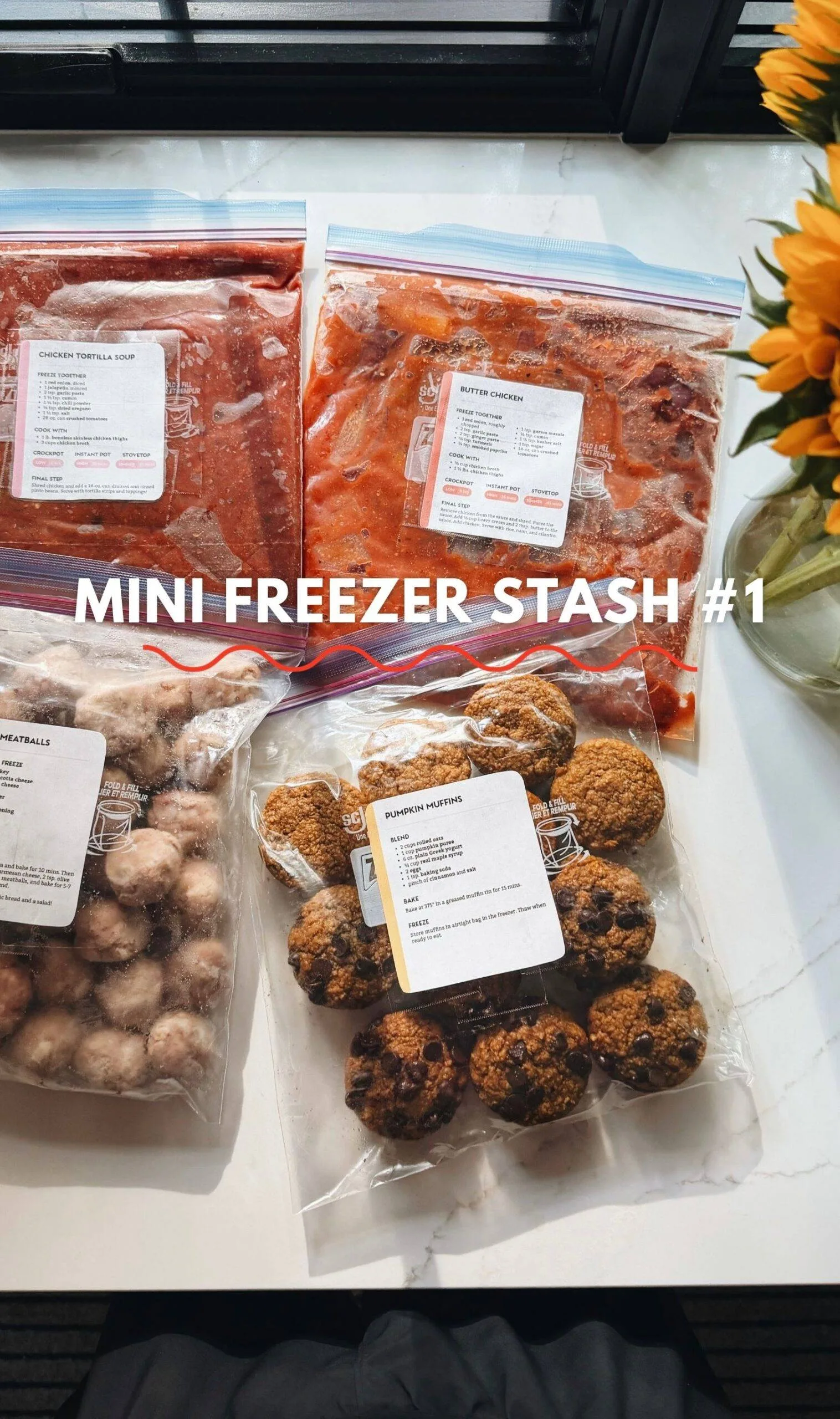
Guys! Welcome to our September Mini Freezer Stash!
I absolutely love how my life feels when I have stuff ready to go. Like a crockpot meal set for our busy ballet night, or wholesome homemade muffins to tuck in a lunchbox. Makes me feel like I’m just crushing it at life.
I really wanted this set to feel NOT overwhelming and actually useful.
This Mini Freezer Stash:
Takes less than one hour
Uses whole food ingredients
Has recipes that we *actually* want to eat.
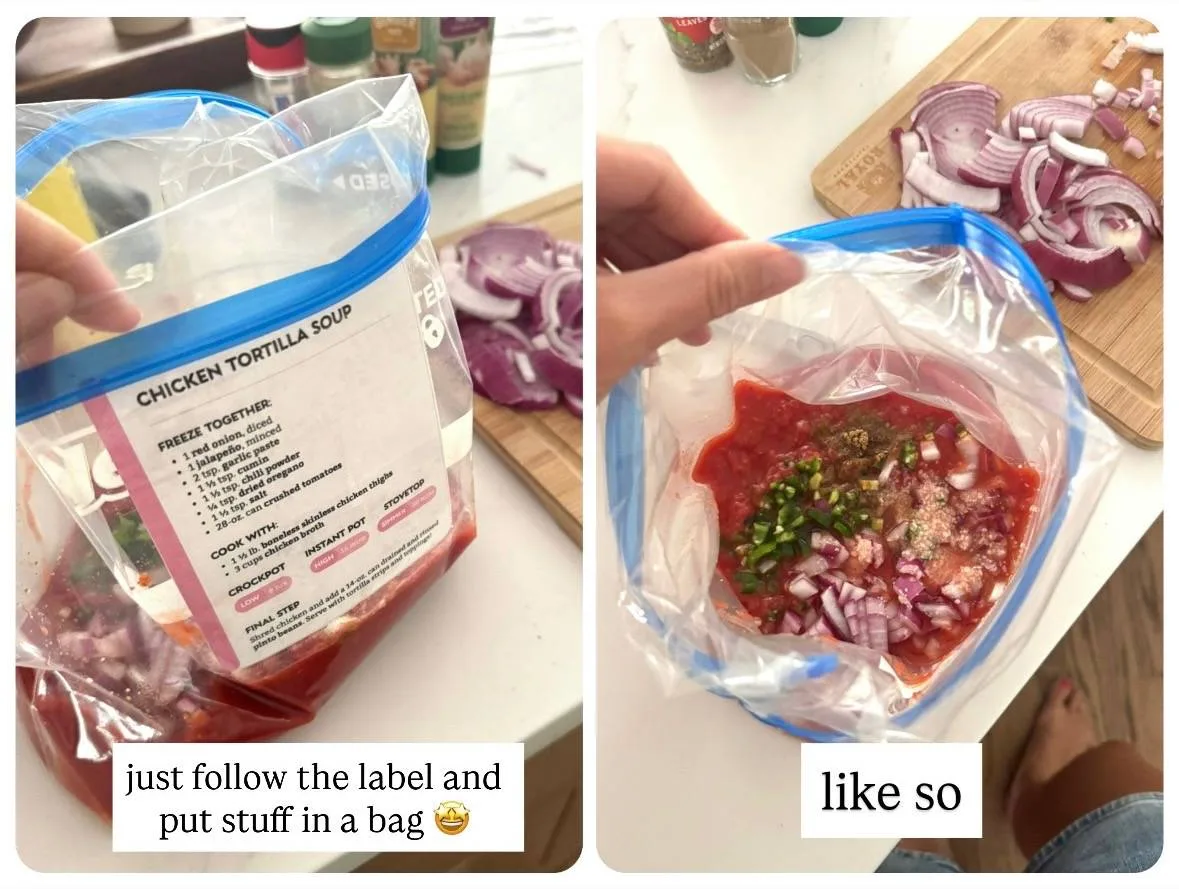
The format couldn’t be easier – you basically assemble stuff in bags and freeze it!
And the recipes this month are some of the top-rated fall faves!
Pumpkin Muffins
Butter Chicken
Tortilla Soup
Ricotta Meatballs
If you want, you can get the cute little recipe cards sent to you (free) via email – the form is right here below. I like to print the cards out and attach them to the bags!
I hope you find this as helpful as it’s been for me!
Final Step: Remove chicken from the sauce and shred into large chunks. Puree the sauce (I use an immersion blender). Add ½ cup heavy cream and 2 tbsp. butter to the sauce. Add chicken back in. Serve with rice, naan, and cilantro.
Things to Know:
The chicken is listed separately to make it safe for crockpot cooking. You add the frozen portion above, plus a package of chicken thighs, to the crockpot (or whatever method you’re using).
Chicken breasts also work.
I thaw this by running the bag under warm water for a few minutes and breaking the mixture into chunks.
Final Step: Shred chicken. Add a 14-oz. can drained and rinsed pinto beans. Serve with tortilla strips, lime wedges, and sour cream!
Things To Know:
Chicken is listed separately to make it safe for crockpot cooking. You add the frozen portion above, plus a package of chicken thighs and the broth, to the crockpot (or whatever method you’re using).
Chicken breasts will also work.
I thaw this by running the bag under warm water for a few minutes and breaking the mixture into chunks.
Freeze on parchment-lined pan; divide into two bags
2 lb. ground turkey
1 cup full-fat ricotta cheese
1 cup Parmesan cheese
1 cup panko
2 tsp. garlic powder
2 tsp. salt
1 tsp. Italian seasoning
Instructions for one bag:
Bake: 400° // 30 minutes
Final Step: After baking, add 32-oz. of marinara sauce like Rao’s. Bake for 10 mins to warm. Mix 1/4 cup panko, 1/4 cup Parmesan, 2 tsp. olive oil, and parsley, sprinkle on meatballs, and broil until golden and crispy. Serve with pasta or garlic bread and a salad!
Things to Know:
Freeze the meatballs on a parchment lined pan so they won’t stick together. Once frozen, transfer to a bag (or two).
I bake these in a shallow Dutch oven or cast iron pan with a bit of oil. Then I can add the sauce directly to that same pan.
The crispies on top are optional but make it more fun to eat!
Virgin Voyages does almost everything differently, and that’s exactly why a first cruise with the brand can catch you off guard. There’s no main dining room, no kids, no set dinner times, and non-traditional entertainment. But there is more packed into your fare than you’d expect if you’ve sailed with other maintstream cruise lines before.
We’ve sailed Virgin in the Caribbean, Mediterranean, and Alaska so we’ve picked up plenty of insider knowledge along the way. That’s why we’ve rounded up the 40 tips we’d hand a friend before their first voyage.
New to Virgin Voyages?
These tips assume you know the basics. For the full rundown on the ships, cabins, fares, and everything included, start with our complete Virgin Voyages guide.
Before You Book
The choices you make before you ever step onboard shape your whole Virgin Voyages experience. Since VoyageFair Choices arrived, the fare you pick affects your price, your flexibility, your WiFi, and even how early you can book dining. Add in Virgin’s solo-friendly pricing and perks you may not know about, and a little planning at this stage pays off. Here’s where to start.
Book early
As with most cruise lines, Virgin’s cruise fares tend to be lowest the moment a new season of itineraries opens, then climb as cabins start to sell out closer to the sailing date. If you already know where and when you want to sail, booking early is the simplest way to pay less for the exact same voyage.
It also gives you first dibs on the popular sailings and cabin categories, which can sell out well ahead of time.
Think hard about which fare you pick
Since VoyageFair Choices launched, your fare isn’t just a price anymore, it’s a set of rules and inclusions. The Base fare is the cheapest, but it’s non-refundable, allows no changes, and your cabin can be assigned as late as 7 days before you sail.
For most first-timers, the Essential price tier is the sweet spot. It’s closest to Virgin’s old all-in feel, stays refundable as credit, and leaves room to change plans. If you’re looking for even more inclusions, go with the Premium fare with adds in premium WiFi and a Bar Tab.
Only book the Base fare if your dates (and travel companions) are locked in stone.
Use a travel advisor
A good travel advisor often has access to group rates, Sailor Loot, or Bar Tab promotions you won’t find booking on your own. On a line with as many quirks as Virgin, having someone who knows the ropes is worth a lot, too, especially if you’re not familiar with the brand.
Best of all, it doesn’t cost you extra, and you get a real person to call when your plans shift or you run into any issues. Since travel advisor commisions are baked into cruise fares, you’re basically paying for one even if you don’t use their services.
Solo travelers, Virgin is built for you
Virgin is one of the few lines that is actually designed for solo sailors. There are dedicated solo cabins priced without the hefty single supplement most lines tack on, so you’re not paying double to travel alone. These cabins are limited so you’ll need to book early to secure one. If these solo cabins are already booked up, watch for promotions with reduced or no single supplements on double occupancy rooms.
The social atmosphere on Virgin Voyages helps too. Communal tables, group activities, and a relaxed crowd make it easy to meet people if you want to, and easy to keep to yourself if you don’t.
Pick your ship by the itinerary
All four Lady ships are nearly identical: the same size, layout, and general vibe. So, there’s no single best ship in the fleet like there is on other cruise lines with huge differences between classes. The experience onboard is extremely similar across ships. Brilliant Lady, sailing in Alaska, has a few slight modifications from her predecessors but nothing major.
That means you can safely choose your voyage based on where it goes, rather than which ship you want to sail on. Let the ports do the deciding for you. Currently, Virgin features sailings in the Caribbean, Mediterranean, and Alaska. In 2028, the cruise line will debut cruises to Scandinavia and the Baltics.
Always buy travel insurance
Cruise plans go sideways for all kinds of reasons, and a good travel insurance policy covers you for medical issues, trip interruptions, lost luggage, and sometimes even cancel for any reason. It’s a small cost against the price of the whole trip, and definitely worth it.
This matters even more on a Base fare, which is non-refundable. If something comes up, insurance may be your only way to recover the money. However, we recommend purchasing this insurance from a separate provider not the cruise line.
Before You Sail
Once your voyage is booked, a handful of small tasks in the days beforehand set you up for a smooth sailing. Knowing what to download, print, and pack ahead of time saves confusion at the terminal. Getting it done before you leave home means you step onboard ready for vacation.
Download the app before your cruise
The Virgin Voyages app runs your whole experience. It starts with checking in for your cruise and booking dining reservations. Once onboard, you’ll use it to book spa appointments or fitness classes, view your onboard spending account, and check the daily schedule for a listing of all the day’s activities and entertainment, so download it well before you sail.
It’s especially important to have because Virgin makes very few loudspeaker announcements. The app sends push notifications in place of the reminders you’d normally hear over the intercom.
Print your luggage tags
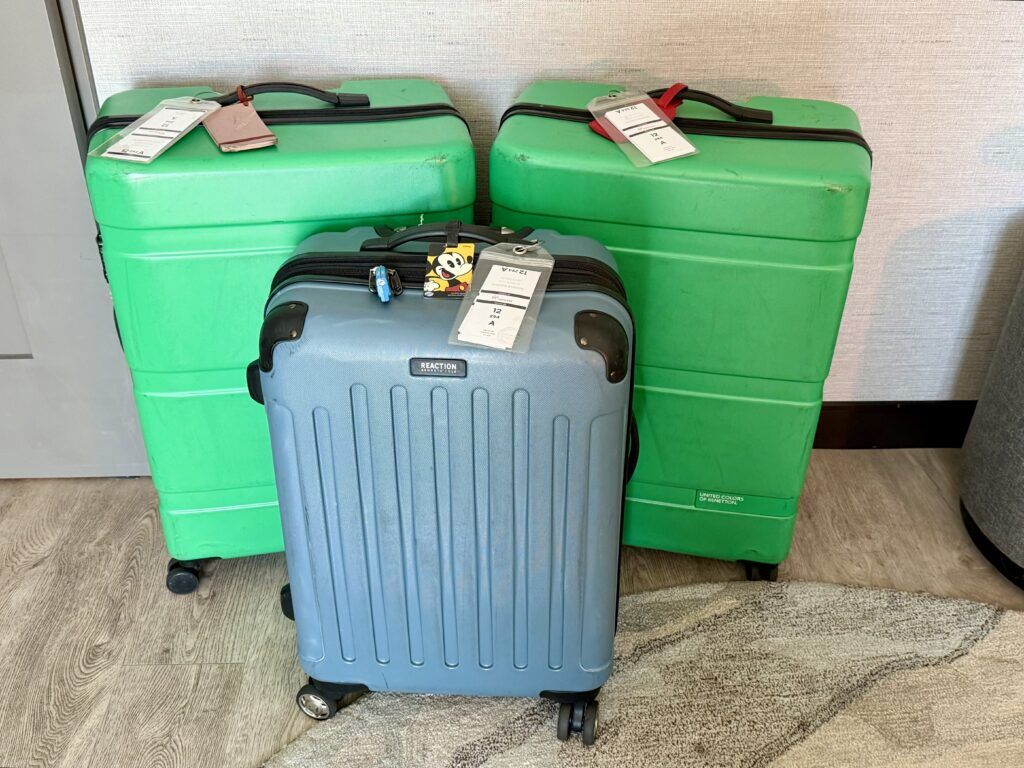
Like many cruise lines, it’ll save you time at the cruise terminal by printing your luggage tags ahead of time. Virgin emails these tags roughly 72 hours before embarkation. Print them at home but don’t attach them until you’re heading to the port on embarkation day. With tags in place, your bags are ready to hand off to the porters the moment you arrive.
It’s a small step, but it saves you from sorting out tags in the port chaos on boarding day. Don’t worry: if you forget them, the porters will have extras on hand.
Travel with your passport
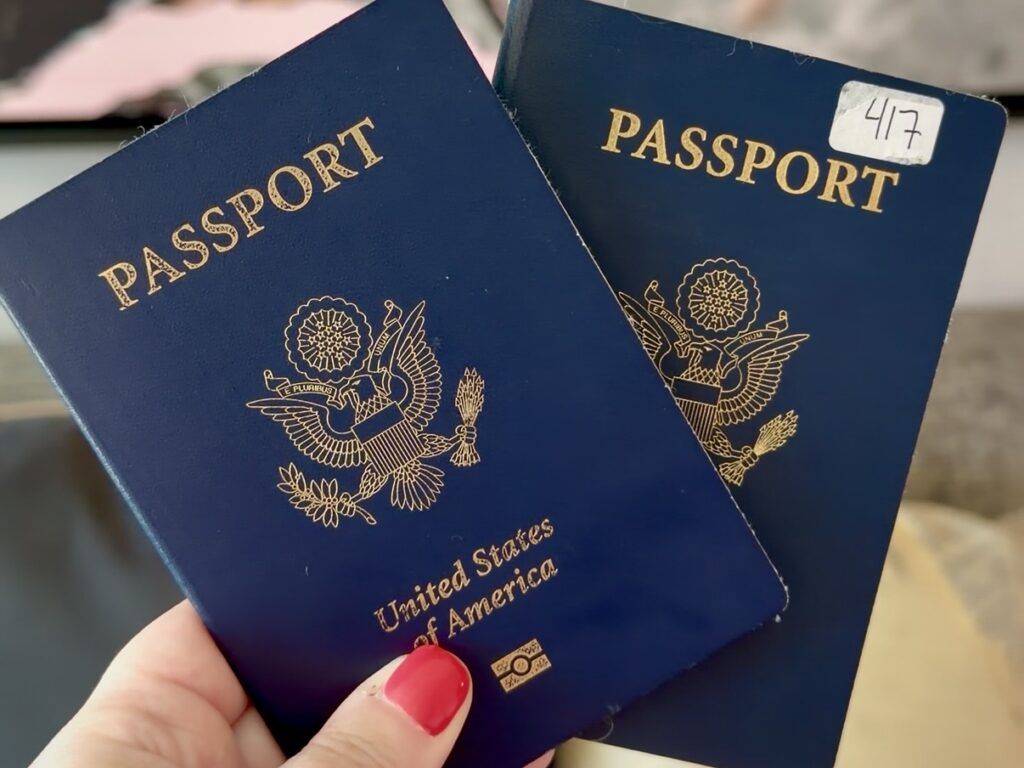
Virgin Voyages is stricter about passports than most cruise lines. Officially every Sailor needs one, though they’ll grant exceptions on eligible closed-loop voyages from Miami, Los Angeles, Seattle, or New York with a birth certificate and government-issued photo ID.
Keep in mind that even though the cruise line will make the exception, it’s still good practice to always travel with one. Some specific ports may require one to disembark for the day. If an unexpected event forces you to leave the ship early in a foreign country, you’ll need one to get home as well. The same applies if you happen to miss the ship at one of your port stops.
Pack red, plus a few themed pieces
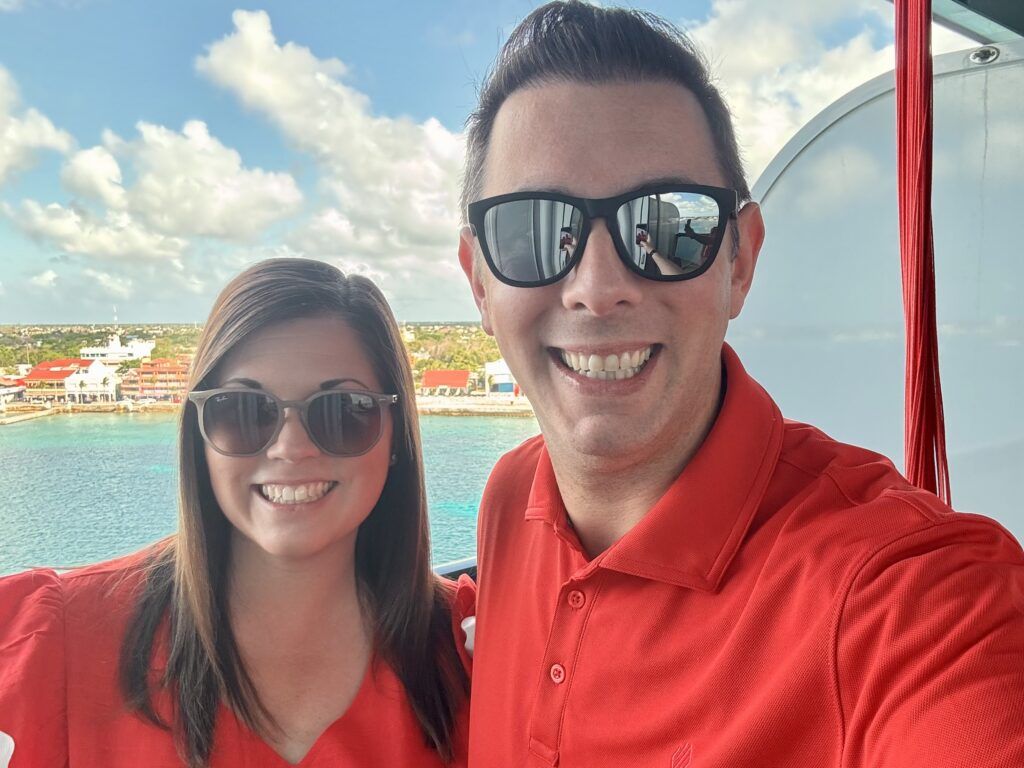
Scarlet Night is the signature event on Virgin Voyages’ sailings. It’s a shipwide, wear-red affair, so pack something in that color to join in on the fun. This can be anything from a touch of red to an over-the-top outfit, let your personality shine.
Check your specific sailing for other themed events too, like the first-night PJ Party, themed nighttime parties in The Manor, or the VHS workout classes. Of course, coordinating attire is optional but why not lean into it.
Pack a few cabin hacks
Virgin rooms are uniquely designed but notoriously compact, so a couple of small items go a long way with cabin organization and storage, especially on longer voyages. The walls of most cruise ship cabins are metal, which makes magnetic hooks perfect for hanging bags, hats, and jackets. We always bring them on all our cruises to help free up some valuable closet space for our actual clothing.
A hanging pocket organizer is the other winner. It holds chargers, toiletries, sunglasses, and the like. It’s a lifesaver for freeing up your limited counter space while still fully unpacking.
Bring a reusable water bottle
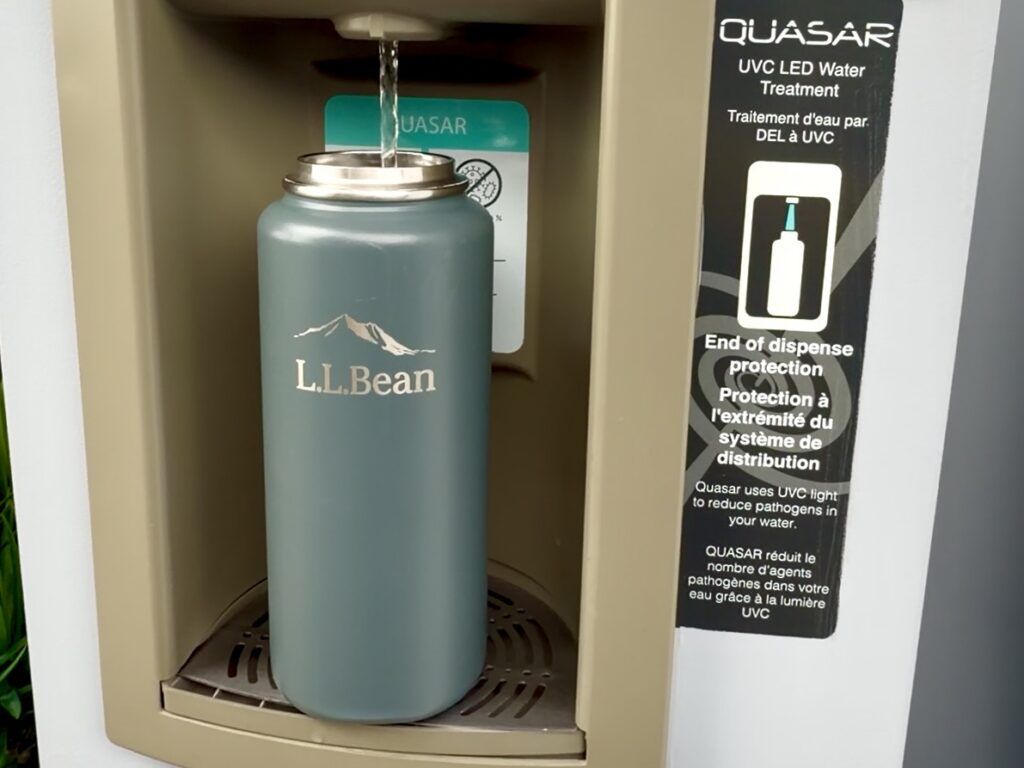
Virgin Voyages has no single-use plastics onboard, so there are no bottled waters available. Instead, you’ll find refill stations around the ship and carafes delivered to your room each day. So, packing a reusable water bottle for your cruise is key.
A reusable bottle means you always have water on hand for port days, workouts, and anywhere else around the ship without hunting for a refill spot when you need water the most.
Bring wine, or pre-order buckets
You’re allowed to carry on two 750ml bottles of wine or champagne per cabin on embarkation day. Buy your favorites at shore prices and enjoy them on your balcony, where there’s no corkage fee. The $25 fee only applies if you drink it in a restaurant. Just note that beer and hard liquor can’t be brought aboard.
If you’d rather not haul bottles, you can pre-order beverage buckets of beer or canned cocktails to have waiting in your cabin instead. It’s convenient and will also save you a bit of money.
Dining
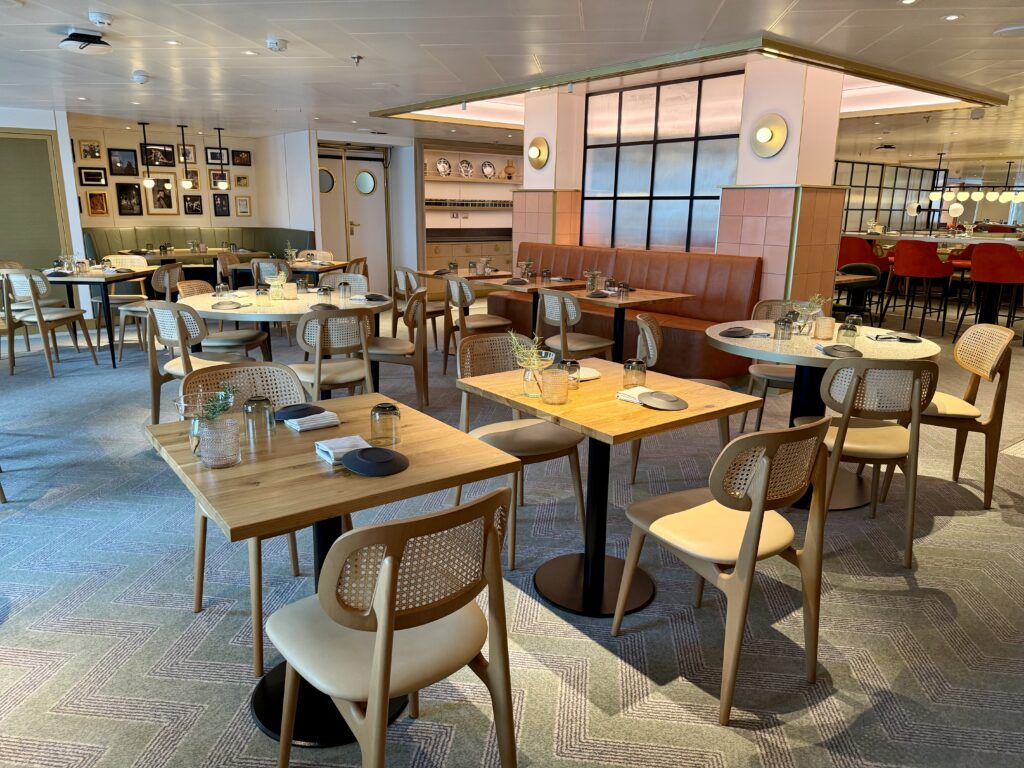
Food is where Virgin shines, but dining works nothing like a traditional cruise. There’s no main dining room, no true buffet, and no set dinner times, just 20-plus restaurants that are all included in your fare. That freedom is great once you know how it works, but a little planning is necessary.
Book your must-do restaurants early
The six main restaurants on Virgin ships require reservations: The Wake, Test Kitchen, Gunbae, Razzle Dazzle, Extra Virgin, and Pink Agave. Your dining reservation window depends on your fare and cabin, running from 120 days out for suites down to 15 days for the Base fare. Whenever yours opens, book your must-dine restaurants immediately.
Don’t fret if you can’t get everything pre-cruise, though. More reservations open once you’re onboard, and the dining concierge on embarkation day can help. Even check throughout the sailing, as new times will open up as other sailors cancel or change their plans.
Order more than one dish
Every restaurant on Virgin is included in your fare, with no per-person cover charges and no upcharge for extree entrees like many other cruise lines. So there’s no reason to hold back. If you’re torn between two appetizers or want to try a second entree, why not order both.
If availability allows, you could even dine at one restaurant for apps and then head to another for dinner later in the evening!
Of note: while most dishes are included, some menus have select “Treat Yourself” items that do cost extra.
Don’t skip brunch
While you may have heard past sailors raving about the dinner menus at these restaurants, you may not realize that a couple of them also serve brunch. So, you shouldn’t sleep in on these offerings.
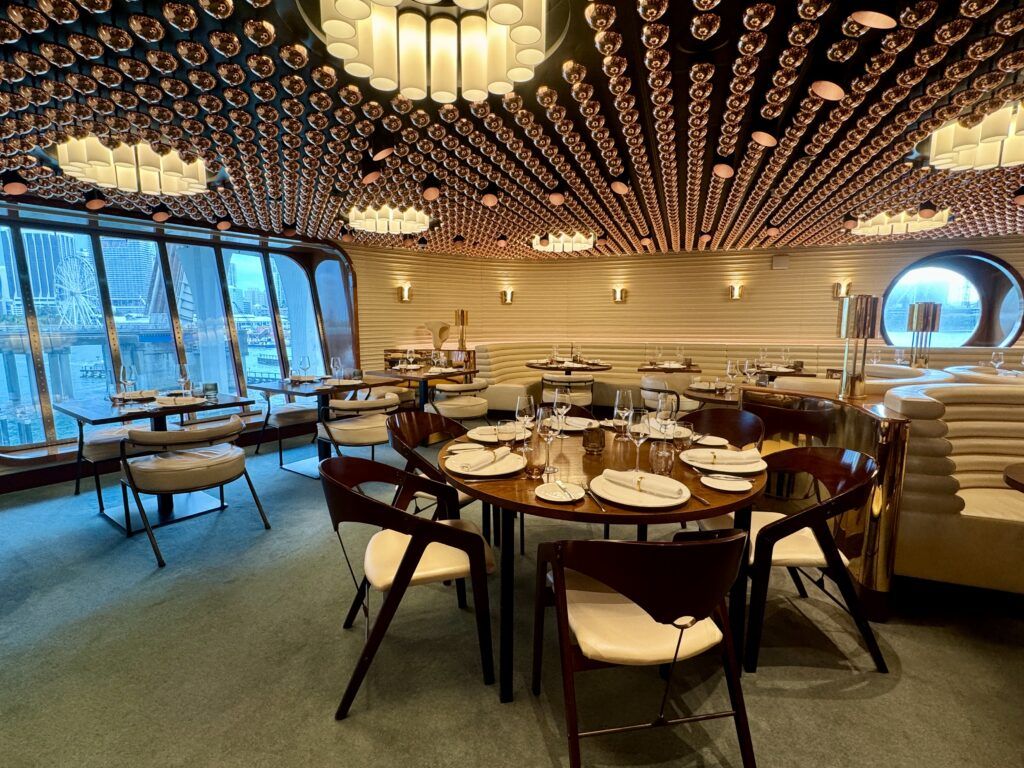
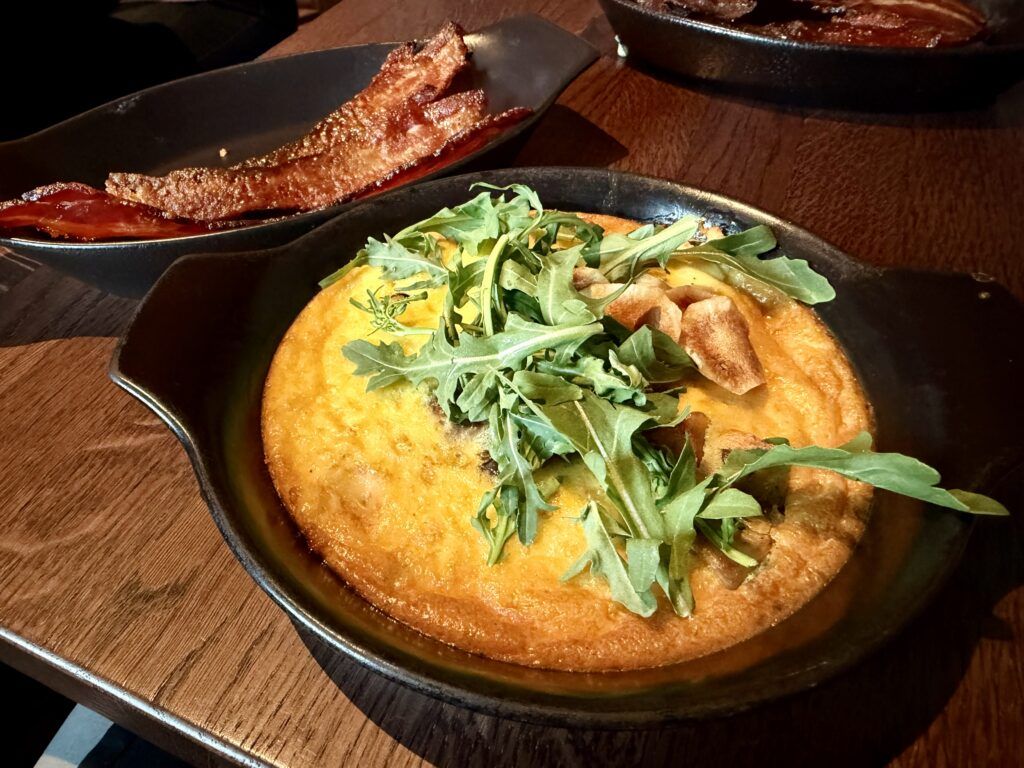
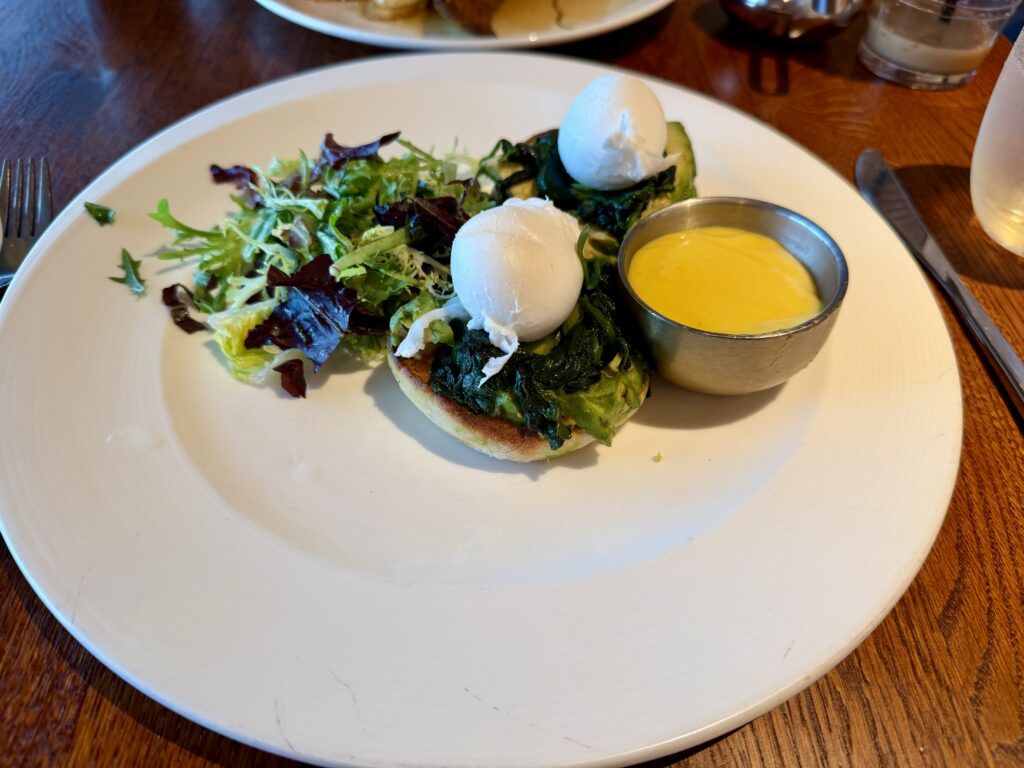
The Wake, better known as the dinnertime steakhouse, features brunch items like steak & eggs and various benedicts. Razzle Dazzle offers brunch too with the can’t-miss smoked bacon. Build a lazy sea day morning around one of them and you won’t be disappointed.
Know that Razzle Dazzle has changed
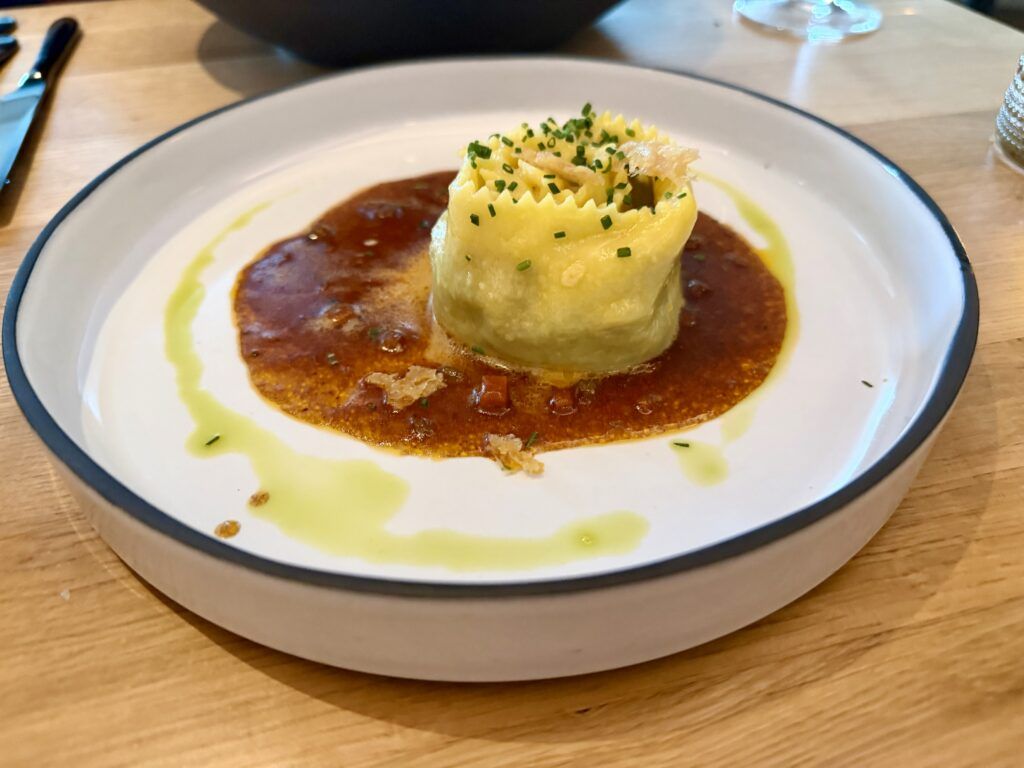
If you’ve sailed Virgin before, Razzle Dazzle might not be the venue you remember. It’s been revamped with new menus, and the evening concept now varies by ship. What used to offer vegetarian-foward dishes, the menu has shifted to American comfort foods. Plus, three ships feature a unique dinner experience: Scarlet Lady – Lucky Lotus (Chinese), Valiant Lady – Ariya (Indian), and Brilliant Lady – Rojo (Spanish).
So even repeat sailors should give it another look if it’s been a while since your last voyage.
Look for Extra Virgin’s ship-specific dishes
Extra Virgin, the Italian trattoria, isn’t identical across the fleet anymore either. Each ship carries a few menu items unique to that vessel. Look for the icon on the menu designating the dishes. It’s a small detail, but if you’re a foodie, it’s worth knowing which dishes are unique to the vessel.
For instance, Brilliant Lady has a signature fritto misto appetizer, along with spaghetti alla puttanesca and braised lamb girella pasta dishes.
Try The Test Kitchen’s vegetarian menu
The Test Kitchen is Virgin’s experimental, lab-themed restaurant with a set tasting menu. The cruise line rotates through three menus depending on the length of the voyage. If you’re a picky eater like I am, don’t let the set menu automatically turn you off from booking.
Beyond the standard menu, there’s a separate vegetarian tasting version. If you’re plant-based or just don’t like one of the courses on the menu, you can swap it out for the alternative vegetarian option. Ask to see that menu once onboard to decide whether those options are more your flavor.
Try Ship Eats
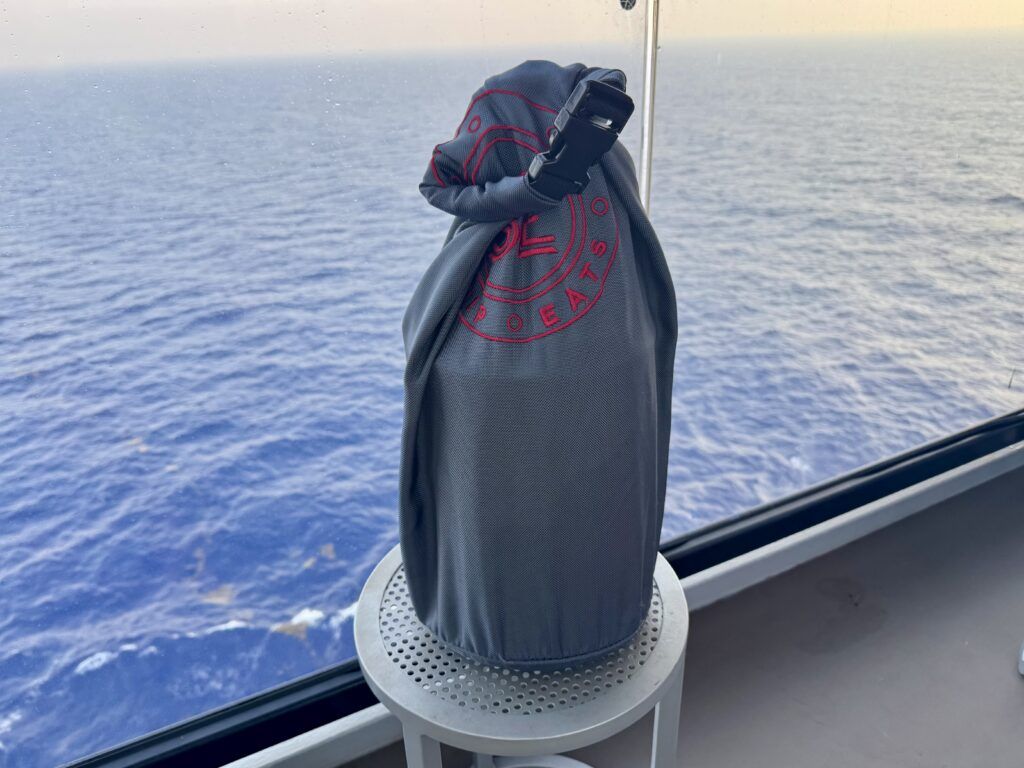
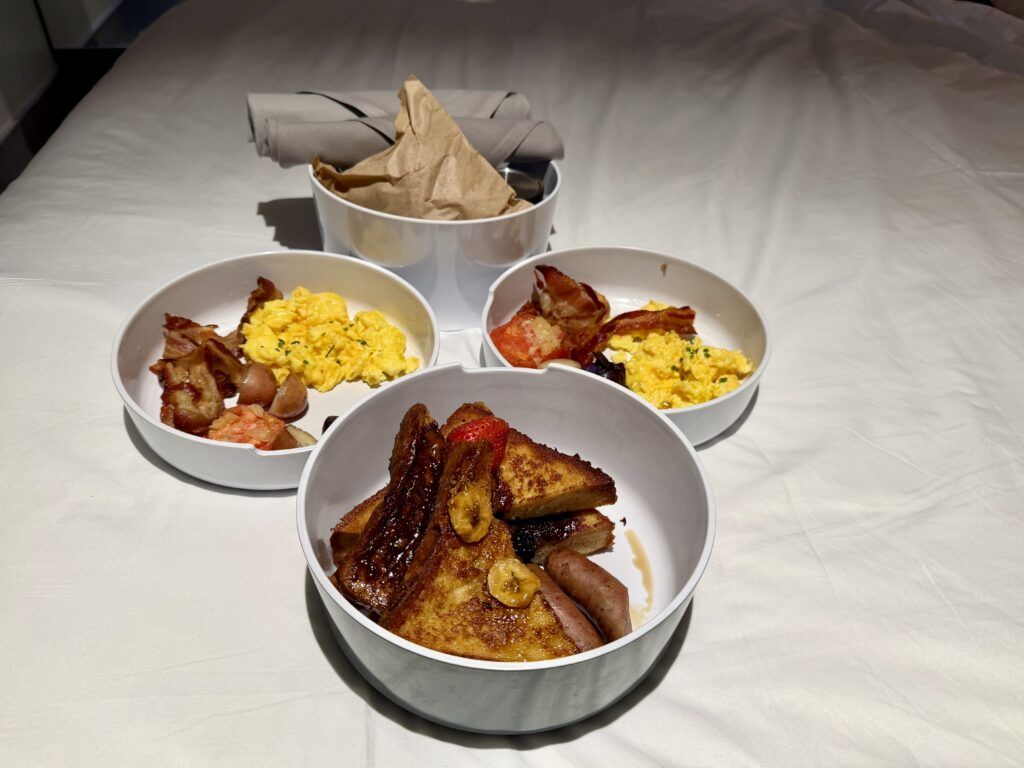
Ship Eats is Virgin’s take on room service that includes breakfast, all-day options, and late-night bites. For a small delivery fee, you can order items like nutella-stuffed French toast or eggs and bacon for breakfast and charcuterie, a cheese burger, or NY strip steak right from your app. There’s a $10 delivery fee (waived if you’re staying in a suite), but it’s perfect for a slow morning on your balcony or a snack after a night out.
It even comes thoughtfully packed in a picnic-like carrying case, which is very convenient for transporting.
Don’t sleep on the casual spots
The included specialty-restaurant-quality venues get all the buzz, but Virgin’s other casual venues are great too. The Dock (and Dock House) does excellent Mediterranean-style tapas with great aft views and a chic beach club vibe. The Pizza Place slings delicious made-to-order personal pies, and The Sun Club Cafe serves up poke bowls and bao buns in an outdoor setting overlooking the pool deck.
Not to mention, there’s free ice cream, snacks like pretzels, hot dogs, and chicken wings at The Social Club, and The Galley with several unique food stalls. The Galley is Virgin’s take on a buffet with made-to-order dishes ranging from burgers and sandwiches to tacos and noodles. There’s even a 24/7 diner so you can grab a good bite at any hour.
Money, Drinks, and Tipping
Virgin keeps its pricing simpler than most lines, but there are still a few smart money moves you should know. Drinks work through a Bar Tab rather than the usual drink packages, gratuities recently changed, and a couple of extras are worth paying for while others aren’t. These tips help you budget accurately and make your dollars go the furthest.
Buy a Bar Tab for the bonus, but only what you’ll drink
Virgin doesn’t sell traditional drink packages. Instead, you can pre-load a Bar Tab, and the line adds bonus credit based on how much you buy. For instance, $300 tab becomes $350 to use for purchasing beverages on the ship. The catch is that you only receive the bonus dollars when purchasing pre-cruise (and sometimes on embarkation day).
One word of caution: Bar Tab is non-refundable once you sail. So estimate honestly what you’ll actually drink and buy to that, since anything left over at the end of the cruise is gone. You don’t want to feel the need to over-indulge the last day of the sailing just to get your money’s worth.
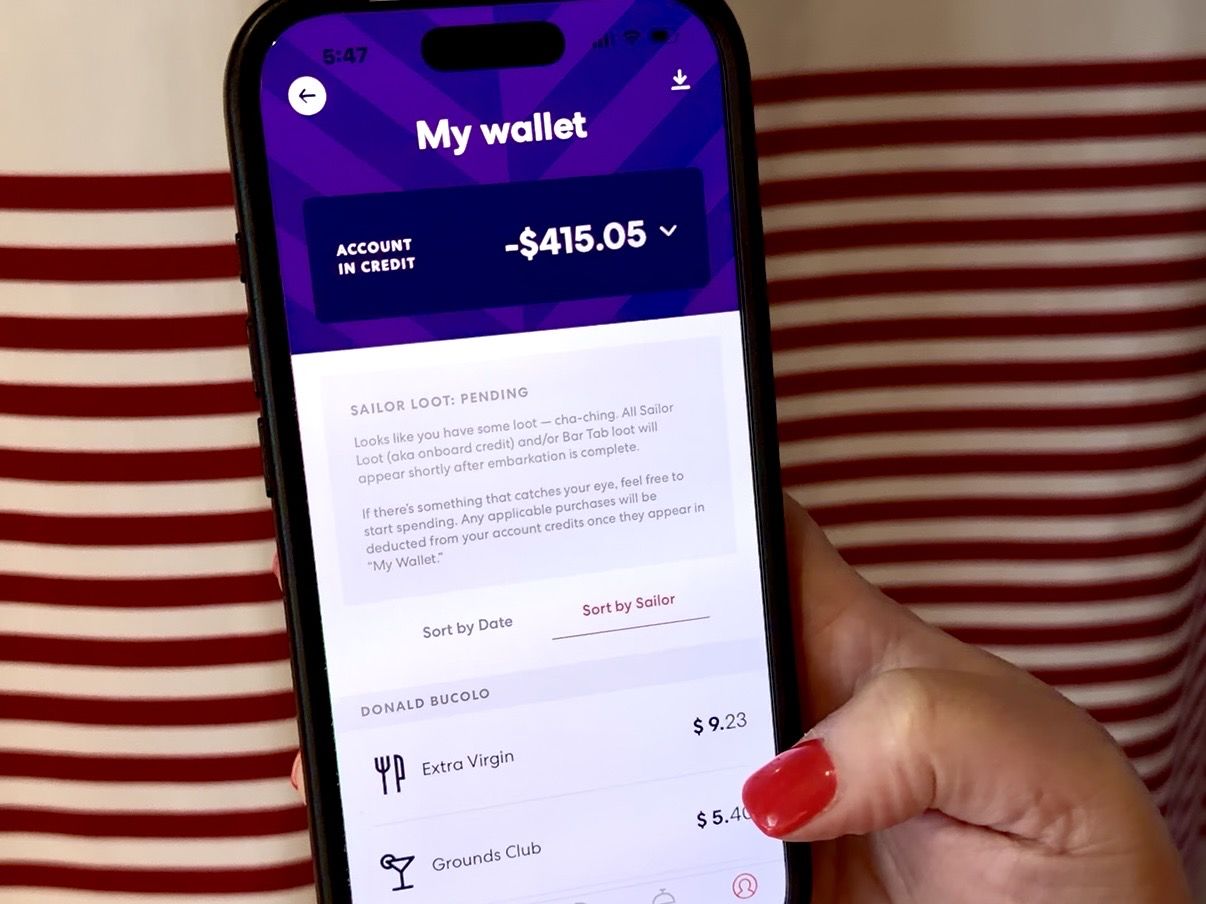
Bar Tab and Sailor Loot aren’t the same
You might be wondering what’s the difference between Bar Tab and Sailor Loot. These two credits look similar on your account but work very differently. Bar Tab covers drinks only. Sailor Loot is flexible and can be used on almost anything, from the spa to excursions to retail. But both are non-refundable. You can purchase a Bar Tab, but Sailor Loot is usually provided as part of a promotion either when booking the cruise or through a travel agent (think onboard credit).
Here’s the insider part. When you buy a drink, Virgin pulls from your Bar Tab first, then your Sailor Loot. So loading a Bar Tab saves your Sailor Loot for other purchases.
Budget for gratuities now
As of late 2025, the daily crew gratuity is no longer part of your cruise fare. It’s a separate charge now, like most other cruise lines, so factor it into your budget from the start. Pre-paying these gratuities locks it in at $20 per person per night, versus $22 if you wait and pay onboard.
Of note: while the daily gratuity is extra now, Virgin doesn’t charge the typical 18% or 20% gratuity on onboard purchases. The price you see is the price you pay.
Buy a thermal suite pass for a port day
The thermal suite at the Redemption Spa isn’t included in your fare, but it’s one of the better splurges onboard. A pass runs roughly $59 on port days and $79 on sea days for a three-hour block (two hours on Brilliant Lady in Alaska). The nice thing is that you don’t have to buy for the full week or even the full day, which makes the cost much more affordable if you want to check it out but not commit.
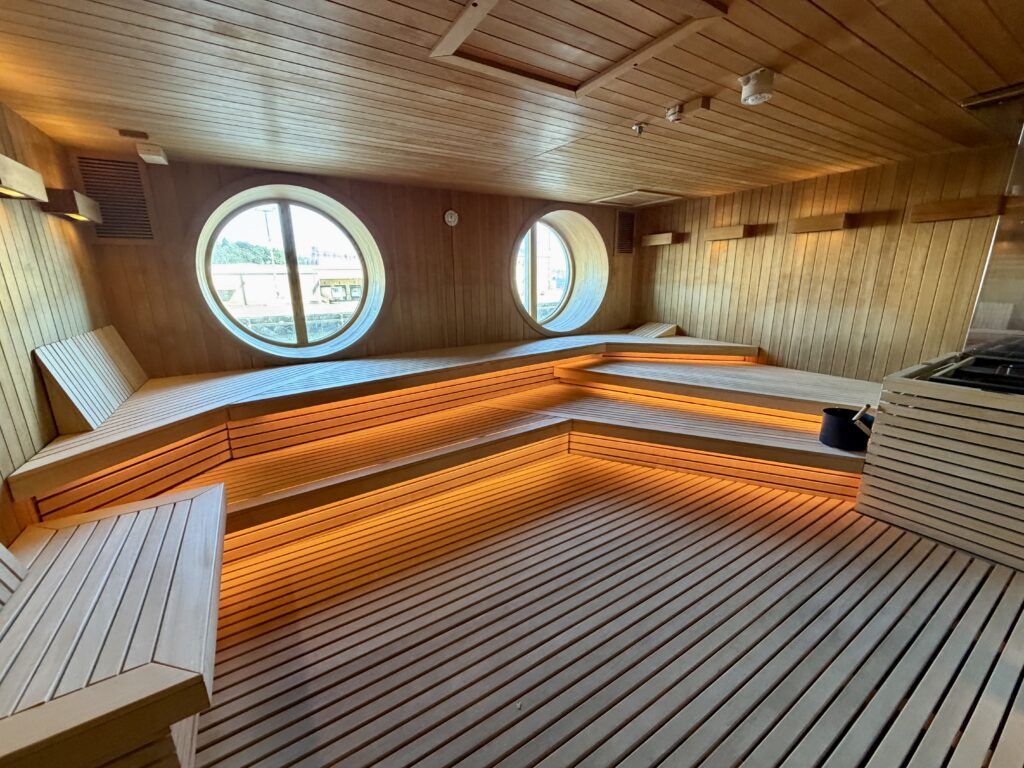
Our recommendation is to purchase a pass on a port day. It’s cheaper and it’s less crowded. While most other sailors are ashore, you can enjoy a relaxing morning or afternoon in the therapy pool, steam rooms, sauna, or salt room.
Embarkation Day
If you haven’t figured it out by now, embarkation day on Virgin runs a little differently, too. Boarding starts later than many lines, think around 2 PM, but there is a silver lining. Get the few quick mandatory tasks out of the way right when you board, and you can still get to enjoying a drink poolside before sail away.
Head straight to your cabin
Unlike many cruise lines where you’re stuck lugging around your carry-on items until mid-afternoon, Virgin has your cabin ready the moment you board. Given the later embarkation time, you can drop your bags and settle in right away on embarkation day. That makes for a smooth start to any trip!
Once you check off the few must-do items, like muster drill and making reservations, you can start exploring the ship and getting ready to set sail the Virgin way.
Knock out the muster drill first thing
Muster drill is a mandatory maritime requirement for all cruise lines, but the good news is that Virgin’s safety drill is mostly digital. You can watch the briefing in the app or on your stateroom’s television. Once complete, you’ll need to check in at your assigned muster station in person for a few brief instructions. This is the place you would report in an actual emergency, so remember it.
Everyone has to complete this process before the ship sails. If you do it as soon as you board, it’s off your list and frees you up to enjoy the rest of the day.
Reserve everything else the second you board
Beyond dining (which you can pre-reserve), a lot of Virgin’s best experiences take reservations, and they can only be made once onboard the ship. These activities will fill fast, so we recommend logging into the cruise line’s WiFi as soon as you board to book these experiences in the app.
Things like group fitness classes, Squid Ink tattoo appointments, spa treatments, select shows, and up-charge activities like mixology classes need to be booked. Waiting even a day can mean missing out on them entirely.
Getting the Most Onboard
Once you’re settled, a handful of habits separate sailors who get the most out of a Virgin cruise from those who miss half of it. A lot of the best moments are easy to walk right past, from free extras to app features. These tips make sure you don’t leave anything good on the table.
Enjoy the relaxed schedule
Unlike some cruise lines where you feel like you need to race from one activity to the next if you want to fit everything into your vacation, the vibe on Virgin is more relaxed. Yes, there’s still a lot to do, but it doesn’t feel as overwhelming.
Along with a later than typcial embarkation, you can also disembark the ship later, allowing you to sleep in or grab breakfast on your final morning. Disembarkation times run as late as about 10:30 AM depending on the ship and itinerary. Just book your flights with the later schedule in mind.
Spend a day at Bimini
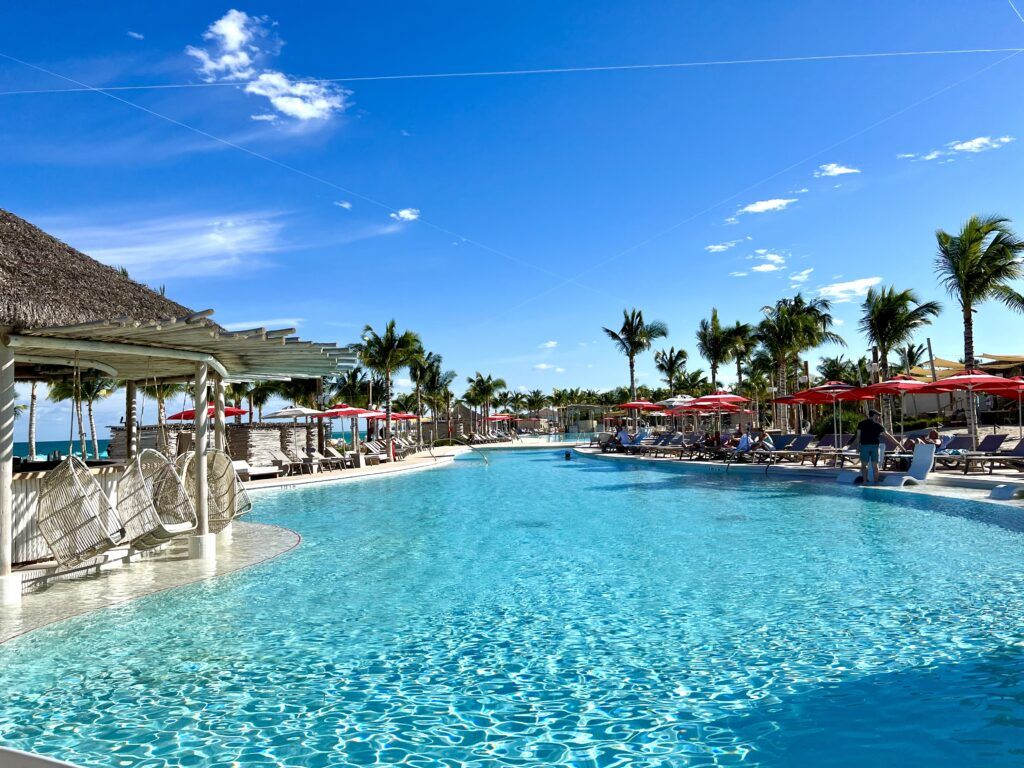
Most Caribbean and Bahamas sailings stop at The Beach Club at Bimini, Virgin’s private beach destination, and it’s included in your fare. There’s no admission fee, food is complimentary, and your Bar Tab works at the bars.
It’s more than a typical beach day, though, as there’s two lagoon-style pools, DJs, a flotilla party, beach games, yoga, and more. But, you’re also free to explore the rest of Bimini if you choose.
Hit the Glam Station before Scarlet Night
Before Scarlet Night (and sometimes on other select evenings), the Virgin Voyages’ Happenings Cast sets up a free “Glam Station” with glitter, rhinestones, and face paint to help you get into the spirit. It’s complimentary, unique to Virgin Voyages, and a fun way to prep for the ship’s biggest party. Check the app for the exact times and location and swing by early as the lines can get long later in the evening.
You don’t have to book excursions through Virgin
Virgin’s own Shore Things are convenient, but they aren’t your only option. These shore excursions through the cruise line are often more expensive and have larger group sizes. Independent operators like Shore Excursions Group often run the same or similar tours for less. Shore Excursions Group even builds in a return-to-ship guarantee or they’ll pay to get you to the next port.
So, when deciding on what to do in port, be sure to weigh all your options.
Use the app to chat with Sailor Services
Besides the typical cruise line app features, Virgin’s app has a built-in chat feature that is free to use. You can chat with Sailor Services right in the app, which beats waiting in line at the desk for a quick question or to resolve an issue. Guests were previously able to chat with each other as well, but this feature wasn’t working on our most recent August 2026 sailing.
Currently, you are only able to link other sailors for the purposes of coordinating reservations. Instead, download WhatsApp prior to your cruise and add your newly made friends to a group chat to communicate with them during the sailing.
Get connected, then go airplane mode
Basic WiFi is included for every sailor, so connect as soon as you board. Then put your phone into airplane mode to avoid surprise roaming charges once you’re at sea.
If you need more than basic browsing, you can upgrade your WiFi to Premium or even Work From Sea. Premium adds faster browsing, video calling, and entertainment streaming, while Work From Sea adds VPN.
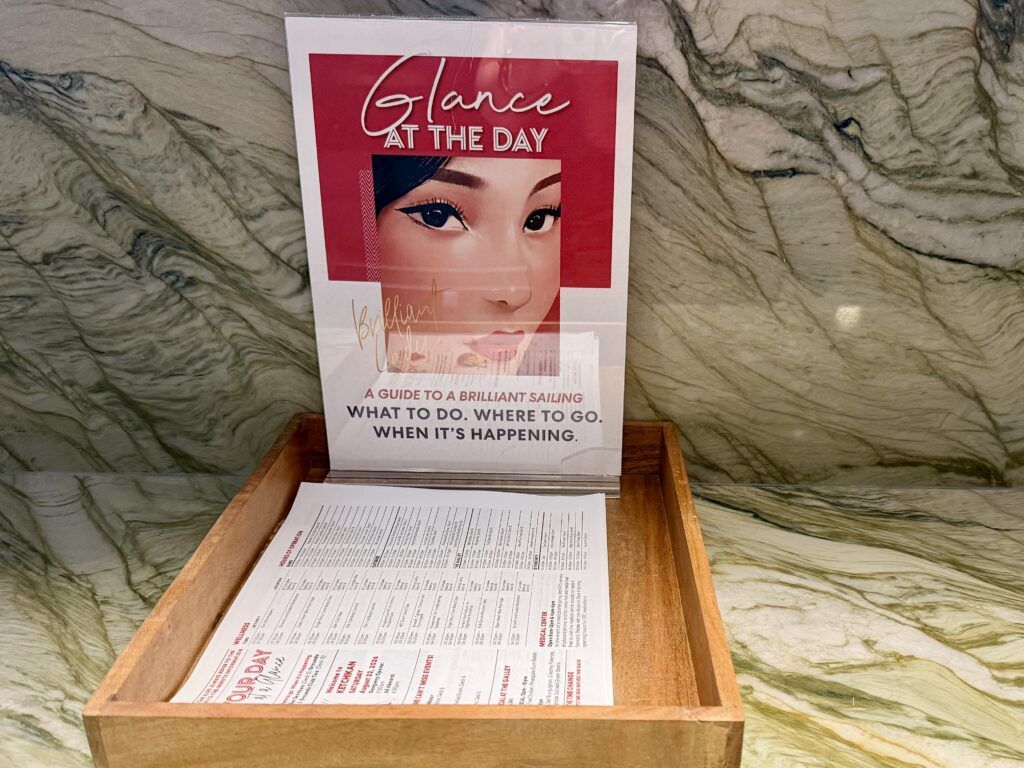
Grab the Daily Program
Your daily schedule of activities and shows lives in the app. It’s the best way to plan your day and stay up to date on what’s happening on the ship. You can even add these events to your calendar and get push notifications when they are about to start.
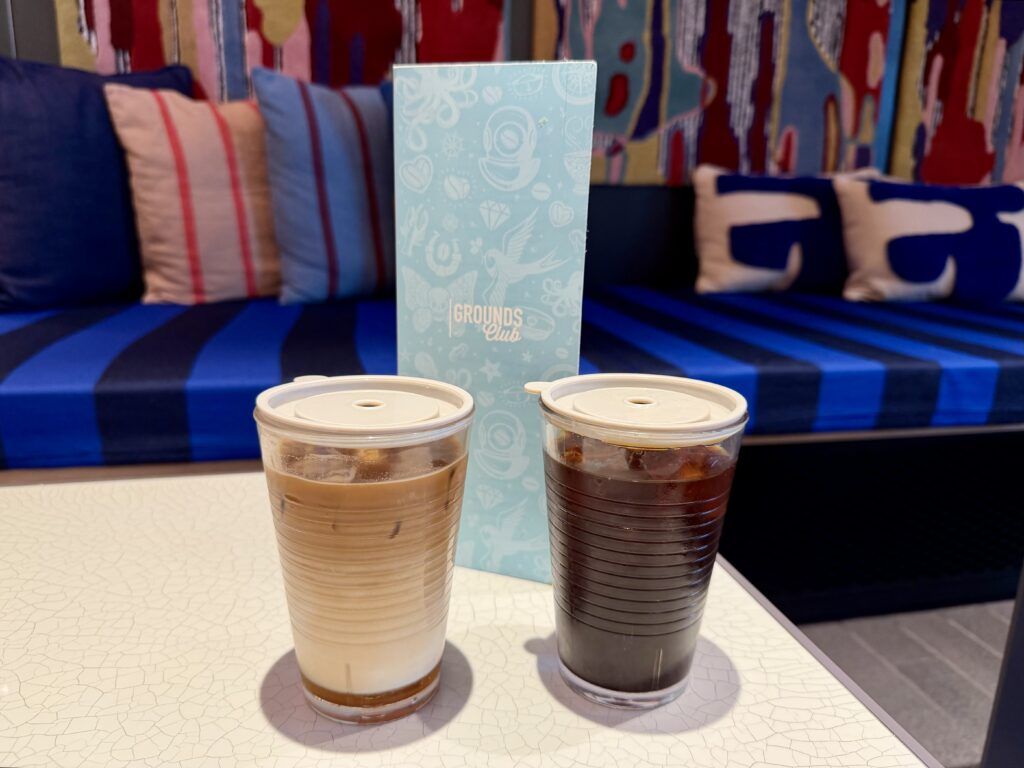
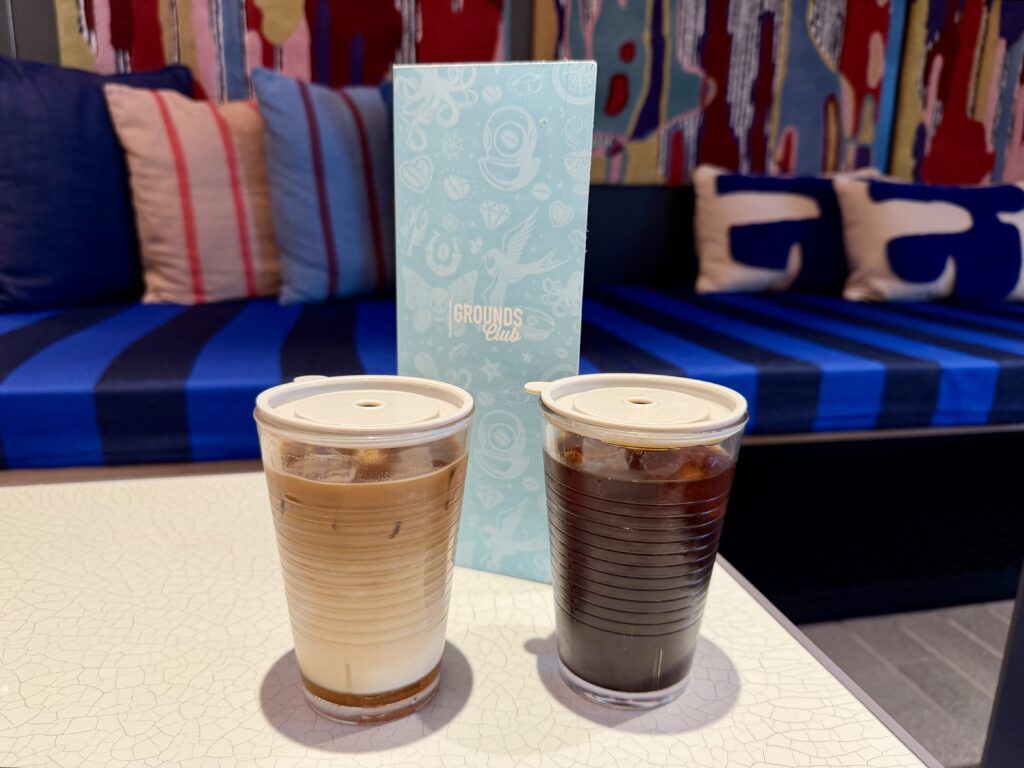
However, if you’d prefer the streamlined paper format, printed copies are usually available at Sailor Services and the Grounds Club. They’re handy for scanning the day at a glance or if you’d prefer not to carry your phone with you at all times.
Don’t miss the ship
Even with your phone in airplane mode, the time zone can change automatically, depending on which satellites its pinging. This means the display time on your phone and smart watch may not match the ship’s time. This mix up could cause you to be late for an activity or a shore excursion, or even worse, cause you to miss the all-aboard time of your ship while in port.
To be safe, the easy fix is to set your phone clock to manual and always match the ship’s time. When in doubt, you can always ask the crew at the gangway for the current time and/or the all-aboard time.
Cash in on your Sailing Club perks
You’re automatically enrolled in Virgin’s loyalty program, the Sailing Club, after your first voyage, with perks that grow as you sail more. Once you’ve reached 3 voyages, you’ll qualify for Blue Extras. Once you’ve reached 5 voyages, you’ll earn even more perks with Deep Blue Extras. These benefits add things like specialty coffees, laundry, priority boarding, and Bar Tab credit.
If you’ve already sailed with the cruise line, check what you’ve unlocked and actually use it. It’s easy to forget a benefit you’re entitled to. Who doesn’t love free lattes?
More is included than you think
If you’ve sailed other mainstream cruise lines before, it’s also easy to forget all the extras that are included on Virgin Voyages that aren’t on other brands. Things like soda, fitness classes, gelato, and arcade games won’t cost you any extra, so take full advantage of them. Free ice cream? Yes, please!
On most lines those little charges pile onto your onboard account one swipe at a time, but on Virgin they’re already yours. There’s no deciding if they’re worth the upcharge or not.
Before You Head Home
The last day of a cruise sneaks up fast, but two quick moves make it better. One saves you money on your next Virgin cruise, and the other saves you a headache after you’re home. Here’s how to end the trip on the right note.
Book your next voyage onboard
If you’ve caught the Virgin bug by the end of your sailing, book your next one before you leave. The My Next Virgin Voyage program offers a better rate plus onboard credit when you book onboard. For a 6-8 night cruise, sailors save $200 on the cruise fare and get $200 onboard credit. You only need a $150 deposit to lock in the next placeholder booking.
You can apply it to a future date you choose later. The newly announced updates to this program change the requirement to book and sail within two years of purchase. Keep in mind that name changes are no longer permitted for new MNVV placeholder purchases.
If you’re ready to book a specific voyage while onboard, you might be able to score an even better deal.
Check your onboard account
The day before you disembark, review your onboard account in the app to make sure everything looks accurate. It’s much easier to sort out a mistaken or duplicate charge while you’re still on the ship. Catching a discrepancy now means a quick visit to (or chat with) Sailor Services, preferably prior to disembarkation morning. Once you’re home, it’s a lot harder to get a charge reversed and means wasted time on the phone trying to dispute it.
Comments
Did you find these Virgin Voyages tips helpful? Do you have a sailing booked on Scarlet, Valiant, Resilient, or Brilliant Lady? Drop us an anchor below with your own Virgin Voyages tips, tricks, and secrets.
Conversations about firearm safety and lethal means safety are an important part of suicide prevention. While Ask Anyway: How to have Conversations for Firearms Safety provides guidance for starting respectful, effective conversations, many individuals, families, professionals and organizations are looking for additional tools, training, and resources to support veterans, service members, and military families in their communities. The resources below can help deepen knowledge, support safety planning, and connect individuals to practical solutions when concerns arise.
Worried About A Veteran – Resources to support conversations about firearm safety, including state-by-state information on legal options for temporary firearm storage outside the home. Worried About A Veteran | State Laws Guide
National Shooting Sports Foundation (NSSF) – Firearm industry-led resources, educational materials, and suicide prevention initiatives that promote responsible firearm ownership, secure storage, and community safety. NSSF | Firearm Storage Guide
Harvard Means Matter – Evidence-based research and educational resources on suicide prevention and reducing access to lethal means during periods of crisis. Harvard Means Matter
Rocky Mountain MIRECC – Practical tools and guidance for healthcare providers, veteran-serving organizations, and helping professionals on discussing firearm safety and implementing lethal means safety strategies. Counseling on Access to Lethal Means | Firearm Storage Recommendations
The Armory Project – A searchable directory that helps individuals locate voluntary, temporary out-of-home firearm storage options in participating communities. Find Firearm Storage
Overwatch Project – Community-focused education and outreach resources that promote suicide prevention and lethal means safety within military and veteran populations. Overwatch Project
Pause to Protect – Educational resources and tools that help firearm owners and businesses support secure storage and suicide prevention Pause to Protect
Training Opportunities
Cohen Veterans Network Lethal Means Safety Training – A free, online training that helps professionals and community members build confidence in having respectful, effective firearm safety conversations with veterans and military families. CVN Lethal Means Safety Training
Suicide prevention is a shared responsibility, and having access to trusted resources can help strengthen the conversations and support systems that veterans and military families rely on. Whether you’re a healthcare provider, peer supporter, or veteran community leader, we encourage you to explore these tools and continue learning about effective suicide prevention strategies. For additional information, resources, and support, visit cohenveteransnetwork.org/suicideprevention
Need Immediate Support? The Veterans Crisis Line is available 24/7. Call or text 988 and press 1, or chat online at Veterans Crisis Line. Trained responders can provide immediate support, answer questions, and help connect veterans, families, caregivers, and providers with appropriate resources and next steps.