New research suggests that having parents who lived to nearly 100 or beyond may give their children a head start on living longer and staying healthier.
By Carolyn Worthington, publisher, Healthy Aging®
Both of my parents lived to be almost 100. When I tell people this, they usually say, “You are lucky. You must have good genes.”
And my reply is, “Yes, unless I mess them up.”
As it turns out, there may be some science behind that exchange.
A recent study published in JAMA Network Open suggests that people whose parents lived to age 100 or beyond may have a significant advantage when it comes to their own longevity. And the benefits may go beyond simply adding years to life. They may include staying healthier longer, too.
What the Research Found
The study, published August 26, 2026, examined data from three major research groups in the United States and United Kingdom, including the New England Centenarian Study.
Researchers analyzed information from more than 4,000 participants, comparing adult children who had at least one parent reach age 100 with people whose parents had shorter lifespans.
The findings were encouraging.
Compared with the other participants, children of centenarians experienced:
A 42% lower risk of death during the study follow-up periods.
A 33% lower risk of cardiovascular disease.
A 32% lower risk of developing high blood pressure.
An estimated three-year delay in mortality, on average.
An estimated five-year delay in developing high blood pressure.
The researchers did not find a significant association between parental longevity and cancer risk.
These results don’t mean that children of centenarians are guaranteed to reach 100 themselves. The percentages reflect differences in risk observed among the study groups, not an individual’s chances of living to a particular age.
But the findings add to growing evidence that exceptional longevity may run in families.
Is It Really All in the Genes?
Not entirely.
Genetics clearly plays a role in how we age. Researchers believe that certain inherited characteristics may help protect against diseases commonly associated with aging.
But families share more than DNA.
They often share eating habits, attitudes toward physical activity, social connections, and approaches to handling stress. Growing up in a family where walking, home-cooked meals, or staying socially engaged were part of everyday life may influence habits that continue for decades.
The JAMA researchers found advantages among centenarians’ children even after accounting for several lifestyle and demographic factors. However, the study was observational and could not establish precisely how much of the advantage came from genetics versus environment.
In other words, having exceptionally long-lived parents may give you a head start, but it doesn’t tell the whole story.
Yes, You Can Mess Up a Good Opportunity
This brings me back to my usual response about inheriting good genes.
Even if longevity runs in your family, lifestyle choices still matter. And if your parents didn’t live to 100, that doesn’t mean you can’t enjoy a long, active life.
Regardless of your family history, there are practical ways to improve your chances of staying well as you age.
Keep moving.Regular physical activity supports heart health, muscle strength, balance, and mobility. Walking, cycling, swimming, dancing, and strength training all count. Find activities you enjoy so you’ll keep doing them.
Eat well most of the time. Build meals around vegetables, fruits, whole grains, beans, nuts, and other nutritious foods. Include adequate protein to help maintain muscle as you age. You don’t need a perfect diet, just consistently good habits.
Don’t smoke. Smoking remains one of the most significant preventable risks to long-term health. Quitting offers benefits at any age. Pay attention to your numbers. High blood pressure, elevated cholesterol, and diabetes can develop without obvious symptoms. Regular checkups and recommended screenings can help identify problems before they become serious.
Make sleep a priority. Consistent, restorative sleep supports physical and mental well-being. Most adults need approximately seven to nine hours a night, although individual needs vary.
Stay connected. Friends, family, community activities, and meaningful relationships contribute to emotional well-being. Make time for people and activities that bring enjoyment to your life.
Keep your mind engaged. Learn something new, pursue a hobby, travel, volunteer, or take a class. Curiosity and a sense of purpose can make the years ahead more rewarding.
Be mindful of alcohol. Drinking less, or not at all, can reduce health risks. Even moderate alcohol consumption carries some risks.
None of these habits guarantees a 100th birthday. But together, they can help improve your chances of enjoying more active, independent years.
The Real Goal: More Good Years
One of the most interesting aspects of the JAMA research is that it focused on more than lifespan. It also examined healthspan, the years we live without major age-related disease.
After all, reaching 100 is one thing. Being able to enjoy your later years is another.
Perhaps the best way to think about inherited longevity is as an opportunity rather than a promise.
If your parents lived exceptionally long lives, you may have inherited some advantages. If they didn’t, the choices you make today still matter. As for me, I’m hoping those family genes continue working in my favor. And I’ll do my best not to mess them up.
Who knows? Maybe someday, you and I will be among those centenarians who would have earned a birthday greeting from the late Willard Scott on NBC’s Today show.
Now wouldn’t that be something to smile about? ________________________________________
One of the most common questions I hear from fellow veterans about the PACT Act is pretty straightforward:
“How much VA disability compensation can I actually get under the PACT Act?”
Here’s what you need to know.
The PACT Act doesn’t have its own payment schedule. There’s no separate “PACT Act check” or automatic 100% VA disability rating just because you were exposed to toxic substances during military service.
What the PACT Act does is make it easier for eligible veterans to establish service connection for certain presumptive conditions associated with burn pits, Agent Orange, and other toxic exposures.
Once you’re service-connected, your monthly compensation depends on your VA disability rating, just like any other service-connected condition.
And with the official 3.6% cost-of-living adjustment (COLA) for 2027, those tax-free payments are increasing.
For example, a veteran rated at 100% with no dependents will receive $4,080.37 per month under the calculated 2027 rates, an increase of $141.79 per month over 2026.
Let’s break down exactly how PACT Act compensation works, the updated 2027 payment amounts, which conditions qualify, and what you need to know about back pay.
Table of Contents
How Much is PACT Act Compensation in 2027?
PACT Act compensation is based on your combined VA disability rating, not the type of toxic exposure you experienced. With the confirmed 3.6% COLA for 2027, calculated monthly payments range from $186.92 at 10% to $4,080.37 at 100% for veterans without dependents. Veterans rated at 30% or higher may qualify for additional compensation for eligible dependents.
The PACT Act expands access to service-connected disability benefits, but it does not create a separate monthly payment.
Two veterans with the same PACT Act presumptive condition can receive very different ratings depending on the severity of their disabilities.
Important: The 3.6% COLA was officially announced October 14, 2026. The increased VA compensation rates are scheduled to take effect December 1, 2026, with the first increased payment expected December 31, 2026. Until then, the 2026 payment amounts remain in effect.
2027 PACT Act Compensation Rates by VA Disability Rating
Here are the updated monthly VA disability compensation amounts for 2027.
2027 VA Disability Compensation: Veteran Without Dependents
Combined VA Rating
2027 Monthly Compensation
10%
$186.92
20%
$369.50
30%
$572.36
40%
$824.49
50%
$1,173.68
60%
$1,486.68
70%
$1,873.55
80%
$2,177.83
90%
$2,447.34
100%
$4,080.37
These amounts apply to veterans without eligible dependents or other additional compensation.
2027 VA Disability Compensation: Veteran With Spouse (No Children)
Combined VA Rating
2027 Monthly Compensation
30%
$639.70
50%
$1,286.61
70%
$2,032.06
100%
$4,307.86
2027 VA Disability Compensation: Veteran With Spouse and One Child
Combined VA Rating
2027 Monthly Compensation
30%
$690.46
50%
$1,370.52
70%
$2,149.13
100%
$4,474.47
Important: Additional compensation for dependents generally begins at a combined VA disability rating of 30%. Veterans rated at 10% or 20% do not receive additional dependent compensation under the standard rate schedule.
Your actual payment can vary based on qualifying dependents, Special Monthly Compensation (SMC), or other applicable VA compensation provisions.
Remember: These are the same standard VA disability compensation rates available to other service-connected veterans. The PACT Act changes how certain conditions may qualify for service connection, not the basic payment schedule.
What is PACT Act Compensation, Exactly?
The PACT Act, formally known as the Sergeant First Class Heath Robinson Honoring our Promise to Address Comprehensive Toxics Act, was signed into law on August 10, 2022.
It’s one of the most significant expansions of VA benefits for toxic-exposed veterans in decades.
The law expanded eligibility for veterans exposed to potentially harmful substances during military service, including burn pits, Agent Orange, and other toxic hazards.
Here’s what changed.
1. More Presumptive Conditions
The PACT Act added numerous medical conditions to the VA’s list of presumptive disabilities.
When a condition is presumptive, the VA generally accepts that it’s connected to qualifying military service without requiring the veteran to independently prove the medical relationship between that service and the condition.
That’s a big deal.
For many veterans, establishing that connection has historically been one of the hardest parts of the claims process.
2. More Veterans Qualify Based on Their Service
The law expanded certain qualifying locations and service periods for toxic-exposure presumptions.
That includes additional eligibility related to burn pits and airborne hazards, as well as expanded Agent Orange exposure presumptions.
3. Expanded VA Health Care Eligibility
The PACT Act also expanded access to VA health care for certain veterans exposed to toxic substances.
VA health care eligibility and VA disability compensation are separate benefit determinations.
4. Additional Consideration of Toxic Exposure Claims
The law strengthened how the VA evaluates certain claims involving toxic exposure.
However, not every medical condition associated with toxic exposure is presumptive.
Veterans with non-presumptive conditions may still establish service connection through other available routes, depending on the evidence.
Here’s the bottom line: A PACT Act presumption can help establish the connection between your military service and a qualifying medical condition. It does NOT automatically determine the severity of your condition or guarantee a particular VA rating.
Which Conditions Qualify for PACT Act Compensation?
Eligibility depends on several factors, including your diagnosed condition, where and when you served, and which presumptive rules apply.
Here are the major categories veterans should understand.
Veterans who served in qualifying locations during specified periods may be eligible for presumptive service connection for certain cancers and respiratory conditions.
Examples include:
Asthma diagnosed after qualifying service
Chronic bronchitis
Chronic obstructive pulmonary disease (COPD)
Constrictive bronchiolitis
Chronic sinusitis
Chronic rhinitis
Certain respiratory cancers
Certain head, neck, reproductive, and other cancers
Not every veteran with one of these conditions automatically qualifies.
Service dates, locations, diagnosis, and other applicable eligibility criteria still matter.
The PACT Act expanded certain eligibility rules for veterans exposed to herbicide agents, including Agent Orange.
Depending on qualifying service, presumptive conditions may include:
Type 2 diabetes mellitus
Ischemic heart disease
Parkinson’s disease
Prostate cancer
Bladder cancer
Chronic B-cell leukemias
Certain other cancers and illnesses recognized by VA
Some of these conditions were presumptive before the PACT Act. Others were added or had their eligibility requirements expanded.
Veterans who served in Vietnam, Thailand, and other qualifying locations should review the specific exposure presumptions that apply to their military service.
Certain veterans exposed to ionizing radiation during qualifying military activities may be eligible for presumptive service connection for specific diseases.
Examples of qualifying exposure circumstances can include certain nuclear weapons testing activities and other radiation-risk activities recognized by the VA.
Eligibility depends on the particular exposure circumstances and applicable regulations.
Radiation-related presumptions have their own requirements and shouldn’t be confused with the PACT Act’s burn pit presumptions.
For official information about qualifying conditions and service requirements, visit the VA’s PACT Act benefits page.
How Your VA Disability Rating Determines Your PACT Act Compensation
Here’s something every veteran should understand.
Your VA disability ratings aren’t simply added together.
The VA uses a combined ratings system commonly called “VA math.”
If you’re already service-connected for one or more disabilities and later receive another rating for a PACT Act presumptive condition, the VA generally combines the evaluations using its combined ratings rules.
That can increase your overall rating and monthly compensation.
Example 1: Adding a PACT Act Condition to an Existing Rating
Let’s say a veteran already has a 30% rating for a knee disability.
Under the 2027 compensation schedule, that veteran receives $572.36 per month without dependents.
The veteran later receives service connection for chronic sinusitis at 30%.
Here’s how those ratings combine:
Existing knee disability: 30%
Remaining efficiency: 70%
Additional 30% disability applied to remaining efficiency: 21%
Combined value: 51%
Rounded combined disability rating: 50%
The veteran’s new 2027 monthly compensation would be $1,173.68, assuming no dependents or additional special compensation.
Monthly increase: $601.32
That’s an additional $7,215.84 per year at the 2027 rates.
These are hypothetical evaluations used to demonstrate VA math. Actual disability ratings depend on the VA’s findings.
Example 2: Multiple PACT Act Presumptive Conditions
Consider a veteran who receives service connection for:
COPD rated at 30%
Chronic rhinitis rated at 10%
Using VA math:
First rating: 30%
Second rating: 10% of the remaining 70%, or 7%
Combined value: 37%
Rounded combined rating: 40%
At the 2027 rates, a veteran with a 40% rating and no dependents would receive $824.49 per month, tax-free.
Actual combined ratings can also be affected by additional disabilities, the bilateral factor, and other applicable calculation rules.
Yes. Some veterans can receive retroactive VA disability compensation, commonly called back pay, for claims granted under the PACT Act.
But there’s an important distinction.
Qualifying for a PACT Act presumptive condition does NOT automatically mean the VA owes you years of back pay.
Your effective date determines when entitlement to compensation begins, subject to the VA’s payment commencement rules.
And effective dates depend on when your claim was filed, when entitlement arose, whether earlier decisions became final, and whether special statutory or regulatory provisions apply.
How PACT Act Effective Dates Work
For many original VA disability claims, the effective date is generally the later of:
The date the VA receives your claim, or
The date entitlement arose.
There are exceptions.
For example, a timely, valid intent to file may preserve an earlier filing date if the completed application is submitted within the applicable one-year period.
Special effective-date rules may apply to certain claims granted under changes in law, including particular PACT Act claims.
The VA also has rules governing when compensation payments actually begin, which may be later than the assigned effective date.
What if the VA Previously Denied Your Claim?
This is especially important for veterans whose toxic-exposure claims were denied before the PACT Act.
If the VA previously denied your claim and your condition is now presumptive, you may be eligible to file a Supplemental Claim requesting review under the change in law.
But don’t confuse an opportunity to receive service connection with an automatic right to compensation dating back to your original claim.
A new law generally does not automatically reopen every prior final decision or restore the original effective date.
Certain continuously pursued claims, liberalizing-law rules, and other exceptions may affect the result.
The point is this: An approved PACT Act claim and an award of several years of back pay are two separate determinations.
If you were previously denied, review the effective-date rules that apply to your particular claim.
Example: How PACT Act Back Pay Can Work
Imagine a veteran receives service connection for chronic sinusitis at 30% based on qualifying military service.
If the VA establishes an effective date that results in 12 compensable months before the award, the veteran may receive retroactive compensation for those months.
The amount depends on the monthly compensation rates in effect during each period, existing ratings, dependent status, and other applicable adjustments.
For a simple example, 12 months at the 2026 rate of $552.47 equals $6,629.64.
That’s a mathematical illustration—not a guarantee that a particular PACT Act claim qualifies for 12 months of back pay.
The legally applicable effective date must be established first.
An intent to file may help preserve a potential effective date while you gather supporting evidence and prepare your formal application.
Generally, you have up to one year to complete an applicable claim after filing a valid intent to file.
However, the appropriate filing approach may differ if you have a previously denied claim or an active decision review.
Step 4: Submit Your Claim
For a new disability compensation claim, you can generally apply through VA.gov, by mail, or through other accepted VA filing methods.
If your condition was previously denied, a Supplemental Claim may be the appropriate route.
Make sure you’re using the correct process for your circumstances.
Step 5: Attend Your C&P Exam
The VA may schedule a Compensation and Pension (C&P) examination to evaluate your condition.
Be thorough and honest when describing your symptoms.
Explain:
How often symptoms occur.
How severe they are.
What treatment you’ve received.
How the condition affects your daily life.
Any relevant functional limitations.
Don’t exaggerate symptoms, but don’t minimize them either.
The examiner’s findings may help the VA determine how your condition should be evaluated under the applicable rating criteria.
(FAQs) Frequently Asked Questions
How much does the PACT Act pay per month in 2027?
The PACT Act uses the standard VA disability compensation schedule. With the confirmed 3.6% COLA, calculated 2027 rates range from $186.92 per month at 10% to $4,080.37 per month at 100% for veterans without dependents. Additional compensation may apply for qualifying dependents or under other VA benefit provisions.
Is the 2027 PACT Act compensation increase official?
The 3.6% COLA was officially announced October 14, 2026. The corresponding VA disability compensation increase is scheduled to take effect December 1, 2026. The individual dollar figures in this article are calculated using the confirmed percentage and published 2026 VA compensation rates.
Can I Receive PACT Act Compensation and Regular VA Disability Compensation at the Same Time?
You may receive additional compensation if a newly service-connected PACT Act condition increases your combined disability rating or otherwise establishes entitlement to additional compensation. However, PACT Act conditions don’t generate an entirely separate monthly VA disability check. Most service-connected disability evaluations are combined under the VA’s rating rules.
Is PACT Act Compensation Taxable?
No. VA disability compensation is generally excluded from federal taxable income. The tax treatment does not change because service connection was established under a PACT Act presumption.
How Long Does a PACT Act Claim Take to Process?
Processing times vary based on the complexity of the claim, available evidence, required medical examinations, and whether additional development is necessary. There is no single timeline that applies to every PACT Act claim.
Can I File a PACT Act Claim If I Was Previously Denied?
Yes. If your condition is now covered by an applicable presumption because of a change in law, you may be able to request review through a Supplemental Claim. A change in law can provide a basis for readjudication, but an award doesn’t automatically carry the effective date of your original claim. Review the applicable decision-review and effective-date rules carefully.
Do I Need a Nexus Letter for a PACT Act Presumptive Condition?
Generally, no separate medical nexus letter is required to establish the connection already supplied by an applicable legal presumption. However, you must satisfy the service and medical requirements of that presumption. For conditions that are not presumptive, medical nexus evidence may be important.
Can a PACT Act Condition Receive a 0% VA Rating?
Yes. A veteran may receive service connection at 0% when the applicable rating criteria support a noncompensable evaluation. A 0% rating does not produce standard monthly disability compensation by itself. However, establishing service connection may provide access to certain benefits and create a basis for requesting an increased evaluation if the disability worsens.
Can Survivors Receive PACT Act Benefits?
Yes, in certain circumstances. Eligible surviving spouses, children, or parents may qualify for Dependency and Indemnity Compensation (DIC) or other survivor benefits when the applicable requirements are met. The PACT Act expanded certain pathways to benefits for survivors of veterans whose deaths were associated with qualifying service-connected conditions.
The Bottom Line on PACT Act Compensation
Here’s what I want every fellow veteran to understand about the PACT Act.
The law doesn’t automatically give you a higher VA rating. It can make it easier to establish service connection for medical conditions that may have been much harder to prove before.
And that matters.
Because once a qualifying condition is service-connected, the VA evaluates it under the applicable disability rating criteria.
That evaluation can affect your combined VA disability rating, monthly tax-free compensation, and potential eligibility for other benefits.
With the official 3.6% COLA for 2027, a veteran with a 100% rating and no dependents will receive $4,080.37 per month under the calculated new schedule.
But whether you’re currently rated at 0%, 30%, 70%, or 90%, the most important thing is understanding which conditions qualify and what medical evidence supports the rating criteria that apply to you.
If you’re dealing with the effects of toxic exposure from your military service, don’t overlook a potentially qualifying condition simply because you were denied in the past.
The rules may have changed.
And you owe it to yourself to understand what those changes could mean for the benefits you’ve earned.
Deserve a Higher Rating? We Can Help!
At VA Claims Insider, we provide education, coaching, and strategies to help veterans better understand the disability claims process and organize the evidence relevant to their claims.
Brian Reese is a world-renowned VA disability benefits expert and the #1 bestselling author of VA Claim Secrets and You Deserve It. Motivated by his own frustration with the VA claim process, Brian founded VA Claims Insider to help disabled veterans secure their VA disability compensation faster, regardless of their past struggles with the VA. Since 2013, he has positively impacted the lives of over 10 million military, veterans, and their families.
A former active-duty Air Force officer, Brian has extensive experience leading diverse teams in challenging international environments, including a combat tour in Afghanistan in 2011 supporting Operation ENDURING FREEDOM.
Brian is a Distinguished Graduate of Management from the United States Air Force Academy and earned his MBA from Oklahoma State University’s Spears School of Business, where he was a National Honor Scholar, ranking in the top 1% of his class.
Content Reviewed By
Quality Assurance Team
The Quality Assurance (QA) team at VA Claims Insider has extensive experience researching, fact-checking, and ensuring accuracy in all produced content. The QA team consists of individuals with specialized knowledge in the VA disability claims adjudication processes, laws and regulations, and they understand the needs of our target audience. Any changes or suggestions the QA team makes are thoroughly reviewed and incorporated into the content by our writers and creators.
The details behind the death of an Air Force special operations instructor killed during a rappelling demonstration Saturday will likely not be known for weeks or even months.
But rappelling demonstrations by military members at large public events, particularly involving highly trained special ops units, are not new.
Air Force Tech. Sgt. Ian Patterson, a Tactical Air Control Party instructor assigned to a training unit at Joint Base San Antonio, Texas, was killed when he fell from the rafters of that city’s Alamodome football stadium prior to a college football game. Patterson was participating in a rappelling demonstration before the game when he fell from the rafters, which are at least 160 feet above the playing field, according to the stadium’s technical manual.
Video of the accident appears to show Patterson holding or attached to rappelling lines but falling unchecked.
Though the Air Force has made no statement on the cause of the accident, some media commentary has suggested that Patterson’s death traces to recent recruiting and marketing blitzes under Secretary of Defense Pete Hegseth, who has pushed the military to project an action- and combat-oriented public persona.
The Air Force did not immediately respond to questions on what chain of command may have ordered or approved the demonstration, but military members rappelling into football games has been a common event across the country for at least a decade.
A group of soldiers rappel with an American flag for the National Anthem during an American Conference football game between the Army West Point Black Knights and University of Texas San Antonio, in Texas, Nov. 29, 2025. Army photo by Spc. David Dumas.
Just in San Antonio, groups of Air Force special warfare instructors stationed at Lackland, as Patterson was, along with groups of Army soldiers, have performed similar demonstrations at the Alamodome and the city’s AT&T Center at least four other times in recent years. Along with football games, military members have rappelled into San Antonio Spurs basketball games and the city’s annual stock show and rodeo, the latter in both 2023 and 2024, prior to Hegseth’s arrival at the Pentagon.
Dating back to at least 2018, military photographers have covered rappelling demonstrations in sports stadiums in Arizona, New York, Idaho, South Dakota, and California, and recorded rappel demonstrations from helicopters at several NASCAR race tracks.
Demonstrators are usually highly trained units
Many military members are exposed to rappelling during basic training or other early stages of their career. But the skill is an integral part of the job for most ground combat units that work in steep terrain or who deploy from helicopters. For helicopter operations, rappelling is considered an “alternate insertion” method, along with fast roping, for missions that lack a safe landing zone.
Many special operations units train specifically to rappel or fast rope in rescues and direct raids. Rappelling is fairly safe and can be done from nearly any height with a long enough rope, but only one team member can use a rope at a time. Fast roping allows several team members to slide down a thicker rope at once, but usually requires a lower hover and can lead to falls.
Rappelling derives from the mountain climbing world, where climbers slide down a rope to safely descend terrain too steep to climb or walk down. Using a mechanical brake or, less commonly, a simple knot, rappelling allows a single individual to slide down a rope very quickly while controlling their speed. A skilled rappeller can rapidly zip down a rope to a specific spot, stop quickly and “tie off” on the rope, keeping them suspended in one spot, such as when a rescuer needs to render aid to an injured patient on a cliff face.
As a TACP instructor, Patterson would almost certainly have been an expert in the skill. TACP is one of four Air Force Special Warfare roles for which rappelling is a core job skill for both steep terrain and helicopter operations.
In August, the Air Force published a 19-photo gallery of Patterson’s unit, Detachment 2 of the 6th Combat Training Squadron, training in rappel techniques. The photos do not identify any airmen by name, but show both TACP instructors and students rappelling from a training tower and from inside a hovering helicopter at Camp Bullis, a training range outside of San Antonio.
Air Force rappel training for all of its Special Warfare roles follows Air Force training rules for rappelling, which are based on the Army’s rappelling manual, TC-21-24. That manual requires that rappel training be overseen by three separate roles for training on fixed structures like a tower. Each rappeller must be overseen by a Rappel Master, who is in charge of all aspects of the training; a Safety Officer, who ensures equipment and personnel are properly prepared; and a rappel lane non-commissioned officer who directly oversees each rappeller on one rope. Training can also include a specific belayer on the ground.
An Air Force investigation into Patterson’s death will review what procedures were in place during the accident.
“Doctor, do you diagnose dementia? Because I need someone who can diagnose dementia.”
A man asked me this question a while back. He explained that his 86-year-old father, who lived in the Bay Area, had recently been widowed. Since then the father had sold his long-time home rather quickly, and was hardly returning his son’s calls.
The son wanted to know if I could make a housecall. Specifically, he wanted to know if his father has dementia, such as Alzheimer’s disease.
This is a reasonable concern to have, given the circumstances.
However, it’s not very likely that I — or any clinician — will be able to definitely diagnose dementia based a single in-person visit.
But I get this kind of request fairly frequently. So in this post I want to share what I often find myself explaining to families: the basics of clinical dementia diagnosis, what kind of information I’ll need to obtain, and how long the process can take.
Now, note that this post is not about the comprehensive approach used in multi-disciplinary memory clinics. Those clinics have extra time and staff, and are designed to provide an extra-detailed evaluation. This is especially useful for unusual cases, such as cognitive problems in people who are relatively young.
Instead, in this post I’ll be describing the pragmatic approach that I use in my clinical practice. It is adapted to real-world constraints, meaning it can be used in a primary care setting. (Although like many aspects of geriatrics, it’s challenging to fit this into a 15-minute visit.)
Does this older person have dementia, such as Alzheimer’s disease? To understand how I go about answering the question, let’s start by reviewing the basics of what it means to have dementia.
5 Key Features of Dementia
A person having dementia means that all five of the following statements are true:
A person is having difficulty with one or more types of mental function. Although it’s common for memory to be affected, other parts of thinking function can be impaired. The DSM-5 (Diagnostic and Statistical Manual of Mental Disorders) lists these six types of cognitive function to consider: learning and memory, language, executive function, complex attention, perceptual-motor function, social cognition.
The difficulties are a decline from the person’s prior level of ability. These can’t be lifelong problems with reading or math or even social graces. These problems should represent a change, compared to the person’s usual abilities as an adult.
The problems are bad enough to impair daily life function. It’s not enough for a person to have an abnormal result on an office-based cognitive test. The problems also have to be substantial enough to affect how the person manages usual life, such as work and family responsibilities.
The problems are not due to a reversible condition, such as delirium, or another reversible illness. Common conditions that can cause — or worsen — dementia-like symptoms include hypothyroidism, depression, and medication side-effects.
The problems aren’t better accounted for by another mental disorder, such as depression or schizophrenia.
Dementia — now technically known as “major neurocognitive disorder” — is a syndrome, or “umbrella” term; it’s not considered a specific disease. Rather, the term dementia refers to this collection of features, which is caused by some form of underlying damage or deterioration of the brain.
Alzheimer’s disease is the most common underlying cause of dementia. Vascular dementia (damage from strokes, which can be quite small) is also common, as is having two or more underlying causes for dementia. For more on conditions that can cause dementia, see here.
What Doctors Need to Do To Diagnose Dementia
Now that we reviewed the five key features of dementia, let’s talk about how I — or another doctor — might go about checking for these.
Basically, for each feature, the doctor needs to evaluate, and document what she finds.
1. Difficulty with mental functions. To evaluate this, it’s best to combine an office-based cognitive test with documentation of real-world problems, as reported by the patient and by knowledgeable observers (e.g family, friends, assisted-living facility staff, etc.)
For cognitive testing, I generally use the Mini-Cog, or the MOCA. The MOCA provides more information but it takes more time, and many older adults are either unwilling or unable to go through the whole test. The SLUMS test is another cognitive test sometimes used in primary care. (The Mini-Mental State Exam was commonly used 30 years ago, but is now used less, as the MOCA and SLUMS are considered better.)
Completing office-based tests is important because it’s a standardized way to document cognitive abilities. But the results don’t tell the doctor much about what’s going on in the person’s actual life.
2. Decline from previous level of ability. This feature can be hard for me to detect on my own during a single visit. To document a decline in abilities, a doctor can interview other people, and/or document that she’s reviewed previous cognitive assessments. I have also occasionally documented that a patient is currently unable to correctly perform a cognitive task that is related to her career or education history. For instance, if a former accountant can no longer manage basic arithmetic, it’s reasonable to assume this reflects a decline from previous abilities.
3. Impairment of daily life function. This is another feature that can be tricky to detect during a single visit, unless the patient is very impaired. I usually start by finding out what kinds of ADLs and IADLs help the person is getting, and what kinds of problems have been noted. This often means talking to at least a few people who know the patient.
Driving and managing finances require a lot of mental coordination, so as dementia develops, these are often the life tasks that people struggle with first.
In some cases — usually very early dementia — it can be quite hard to decide whether a person’s struggles have become enough to qualify as “impairment of daily life function.” If someone isn’t taking his medication, is that just regular forgetfulness? Ambivalent feelings about the medication? Or actual impairment due to brain changes? If I’m not sure, then I may document that the situation seems to be borderline, when it comes to impairment of daily life function.
4. Checking for reversible causes of cognitive impairment. I mentally divide this step into two parts. First, I consider the possibility of delirium, a very common state of worse-than-usual mental function that’s often brought on by illness. For instance, I’ve noticed that older people are often mentally assessed during or after a hospitalization. But that’s not a good time to try to definitely diagnose dementia, because many elders develop delirium when they are sick, and it can take weeks or even months to return to their previous level of mental function.
(My approach to considering dementia in older adults who are confused during or after hospitalization: Make a note that they may have underlying dementia, and plan to follow-up once the brain has had a chance to recover.)
After considering delirium, I check to see if the patient might have another medical problem that interferes with thinking skills. Common medical disorders that can affect thinking include depression, thyroid problems, electrolyte imbalances, B12 deficiency, and medication side-effects. I also consider the possibility of substance abuse.
If I do suspect delirium or another problem that might cause cognitive impairment, I don’t rule out dementia. That’s because it’s very common to have dementia along with another problem that’s making the thinking worse. But I do plan to reassess the person’s thinking at a later date.
5. Checking for other mental disorders. This step can be a challenge. Depression is the most common mental health problem that makes dementia diagnosis difficult. This is because depression is not uncommon in older adults, and it can cause symptoms similar to those of dementia (such as apathy, and poor attention). We also know that it’s quite common for people to have both dementia and depression at the same time.
In many cases, there may be no easy way to determine whether an older person’s symptoms are depression, early dementia, or both. So sometimes we end up trying a course of depression treatment, and seeing how the symptoms evolve over time.
It’s also important to consider the older person’s mental health history. Paranoia and delusions are quite common in early dementia, but could be related to a mental health condition associated with psychosis, such as schizophrenia.
Is it Alzheimer’s Disease or another form of Dementia?
Families often want to know just what type of dementia their loved one has. Is the underlying condition Alzheimer’s disease? Lewy-body disease? Vascular dementia? Or frontotemporal?
The truth is that as people get into their 80s, the answer is that usually it’s “mixed dementia,” meaning that if we were to look inside the brain, we would find two or more causes of damage to brain cells.
This has been a consistent finding in brain studies of older adults with dementia, with one autopsy study finding that 78% of participants had 2+ causes, and 58% had 3+ causes. This study found that Alzheimer’s disease was very common (present in 65% of participants), but was rarely the only underlying cause of dementia.
In other words, especially in people aged 85+, the symptoms that families observe are probably a mix of two or more dementia causes.
Furthermore, in geriatrics, we find that the likely type of dementia does not help us manage symptoms and care. Most medications that are FDA-approved for dementia can be used for the various types (and none works very well). Generally, the best way to provide care is to focus specifically on whatever symptoms or difficulties the person with dementia is experiencing.
That said, it’s true that in recent years, researchers have been able to identify “biomarkers” to help identify certain dementia causes in the brain.
This is especially true for Alzheimer’s disease, which starts affecting the brain an estimated 15 years prior to obvious symptoms. Signs of “pre-clinical” and very early Alzheimer’s disease can be detected through special brain scans, and through analysis of the cerebrospinal fluid.
However, until recently, this type of biomarker assessment was mostly used in special research studies. Biomarker tests for Alzheimer’s have now been cleared by the FDA, for use in certain people experiencing cognitive symptoms. I explain more about biomarkers in this video here.
Sometimes, when an older person is having memory problems or other cognitive issues, they end up diagnosed with “mild cognitive impairment.”
Mild cognitive impairment (MCI) means that a person’s memory or thinking abilities are worse than expected for their age (this should be confirmed through office-based cognitive testing), but are not bad enough to impair daily life function.
The initial evaluations for MCI and dementia are basically the same: doctors need to do a preliminary office-based cognitive evaluation, ask about ADLs and IADLs, look for potential medical and psychiatric problems that might be affecting brain function, check for medications that affect cognition, and so forth.
But remember: in practical terms, if an older person’s memory problems have gotten bad enough that he can’t grocery shop the way he used to, or she can no longer manage her finances on her own…those qualify as impairment in daily life function. And so, a diagnosis of “mild cognitive impairment” is probably not appropriate for those cases.
To learn more about the difference between mild cognitive impairment, Alzheimers and dementia, watch this video:
Can Dementia Be Diagnosed During a Single Visit?
So can dementia be diagnosed during a single visit? As you can see from above, it depends on how much information is easily available at that visit. It also depends on the symptoms and circumstances of the older adult being evaluated.
Memory clinics are more likely to provide a diagnosis during the visit, or shortly afterwards. That’s because they usually request a lot of relevant medical information ahead of time, send the patient for tests if needed, and interview the patient and a family member (or other knowledgeable “informant”) extensively during the visit.
But in the primary care setting, and in my own geriatric consultations, I find that clinicians need more than one visit to diagnose dementia or probable dementia. That’s because we usually need to order tests, request past medical records for review, and gather more information from the people who know the older person being evaluated. It’s a bit like a detective’s investigation!
Can Dementia be Inappropriately Diagnosed in a Single Visit?
Sadly, yes. Although it’s common for doctors to never diagnose dementia at all in people who have it, I have also come across several instances of busy doctors rattling off a dementia diagnosis, without adequately documenting how they reached this conclusion. (It’s also common for them to hardly document anything in terms of the older person’s cognitive state, other than “confused, didn’t know date.”)
Now, often these doctors are right. Dementia becomes common as people age, so if a family complains of memory problems and paranoia in an 89-year-old, chances are quite high (at least 60%, according to UpToDate) that the older person has dementia.
But sometimes it’s not. Sometimes it’s slowly resolving delirium along with a brain-clouding medication. Sometimes it’s depression.
It is a major thing to diagnose someone with dementia. So although it’s not possible for an average doctor to evaluate as thoroughly as the memory clinic does, it’s important to document consideration of the five essential features of dementia that I listed above.
If You’re Worried About Possible Alzheimer’s or Dementia
Let’s say you’re like the man I spoke to recently, and you’re worried that an older parent might have dementia. (Remember, most dementia is due to Alzheimer’s or a similar underlying brain condition.) You’re planning to have a doctor assess your parent. Here’s how you can help the process along:
Obtain copies of your parent’s medical information, so you can bring them to the dementia evaluation visit. The most useful information to bring is laboratory results and any imaging of the brain, such as CAT scans or MRIs. See this post for a longer list of medical information that is very helpful to bring to a new doctor.
Consider who else might know how your parent has been doing and behaving recently: other family members? Close friends? Staff at the assisted-living facility? Ask them to share their observations with you and jot down what they tell you. Share these notes, along with the names of the informants, with your parent’s doctor.
Be prepared to explain how your parent’s abilities have changed from before.
Be prepared to explain how your parent is struggling to manage daily life tasks, such as work, house chores, shopping, driving, or any other ADLs and IADLs.
Bring information about any recent hospitalizations or illnesses.
Bring information about any history of depression, depressive symptoms, or other mental illness history.
By understanding what it takes to diagnose dementia, and by doing a little advance preparation when possible, you will improve your chances of getting the evaluation you need, in a timely fashion.
Watch this Youtube video to learn six ways getting evaluated for memory loss benefits an older person and their family:
And if you have an aging parent who is refusing to get evaluated for memory loss or other concerning symptoms: my free online training for families (see below) covers how to get past this, and includes a nifty PDF summarizing what to say and not say to your parent who may have dementia.
This article was last updated by Dr. K in October 2026.
Defense Secretary Pete Hegseth directed the Army to restore a Confederate memorial at Arlington National Cemetery, a project expected to cost taxpayers approximately $9 million, cemetery officials confirmed to Task & Purpose.
“The current estimated cost of comprehensive conservation, replacement of the internal support structure and installing the Moses Ezekiel sculpture in Arlington National Cemetery is approximately $9 million in Operation and Maintenance Army (OMA) funds,” an Arlington National Cemetery spokesperson said.
Kyle Bibby, co-founder and co-CEO of the Black Veterans Project, criticized the Pentagon’s decision to spend public money restoring a monument to the Confederacy.
“Public land and public money should not memorialize men who took up arms against the United States,” Bibby, a former Marine Corps infantry officer, told Task & Purpose.
The Army expects to reinstall the sculpture in 2027 and said it will develop historical context for visitors.
Arlington officials also confirmed that the sculpture was gifted to the Shenandoah Valley Battlefields Foundation, a private nonprofit, in January 2026. The Army’s existing loan agreement remained in place.
The Army plans to spend approximately $9 million in federal funds conserving, repairing, and reinstalling the sculpture, despite its private ownership.
As previously reported by Task & Purpose, the memorial was removed in December 2023, following recommendations from the Naming Commission, established by Congress under the 2021 National Defense Authorization Act. The legislation required the Pentagon to remove Confederate monuments and symbols from military property by Jan. 1, 2024.
More than 40 Republican members of Congress opposed the removal, writing to then-Defense Secretary Lloyd Austin that the monument was intended to commemorate “reconciliation and national unity,” rather than the Confederacy.
That position found a receptive audience under Hegseth, who subsequently directed the Army to return the monument to Arlington.
“The Secretary of War under title 10, United States Code, section 113, directed the U.S. Army to coordinate with the Commonwealth of Virginia to display Moses J. Ezekiel’s sculpture at his burial site in Arlington National Cemetery,” the spokesperson said.
A July 2020 photo of the Confederate Memorial in Section 16 of Arlington National Cemetery. Army photo by Elizabeth Fraser.
Bibby challenged the memorial’s portrayal of enslaved Black Americans, arguing that the imagery misrepresents their relationship to the Confederacy.
“This is not about preserving history because this sanitized version of slavery is ahistorical,” he said. “Black people were not marching willingly in arms alongside the men who enslaved them, erased their lineage, sold their children away, and answered the Civil War with a century of Jim Crow and racial terror.”
Ezekiel’s devotion to the Confederacy extended well beyond his military service. A former Virginia Military Institute cadet who fought for the Confederacy as a teenager, he spent much of his adult life living in Rome, where he continued celebrating the Confederate cause decades after the Civil War ended.
According to research by art historian Samantha Baskind, Ezekiel displayed a Confederate flag in his Rome studio for roughly 40 years, signed letters affirming his loyalty to the Confederate cause and enthusiastically produced monuments honoring Confederate military leaders.
In his memoir, he maintained that he had fought not for slavery but for “states’ rights and for free trade,” despite slavery’s central role in the Confederacy’s formation.
The decision to restore Ezekiel’s monument follows a sweeping effort under Hegseth to reverse the military’s removal of Confederate-associated names and symbols.
At the time of the memorial’s removal, the Defense Department was also renaming military installations, streets and buildings that honored Confederate leaders. Fort Benning, Georgia, became Fort Moore, while Fort Bragg, North Carolina, became Fort Liberty.
Arlington National Cemetery Section 27. Army photo.
This isn’t the first controversial topic the Army-funded Arlington National Cemetery has found itself in under Hegseth’s Defense Department.
In March 2025, Task & Purpose reported that the cemetery had removed public-facing links to dozens of educational resources and lists of notable graves highlighting Black, Hispanic and female service members. The changes also affected materials about Medal of Honor recipients, the Civil War and the history of formerly enslaved people buried at Arlington.
Cemetery officials confirmed at the time that the materials had been “unpublished” to comply with executive orders targeting diversity, equity and inclusion programs.
Task & Purpose asked the Pentagon whether it had consulted service members or assessed how restoring the Confederate memorial could affect military morale and unit cohesion. The Pentagon did not answer, instead referring the questions to the Army and Arlington National Cemetery.
The Army, however, had already directed those questions to Hegseth’s office, which it identified as responsible for the restoration.
“I would still stand by OSW having the ultimate lead, as this was directed by their office,” an Army public affairs official told Task & Purpose.
A July 2020 photo of the Confederate Memorial in Section 16 of Arlington National Cemetery. Army photo by Elizabeth Fraser.
The Army subsequently confirmed that it had not solicited feedback from service members about the restoration’s potential impact on morale and unit cohesion.
Bibby said he understood why the Army had not sought service member feedback, citing unexpected combat deployments to the Middle East and more pressing concerns facing troops.
“I believe this isn’t a priority for most service members,” he said.
But Bibby drew a distinction between the demands facing service members and the priorities of Pentagon leadership, which he accused of failing to consider whom the military should honor.
“Unfortunately, this decision is consistent with Pentagon leadership that has made clear it prefers racist mythology to the harder work of building a genuinely unified military,” he said.
UPDATE: 10.20.2026; This article was updated after publication with additional photos of the Confederate Memorial and to clarify Task & Purpose’s questions to the Army and the service’s response.
Over the last year the Army has shuttered most of its specialized units that train and advise foreign militaries around the world, but one is left standing. The 5th Security Force Assistance Brigade has been able to “find work” working with allies in the region, as part of the Army’s broader strategy to build alliances to counter Chinese influence, the commander said.
The 5th SFAB, for short, is based out of Joint Base Lewis-McChord, Washington, and is the last of six original SFAB units that were stood up in 2018 as part of the Army’s advise and assist mission. They were inspired by U.S. partnerships with Afghan allies during the Global War on Terror.
“The environment, the geography sort of naturally lent itself to an SFAB-type mission set,” Col. Daniel Hodermarsky, the 5th SFAB commander, told Task & Purpose in an interview at the Association of the United States Army’s annual conference in Washington, D.C., earlier this month.
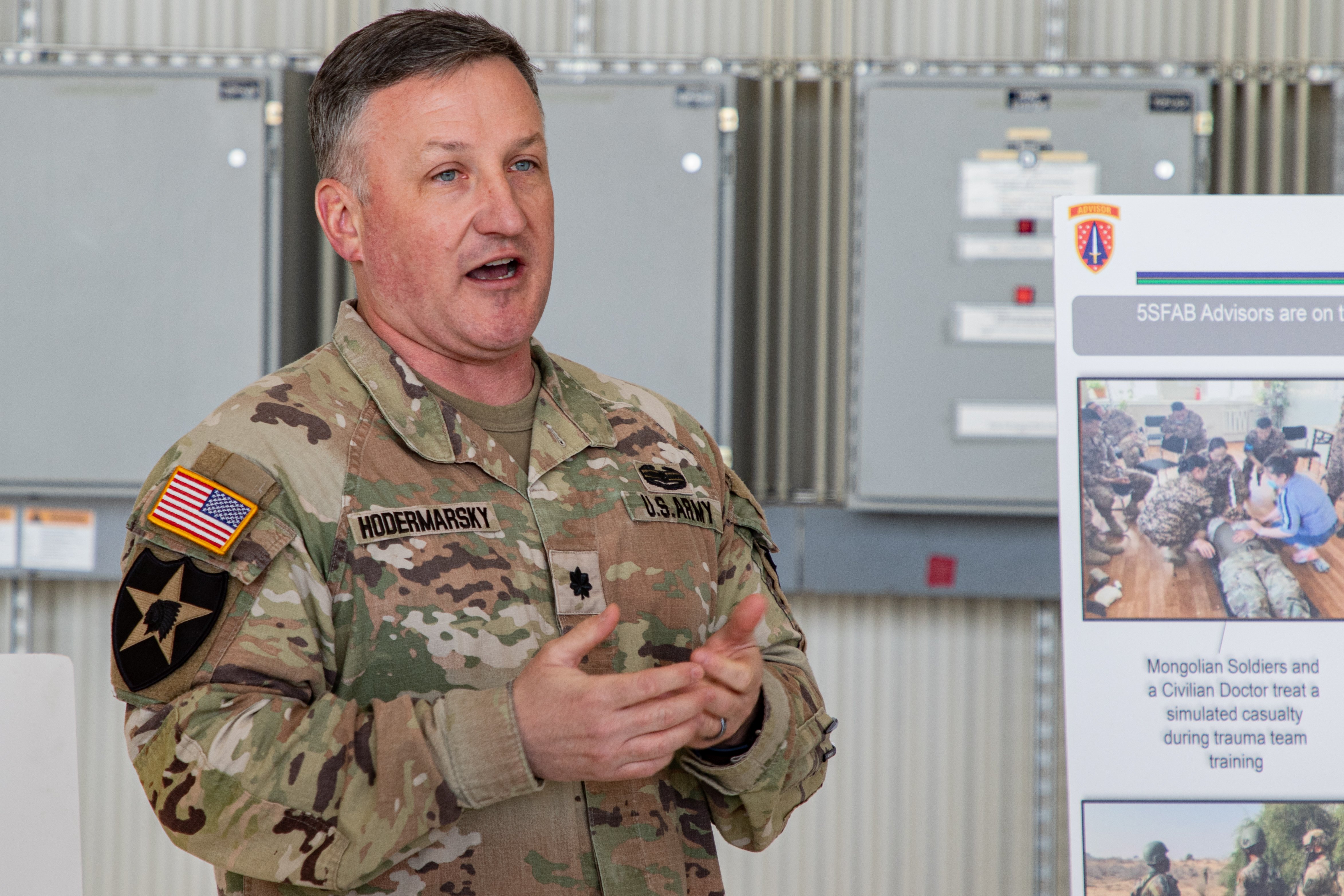
Lt. Col. Dan Hodermarsky, commander of 3rd Squadron, 5th Security Force Assistance Brigade, holds a briefing on the unit’s mission and partnerships at Joint Base Lewis-McChord, Washington, April 25, 2025. Army photo by Sgt. Rebecca Watkins.
As for the 5th SFAB, Hodermarsky said they have been able to stay relevant because they’ve been incorporated into the U.S. Army Pacific strategy.
“We had excellent support from U.S. Army Pacific as far as their G-3 [operations division] giving us direct priorities over the years of where we fit into the forward edge of their campaign to set conditions for the out years,” he said. “I think it was just sort of a good blend of geography and attention from the theater Army putting us to work that fit the profile of the formation.”
One of the 5th SFAB’s most recent collaborations that was highlighted by leaders in the unit was its work with the Mongolian army as they standardized their noncommissioned officer academy. Hodermarsky insists that their initial project has helped the U.S. become their “partner of choice” in the region. Now the Mongolian military is planning exercises with American soldiers in Alaska.
“We completed our work building that NCO corps, starting from helping them build the [program of instruction] and build the instructors so they can actually train their own and to have — I would say — an enduring NCO professional military education course,” Command Sgt. Maj. Mark Millare said. “We transitioned that to exercises with the 11th Airborne. Now [the] 11th Airborne Division is the one helping Mongolia execute some of those missions if they need some more extra help. So we were there to help stand it, get it running, pilot and test it, and once it’s good to go, then we transitioned to 11th Airborne.”
Before SFAB units take on a new project, they’ll take input from embassy officials, local military leaders or Army leadership in the region to discuss what the partner is looking for. Hodermarsky said that these days, partners in the Pacific are regularly asking for advice on things like how the U.S. is employing new tactics from the Russia-Ukraine war, or how to build deployable brigades and move them hundreds of miles across countries.
As some Pacific militaries like the Philippines and Thailand field U.S. air defense systems, their governments are also looking for chances to train with units that have years of experience using that equipment.
“We call them subject matter exchanges where they want to have people that operate in that type of unit in 7th [Infantry Division] or 4th [Infantry Division] come and talk to them in exchange and do training together,” he added.
Hodermarsky said Pacific allies overall are trying to figure out how their militaries can fight alongside others in a region with more loosely tied alliances compared to Europe.
“You don’t have a 70-year old alliance dating back to World War II, where there’s standard NATO doctrine, standard NATO practices, coordination measures between allies. You have a lot of bilateral, some trilateral partnerships across both island chains,” Hodermarsky said. “What they’re really asking is, how do we work better together? How do we tie in interoperable systems that can talk to U.S. forces, that can communicate with U.S. forces? How do we train and exchange knowledge?”
WASHINGTON – The Veterans of Foreign Wars’ (VFW) annual Washington Conference begins Sunday, Mar. 1, in Washington, D.C., and will continue through Thursday, Mar. 5. Several hundred VFW and Auxiliary members are anticipated to arrive in the nation’s capital, traveling from around the world to conduct organizational business and participate in the organization’s largest yearly advocacy event.
“As a VFW member and advocate, I have been in House and Senate offices numerous times communicating with lawmakers on what veterans care about most,” said VFW National Commander Carol Whitmore. “But none of those experiences compare to my task this week. Veterans benefits have come under attack with echoes from the 1930s, with some who have never worn the uniform claiming benefits are wasteful, or that the wear-and-tear of 20 years of war is somehow frivolous. The VFW resolutely fought against cuts then, just as we are today. Real lives are impacted by what we’ve come to advocate for, and real consequences await service members and veterans if Congress and administration leaders do not Honor the Contract.”
The main event of the Washington Conference is the annual commander-in-chief’s testimony set for Tuesday, Mar. 3 at 10 a.m. EST before a special joint hearing of the House and Senate Committees on Veterans’ Affairs held at the Dirksen Senate Office Building in Room SD-G50.
“What weighs heaviest on my heart are the combat injured veterans who are accused of wanting to double dip when they have earned everything they are asking for: their full retirement pay and disability compensation without offset,” Whitmore said. “It is unconscionable that Congress continues to stonewall this injustice, and we will not continue to stand by while their families pay the price of their war wounds. They didn’t ask to be retired early; they were forced, and they are due every single dime of their earned benefits.”
Whitmore is prepared to discuss the VFW’s top priorities for 2026 including:
VA Community Care: Passing the Veterans’ ACCESS Act of 2025 and the Foreign Medical Program Modernization Act of 2025.
Concurrent Receipt: Passing the Major Richard Star Act.
Veteran Suicide: Passing the Written Informed Consent Act and the Veteran Suicide Prevention Act.
Brain Health Care: Passing the Innovative Therapies Centers of Excellence Act of 2025, the Blast Overpressure Research and Mitigation Task Force Act, the Precision Brain Health Research Act of 2025, and the Veterans National Traumatic Brain Injury Treatment Act.
Whitmore also plans to cover legislative efforts that would prohibit the exploitation of veterans by Claim Sharks, codify accredited claims representatives’ access to service members in military Transition Assistance Program classrooms and ensure oversight and transparency of the VA presumption decision process as passed in the Honoring our PACT Act of 2022 (Public Law 117-168).
The VFW’s annual Washington Conference is also the culmination of the VFW-SVA Legislative Fellowship program, which is currently in its 12th year. Fellows will accompany VFW advocates on Capitol Hill to employ the leadership and advocacy skills they have learned since beginning the program in October 2025. Together with their VFW delegations, each fellow will discuss the importance of increasing the Post-9/11 GI Bill book stipend with lawmakers and staff, leveraging their experiences as student veterans who commonly rely on fixed incomes.
Finally, the night before Commander Whitmore’s testimony, the VFW and its partners from Grunt Style Foundation and Irreverent Warrior will convene at the Lincoln Memorial at 5pm to tour our nation’s war memorials, reflecting on the sacrifices of the generations before us and recommitting to advocate for our veterans and the benefits they have earned. Dubbed the “Bonus Army Memorial March,” this evening hike around the National Reflecting Pool will serve as a time to reinforce the VFW’s mission for the week, while remembering our history and the fights that paved the way for our nation’s warfighters.
Read the VFW’s complete list of 2026 Priority Goals here.
The U.S. Senate Committee on Veterans’ Affairs will livestream this year’s testimony on its hearings page here. It can also be viewed on the VFW’s website here.
Get ready for the 2026 Washington Conference by downloading the VFW Events 2026 app from the Apple App Store or Google Play Store today. Visit vfw.org/VFWDC2026 for all Washington Conference updates.
WASHINGTON – The Veterans of Foreign Wars (VFW) commends the Department of Veterans Affairs (VA) for officially rescinding its interim final rule that would have changed how disability ratings are evaluated, a policy the VFW warned could unfairly reduce benefits for disabled veterans.
Since VA opened the rule for public comment, more than 20,000 comments have been submitted to the Federal Register urging the department to withdraw the policy.
“These last 10 days prove that when our veterans speak, leaders will listen,” said VFW National Commander Carol Whitmore. “We thank Secretary of Veterans Affairs Doug Collins for hearing veterans’ concerns and taking meaningful steps to reverse an abrupt policy change that could have had far-reaching unintended consequences for veterans whose medication and other treatments allow them to live day-to-day with their service-connected health conditions.”
Last week, the VFW publicly demanded VA rescind the rule change, raising “serious concerns” it threatened the benefits veterans earned through their service.
“The VFW has long maintained that no veteran should ever think they could be penalized for seeking the medical care they need,” said Whitmore. “We appreciate VA’s willingness to engage with veterans on this critical issue.”
While this reversal is a significant step forward, the VFW will continue to work with Congress, VA, and other stakeholders to ensure that future policy changes are developed with full transparency, genuine veteran input and a steadfast commitment to protecting the benefits and well-being of all veterans.
WASHINGTON – Last night, the United States and its Israeli ally began combat operations against Iran in an operation dubbed Epic Fury.
As war once again comes to the Middle East, the Veterans of Foreign Wars (VFW) asks all Americans to keep our brave service members overseas in their thoughts and prayers. At this very hour, they are carrying out difficult and dangerous missions in defense of our nation and our allies.
The VFW understands all too well that freedom is never free and that our world remains a dangerous place. America’s prepared, professional and resolute all-volunteer force continues to stand watch, serving on the front lines far from home so that our families may live in safety.
We will never forget the weight of that responsibility, nor the sacrifices borne by those in uniform and their loved ones. The VFW remains unwavering in our commitment to support you and your families, advocate for you, and ensure the American people fully understand the significance of your service and sacrifice in defense of liberty. Finally, when your mission and service to our country is complete, we will make sure that our elected officials maintain the care and benefits you earned and Honor the Contract you have upheld.
WASHINGTON – The Veterans of Foreign Wars (VFW) proudly presented its 2026 Congressional Award to Rep. August Pfluger, R-Texas, tonight at the conclusion of its annual Washington Conference, recognizing him for his leadership in the 119th Congress and his career-long advocacy on behalf of veterans and service members.
“Representative Pfluger uses his personal experience as a combat fighter pilot to identify and fix gaps and shortcomings in our system, ensuring veterans have a passionate and determined advocate in the halls of Congress,” said VFW National Commander Carol Whitmore. “His commitment and resolve for action over words on many VFW priorities is evident, and we are eager to continue working alongside him to better care for America’s service members, veterans and their families.”
Presented annually since 1964, the VFW Congressional Award is given to one member of the House or Senate for significant legislative contributions on behalf of veterans and military personnel. Past recipients include strong national security and veterans’ advocates, such as Sen. Bob Dole, R-KS, Rep. G.V. “Sonny” Montgomery, D-MS, Sen. John McCain, R-AZ, Sen. Daniel K. Inouye, D-Hawaii, Sen. Bernie Sanders, I-VT, Rep. Joe Wilson, R-SC, and Sen. Jon Tester, D-MT, among many others. Last year’s award went to Rep. Derrick Van Orden, R-WI, who currently serves on the House Committees on Veterans’ Affairs, Armed Services and Agriculture.
Rep. Pfluger’s work in Congress led him to introduce the House version of the Aviation Cancer Examination Study (ACES) Act, a long-standing VFW priority enacted as Public Law 119-32, which directed VA to study cancer rates among military fixed-wing aircrew and advance accountability and life-saving care. He has also cosponsored key VFW priorities, including the Major Richard Star Act, the Veterans’ ACCESS Act of 2025, the Guard and Reserve GI Bill Parity Act of 2025, and the Innovative Therapies Centers of Excellence Act of 2025, safeguarding earned benefits, expanding access to care, and strengthening support for National Guard and Reserve, and medically retired service members.
Before joining Congress, Rep. Pfluger graduated from the United States Air Force Academy in 2000. A former squadron commander, he has logged more than 2,000 flight hours, including 300 in combat over Syria and Northern Iraq. He is currently a colonel in the Air Force Reserve.
“Rep. Pfluger’s military experience and tenacity make him a leading voice in Washington on veterans issues and national security, and the more than 1.3 million VFW and VFW Auxiliary members are proud to bestow upon him this year’s Congressional Award.”