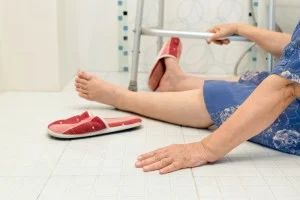
Worried about falls in an older person?
You’re right to be concerned, especially if the older person has already experienced a fall. Research suggests that falling once doubles your chance of falling again.
And falls, as everyone knows, can cause life-changing injuries. The Centers for Disease Control (CDC) reports that:
- One out of five falls causes a serious injury such as broken bones or a head injury
- Each year at least 300,000 older people are hospitalized for hip fractures
- More than 95% of hip fractures are caused by falling, usually by falling sideways
- Falls are the most common cause of traumatic brain injuries
For these reasons and more, preventing falls is a major focus of preventive care for older adults, and is a big part of what we do in geriatrics.
But if we want to protect older people from the potentially devastating consequences of falls, it’s not enough to help them reduce falls.
We also need to think about how we can reduce the likelihood of injury from a fall.
In this article, I’ll share with you three approaches that can help reduce fall-related injuries.
Then I’ll address two other approaches that are sometimes tried, but are less likely to help.
3 ways to prevent fractures and other injuries related to falls
1.Detection and treatment of osteoporosis
Why: Stronger bones are less likely to break when one falls. But unfortunately, many older adults — especially women — tend to lose bone mineral density as they get older. Most people who experience hip fractures have reduced bone density.
Research shows that treatment of osteoporosis — which can be diagnosed when bone mineral density is low enough — is associated with a decreased risk of hip fracture. Bone mineral density is usually assessed through a DEXA (dual-energy x-ray absorptiometry) scan.
The US Preventive Services Task Force recommends that all women aged 65 or older be screened for osteoporosis. Routine screening for men is not recommended. However, as some men do get osteoporosis, it is often reasonable to screen or assess certain men who appear to be at higher risk for bone loss.
What to do: All older women should be sure to be screened at least once for osteoporosis. Older adults of either gender who experience a fracture should also be screened.
Note: Expert guidelines recommend treating osteoporosis with a combination of lifestyle changes and pharmacological therapy. Bisphosphonate drugs are usually considered as first-line therapy. These drugs have been associated with rare serious side-effects, which has left some people with osteoporosis reluctant to take them. However, research indicates that for most people with osteoporosis, the likely benefit of pharmacologically treating osteoporosis outweighs the risk of harm.
For more information:
2. Reducing time spent on the floor
Why: Many older adults are unable to get up from the floor after a fall. One study of older adults found that 47% were unable to get up after a non-injurious fall.
Remaining down after a fall can be dangerous to an older person’s health. Especially if the person remains down for hours or even a day, an aging adult can experience dehydration, muscle injury, and many other problems. Certain fall-related injuries may also become worse as a result of lying on the floor for several hours.
What to do: A personal emergency response system (e.g. a “Lifeline” type device) can enable an older person to call for help in the event of a fall. However, research suggests that older adults often fail to use an available call alarm, after a fall. So, it may be a good idea to consider a device with automatic fall detection, or even a smartwatch, which also often now includes automatic fall detection.
An alternative to a call device (which many older adults don’t or won’t wear) is to set up some kind of monitoring system, so that a family or community can notice if an older person is up and moving around as usual.
People have implemented low-tech versions of this for years, such as noticing whether an older adult has opened his or her curtains, as usual, every morning. This will not prevent an older person from remaining down for a few hours, but might prevent someone from being down for a full day. Video monitors in an older person’s living environment are another option, although this raises obvious privacy issues for the older person (and someone has to be monitoring the video).
The higher-tech version of this strategy is to set up a newer home-based sensor system; these keep track of an older person’s movements, and send an alert if the person isn’t moving around as expected. However, a new sensor-based system can be tricky to select, as most don’t yet have an established track record of being reliable (or affordable).
In some communities, it may be possible to sign up with the police or another local agency for daily check-ins. A recent Washington Post story describes this here.
Note: Teaching older adults how to get up after a fall has only occasionally been clinically studied. I share two resources below that offer sensible advice on how to get up, or how to help an older person up. Practicing this skill regularly before a fall happens is a good idea!
For more information:
3. Balance training and strength exercises for fall prevention
Why: Exercises for fall prevention usually help older adults improve their balance and their lower leg strength.
Independent of their effect in reducing falls, such exercises have also been proven to reduce injuries related to falls.
What to do: Stick with an exercise program that improves balance and leg strength, even if you keep experiencing falls. Better leg strength, in particular, may be instrumental in being able to get up after a fall, or in protecting oneself as one falls, in order to minimize injury.
There are some programs available designed to provide leg strength and balance training for elders; Otago is a clinically proven physical therapy program. Or you can look for something like tai chi, which has also been linked to reduced falls.
For more information:
3 other approaches to preventing injury
Here are three other approaches that you may have heard about, to reduce injuries related to falls. I consider these less useful than the approaches listed above.
1.“Learn to fall safely” programs: Although it certainly sounds appealing to “learn to fall safely,” and there are people claiming to teach this, I’ve been unable to find published medical literature proving this actually reduces injuries.
Now, many programs for “falling safely,” such as this Judo4Balance program, do help older adults improve their strength and balance. So this kind of program can potentially be useful…but we still don’t know that they are teaching a “falling safely” technique that’s actually effective in reducing injuries.
In 2025, a small study (24 participants) called the Falling Safely Training study, which did randomize 12 participants to a safe-falling program, reported promising results in terms of decreased fall-related head impacts during experimental induced falls after the training was complete. (The control group did Otago exercises, which means they built strength and balance without learning special falling techniques). These are intriguing initial results, but the study was very small and didn’t follow actual falls as an outcome.
At this time, I believe that learning to “fall safely” is an interesting idea that remains still unproven. I would recommend older adults commit to working on leg strength and balance instead, and also simply regularly practice getting up off the floor.
2.Hip protectors: Hip protectors are special pads that cover the hips. They are usually embedded within a special pair of pants or underwear, and they are meant to cushion the hips in the event of a sideways fall, in order to prevent fractures.
Hip protectors have been studied, and some research suggests they may reduce the risk of fracture, especially in older adults who live in nursing homes.
However, the biggest problem with hip protectors is that most older adults will not wear them consistently. So, I don’t consider them a very viable solution for preventing fall-related injury.
In recent years, innovators have developed special belts with rapidly inflatable hip pads. It remains to be seen whether these do reduce injuries, and whether older adults will be willing to wear them enough for these to make a difference.
Much of the recent research on hip protectors is summarized in this scholarly review.
3. Assistive devices: Mobility devices such as canes and walkers are often used by older adults at risk for falls. Walkers, in particular, can provide stability and support to older adults who tire easily, or who are experiencing balance or gait problems. (Canes provide less support and require much more coordination, so they are only rarely a good choice for an older person at high risk for falls.)
However, whether using such devices prevents falls and/or injuries has not been well tested in randomized trials. So, we don’t truly know if these devices prevent falls, or reduce fall-related injury.
A 2013 review of the use of walkers in older adults concluded that “the evidence reviewed neither proves nor disproves their effectiveness in the prevention of falls.”
In fact, observational studies have sometimes found that using an assistive device is associated with higher fall risk. (An observational study is one where you study outcomes or associations, but you haven’t randomly assigned similar people to use or not use a treatment.)
But this undoubtedly reflects the fact that canes and walkers are more likely to be prescribed to — or otherwise used — by older adults with balance and/or gait problems.
Emergency room studies have confirmed that fractures and injuries are not uncommon, among older adults using walkers.
So should you count on a walker or cane to prevent fall-related injuries? I find it hard to recommend this, because the evidence just isn’t there.
Instead, consider a walker (or cane) if it’s recommended by a physical therapist, to help you with mobility or rehabilitation, rather than for the particular purpose of fall-related injury prevention.
And make sure you’re correctly fitted and trained to use the device; some research suggests that many older adults use assistive devices incorrectly, and this might even increase fall and injury risk.
To learn more about correctly selecting and using assistive devices, see these resources:
Make your action plan to reduce fall-related injuries
In short, to minimize your — or your older relative’s — risk of injury related to a fall, I recommend you:
- Make sure you’ve been checked for osteoporosis, if you are a woman over age 65 or an older adult of either gender with risk factors for low bone density, or a past “fragility fracture” (e.g. a broken bone after a fall).
- If you are diagnosed with osteoporosis or low bone density, consider osteoporosis treatment and discuss options for improving your bone strength with your doctors. (See the resources listed above to learn about treatment options.)
- Plan for how you might call for help or be found promptly, should you fall and be unable to get up.
- This is especially important for those older adults who live alone.
- Consider balance training and leg strength exercises proven to reduce falls in at-risk older adults.
- Physical therapy and certain proven exercise programs help older adults improve leg strength and balance. Not only do these reduce the risk of falling overall, but they have also been associated with reduced injuries if a person does fall.
- It’s not clear that it’s worthwhile to try to learn to “fall safely”; there is much better scientific evidence for focusing on exercises that reduce your fall risk overall.
If you or your older relative is using a cane or walker, you’ll want to make sure you’ve been properly fitted for the device, and are using it correctly. A physical therapist is usually the best type of clinician to make this assessment. (Most doctors, including myself, have not had the right training for this.)
Of course, the very best way to prevent injuries from falls is to prevent falls in the first place! For more information on this, see here: Preventing Falls in Aging Adults. or watch my fall prevention videos on YouTube.
This article was last reviewed and updated in October 2026.