Are you shortening your daily walks because you just feel too sore to go your usual distance? What about gardening… are you using a stool these days instead of bending over? Avoiding picking up a grandchild because you’re more worried about your back?
These are the kinds of activities that make life enjoyable, but nagging pain and stiffness can sometimes get in the way.
Without even realizing it, you start compensating … You take the elevator instead of the stairs. You shorten your walks. You pass up an activity because you’re not sure how your knees, hips, or back will feel afterward.
Over time, those little decisions can add up, gradually limiting the very activities you enjoy most.
But does getting older necessarily mean accepting a less active lifestyle?
Looking Beyond Pain Relief
Pain medication can provide welcome relief, and for many people it plays an important role in managing discomfort. But addressing pain isn’t always the same as addressing the factors that may be contributing to it.
Muscle strength, flexibility, balance, and confidence in movement can all influence our ability to remain active.
And while some physical changes come with age, that doesn’t mean we should automatically lower our expectations for what our bodies can do.
In the Fall 2026 issue of Healthy Aging® Magazine, physiotherapist Phil Evans explores a different way of thinking about pain and stiffness.
With more than 20 years of experience helping adults improve their mobility, Evans encourages readers to look beyond simply relieving discomfort and consider how movement, strength, and confidence can help them continue doing the things they love.
“Here’s one of the biggest misunderstandings I’ve seen after more than twenty years as a physiotherapist. Too many people spend years trying to reduce pain when what they often need to do is rebuild the muscles, movement, and confidence that support their joints.
“Painkillers can play an important role. They can reduce pain enough to help you sleep better, get through the day, or start moving again. For many people, that’s exactly what’s needed in the short term. The problem isn’t the medication itself. It’s when painkillers become the whole plan instead of one part of a bigger strategy.
“They can’t strengthen muscles, improve balance, or rebuild confidence. Those things come from giving your body the opportunity to adapt.”
Five Ways to Keep Moving Forward
In his complete magazine article, Evans outlines five practical approaches to maintaining mobility, rebuilding strength, and feeling more confident about physical activity.
He also discusses why walking, while beneficial, may not be enough on its own, how strength training supports everyday movement, and the importance of focusing on the activities you want to continue enjoying.
Whether your ambition is to travel more, return to a favorite hobby, or simply move through everyday life with greater ease, his advice offers a useful perspective.
About the Author Phil Evans (Phil the Physio) is a chartered physiotherapist and author of Built to Last After 50. With more than 20 years of experience, he has helped adults over 50 improve strength, mobility, and confidence so they can remain active and independent.
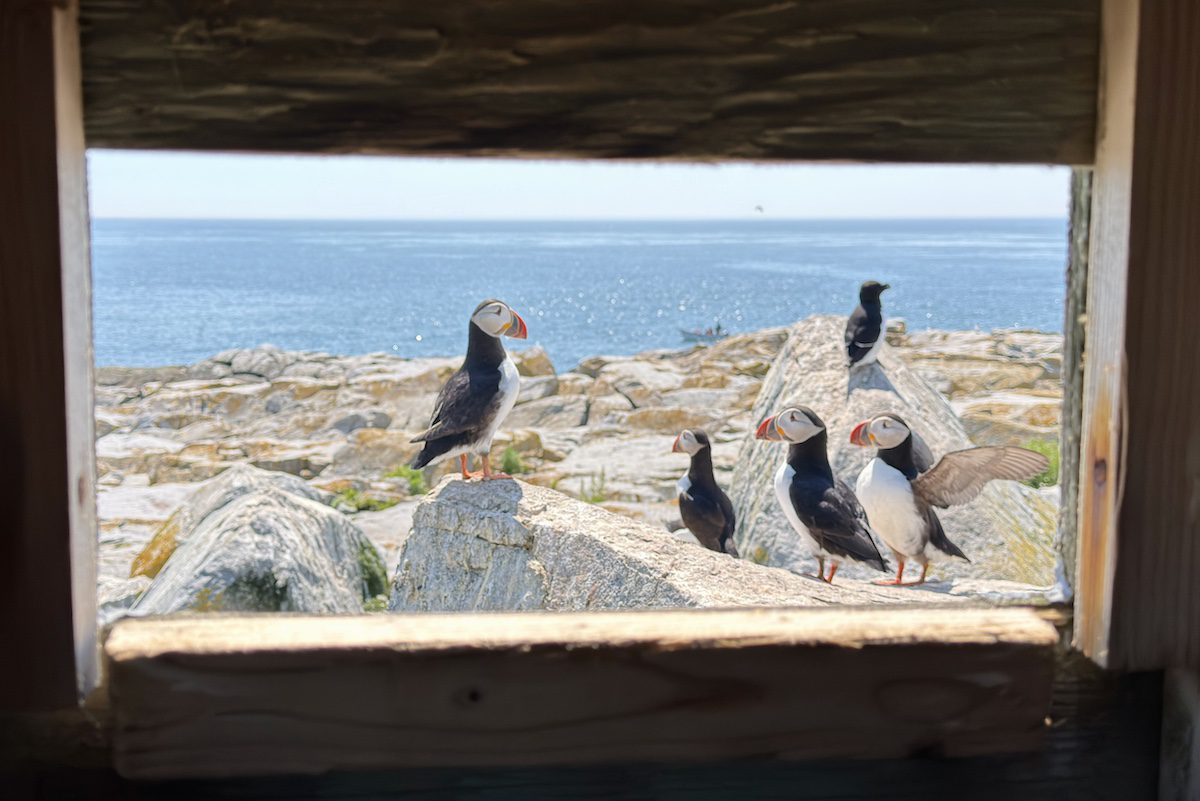
Featured image: Puffin spotting from the viewing blind on Machias Seal Island | Photo by Jennifer Bain
Birders flock to Newfoundland and New Brunswick to see puffin colonies from tour boats and sometimes even from land
by Jennifer Bain
The summer begins with the sound of puffins tap-dancing over my head.
I’m standing inside a bird blind on Machias Seal Island surrounded by Atlantic Puffins as one of them lands on the roof. Click-click-clack goes the pitter-patter of bright orange webbed feet. Thunk. Thunk. Two more clowns of the sea land and now a full-blown puffin performance is in full swing.
Inside the plywood shack that’s barely bigger than an outhouse, four of us swap knowing looks. We’re having an incredibly rare land-based puffin experience.
I’m the kind of birder that loves a single-species quest. I’ve seen Nebraska’s Sandhill Crane migration twice, the world’s smallest hummingbirds in Cuba, Blue-footed Boobies in the Galápagos, and magnificent Frigatebirds in Barbuda. I’ve written about Yellow-shouldered Amazons being reintroduced in Aruba after going locally extinct because of the pet trade, and about eccentric American Woodcocks whose mating rituals steal the show at the Festival of Birds at Ontario’s Point Pelee National Park.
At the top of my bird bucket list are Japan’s Shima-enaga (Snow Fairies) and the single Steller’s Sea Eagle that found its way to Newfoundland from either Russia, Japan or Korea. But puffins would be my desert island bird. Luckily, I live in Toronto and am just a plane ride away from the puffin colonies of New Brunswick and Newfoundland and Labrador.
Puffin spotting on Machias Seal Island in New Brunswick
“With a show of hands, who’s excited to see some terns?” guide Rorey Chamberlain says as Sea Watch Tours launches from Grand Manan Island in New Brunswick.
A few hands shoot up.
“Guillemots?”
A few more go up.
“Who’s here to see the puffins today?”
All 20 people whoop and wave their hands.
Machias Seal Island Migratory Bird Sanctuary is a tiny, treeless island and Important Bird Area (IBA) that’s home to more than 1,000 pairs of Atlantic Puffins and one of the most southerly colonies.
Machias Seal Island is tiny and rocky / Photo by Jennifer Bain
It also attracts Razorbills with black and white feathers and thick, blunt bills, plus Arctic and Common Terns, who can be so protective of their nests that they dive-bomb people, so we’re going to carry “tern sticks” to protect our heads.
“I will not let anybody get terned to death on my watch,” Chamberlain vows.
This outing has an interesting geopolitical twist.
Twenty-acre Machias Seal Island lies where the Bay of Fundy meets the Gulf of Maine, and Canada and the United States have been righting over it since the War of 1812 even though it’s just 500 metres long and 250 metres wide.
The island is Canadian as far as I’m concerned. There’s a Canadian flag, a Canadian-built lighthouse, rotating Canadian Coast Guard staff and regular researcher visits from the University of New Brunswick and the Atlantic Laboratory for Avian Research.
The Canadian Wildlife Service manages the migratory bird sanctuary. Fisheries and Oceans Canada grants permission to land. It lets one Canadian operator (Sea Watch) and one American (Bold Coast Charter Co. out of Cutler, Maine) bring an equal number of tourists during the summer nesting season.
“I want to remind you it’s a privilege and not a right to be here,” Chamberlain says as we stop near the island and prepare to take a smaller skiff to the rockweed-covered landing ramp.
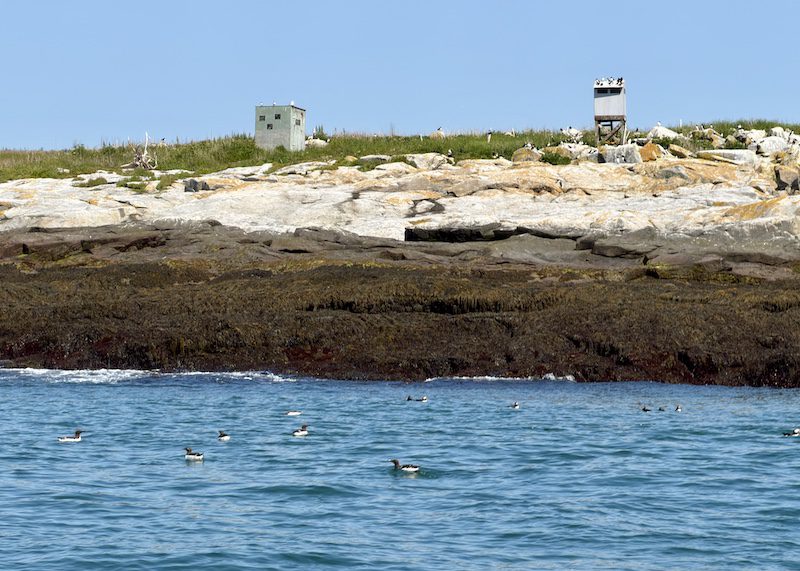
Sea view of bird blinds on Machias Seal Island / Photo by Jennifer Bain
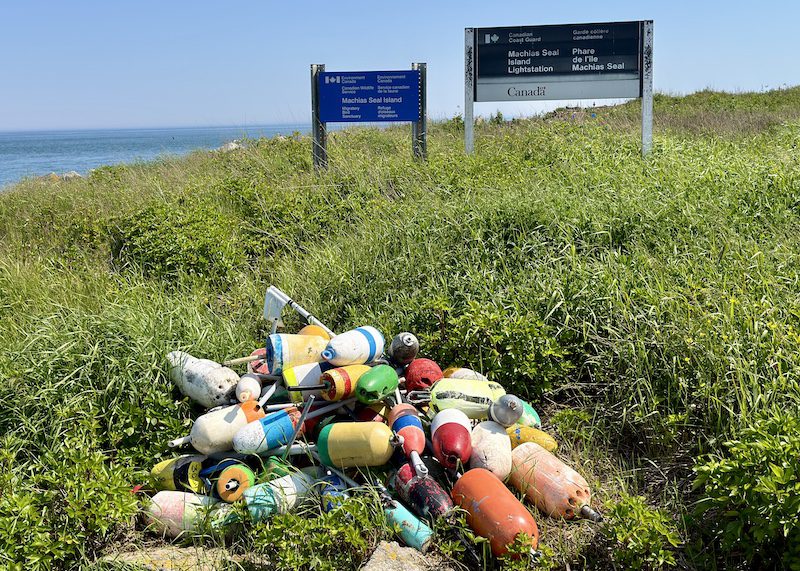
Canadian government signs on Machias Seal Island / Photo by Jennifer Bain
Five people bought tickets to simply view the puffins from the sea. Fifteen of us will walk single file along a boardwalk and divide among four bird blinds. We must keep our heads, hands and camera lenses inside the blinds. We can open small sliding panels/viewing ports, but not two that face each other lest the puffins try to fly through them. We get one hour in the blinds. There are no bathrooms, and we can’t leave until someone returns to collect us.
“Our livelihood depends on following the rules,” Chamberlain warns.
Coming here is a wonderful consolation prize for failing to make it to Skomer Island in Wales recently because the sea didn’t cooperate. Home to 40,000 puffins and managed by the Wildlife Trust of South and West Wales, Skomer welcomes some daytrippers but also overnight guests.
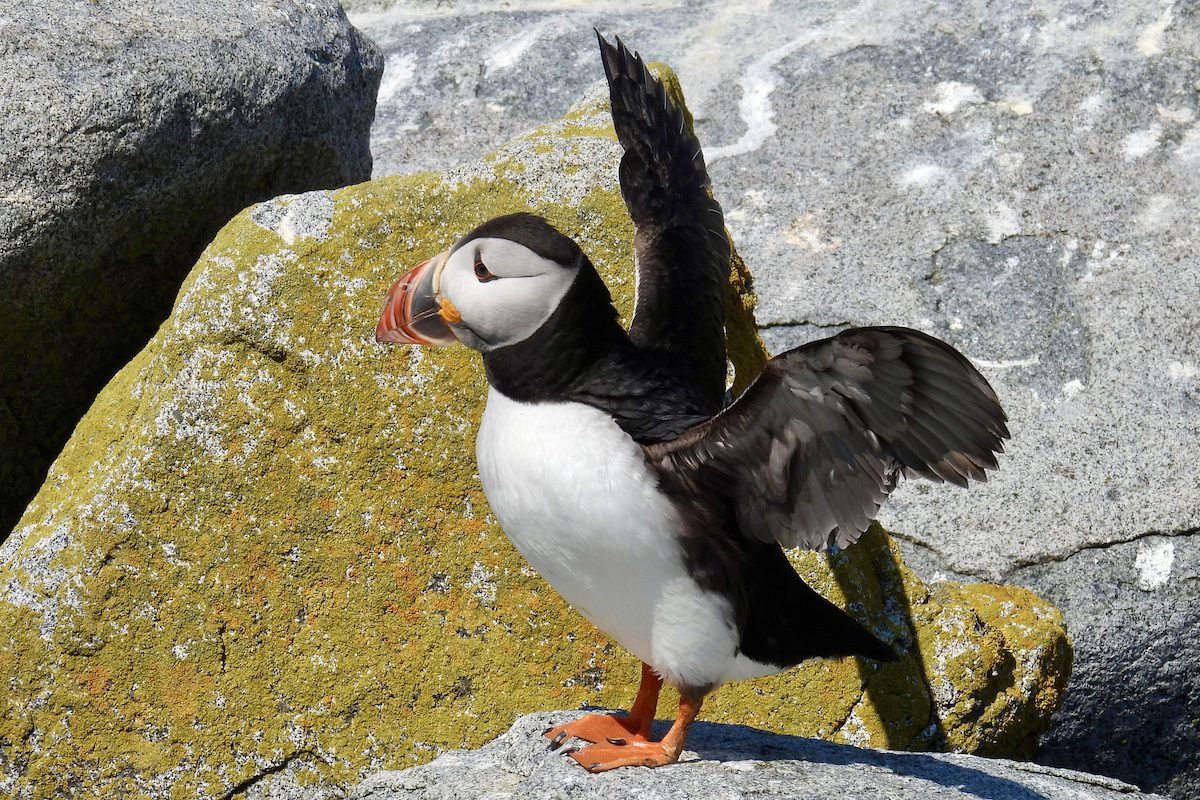
I’m ready to make the most of my precious hour on Machias Seal Island watching puffins live their best lives as they prepare nests and await pufflings. Fun fact — their famously colourful striped beaks only appear during breeding season.
“Are we puffined out?” Chamberlain asks when we reluctantly return to the lobster boat turned tour boat.
“No,” everyone shouts.
I can’t speak for my fellow birders, but I’m heading to Newfoundland to commune with more puffins.
A puffin flaps its wings on Machias Seal Island / Photo by Jennifer Bain
Walking with sticks down boardwalk on Machias Seal Island / Photo by Jennifer Bain
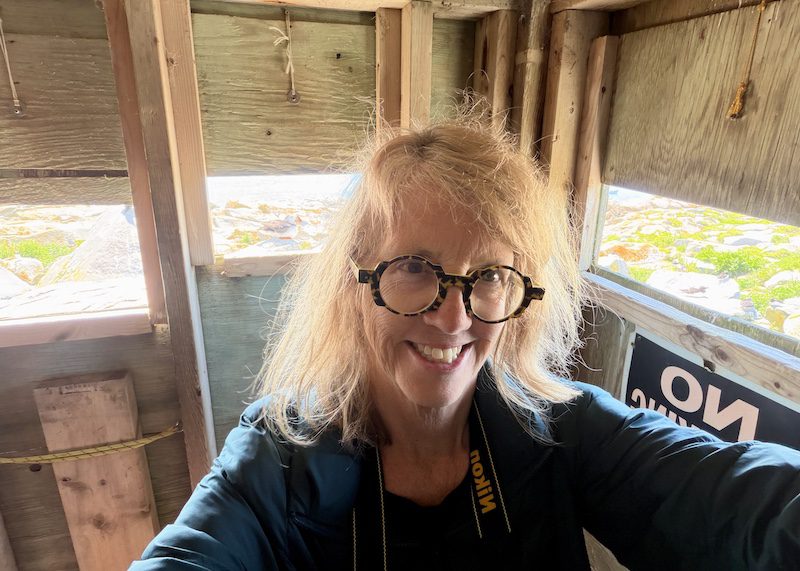
Writer Jennifer Bain inside a bird blind on Machias Seal Island / Photo by Jennifer Bain
Puffin spotting in Newfoundland and Labrador
Atlantic Puffins are the provincial bird here for good reason.
“Atlantic Puffins are easier to see here than almost anywhere else on the planet,” explains Jared Clarke, whose company, Bird the Rock, creates custom bird and nature tours. “More than 95 per cent of all the Atlantic Puffins in North America breed along our coasts, many of them in huge spectacular colonies that are the most accessible in the world.”
Puffin lovers gravitate to Elliston on the Bonavista Peninsula.
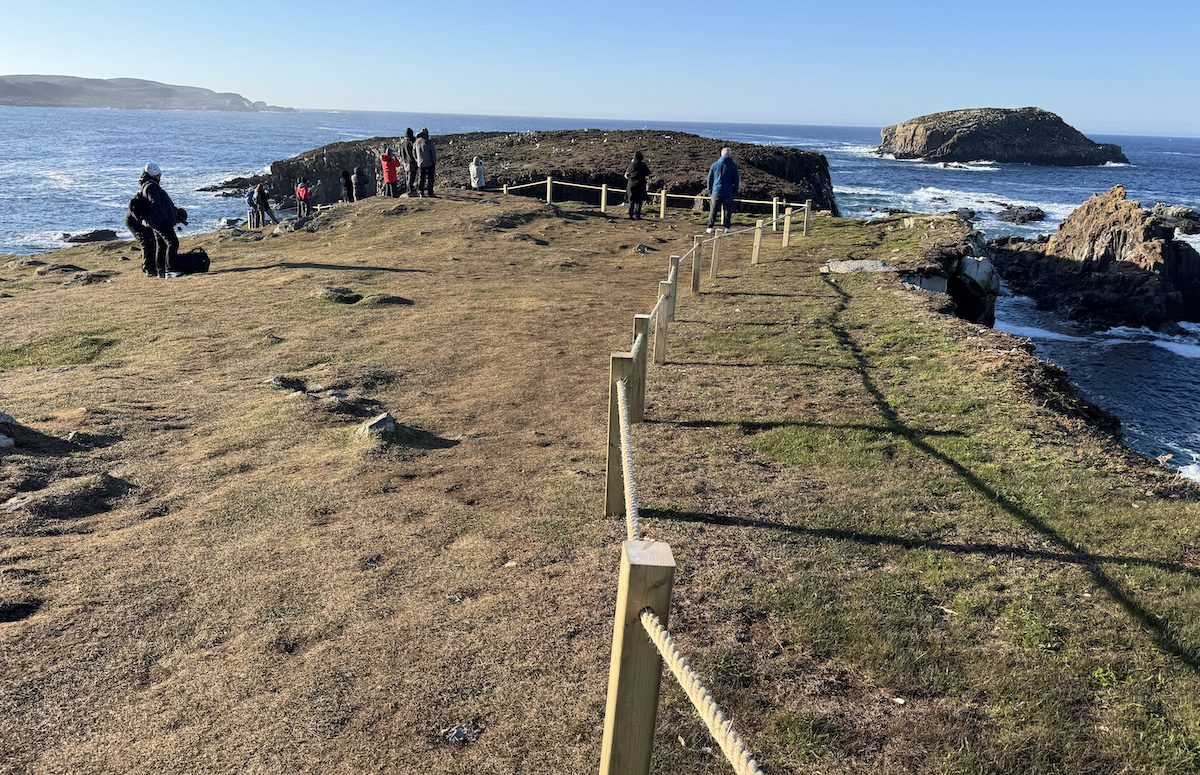
The community is one of the only places in North America where you can watch puffins from the comfort of land. Not only can you walk to the Elliston Puffin Viewing Site from your car in just a few minutes, but it’s also free (although donations are very welcome).
You’ll stand on a grassy cliff about 30 metres from the rocky islet that locals call Puffin Island.
“When we were young, puffins were not a big deal in the community,” Marilyn Coles-Hayley, a former chair of Tourism Elliston, tells me. “As the interest in wildlife grew, and birding grew, we recognized the value of the puffin site. It’s one of our most valuable assets. The whole community benefits — restaurants, craft stores, donations, B+Bs.”
I’ve visited before, but this time I linger for two days to photograph the colony at sunrise and sunset.
It’s neat to see how Elliston has started plowing grant money into the site. There’s a more defined pathway with compacted crushed stone. Stairs help people navigate a short hill. Ropes try to keep everyone away from the dangerous, eroding cliff edge. Visitor counters will bring in useful statistics. An interpretation centre is in the works.
Elliston Puffin Viewing Site / Photo by Jennifer Bain
For now, there’s no staff on site — just a donation box.
“We do the best we can,” says Coles-Hayley. “We do need to educate people about how they need to be respectful of the puffins’ space so they can come and go as they please and not be frightened of people.”
Which brings me to one heads-up. Some daring puffins fly over from the safety of their islet and land within reach of their fans. That happens several times when I’m there and everyone freezes and snaps as many photos as possible. But just after I leave one night, a puffin gets carried off by a fox and somebody posts a rather gruesome photo on a Facebook site devoted to the site.
“Oh my god, that was heartbreaking,” remembers Coles-Hayley. “I guess in the end that’s the way it is in nature.”
Her comment reminds me of my two stints with the Puffin & Petrel Patrol, a grassroots movement that’s now run by the Canadian Parks and Wilderness Society Newfoundland and Labrador Chapter (CPAWS-NL).
Light pollution from coastal communities south of St. John’s can draw confused pufflings from the Witless Bay Ecological Reserve to shore who think they’re following the moon out to sea. Many get run over or killed by wildlife and pets.
Volunteers patrol the towns at night hoping to rescue wayward pufflings that are then released back to sea the next day either from a beach or a tour boat.
Witless Bay is a four-island reserve that protects several million nesting seabirds, including North America’s largest Atlantic puffin colony with more than 260,000 pairs.
“Welcome to Jurassic Park,” guide Noah O’Brien quips this summer. “There are lots of puffins today. Mostly they’re up in the sky, flying around, and you will see them on the surface of the water as well. Common murres are pointy on each end, kind of like a football with wings, and the puffin is round on each end, kind of like a flying potato.”
From the top deck, 98 of us packed on benches gaze up at grassy slopes where puffins are milling around burrows.
“Once they take a mate, that will be their mate for life,” says O’Brien. “Everyone thinks it’s really cute. I think it’s a bit boring, myself. They will keep the same burrow for life as well — so same house, same spouse. A good Catholic seabird refuge.”
It’s lovely to have commentary. It’s even nicer when the talking stops so we can take in the cacophony of puffins mixing with Common Murres, Razorbills and Black-legged Kittiwakes and other less-loved seabirds.
I can’t speak for the others, but I’ve got one more puffin colony to visit.
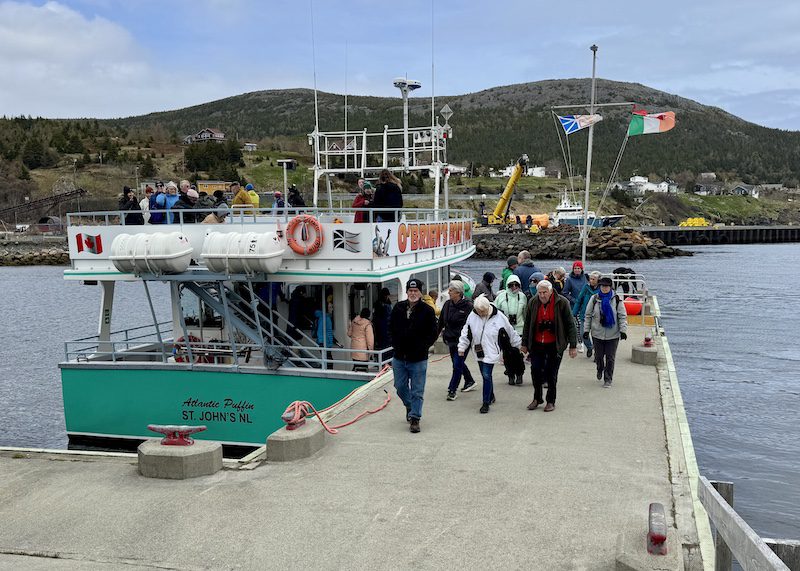
O’Brien’s Whale and Bird Tours disemarking / Photo by Jennifer Bain
Elliston puffins by Heidi Fuchs (@hfuchsartagain) / Photo by Jennifer Bain
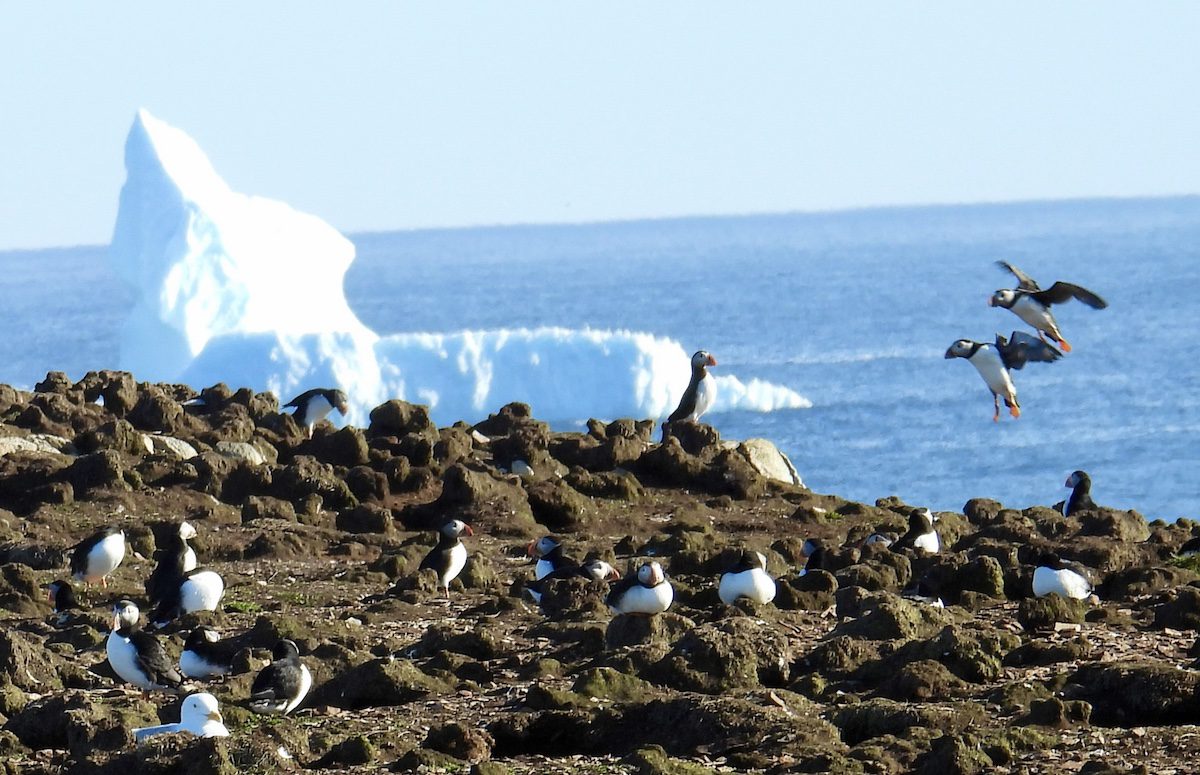
Two puffins land in front of iceberg in Elliston / Photo by Jennifer Bain
Puffin spotting near Fogo Island
Why do we love puffins so much? I turn to Clarke for answers.
“Atlantic Puffins are an iconic symbol of Newfoundland and Labrador for a reason — everyone that visits here dreams of seeing one (or thousands),” he philosophizes.
“These little seabirds are the definition of adorable, with their colourful, cartoonish bills, silly antics and overall cuteness. But they are also an image of what it means to be truly wild, free and (surprisingly) tough — spending most of their lives eking out a living on the cold, open ocean much like generations of people have done in the province.”
I head to my cottage on Fogo Island for my annual boat trip to Little Fogo Islands. Nobody has counted how many puffins visit this lesser-known colony, but anecdotally the population is exploding and spreading across the archipelago.
My puffin-spotting summer ends aboard the MV Island Explorer with Fogo Island Boat Tours as I stand in silent reverie as the sky fills with swarms of puffins. I learn that a group of puffins is called a colony when the seabirds are on land, a raft when they’re swimming and a whirl when they’re flying.
The summer ends with the sound of a whirl of puffins flying over my head.
Make a trip to Atlantic Canada happen
How to get to New Brunswick: Air Canada and Flair Airlines fly into Saint John (YSJ). From there, drive one hour to Blacks Harbour to catch a Coastal Transport vehicle ferry to Grand Manan Island. To get to Machias Seal Island, you can only book “ashore” or “skiff” spots with Sea Watch Tours. The short tour season typically runs late June to late July. Check flights here.
How to get to Newfoundland: Air Canada, WestJet, Porter Airlines and Flair Airlines all fly to St. John’s (YYT). You can use St. John’s as a base for the Witless Bay Ecological Reserve and Puffin & Petrel Patrol, Elliston or Trinity as a base for the Elliston Puffin Viewing Site, and Fogo Island as a base for Little Fogo Islands. Check flights here.
How to get around: Pick up car rentals at the airport. They can be in short supply in Newfoundland, so secure a car before you book a flight. Find a rental car here.
Best time to visit: Puffins typically arrive around mid-May to breed and return to the open ocean by mid-September.
Where to stay in New Brunswick: There are a handful of modest spots to stay on Grand Manan, including Surfside Motel.
Stay Connected in Canada: Skip the roaming fees and stay connected with an Airalo eSIM. Use code JOURNEY15 for 15% off your first plan. Get an Airalo eSIM here!
Disclaimer: Jennifer Bain was hosted by Tourism New Brunswick and Newfoundland and Labrador Tourism. She was not compensated for her time spent researching, travelling and writing this feature, nor was JourneyWoman for publishing it. In addition, the host organizations did not review this article before it was published, a practice that allows the writer to express her perspective with integrity and candour.
Featured image: Outdoor yoga is a popular wellness activity when women choose alcohol-free travel, like on a retreat with Dry Tripping Travel | Photo courtesy of Isabel van Zuilen
For alcohol-free women travellers, finding a group trip just got easier
by Teresa Bergen
Nondrinkers can feel trepidatious when signing up for a group trip, wondering how much their fellow travellers are going to drink. If they’re in recovery, they might fear being tempted to relapse. If they don’t drink for other reasons, they may dread obnoxious behaviour and loud late nights.
That’s why Isabel van Zuilen launched Dry Tripping Travel. Her platform brings together alcohol-free trips around the world. Her target audience is people who don’t want to drink on their vacation, whether they’re in addiction recovery, sober curious, or alcohol-free for other personal reasons. “Every retreat on Dry Tripping Travel is alcohol-free by design, not by exception,” Izzy said. “You’re not the odd one out skipping the wine pairing.”
Most of the trips include wellness activities like yoga or hiking. Many have sharing circles or personal development workshops which help groups get to know each other quickly. Whether participants choose a skiing trip in France or a one-on-one wellness retreat in Ecuador, they’re doing it alcohol-free.
Izzy quit drinking in May 2019 while she was in her forties and living in Spain. Like many people these days, she sought help online. “I threw myself on Instagram,” she said. “There was a big sober community on there where I met loads of people, which was amazing. Other sober or sober curious women who were interested in not drinking.” But the people in her real life still drank. She craved in-person interactions with other alcohol-free women.
After Covid lockdowns lifted, Izzy launched her own series of sober women’s retreats in Malaga. I attended one last year, and it was sweet and gorgeous—a beautiful rented villa on the beach, sound baths and padel tennis, a private chef for our group, and the delicious nonalcoholic champagne never stopped flowing. It was both relaxing and celebratory.
In 2025, Izzy moved to San Francisco and started Sobertopia, a community for nondrinking women that included both online support and in-person events like walks, cold plunges and coffee meet-ups. But at the same time, she was contemplating something more far-reaching.
“I realized that in 2021 I was one of the few organizations that offered specific alcohol-free trips,” she said. “But now there are so many more available.” She’s gathered that all into one place on Dry Tripping Travel.
Not only is Izzy listing trips on her new platform, but she’s vetting them. I asked her how she can evaluate these far-flung offerings, and she said it starts with personal experience. “I’ve spent seven years on Instagram,” she said. “I have loads of Instagram friends, and many of them I’ve met in real life. I’ve been on quite a few sober retreats myself as a guest because I love to go on them. So I know a lot of retreat hosts personally. I know what they have to offer.”
Of course, what makes a good retreat is individual. Some people want more time to relax; some want adventure. Group time versus alone time is another consideration. Izzy includes as much information as possible in her listings, such as sample itineraries, background on the hosts, dietary options that can be accommodated and overall vibe. Each trip description addresses whether the group will be secluded from alcohol, or if some activities will have alcohol around. For example, when I joined Izzy’s own retreat in Malaga, our villa was alcohol-free, but we went out for a meal at a regular restaurant where other people were drinking. She made sure that the restaurant had zero-proof options for us.
Hiking on a sober retreat / Photo courtesy of Isabel van Zuilen
Izzy is an expert on bubbly nonalcoholic libations / Photo courtesy of Isabel van Zuilen
“A lot of women reevaluate their relationship with alcohol in their forties and fifties,” Izzy said. “I sure did. A retreat can be the perfect way to try that on, surrounded by people who get it, without having to explain yourself.” That said, some of the trips skew younger. Izzy had a fabulous time at a Lake Tahoe retreat hosted by Laura Bojangles of Your Sober Pal Adventures and didn’t mind that the other guests were under 40. But if this sounds uncomfortable to you, research the hosts to learn about their clientele before committing.
I’ve been on four group trips now for nondrinkers and find that the participants connect quickly and deeply. People in recovery are especially likely to get very real very fast—we obviously haven’t had perfect lives if we had to quit drinking, so why pretend? This makes for a supportive group dynamic and an effort to make space for people going through various mental and emotional processes. It’s not your typical package trip.
People make close connections on sober retreats / Photo courtesy of Isabel van Zuilen
Enjoying a meal and an alcohol-free beverage / Photo courtesy of Isabel van Zuilen
Izzy had signed up to go on Payton Kennedy’s Expand Beyond Recovery retreat in Texas. Two weeks before the retreat, Izzy’s father passed away. “I was thinking about cancelling it. But then my husband said maybe it’s the right time to go.” She found a supportive environment that helped her grieve. “It was super intense for me, but that was beautiful.”
In Dry Tripping Travel, Izzy is creating opportunities for nondrinkers to support and uplift each other as they see the world. “Alcohol-free living doesn’t have to mean giving something up and doing it alone,” she said. “That’s really the idea behind Dry Tripping Travel, and everything else I do: making this life feel connected and full, not smaller.”
Medicare Open Enrollment runs through December 7, giving beneficiaries an opportunity to review their coverage options for 2027. Photo: Deposit Photos
Medicare plans and costs are changing for 2027. Here’s what to review, how to compare your coverage options, and where to find help making an informed decision.
If you’re enrolled in Medicare, October 15 through December 7, 2026 is an important time to take another look at your health insurance coverage. Even if you’re satisfied with your current plan, changes coming in 2027 could affect what you pay, which doctors you can see, and how your prescription medications are covered.
During Medicare’s annual Open Enrollment Period, beneficiaries can change Medicare Advantage plans, switch prescription drug plans, or move between Original Medicare and Medicare Advantage. Changes made during this period take effect January 1, 2027.
The good news? You don’t have to change plans if your current coverage continues to meet your needs. But taking the time to review your options could help you avoid unexpected expenses.
What’s Changing for Medicare in 2027?
Several changes are worth understanding before making a decision.
Prescription drug costs: The annual out-of-pocket limit for covered Medicare Part D prescription drugs increases from $2,100 in 2026 to $2,400 in 2027. Once you reach that threshold, you generally won’t pay additional out-of-pocket costs for covered Part D drugs for the remainder of the year.
The maximum deductible for the standard Part D benefit also rises from $615 to $700, although individual plans may charge a lower deductible.
Medicare Advantage premiums: The Centers for Medicare & Medicaid Services (CMS) projects that average monthly Medicare Advantage premiums will decline approximately 16.5%, from $14.37 in 2026 to $12 in 2027. However, premiums and other costs vary considerably by plan and location.
Prescription drug plan premiums: CMS projects that average monthly premiums for stand-alone Part D plans will increase by less than $1. Individual plans may have much larger changes.
These national averages are useful, but what matters most is how your particular coverage will change.
Original Medicare vs. Medicare Advantage: What’s the Difference?
One of the most important decisions is choosing how you receive your Medicare benefits.
Original Medicare is the traditional federal government program. It includes Part A (hospital insurance) and Part B (medical insurance). With Original Medicare, you can generally visit any doctor or hospital in the United States that accepts Medicare. You typically don’t need referrals to see specialists.
However, Original Medicare doesn’t cover all health care expenses. Beneficiaries generally pay deductibles and coinsurance, and there is no annual out-of-pocket limit for Part A and Part B services.
Many people purchase Medicare Supplement Insurance, commonly called Medigap, to help cover these expenses. Prescription drug coverage is usually purchased separately through a Part D plan.
Medicare Advantage (Part C) is an alternative way to receive Medicare benefits through private insurance companies approved by Medicare.
These plans must cover all medically necessary services covered by Original Medicare. Most include prescription drug coverage and may offer additional benefits such as routine dental, vision, or hearing services.
Some Medicare Advantage plans have low or $0 additional monthly premiums, although beneficiaries generally must continue paying their Medicare Part B premium.
There are trade-offs. Medicare Advantage plans often have provider networks, meaning you may need to use participating doctors and hospitals for nonemergency care. Referrals or prior authorization may also be required for certain services.
Unlike Original Medicare alone, Medicare Advantage plans have an annual out-of-pocket spending limit for covered Medicare services.
Which is better? Neither option is automatically the best choice for everyone.
Original Medicare may appeal to people who value flexibility in choosing physicians, particularly if they travel frequently or receive care in different parts of the country.
Medicare Advantage may appeal to those who prefer bundled coverage, additional benefits, and predictable copayments for certain services.
One important caution: If you’re considering switching from Medicare Advantage to Original Medicare, investigate whether you can obtain Medigap coverage before making the change. Outside certain enrollment periods and special circumstances, insurers may be permitted to consider your health history or deny coverage, depending on state law.
Before deciding to keep or change your coverage, take a few minutes to review these important details.
Read your Annual Notice of Change. If you’re enrolled in a Medicare Advantage or Part D plan, your insurer sends information explaining changes to your coverage, costs, and benefits for the coming year.
Check your doctors and hospitals. If you have Medicare Advantage, confirm that your preferred providers will participate in your plan’s network in 2027. Don’t assume that participation will continue automatically.
Review your prescription drugs. Make sure your medications remain on your plan’s list of covered drugs, known as its formulary. Check copayments, deductibles, and whether your pharmacy remains preferred or in-network.
Compare total costs, not just premiums. A plan with a low monthly premium isn’t necessarily the least expensive option. Consider deductibles, copayments, coinsurance, and annual out-of-pocket limits.
Evaluate extra benefits. Dental, vision, hearing, fitness, and other benefits can be useful, but look closely at coverage restrictions and spending allowances before making them a deciding factor.
Could You Qualify for Help With Medicare Costs?
Some beneficiaries may qualify for programs that help pay Medicare expenses.
Medicare Savings Programs can help eligible individuals pay certain premiums and other costs. The Part D Low-Income Subsidy, also called Extra Help, assists qualifying beneficiaries with prescription drug expenses.
The nonprofit National Council on Aging (NCOA) offers a free resource, BenefitsCheckUp.org, to help people identify programs for which they may qualify.
Eligibility depends on factors including income, resources, and state requirements.
Where to Get Free, Unbiased Medicare Assistance
You don’t have to navigate Medicare decisions alone.
The official Medicare.gov website provides a plan comparison tool that lets you review available plans, estimate prescription drug expenses, and compare coverage options in your area.
You can also call 1-800-MEDICARE (1-800-633-4227) for assistance.
Be cautious about unsolicited calls, advertisements, or anyone pressuring you to switch coverage immediately. Never share your Medicare number with an unfamiliar caller.
Make an Informed Decision
Medicare coverage isn’t something to choose once and forget. Plans, costs, health care needs, and personal circumstances can change from year to year. Whether you’re happy with your current coverage or considering something different, a little research now can help you make a more confident decision about the year ahead.
Remember: Medicare Open Enrollment ends December 7, 2026. Any changes you make during this period generally take effect January 1, 2027.
A Guide to Bone Health and Density Loss Prevention
Bone aging is a major concern for senior adults, as it leads to an increased risk of falls and severe injuries. Low bone density is especially common among post-menopausal women, but is observed in most seniors over age 65, making it an important focus of our health regimen.
Like most chronic conditions and elderly ailments, genetics influence bone health in elderly adults, but lifestyle factors also play a powerful role. Here are some essentials on how to improve bone health, as well as some warning signs of osteoporosis—the most commonly diagnosed bone health issue—and osteopenia.
Aging and Other Contributors to Bone Density Loss
Bones naturally start to lose density beginning in middle age. This has to do with the routine cell replacement rates of our bodies; as we get older, we replace cells more slowly. We may forget that our bones are living tissue, but they are continuously regenerating like the rest of our body.
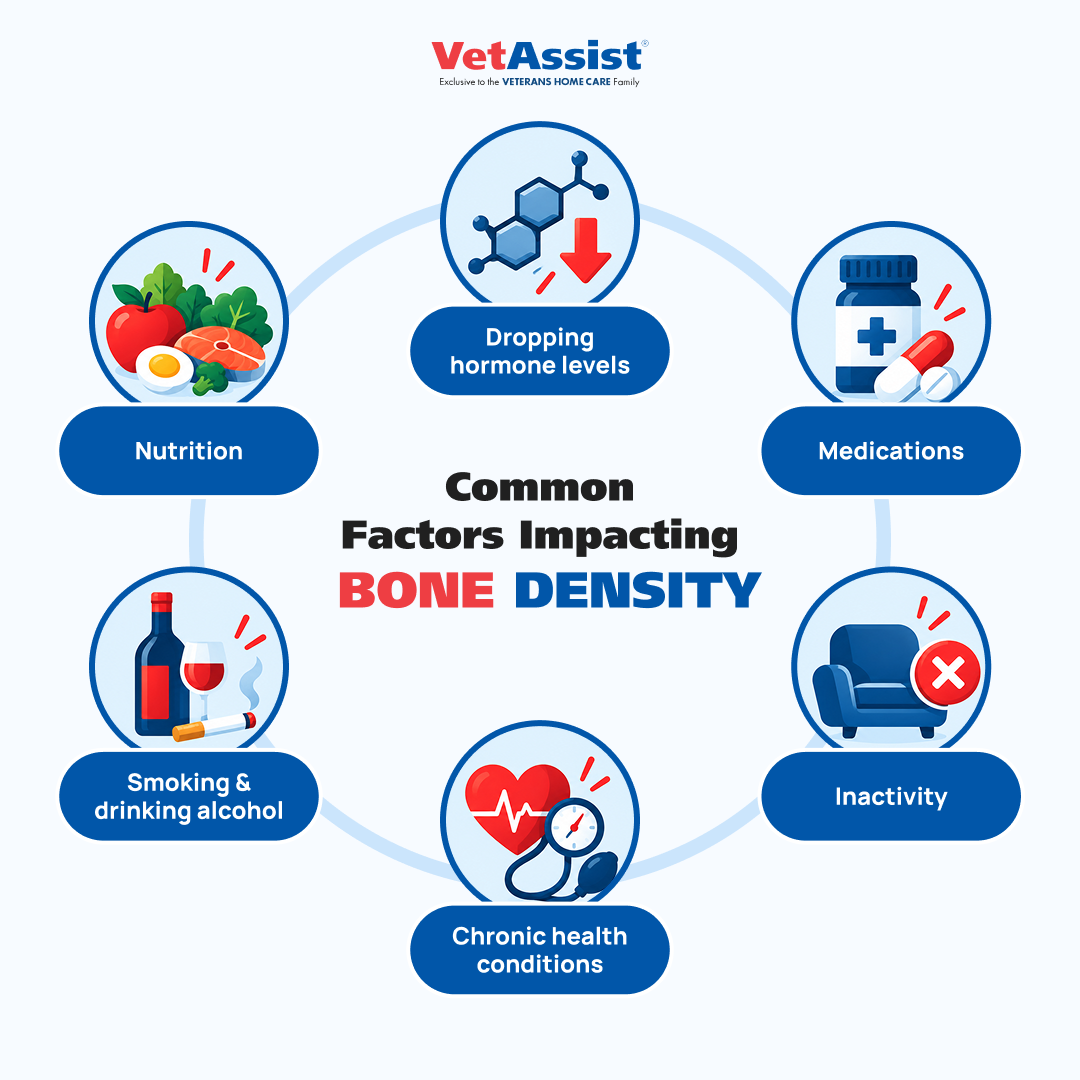
Some common factors that impact aging bone density include:
● Dropping hormone levels. Post-menopausal women have less estrogen, which helps regulate bone cell replacement. Men can face a similar challenge related to testosterone.
● Nutrition. Those who are malnourished or eat a diet too low in needed vitamins and minerals face a higher risk of bone disease.
● Smoking and drinking alcohol. These introduce additional challenges to the body like impaired blood circulation, toxic free radicals, hormone disruption, and slowed cell turnover. They can also make it more difficult for the body to absorb the nutrients it needs for bone and other tissue health.
● Inactivity. Unused, unchallenged bones and muscles get smaller and weaker.
● Certainmedications. These include diuretics, hormone-based cancer therapies, seizure medications, corticosteroids (such as those used to treat eczema or arthritis), blood thinners, and PPIs taken for acid reflux or ulcers.
● Chronic health conditions like diabetes, kidney disease, hyperthyroidism, and bone-related autoimmune disease.
Our genes and natural aging play a role in bone density loss, but there are factors we can control to slow down bone aging and minimize the chance of fractures, breaks, and related health complications.
Bone Health Foods and Easy Workouts
Nutrition is one of the best things we can focus on to preserve bone density (as well as general quality of life). Healthy choices support our bodies in regenerating cells and fighting disease. Bone-focused nutrition should include the following:
● Calcium. Women over 50 should increase their calcium intake through calcium-rich foods or supplements. (Always discuss supplements and dietary changes with your doctor.)
● Vitamin D. Vitamin D helps the body absorb calcium. While we absorb vitamin D from the sun through our skin, this can increase the risk of developing skin cancer, so turn to food and supplement sources for this important nutrient.
● Protein.Protein supports muscle health and maintenance and can be enjoyed in a wide range of foods.
A colorful diet rich in whole foods and low in sugar and saturated fats has long been touted for overall health by registered dietitians and other health professionals. Be sure to speak to your doctor about foods or supplements that could interact with medications you take.
Another piece of the puzzle is exercise, which is crucial to preventing and slowing osteopenia and osteoporosis. Aerobic exercise supports faster cell turnover and resilience, while weight training grows protective muscles and strengthens bones. The right workouts also train in balance and flexibility to minimize the risk of injury. A physical therapist may be able to help you create a routine that targets your particular needs. Make sure to talk to your doctor about safety while exercising, and if needed, explore assistive devices for mobility.
Some popular options include:
● Moderate intensity aerobics. How do you know you’re at the right intensity? You should be able to talk, but be too out-of-breath to sing. Walking is a good place to start for most people. Many seniors enjoy water aerobics, and dancing offers exercise plus cognitive benefits from coordinating with music as well as a partner or group. Hiking or riding a bike on a flat trail can get you out in nature while raising that heart rate. Even less traditional exercise like mowing the lawn or gardening can be beneficial. Shoot for about 20-30 minutes of aerobic exercise most days per week.
●Strength training. You can use weights or even household items to do repetitions learned in a class, with a physical therapist, or online. Some common strength exercises use your own weight as resistance, and you can even find chair-based routines to start off slowly. Try to do 15-30 minutes of strength training twice a week. You can also put everyday effort on your muscles by carrying groceries, climbing stairs, and sitting and rising up from the floor.
● Balance and flexibility training.Yoga and tai chi are popular activities for seniors that help increase personal safety and mobility. They have the side benefit of building muscle strength as well. You can do short routines daily, or longer balance/flexibility routines a couple times per week to feel marked benefits.
Supporting Bone Density in Older Adults
If you care for an elderly loved one, support their safety, quality of life, and health outcomes by educating them on bone health and steps they can take to prevent falls and fractures. Bone density should be tested by your healthcare provider starting at age 65 for women and age 70 for men. Home modifications can be made to prevent slipping and falling, and smart technology can even be used to set routines and reminders for exercise, meals, and staying hydrated.
A professional home care provider is an ally in caring for your loved one and making sure they maintain health-supporting routines. If your loved one needs home care, our VetAssist mission is to make home care easily and quickly accessible for those who qualify through the VA Pension with Aid and Attendance benefit. Veterans Home Care can help you determine whether you or your loved one will be eligible to receive the benefit, which can cover some or all of the cost of home care, and we make it easy to apply. Chat with us via our website, or call us at (888) 314-6075.
Figuring out what to pack for a cruise can be more difficult than you might expect. You’ll need outfits for sea days, dinners onboard, time by the pool, and exploring each port of call. If you have active excursions planned, you’ll also need comfortable clothing and shoes that can handle a full day of walking, hiking, or whatever else is on your itinerary.
After more than 55 sailings and decades of traveling around the world, I’ve become pretty efficient at packing for a cruise. Of course, what I bring depends heavily on where I’m going and how long I’ll be traveling.
Regardless of where I’m cruising, I have some must-bring outfits that I pack for nearly every sailing. Whether you’re preparing for your first cruise or just looking for outfit inspiration, these are some of my favorite cruise outfit ideas for every part of the trip.
And just a warning: I am absolutely not a fashionista! These are just the outfits I’ve worn and felt comfortable in during my cruises. Consider this a source of ideas and inspiration as you decide what to pack for your next cruise.
What to consider before packing your cruise outfits
Before choosing your outfits and packing your suitcase, there are a few important things you’ll want to consider. Your destination, the time of year, the length of your cruise, and the activities you have planned can all influence what belongs in your suitcase.
Taking a few minutes to think through your itinerary ahead of time will help you pack more intentionally and avoid bringing items you won’t actually wear.
Here are some considerations:
Destination: If you’re sailing to colder destinations, such as Alaska, Norway, Iceland, New Zealand or South America, you’ll need to prioritize warmer layers. Even summer cruises to these destinations can be chilly, especially on deck or during early morning excursions.
Cruise Line Dress Code: Every cruise line has its own dress code and overall onboard atmosphere. Some cruise lines are very casual, while others host formal nights or encourage guests to dress up for dinner. Be sure to check the dress code before packing so you don’t arrive onboard without the proper attire!
Length of Sailing: Naturally, longer cruises require more clothing, although you don’t necessarily need a completely different outfit for every day. Most cruise ships offer laundry services, and some have self-service laundry rooms, making it easier to pack fewer items. And in a pinch, you can also do laundry in your cabin bathroom!
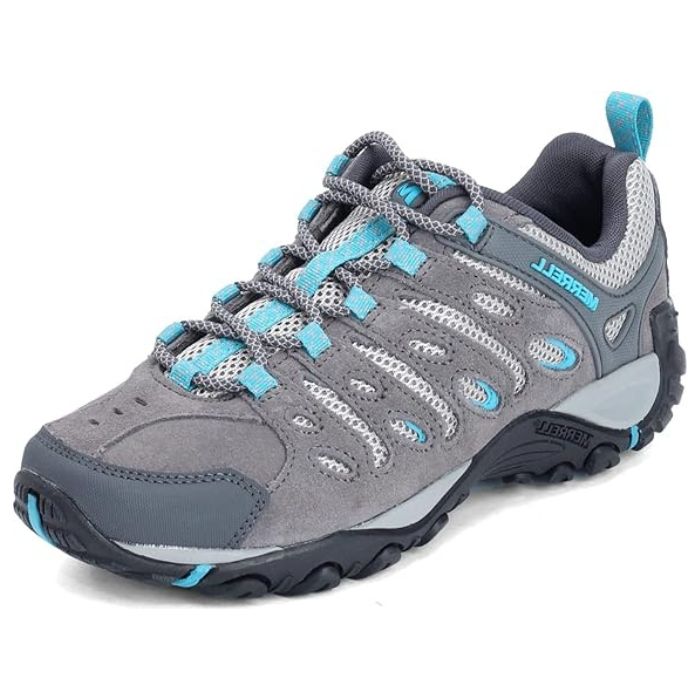
Planned Excursions:Your excursions will also influence your packing list. It’s essential to pack comfortable walking shoes for exploring ports, while hiking, snorkeling, or active excursions may require specialized clothing or gear.
Onboard Activities: Think about how you plan to spend your time onboard before packing. If you want to use the fitness center or enjoy the pool deck, you’ll need to pack appropriate athletic outfits, walking shoes, and swimwear.
Luggage and Cabin Space: Cruise cabins are often smaller than hotel rooms, so it’s important not to overpack. I recommend choosing versatile clothing that can be mixed and matched throughout the cruise. Planning outfits ahead of time can also help prevent you from bringing items you never wear.
Embarkation Day Outfits
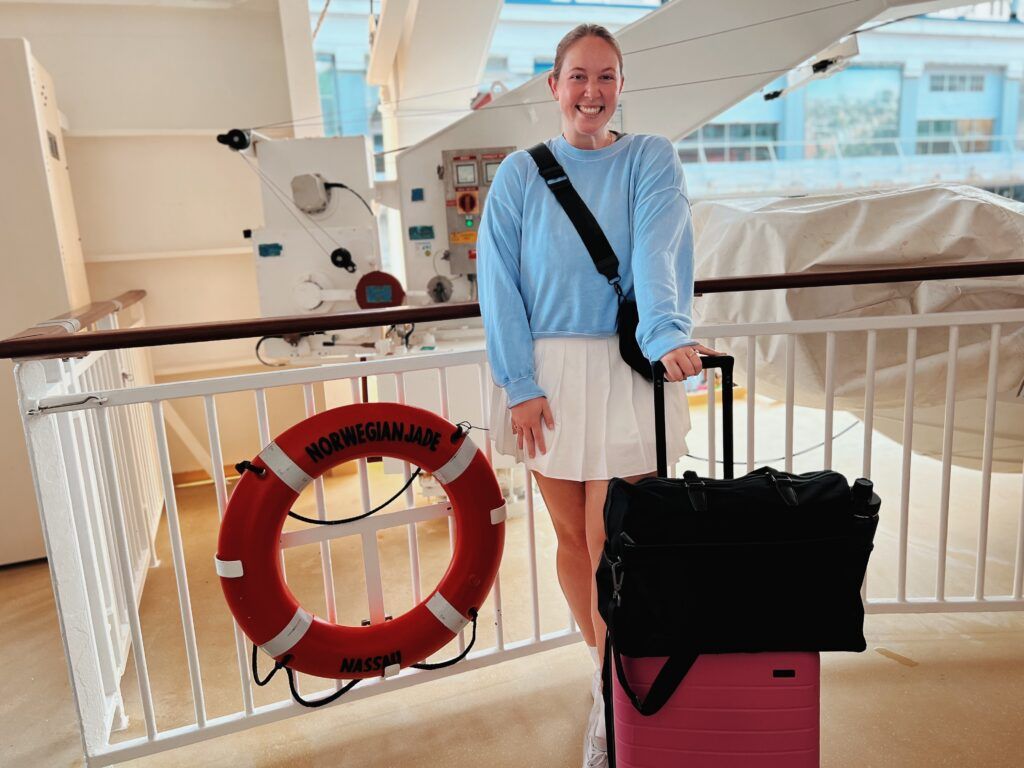
For embarkation day, I always prioritize comfort and practicality. You’ll be going through boarding and security, possibly hauling your luggage around the ship, waiting for your room to be ready, and exploring before you’re fully settled.
More often than not, I find myself sweating on embarkation day because I am moving from one thing to the next!
A good embarkation day outfit could include the following options:
Shorts with a lightweight, casual top
A matching set
Comfortable walking shoes
Athletic dress or skort with T-shirt
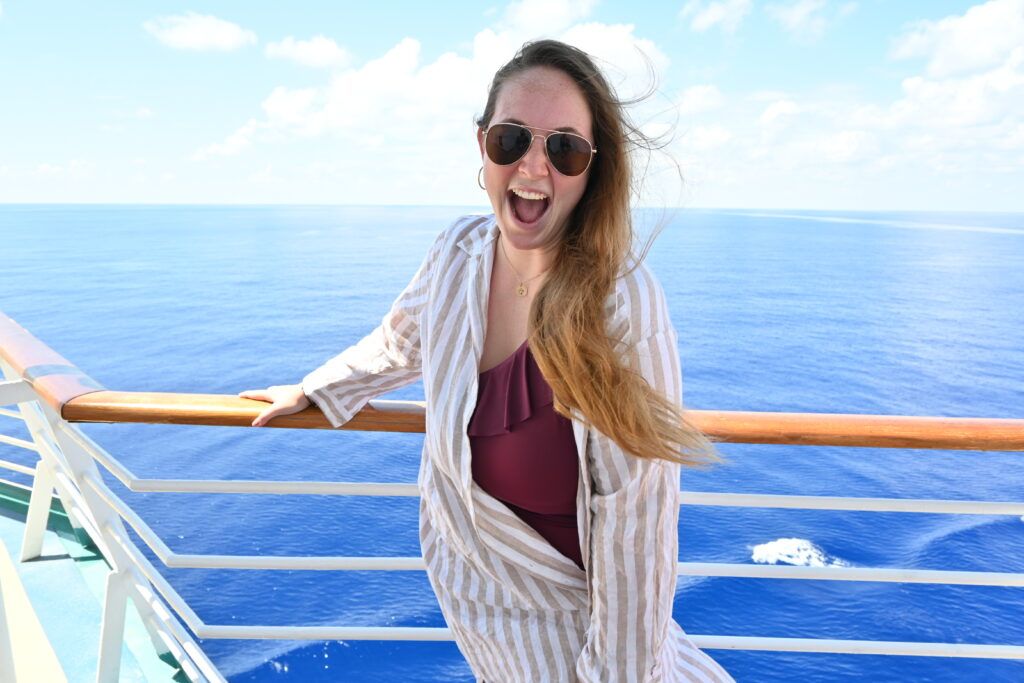
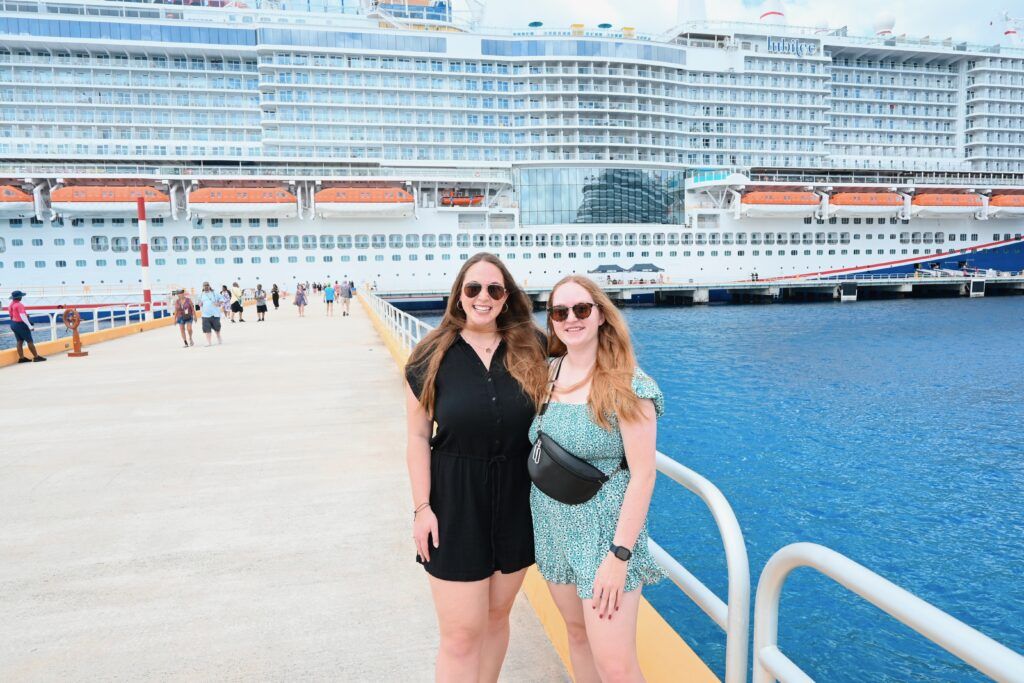
For hot Caribbean sailings, I’ll normally wear a lightweight matching set or an athleisure outfit. This might be an athletic skort, comfortable walking shorts, or a casual tank top. If I want to look a little more put together, I’ll wear jean shorts with a basic T-shirt. Honestly, it’s nothing too fancy unless you want a nicer outfit in your “Welcome Aboard” photo!
I also pack a few extra outfits in my carry-on, just in case my checked luggage takes a while to arrive. This usually includes a dinner outfit, another casual outfit, a swimsuit, pajamas, and other essentials (like medication). This makes it much easier to start enjoying your vacation immediately without waiting around for your bag!
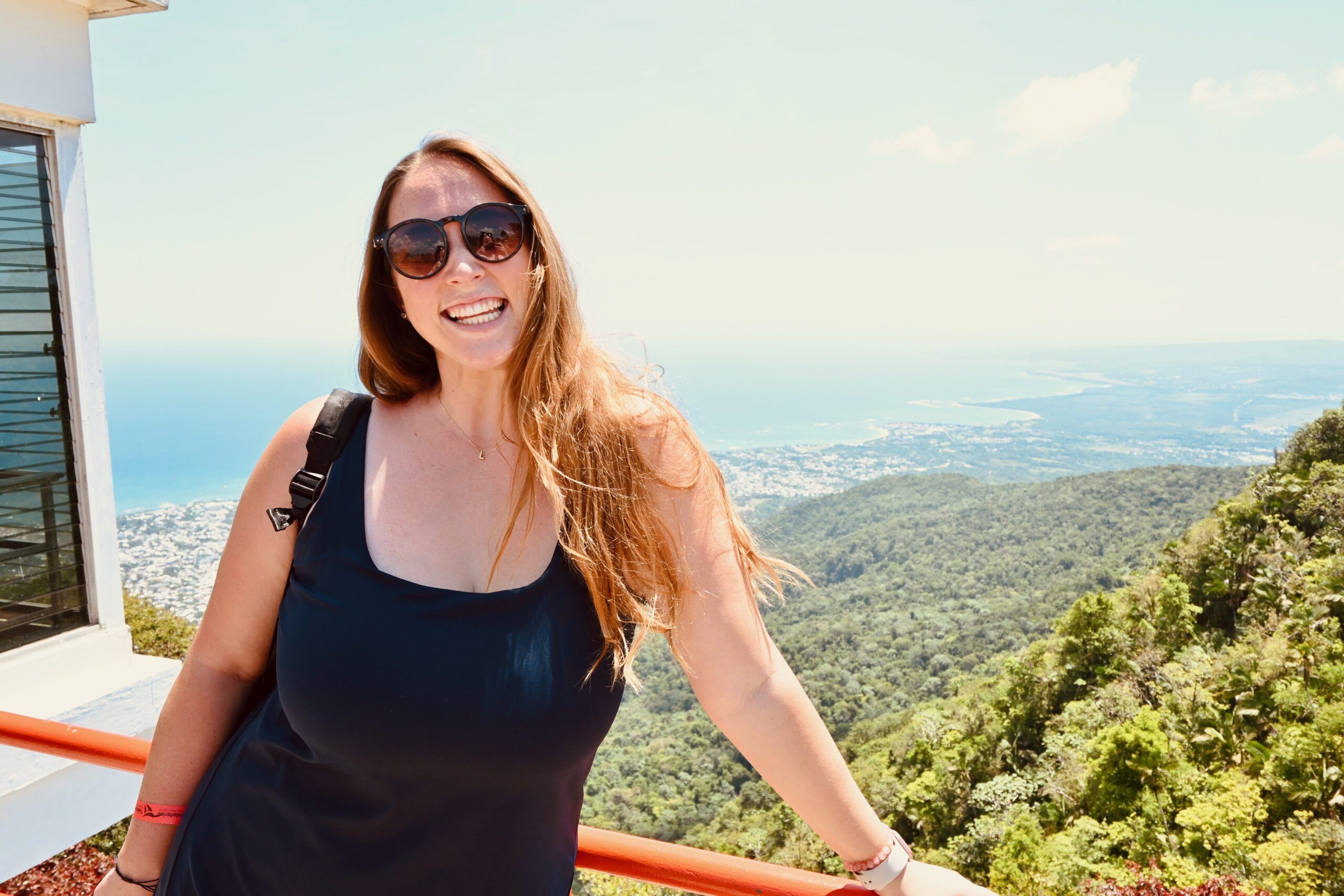
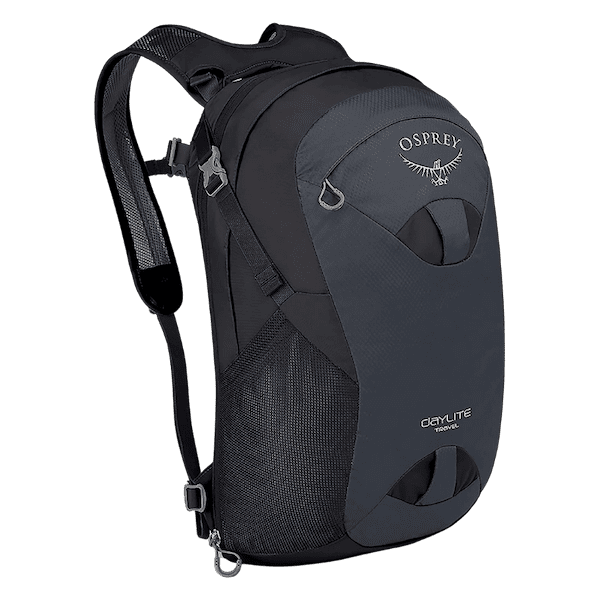
A crossbody bag or small backpack is also helpful for embarkation. I like to keep my wallet, passport, phone, sunglasses, lip balm, and embarkation documents close to me while boarding.
If you’re traveling with a group, you might even consider matching shirts! These are very popular right now and can make it easier to find everyone in a crowd. It also makes for an awesome embarkation-day photo!
Sea Day Outfits
Personally, I prioritize comfort above everything else on sea days. When I have nowhere to be besides maybe an afternoon nap, I’m not getting dressed up! Whether I’m sitting by the pool, reading inside or grabbing a meal onboard, I’m keeping things casual and comfortable.
If you plan to walk on the ship’s track or visit the gym, you’ll also want to pack a few workout outfits. For lounging around the ship, I usually like lightweight athletic shorts with a casual T-shirt.
For a pool day, you’ll definitely want to pack:
A swimsuit
A cover-up
Sandals
Sunglasses
Sunscreen
Also, indoor areas can feel unexpectedly cool because of the blasting air conditioning, so I always recommend packing a light jacket or cardigan. On cooler-weather cruises, I’ll wear leggings with a sweater or cozy pants paired with a sweatshirt.
I should mention that some women prefer to dress a little nicer on sea days, and that’s perfectly fine. In my experience, the overall atmosphere is really casual and comfort is key!
Cruise Dinner Outfits for Women
When I first started cruising about 20 years ago, everyone seemed to dress up for dinner, especially on formal nights. That’s not really the case anymore, as most people wear more practical, relaxed outfits in the evenings.
For most cruises, I only bring a few outfits specifically for dinner. If I’m trying to save space in my luggage, I’ll bring even fewer dinner outfits and prioritize packing outfits that can be worn during the day or dressed up in the evening.
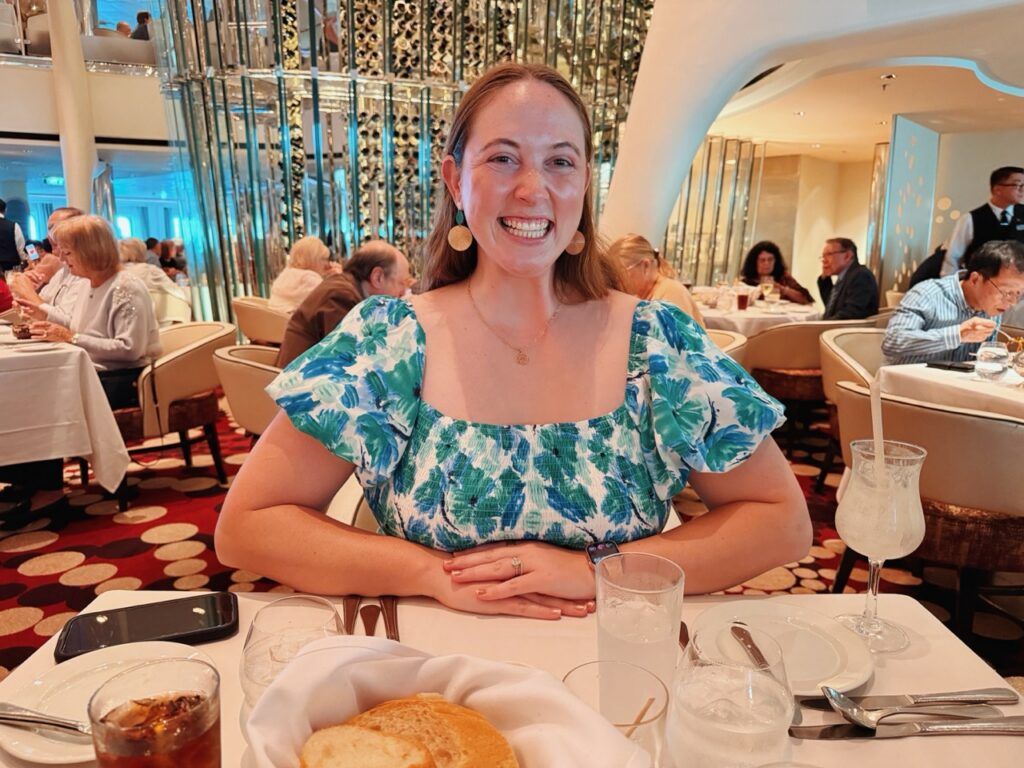
I personally love wearing sundresses to dinner while cruising. I also prefer relaxed-fitting outfits because cruise food always leaves me feeling a little bloated. After enjoying a big meal, the last thing I want to wear is something super fitted when I feel like I’m about to bust at the seams!
For cooler itineraries, such as Alaska or Norway, I’ll pack long-sleeve dresses and warm cardigans to layer. Even when it’s cold outside, these outfits are comfortable once you’re indoors on the ship.
If you don’t like dresses, then casual pants, slacks or capris are perfectly fine. Almost every night of a cruise, you’ll find my mom (who is in her mid-60s) wearing pants with a dressy top. If you’re looking to save space, you could consider bringing a few dressy tops and bottoms that can be mixed and matched.
I also recommend packing a light cardigan or sweater for dinner. As I mentioned earlier, the ship’s air conditioning can feel intense, especially in the dining room. In this way, it’s nice to have an extra layer for the evenings if you get cold easily.
However, some cruise lines do enforce stricter dress codes in certain restaurants or on formal nights. For example, Cunard is known for enforcing more traditional formal-night dress codes while Celebrity Cruises doesn’t allow shorts in the dining room. Ultimately, it’s always a good idea to check your cruise line’s dress code before you start packing.
What to Wear on Formal or Elegant Night
Most cruise lines host a formal evening, while longer itineraries might include a couple of elegant nights. These evenings may be called “elegant night” or “dress your best,” but they’re all pretty much the same thing.
For these occasions, I’ll usually wear a slightly nicer dress that’s longer or midi-length. I’ll also spend a little more time on my makeup and hair, but honestly, I don’t stress too much about what I wear on formal nights.
When it comes to formal night, the atmosphere can vary quite a bit from sailing to sailing. Some guests go all out in full-length ballgowns, while others wear something basic, like a sundress.
For shoes, I really like to keep things basic. I’ll usually pack flats or cute sandals that don’t take up much room but are still comfortable enough to wear around the ship in the evenings. Truly, you won’t find me packing heels just for dinner because I’d rather save the space for something else.
This isn’t the case for everyone, though! For instance, my mom will happily bring a couple of pairs of shoes for dinner in her suitcase, even if she doesn’t wear them all. Everyone has their own packing style, and there’s no single right way to do it.
One thing to keep in mind: at the end of many cruises, the outfits I didn’t wear were usually the ones I packed specifically for dinner. If you’re short on luggage space, you may want to limit the number of dinner-only outfits you bring and focus on versatile pieces you can wear more than once.
What to Wear in Port
As I mentioned earlier, your port day outfits will depend heavily on your itinerary and daily plans. Whale watching in Alaska is very different from spending the day on a Caribbean beach or exploring historic sites in Europe!
No matter what you’re doing, prioritize sturdy, weather-appropriate clothing and shoes. This is especially important if you’ll be walking for several hours!
You should also consider whether you’ll be visiting churches or religious sites. Some locations require more modest clothing to tour certain sites, which is especially common on European and Mediterranean itineraries.
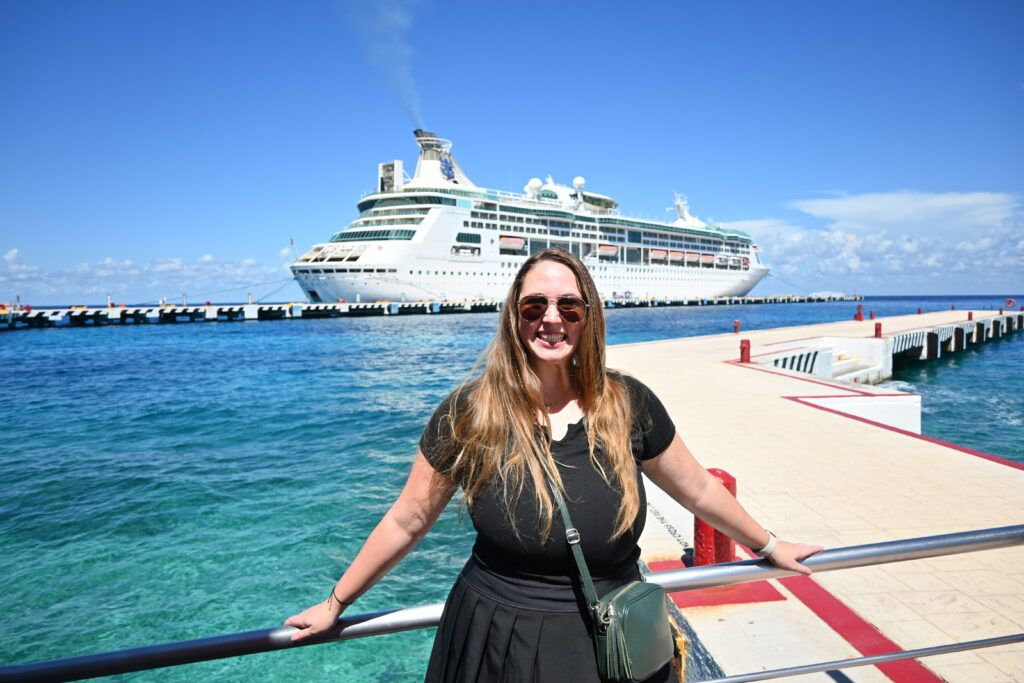
When heading ashore, I always bring a crossbody or backpack for carrying my essentials. A small black crossbody works with most of my outfits and is usually all I need for a day ashore. For longer days or excursions where I need to carry more, I’ll bring my small leather backpack to hold additional things.
Here are a few examples of outfits I’ve worn in different climates and for different types of port days.
Caribbean Beach Day
For a Caribbean beach day, I would usually consider wearing one of these outfits:
A swimsuit with a cover-up
Linen shorts
Matching set with breathable fabric
Athletic dress
Rubber sandals
Sunglasses
If I’m heading to the beach in the Caribbean, I’ll usually wear a swimsuit with linen shorts and a lightweight cover-up. This is easy to throw on, comfortable in the heat, and practical for the beach. On the other hand, if I’m spending the day exploring instead, I’ll opt for something casual, like an athletic dress or a lightweight matching set.
Cold-Weather Excursion Day
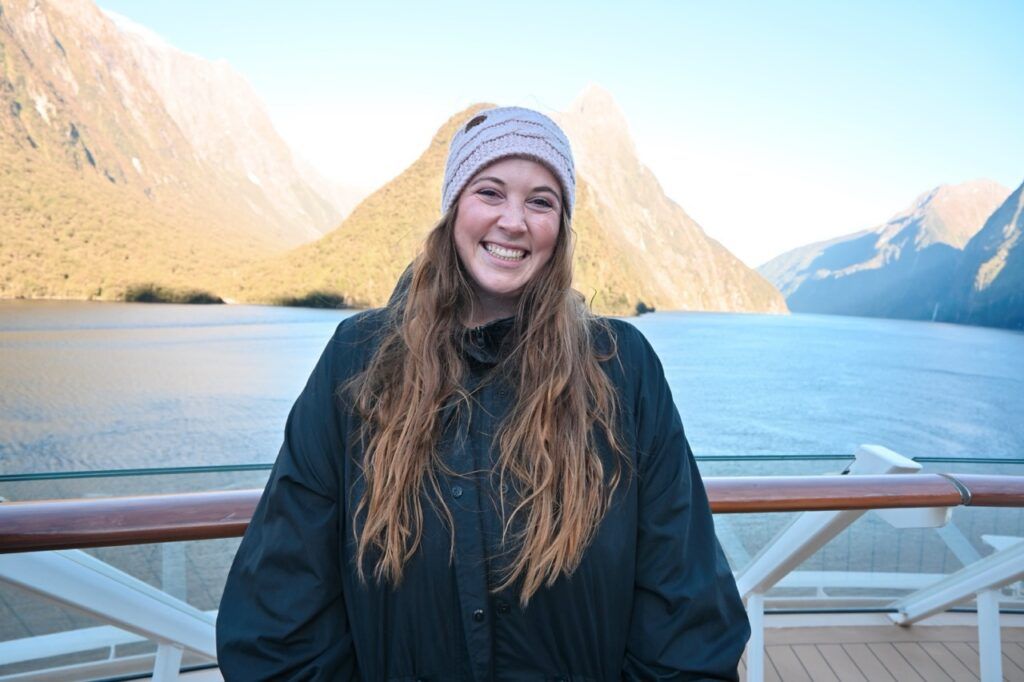
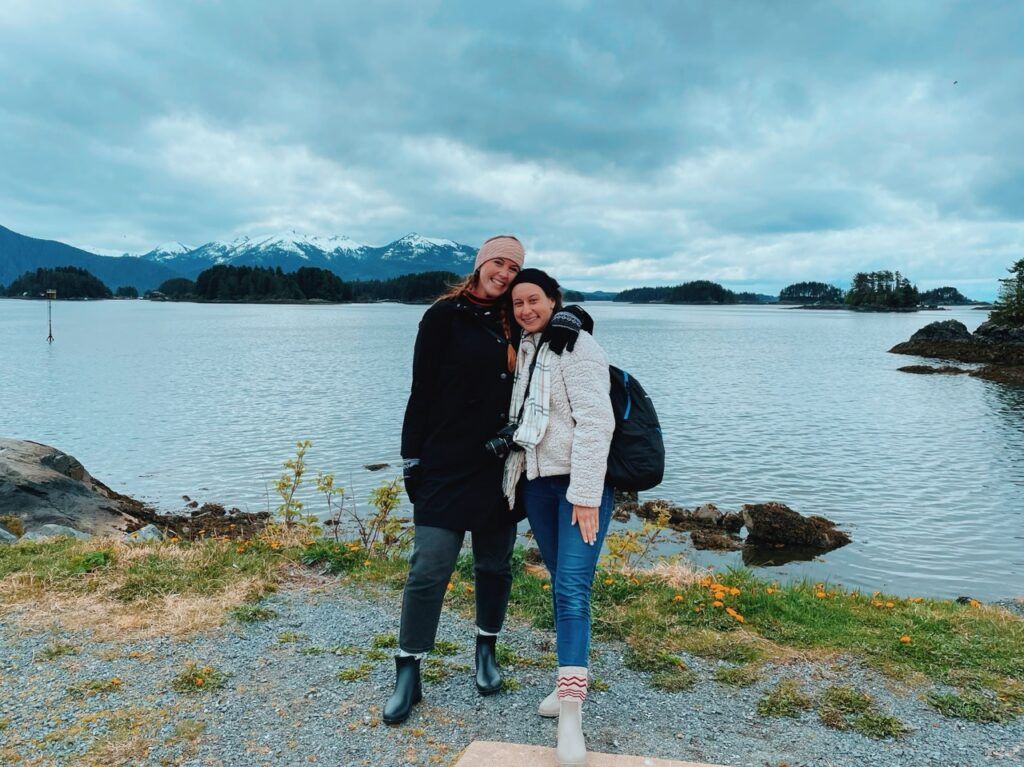
I’ve worn this type of outfit in Alaska, Norway, Iceland, and New Zealand:
Leggings
Waterproof boots
A tunic sweater
A black rain jacket
A hat, scarf, and gloves
If we’re doing a lot of walking and rain isn’t in the forecast, I might wear white sneakers instead. For more active days, waterproof rain boots are the better choice, especially when hiking in Iceland or exploring Alaska.
European City Exploration
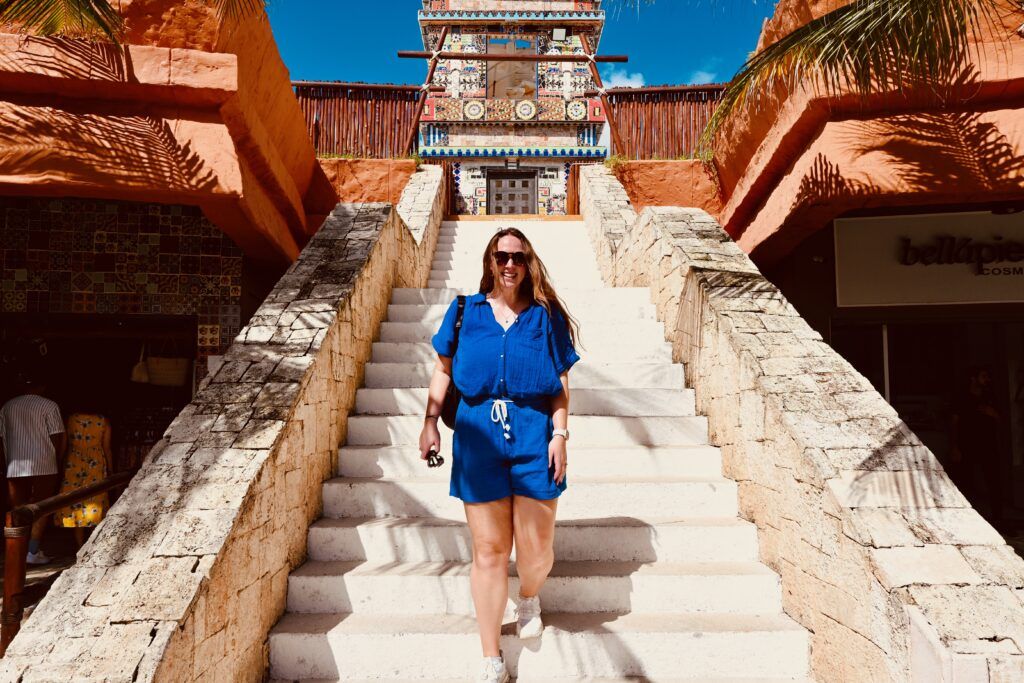
For exploring a European city, I love wearing a breezy sundress with white sneakers. It’s cute for photos, appropriate for visiting cultural sites, and comfortable enough for walking around all day.
If the weather is cooler, especially in the spring or fall, I’ll wear linen pants with a light cardigan and white sneakers. This is still practical for walking around but provides a little extra warmth.
Active Excursion Day
For an active excursion day, I usually choose something athletic and suited to the climate. While kayaking in New Zealand, I wore a quick-dry skort with a tank top and a lightweight white long-sleeve shirt for sun protection.
Whatever you wear, make sure your shoes are broken in and have good traction. The right shoes can make a huge difference when you’re hiking, walking on uneven ground, or spending an entire day outdoors.
Don’t overthink your cruise outfits, but come prepared
After more than 55 cruises, I’ve learned that you really don’t need a completely different outfit for every day, activity, and meal onboard.
I recommend choosing versatile pieces that can be worn more than once. For instance, a sundress can work for a day in port and dinner that evening, while a lightweight cardigan can come in handy for chilly dining rooms, cool-weather destinations, and air-conditioned areas around the ship.
At the same time, it’s important to come prepared for the activities on your itinerary. Pack supportive walking shoes for port days, weather-appropriate layers for cooler destinations, and a few nicer outfits if your cruise includes formal or elegant nights. If you have an active excursion planned, make sure you bring clothing and shoes that can handle a full day outdoors.
You probably won’t wear everything you pack, so focus on bringing outfits that make you feel comfortable and confident. There’s nothing wrong with repeating a favorite dress, wearing the same sneakers in multiple ports, or skipping the heels altogether.
The best cruise wardrobe is one that gives you plenty of options without leaving your suitcase completely stuffed!
Comments
Do you agree with these suggestions on cruise outfits for women? Do you have any other cruise outfit ideas? Drop us an anchor below to share what you usually wear on a cruise.
My hot cowboy dip is what I’m bringing to the next game day party! It’s loaded with savory sausage, gooey cheese, and a little kick from the jalapeños. Everything comes together in one skillet, so there’s less cleanup and more time to dig in!
Why This Dip Will Steal the Show!
One Skillet Wonder: Cook the sausage, melt the cheese, and bake everything in one pan. Less cleanup is always a win!
Loaded With the Good Stuff: Three kinds of cheese, savory sausage, beans, corn, and jalapeños make every bite extra delicious!
Game Day Gold: Set it out with tortilla chips and watch everyone gather around. It’s hearty enough to keep hungry fans happy!
Ingredients for Hot Cowboy Dip
Control the Heat: If you prefer a milder dip, use mild sausage and mild diced tomatoes with green chiles. Then, skip the fresh and canned jalapeños, or swap the fresh ones for diced bell peppers.
Switch Up the Cheese: If pepper jack is too spicy, try cheddar, Colby Jack, or Monterey Jack instead. For the best melt, use freshly shredded cheese!
Choose Your Dippers: Once the dip is hot and bubbly, serve it with tortilla chips, corn chips, pita chips, or toasted bread. They’re all delicious for scooping up that cheesy goodness!
How to Make Baked Cowboy Dip
Baked cowboy dip comes together in one skillet, making it perfect for game day! Once it’s hot and bubbly, serve it with tortilla chips alongside buffalo chicken wings, pigs in a blanket, or potato skins. If you’re feeding a crowd, don’t expect leftovers!
Cook Sausage: Preheat the oven to 350°F. In a large oven-safe skillet, cook and crumble the sausage over medium-high heat for 6–7 minutes, until fully cooked, then drain excess grease.
Add Ingredients: Reduce heat to medium-low. Add cream cheese, sour cream, Velveeta, half the pepper jack, tomatoes and green chiles, beans, jalapeños, corn, chili powder, salt, and pepper.
Melt Cheese: Stir until the cheese melts and everything is combined. Taste and adjust salt and pepper if needed.
Bake: Sprinkle the remaining pepper jack on top, thn bake for 13–15 minutes, until bubbly and lightly golden. Garnish hot cowboy dip with green onions and serve warm.
Alyssa’s Pro Tip
Don’t rush melting the cheese! Keep the heat on medium-low and stir until everything is smooth and creamy before baking. High heat can cause the cheese to separate and turn oily.
1poundItalian or breakfast sausageheat level to your preference
8ouncessoftened cream cheese
1cupsour cream
8ouncescubed Velveeta cheese
2cupsshredded pepper jack cheese
1(15-ounce)can diced tomatoes and green chilesnot drained
1(15-ounce)can black beansdrained and rinsed
1(4-ounce)can sliced jalapeños not drained
1cupfrozen sweet corn
¼cupdiced fresh jalapeños deseeded and deveined
2teaspoonschili powder
½teaspoonsalt
¼teaspoonground black pepper
sliced green onionsfor garnish
Instructions
Preheat the oven to 350 degrees Fahrenheit.
Heat a large 14-inch oven-safe skillet over medium-high heat and add 1 pound Italian or breakfast sausage. Cook and crumble until no pink remains, about 6-7 minutes. Drain any excess fat.
Reduce the heat to medium-low, then add 8 ounces softened cream cheese, 1 cup sour cream, 8 ounces cubed Velveeta cheese, half of the 2 cups shredded pepper jack cheese, 1 (15-ounce) can diced tomatoes and green chiles, 1 (15-ounce) can black beans, 1 (4-ounce) can sliced jalapeños , 1 cup frozen sweet corn, ¼ cup diced fresh jalapeños , 2 teaspoons chili powder, ½ teaspoon salt, and ¼ teaspoon ground black pepper.
Cook and stir until all the cheeses are melted, and everything is combined. Taste and season with additional salt and pepper and needed.
Top with the remaining half of the pepper jack cheese, then place the skillet in the oven. Bake for 13-15 minutes, until the edges are bubbling and the cheese is melted and starting to brown on top.
Top with sliced green onions and serve with your choice of chips.
Notes
Leftover Instructions
Refrigerator: Store cooled leftovers in an airtight container in the fridge for up to 3–4 days.
Reheat: Warm in the oven at 350°F, covered, until heated through, or microwave individual portions in short intervals, stirring between each.
Freezer: I don’t recommend freezing this dip. The cream cheese and sour cream can separate after thawing, changing the texture.
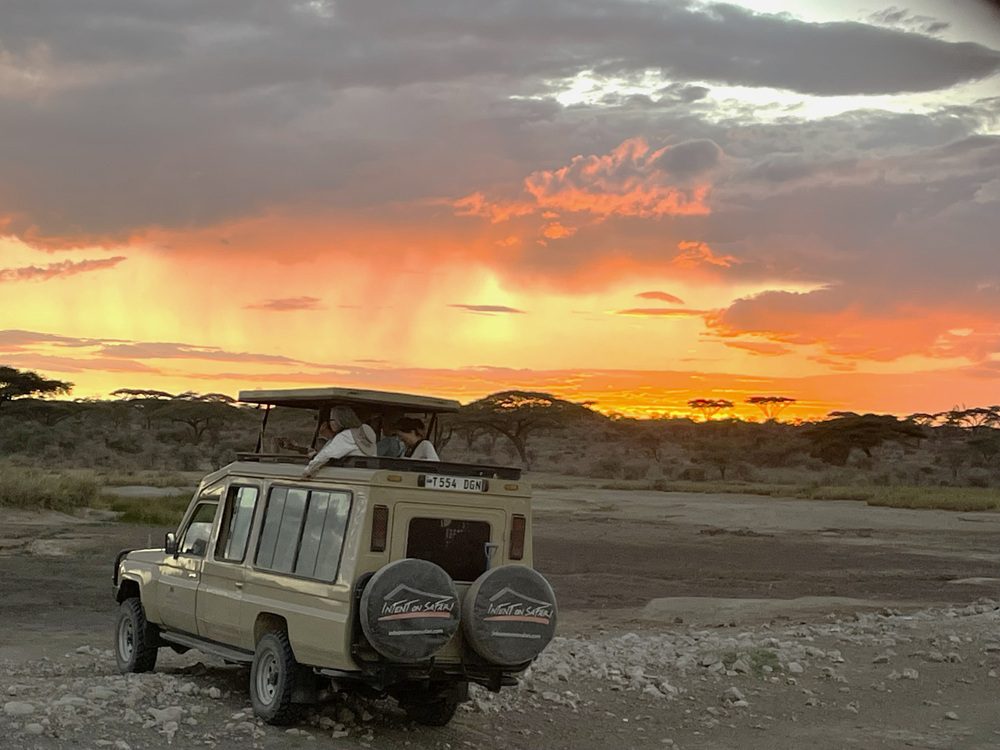
Featured image: There are two Tanzania safaris scheduled for 2026 | Photo by Intent on Safari
Trip details for Tanzania in November and December 2026
JourneyWoman is partnering with our trusted Women’s Travel Directory partner Intent on Safari to offer two women-only safaris in Tanzania in November and December 2026. On this trip, women will experience Tanzania’s wildebeest migration, which is timed for low season before the holiday rush and the start of the rains—when over a million wildebeest begin their trek to the Ndutu/Serengeti plains. We’ll spend two nights in Tarangire National Park, explore the Ngorongoro Crater (a natural wonder), two nights in the Ndutu area tracking the herds, and two nights in the Serengeti including a hot air balloon flight over the plains. This also includes a talk from KopeLion conservation group. There are optional extensions available: Gorilla trekking in Rwanda or beach relaxation in Zanzibar. Find full trip details here.
This year’s host is for the December trip is JourneyWoman CEO Carolyn Ray, who will be joining our safari hosts Laura and Colin Simpson, Owners of Intent on Safari. Watch the March 2026 introductory call about this trip here, and join us on October 15 for our pre-trip call for both groups. Calls are recorded for later viewing.
Note: Most light scheduled and private charter flights have a strict luggage allowance of 15-20 kilograms per person for your safety. This includes carry-on and camera gear. It is essential to pack light and in soft-sided bags. Laundry service is available in lodges and while camping, so there is no need to bring more than a few days’ worth of clothing.
The Basics
Valid passport: A valid passport is required to enter Tanzania/Kenya. It should be valid for at least six months from your expected entry date. If this is not the case, you must have another passport issued. If you hold any passport other than UK/USA/CANADA check with us and we will confirm if you require a visa. Please apply for your visa before you travel to Tanzania/Kenya. You should allow plenty of time for processing before your departure. (Approval can take anything from 24 hours or 24 days).
Visa: The visa application can be done online, please ONLY use the following websites– there are scammers out there!
Kenya: Your visit to Kenya begins here · Kenya Electronic Travel Authorization (eTA) https://etakenya.go.ke/
An ordinary Tanzanian tourist visa costs $US 50 for Canadian/British/European citizens.
US citizens must obtain a multiple entry visa US$100
A Kenyan electronic travel authorization costs $30 +handling fees for all nationalities.
Travel Insurance: It is a condition of Intent on Safari Ltd. that all participants be fully insured with trip cancellation, medical and evacuation insurance as a condition of travel. Trip cancellation insurance is essential in the event you are unable to travel due to illness. Most policies also provide for cancellation in the event of illness of a family member. Check prices on insuremytrip.com. Do not assume insurance is covered on your credit card.
Tanzania Inbound Travel Insurance:Please purchase your Mandatory Inbound Travel Insurance for Tanzania before departure. There is a chance that at check-in you will ask to show a copy of this at the airport along with your visa, before they let you on the plane. To start the process please use the following website: https://inbound.nicinsurance.co.tz/, click on the green button ‘Apply for Insurance, Click on the Individual Package, and fill in your details.
Vaccines: Please consult your doctor or Health Travel Advisory Service to get up to date advice on vaccinations and malaria prophylaxis. Please allow plenty of time to obtain the necessary immunizations. Current recommended vaccinations for travel to East Africa:
Hepatitis A
Typhoid
Yellow Fever. Only if you are travelling from a country that has yellow fever.
Malaria: Malaria is a serious tropical disease that affects millions of people each year, mostly locals. Most areas in East Africa are within a malarial zone, notably the coastal areas and lower elevations; and there are strains of malaria present that can be resistant to certain anti-malaria drugs. It is recom-mended that you take anti-malarial tablets before, during and after your stay in East Africa. Please contact your doctor or international health clinic to get the best advice on which anti-malarial to take. Malaria is spread by one species of mosquito (Anopheles gambiae) that feeds from dusk to dawn.
The best way to prevent contracting malaria is to avoid being bitten by mosquitoes. Follow these suggestions:
Use insect repellent especially in the evenings
Cover exposed skin after dark ( long sleeves & long trousers)
Use a mosquito net when provided (at the coast and low elevations)
Time zone: Tanzania and Kenya are + 3 GMT. This means the local time is three hours ahead of London, eight hours ahead of New York and elev-en hours ahead of Los Angeles. East Africa does not observe daylight saving time so the difference changes by +2 in the European and North American summer. (End of March -End of October).
Money: The currency across East Africa is the National shilling. However, almost anything can be purchased with US currency and most places will accept US Dollars (Not Euros & Pounds) so you do not really need local currency. Some of the things that you may need money for include: drinks while staying in lodges, Spa Treatments, Laundry, Souvenirs and curios, Books and postcards, Gratuities (Tips). See tipping guidelines below.
We suggest travelling with the following: A Credit card as an emergency back-up. A pre-paid bank Debit card with a sensible balance for shopping and other incidentals/extras. (Wise is a good alternative, get an account here).
Warning: There are often network outages and the lodge card machines fail. If this happens you will need to pay by cash. Please make sure all notes are more recent than 2009, as most establishments and banks do not accept notes older than 2009. Bring some smaller notes for small bill payments. Otherwise, you will get a handful of local cash as change!
Water and Food: While in East Africa you should not drink tap water. Only drink commercially bottled water, unless the source of water is confirmed as safe to drink.
In a bid to reduce plastic waste, most lodges and camps now have drinking water treatment plants and water coolers where you can fill your travel bottles for free. Do not drink from any taps, and always brush your teeth with water provided for that purpose or from your travel bottle.
Food in lodges is to a very high standard of hygiene. Salads and fruits are disinfected however that still does not guarantee you won’t get an upset stomach. If you have a sensitive stomach stay away from too much fruit, raw vegetables and salads. (It is a good idea to pack some Imodium –Loperamide anyway). Most dietary requests can be catered for if given ample notification. If you require very specific types of food/drink within your diet then we advise bringing them with you. (Just enough to survive!) Bars of your favourite chocolate!!
Personal safety: As with travelling to any part of the world use common sense with your money and belongings. Please leave all valuable jewellery/wrist watches at home. Hotel rooms have small safes for travel valuables. If a safe is not available often the reception will keep travel valuables (passports/tickets) for safe keeping – just don’t forget to pick them up before you depart! Take expensive camera equipment to the dining room with you, or lock it in a large suitcase. Whilst camps/lodges have a very good track record for security it is best not leave your valuables lying around to avoid temptation. Read more about how to dress to stay safe while travelling here.
Tipping: Although tipping is optional and totally up to your personal discretion, it is a safari tradition. Staff are paid fairly, but they do appreciate reward for excellent service.
Typically, we recommend US$10 per client per night at smaller luxury camps, and US$5 per client per night at bigger lodges. If there is a lodge/hotel stay included in your safari you may want to consult the reception for the whereabouts of the tip box. Most lodges and camps divide the tip box by all the staff so it is not necessary to tip bag carriers, waiters, barmen, room stewards etc individually.
Safari guides typically receive around US$ 20-$30 per person per game driving day or $100 a day from the group/family, whichever is the lesser amount, depending on the level of satisfaction.
Airport Taxi Transfers $5 per trip
What to pack
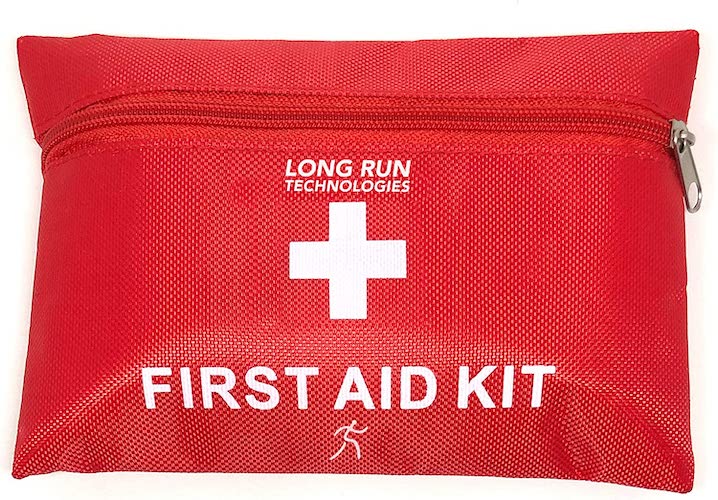
First aid, prescription glasses & sun protection: You should travel with your own personal first aid kit including any over-the-counter or prescription medications that you regularly use or may need. Eyeglass wearers should bring an extra pair and contact lens wearers should bring glasses as well. There is a lot of dust and glare on safari that can affect sensitive eyes. A good pair of sunglasses and plenty of sunscreen (including lip balm with UV protection) are also essential, as is a broad-brimmed hat.
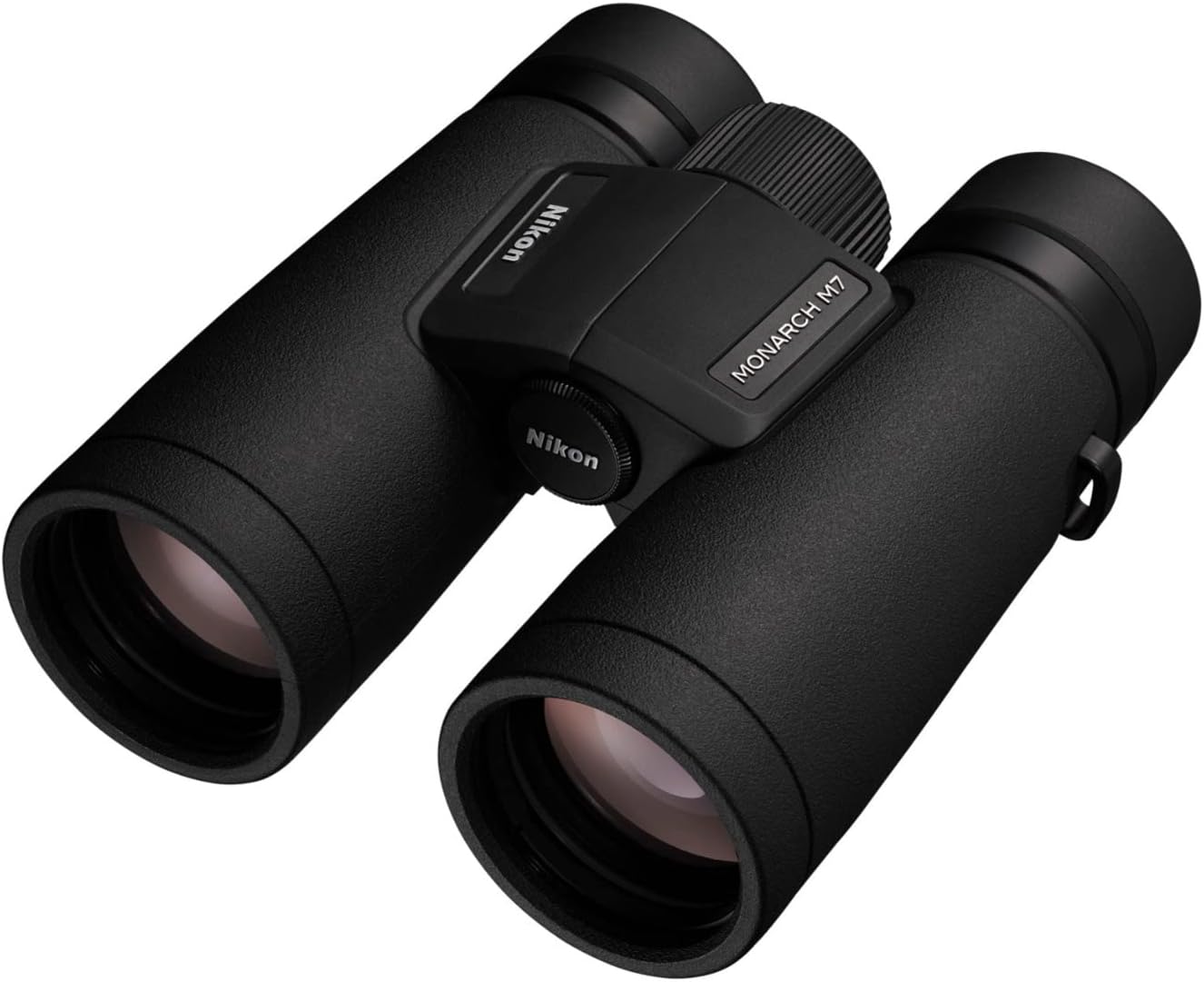
Binoculars and Camera: Having a good camera and binoculars on a safari is absolutely essential and worth the investment. Unless your phone has a telephoto lens, you will miss out!
Good equipment is essential for those who want good photography. Don’t rely on a “point and shoot” to give professional results, although they can provide fun snap-shots of people, places etc.
Cameras & Lenses: For good wildlife shots a 35mm SLR with two zoom lenses (28-80mm & 75-300mm or Larger). If you are passionate about photography, consider the following: Two camera bodies (Africa is hard on equipment). Wide angle lens – 20, 24, or 28mm or zoom lens to cover 24-80mm. Telephoto lens 300mm or above or zoom lens to cover 75-300mm. Read our article on photography equipment here.
Battery pack, phone, adapter, charger and eSim: Whether it’s staying connected on a mobile phone, using online maps or apps or taking photographs, stay connected with an eSIM (electronic SIM card) like one from Airalo (Use code JOURNEYWOMAN for 15% off). Make sure you have a battery pack. Anker battery packs are recommended by many women. In Africa, you can use a European travel adapter. Put everything in a plastic bag just in case to protect it from the rain.
Softsided luggage: On most safaris, the luggage allowance is minimal. Use a soft duffle bag that will fit in the various small bush planes that will take us from place to place. The duffle bag and carry-on must weigh no more than 44lbs. combined. If you are taking a domestic light aircraft max bag dimensions should be: L+H+W = 51 inch-es/129.5 cm including wheels, to fit in the pod of the plane.
An open-plan kitchen and living area showcase spacious interiors at JW Marriott Residences Reston Station. Photo: Christopher Spillman
Moving from a multi-level house to single-level living doesn’t have to feel like giving something up. In the right community, it can feel like an upgrade: open, spacious layouts and luxury finishes, with far less upkeep and far fewer stairs. If you’re thinking about your next move, here’s why single-level living deserves a close look.
Less Maintenance, Not Less Space
Single-level living lets you keep the room you’re used to while leaving much of the upkeep behind. With everything on one floor, there’s no lugging a vacuum up the stairs and no climbing ladders to clean gutters. Fewer stairs also means fewer everyday risks, and that matters: according to the CDC, falls are the leading cause of injury for adults 65 and older.
A bedroom and bathroom highlight the light-filled interiors and contemporary finishes at JW Marriott Residences Reston Station. Photo: Christopher Spillman
At JW Marriott Residences Reston Station, that ease comes with plenty of room to spread out. Its newly released three-bedroom model shows just how open and expansive single-level living can feel.
Luxury communities often handle the bigger jobs, too. Homeowners at JW Marriott Residences Reston Station have an on-site concierge, on-site management and a building engineer available seven days a week, so an air conditioning or plumbing problem is no longer yours to fix. You can still enjoy outdoor spaces without ever mowing a lawn, and spend your time on what matters most to you.
A generous island and streamlined cabinetry define this contemporary kitchen at JW Marriott Residences Reston Station. Photo: Christopher Spillman
“Lock and Leave” with Ease
A single-level home in a managed community also makes it easy to “lock and leave.” Whether you’re away for a long weekend or the whole winter, you won’t have to worry about security or upkeep on an empty house. Private mail and package rooms keep deliveries safe while you’re gone.
JW Marriott Residences Reston Station takes the lock-and-leave lifestyle a step further with 24/7 valet service and a private parking garage. Residents can head off on their next adventure knowing everything at home is taken care of.
The rooftop lounge and expansive terrace at JW Marriott Residences Reston Station with sweeping views of Northern Virginia. Photo: Christopher Spillman
Amenities That Bring Neighbors Together
Living in a multifamily community also puts connection right outside your door. At JW Marriott Residences Reston Station, homeowners share a rooftop lounge with sweeping views, a resident lounge with a catering kitchen and a fitness center that makes it easy to stay active close to home. As we explored in the first article in this series, staying socially connected and physically active both play a real part in healthy aging, and spaces like these make both part of everyday life.
Close to Everything
In a lively area like Reston, the amenities continue well beyond your front door. It’s also usually easier to find a single-level home in a vibrant, walkable neighborhood when you look at multifamily communities rather than detached houses, since so many of these communities are built close to shops and restaurants.
JW Marriott Residences Reston Station is located in the heart of Reston Station, with shopping and local dining just steps away. Reston itself has been recognized by publications such as Forbes and Money as a premier place to live, work and retire, and the town is a big part of what sets the Residences apart.
Making the Move
If you want a low-maintenance lifestyle without giving up the luxuries you’ve earned, single-level living may be the right choice. When you’re ready to plan your next move, consider a tour of JW Marriott Residences Reston Station, the only JW Marriott–branded residences in Virginia.
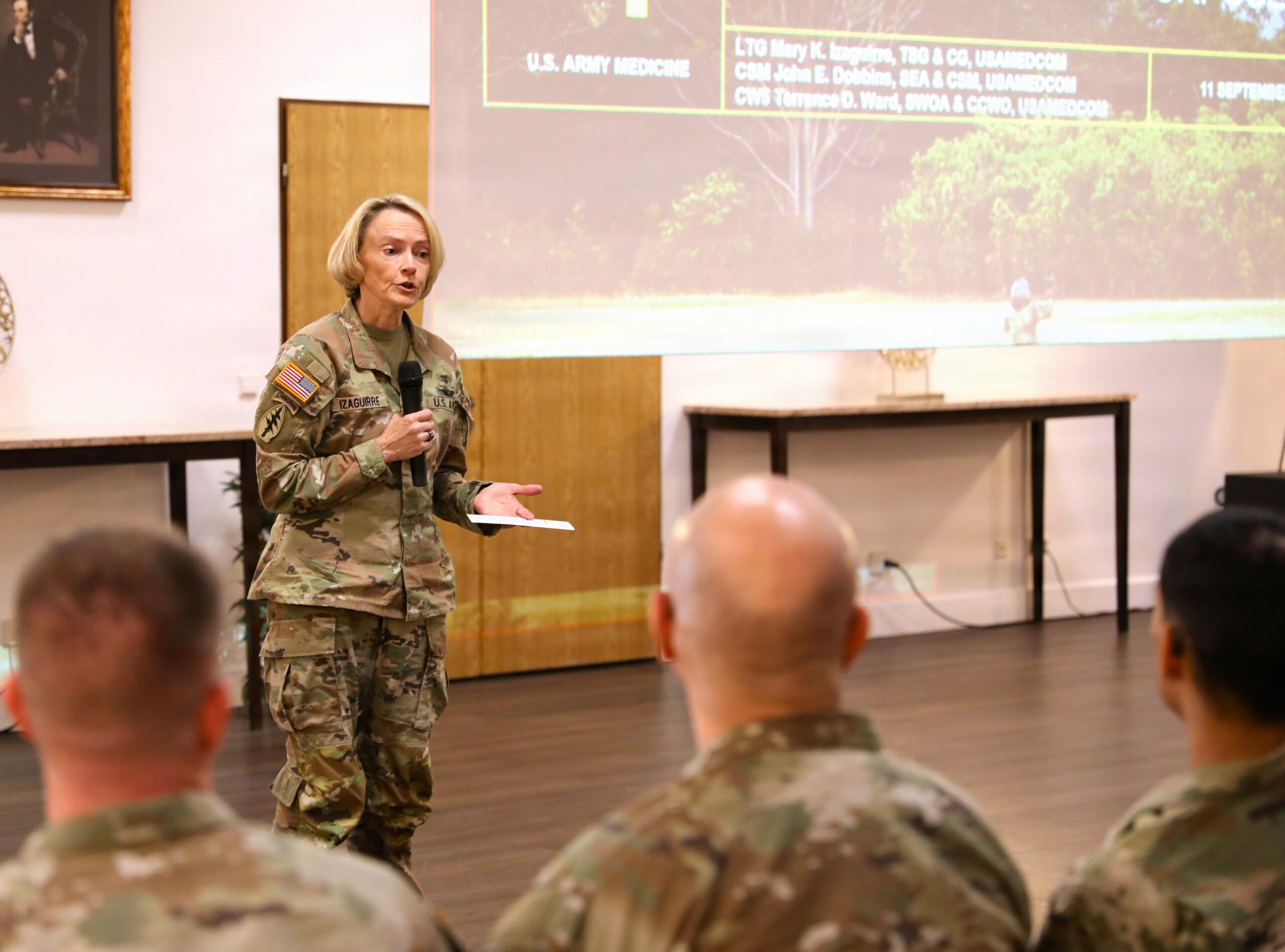
To military parents who are frustrated because they can’t get access to their teenagers’ medical records, the U.S. Army Surgeon General has a message: “We share your concern,” and are working to address it.
Currently, parents don’t have access to a child’s medical records from the time they turn 13, “based on current departmental policy,” Lt. Gen. Mary K. Izaguirre said Tuesday at the annual meeting of the Association of the United States Army.
In addition, children don’t have ID cards to sign in to the Defense Enrollment Eligibility System (DEERS), she said. Children must be at least 18 to log in to the system.
The question of parents’ access came up during a family forum at AUSA. Izaguirre said the issue is one of her husband’s favorite topics, and “I share his passion for it,” she said.
For now, parents must go to the patient administration offices at their military treatment facilities and have their teenage children sign consent forms to give parents permission for access to their medical records.
“That’s a barrier,” Izaguirre said, adding that “we’ve been working with the [Defense Health Agency], and the [Department of Health and Human Services]” to address the hurdle.
The issue stems from privacy laws and has come up in various settings with military families.
Researchers with the organization Feedback were “surprised at how often this came up, not just one parent at one base,” said Erin Domagola, the research director at the organization. Feedback analyzed comments received in the Federal Register, following a Defense Department solicitation in March for comments and suggestions from military families on how DoD could improve their quality of life.
Feedback uses applied anthropology, behavioral science and digital ethnography to understand what people experience and why.
The company independently analyzed Federal Register military family comments from 2024 to 2026 about quality of life. While there were a relatively small number of comments overall —117 in 2026 — it does provide a window into some of the concerns and suggestions, the researchers said.