A career in the Coast Guard offers dynamic missions, specialized skills, and a clear path toward personal and professional growth; but knowing where to start is key. Whether you’re comparing branch options or ready to talk to a recruiter, we’ve gathered answers to the most common recruit questions alongside actionable advice to help you land the role you want.
These Sheet Pan Chicken Thighs roast up juicy and golden with butternut squash, Brussels sprouts, and red onion all on the same pan. I love sheet pan meals because they’re super easy to throw together, budget-friendly, and great for feeding the family or stocking the fridge with leftovers for the week. This one is packed with warm, autumnal flavors from smoked paprika, dried thyme, garlic, and even a little cinnamon, but it absolutely works year-round, too. And at just $2.66 per serving, it’s perfect for a busy weekday night or a relaxed, comfy weekend meal at home!
One Pan, Plenty of Flavor
I made sure these sheet pan chicken thighs and veggies were as simple and easy as they possibly could be, but that doesn’t mean I skimped on flavor. I chose to roast everything at a very high heat (450°F) on purpose. That high heat gives the chicken skin a chance to crisp up and helps the vegetables brown and caramelize around the edges. As the chicken roasts, it also releases its savory juices onto the pan, where they mingle with the seasonings and coat the veggies in all that rich, glossy, deeply savory goodness.
Another little move I make is brushing the seasoned oil underneath the chicken skin, not just over the top. That gets the seasoning right onto the meat, so you’re not relying on the crispy skin to do all the heavy lifting flavor-wise. There’s also no marinating, no precooking, and no extra step halfway through this recipe. And because everything cooks on one pan, there’s less cleanup and more time to enjoy dinner!
Recipe Success Tips
Use the vegetables you have. I chose butternut squash, Brussels sprouts, and red onion because they’re all great for roasting, but this is also a perfect clean-out-the-fridge dinner. Potatoes, parsnips, rutabaga, or carrots can all go in from the beginning. If you have quicker-cooking veggies like tomatoes, zucchini, or summer squash to use up, add them about halfway through so they don’t burn or turn too mushy before the chicken is ready.
Keep your vegetable pieces consistent. I probably sound like a broken record here, but like I mentioned in my gnocchi with sausage and fall vegetables recipe, size really matters with sheet pan dinners! For this recipe, I small-dice the butternut squash into ~½-inch cubes, halve the Brussels sprouts, and medium-slice the red onion (about ½-inch thick slices). Keeping everything fairly uniform helps the vegetables cook through within the timing I’ve specified, so you’re not left with crunchy squash next to overcooked onion.
Don’t worry if the pan looks pretty full. I pack a lot of veggies on this sheet pan, and that’s okay! They release some steam as they roast, which helps everything soften and cook through. The vegetables and edges exposed to the high heat still get those lovely browned, caramelized spots, so you get a nice mix of tender and roasted textures.
Check the chicken with a thermometer. Chicken thighs can vary quite a bit in size, so I start checking them toward the end of the cooking time rather than relying on color alone. Insert an instant-read thermometer into the thickest part without touching the bone. Once it reaches 165°F, the chicken is safely cooked.
Play around with the seasoning. I went fully in on the warm, cozy flavors with smoked paprika, garlic powder, chili powder, cinnamon, and dried thyme, but you can absolutely change the spice blend to suit what you have. Most dried herbs, onion powder, or a little nutmeg, allspice, ginger, or clove would work nicely. Just go lightly with the stronger spices. A little can quickly become a lot!
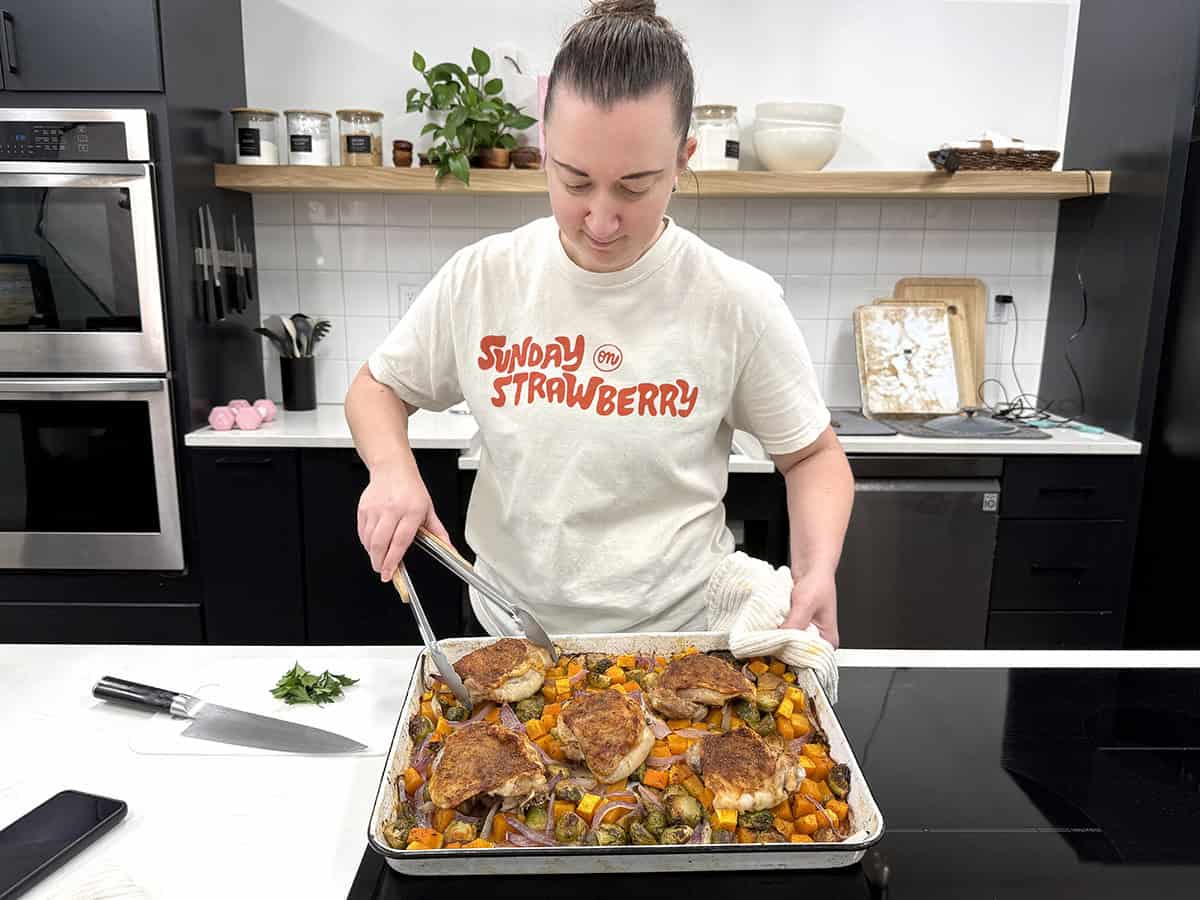
Melissa Nolan making her sheet pan chicken thighs recipe in our Nashville test kitchen.
Meal Prep it!
This recipe practically meal preps itself! Once the chicken and veggies have cooled, I portion one whole chicken thigh with the roasted vegetables into each container, then add a green salad in a separate compartment (like I’ve shown below). Keeping the chicken whole helps it stay juicy, and keeping the salad separate means I can pull it out before reheating. Store everything covered in the refrigerator and enjoy within 3-4 days.
For lunch, reheat the chicken and veggies until the chicken reaches 165°F. Or switch things up by pulling the meat from the bone and shredding it for a grain bowl, wrap, or salad. I like doing this later in the week when I want lunch to feel different without actually cooking again. 🙂
Preheat the oven to 450°F. Gather all ingredients and cut all the vegetables.
For the vegetables, place the cut butternut squash, red onions, and Brussels sprouts in a large bowl. Drizzle in the 2 Tbsp vegetable oil and sprinkle with 1½ tsp salt, 1 tsp pepper, 1 tsp garlic powder, and ½ tsp dried thyme. Toss to coat and lay them flat on the sheet pan.
For the chicken thighs, in a small bowl, mix the 2 Tbsp vegetable oil, ½ tsp smoked paprika, ½ tsp garlic powder, ¼ tsp chili powder, ¼ tsp cinnamon, ¼ tsp dried thyme, 1½ tsp salt, and 1 tsp pepper.
Using a pastry brush, completely coat all sides of the chicken thighs, including underneath the skin. Make sure to distribute the seasoning evenly.
Lay the chicken thighs on top of the vegetables.
Place the sheet pan in the preheated oven and cook for 30-35 minutes, until the chicken reaches the safe internal temperature of 165°F.
Remove the pan from the oven and divide the vegetables and chicken thighs evenly between five plates, then enjoy.
*I love using bone-in, skin-on chicken thighs because they stay juicy and develop a nice crispy skin when roasted at a higher temperature. You can also use boneless, skinless chicken thighs, chicken breasts, or pork chops, but these cuts may cook faster than the bone-in thighs. Chicken should reach an internal temperature of 165°F; pork chops should reach 145°F, then rest for 3 minutes.
**Chili powder in the U.S. is a mild seasoning blend typically made with ground chiles, cumin, garlic, and other spices. It isn’t particularly spicy, so don’t substitute an equal amount of cayenne or pure ground chile pepper.
Ovens can run hotter than expected. If the chicken skin or vegetables are browning too quickly before the chicken is cooked through, reduce the oven temperature by 25°F and continue roasting until the chicken reaches 165°F internally.
how to make Sheet Pan Chicken Thighs Step-by-Step Photos
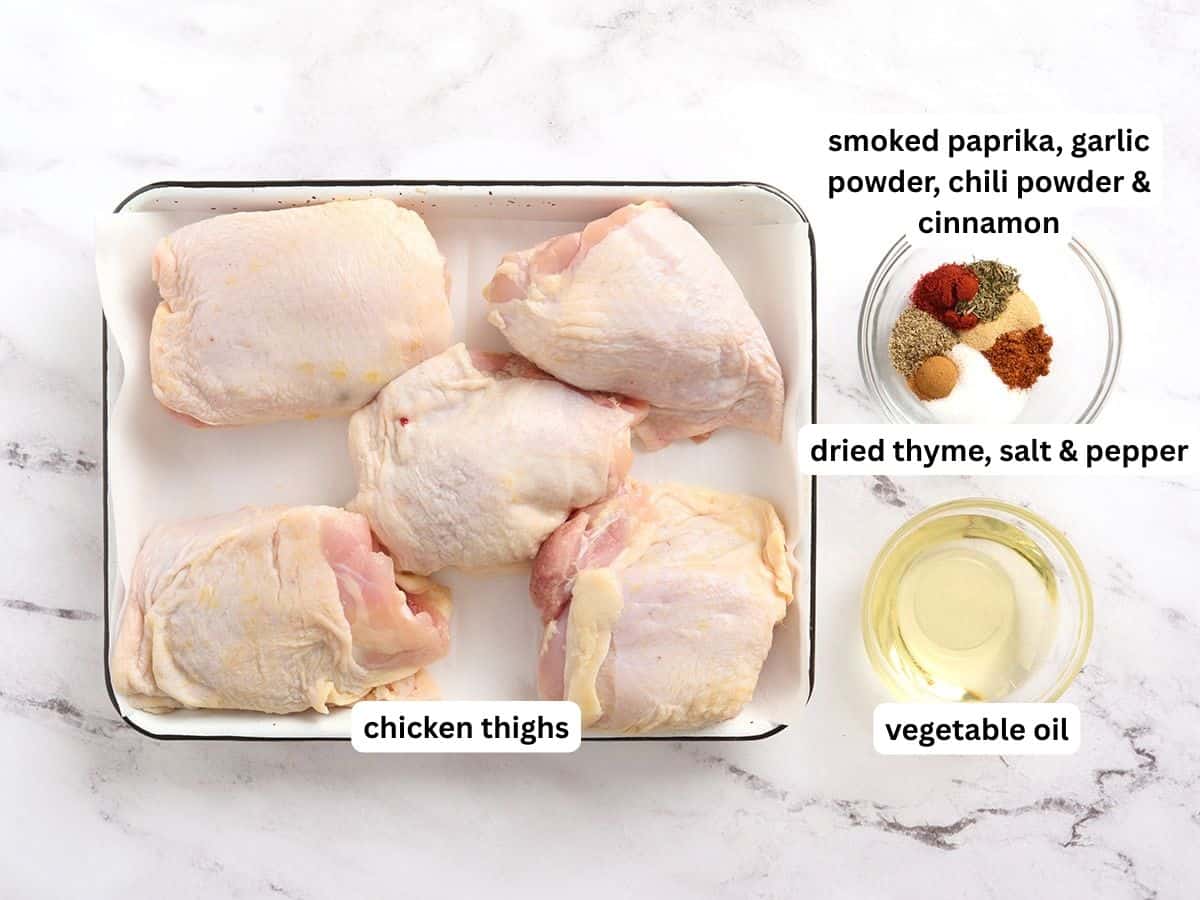
Gather all of your chicken ingredients: You’ll need 5 bone-in, skin-on chicken thighs (about 2.5 lbs), 2 Tbsp vegetable oil, ½ tsp smoked paprika, ½ tsp garlic powder, ¼ tsp chili powder, ¼ tsp ground cinnamon, ¼ tsp dried thyme, 1 ½ tsp salt, and 1 tsp black pepper.
Also preheat your oven to 450°F.
Gather all of your veggies: You’ll need 1 butternut squash, 1 medium red onion, 1 lb. Brussels sprouts, 2 Tbsp vegetable oil, 1½ tsp salt, 1 tsp black pepper, 1 tsp garlic powder, and ½ tsp dried thyme. Trim the tough ends from the Brussels sprouts and slice each sprout in half. Cut the red onion into chunky slices about ½ inch thick. You don’t need tiny, perfectly identical pieces, but keeping everything roughly the same size helps it cook evenly.
Prep the squash: I know butternut squash can be a tricky one to prep. Here’s how I cut butternut squash: start by peeling 1 butternut squash and trimming off both ends. Cut the squash crosswise where the narrow neck meets the round base. Slice the round portion in half lengthwise and scoop out the seeds with a spoon. Cut both sections into roughly ½-inch cubes. Keeping the pieces fairly consistent helps the squash become tender in the same amount of time as the chicken cooks.
Season the veggies: Add the diced squash, halved Brussels sprouts, and sliced red onion to a large bowl. Drizzle with 2 Tbsp vegetable oil, then sprinkle over 1½ tsp salt, 1 tsp pepper, 1 tsp garlic powder, and ½ tsp dried thyme. Toss well until the vegetables look evenly glossy.
Transfer everything to a 15×12-inch sheet pan. The pan will look nice and full, and that’s okay. There should be a good mix of vegetables spread underneath where the chicken will sit.
Make the seasoned oil: In a small bowl, add 2 Tbsp vegetable oil, ½ tsp smoked paprika, ½ tsp garlic powder, ¼ tsp chili powder, ¼ tsp cinnamon, ¼ tsp dried thyme, 1½ tsp salt, and 1 tsp pepper.
Stir until the spices are evenly dispersed through the oil.
Season the chicken: Use a pastry brush to coat 5 bone-in, skin-on chicken thighs (about 2.5 lbs.) with the seasoned oil. Brush it over all sides and carefully get some underneath the skin, too. Make sure each thigh gets its share of the spice mixture rather than using most of it on the first few!
Add the chicken: Nestle the seasoned chicken thighs on top of the vegetables. The vegetables should sit underneath and around the chicken rather than being moved off to the edges of the pan.
Roast the chicken and vegetables: Place the sheet pan in the preheated 450°F oven and roast for 30-35 minutes. The chicken should look golden and crisp on the outside, and the squash and Brussels sprouts should be tender with browned spots.
Check the chicken with an instant-read thermometer inserted into the thickest part of the thigh without touching the bone. It should register at least 165°F before serving.
Plate it up: Divide the roasted vegetables evenly between five plates and top each portion with one chicken thigh. Spoon over any flavorful vegetables and juices left behind on the sheet pan, then serve hot and enjoy!
What to Serve with Sheet Pan Chicken Thighs
This sheet pan dinner definitely doesn’t need any extras, but I’m never going to talk you out of adding a good side (or dessert!) if you’ve already got the ingredients to hand! Our kale salad is fresh and bright next to the roasted chicken, and the sturdy kale holds up really well alongside all those warm veggies. I’d also add a batch of garlic bread if you want something hearty for soaking up those savory pan juices.
If you’re a sauce person, a little honey mustard sauce on the side is so good with both the chicken and roasted vegetables. And lastly, for a sweet fall treat, I recommend making our pumpkin spice fudge! It only takes 12 minutes to make, but needs some time to set up before serving. Make it the day before, and you can enjoy it for days.
Store any leftover chicken and vegetables in an airtight container in the refrigerator for 3-4 days. Let everything cool first before storing to avoid trapping condensation in the container and making the food soggy.
Reheating
For the best texture, reheat leftovers in a 350°F oven or air fryer for about 10-15 minutes, or until the chicken is heated through. This helps the skin crisp back up a little better than the microwave.
Freezing
You can freeze the cooked sheet pan chicken thighs and veggies for up to 3 months in a freezer-safe container. Just keep in mind the vegetables will be much softer once thawed. For the best texture, I’d freeze the chicken separately if you know ahead of time that you’re saving some for later.
If you want another way to use chicken thighs, try my Sheet Pan Honey Mustard Chicken and Veggies. The sweet and tangy honey mustard sauce is SO good with all those roasted vegetables.
I also really like this Sheet Pan Chicken Sausage Dinner when I need to use up vegetables hanging around in the fridge. It’s super flexible and comes together in about 45 minutes.
When the world ends in Matt Dinniman’s Dungeon Crawler Carl, its title character enters the apocalypse in boxer shorts, a leather jacket, and a pair of pink Crocs that don’t quite fit. He is also carrying his ex-girlfriend’s prize-winning Persian cat.
Stay connected across Europe without the hassle of swapping physical SIM cards or paying expensive roaming fees. This guide covers the best eSIM for Europe travel, including what to look for and how to choose the right plan for your trip.
Have you been worried about an older person’s memory or thinking abilities?
Maybe your parent has seemed more confused recently. Or you may have noticed that your aging spouse is repeating herself, or struggling to do things that didn’t use to pose much of a problem.
Or you may have noticed false accusations, or irrational worries getting out of control.
These are very common concerns, and they often lead to questions such as:
Is this normal aging or something more significant?
What is wrong?
Could this be Alzheimer’s? Or some other form of dementia?
Can these memory problems be treated or reversed?
What should we do about this??
The answer to the last question is this: if you are worried about memory or thinking, then you should seek out some kind of medical evaluation.
That’s because when families worry about an older person’s cognitive abilities, there often are some underlying health issues affecting the mind’s function.
Those need to be detected, and treated if at all possible. So, you’ll need to request help from a health professional, and in this article, I’ll explain what that initial help should consist of. This way you’ll know what to expect, and what the doctor might ask you about.
Technically, these kinds of problems are called “cognitive impairment.” This is a broad term that means some kind of problem or difficulty with one’s memory, thinking, concentration, and other functions of the conscious brain, beyond what might be expected due to normal “cognitive aging.”
Cognitive impairment — which is also called “cognitive decline” — can come on suddenly or gradually, and can be temporary or more permanent. It may or may not keep getting slowly worse; it all depends on the underlying cause or causes.
In this article, I’ll share with you the more common causes of cognitive impairment in older adults.
I’ll then share a list of 10 things that should generally be done, during a preliminary medical evaluation for cognitive decline in an older adult.
You can also watch a subtitled video version of this information below.
Common causes of cognitive impairment in older adults
Cognitive impairment, like many problems in older adults, is often “multifactorial.” This means that the difficulties with memory, thinking, or other brain processes are often due to more than one cause.
Common causes of cognitive impairment in older adults include:
Medication side-effects. Many medications interfere with proper brain function.
“Metabolic imbalances.” This term refers to abnormalities in one’s blood chemistry.
Examples include abnormal levels of blood sodium, calcium, or glucose.
Kidney or liver dysfunction can also cause certain types of metabolic imbalances, and these sometimes affect brain function.
Problems with hormones, such as thyroid hormones.
Imbalances in estrogen and other sex hormones may also affect cognitive function.
Deficiencies in vitamins and other key nutrients.
Brain function is especially known to be affected by low levels of vitamin B12, other B vitamins, and folate.
Delirium. This is a state of worse-than-usual mental function that can be brought on by just about any type of serious illness.
Delirium is very common in hospitalized older adults, and can also occur due to infection or other health problems in older people who are not hospitalized.
Psychiatric illness. Most psychiatric conditions can cause problems with memory, thinking, or concentration. Psychiatric illnesses can also cause paranoia and other forms of late-life psychosis.
Depression and anxiety are probably the most common psychiatric conditions in older adults.
It is also possible for older adults to have bipolar disorder, schizophrenia, or other forms of major mental illness; these have often been diagnosed earlier in life.
Substance abuse and/or substance withdrawal.
Both acute intoxication and chronic overuse of certain substances (such as alcohol, illicit drugs, or even prescription drugs) can impair brain function.
Damage to brain neurons, due to an injury.
“Vascular” damage to neurons means damage caused by problems with the blood vessels, such as strokes or some form of cerebral small vessel disease.
Head injuries are also associated with temporary or longer-lasting cognitive impairment.
Damage to brain neurons, due to a neurodegenerative condition.
Neurodegenerative conditions tend to slowly damage and kill neurons. This can cause mild cognitive impairment, and then eventually dementia.
The more common neurodegenerative conditions include Alzheimer’s disease, Lewy-Body disease, Parkinson’s disease, and frontotemporal degeneration.
Infections.
Historically, this has not been as common in older adults as the other causes above, but certain chronic or acute infections can affect brain cells directly. (If cognitive impairment is caused by an infection outside the brain, such as pneumonia or a urinary tract infection, this would be considered delirium.) More recently, the COVID virus has become fairly prevalent; it does affect brain cells in some cases, and research is ongoing to learn more about this.
Toxins are another potential cause of cognitive impairment. Research is ongoing as to the cognitive effects of toxins people may be exposed to, such as heavy metals, air pollutants, contaminants in our drinking water, pesticides, and others.
Poor sleep and/or high levels of stress are two additional factors to consider, as the brain works less well under these conditions. (For more on sleep problems in aging, see here.)
Now that I’ve covered the most common causes of cognitive impairment in older adults, here’s what an initial medical evaluation should generally cover.
10 Things the Doctor Should Do When Evaluating Cognitive Impairment in an Older Adult
Here are ten specific things the clinician should ask about, check on, or do, as part of an initial evaluation for cognitive impairment in an older adult.
The following list reflects my own practice and that of most geriatricians. It is in line with most syntheses of guidelines and best practices, including the UpToDate.com chapter on this subject.
Most experts agree that these steps can be done by primary care clinicians.
1. Ask about and document the patient’s concerns about memory and thinking.
At a minimum, the clinician should ask an older person something like “So, have you noticed any changes in your memory or thinking abilities?”
Now, many older adults will either have noticed nothing or won’t want to talk about it. This is in of itself worth noting, especially if family or others have voiced concerns.
If the older person does have concerns or observations, these should be explored. It’s especially important to ask when the problems started, whether they seem to be getting worse, and how quickly things seem to be changing.
(Wondering how to talk to an older person about their memory loss? I explain how to do this here.)
2. Obtain or request information on memory or thinking difficulties from family members or other “informants.”
Older adults with cognitive impairment are often unaware of — or reluctant to reveal – the difficulties they are experiencing. For this reason, a health provider who has been alerted to the possibility of cognitive impairment should make an effort to get information from a family member or other knowledgeable informant.
It’s sometimes necessary for the health provider to be diplomatic about requesting and getting information from family members, especially if the older person finds it upsetting. People may think that HIPAA doesn’t allow doctors to talk to family over an older person’s objections, but actually, clinicians do have some leeway in these situations. (See my HIPAA article here.)
Family members can facilitate this process by bringing in a written summary of what difficulties they’ve observed. Be sure to include information on when the problems started and whether they seem to be getting worse.
3. Ask about difficulties managing instrumental activities of daily living (IADLs) and activities of daily living (ADLs).
The ideal is for the health provider to ask both the patient and the family about this. Older adults with cognitive impairment are often not reliable reporters of what difficulties they’re having.
Instrumental activities of daily living (IADLs), in particular, are often affected by cognitive impairment. So it’s important to ask if the older person is having difficulty with problems with tasks such as:
Driving and other forms of transportation
Management of finances
Grocery shopping and meal preparation
Home maintenance
Managing the telephone, the mail, and other forms of communication
Medication management
The provider should also ask about ADLs, which are the more fundamental self-care tasks such as walking around, feeding oneself, getting dressed, managing continence, and so forth.
Difficulties with IADLs and ADLs (which geriatricians refer to as “functional impairment”) are important to document. They offer a practical lens on how “severe” an older person’s cognitive impairment might be, and on what steps could be taken to support an older person while these cognitive issues are getting evaluated.
Functional impairments may correspond with safety issues that need to be addressed; if an older person is having difficulty with finances, it may be a good idea to check for signs of financial exploitation, or otherwise take steps to protect the person financially.
Last but not least, impairment in daily functioning is also a criterion that separates mild cognitive impairment (MCI) from more significant impairment (including dementia). In MCI, a person may be experiencing some cognitive impairment, but it should not be bad enough to significantly interfere with performing their usual daily life tasks.
4. Check for the presence of other behavioral, mood, and thinking symptoms that may be related to certain causes of cognitive impairment.
These include:
Hallucinations
Delusions
Personality changes
Apathy (losing motivation)
Depression symptoms
Anxiety symptoms
Getting lost
Confusion about visual-spatial tasks (e.g. having difficulty figuring out how to put on one’s shirt)
5. Ask about any new symptoms or changes in physical health.
It’s especially important to ask about symptoms related to neurological function, such as new difficulties with walking, balance, speech, and coordination. Checking for tremor and stiffness (both of which are associated with Parkinsonism) is also recommended.
The exact questions the clinician asks will depend on the person’s particular medical history, and the other signs and symptoms that have been brought up.
6. Ask about substance use and consider the possibility of substance abuse and/or withdrawal.
Excessive use of alcohol, certain prescription drugs (such as tranquilizers), or of illicit drugs can affect cognitive function. Health providers should inquire about an older person’s use of these substances.
Suddenly stopping or reducing the use of alcohol or other substances can also occasionally cause or worsen cognitive function.
7. Review all medications, with a focus on identifying those known to worsen cognitive function.
Certain types of medications tend to dampen brain function, and may cause a noticeable worsening in cognitive abilities. The health provider should especially ask about use of:
Benzodiazepines, which are often prescribed for either insomnia or anxiety
Commonly prescribed benzodiazepines include lorazepam, diazepam, temazepam, alprazolam (brand names Ativan, Valium, Restoril, and Xanax, respectively)
Prescription sleeping pills, such as zolpidem (brand name Ambien)
Anticholinergics, a broad category of medications which includes most over-the-counter sleeping aids, sedating antihistamines, drugs for overactive bladder, muscle relaxants, and others.
At a minimum, the health provider should check vitals (blood pressure and pulse) and should also complete a basic neurological evaluation, including an observation of the person’s gait, balance, and coordination.
The purpose of the physical exam is to look for physical signs that may correspond to causes of cognitive impairment, or that may relate to other symptoms the patient or family brought up.
9. Assess the person’s orientation and perform some type of office-based cognitive test.
Assessing “orientation” means checking to see whether the patient knows things like the day, date, month, year, and where he or she is.
Some office-based testing should also be done, to check and document the older person’s memory and thinking abilities.
Probably the shortest well-validated test is the Mini-Cog, which involves a three-item recall and a clock draw.
A more detailed office-based cognitive test that can be done in primary care is the MOCA test (Montreal Cognitive Assessment Test). This takes 10-20 minutes to administer, so it often requires scheduling a separate visit.
There are some other “intermediate” length tests that can be done in the primary care office, such as the SLUMS (St. Louis University Mental Status Examination). The Mini-Mental State Exam is another option, although most experts (including myself) consider it less useful than the MOCA or SLUMS.
10. Order laboratory testing (unless recently done) and consider brain imaging.
In most cases, it will be appropriate for the health provider to order blood tests, to check for common health problems that can cause or worsen cognitive impairment.
Blood tests to consider include:
A complete metabolic panel, which assesses electrolytes, kidney function, and liver function tests
As for brain imaging (e.g. brain MRI or head CT), some expert guidelines recommend it for everyone and other guidelines suggest it be used “selectively.”
The main value of most brain imaging is that it can help rule out certain uncommon causes of cognitive impairment, such as a tumor or chronic subdural hematomas.
Brain imaging also can show whether there are signs of significant cerebral small vessel disease, which is a key driver of vascular cognitive impairment and vascular dementia.
(Of note, with brain imaging, almost all older adults will show signs of at least a little bit of cerebral small vessel disease, and the amount seen tends to have a variable correlation with cognitive symptoms.)
Specialized volumetric brain MRIs can detect atrophy in specific parts of the brain, but most brain imaging is not of this type.
Please note: most common causes of cognitive impairment can NOT be definitely ruled in or ruled out by a regular brain MRI.
In Summary
Overall, an initial medical evaluation should result in these four key things happening:
Documentation of the patient’s and family’s cognitive concerns.
This means documenting what the patient and family have noticed, in terms of difficulties and changes in memory, thinking, behavior, or personality.
Documentation of any functional impairment the older person is experiencing.
This means documenting what the patient and family have noticed, in terms of difficulties managing life tasks (IADLs and ADLs).
An objective assessment of the older person’s memory and thinking skills.
This best done through some form of short standardized office-based test, such as the Mini-Cog.
Clinicians can also document their impressions and observations based on talking to the older person. (Did the person seem confused? Paranoid? Repetitive? Tangential? Was the person able to answer detailed questions?)
An evaluation for common medical causes and contributors of cognitive impairment.
This means checking for those common problems that can cause or worsen cognitive impairment.
Generally, it will take at least two primary care visits to complete an evaluation for cognitive impairment.
The second visit is often used to do a cognitive test such as the MOCA, and can enable the clinician to follow up on laboratory tests that were initially ordered.
And then what?
Well, what happens next depends on several things, such as:
Whether the health provider was able to draw conclusions about what is likely causing the cognitive impairment
Whether treatable conditions were identified
How the patient and family feel about the evaluation
Whether the older person is willing and able to cooperate
Whether the clinician feels that referral to a specialist is necessary
Whether the clinician is willing and able to help the older person and the family (or refer them for help) addressing any functional impairment or safety issues
You may be wondering: should you expect a diagnosis or “an answer” after this evaluation?
I’ll be honest here: probably not. Even with an adequate initial evaluation, cognitive impairment may take a few months (or even longer) to completely evaluate and diagnose. For instance, it’s often necessary to try treating one or more potential causes, to see if the cognitive problems improve or not.
Other causes of cognitive decline — notably neurodegenerative conditions such as Alzheimer’s and some of the other dementias — can take a while to diagnose because clinicians are first supposed to exclude the other potential causes, and that can take a while. (For more on the diagnosis of dementia, see “How We Diagnose Dementia: The Practical Basics to Know.)
What to expect from an initial evaluation for cognitive decline
It may not be realistic to expect definite answers. But that doesn’t mean you can’t expect some explanations.
Your health provider should be able to explain:
How substantial the cognitive impairment appears to be, based on the office-based testing and the evaluation so far,
What was checked for, and what has been ruled out (or deemed unlikely) as a cause for the problems you’ve been worried about,
Whether any of the medications might be making memory or thinking worse, and what the options are for stopping or reducing those medications,
What the healthcare team proposes to do next, to further evaluate the issues or follow up on the problems.
So if you’ve been worried about memory or thinking problems, ask for that medical evaluation. If your health provider skips any of the steps I listed, don’t be shy and ask about it. (Either it’s an oversight or they should be able to explain why it’s not necessary.)
You probably won’t get all the answers and certainty that you’re hoping for, but you’ll have gotten started and that’s vitally important.
Of course, you may well be facing the problem of not being able to get your older loved one to go to the doctor. That’s a very common issue, but it’s too complicated to cover in an article. (So I’ve written a book! You can find it here.)
In the meantime, especially if it’s a challenge to see the doctor for some reason, then it’s all the more important to make the most of your medical evaluation when you do manage to get there.
This article was last reviewed and updated by Dr. Kernisan in September 2026.
A well-written VA buddy letter can help fill in important gaps in your VA disability claim.
Here’s the key: A strong buddy statement isn’t about using fancy language or trying to sound like a doctor.
It’s about giving the VA specific, credible information from someone who knows what happened, knows about your condition, or has seen how your disability affects your life.
In my experience helping Veterans understand the VA disability claims process, one of the biggest mistakes I see with buddy letters is that they’re simply too vague.
“John has terrible back pain” isn’t very useful.
But explaining what John used to be able to do, what you personally saw change, how frequently he struggles, and what those struggles actually look like in daily life?
That’s useful evidence.
In this guide, I’ll show you how VA buddy letters work, what to include, what to leave out, how to write one step by step, and I’ll give you both a VA buddy letter example and an easy-to-use template.
Summary of Key Points
Purpose of VA Buddy Letters: VA buddy letters can provide crucial firsthand evidence to support a veteran’s VA claim by detailing their condition and its impact.
Structure of a Buddy Letter: Use VA Form 21-10210 to establish the writer’s relationship with the veteran, describe witnessed events or conditions, outline current symptoms, and certify the statement’s truthfulness.
Writing Tips: Keep buddy letters concise and factual, emphasizing the relationship with the veteran and avoiding embellishments to ensure clarity and credibility.
Table of Contents
What is a VA Buddy Letter?
A VA buddy letter, also called a buddy statement, lay statement, or witness statement, is written evidence submitted in support of a VA claim.
The statement might come from:
A spouse
Family member
Friend
Fellow service member
Coworker
Supervisor
Clergy member
Another person with relevant knowledge about your condition or claim
The VA officially refers to this type of evidence as lay evidence or a lay/witness statement.
VA Form 21-10210 is the VA’s dedicated Lay/Witness Statement form, and VA says the form can be used to support your own claim or the claim of another Veteran or eligible family member. VA also refers to these statements as “buddy statements.”
Why Does Lay Evidence Matter?
Your medical and military records don’t always tell the whole story.
Maybe an injury happened during service but wasn’t thoroughly documented.
Maybe your spouse has watched your symptoms get progressively worse for years.
Maybe a former service member remembers the exact training accident that injured you.
Or maybe a coworker regularly sees how your migraines, back pain, or other symptoms affect your ability to work.
That’s where lay evidence can become valuable.
Can a Buddy Letter Help Your VA Disability Claim?
Yes, absolutely—when the statement contains relevant information that helps support the facts of your claim.
The VA specifically tells Veterans that supporting statements can come from people who know about—or who you’ve talked to about—your claimed condition and how and when it occurred.
Here are four areas where I think buddy statements can be especially useful.
#1. Documenting an In-Service Event or Injury
Suppose you injured your knee during a field exercise, but there isn’t much documentation in your service treatment records.
A fellow service member who was there may be able to explain:
What happened
Where you were
Approximately when it occurred
What they saw
What happened immediately afterward
That statement doesn’t automatically prove every part of your claim.
But it can provide evidence about an event that might otherwise be difficult to establish.
#2. Showing Symptoms Over Time
Someone who has known you for years may be able to describe how your symptoms developed or changed.
This can be particularly useful when there are gaps in your treatment history.
Maybe your medical records don’t show every bad day.
Your family probably does.
#3. Showing How Your Disability Affects Daily Life
Doctors see you during appointments.
Your spouse might see you every day.
Your coworkers might see you five days a week.
Those people can sometimes describe real-world limitations that don’t come through clearly in a medical record, including problems with:
Walking
Standing
Sleeping
Driving
Working
Concentrating
Socializing
Household chores
Relationships
Activities you used to enjoy
#4. Showing a Before-and-After Change
This is one of my favorite angles for a good buddy statement.
If someone knew you before and after an injury, illness, traumatic event, or worsening condition, they may be able to explain exactly what changed.
That can make a statement much easier for a VA rater to understand.
What Can’t a VA Buddy Letter Do?
This is important.
A buddy letter is evidence—but it isn’t magic.
It also doesn’t automatically replace medical evidence when the issue requires medical expertise.
For an original service-connected disability claim, the VA generally looks for evidence of:
A current disability
An event, injury, or disease during military service
A link between the current disability and military service
The evidence required depends on the claim. In many cases, medical records or a medical opinion are used to help establish that connection. Presumptive claims can work differently because the VA may presume the service connection when the eligibility requirements are met.
Here’s My Advice:
Don’t make your buddy letter try to do a doctor’s job.
A non-medical witness generally shouldn’t write:
“John’s military service caused his degenerative disc disease.”
Instead, write what you actually know:
“Before John injured his back during our training exercise, I never saw him have difficulty running or carrying his equipment. After the injury, I regularly saw him walk slowly, hold his lower back, and ask other members of the unit for help lifting his gear.”
See the difference?
The second statement gives the VA specific facts and observations that can be evaluated alongside the rest of the evidence.
Who Can Write a VA Buddy Letter?
There’s no rule that says your buddy letter has to come from another Veteran.
The right person is someone who has relevant information about your claim.
That could include:
Your Spouse or Partner
Your spouse may be in a great position to describe symptoms that happen at home, such as:
Sleep problems
Mobility limitations
Changes in mood or behavior
Difficulty completing everyday activities
Changes in relationships
Things you can no longer do
Family Members
Parents, siblings, adult children, and other relatives may be able to describe changes they’ve observed over time.
Fellow Service Members
This is the classic “buddy statement.”
Someone you served with may be able to describe:
An in-service injury
An accident
Deployment conditions
A traumatic event
Your physical condition during service
Changes they noticed after an event
Friends
A longtime friend may have useful information about changes in your activities, personality, mobility, social life, or other observable symptoms.
Coworkers or Supervisors
Coworkers may be able to describe things like:
Missing work
Leaving early
Needing additional breaks
Physical limitations
Difficulty completing certain tasks
The VA specifically lists service members, family and friends, clergy members, and law enforcement officers as examples of people who may provide supporting statements.
What Should You Include in a VA Buddy Letter?
Here’s what I recommend.
Make it easy for the VA rater to understand 3 things right away:
Who are you? How do you know the Veteran? What relevant information do you have?
Then get specific.
1. Explain Who You Are
Include your name and relationship to the Veteran.
Explain:
How long you’ve known them
How you know them
How often you interact with them, if relevant
For example:
“My name is Michael Smith. I served with John Davis in the Army from 2007 through 2010. We were assigned to the same company and trained together almost daily.”
That establishes context immediately.
2. Identify What You’re Writing About
Don’t make the VA guess.
Explain the issue your statement addresses.
For example:
“I’m writing about the right knee injury John suffered during a field training exercise in 2009.”
Simple.
Direct.
3. Describe What Happened
Give specific details when you know them:
Approximate date
Location
What happened
Who was there
What you observed afterward
You don’t need to invent an exact date you can’t remember.
If you remember it happened “during our deployment in 2009,” say that.
Never sacrifice accuracy just to sound more specific.
4. Describe Specific Symptoms or Limitations
This is where many buddy letters fall apart.
Don’t just write:
“Her migraines are bad.”
Tell the VA what “bad” actually looks like.
For example:
“Two or three times per month, I see her go into our bedroom, shut the blinds, turn off the lights, and lie down for several hours because of her headaches.”
That’s concrete.
5. Explain What Changed
If you knew the Veteran before the event or before the condition worsened, consider a before-and-after comparison.
What could they do before?
What changed?
When did you first notice it?
6. Describe the Impact on Daily Life
When relevant, explain how you’ve seen the condition affect:
Work
Sleep
Mobility
Relationships
Social activities
Household tasks
Exercise
Hobbies
Everyday independence
7. Be Truthful
This should go without saying, but I’ll say it anyway:
Never exaggerate a buddy statement.
You don’t need dramatic language.
You need accurate information.
How to Write a VA Buddy Letter Step by Step
Here’s the simple seven-step process I recommend.
Step #1: Decide What Your Statement Is Trying to Show
Don’t write the Veteran’s entire biography.
Ask yourself:
What specific fact am I helping document?
Maybe you saw the injury.
Maybe you noticed symptoms beginning after deployment.
Maybe you’ve watched the Veteran struggle with a condition every day for 15 years.
Stay focused.
Step #2: Explain Your Relationship to the Veteran
Tell the VA why you have relevant knowledge.
Example:
“My name is Michael Smith. I served with John Davis from 2007 through 2010 in the same Army infantry company. We trained and worked together regularly.”
Step #3: Describe the Relevant Event or Situation
If you’re discussing an injury or event, explain what happened in plain English.
You don’t need legal language.
You need facts.
Step #4: Describe What You Observed
What did you see?
What did you hear?
What changed?
How often did it happen?
Specific observations usually make a statement much more useful than broad conclusions.
Step #5: Use Before-and-After Comparisons When They Make Sense
Here’s an easy framework:
Before: What was the Veteran able to do?
After: What changed?
This is especially helpful when someone has known the Veteran for a long time.
Step #6: Explain the Real-World Impact
Help the VA understand what the symptoms actually mean.
Don’t stop at:
“He has knee pain.”
Explain:
“He no longer goes hiking with our family and often has to stop and rest after walking across a large parking lot.”
Step #7: Review It Before You Submit It
Ask yourself:
Is this accurate?
Is it specific?
Is it relevant?
Did I clearly explain how I know this?
Am I stating facts rather than guessing?
Did I repeat myself unnecessarily?
If the answer looks good, you’re ready to submit it.
VA Buddy Letter Example
Here’s a simple example involving a fellow service member describing an in-service knee injury.
Don’t copy this word for word.
Use it to understand the structure, then write your own statement based on what you actually know.
My name is Michael Smith, and I served with Veteran John Davis in the U.S. Army from 2007 through 2010. We were assigned to the same company and trained together regularly.
During a field training exercise in approximately May 2009, I was with John when he injured his right knee while carrying equipment down a steep incline. I saw him fall and immediately grab his knee. He had difficulty standing and needed help getting back to our vehicle.
Before that incident, John regularly completed unit runs, ruck marches, and physical training without any obvious difficulty with his right knee.
After the injury, I personally noticed that he began limping during longer walks and frequently had trouble during runs and ruck marches. On several occasions, I saw him stop during training to stretch or hold his right knee.
We continued serving together for approximately another year, and I continued to notice problems with his knee during that period.
I am providing this statement based on what I remember and observed while serving with John.
Signed: Michael Smith Date: [DATE]
Why This Buddy Letter Works
Notice what Michael does.
He:
Explains how he knows the Veteran
Identifies the event
Gives an approximate date
Describes what he personally witnessed
Explains how the Veteran functioned before the injury
Describes what changed afterward
Avoids making a medical diagnosis
Doesn’t exaggerate
That’s the formula.
VA Buddy Letter Template
Use the template below as a framework (not a script).
Your statement should sound like YOU.
My name is [FULL NAME], and I am [RELATIONSHIP TO VETERAN]. I have known [VETERAN’S NAME] for approximately [NUMBER] years.
I am writing this statement regarding [CONDITION / EVENT / CLAIMED ISSUE].
[Explain how you know the Veteran and why you have relevant knowledge about the issue.]
I know or have personally observed the following:
[Describe the event, symptoms, behaviors, or limitations. Include approximate dates, locations, frequency, and other useful details when you know them.]
Before [EVENT / CONDITION / TIME PERIOD], I observed [DESCRIBE WHAT THINGS WERE LIKE BEFORE, IF RELEVANT].
Afterward, I noticed [DESCRIBE WHAT CHANGED].
I have seen this affect [VETERAN’S NAME] by [DESCRIBE SPECIFIC EFFECTS ON WORK, SLEEP, MOBILITY, RELATIONSHIPS, DAILY ACTIVITIES, ETC.].
I am providing this statement based on my knowledge and observations.
Signed: [NAME] Date: [DATE]
Again:
Don’t copy somebody else’s buddy letter and change the names.
Personalized details are the whole point.
What is VA Form 21-10210?
VA Form 21-10210 is the Lay/Witness Statement form.
The VA says you can use this form to submit a formal statement supporting:
Your own VA claim
Another Veteran’s claim
An eligible family member’s claim
The VA also specifically notes that people sometimes call this a buddy statement.
And here’s something important:
VA Form 21-10210 isn’t the only possible format for lay evidence.
VA guidance says lay evidence may also be submitted as a written statement or using VA Form 21-4138, Statement in Support of Claim.
Still, if you’re specifically preparing a buddy or witness statement, VA Form 21-10210 is the dedicated form built for that purpose.
How Do You Submit a VA Buddy Letter?
If you’re submitting evidence with a pending disability claim, my recommendation is simple:
Get relevant evidence submitted as early as reasonably possible.
The VA says Veterans waiting for a decision on a disability claim can upload supporting evidence through the online claim status tool. VA currently allows additional evidence to be uploaded for up to one year after it receives the claim, but it may make a decision sooner if it has enough information.
You have several options.
Option #1: Submit VA Form 21-10210 Online
The VA offers an online tool for submitting the Lay/Witness Statement instead of mailing the paper form.
Option #2: Upload Supporting Evidence to Your Pending Claim
If you’ve already filed your disability claim and are waiting for a decision, you can upload supporting evidence through the VA’s claim status tool.
Option #3: Use QuickSubmit When Appropriate
The VA also directs Veterans to QuickSubmit for certain other documents and evidence submissions.
Option #4: Submit the Paper Form
You can also use the paper version of VA Form 21-10210 and follow the VA’s current submission instructions.
I recommend downloading the form directly from VA.gov rather than using an old copy saved somewhere on your computer.
The VA currently identifies Form 21-10210 as the Lay/Witness Statement.
What if the VA Already Denied Your Claim?
This is where you need to pay attention.
You can’t automatically submit new evidence under every VA decision-review option.
As of September 2026:
Supplemental Claim: You can submit new and relevant evidence.
Higher-Level Review: You can’t submit new evidence.
Board Appeal – Evidence Submission: You can submit new evidence.
Board Appeal – Hearing: You can submit new evidence.
Board Appeal – Direct Review: You can’t submit new evidence.
The VA even gives a buddy statement as an example of evidence that could qualify as new and relevant evidence for a Supplemental Claim.
So if you’ve already received a rating decision, make sure the review option you’re using actually allows new evidence before you submit the statement.
“When we go grocery shopping, John usually needs to stop and sit down before we finish because he says his back is hurting. I’ve also seen him struggle to lift grocery bags that he previously carried without help.”
Specific beats vague every time.
Mistake #2: Only Repeating What the Veteran Told You
The VA says supporting statements can come from people who know about—or have talked to the Veteran about—the claimed condition.
But here’s my recommendation:
Whenever you can, add your own observations.
Instead of stopping at:
“My wife told me she doesn’t sleep well.”
Explain:
“Three or four nights most weeks, I hear my wife wake up repeatedly and walk around the house because she can’t get back to sleep.”
That’s far more useful.
Mistake #3: Playing Doctor
Unless you’re qualified to give a medical opinion in the relevant context, don’t diagnose the Veteran or make complicated medical conclusions.
Describe:
What you saw
What you heard
What changed
What the Veteran can and can’t do
Let the medical evidence handle the medical conclusions.
Mistake #4: Exaggerating
If the problem happens twice per month, don’t call it “constant.”
If you don’t remember the exact date, don’t make one up.
Accuracy builds credibility.
Mistake #5: Not Explaining Your Relationship
Don’t assume the VA knows who you are.
Tell the reviewer:
How you know the Veteran
How long you’ve known them
Why you’re familiar with the issue
Mistake #6: Leaving Out Specific Examples
Broad statements are easy to write.
Examples are much more useful.
Use:
Approximate dates
Specific events
Frequency
Locations
Activities affected
Before-and-after changes
when they’re relevant and accurate.
Mistake #7: Writing a Novel
Your goal isn’t to win an award for the longest buddy statement.
Your goal is to communicate useful evidence.
Write enough to explain the relevant facts clearly, then stop.
Buddy Letters for Specific VA Disability Claims
Different claims call for different kinds of observations.
That’s why I don’t recommend trying to stuff every possible buddy-letter scenario into one article.
VA Buddy Letter From a Spouse or Wife
Your spouse may have some of the best firsthand knowledge of symptoms that affect your everyday life at home.
A spouse or bed partner may have relevant observations involving loud snoring, gasping, pauses in breathing during sleep, disrupted sleep, or daytime symptoms they’ve observed.
Write about the information that’s actually relevant to that specific claim.
Do You Need a Buddy Letter for a VA Claim?
No. Not every VA disability claim needs a buddy letter.
I don’t recommend adding evidence just because someone told you “more evidence is always better.”
That’s not the right mindset.
Instead, ask:
Does this person have relevant information that helps establish something important about my claim?
A buddy statement may be worth considering when:
Someone witnessed an in-service event
Important facts aren’t fully documented in your military records
Someone has observed your symptoms over time
Another person can describe functional limitations that don’t show up clearly in your medical records
Someone can describe a significant before-and-after change
You have a gap in records that another person’s knowledge may help explain
The VA recognizes supporting statements as evidence that can be submitted with a disability claim.
But the goal isn’t to collect letters.
The goal is to submit relevant evidence that helps tell the truth about your claim.
FAQs
Does the VA Accept Buddy Letters?
Yes.
VA Form 21-10210 is specifically designed for lay/witness statements supporting VA claims, and VA itself notes these are commonly called buddy statements.
Who Can Write a VA Buddy Letter?
The writer should be someone with relevant information about the Veteran’s condition, symptoms, event, or claim.
That might be a spouse, family member, friend, fellow service member, coworker, supervisor, clergy member, or another person with useful knowledge.
Does a VA Buddy Letter Need to Be Notarized?
VA’s current Form 21-10210 instructions do not require notarization.
Follow the certification and signature instructions on the current VA form.
How Long Should a VA Buddy Letter Be?
There’s no benefit to padding a statement just to make it longer. My recommendation:
Make it long enough to explain the important facts clearly—and no longer.
A focused statement with several specific examples can be more useful than pages of repetitive generalities.
Can Your Spouse Write a VA Buddy Statement?
Yes. Family members can provide supporting statements, and spouses may have valuable knowledge about symptoms and functional limitations that happen outside a clinical setting.
Can Another Veteran Write a Buddy Letter?
Absolutely. A fellow service member may be especially helpful when they remember an event, injury, deployment condition, or other circumstance that happened during service.
Can You Submit More Than One Buddy Statement?
Yes, you can submit multiple statements when multiple people have relevant information. That doesn’t mean you should submit ten letters that all say the exact same thing. Different witnesses are most useful when they add meaningful evidence or perspectives.
What Form Should You Use for a VA Buddy Statement?
The dedicated form is VA Form 21-10210, Lay/Witness Statement.The VA also provides other ways to submit lay evidence, including written statements and VA Form 21-4138
The Bottom Line
Here’s what I want you to remember:
A winning VA buddy letter isn’t about sounding impressive. It’s about being specific, accurate, and relevant.
Make sure the person writing the statement clearly explains:
Who they are
How they know you
What issue they’re addressing
What they know or observed
Approximately when it happened
What changed
How the condition affects you in real life
Don’t exaggerate.
Don’t make medical conclusions you aren’t qualified to make.
Don’t fill the letter with generic statements that don’t tell the VA anything useful.
Tell the truth, give specific examples, and make it easy for the VA rater to understand why the statement matters to your claim.
You served. You earned the right to file. You earned the right to be heard. And you earned the right to pursue every VA benefit you legally qualify for.
So here is the real question:
Do you have the VA rating you were given, or the VA rating you truly deserve?
Want Expert-Level VA Claim Help? WE GOT YOUR SIX!
VA Claims Insider helps educate and empower veterans to get the VA rating they deserve.
Work directly with a VA Claims Insider Coach who can help lead you to VA claim victory.
50,000+ disabled veterans served in our membership programs since 2016.
33% average rating increase for veterans who complete our Elite program.
Brian Reese is a world-renowned VA disability benefits expert and the #1 bestselling author of VA Claim Secrets and You Deserve It. Motivated by his own frustration with the VA claim process, Brian founded VA Claims Insider to help disabled veterans secure their VA disability compensation faster, regardless of their past struggles with the VA. Since 2013, he has positively impacted the lives of over 10 million military, veterans, and their families.
A former active-duty Air Force officer, Brian has extensive experience leading diverse teams in challenging international environments, including a combat tour in Afghanistan in 2011 supporting Operation ENDURING FREEDOM.
Brian is a Distinguished Graduate of Management from the United States Air Force Academy and earned his MBA from Oklahoma State University’s Spears School of Business, where he was a National Honor Scholar, ranking in the top 1% of his class.
For some, the word yoga conjures up images of lithe, leotard-clad women performing seemingly impossible, acrobatic poses that require pretzel-like flexibility. It’s hard to see images like that and not think of yoga as an inaccessible practice that is far away from what our own bodies are capable of — especially as we age.
While there are indeed yoga poses that can push the body to its limits, this is not the purpose — or even the goal — of yoga.
As a longtime yoga teacher and yoga therapist, I’ve learned that yoga can be easily adapted in myriad ways to meet the specific needs of the individual. One of my favorite ways to make yoga accessible is through chair yoga.
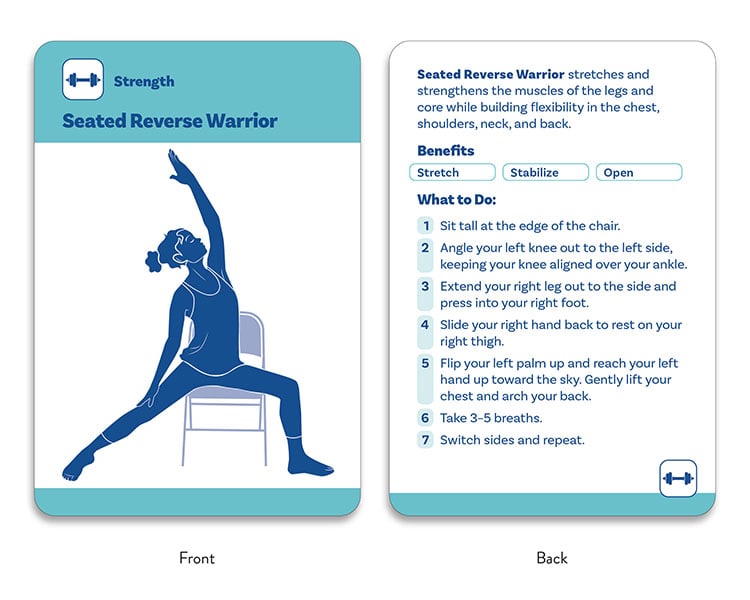
Sample exercise card from The Chair Yoga deck by Lauren Maher. Used with permission from Adams Media
What Is Chair Yoga?
Chair yoga is a gentle practice that adapts traditional yoga postures to be done seated, or with the support of a chair. This style of yoga is quite different from practices that you might see in a traditional yoga class. It is inherently low impact, and since you have the support of the chair, there is no need to transition up and down off the floor.
This can make it an ideal practice for a variety of concerns and conditions, including arthritis, balance or mobility issues, injury recovery, and chronic illness.
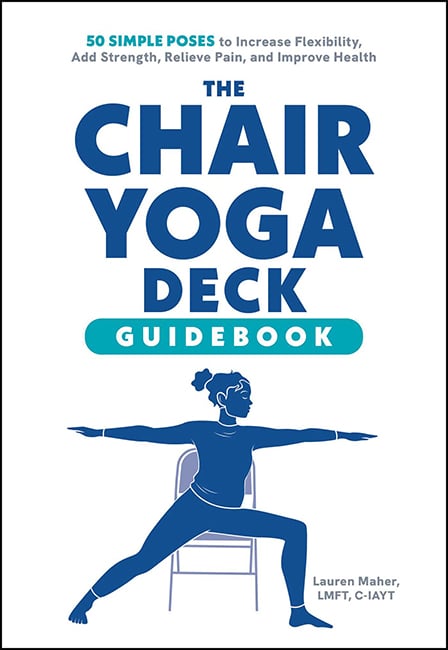
Read more about the benefits, sample exercises, how to get started and how to practice safely in the article by Lauren Maher, author of The Chair Yoga Deck (Adams Media).
Everyone around me knows that when it comes to cooking, I lean toward recipes with a French twist. Having attended Le Cordon Bleu in Paris, worked in a pastry shop in Lyon, and served as an observatrice at the Plaza Athénée in Paris, I have the basics of French cooking in my soul.
But I love trying new cookbooks, no matter what their style. I’ll skim through new books and try a recipe or two, but it’s not often that I find one that becomes a go-to cookbook. Over the past few months, I’ve found two.
Both are from Simon Element, and both are fabulous. That’s high praise from someone who has hundreds of cookbooks on her shelves.
Here’s one recipe from Dig In! to tantalize your tastebuds:
One-Pan Sicilian Baked Cod with Roasted Tomatoes & Olives
Makes 4 servings
½ teaspoons kosher salt, divided
1 teaspoon freshly ground black pepper, divided
1 teaspoon garlic powder
1 teaspoon smoked paprika
½ teaspoon dried oregano
4 (6-ounce) cod fillets, about 1 inch thick
2 cups cherry tomatoes (about 12 ounces), halved
½ small red onion, thinly sliced
½ cup halved kalamata olives
¼ cup dry white wine (I use Sauvignon Blanc)
4 garlic cloves, finely chopped
2 tablespoons extra-virgin olive oil
1 tablespoon drained capers
½ teaspoon crushed red pepper
2 tablespoons fresh lemon juice (about one lemon), for serving
Fresh torn basil, for garnish
Fresh torn mint, for garnish
Lemon wedges, for serving
Preheat the oven to 400°F.
In a small bowl, combine 1 teaspoon of the salt, ½ teaspoon of the black pepper, the garlic powder, smoked paprika, and oregano.
Place the fish on a plate and pat dry. Sprinkle the reserved spice mixture all over the fillets and pat to stick to the fish. Set aside.
In a 9 x 13-inch baking dish, add the tomatoes, onion, olives, wine, garlic, oil, capers, crushed red pepper, and the remaining ½ tea-spoon each of salt and black pepper. Toss to combine.
Bake until the tomatoes start to wrinkle and release their juice, 20 minutes.
Make a space for the fish in the center of the baking dish and place the fish directly on the bottom of the dish surrounded by the vegetables. Bake for 10 to 12 minutes, until the fish is cooked through and flakes easily with a fork (see Hot Tips).
TO SERVE: Divide the roasted vegetables among four plates and top with fish. Sprinkle the lemon juice over each plate, garnish with the torn basil and mint, and serve with lemon wedges.
HOT TIPS When cooking fish, an opaque color signals doneness, along with the flake test: Insert a fork into the thickest part of the fish and pull away at an angle to see if it flakes, indicating a perfect cook. Or use a meat thermometer to check for an internal temperature of 140° to 145°F.
Halibut or sea bass also work great; just adjust bake time depending on the fillet’s thickness.
Read the full article in the Fall issue of Healthy Aging® Magazine for more from both cookbooks, including additional recipes. Sign up for the free Healthy Aging® newsletter for the latest stories, tips, and inspiration delivered to your inbox—and subscribe to Healthy Aging® Magazine for even more ways to live better and age smarter.
That’s about the length of a coffee break, part of a morning walk, or the time you might spend scrolling through your phone without giving it much thought.
What if, instead, you used those 20 minutes to learn something you’ve always wondered about?
September Is Healthy Aging® Month is all about looking forward, trying something new, and staying engaged with the world around you. This year’s theme, “Curiosity Has No Age Limit,” is a reminder that learning as you age can begin with something as simple as following a question that interests you. There is always another question to ask, skill to try, place to discover, or subject to explore.
And you don’t have to enroll in a semester-long course to get started.
Why Keep Learning?
The National Institute on Aging describes cognitive health as the ability to think, learn, and remember clearly. Among its recommendations for supporting cognitive health is a simple one: keep your mind engaged.
Research has explored what happens when older adults tackle genuinely new and challenging activities. In one study cited by the National Institute on Aging, adults who learned digital photography or quilting showed greater improvement in memory than participants engaged in less cognitively demanding activities. The NIA also points out that the evidence about the long-term cognitive effects of particular activities is still developing — so beware of programs promising that one game or exercise can somehow guarantee a sharper brain.
More recently, a 2025 study of more than 12,000 U.S. adults age 65 and older found that participation in educational or training courses later in life was associated with better cognitive function over time. The study does not establish that taking a course causes better cognition, but the findings add to research examining the potential value of continued learning as we age.
That gives you one more reason to follow your curiosity.
Why 20 Minutes?
There is nothing scientifically magical about 20 minutes.
That’s the point.
Twenty minutes is simply short enough to feel doable. You’re not committing to becoming fluent in Italian, mastering watercolor painting, or understanding the entire history of ancient Rome by next month.
You’re giving yourself permission to begin.
Set a timer. Pick one subject. When the 20 minutes are up, stop — unless you’re having too much fun to quit.
What Could You Learn?
Try a new language.
Learn five words today. Tomorrow, learn five more. Practice how to order breakfast, ask for directions, or introduce yourself. If there’s a country you hope to visit someday, start with its language.
Explore a place you’ve never been.
Pick a city, national park, country, or region and find out what makes it distinctive. Read about its history one day, food the next, then music, architecture, traditions, or landscape.
Go back in history.
Choose one event, person, or year and follow wherever it leads. The Library of Congress Today in History collection uses material from the Library’s digital collections to explore events in American history and offers links for digging deeper.
Learn about art, science, or culture.
You could spend weeks wandering through the free Smithsonian Learning Lab, which brings together millions of Smithsonian images, recordings, texts, videos, and other resources covering art, history, culture, and science.
Figure out one piece of technology.
Instead of saying, “I’m terrible at this,” choose one thing. Learn how to organize the photos on your phone. Try a video call. Explore artificial intelligence. Learn to edit a picture, create a playlist, or use a feature you’ve been ignoring.
Try something creative.
Draw what you see outside your window. Learn three chords on a guitar. Practice taking better photographs. Write the first paragraph of a family story. Try a new recipe and find out something about the culture it comes from.
Learn something about your own family.
Identify the people in an old photograph. Call a relative and ask about a story you’ve heard for years. Research an ancestor. Write down a memory you don’t want the next generation to lose.
And sometimes learning can bring people together. Take a class, join a club, practice with a friend, or ask someone to teach you what they know. The Centers for Disease Control and Prevention notes that strong social connections are important to both physical and mental well-being.
Start With One Question
You don’t need a syllabus.
Start by asking yourself:
What have I always wanted to know how to do?
Or:
What am I curious about right now?
Then give it 20 minutes today.
Do it again tomorrow if you want to.
A month from now, you may know a little more about Spanish, photography, astronomy, your family history, your smartphone, or a destination halfway around the world.
Or your first question may have led you somewhere completely unexpected.
That’s the fun of curiosity.
Your Healthy Aging Month challenge:
Choose one thing you want to learn and give it 20 minutes today.
Thinking of joining the Coast Guard? Want to know what it takes and what types of jobs in the Coast Guard are available? Get the lowdown in this fact sheet.